

Key takeaways
• A modern smart intercom system is a sensor, not a doorbell. Every call, door event, face embedding, delivery and device-health ping becomes analytics data that property operators and product teams now routinely mine for security, operations and tenant experience.
• The best-run intercom platforms track five KPI families. Answer rate, time-to-answer, door-event anomalies, device uptime and unauthorised-entry attempts — in that order of business impact.
• Edge AI on the device is now the default architecture. An NVIDIA Jetson Orin Nano Super ($249, 67 TOPS) runs face detection, liveness and embedding generation locally; only metadata leaves the device. (Google’s Coral Edge TPU used to be the low-power pick, but Google has effectively abandoned it.) Raw video stays on-premise — both a privacy requirement under GDPR and a cost win.
• Biometric analytics are high-risk under the EU AI Act. Real-time face recognition is a regulated category. Your platform needs consent flows, short retention for raw video (24–72h by default), fundamental-rights documentation, and human-in-the-loop review — or you will not ship in Europe.
• The market is big and shifting to IP fast, even if analysts disagree on the size. Narrow device estimates put it near $2.4–5.3B for 2025, broader definitions at $47–52B, with ~8–13% growth and IP/smart units crossing from about 53% of installs toward two-thirds by 2026. Vendors that ship real analytics dashboards (ButterflyMX, Akuvox, DoorBird) are taking share from analog incumbents.
Why Fora Soft wrote this playbook
Fora Soft has built video, communications and computer-vision software since 2005: 250+ products shipped by an in-house team of around 50 engineers. We run the sole development team behind VALT, a video-surveillance platform used by 770+ US organizations and 50,000+ users under HIPAA; we shipped on-premise real-time communication for Nucleus; we brought one of the earliest IP video-surveillance apps back to life in Netcam Studio; and we layer AI vision into products through our AI integration practice and video-surveillance engineering. The same stack (edge inference, WebRTC, event streams, cloud analytics) underpins the smart intercom system work we help product teams build and scale today.
If you are a hardware vendor, a property-tech founder or a smart-building integrator, this article is the short version of what we say on week-one of every engagement: here is the data an intercom actually emits, here is the analytics layer that makes it useful, here is the architecture that survives a GDPR audit, and here is the one pitfall per stage that trips teams up.
Building an intercom product and need the analytics layer?
Bring the hardware, the SDK and the customer problem. We will map it to a data model, a reference architecture and a realistic delivery plan in one 30-minute call.
What data a smart intercom actually emits
A modern IP intercom is a multi-sensor node. It streams audio and video, controls a door strike, runs local AI inference, and syncs state to a cloud control plane. Each of those touches produces an event you can analyse.
| Data source | Events generated | Typical volume |
|---|---|---|
| Call button + SIP stack | Call attempts, answered, missed, duration, abandoned | 5–50 events/day/device |
| Camera + edge AI | Face detections, embeddings, liveness scores, motion events | 1–10 events/sec (bursty) |
| Door strike + relay | Release, door-held-open, forced open, failure-to-open | ~2–3× call volume |
| Microphone + ASR | Voice activity, optional transcripts (PII-sensitive) | Per call |
| Device telemetry | Uptime, RSSI, firmware, power, temperature, reboots | 1/min heartbeat |
| Mobile / resident app | Remote answer, door release, delivery authorisation, pre-authorised visitors | Per interaction |
The design decision that matters most: which of these events travel to the cloud, which stay on-device, and in what form. Raw video is expensive to move and legally dangerous to store. Metadata and embeddings are cheap, auditable and useful. A well-built platform sends the second and only rarely the first.
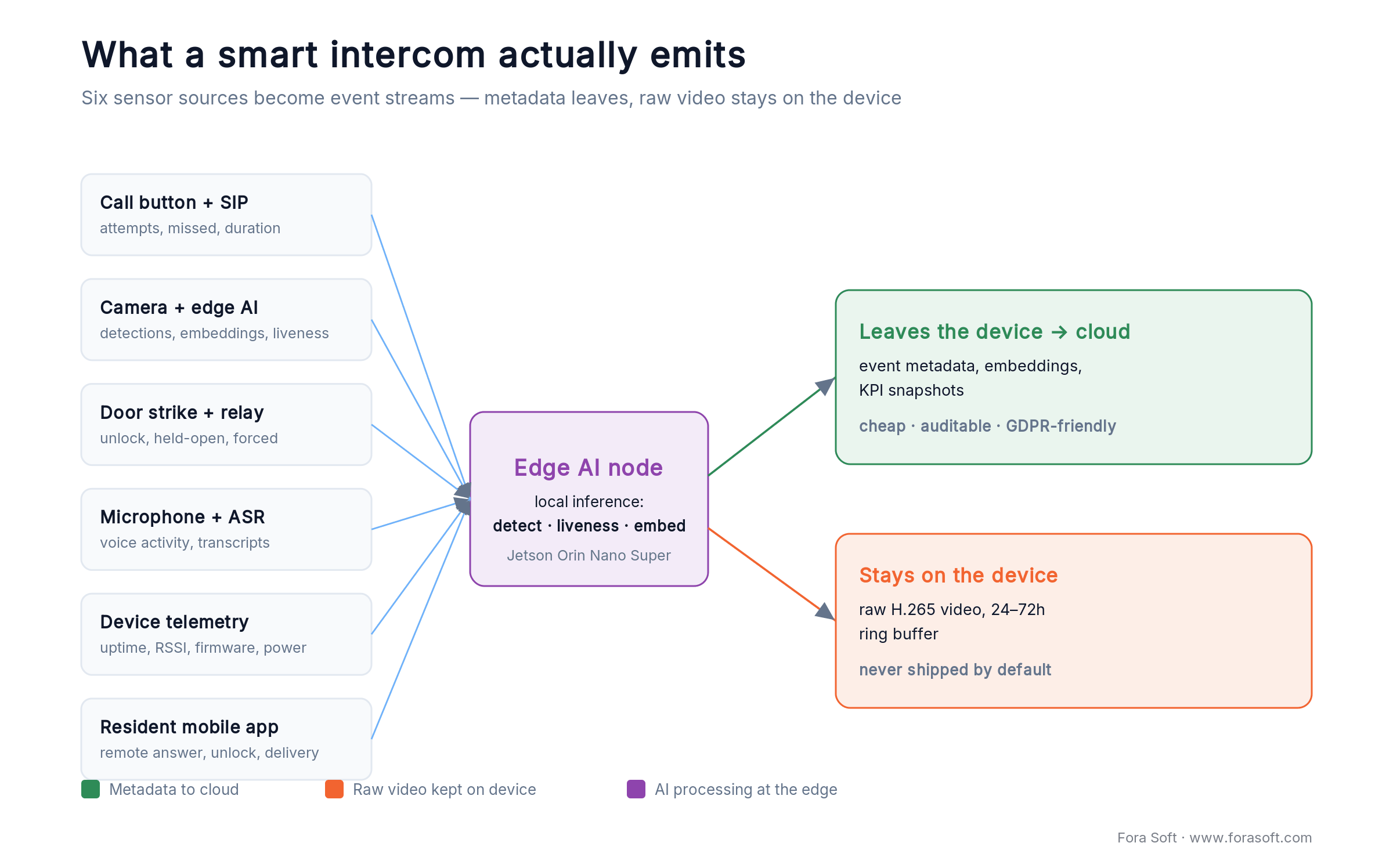
Figure 1. What a smart intercom emits — and which data leaves the device versus stays local.
The five KPIs property operators actually want
When we sit with building operators, concierge managers or property-tech product owners, the dashboard conversation converges on the same five KPI families. Everything else is a supporting chart.
1. Answer rate. Percentage of intercom calls answered within the SLA window (15 seconds is a common target). A stable >90% answer rate is what separates a “secure building” from a “building where people let themselves in”.
2. Time-to-answer. Mean and p95 latency from doorbell press to first response. The p95 is more honest than the mean — it tells you how the slowest 5% of visitors experienced the building.
3. Door-event anomalies. Door held open >30 seconds, forced-open alerts, unusual-hour door releases, tailgating signals (multiple people on a single release). These are the incidents that board security reviews care about.
4. Device fleet uptime. Percentage of devices reachable over MQTT in a rolling 24-hour window. Operators expect >99.5%. Anything less starts looking like a dropped call in the maintenance SLA.
5. Unauthorised-entry attempts. Face matches to a denied list, credential-failed retries, attempts outside authorised hours. This is the KPI that moves executives — it quantifies the value proposition of the analytics layer.
Reach for this KPI pack when: pitching analytics to a multi-building operator. The first three move tenant NPS; the last two move risk and renewal conversations.
A reference architecture that survives a privacy audit
Four layers, in this order, with clear boundaries on what crosses each layer. The privacy wins flow from the architecture, not from policy documents bolted on later.
Layer 1 — Device and edge AI. Camera, microphone, door strike, SIP stack, local inference on NVIDIA Jetson or Google Coral. Face detection, liveness check and embedding generation all happen here. A local SQLite event queue and a short H.265 ring buffer (24–72 hours at 1080p) mean the device can keep working through a WAN outage.
Layer 2 — Transport. MQTT 3.1.1 or 5.0 with QoS 1 for events, WebRTC for live video call sessions, RTSP for recording ingest where allowed. TLS 1.2+ everywhere, certificate pinning on the device, mTLS for control-plane messages.
Layer 3 — Cloud analytics. The event stream lands in Kafka or Kinesis, feeds a Flink or Spark stream processor, and is written to a columnar store (ClickHouse) for raw events, a time-series store (InfluxDB) for KPI snapshots, and a vector database (Pinecone, Milvus, pgvector) for face-embedding similarity search. PostgreSQL holds the normalised entity model — residents, devices, alerts, policies.
Layer 4 — Presentation. Grafana or a custom dashboard for operators, a thin resident app for mobile, REST or GraphQL APIs for integration with property management systems. Alerts fan out via webhooks, email, and the resident app’s push channel.
Reach for this architecture when: you are building a multi-tenant SaaS across dozens of properties. Layer 1 keeps raw biometrics local; layer 3 keeps analytics queryable at scale. Each layer can be audited independently.
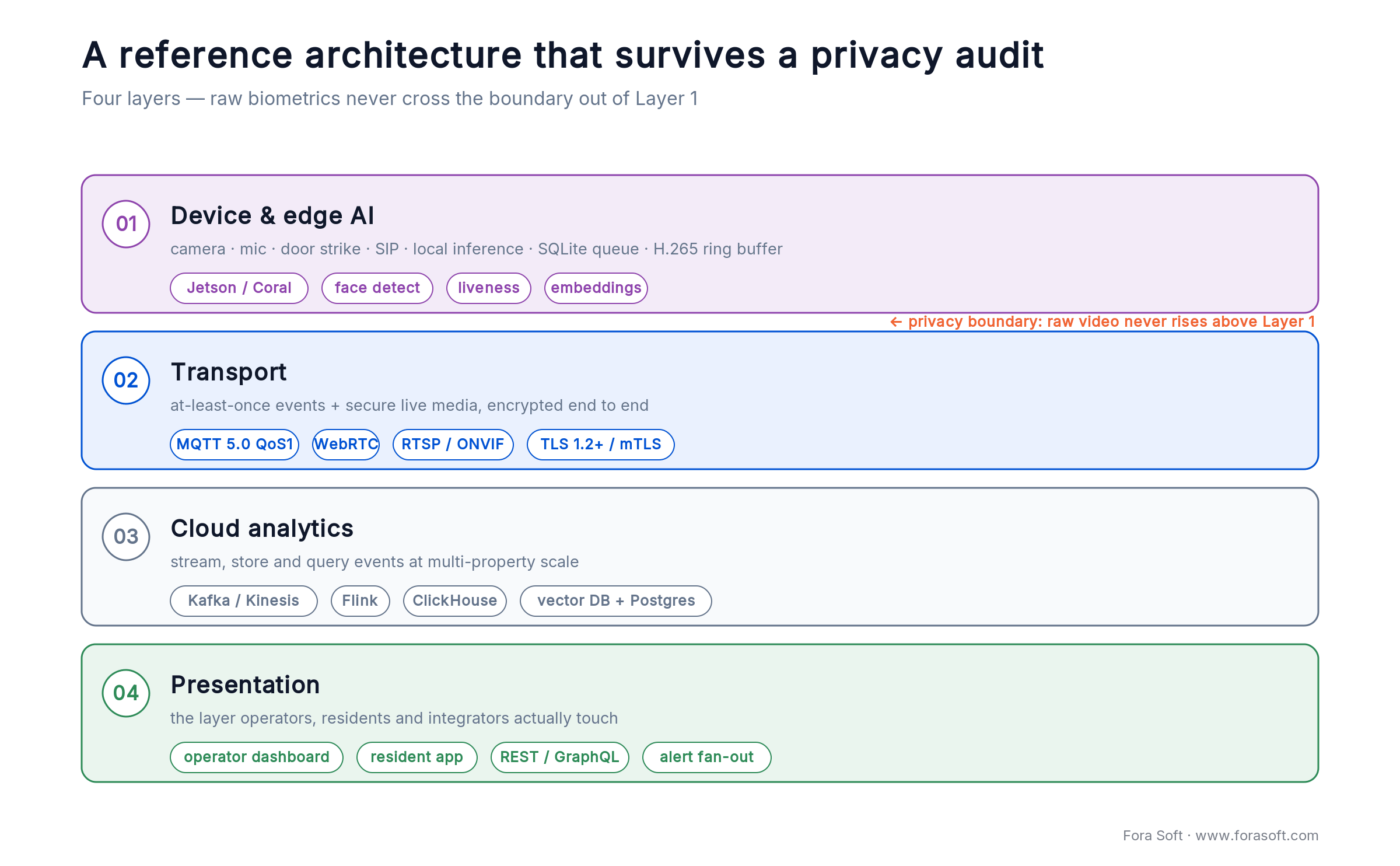
Figure 2. A four-layer reference architecture; raw biometrics never cross the boundary out of Layer 1.
Edge compute options compared
The hardware choice at the edge sets the cost envelope and the analytics ceiling for the whole platform. These are the four options we typically benchmark; we go deeper on running models on the device itself in our on-camera edge AI guide.
| Platform | Best at | Typical power draw | Limitations |
|---|---|---|---|
| NVIDIA Jetson Orin Nano Super | General-purpose GPU, ONNX/PyTorch/TF, multi-person 1080p | 7–25W | Heat and cost, but 67 TOPS for $249 (2024 refresh) |
| Google Coral (Edge TPU) | Ultra-low-power INT8 inference | ~2W | TF Lite only; effectively EOL — unmaintained by Google (2025) |
| RPi CM4 + accelerator | Cost-sensitive retrofit products | 3–5W | Performance ceiling; model size |
| Cloud-only inference | Fastest time-to-market | n/a (cloud $) | Privacy risk, bandwidth cost, worst GDPR fit |
Our default for a fresh build in 2026 is the Jetson Orin Nano Super at the door station: $249 buys 67 TOPS, enough for multi-person 1080p with headroom for vision-language models. We used to reach for Google Coral on battery-powered outdoor units, but Google has effectively walked away from the Edge TPU: the dev board is stuck on a 2021 image and the PCIe driver has not tracked recent Linux kernels, so we now treat it as legacy, not a fresh-build default. Full cloud inference is tempting for MVPs but compounds both bandwidth and compliance pain in production.
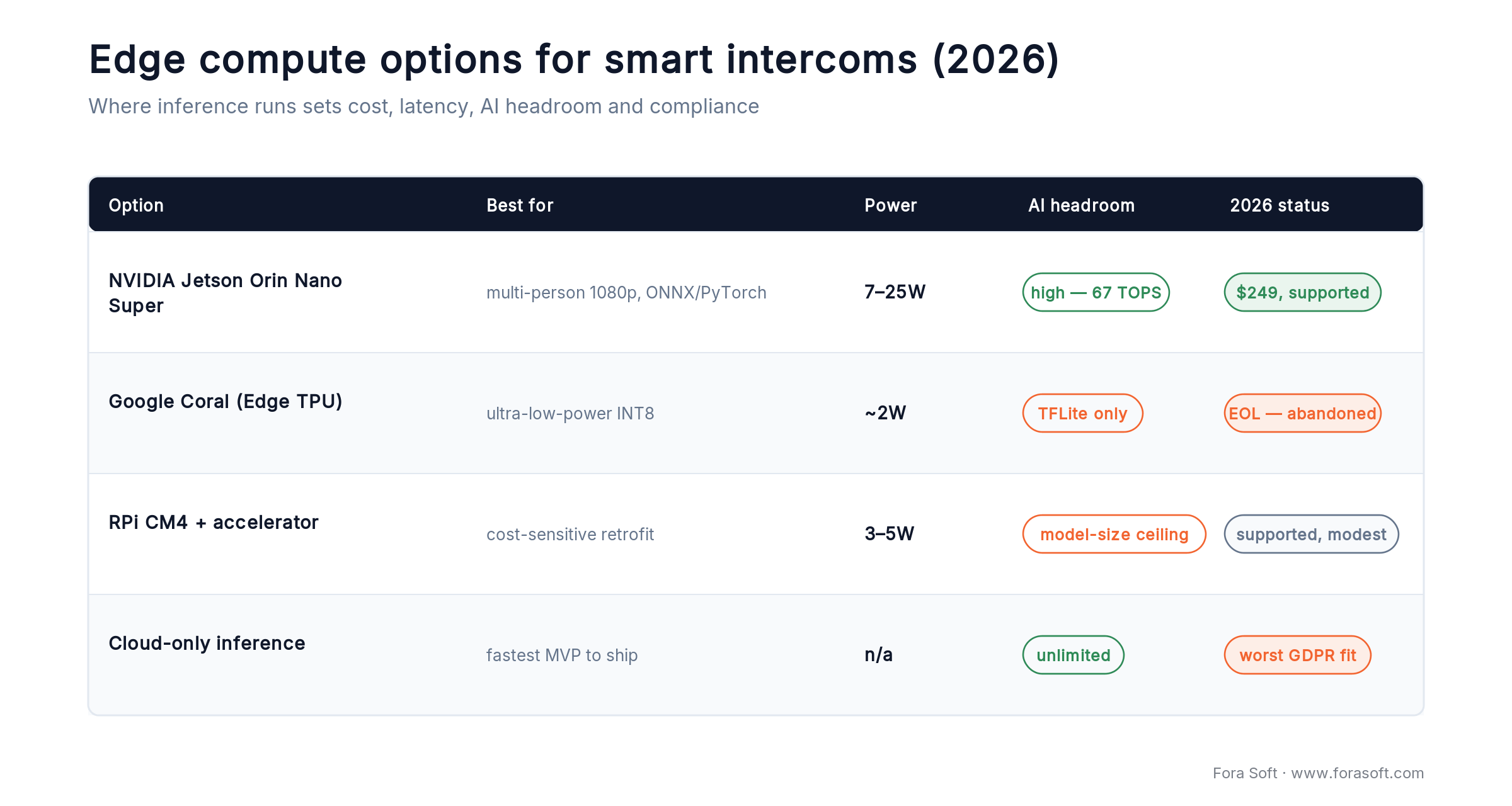
Figure 3. Edge compute options for 2026, including Coral’s end-of-life status.
Compliance: GDPR, the EU AI Act and CCPA
GDPR (EU, UK, EEA). Face embeddings are special-category biometric data under Article 9. Processing needs either explicit consent (opt-in by residents) or a narrow legitimate-interest basis that passes a documented necessity test. The European Data Protection Board’s 2019 video-surveillance guidelines treat 24–72 hours as the default retention ceiling for raw video; going longer requires a documented, defensible reason.
EU AI Act. Two regimes get conflated here. The Article 5 ban on real-time remote biometric identification in public spaces has applied since 2 February 2025, but it targets law enforcement, not a private building. Property-operator face recognition instead lands in the high-risk column (Annex III): from 2 December 2027 you will need a fundamental-rights impact assessment, registration in the EU database, documented human oversight and post-market model monitoring. Penalties have been enforceable since 2 August 2025 (up to €35M or 7% of global turnover), so design the controls in now, not in 2027.
CCPA and US state laws. Face data counts as biometric information in California, Illinois (BIPA), Texas, Washington and a growing list of states. Residents have the right to know, delete and opt out. Illinois BIPA still carries statutory damages of $1,000 (negligent) or $5,000 (reckless) per violation, but a 2024 amendment (SB 2979, effective 2 August 2024) capped recovery to a single violation per person per collection method rather than one per scan, and in April 2026 the Seventh Circuit held that limit applies retroactively. The exposure is smaller than the pre-2024 headlines, but it has not vanished: opt-in consent and a documented retention policy are still the price of shipping native face recognition in Illinois.
Practical defaults we ship. 24–72h raw-video retention (longer only for flagged incidents, with a documented justification), embedding-only transit to the cloud, consent gates per resident on first install, role-based access with a per-action audit log, automatic blurring of non-authorised faces in analytics exports, a documented human-review workflow for every biometric alert.
Reach for this checklist when: a procurement or security team asks for the “privacy story”. Ship it as a two-page document in the RFP response; it answers most of the questions before they are asked.
Need a privacy-compliant intercom analytics platform?
We have shipped edge-AI video and communications products that cleared GDPR and on-premise security reviews. Tell us the geography and the building type; we will map the compliance surface first and then the code.
Analytics use cases by segment
The same event stream powers different dashboards for different buyers. Knowing which analytics matter per segment is what lets a single platform serve residential, commercial, and mixed-use buildings without forking the product.
Multi-family residential
Delivery-package patterns (volume, dwell-time, repeat couriers), visitor frequency per unit, answer-rate by floor, cross-unit tailgating detection, emergency-contact escalation logs. These map directly to tenant NPS and building-insurance claims.
Commercial and corporate
Receptionist load by hour, meeting-room badge issuance vs. intercom call correlation, vendor/contractor reliability scoring, badge vs. face-match mismatch reports. These feed workplace-experience and facilities budgets.
Mixed-use / smart-city pilots
Cross-device occupancy heat maps, anomalous-entry detection shared across a campus, anonymised footfall for retail tenants. These are the flagship dashboards that sell next year’s budget to city and campus owners.
The vendor lineup, in one table
| Vendor | Strength | API / integration | Data posture |
|---|---|---|---|
| DoorBird (DE) | Premium hardware, SIP-native | REST API + webhooks | Hybrid; EU-friendly |
| 2N (CZ, Axis-owned) | Mature SIP + ONVIF | HTTP API, licenced | On-prem friendly |
| Akuvox (CN) | Cost-effective + native face recognition | REST API + ONVIF + cloud platform | Hybrid; security caveats (13 CVEs, 2023) |
| ButterflyMX (US) | Cloud-native rental focus; delivery PIN + timestamped photos | REST API + 10+ PMS integrations | Cloud-only SaaS |
| Swiftlane (US) | Touchless + native face recognition; loitering detection | REST API + Brivo, Eagle Eye | Cloud + edge; US-hosted |
| Aiphone (JP) | Reliability, legacy install base | SIP, limited HTTP | On-prem first |
| Ring / Google Nest | Consumer-grade, phone-first | Limited partner APIs | Cloud-only; strong consumer privacy stance |
Takeaway for product teams: if you are building a middleware/analytics layer, you will integrate two to three of these simultaneously. Design for the union of their APIs, not the intersection.
Market size and where growth is going
Analyst numbers for this market disagree by an order of magnitude, so treat any single figure with suspicion. Narrow ‘IP / video-intercom device’ estimates cluster around $2.4–5.3 billion for 2025 (Market Research Future; Wise Guy Reports), while broader ‘video intercom devices and equipment’ definitions that fold in access control run to $47–52 billion (Fact.MR; Mordor Intelligence, 2025). What they agree on is direction: high-single to low-double-digit CAGR (roughly 8–13%) and IP/smart units crossing from about 53% of installations in 2025 toward two-thirds by 2026. The pull comes from three forces at once: smart-building procurement cycles turning over, edge-AI hardware getting cheaper, and tenant experience becoming a scored line item in property-management RFPs.
Regionally, North America and Europe hold roughly 35% and 30% of the market respectively, APAC is closer to 25% and climbing fastest. China is dominant in manufacturing (Akuvox, BAS-IP, Hikvision), while Western premium and compliance-sensitive segments remain with DoorBird, 2N, Aiphone and ButterflyMX. If your product targets the EU, expect GDPR-first positioning to be a decisive buyer criterion, not a footnote.
Mini case: why edge inference is the cheaper architecture
On an intercom analytics project we scoped for a European multi-building operator, the initial ask was all cloud — ingest full 1080p video for every call and run recognition centrally. A back-of-envelope pass made the problem obvious: 20 door stations streaming at 4 Mbps only during calls would still emit dozens of GBs per month per building once the recording ring buffer was synced, and fell foul of the country’s video-retention rules.
The redesign pushed inference to a Jetson Orin Nano at each door, sent only embeddings and event metadata over MQTT, and kept video on the device for a 48-hour ring buffer. Monthly egress dropped by more than an order of magnitude, face-recognition latency fell from seconds to well under a second because the round-trip to the cloud disappeared, and the privacy review went from “needs a lawyer” to “tick the box”. Same product, cheaper and easier to defend.
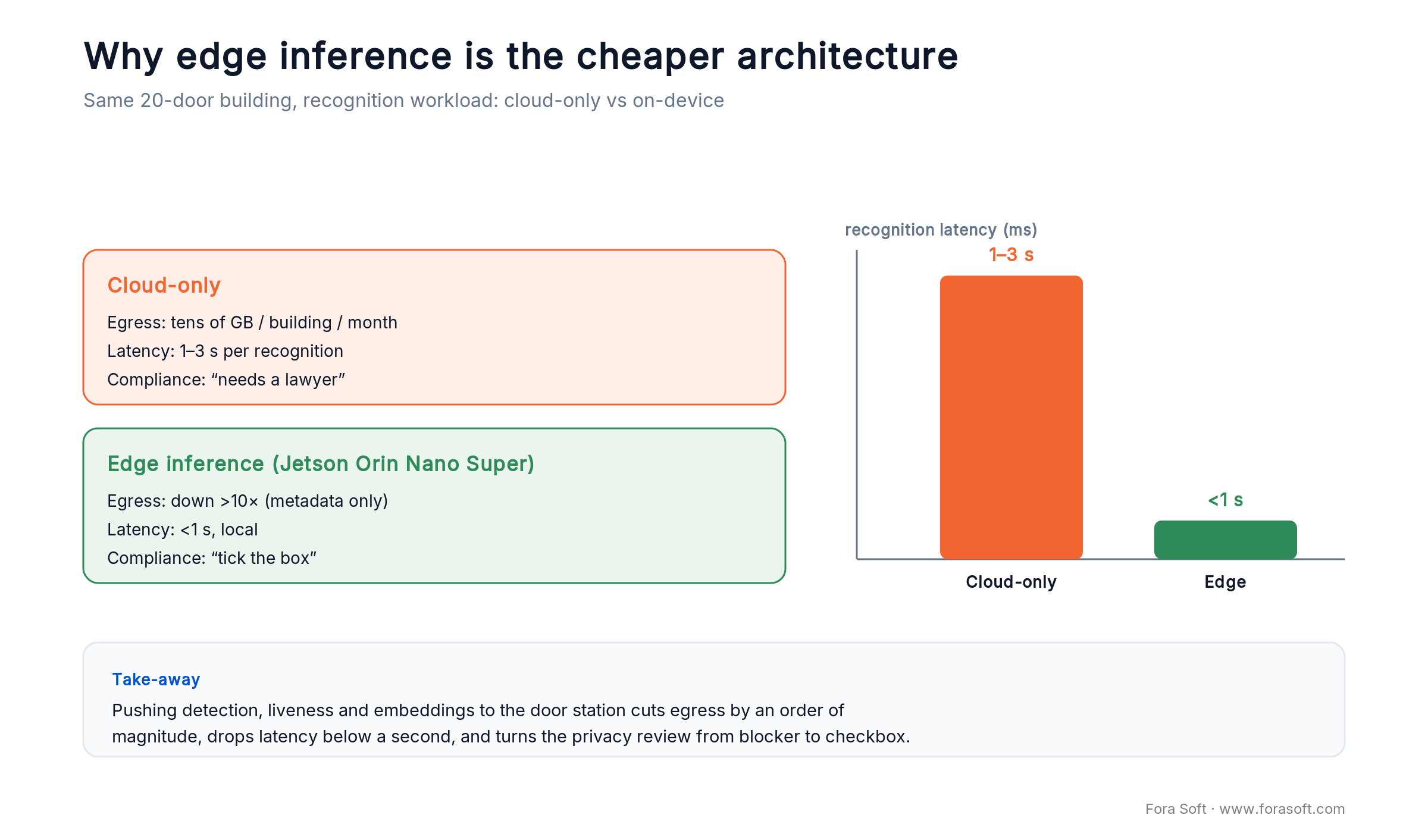
Figure 4. Cloud-only versus edge inference on the same building: egress and latency both drop sharply.
A decision framework — five questions to shape your intercom analytics
1. What is the primary buyer — operator, tenant or security? Each one values a different KPI slice. Operators want fleet uptime and answer-rate trends. Tenants want delivery clarity and response time. Security wants anomaly alerts and audit trails.
2. Which jurisdictions will you ship in? Shipping in the EU forces edge inference and 7–14 day retention. Shipping in Illinois forces opt-in consent flows. Shipping in the UAE opens different options entirely. Pick the strictest jurisdiction you care about and design for that.
3. Hardware-only, middleware or full stack? Integrating existing devices (DoorBird, 2N, Akuvox) is faster to market but leaves you dependent on their firmware roadmap. Building a full stack including custom hardware is slower but owns the data layer end-to-end.
4. What is your acceptable failure mode? Face-recognition false positives and false negatives have different business costs. A missed authorised visitor is inconvenient; a false match triggers a legal incident. Tune thresholds deliberately, document the trade-off, add human-in-the-loop review for high-risk decisions.
5. How will this integrate with the rest of the building stack? Property management software, access control, CCTV, elevator systems. If your analytics live on an island, adoption stalls. Plan the API surface with integration partners before the first sprint.
Five pitfalls we see in every second rescue engagement
1. Face-recognition bias shipped without review. NIST’s demographic testing (NISTIR 8280, 2019; ongoing in FRVT Part 8) found false-match rates varying by up to two orders of magnitude across demographic groups. Leaders have improved: by January 2024 the best algorithms held worst-case subgroup false-match rates near 2.4%, but the gap widens exactly where door cameras live: poor lighting, off-angle faces, low resolution. Validate on your own installed population, not a vendor brochure.
2. Model drift. A face model trained on one year’s population degrades on the next. Monitor confidence-score distributions; retrain or swap models when mean confidence drifts by more than 5% from baseline.
3. Weak control-plane auth. Too many devices ship with hardcoded credentials or HTTP-basic auth on the control plane. Enforce mTLS, token rotation and certificate pinning on every control-plane endpoint. Treat it like a financial API, not a home router.
4. PII in logs. Visitor names, vehicle plates, call transcripts. Structured logging with PII tokenisation and role-based access on the log store is not optional in 2026.
5. No human-in-the-loop on biometric actions. A face match alone should not open a door. A face match plus a second factor (resident approval, time-of-day policy, badge) should. Document the escalation path and keep the audit trail.
What a good operator dashboard looks like
Quality KPIs. Answer rate > 90%, time-to-answer p95 < 15 seconds, face-recognition confidence mean > 0.85, false-positive rate on the denied list < 0.1%.
Business KPIs. Daily call volume trend, delivery events per resident per week, unauthorised-entry attempts per month, ticket-to-resolution time on device faults, cost per monitored door per month.
Reliability KPIs. Device fleet uptime > 99.5%, MQTT message loss < 0.01%, mean time to acknowledge alert < 30 seconds, failed-release retry rate below threshold.
Rolling out an intercom analytics dashboard?
We can take you from an event schema on a whiteboard to a Grafana dashboard shipping real KPIs to operators in weeks, not quarters — with Agent-Engineering-accelerated delivery so the price reflects the speed.
Alerting and runbooks: turning analytics into action
An analytics stack with no alerts is a museum. Operators only trust a dashboard if it pages someone when something matters. Three rules separate signal from noise.
1. Tier alerts by business impact, not by event type. Door-held-open for 30 seconds at 14:00 is a curiosity. The same event at 03:00 is a security incident. Encode that context in the alert rule, not in the on-call engineer’s head.
2. Every alert has a runbook. One linked page per alert: what triggered it, the three things to check first, who to escalate to, and the rollback path. Operators rotate; runbooks do not.
3. Track alert quality, not just alert count. Mean time to acknowledge, mean time to resolve, false-positive rate per rule. Tune ruthlessly. A dashboard that produces 50 alerts a day and 2 real ones is worse than no dashboard at all.
Reach for runbooks when: shipping the analytics platform to a property-management team that does not have an SRE function. Boring runbooks beat clever dashboards every time.
Integrations that multiply the value of your data
Property management systems. Yardi, AppFolio, Buildium. Push resident changes and unit assignments into the intercom platform; surface intercom events in the PMS ticketing queue.
Access-control systems. HID, Brivo, Genetec. Correlate badge events with intercom calls; identify tailgating, badge-pass-back, and credential sharing.
Video management systems. Milestone, Genetec Security Center, Avigilon. Reference intercom events as markers on recorded video timelines without duplicating storage.
IT ticketing and alerting. PagerDuty, Opsgenie, Slack, Teams. Device-health and high-severity analytics alerts route to the on-call engineer, not a forgotten email inbox.
When intercom analytics is not worth the effort
Single-building, low-traffic installations. Below a certain event volume, a human concierge with a spreadsheet outperforms an analytics platform in cost and signal. Set a floor — typically 5–10 doors or a few hundred daily events — below which the dashboards are vanity.
Jurisdictions with blanket biometric bans. If your deployment location prohibits facial recognition outright, the analytics layer still works — but only on events, not on identity. Plan the feature matrix accordingly.
When the customer is only buying hardware. Some installers resell devices and nothing else. Your analytics product will not sell to them. Sell into the operator layer instead, and partner with installers for the hardware.
How to evaluate a software partner for this build
Ask for a reference architecture. A vendor without a whiteboard story about edge, transport, cloud and presentation is improvising. You can see the version of ours in our AI integration practice, our planning and analytics service and our video-analytics engineering playbook.
Ask for their GDPR checklist. If they cannot hand you a short document covering retention, consent, subject-access requests, and biometric-data specifics, they have not shipped in Europe at scale.
Ask about operational handover. Which runbooks, monitoring setups and SLAs they deliver with the product. This is usually where internal and external teams meet at 3 a.m. — the quality of the handover pays for itself within a quarter.
Ask for real KPI dashboards from shipped products. Screenshots (redacted) of a live operator dashboard tell you more than any sales deck.
FAQ
Do we need AI to get value out of intercom analytics?
No. Even a non-AI dashboard surfacing answer rate, time-to-answer, delivery events and device uptime produces operational lift from week one. AI-powered features (face recognition, anomaly detection) add value on top and also add regulatory weight. Start with the boring metrics and graduate to AI once the operational value is proven.
Is face recognition allowed in multi-tenant residential buildings in the EU?
Conditionally. You need a lawful basis under GDPR Article 9 (typically explicit resident consent), a documented proportionality test, a retention policy, a subject-access request process, and — under the EU AI Act — a fundamental-rights impact assessment plus human oversight. In practice it is possible, but not trivial; the architecture has to enforce the policy, not just the privacy notice.
How long should we keep intercom video?
Under EU data-minimisation guidelines (EDPB 3/2019), raw video should default to roughly 24–72 hours; keeping it 7–14 days or longer is defensible only for flagged incidents with a documented reason. Store video on-device where possible, and keep only flagged clips in the cloud.
Can we integrate with existing DoorBird / 2N / Akuvox hardware?
Yes. DoorBird, 2N and Akuvox all expose event webhooks or REST APIs that we wrap into a unified event schema. You usually pay a brief abstraction-layer cost up front; after that, a single analytics and dashboard product serves all three vendors’ devices.
What is a realistic timeline for a first production deployment?
For an MVP covering device onboarding, MQTT event ingest, a small set of KPIs, and a basic operator dashboard, we typically plan 10–14 weeks of delivery after a 3–5 week discovery phase. Adding AI features (face recognition, anomaly detection) adds 4–8 weeks depending on compliance posture.
Cloud or on-premise — which do buyers actually want?
Mid-market buyers default to cloud for the ops simplicity. Enterprise, regulated and EU buyers increasingly ask for hybrid or full on-premise options. Build for the hybrid model from day one — it keeps both doors open without doubling the engineering team.
How do we handle updates and model drift?
OTA firmware updates with staged rollouts (1% → 10% → 100%) and automatic rollback on health-check failure. For ML models, track confidence-score distributions per device and retrain when the weekly mean drifts beyond a set threshold. Keep a per-model audit log so you can answer “which model made this decision” under EU AI Act scrutiny.
How does Fora Soft price this kind of engagement?
Discovery is a fixed-scope engagement; build is time-and-materials against a signed backlog with feature-level estimates. Our Agent Engineering tooling (AI-assisted delivery) compresses the discovery and early delivery phases by roughly 15–20% compared with traditional agency timelines — we pass that through as a shorter timeline and a lower invoice, not a padded one.
What to Read Next
Smart intercoms
AI-powered intercom software systems
Where AI, voice and video combine into the next generation of intercom products.
AI + voice
Voice recognition in AI intercom software
How speech analytics turn intercom audio streams into actionable events and transcripts.
Cloud intercoms
Cloud intercom software benefits and applications
The trade-offs between cloud-native and hybrid deployments for multi-building operators.
AI layering
How we improve software products with AI features
The playbook for adding AI to an existing product without rebuilding it from scratch.
Planning
How wireframing saves time and money
The upstream discipline that decides whether your intercom analytics ship on budget.
Ready to turn intercom events into business outcomes?
An intercom without analytics is a doorbell. An intercom with analytics is the most sensor-rich node in the building — one that can raise tenant NPS, cut security incidents, extend device life, and generate the kind of evidence that wins RFPs. The gap between those two versions of the same device is mostly software, and mostly upstream planning.
If you are a hardware vendor, a property-tech founder or a smart-building integrator, the next step is a short, specific conversation about the data your devices already emit and the KPIs your buyers actually reward. We will bring the reference architecture, the compliance checklist and an honest estimate.
Let’s map your intercom data to a shippable product.
One 30-minute call, three outputs: a data model, a reference architecture, and a realistic delivery timeline with Agent Engineering built into the numbers.

