

Key takeaways
• Voice recognition is three jobs, not one. An AI intercom system has to hear the words (ASR), confirm who is speaking (voice biometrics), and refuse a recording (anti-spoofing). Skip any one and the door is either annoying or unsafe.
• Pick the speech engine for your door, not the leaderboard. Deepgram Nova-3 wins on latency (sub-300ms), NVIDIA Parakeet wins on self-hosted unit cost, Google Chirp wins on languages. Benchmark on your own lobby audio first.
• Voiceprints are regulated data. Illinois BIPA wants written consent before you store one, and the EU AI Act regulates biometric identification tightly. Design consent in on day one, not after legal review.
• Keep the wake-word and the voiceprint on the edge. On-device matching cuts latency, keeps raw audio in the building, and still opens the door when the WAN drops.
• Runtime is cheap; the build is the cost. Voice adds about $4.83 per door per month at 40 uses a day. What you pay for is the integration, the compliance, and the anti-spoofing, not the API bill.
A tenant walks up with two bags of groceries and says “let the dog walker in at four.” A courier holds up a phone playing a recording of the owner’s voice. One of those should open the door and one should not, and your intercom has about 800 milliseconds to tell them apart. That gap — between a convenient AI intercom system and a liability bolted to a wall — is where the engineering actually lives.
Fora Soft has shipped audio, video, and AI software since 2005, across 250+ projects. This is the honest build guide we wish existed when clients first asked us to put a voice on the door: what the words “voice recognition” really cover, which engines to use in 2026, how to stop a replayed recording, what it costs, and where the whole idea falls apart.
Why Fora Soft wrote this voice-intercom playbook
We build the two things a voice intercom is made of: real-time media and applied AI. Our security-video platform VALT records and streams for 770+ organizations and 50,000+ active users, including courtrooms and universities where a missing audit log is a legal problem, not a bug. Our Netcam work rebuilt a surveillance product that predates most of the cloud. We know what it takes to keep audio and video reliable when a real building depends on it.
That background matters here because a voice intercom fails in the boring places: a lobby that echoes, a network that drops, a recording held up to the mic, a privacy law nobody read. We have hit each of those on real projects. This guide is written from that side of the table, not from a vendor deck. If you want the wider system view first, our sister piece on smart intercom software architecture covers the IoT and hardware layer; this one goes deep on voice. When you want a build partner, our AI development team does exactly this work.
Scoping a voice feature for your intercom?
Tell us about your door, your users, and your compliance region. We will map the voice stack and flag the risks before you write code.
What voice recognition actually means in an intercom
In an intercom, “voice recognition” is a bundle of three separate capabilities that people constantly mix up. Getting them straight is the difference between a spec that ships and one that argues with itself.
1. Speech recognition (ASR). This turns sound into text: “open for the plumber” becomes a string a computer can act on. It answers what was said. It says nothing about who said it. This is the layer people usually mean when they say “the intercom understands speech.”
2. Voice biometrics (speaker verification). This compares a live voice against a stored voiceprint and answers who is speaking. A voiceprint is shaped by anatomy — the vocal tract, larynx, and nasal cavity — plus learned habits like accent and cadence. This is the layer that decides whether a voice is allowed to give a command at all.
3. Intent understanding (NLU). This maps the recognized words to an action and its limits: “let the dog walker in at four” becomes a one-time, time-boxed entry, not a standing key. It answers what to do and, just as important, what not to do.
Around all three sits anti-spoofing: the check that a voice is a live human at the door, not a recording or a synthetic clone. Most weak intercom demos have great ASR and no biometrics or liveness at all. That is a door that opens for anyone who can pronounce the words. For the ASR fundamentals on their own, our guide to speech recognition accuracy in noisy environments goes a level deeper.
Reach for full voice biometrics when: the voice can trigger a physical action (entry, a delivery drop, an elevator call). If the mic only routes a call to a human who decides, plain ASR plus captions is enough — and a far smaller compliance footprint.
The 2026 voice intercom reference architecture
A spoken request at the door travels through six stages before anything happens: door station, wake-word, speech-to-text, intent, verification-and-policy, then action. The design decision that colors everything is where you draw the line between the edge (the device on the wall) and the cloud (your servers and video management system).
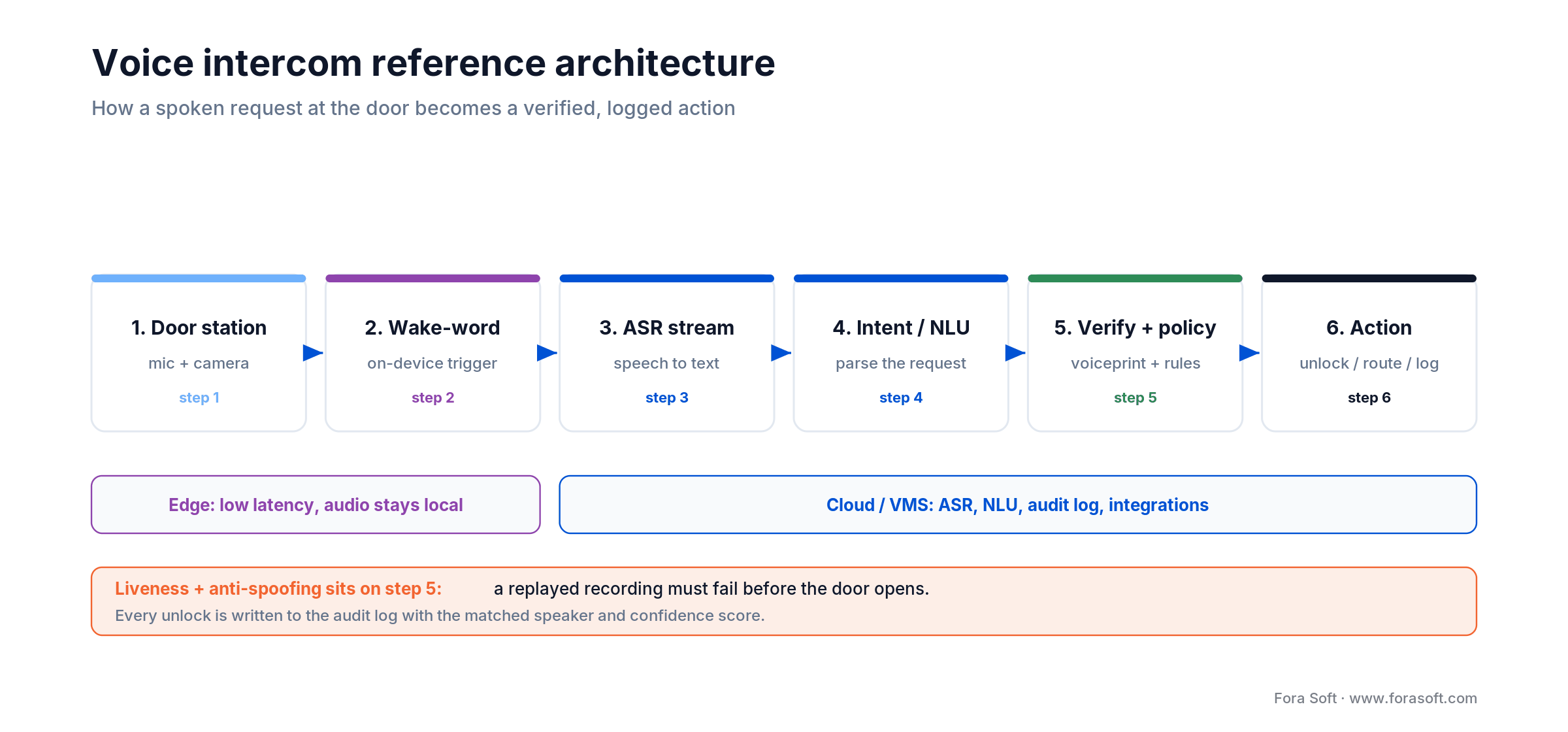
Figure 1. The path from a spoken request to a verified, logged door action. Anti-spoofing gates step five.
The door station carries the microphone array and camera. The wake-word runs on-device and stays asleep until it hears its trigger, so you are not streaming a public lobby to the cloud all day. ASR converts the request to text, intent parses it, and verification plus policy checks the voiceprint against the rules for that person and that time. Only then does the action fire: release the lock, route to a human, and write an audit record with the matched speaker and a confidence score.
Two protocols do most of the plumbing. SIP sets up the call leg to a resident or an operator; WebRTC often carries the live media to a browser or app. If you are also handling the video and access-control side, keep that pipeline in the same video management system so entries, clips, and voice events share one timeline. Our video surveillance engineering hub covers that VMS layer in depth.
Which speech-to-text engine belongs at the door
Short answer: for a door, latency beats a leaderboard. Deepgram Nova-3 streams with sub-300ms partials and a median word error rate near 6.84% on real-world audio, which is why it suits live entry. If unit cost and data residency matter more, a self-hosted NVIDIA Parakeet model runs for cents an hour at scale. Google Chirp trails on latency but reads 125+ languages, useful for a mixed-tenancy building.
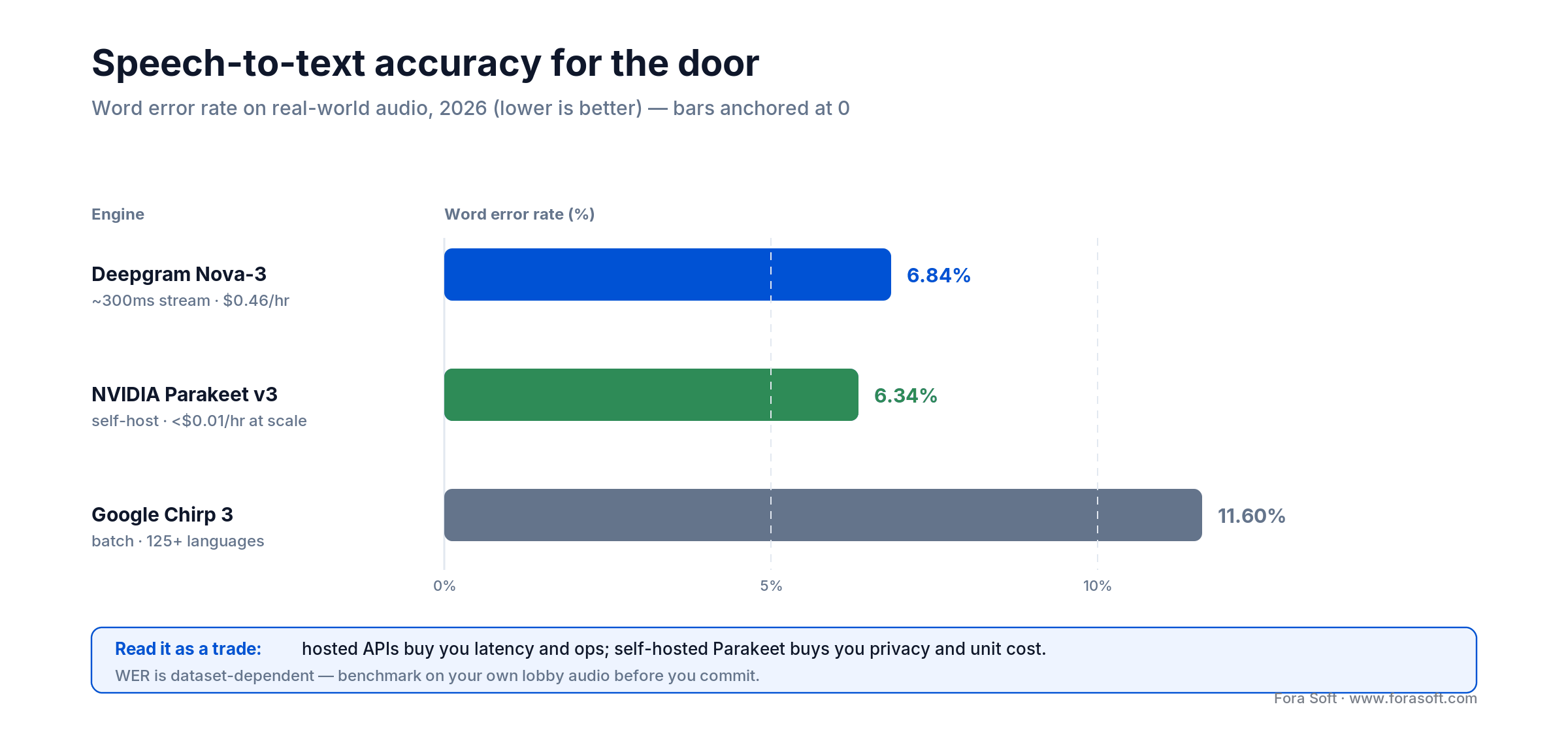
Figure 2. Word error rate on real-world audio, 2026. Lower is better; latency and price tell the rest of the story.
The numbers move with the dataset, so treat them as a starting point, not gospel. NVIDIA’s Parakeet-TDT v3 reports about 6.34% average word error rate across 25 European languages on the public Open ASR Leaderboard, and it is fast enough for real-time. Deepgram publishes streaming pricing around $0.46 per hour; you can check current tiers in the Deepgram model docs. The honest move is to record 200 real clips from your own lobby and score every candidate on those, because a mic two meters up on a hard wall is nothing like the clean audio these benchmarks use. Our primer on audio engineering for real systems explains why.
Reach for self-hosted Parakeet when: volume is high, budgets are tight, or raw audio cannot leave your infrastructure for legal reasons. You trade a managed API for a GPU to run and patch — worth it past a few thousand door-interactions a day.
Voice biometrics: proving who is speaking
Voice biometrics answers one question: is this the person we enrolled? Good engines pass 95% accuracy in 2026, but a single accuracy number hides the real decision. Every system trades false accepts against false rejects, and where you set that threshold decides whether an impostor gets in or a resident gets locked out in the rain.

Figure 3. Set the match threshold too loose and impostors slip in; too strict and real people get rejected. EER is the balance point.
Two terms run this section. FAR, the false acceptance rate, is how often an impostor is wrongly accepted. FRR, the false rejection rate, is how often the right person is wrongly turned away. The point where they cross is the equal error rate (EER), the standard way to compare engines. Optimal text-dependent systems reach FAR below 1% at FRR below 3%, and the best published tests have shown 0.01% FAR at 5% FRR. For a door, you bias toward a low FAR and accept that a real resident occasionally repeats themselves.
Text-dependent vs text-independent
Text-dependent verification asks for a fixed passphrase (“open sesame” is a bad one; a random per-user phrase is better) and is more accurate because the system knows what it should hear. Text-independent verification works on any speech, which feels natural but needs more audio and more careful tuning. For entry, a short text-dependent phrase paired with the camera feed is the pragmatic default: two weak signals combined beat one strong one that can be fooled.
Enrollment is where projects rot
A voiceprint is only as good as the enrollment behind it. Capture three to five clean samples per person, in conditions close to the real door, and re-enroll when someone reports repeated rejections. Voices drift with a cold, with age, with a new phone. Plan for re-enrollment as routine maintenance, not an incident.
Anti-spoofing: beating recordings and deepfakes
Here is the catch that sinks naive intercoms: voice biometrics alone cannot tell a live person from a recording of that person. If someone captures a resident saying the passphrase and plays it at the door, a system without anti-spoofing opens right up. Stopping that is a separate discipline, and it is not optional for anything that controls entry.
The anti-spoofing field groups attacks into four kinds: impersonation, voice conversion, text-to-speech synthesis, and replay. The ASVspoof challenge series benchmarks detectors against the synthetic and replay ones; its fifth round, ASVspoof 5, ran in 2024. For a door, replay is the cheap, common threat — a phone speaker held to the mic — while synthetic clones are the fast-rising one.
Three defenses stack well. Liveness detection looks for the acoustic signatures a loudspeaker leaves behind. Challenge-response asks the speaker to say a random phrase or digit the attacker could not have pre-recorded. And multi-modal fusion ties the voice to the live camera feed, so a voice with no matching face at the door is refused. The important design rule from ASVspoof is that your countermeasure has to generalize to attacks it has never seen, because the generators improve every year. Build the anti-spoofing model so it can be updated in the field.
Reach for challenge-response when: the door protects real assets or people. A random-digit prompt adds two seconds and defeats every replay attack in one move — the cheapest security you will buy on the whole project.
From speech to a door action: intent and guardrails
Once you trust the words and the speaker, intent understanding turns “let the plumber in” into a bounded action. The guardrails around that action matter more than the model behind it. A resident’s voice should not be a master key; it should be a request that policy either grants or denies.
Design intents as verbs with limits. “Let the dog walker in at four” is a one-time grant, scoped to a name and a window, logged, and revocable. “Hold all deliveries” changes a mode, not a lock. Anything ambiguous routes to a human instead of guessing. This is the same pattern behind a good AI receptionist and the voice assistants we build: the language model proposes, the policy engine disposes.
Large language models make intent parsing far more forgiving of how people actually talk, but never let the model hold the keys directly. Put a deterministic policy layer between the parsed intent and the lock, so a clever phrase can never talk its way past a rule. When in doubt, the system says “I’ll get a person” — the safest sentence a door can speak.
Worried a recording could open your door?
We will pressure-test your voice flow against replay and deepfake attacks and show you exactly where liveness has to sit.
Edge or cloud: where voice should run
Run the wake-word and the voiceprint match on the device; send only what the cloud truly needs. That one rule fixes latency, privacy, and resilience at the same time. A cloud-only design streams every mic sample to a server, which adds round-trip delay, ships raw voice out of the building, and goes deaf the moment the network hiccups.

Figure 4. The same intercom, two architectures. Hybrid-edge keeps the sensitive work local and the door responsive.
A hybrid-edge design keeps the always-on listening and the biometric match on the door station, where they are private and instant, and reaches the cloud only for the heavier ASR and intent work on a request that already passed the wake-word. When the WAN drops, a known resident can still get in on a locally cached voiceprint. Modern door hardware has the compute for this: on-device speech models now run comfortably on the kind of SoC these panels ship with.
Reach for cloud ASR when: you need many languages, frequent model upgrades, or heavy natural-language reasoning. Just gate it behind an on-device wake-word so you are not transcribing an empty lobby all day.
Noise, accents, and the lobby problem
The demo works in a quiet office and dies in a real entrance. Traffic, wind, a hard-tiled lobby that echoes, two people talking at once — this is where accuracy quietly collapses and residents start hating the thing. Voice at the door is an acoustics problem first and an AI problem second.
Three fixes carry most of the weight. A microphone array with beamforming focuses on the person at the panel and suppresses the street. Acoustic echo cancellation and noise suppression clean the signal before ASR ever sees it. And accent-aware models matter in any real building: an engine tuned on American English will stumble on the actual population using the door. We cover the signal-processing side in our write-up on recognition accuracy in noisy environments, and the deeper theory sits in our audio engineering hub.
Set expectations with a number, not a promise: decide the word error rate you will accept on your lobby audio, then hold every vendor to it. A model that scores 6% in a lab and 20% at your door has failed, whatever the marketing says.
Multilingual and accessibility features
A voice intercom that only serves fluent English speakers excludes a chunk of the people who use the building and, in many regions, breaks accessibility law. The good news is that the same stack that adds voice can add inclusion cheaply.
Language auto-detect routes a request through the right model and can reply in the speaker’s language; engines like Google Chirp cover 125+ languages out of the box. Real-time captions on the resident’s app make a noisy or muffled exchange readable, and they help anyone with hearing loss — the same captioning we build for live interpretation platforms. Because a door is a public accommodation, treat captions and a visible text fallback as requirements, not extras. A voice-only interface with no visual path is a lawsuit waiting for the right plaintiff.
Security and privacy architecture
A voiceprint is not a password; a person cannot change their voice after a breach. That single fact should drive the whole security design. Store as little as you can, encrypt what you keep, and keep the most sensitive step on the device.
Encrypt in transit and at rest. Media rides over SRTP and TLS; voiceprints sit in an encrypted store, ideally a hardware-backed enclave on the door station. Store templates, not audio. Keep the mathematical voiceprint, discard the raw recording, and you shrink both your breach exposure and your compliance load. Set retention deliberately. Decide how long an enrollment lives and delete on a schedule, because “forever” is a liability. The broader patterns are in our guide to secure video communication apps, which shares the same threat model.
Compliance: BIPA, GDPR, and the EU AI Act
Voiceprints are biometric data, and three regimes decide whether you can collect them. Get this wrong and the penalty runs per person, and across a building it adds up fast. Design consent and retention in before you write the enrollment screen.
Illinois BIPA. The strictest US rule treats a voiceprint as a biometric identifier. You need written consent and a public retention policy before you capture one, and statutory damages run $1,000 per negligent violation and $5,000 per intentional one. Illinois narrowed the old per-scan accrual theory in 2024, but across a whole building of tenants the exposure is still serious. Extracting a voiceprint without that consent is itself the violation.
GDPR. In the EU, a voiceprint is special-category data under Article 9, so you need an explicit lawful basis, data-minimization, and the right to erasure baked in.
EU AI Act. The Act draws a sharp line. Remote biometric identification, matching one voice or face against many at a distance, is heavily restricted. Biometric verification, where a resident steps up and confirms they are who they claim, is the lighter-touch case and sits outside that high-risk identification bucket. That one-to-one check is exactly what a door intercom does. Separately, biometric categorization that infers sensitive traits is prohibited outright. The IAPP breakdown of biometrics under the GDPR and AI Act is the clearest map we have found. None of this blocks a voice intercom; it just means consent, minimization, and a clear opt-out are part of the build, not an afterthought.
The voice stack compared, block by block
Every AI intercom system is assembled from five blocks. For each, you can buy a managed service or build and self-host. Here is how we choose, and where each path breaks.
| Block | Buy (managed) | Build (self-host) | When the block breaks |
|---|---|---|---|
| Speech-to-text | Deepgram Nova-3, Google Chirp | NVIDIA Parakeet, Whisper on a GPU | Real lobby noise, thick accents |
| Voice biometrics | Phonexia, ID R&D, Aculab | Open speaker-verification models | Bad enrollment, voices drift |
| Anti-spoofing | Liveness SDKs, fusion vendors | ASVspoof-trained countermeasures | New, unseen synthetic attacks |
| Intent / NLU | Hosted LLM + function calls | Small on-prem intent model | Ambiguous or adversarial phrasing |
| Infra / edge | Cloud VMS + off-the-shelf panel | Edge SoC panel + your servers | WAN drops, panel compute limits |
Most real builds are hybrids: buy the ASR, build the policy and anti-spoofing you cannot afford to outsource, and keep the biometric match on the edge. The wrong question is “build or buy?” The right one is “which block, and why?”
What an AI intercom system costs to build and run
The running cost of voice is smaller than most people expect. At 40 interactions per door per day with hosted streaming ASR, the monthly bill lands near $4.83 a door. The real spend is the one-time build: the integration, the anti-spoofing, and the compliance work.

Figure 5. Run-cost math for one busy door. Self-hosting the ASR pushes the recurring line toward cents.
The arithmetic is worth doing out loud. Forty interactions a day at eight seconds each is 9,600 seconds a month, or 2.67 hours. At Deepgram’s roughly $0.46 per streaming hour that is $1.23, and 1,200 voiceprint checks at about $0.003 each add $3.60, for $4.83. Self-host Parakeet on a shared GPU and the ASR line falls toward pennies. Scale to a thousand doors and the recurring cost is still a rounding error next to the build.
We size the build with Agent Engineering, so a small senior team covers scope that used to need a bigger one, which keeps our estimates lean. We would rather quote you a real number against your spec than print a range here that turns out wrong. If you want that number, our AI development service page is the place to start.
Want a real estimate, not a range?
Send us your door count, regions, and must-have features. We will scope the build and give you a number you can plan around.
What we learned shipping security video at scale
The hardest part of a voice intercom is not the AI. It is the boring reliability and audit work that a real building demands, and that is exactly what we spent years on with VALT, our security-video platform.
The situation: VALT records and reviews sensitive sessions for more than 770 organizations and 50,000 active users, including courtrooms and clinical settings where every recording is potential evidence. A dropped stream or a gap in the audit trail is not a nuisance there; it can invalidate a case. The plan was unglamorous on purpose — make capture resilient to network loss, and make every action traceable to a who, a what, and a when.
The result was a system organizations trust with their most sensitive footage at that scale. The lesson transfers straight to voice at the door: the model that recognizes the speaker is a week of work; the audit log, the offline fallback, the retention policy, and the consent flow are the months that make it deployable. We have not run a single-tenant voiceprint system past 50,000 concurrent enrollments — beyond that, we would size it carefully rather than promise. Want a similar assessment for your build? Grab a 30-minute call and we will walk your architecture.
A decision framework in five questions
Before you brief a team, answer these five. They decide most of the architecture for you.
1. Does the voice trigger a physical action? If yes, you need biometrics and anti-spoofing. If it only routes a call, plain ASR plus captions is enough and your compliance load drops sharply.
2. Where do your users and their data live? Illinois, the EU, or California pull you toward on-device processing and explicit written consent. Region decides your storage design.
3. How many languages and accents use the door? A mixed building rules out an English-only model and pushes you toward Chirp-class language coverage or per-tenant tuning.
4. What happens when the network drops? If the door must still work offline, you need a cached voiceprint and local logic, which means an edge-capable panel, not a thin client.
5. Build, buy, or hybrid per block? Answer it block by block from the table above, not as one big decision. Most winners buy the ASR and build the policy and anti-spoofing. If you want a second opinion on your answers, that is a good first call with our team.
Five pitfalls to avoid
1. Shipping ASR with no anti-spoofing. The most common and most dangerous mistake. A door that opens for a recording is worse than a dumb keypad, because everyone trusts it.
2. Benchmarking on clean audio. A model that scores 6% word error rate in a lab and 20% on your echoing lobby wall has failed. Test on your own recordings or you are buying a demo, not a product.
3. Treating consent as paperwork. BIPA damages run per person, and a building full of tenants adds up fast. Retrofitting consent after launch is how a pilot becomes a class action.
4. Letting the language model hold the keys. An LLM should propose an intent, never actuate a lock. Without a deterministic policy layer, a clever sentence becomes a skeleton key.
5. Forgetting re-enrollment. Voices change with colds, age, and new hardware. A system with no easy re-enrollment path turns real residents into false rejects and generates support tickets forever.
KPIs: what to measure
Quality KPIs. Track word error rate on your own audio, the biometric false acceptance and false rejection rates at your chosen threshold, and the anti-spoofing detection rate against a replay test set. Set target thresholds before launch, for example FAR below 1% and end-to-end response under one second.
Business KPIs. Measure successful voice entries per day, the fallback-to-human rate, and average time-to-entry. If people stop using the voice path and go back to a fob, the feature is decorative and the number will tell you.
Reliability KPIs. Watch door-station uptime, offline-mode success rate when the WAN is down, and audit-log completeness. For anything security-adjacent, a 100% complete audit trail is the KPI that keeps you out of court.
When not to add voice recognition
Sometimes the right answer is no, and saying so early saves everyone money. Skip voice biometrics when the door protects nothing valuable and a keypad or fob already works; you would be adding regulated data and attack surface for a party trick.
Skip it when your users cannot give meaningful consent, or when your region’s law makes storing voiceprints more trouble than the convenience is worth. And skip it when you cannot commit to the unglamorous parts — enrollment support, re-enrollment, audit logging, retention. A voice intercom you cannot maintain is a security downgrade dressed as an upgrade. In those cases, a good camera, a solid access-control system, and plain two-way audio serve the building better. Honesty about this is part of why clients trust us with the projects that do make sense.
FAQ
How accurate is voice recognition in an AI intercom system?
Two numbers matter. Speech-to-text engines hit roughly 6–12% word error rate on real-world audio in 2026, and speaker verification passes 95% accuracy, with the best text-dependent systems reaching false acceptance below 1%. But both drop in a noisy lobby, so the only number that counts is the one you measure on your own door.
Can someone open the door with a recording of my voice?
Only if the system has no anti-spoofing, which is sadly common in cheap products. A properly built intercom adds liveness detection and a random challenge-response prompt, so a played-back recording fails because it cannot answer the new prompt. Never deploy voice entry without this.
Which speech-to-text engine is best for an intercom?
For live entry, latency wins: Deepgram Nova-3 streams under 300ms. For low unit cost or strict data residency, self-host NVIDIA Parakeet. For many languages, Google Chirp covers 125+. There is no single best; benchmark two or three on your own lobby audio and pick from the results.
Is storing voiceprints legal?
Yes, with consent. Illinois BIPA requires written consent and a public retention policy before you capture a voiceprint, with damages of $1,000 to $5,000 per violation. The EU treats voiceprints as special-category data under GDPR; the AI Act restricts remote biometric identification while treating the one-to-one verification a door does as the lighter-touch case. Build consent and deletion in from the start.
Should voice processing run on the device or in the cloud?
Use a hybrid. Keep the wake-word and the voiceprint match on the door station for speed, privacy, and offline operation, and send only the heavier ASR and intent work to the cloud after the wake-word fires. That combination gives you the lowest latency and the smallest privacy surface.
How much does voice add to running costs?
Less than most people fear. At 40 interactions per door per day, hosted streaming ASR plus voiceprint checks costs about $4.83 per door per month, and self-hosting the ASR pushes that toward cents. The meaningful cost is the one-time build and the compliance work, not the monthly API bill.
Does it work for people with strong accents or in loud areas?
It can, but only with the right audio front-end. A beamforming microphone array, echo cancellation, noise suppression, and accent-aware models are what keep accuracy up in a real entrance. An engine tuned only on American English will frustrate a diverse building, so match the model to the people using the door.
How long does it take to build a voice intercom feature?
A focused pilot on existing hardware can run in weeks; a production system with biometrics, anti-spoofing, and full compliance is a multi-month effort. The recognition model is the quick part. The audit trail, offline fallback, consent flow, and re-enrollment are what take the time. We scope it against your exact door before quoting.
What to read next
Intercom architecture
Smart Intercom Systems: AI, IoT and Software Architecture
The full system view that surrounds the voice layer covered here.
Speech
Speech Recognition Accuracy in Noisy Environments
The signal-processing side of keeping ASR sharp at a real door.
Voice AI
AI Receptionist Development: A Practical Guide
The intent-and-guardrails pattern applied to a full voice agent.
Security
Secure Video Communication Apps: Engineering Guide
The encryption and threat model that voice at the door shares.
Ready to give your intercom a voice?
A voice-enabled AI intercom system is three capabilities working together: hear the words, confirm the speaker, and refuse a fake. Pick the speech engine for your door rather than the leaderboard, keep the wake-word and voiceprint on the edge, and design consent and anti-spoofing in from the first sprint. Do that and the running cost is a few dollars a door a month.
The recognition model is the easy week. The audit trail, the offline fallback, the compliance, and the honest “no” when voice is the wrong call are what make it work in a real building. That is the part we have shipped, at scale, for organizations that cannot afford to get it wrong.
Let’s build a voice intercom you can trust
Bring your door, your users, and your region. We will map the voice stack, the anti-spoofing, and the compliance, and give you a real estimate.

