


KEY TAKEAWAYS
- An intercom system for business is an integration project, not a hardware project. Aiphone, 2N, Zenitel, DoorBird and Akuvox already ship solid SIP/PoE hardware. Your value sits in routing logic, access-control bridges, mobile apps and compliance.
- Buy off-the-shelf until you need your own brand or deep integrations. ButterflyMX, Latch and Swiftlane are fine for a single building. Custom software wins when you own the tenant relationship, tie into your own systems, or run a large portfolio.
- Mobile-first is the baseline, not a feature. Residents and staff expect call-to-phone, delivery alerts and remote door release — on iOS CallKit and Android ConnectionService, not a generic video-app icon.
- The 3-year crossover sits near ~260 doors. Off-the-shelf subscriptions run $30–100/door/month; above roughly 260 doors, a custom platform you own is cheaper over three years — and it is your product, not a vendor’s.
- Agent Engineering cuts 30–40% off integration work. SIP dialplans, access-control bridges and mobile boilerplate are the kind of code agents now scaffold with senior engineers in review.
An intercom system for business in 2026 is really a software decision. The door station, the wiring and the video sensor are commodities you can buy from Aiphone, 2N or DoorBird this afternoon. What separates a system your residents, tenants and guards actually like from one they file support tickets about is the software layer: how calls route, how the phone rings, how the door releases, and how it all ties into the access control, property-management and compliance systems you already run.
This playbook is for CTOs and product leaders at proptech startups, property-management groups, security integrators and enterprise facilities teams who are scoping exactly that. We’ll cover what changed in 2026, when to buy versus build, the hardware you integrate against, the AI features that moved from nice-to-have to table stakes, real per-door and custom-build costs, a 16-week rollout, and the pitfalls we keep fixing on rescue projects.
Scoping an intercom system for business?
We’ll walk your topology, hardware shortlist and integration surface, then hand back a sized plan and a build-vs-buy number before you sign a vendor contract.
What changed for intercom systems in 2026
- IP hardware is the default. Analog 2-wire installs are being retired at the tail of their 15-year lifecycle. Greenfield RFPs now assume SIP over TLS, PoE+ or PoE++, and HD video.
- AI noise suppression and live transcription are baseline. A call with 12 dB of background noise and no transcript no longer passes a 2026 procurement review.
- Mobile is the primary endpoint. The door station is the sensor; the phone is the interface. CallKit and ConnectionService integration is expected, not optional.
- Multi-tenant SaaS is the dominant commercial model. Property managers with 50–500 buildings want one pane of glass, not 50 vendor portals.
- Compliance pressure rose. GDPR and Illinois BIPA now bite intercom projects that record voice or faces, and ADA / UK Equality Act conformance is audited at acceptance.
The money follows that shift. The video-intercom devices market is worth roughly $3.1 billion in 2026 and growing about 10% a year (Mordor Intelligence, 2026) — estimates vary widely by scope, but every analyst has the curve pointing up and to the right, driven by cloud management, mobile access and contactless entry.
Off-the-shelf vs custom: which fits your business?
Short answer: buy off-the-shelf until you need your own brand, deep integrations, data ownership or portfolio-scale economics — then build. Most single-building offices are well served by a packaged intercom system for business from ButterflyMX, Latch or Swiftlane. Custom software pays off when one of four things is true, which is exactly what the decision tree below walks through.

Figure 1. From brand ownership to portfolio economics, four questions that decide buy, bridge or build.
| Your situation | Pick | Why |
|---|---|---|
| Single building, standard entry, no branding | Buy off-the-shelf | ButterflyMX / Latch / Swiftlane cover it at $1,000–7,000/door |
| You own the tenant relationship & brand | Build custom | proptech can’t rent its users to a vendor’s app |
| Deep ties to access control, PMS, EHR, SSO | Build or bridge | off-the-shelf APIs stop where your workflows start |
| Air-gap, on-prem or strict data ownership | Build on-prem / hybrid | healthcare, government and industrial can’t depend on a vendor cloud |
| Portfolio above ~250 doors / multi-site | Build custom | per-door subscriptions compound past the build cost (see the cost section) |
Rule we give clients. If you can name the off-the-shelf product that does 90% of what you need and you don’t mind its logo on every call, buy it and spend your budget elsewhere. The moment you find yourself asking a vendor to change their roadmap for you, you’ve outgrown off-the-shelf.
The 2026 hardware you integrate against
You almost never build the door station. You integrate against proven SIP/PoE hardware and put your engineering into the software above it. Here’s what shows up in real RFPs by segment.
| Segment | Hardware you integrate against | Notes |
|---|---|---|
| Residential MDU | Aiphone IX, 2N, DoorBird D21x, Akuvox R2x, Comelit Ultra | Mobile-first, package-delivery flows |
| Commercial office | 2N IP Verso, Aiphone IX-DVF, Axis A8207-VE, Hikvision DS-KV82 | Video + ONVIF, SSO expectations |
| Manufacturing / warehouse | Zenitel TurboNet, Commend CITYLINE, Barix, Valcom | IP65/66/69K, ATEX zones |
| Healthcare | Ascom Myco, Rauland Responder, Hill-Rom NaviCare | HIPAA, nurse-call interop |
| Education | Valcom, Algo, Cisco CUCM integration, Rauland | PA zones, lockdown workflows |
The software layers you actually build
A custom intercom system is a stack of layers. The door hardware is on the left, your software core is in the middle, and your people and business systems are on the right. Figure 2 shows how they connect — SIP in from the stations, WebRTC out to the clients, control signals looping back to open the door.
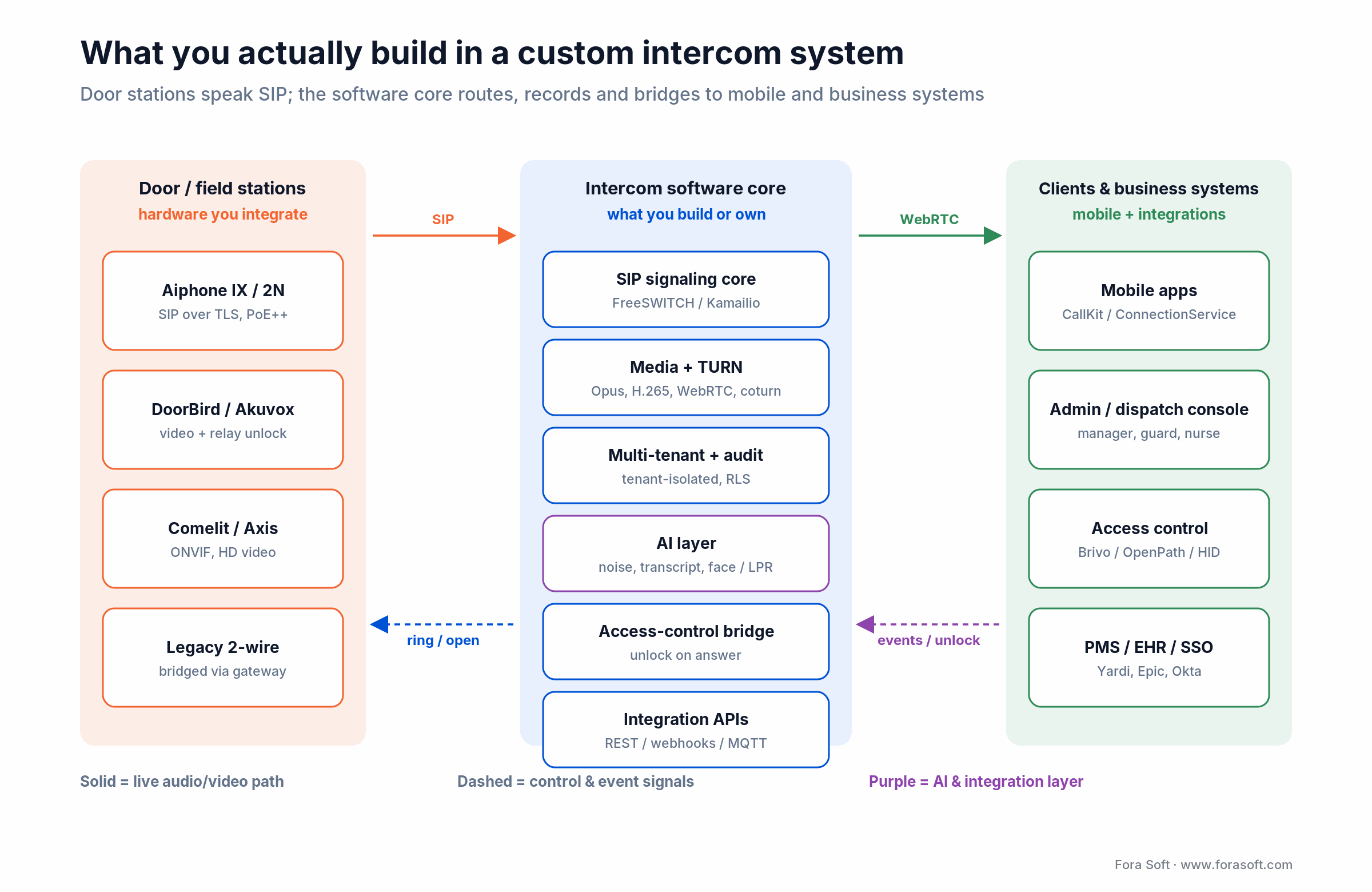
Figure 2. The software you build sits between commodity door hardware and the systems your business already runs.
- SIP signaling core. FreeSWITCH, Kamailio or Asterisk — or a managed layer like Twilio / Vonage if you can stomach the per-minute economics.
- Media stack. Opus for audio, H.264/H.265 for video, WebRTC for the browser leg, coturn for TURN, ideally geographically distributed.
- Mobile apps. Native iOS (CallKit, PushKit VoIP push) and native Android (ConnectionService, high-priority FCM). React Native or Flutter around native modules is fine for the UI; the calling plumbing stays native.
- Admin & dispatch console. Property-manager console for MDU, guard console for commercial, nurse console for healthcare. Different UI per segment, shared data model.
- Access-control bridge. Release the door on a successful call; authenticate against existing badge and credential systems (HID, Genetec, Lenel, Brivo, OpenPath).
- AI layer. Noise suppression, live transcription, face and license-plate recognition where legally allowed, smart routing.
- Compliance & audit. Encrypted recording storage, role-based access, consent signage, retention-policy enforcement, export.
- Integration APIs. REST/GraphQL for third parties, webhooks for delivery events, MQTT for IoT edges.
Why a mobile app means native calling plumbing
The biggest cause of one-star reviews on intercom apps is the call that rings but can’t be answered because the phone is locked. The fix is well understood and still routinely skipped.
- iOS. Use CallKit with a PushKit VoIP push to wake the app into the background, then report the call within Apple’s enforced window. Anything else is a rejection waiting to happen.
- Android. High-priority FCM, ConnectionService for the system call UI, a foreground service to survive Doze, and OEM allow-listing (Xiaomi, Huawei, Samsung) because the platform rules aren’t quite uniform.
- Cross-platform UI. React Native or Flutter for the app shell is fine. The call screen itself should be the OS-native call UI, because users already know how to answer it.
Field rule. Test your call-from-locked-phone scenario on a real Xiaomi Redmi, not just a Pixel. If battery-saver mode kills the incoming call, you’ll find out at 11 p.m. from an angry resident, not during QA. For the framework trade-offs, see our cross-platform video app guide.
AI features that earn their keep in 2026
Not every AI feature is worth the build. These are the ones that pay for themselves on real intercom projects — the rest are demos. We wire most of them through a dedicated AI integration layer so they stay swappable as models improve.
- DNN noise suppression (Krisp, RNNoise, or a fine-tuned in-house model). Table stakes on any loud entrance or lobby.
- Live transcription (Whisper on-prem, Deepgram Nova in the cloud). Needed for compliance and accessibility.
- Face recognition for known residents and staff. Legal in most U.S. states, restricted in Illinois (BIPA) and the EU. Always opt-in, always with written consent.
- License-plate recognition for commercial garages and gated communities. Solid ROI on delivery and contractor workflows.
- Smart routing. An “Amazon delivery” visual classification rings the parcel locker; everything else rings the resident.
- Visitor pre-authorization. A QR or SMS code the AI layer matches to the pre-authorized visitor, then opens the door — no resident call needed.
- Real-time translation for multilingual buildings. Treat accuracy as something you measure per engine and noise level, not a marketing number.
Integration targets by segment
The integrations decide the build size far more than the call feature set. Here are the must-haves and nice-to-haves we see per segment.
| Segment | Must-integrate | Nice-to-have |
|---|---|---|
| Residential MDU | Access control (Brivo/OpenPath/Kisi), property management (AppFolio/Yardi/Buildium) | Parcel lockers, smart locks, Alexa/Google Home |
| Commercial office | SSO (Okta/Azure AD), visitor management (Envoy/Proxyclick), access (HID/Lenel/Genetec) | Slack/Teams alerts, room booking |
| Healthcare | Nurse call (Rauland/Ascom), EHR (Epic/Cerner), HIPAA audit logs | Wayfinding, badge printing |
| Education | SIS (PowerSchool/Skyward), PA (Valcom), lockdown triggers | Parent app, bus tracking |
| Manufacturing | PLC/MES/SCADA, fire panel (Notifier/Simplex), badge | AR glasses, TSN |
Three architecture patterns that ship cleanly
Pattern A: Managed SIP (Twilio / Vonage / SignalWire). Fastest to market. You don’t operate SIP infrastructure; you pay per minute and focus on the experience. Viable until roughly 50K active endpoints, where the per-minute bill starts to dominate.
Pattern B: Self-hosted core + managed media. FreeSWITCH or Kamailio on Kubernetes, WebRTC via LiveKit or Janus. It balances control and ops burden, and it’s our most common recommendation for mid-size multi-tenant SaaS. It leans on the same real-time video and WebRTC work we do across the rest of our portfolio.
Pattern C: Fully on-prem. Required for air-gapped customers (defense, some healthcare, industrial). FreeSWITCH + PostgreSQL + object storage on a ruggedized appliance per site.
What an intercom system for business costs
Two very different price tags, depending on the path. Off-the-shelf is priced per door plus a monthly subscription; custom is priced as a one-time build plus a support retainer. Here are real 2026 numbers for both.
Off-the-shelf (installer benchmarks, Swiftlane 2026):
| Line item | 2026 range | Notes |
|---|---|---|
| Audio-only station | $200–800/door | legacy tier, rarely specified new |
| Basic video intercom | $1,000–3,000/door | entry-level video + relay |
| IP video + cloud-managed | $2,000–5,000+/door | mobile app, remote management |
| Cloud software subscription | $30–100/door/month | or $5–15 per unit/month |
| Whole project | $1,000–5,000 small · $5,000–30,000 mid · $30,000–50,000+ large | hardware + install, subscription separate |
Custom software build (Fora Soft, conservative, Agent Engineering):
| Tier | Scope | Range | Timeline |
|---|---|---|---|
| Residential pilot | 100 units, 1 building, mobile app, access control, admin console | $90K–180K | 10–14 weeks |
| Commercial mid-market | 10 sites, 500 endpoints, SSO, visitor management, SOC-2 controls | $350K–750K | 5–8 months |
| Enterprise multi-tenant SaaS | Multi-tenant, branded per customer, AI suite, mobile + web, public API | $1.2M–3M | 12–18 months |
| Specialized vertical | Plus HIPAA / PLC / fire-panel integration, air-gapped installers | +30–60% | +3–6 months |

Figure 3. Off-the-shelf grows with every door; a custom build is mostly fixed. They cross near 260 doors over three years.
The worked example. Take a growing portfolio and compare software cost only (both paths still buy hardware). Off-the-shelf at $50/door/month over 36 months is $50 × 36 = $1,800 per door. A custom build runs about $300K plus roughly $120K of three-year support, call it $420K fixed, plus a small hosting cost of about $180 per door over three years. Set them equal: $1,800 × doors = $420,000 + $180 × doors, so $1,620 × doors = $420,000 and the break-even lands near 260 doors. Below that, buy. Above it, the custom platform is cheaper over three years, and it’s your product, on your brand, with your integrations.
Budgeting tip. The crossover moves with your subscription tier and integration depth, so run your own three-year math before you commit. If a vendor quotes $90/door/month, break-even arrives closer to 140 doors. For the video leg specifically, our video app cost guide breaks the media pipeline down further.
Team composition for a 6–9 month build
- Solution architect (0.5 FTE): SIP topology, integration surface, compliance.
- Backend engineers (2 FTE): SIP core, integrations, multi-tenancy.
- iOS engineer (1 FTE): CallKit, PushKit, native call UI.
- Android engineer (1 FTE): ConnectionService, FCM VoIP, OEM quirks.
- Frontend engineer (1 FTE): admin & dispatch consoles.
- ML engineer (0.5 FTE): noise suppression, transcription, optional face/LPR.
- QA & compliance (1 FTE): end-to-end scenarios, ADA/accessibility, privacy review.
- DevOps (0.3 FTE): Kubernetes, SIP load testing (SIPp), TURN scaling.
Mini case: patterns we reuse from V.A.L.T.
Situation. V.A.L.T. is a video management platform we’ve been the sole dev team on for over a decade: 770+ US organizations, 50,000+ users, HIPAA-grade evidentiary storage. It isn’t an intercom, but the disciplines transfer directly.
Lessons that transfer to intercom builds. First, multi-tenant means tenant-isolated storage and row-level security from day one, not a flag added at Series B. Second, audit evidence is a first-class data product — treat it like accounting ledgers, not log files. Third, mobile clients fail in ways web clients never do; you need a dedicated mobile telemetry pipeline to catch carrier-specific bugs before reviews flag them.
Outcome. Every intercom build we’ve run since 2022 inherited those patterns. If you want our architect to walk them through your topology, book a 30-minute slot.
Planning a multi-tenant intercom SaaS?
We’ll review your tenant model, SIP topology and compliance posture, and tell you what the build actually costs, not a range off a pricing page.
A 16-week residential-pilot rollout
Here’s how a residential pilot actually sequences into eight two-week phases, from discovery to a live building. Figure 4 lays out the same plan on a timeline.
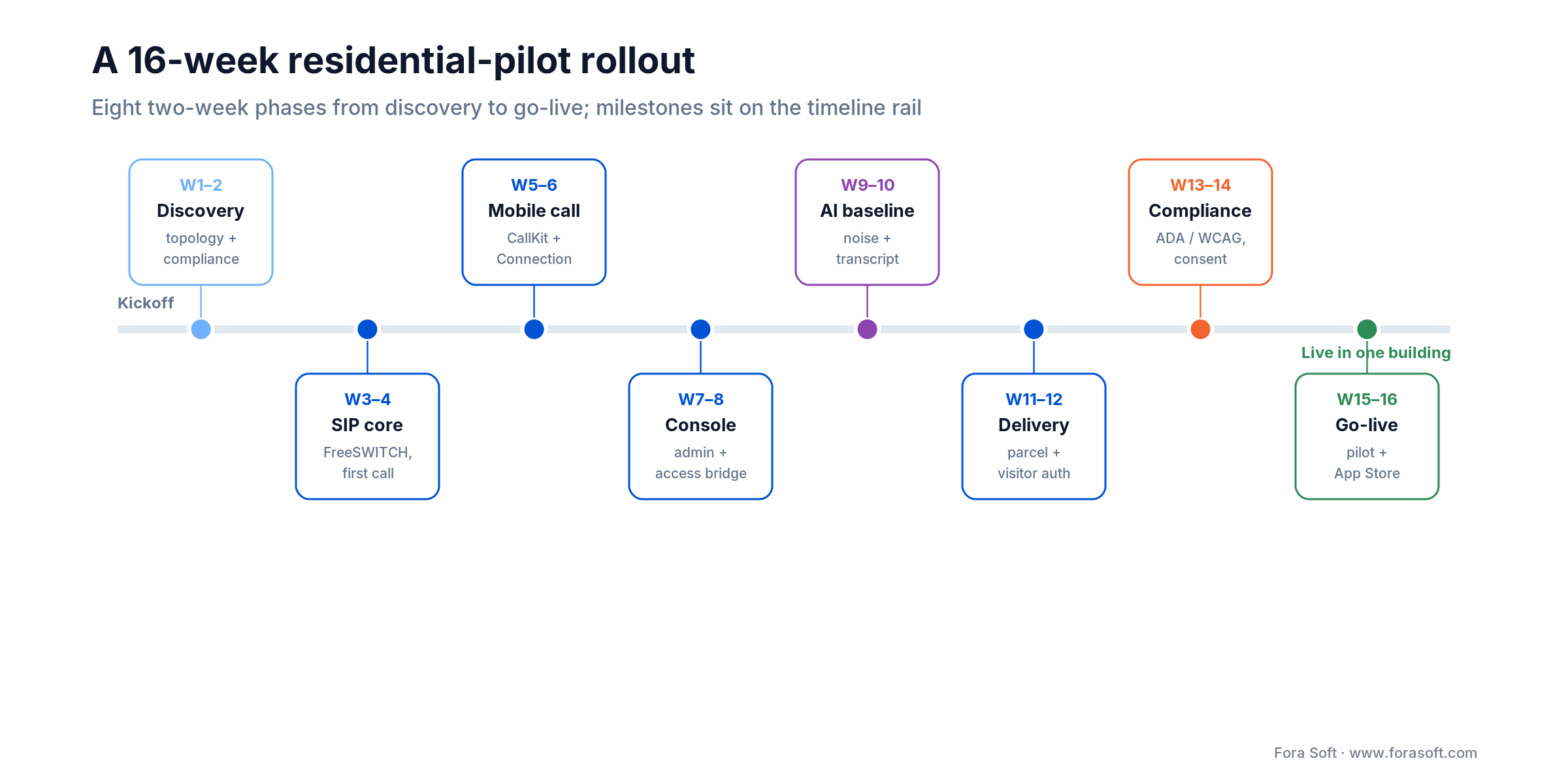
Figure 4. A residential-pilot rollout in eight two-week phases, from discovery to live in one building.
- Weeks 1–2. Discovery: hardware choice, building topology, property-management integration, compliance gaps.
- Weeks 3–4. SIP core stand-up (FreeSWITCH), first station paired, first call from a test iOS device.
- Weeks 5–6. CallKit + PushKit on iOS; high-priority FCM + ConnectionService on Android.
- Weeks 7–8. Admin console, resident onboarding, access-control bridge (Brivo/OpenPath/Kisi).
- Weeks 9–10. DNN noise suppression, live transcription, encrypted recording storage.
- Weeks 11–12. Package-delivery flow, visitor pre-authorization, parcel-locker integration.
- Weeks 13–14. Accessibility (ADA / WCAG 2.2), consent signage, GDPR DSAR tooling.
- Weeks 15–16. Hypercare pilot in one building, telemetry, App Store submission, go-live.
KPIs your product team should watch
- Answer rate on first ring ≥ 85% across iOS and Android.
- Call setup latency (ring to audio) < 1.5 s.
- Failed-to-deliver push rate < 2% per carrier / OEM.
- App crash-free sessions ≥ 99.8%.
- Resident NPS ≥ 40 after 90 days.
- Property-manager ticket volume down 40% within 6 months vs. legacy intercom.
Seven pitfalls we fix on rescue projects
- Ordinary FCM instead of high-priority VoIP push. Calls miss when the phone is in Doze.
- A hand-rolled call UI instead of CallKit / ConnectionService. Users can’t answer from the lock screen.
- One TURN server in one region. Works in the demo, fails on international tenants.
- Storing recordings unencrypted. A GDPR / BIPA problem waiting to happen.
- Ignoring OEM battery-saver quirks. Xiaomi, Huawei and Samsung each block background wake differently.
- Shipping without SIPp load tests. You discover the signaling bottleneck at the first move-in weekend.
- No tenant-isolated storage. One incident, and every tenant’s data is in the breach-notification letter.
Rule of thumb. Budget 20% of total build effort on mobile calling plumbing (CallKit, PushKit, FCM, OEM quirks). Every team we rescue underestimated this line item — not the SIP core, not the AI, not the admin console. The phone plumbing.
How Agent Engineering changes the math
On our last three intercom builds, Agent Engineering cut 30–40% off the integration and boilerplate phases. Where it earns its keep:
- SIP dialplans. A routing DSL becomes generated FreeSWITCH XML / Kamailio configs with tests.
- Access-control bridges. A vendor OpenAPI spec becomes a client with retry logic, pagination and a full test suite.
- Mobile boilerplate. Screens, navigation, localization, empty states, push-handling shells.
- CSV import/export. A tenant schema becomes validators, a preview UI and reconciliation reports.
- Webhook receivers. A delivery-event schema becomes a signed endpoint with replay protection and a dead-letter queue.
What it doesn’t do well: CallKit subtleties, OEM battery-saver forensics, and anything that needs a real phone in a real hand on a real carrier. Senior engineers still spend their time there — which is exactly where it should go.
When not to build a custom intercom
Custom isn’t always the right call, and we’ll say so on a scoping call. Skip the custom build when any of these describe you:
- One building, standard needs, no branding. A packaged system installs in days and costs a fraction of a build. Buy it.
- Fewer than ~250 doors and no growth plan. You’ll likely never reach the three-year crossover, so the subscription math favors off-the-shelf.
- No product owner. A custom platform needs someone to own the roadmap, triage field bugs and make trade-off calls. Without that, it rots.
- You just want the door to open. If nobody on your team can name a workflow the vendor app gets wrong, there is nothing to differentiate yet.
The honest version: most single-building offices should buy. Custom software is for teams whose product, brand or portfolio depends on owning the experience, and for them it’s not close.
Compliance obligations by segment
- Residential (US). ADA for accessibility, state wiretap-consent laws (two-party states like California, Illinois, Florida), and BIPA in Illinois for voiceprints and faceprints.
- Residential (EU/UK). GDPR, UK Equality Act 2010, a DPIA if face recognition is used.
- Commercial. SOC 2 Type II is table stakes for enterprise sales; ISO 27001 if international.
- Healthcare. HIPAA, HITECH, state privacy laws, and BAAs with every subprocessor.
- Education. FERPA in the US, COPPA if minors, plus state student-data-privacy acts.
- Industrial. OSHA, NFPA 72, ISA/IEC 62443. See our industrial intercom playbook.
Biometrics deserve their own paragraph. Illinois BIPA requires informed written consent before you capture a face or voice template, a public retention-and-destruction schedule, and no sale of biometric data. The risk is real but shifting: on 1 April 2026 the Seventh Circuit held that the 2024 BIPA amendment limiting damages to per-person (not per-scan) applies retroactively to pending cases. Lower exposure, but BIPA still bites. Our BIPA guide in Learn covers the consent flow in depth.
2026–2027 trends to budget around
- Agentic concierge. LLMs handling “tell the resident I’ll be there at 5” without a human dispatcher.
- RCS / Matter integration. Richer messaging flows and smart-home handoffs beyond Alexa and Google Home.
- Apple Vision Pro / Meta Quest 3 as intercom endpoints for facilities staff and security operations centers.
- On-device LLMs. Small models on the door station for offline keyword spotting and basic visitor Q&A.
- CBRS / private 5G replacing PoE runs in new-construction MDU.
FAQ: custom intercom software
What is an intercom system for business?
It’s a networked audio/video entry and communication system for offices, multi-tenant buildings, campuses or facilities — door stations plus software that routes calls to phones and consoles, releases doors, and ties into access control and property systems. In 2026 most are IP/SIP-based with a mobile app as the primary endpoint.
Should we buy off-the-shelf or build custom?
Buy off-the-shelf (ButterflyMX, Latch, Swiftlane) for a single building with standard needs. Build custom when you own the tenant relationship and brand, need deep integrations, require on-prem/data ownership, or run a portfolio above ~260 doors where subscriptions overtake the build cost.
How long does a custom intercom build take?
Residential pilot: 10–14 weeks. Commercial mid-market: 5–8 months. Multi-tenant SaaS: 12–18 months. Specialized verticals (healthcare, industrial) add 3–6 months for compliance and system integration.
Can we skip native iOS/Android and use React Native or Flutter?
Yes for the app shell (screens, nav, settings). No for the calling plumbing. CallKit, PushKit, ConnectionService and OEM battery-saver handling need native modules — either custom TurboModules or well-maintained community plugins with native fallbacks.
Should we use Twilio or self-host FreeSWITCH?
Start on Twilio for v1 if you want speed. Near 50K active endpoints, model the inbound-leg per-minute bill against a self-hosted FreeSWITCH cluster — the switch usually pays back in under 12 months. Keep signaling abstracted so the migration is painful, not lethal.
How do we handle face recognition legally?
Always opt-in, with explicit written consent (BIPA in Illinois). Store biometric templates encrypted at rest with rotating keys, keep a public retention/destruction schedule, and never move biometric data across borders without a DPIA in the EU. Let users delete their face data in one step.
Do we need our own TURN servers?
Yes, at scale. Run coturn across at least three regions with per-tenant rate limiting. Without distributed TURN, international residents hit 400–800 ms setup latency or fail behind strict NATs.
What does ongoing support cost?
A year-one retainer runs 18–25% of build cost: SIP-core uptime, iOS/Android SDK updates, OEM quirk remediation, AI model tuning and compliance review. Year two drops to 12–15% for a mature product.
What to read next
Read next
Customizing Residential & Commercial Intercom Software
The residential-and-commercial cut of this playbook, deeper on tenant experience.
Read next
Custom Industrial Intercom Software for Plants & Warehouses
Plant-floor specific: ATEX, PLC/MES, noise floors, private 5G.
Read next
Cross-Platform Video App Development: A 2026 CTO Guide
Flutter vs React Native vs native — the mobile-app framework calculus.
Read next
Video Streaming App Development Cost: A 2026 Guide
The deep-dive cost model for the video leg of the intercom stack.
Read next
V.A.L.T. — our multi-tenant video platform
770+ organizations, 50,000+ users — the multi-tenant patterns we reuse on intercom builds.
Ship an intercom your residents and guards actually like
Walk us through your plan — we’ll tell you what’s missing, what’s over-scoped, and what the real number looks like.
Sum up
An intercom system for business in 2026 is an integration and mobile-experience project. The hardware is solved. Your build succeeds or fails on CallKit / ConnectionService quality, access-control bridges, multi-tenant data isolation, baseline AI features and compliance evidence.
Buy off-the-shelf for a single building; build custom when you own the brand, the integrations or a portfolio past ~260 doors. Cost realistically: $90K–180K for a residential pilot, $350K–750K for commercial mid-market, $1.2M–3M for enterprise multi-tenant SaaS. Agent Engineering trims 30–40% off the integration tier, and 20% of total effort belongs on mobile calling plumbing — the line item teams underestimate.
If you want that conversation to be with us, pick a 30-minute slot and bring your topology.

