

Key takeaways
• A building intercom system is really two products. Residents want to answer from anywhere, buzz in a courier, and pre-clear guests. Commercial tenants want SSO, visitor logs, and a guard console. One platform, two UX stacks.
• Mobile calling is where most builds break. On iOS only a PushKit VoIP push wakes CallKit; on Android a high-priority FCM data message plus ConnectionService, with a WebSocket or SIP REGISTER as backup. Underscoped vendors skip this.
• Hardware is a commodity; the software layer is the moat. 2N, Aiphone, DoorBird, Akuvox and Comelit all ship excellent IP stations. Your custom software owns tenants, branding, access control, AI, and compliance.
• Two different budgets. Turnkey hardware runs $1,200–3,000 per door; a custom multi-tenant platform is $90K–2.5M depending on scope. Don’t confuse the two line items.
• Agent Engineering trims 30–40% off integration boilerplate. Access-control SDK wrappers, property-management pipelines, and mobile scaffolding ship faster with senior engineers reviewing agent output instead of typing it.
A modern building intercom system is no longer a buzzer wired to a door strike. It’s a mobile app, a cloud backend, an access-control bridge, and a compliance surface — and residential and commercial buildings pull that stack in different directions. This playbook is for the product leaders scoping a custom build in 2026: proptech founders, multi-property management groups, and commercial security integrators who need to own the tenant relationship instead of renting it from a turnkey vendor.
We’ve shipped this stack. It’s the residential and commercial companion to our custom intercom software guide and our industrial intercom playbook. Below: where the two segments diverge, the hardware you’ll integrate against, the UX patterns that survive two years in the App Store, the AI baseline in 2026, compliance by segment, real costs, and a 16-week rollout plan.
Scoping a residential or commercial intercom rollout?
We’ll walk your topology, hardware shortlist and integration surface, then tell you where the rescue projects we see most often went wrong.
Where residential and commercial actually diverge
Residential and commercial intercom software share a calling core and split above it. The resident-facing product optimizes for a person on a phone; the commercial product optimizes for a guard at a console plus a tenant on a phone. Miss that split and you ship one bloated app that serves neither well.
- Primary user. Residential: the resident on a phone. Commercial: a lobby guard at a console, plus the tenant on a phone.
- Authentication. Residential: phone-number-bound invite. Commercial: SSO (Okta, Azure AD, Google Workspace) tied to the tenant company’s identity provider.
- Access control. Residential: smart locks, parcel lockers, PIN codes, delivery QR. Commercial: a full access-control system with badge readers (HID, Genetec, Lenel, Brivo, OpenPath, Kisi).
- Compliance. Residential: state wiretap and consent laws, biometric laws like Illinois BIPA. Commercial: SOC 2, tenant data isolation, contractual audit rights.
- Pricing model. Residential: per-door or per-unit, per month. Commercial: per-site, per-endpoint, or per-seat with a property-manager admin overlay.
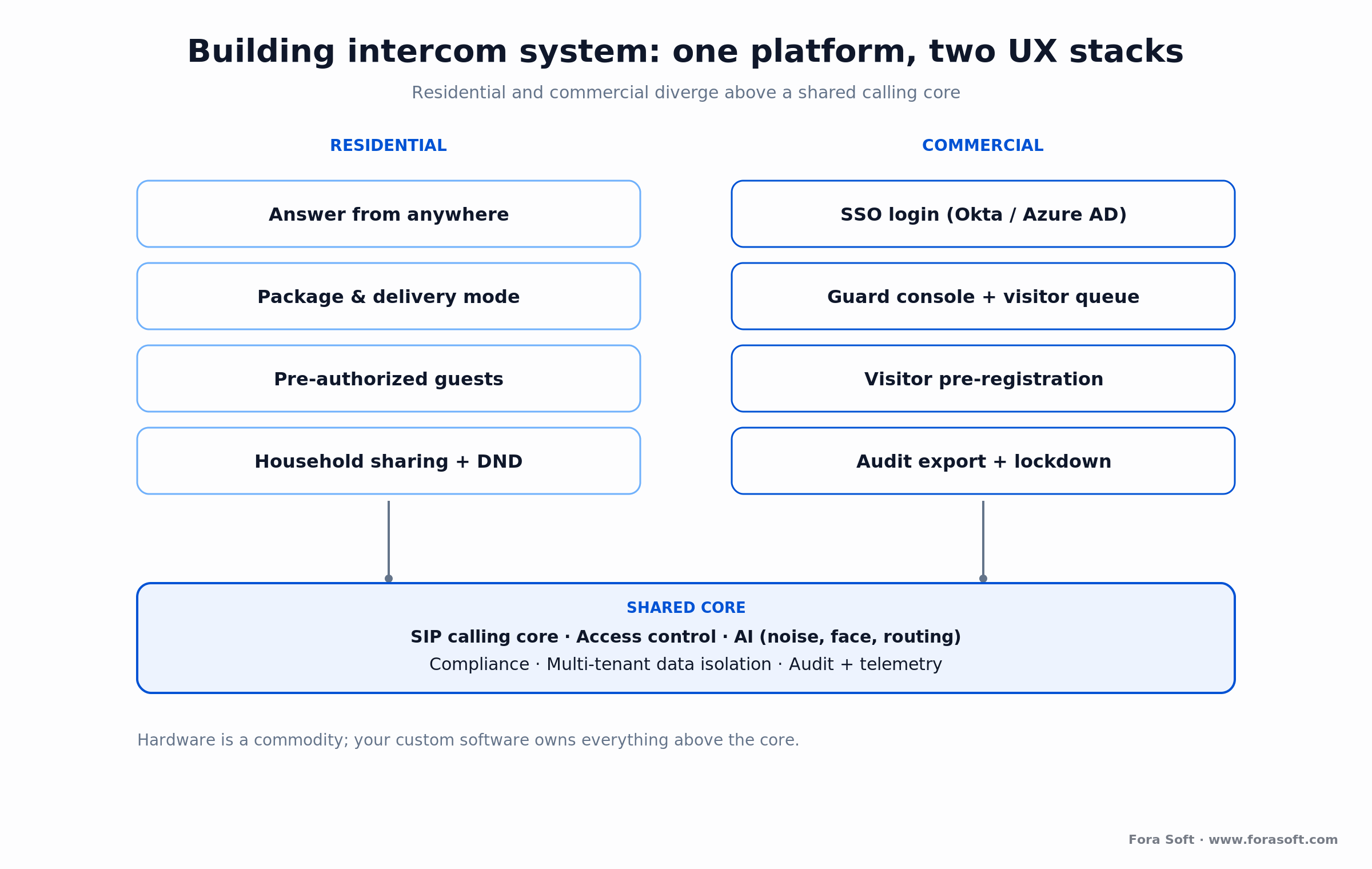
Figure 1. One platform, two UX stacks. Everything above the shared core is where residential and commercial builds diverge.
The 2026 hardware shortlist by segment
Pick stations for weatherproofing, camera quality, and SIP support, not brand loyalty. Three brands dominate multi-tenant IP intercom in 2026: Akuvox, 2N, and Aiphone. The 2N IP Verso 2.0 ships a wide-angle full-HD camera, an ARTPEC-7 processor with on-board QR reading, and up to 20 combinable modules. Aiphone’s IXG series is the multi-tenant sibling of the IX line and scales to 9,999 devices over SIP. Akuvox covers the retrofit end with 2-wire R20A units and a stainless X912S for premium entrances.
| Segment | Primary station picks | Sweet spot |
|---|---|---|
| Multifamily residential | Aiphone IXG, 2N IP Verso 2.0, DoorBird D21x, Akuvox R29, Comelit Ultra | Weatherproof video, package flow |
| Luxury condo / smart-home | DoorBird D11x, Comelit Mini, Control4 integration | Designer aesthetics, Matter / HomeKit |
| Commercial office lobby | 2N IP Verso 2.0, Aiphone IX-DVF, Axis A8207-VE | Visitor workflow, guard console |
| Mixed-use / retail | 2N IP Force, Aiphone IX-SS, Viking E-1600 | Rugged, ADA-compliant |
| Gated community / perimeter | Talkaphone VOIP-500, Valcom, DoorBird D10x | Outdoor, cellular fallback |
Most real deployments are multi-vendor, and the custom software layer is what normalizes them. We’ve shipped apps that speak to 2N at the main door, Aiphone at the service entrance, and DoorBird at the package room, while the resident sees one interface. DoorBird has premium build quality and deep smart-home integrations (Control4, Home Assistant, Crestron), but its Wi-Fi units can lag on congested networks, so we hardwire stations wherever the conduit allows.
Residential UX patterns that survive two years in the App Store
Residents judge an intercom app by one moment: someone is at the door and the phone rings. Everything below protects that moment across OS updates, carriers, and battery-saver modes.
- Answer from the lock screen. CallKit on iOS, ConnectionService on Android. Non-negotiable.
- One-tap door release during the call. No separate “open door” screen hiding behind the video. The release button sits on the call UI.
- Package delivery mode. The resident sets a window; the courier gets a one-time PIN or QR; the log shows who opened the door and when.
- Pre-authorized visitors. Guests get a link; the station recognizes the face or code and opens without ringing the resident.
- Household sharing. Multiple phones per unit, roommate and child profiles, each with its own notification preferences.
- Do-not-disturb with fallback. The resident silences the app at night; calls route to a second resident, then the property manager, then voicemail.
- Offline fallback. If the resident’s phone has no signal, the station still lets a trusted visitor in with a pre-issued PIN.
Commercial UX patterns that pass a security review
Commercial buyers run your app past their security team before signing. Design for that review from day one, not as a retrofit.
- SSO-first login. Okta, Azure AD, Google Workspace, Ping. No local accounts except an emergency break-glass path.
- Guard console with a multi-camera grid, visitor queue, escalation, and shift-handoff notes.
- Visitor pre-registration by tenant employees via email, Slack or Teams, with a QR code sent to the station.
- Audit export. Every call, every door release, every override logged as SIEM-ready JSON lines.
- Tenant isolation. Tenant A’s property manager cannot see Tenant B’s logs. Enforced at the database layer, not the UI.
- Visitor-management integration (Envoy, Proxyclick, Sine) instead of reinventing it.
- Lockdown workflow. One button on the guard console triggers door lockouts, a camera-recording boost, and an optional mass-notification push to tenants.
Why mobile calling is where most builds break
The short version: getting a phone to ring reliably when the door station calls is a specialist job, and it’s the single line item underscoped vendors get wrong. A missed ring is a resident standing in the rain, and it shows up as a one-star App Store review within a week.
On iOS, only a PushKit VoIP push (the voip push type, with its own VoIP certificate) wakes the app and lets CallKit paint the native lock-screen call. A regular notification won’t do it. On Android, the native incoming-call screen needs ConnectionService plus a high-priority FCM data message. Here’s the catch: FCM data-only messages are treated as low priority and get throttled when the phone is in Doze, backgrounded, or low on battery. Worse, Android will deprioritize your high-priority sends if you keep receiving them without showing a call UI.
So we never rely on push alone. We keep a persistent WebSocket or a SIP REGISTER with a short expiry as a backup wake path, and we run a quarterly battery-saver regression pass across Samsung, Xiaomi, and Huawei devices, which are the usual offenders. That plumbing is roughly 20% of total build effort, and skipping it is the number-one reason rescue projects land on our desk.
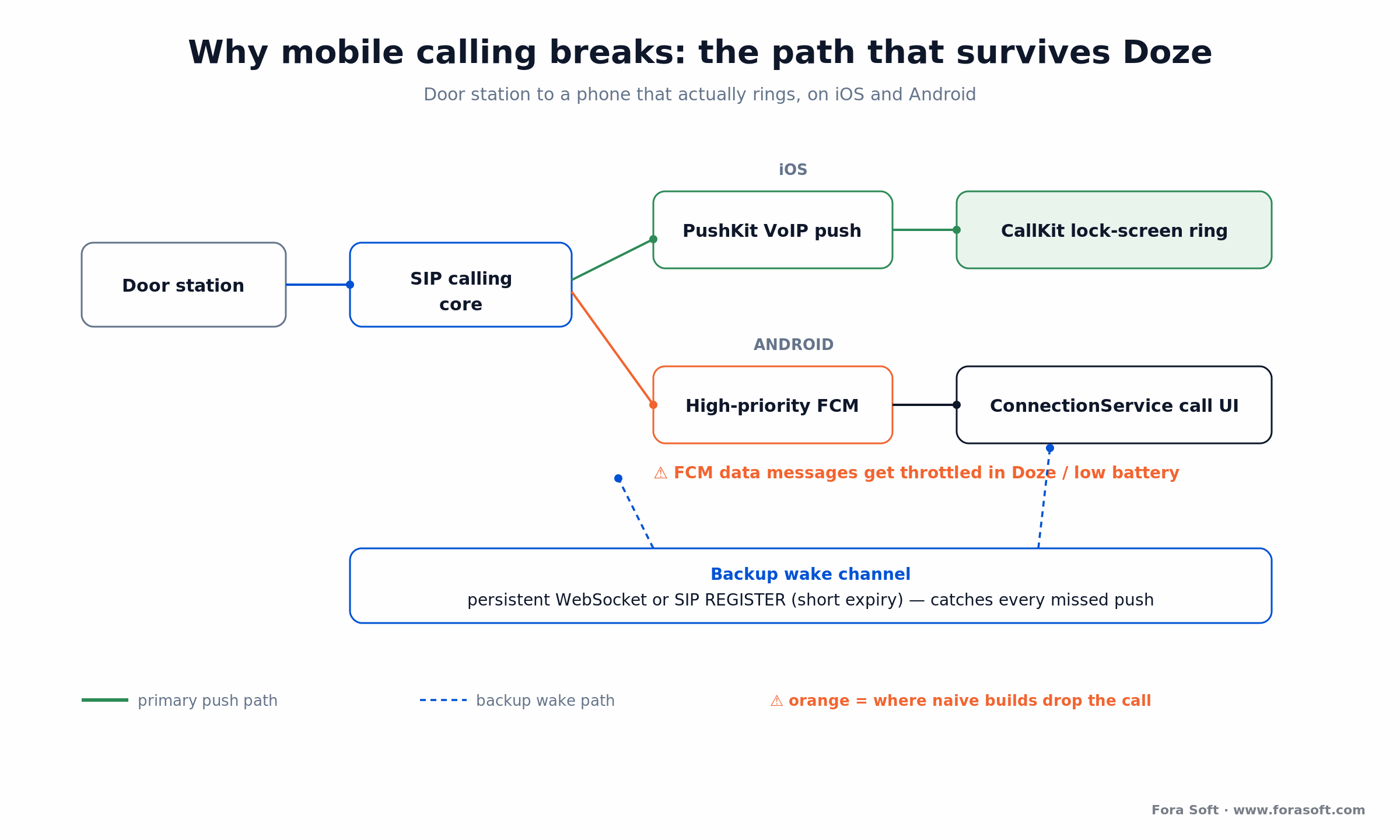
Figure 2. The call path that survives Doze. The backup wake channel (WebSocket / SIP REGISTER) is the part vendors skip.
Reach for native calling code when: ring reliability is a product requirement, which for an intercom is always. Use React Native or Flutter for the app shell, but keep CallKit, PushKit, and ConnectionService in native code.
Worried your team can’t ship reliable mobile calling?
That’s the part we’ve shipped over and over. We’ll review your CallKit and ConnectionService plan and flag the carrier and battery-saver traps before they become one-star reviews.
The 2026 AI baseline for both segments
AI in intercoms crossed from demo to buying criterion in 2026. The baseline features below pay for themselves; the leading-edge ones are worth piloting.
- Noise suppression (Krisp, RNNoise) on both call legs. Residential fights street traffic and TV; commercial fights lobby crowd noise.
- Live transcription (Whisper on-prem or Deepgram in cloud). Helps residents with hearing loss and gives commercial buildings an audit trail.
- Face recognition, opt-in. Known residents and staff skip the ring. In Illinois this triggers BIPA; in the EU it needs a data-protection impact assessment. Treat it as an opt-in feature, never a default.
- License-plate recognition for gated communities and commercial garages. Best ROI on delivery and tenant parking.
- Smart routing. An “Amazon delivery” phrase routes to the parcel locker; a uniformed courier plus badge color routes to the loading dock; an unknown visitor routes to the guard console.
- Translation bridge. A resident speaks Mandarin, a visitor speaks English, with 2–3 second latency and 85–92% accuracy. Usable today, smoother by 2027.
- Concierge agent. “Tell Sarah I’ll be there at five” becomes a message in her app. Early deployments, big UX win when it’s done well.
Privacy rule: face and voice biometrics are a separate regulatory class from general video recording. Give them their own consent flow, retention policy, and encryption keys. Never pool all three in one “media” bucket.
The integration surface in practice
The integration surface is where residential and commercial diverge most, and where scope creep hides. Map every system on this list before you quote a build, because each row is an API, a data model, and a support relationship.
| Category | Residential | Commercial |
|---|---|---|
| Property management | AppFolio, Yardi, Buildium, Entrata | MRI, Yardi Commercial, VTS |
| Access control | Brivo, OpenPath, Kisi, August, Yale | HID, Genetec, Lenel, Software House, AMAG |
| Parcel / delivery | Luxer One, Parcel Pending, Amazon Hub | Mailroom workflow integrations |
| Visitor management | Built-in simple flow | Envoy, Proxyclick, Sine, Traction Guest |
| Notifications | Mobile push (APNs / FCM), SMS fallback | Slack, Teams, email, PagerDuty |
| Smart home / BMS | Matter, HomeKit, Alexa, Google Home | Crestron, Johnson Controls, Honeywell |
| Cameras / VMS | Optional ONVIF pairing | Milestone, Genetec, Avigilon, Axis |
Three architecture patterns that ship cleanly
Pattern A — managed SIP, single-region backend. Twilio, SignalWire, or Vonage for signaling and media; one backend region. Fastest to market for a residential pilot or small commercial portfolio, roughly 10–14 weeks to launch.
Pattern B — self-hosted SIP core, managed media, multi-region. FreeSWITCH or Kamailio on Kubernetes, WebRTC via LiveKit or Janus, multi-region TURN via coturn. This is our default for a mid-size multi-tenant platform. If real-time media is new to your team, our video streaming learning track covers the transport basics your calling core depends on.
Pattern C — regional sovereignty, on-prem option. Required for EU data sovereignty, public-sector tenants, and regulated industries where data can’t leave the boundary. Plan for 4–6 months longer and 30–50% more cost.
Reach for Pattern B when: you’re building a multi-tenant SaaS with more than a handful of buildings and international residents. A single-region managed stack (Pattern A) hits 400–800 ms call setup for overseas tenants and stalls behind strict corporate firewalls.
Compliance, tier by tier
Compliance is not a launch checklist; it’s an architecture input. The consent flow, storage boundaries, and audit tooling all change your data model, so decide the tier before you build.
- US residential. ADA Title III for public-facing entrances, two-party consent in California, Illinois, Florida and others, and Illinois BIPA for biometrics. A 2024 BIPA amendment (SB 2979, signed August 2024) caps liability at one violation per person rather than per scan, and a 2026 appeals ruling made that cap retroactive, but written consent is still mandatory before any face or voice print.
- US commercial. SOC 2 Type II is table stakes. ISO 27001 for international tenants. Data-processing agreements with every subprocessor.
- EU and UK. GDPR, the UK Equality Act 2010 as the accessibility equivalent, a data-protection impact assessment if you run face recognition, and a data-protection officer if processing is large-scale.
- Canada. PIPEDA plus provincial laws, notably Quebec’s Law 25.
- Accessibility. Target WCAG 2.2 AA for the mobile app and web console. Don’t ship without a paid audit.
Realistic 2026 cost tiers
First, separate two budgets people constantly conflate. Turnkey hardware is priced per door: a Swiftlane reader runs about $1,200–1,500 and a ButterflyMX panel $1,500–3,000, so a six-unit building lands around $2,000–6,000 all-in and a large multi-entry commercial property can pass $50,000. Custom software is a different line item entirely, priced by scope, not by door. The table below is the software build.
| Tier | Scope | Range | Timeline |
|---|---|---|---|
| Residential pilot | 1 building, 100 units, mobile app, access control, admin | $90K–180K | 10–14 wks |
| Residential portfolio | 25 buildings, 3,000 units, branded app, PM integration | $350K–650K | 5–7 mo |
| Commercial portfolio | 20 buildings, guard consoles, SSO, visitor mgmt, SOC 2 | $450K–850K | 6–9 mo |
| Multi-tenant SaaS | Multi-tenant, branded per customer, AI suite, public API | $1.2M–2.5M | 12–18 mo |
A worked example for the residential pilot. Budget roughly 300 engineering-days: 2 backend engineers for 14 weeks (about 140 days), 1 iOS and 1 Android engineer for the calling plumbing (about 120 days), and a shared 0.5 FTE for architecture and QA (about 40 days). At a blended $520/day that’s about $156K of engineering, which lands inside the $90K–180K band once discovery and a lighter integration scope pull it down. Ongoing costs run $1,500–4,000 per month per 10,000 active endpoints for SIP, TURN, and AI inference, plus a year-one support retainer of 18–25% of build.
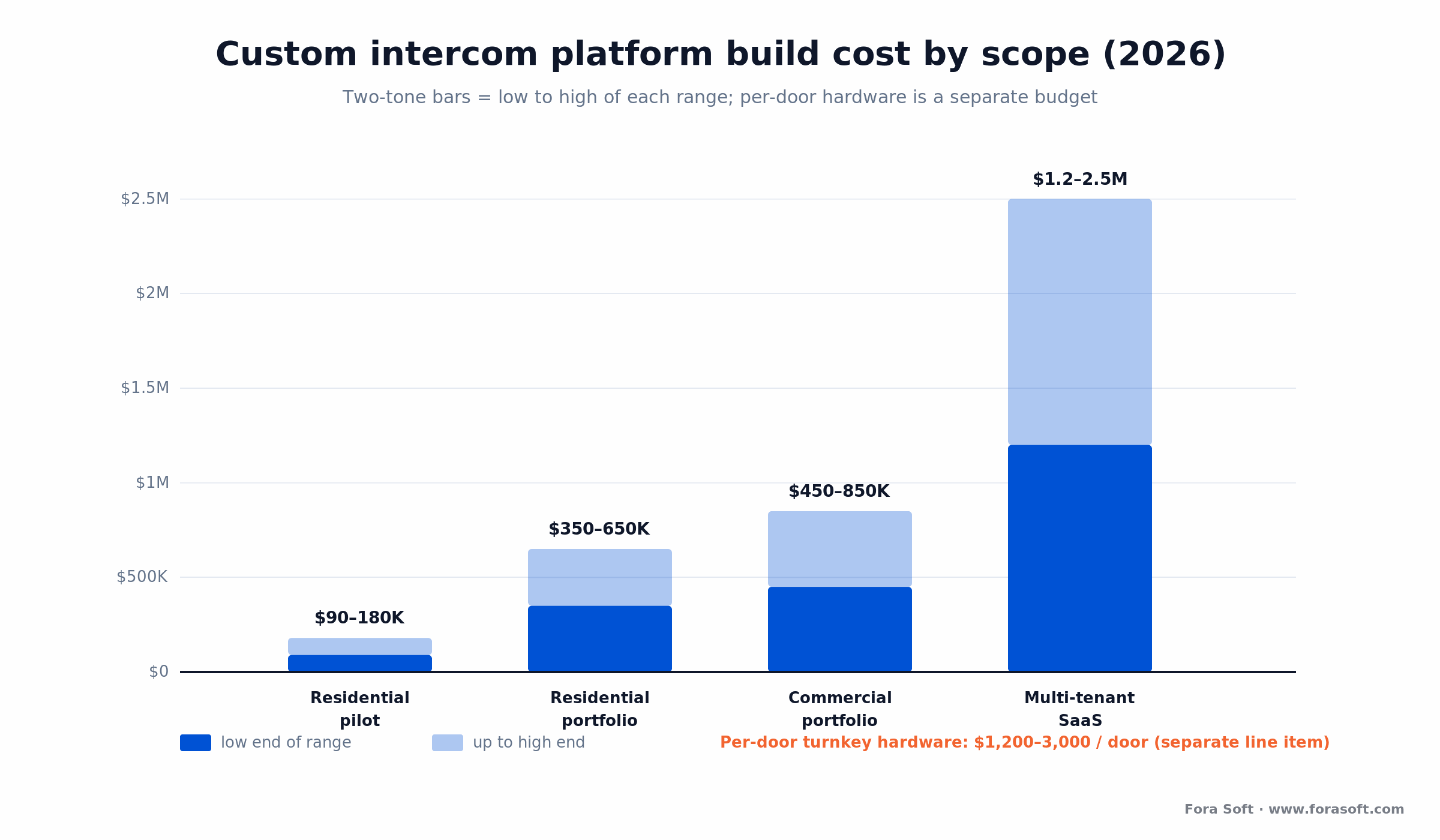
Figure 3. Two different budgets: per-door turnkey hardware versus a custom software platform priced by scope.
Scaling tip: multi-tenant SaaS looks like a linear cost curve, add a tenant and add some storage. It isn’t. Every tenant brings its own SSO flavor, a branding tweak, and at least one “just one small thing” integration. Budget 10–15% of build cost per year for tenant-specific work.
Want a real number for your building intercom system?
Send us your unit count, hardware, and integration list. We’ll come back with a scoped range and the hidden line items most quotes miss.
Team composition for a six to nine month build
- Solution architect (0.5 FTE): SIP topology, multi-tenancy model, SSO, compliance.
- Backend engineers (2 FTE): SIP core, tenancy, integrations, API.
- iOS engineer (1 FTE): CallKit, PushKit, native call UI.
- Android engineer (1 FTE): ConnectionService, FCM VoIP, OEM battery-saver quirks.
- Frontend engineer (1 FTE): guard console, property-manager admin, tenant admin.
- ML engineer (0.3–0.5 FTE): noise suppression, transcription, face and plate recognition.
- QA and accessibility (1 FTE): WCAG 2.2, multi-device, carrier scenarios.
- DevOps and security (0.5 FTE): Kubernetes, SOC 2 controls, vendor risk reviews.
Mini case: the V.A.L.T. patterns we reuse
Situation. V.A.L.T. is a video management platform we build and maintain as the sole development team: 770+ US organizations, 50,000+ users, multi-tenant media pipelines, and evidentiary storage under HIPAA. It isn’t an intercom, but the multi-tenant patterns transfer directly to one.
Lessons. Tenant isolation lives at the database layer, not the UI, so a support engineer debugging Tenant A can’t see Tenant B’s data. Role-based access is generated from the tenant model, not hand-configured per tenant, or you ship the wrong default somewhere. And mobile telemetry is its own sub-product: without it you learn about carrier-specific call failures from App Store reviews instead of dashboards.
Outcome. Every residential and commercial intercom build we’ve done since 2022 inherits these patterns. Want our architect to walk your topology with them in mind? Grab a 30-minute slot.
A 16-week plan for a mixed-use deployment
- Weeks 1–2. Discovery: hardware, topology, property-management and access-control stack, compliance scope.
- Weeks 3–4. SIP core, station pairing, first call from a test iOS and Android device.
- Weeks 5–6. CallKit and PushKit on iOS; ConnectionService and high-priority FCM on Android.
- Weeks 7–8. Property-manager admin console, resident onboarding, access-control bridge.
- Weeks 9–10. AI baseline (noise suppression, transcription), encrypted recording storage.
- Weeks 11–12. Commercial layer: SSO, guard console, visitor-management integration.
- Weeks 13–14. ADA and WCAG 2.2 audit, consent signage, GDPR data-request tooling.
- Weeks 15–16. Pilot in one building, telemetry, App Store submission, go-live.
KPIs your ops team should watch
- Answer rate on first ring at or above 85% across iOS and Android.
- Call setup latency under 1.5 seconds, ring to audio.
- Delivery-mode engagement (residential) at or above 90% when enabled.
- Failed-to-deliver push under 2% per carrier and OEM.
- Crash-free sessions at or above 99.8%.
- Guard-console time-to-answer (commercial) under 20 seconds median.
- Tenant audit exports completing under 5 minutes for a 30-day window.
Seven pitfalls we clean up on rescue projects
1. Ordinary FCM instead of high-priority VoIP push. Calls miss when the Android phone sits in Doze. This is the single most common cause of a failed intercom launch.
2. A custom in-app call screen instead of CallKit and ConnectionService. Lock-screen answer fails and App Store reviews tank within weeks.
3. Tenant isolation bolted onto the UI, not the database. One leaky support tool exposes every tenant at once.
4. One TURN server in one region. International tenants hit 400–800 ms setup or fail behind strict corporate firewalls.
5. Biometric templates in the same bucket as general video. That’s a BIPA and GDPR problem waiting for an audit.
6. No offline fallback at the station. The internet drops and nobody gets in.
7. Hand-rolled consent flows per jurisdiction. Update one, forget three, and you have a regulatory incident.
A decision framework in five questions
1. Do you own a roadmap, or one building? One building with no roadmap points to turnkey. A product roadmap points to custom.
2. Whose brand is on the app? If the answer must be yours, you can’t rent it from ButterflyMX or Latch.
3. Residential, commercial, or both? Both means you’re funding two UX stacks over one core, so budget accordingly.
4. How many jurisdictions? More than one triggers a configurable consent and retention engine, not hard-coded rules.
5. Do you have native calling talent? If nobody on the team has shipped CallKit and ConnectionService in anger, that’s the first hire or the first partner. It’s the line we’d protect above all others.
How Agent Engineering changes the build math
Our last three intercom builds all used Agent Engineering, and quality went up while 30–40% of the boilerplate and integration time went away:
- Access-control SDK wrappers. A vendor OpenAPI spec becomes a typed client with retries, pagination, and tests.
- Property-management pipelines. An AppFolio or Yardi export schema becomes a validator, a preview UI, and a reconciliation step.
- Mobile scaffolding. Screens, empty states, localization, and push-handling shells on both iOS and Android.
- Multi-tenant SQL migrations. Model diffs become safe, zero-downtime migrations with rollback scripts.
- Webhook receivers. A signed endpoint with replay protection and a dead-letter queue per integration partner.
What agents don’t do well: CallKit edge cases, carrier-specific call-drop forensics, manual WCAG 2.2 audits, and the conversation with a property manager about how they actually answer the door. Senior engineers still own those hours, and we bill them honestly.
Build vs buy vs hybrid
- Buy. ButterflyMX, Latch, Swiftlane, DoorBird Cloud. Fast to deploy, but you rent the user relationship, which breaks proptech branding and limits cross-sell.
- Build from scratch. Full differentiation, 12–18 months to a production platform, with the biggest risk on mobile-calling plumbing and tenant-isolated multi-tenancy.
- Hybrid, our usual recommendation. Vendor hardware, a vendor-agnostic SIP layer, and custom software development that owns tenancy, branding, AI, integrations, and compliance. You can swap any single vendor within five years without re-architecting the product.
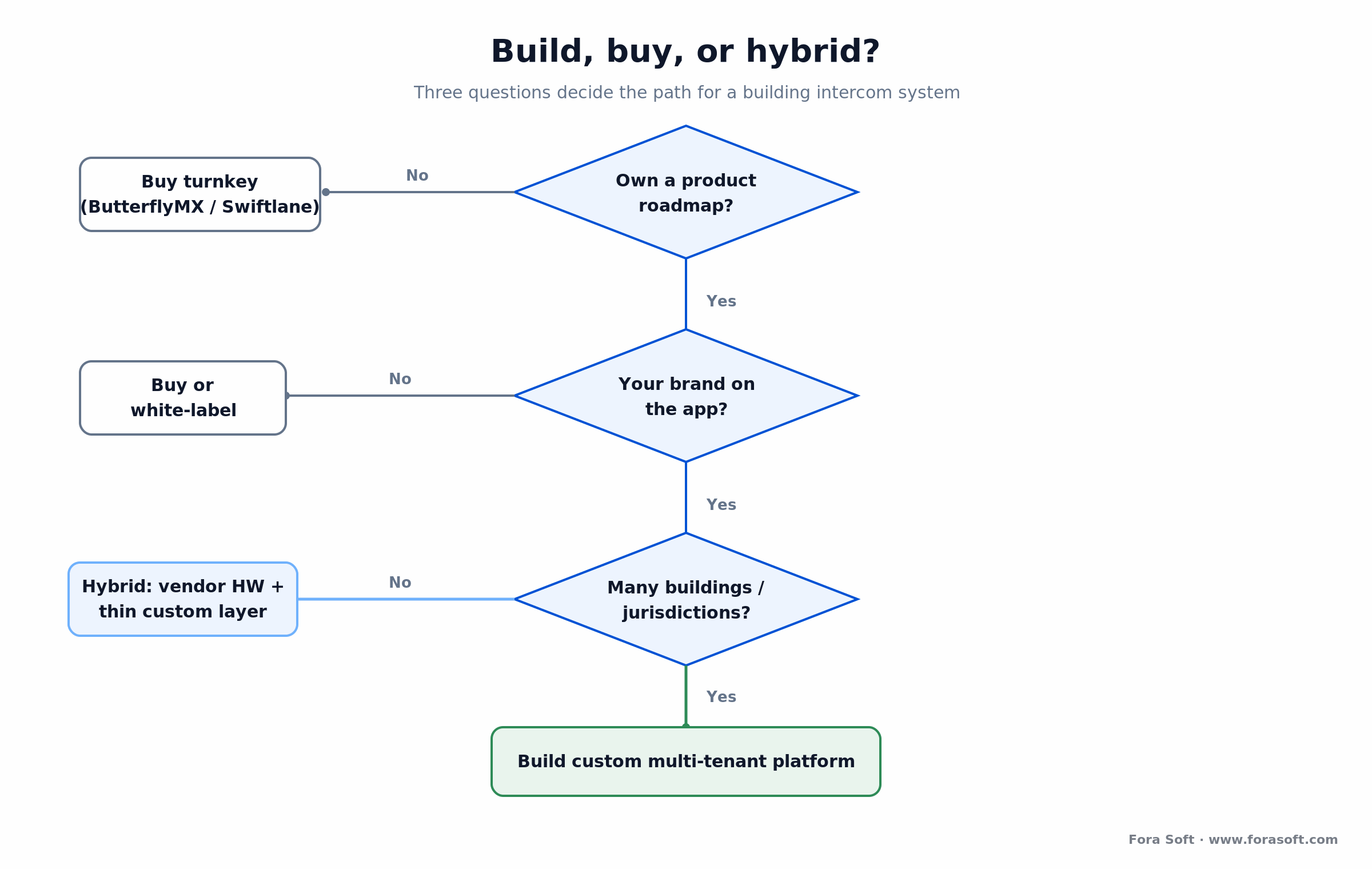
Figure 4. Build, buy, or hybrid, keyed to whether you own a product roadmap, need your own brand, and run a portfolio.
When NOT to build a custom intercom
Honesty sells better than a pitch, so here’s where we’d tell you to skip a custom build. If you manage a single building with no plan to grow, buy a turnkey system like ButterflyMX or Swiftlane and spend the saved budget elsewhere. If your differentiation isn’t the entry experience, don’t sink a year into rebuilding calling plumbing that a vendor already runs at scale.
Custom pays off when the intercom is a feature of a larger proptech product you own, when your brand must be on the resident’s phone, or when you operate across enough buildings and jurisdictions that per-door SaaS fees and vendor lock-in start to hurt. Below that line, buy. Above it, build a thin vendor-agnostic layer and own the relationship.
2026 and 2027 trends worth budgeting around
- Matter reaches the door station. The Connectivity Standards Alliance finalized Matter 1.5 with a dedicated intercom device type on 20 November 2025, and Matter 1.5.1 (March 2026) refined it. The intercom type must carry audio and uses WebRTC transport, so plan for it in new-build MDU. As of mid-2026, only Samsung SmartThings ships the camera profile, so it’s a roadmap item, not a launch dependency.
- Spatial endpoints. Apple Vision Pro and Meta Quest as intercom screens for concierges, security operations centers, and luxury residents.
- Concierge language models. Natural-language flows at the door station, opt-in for residents. Proof-of-concept in 2026, mainstream by 2027.
- On-device models on the station for offline keyword spotting, visitor question-and-answer, and translation.
- Private 5G (CBRS in the US). Replaces PoE runs in new-build MDU, adding $80–150K of capital cost but eliminating trenching.
FAQ
What is a building intercom system in 2026?
A building intercom system lets residents or staff see and speak with a visitor at the entrance and open the door remotely from a mobile app, an indoor station, or a phone. In 2026 the software layer, not the hardware, is where buildings differentiate: mobile calling, access control, AI routing, audit logs, and multi-tenant management.
How much does a building intercom system cost?
Turnkey hardware runs about $1,200–3,000 per door, so a six-unit building is roughly $2,000–6,000 all-in and a large commercial property can exceed $50,000. A custom software platform is a separate budget: $90K–180K for a single-building pilot, up to $1.2M–2.5M for a branded multi-tenant SaaS.
Do we need separate apps for residents and commercial tenants?
Not always. Many of our builds ship one app with a mode toggle based on tenant type, plus a separate guard console for commercial sites. The SIP and access-control code is shared; the UX diverges above it.
How do we make the app survive two years in the App Store?
Three investments: native CallKit and ConnectionService implementations that track iOS and Android release cycles; a mobile telemetry pipeline that surfaces carrier-specific call drops within hours; and a quarterly battery-saver regression pass across Samsung, Xiaomi, and Huawei devices.
Can we use React Native or Flutter for this?
Yes for the app shell, settings, onboarding, and tenant admin. No for the calling plumbing: CallKit, PushKit, ConnectionService, and OEM battery-saver handling are native work either way. Our cross-platform video-app guide covers the framework trade-offs.
What is the deal with BIPA and face recognition?
Illinois’ Biometric Information Privacy Act requires written informed consent before collecting or storing a face or voice print. A 2024 amendment capped damages at one violation per person (about $5,000), and a 2026 appeals ruling made that retroactive, but consent is still mandatory. If you deploy face recognition in an Illinois building, ship a signed consent flow, on-premise template storage, and a clear deletion path. Many operators simply disable the feature there.
Which hardware works best for an apartment building?
For multifamily in 2026, Aiphone IXG (scales to 9,999 devices over SIP), 2N IP Verso 2.0 (modular, full-HD, on-board QR), and Akuvox R-series (strong for 2-wire retrofits) are the safe picks. Choose on SIP support, camera quality, and retrofit wiring, then let your software normalize whichever mix a building already has.
How do we price this to property managers?
Residential software runs $3–8 per unit per month in 2026, with a one-time install fee. Commercial runs $15–40 per endpoint per month plus SSO and enterprise-tier fees. A SaaS with an enterprise API tier on top is a standard multi-tier model.
What to read next
Playbook
Custom Intercom Software: A 2026 Build Guide
The broader parent playbook covering all segments and the shared architecture layer.
Sibling
Industrial Intercom Software for Plants and Warehouses
The plant-floor cousin, with ATEX, PLC and MES specifics.
Mobile
Cross-Platform Video App Development in 2026
Flutter vs React Native vs native for the mobile half of your stack.
Cost
Video Streaming App Development Cost in 2026
A deeper cost model for the video leg of the intercom stack.
Case study
V.A.L.T. — our multi-tenant video platform
770+ US organizations, 50,000+ users: the multi-tenant patterns we reuse.
Not sure whether to build, buy, or go hybrid?
Walk us through your plan. We’ll tell you what’s missing, what’s over-scoped, and what the real build costs, with no pressure to hire us.
Sum up
A building intercom system is one platform serving two UX stacks. Residents want to answer from anywhere, run package flow, and pre-clear guests. Commercial tenants want SSO, a guard console, visitor logs, and lockdown. Underneath sits the shared layer: SIP calling, access control, AI, compliance, and multi-tenant data isolation.
Keep the two budgets straight: $1,200–3,000 per door for turnkey hardware, versus $90K–2.5M for a custom software platform priced by scope. Spend about 20% of build effort on mobile calling, because that’s where launches fail. Treat face and voice biometrics as a distinct compliance class. And let Agent Engineering take 30–40% off the boilerplate while your seniors own the hard parts.
Building with us? Bring your topology and unit count, and pick a 30-minute slot — you’ll leave with a scoped range and a shorter list of surprises. Fora Soft has shipped video and real-time communication software since 2005, across 250+ projects.

