


Key takeaways
• The hardware is solved; the software is the project. An industrial intercom system in 2026 buys its stations off the shelf and spends 60–75% of the budget on the software that routes calls, pages zones, records for audit, and talks to plant systems.
• The noise floor sets the whole spec. Plant floors sit at 85–95+ dBA, at or above the OSHA action level, so DNN noise suppression, high-SPL horns and visual strobes are baseline, not upgrades.
• Hazardous zones need certified stations, not custom hardware. ATEX/IECEx Zone 1 and Zone 2 stations already ship from Zenitel, Commend and Gai-Tronics. You buy the box and build the brains.
• Security is a standard you pass or fail. SIP over TLS 1.3 with SRTP and ISA/IEC 62443 network segmentation is the bar; default passwords and flat networks are the usual audit findings.
• Build vs buy is three-year math. Off-the-shelf wins for a small single site; a custom platform flips ahead once you pass ~200 endpoints or need deep PLC/MES integration.
Most industrial intercom projects fail for the same reason: someone treats a plant-wide communication system like a bigger doorbell. They pick a station, mount it, wire it to a handset, and discover six months later that it cannot page a zone during an evacuation, cannot log who acknowledged an alarm, and cannot survive the day the network blinks. The station was never the hard part. The software above it was.
We’re Fora Soft, and we’ve built real-time communication software since 2005, 250+ projects, a 50-engineer in-house team, and a 100% job-success record on Upwork. This playbook is the honest version of what we tell plant-IT leads who ask whether to buy an industrial intercom system, bridge one, or build it. No vendor pitch, no hand-waving: the ratings that matter, the cost math, the integration work nobody quotes, and the point where custom stops being worth it.
Why Fora Soft wrote this industrial intercom playbook
We build the software layer, not the steel. That distinction is why this guide is useful: we have no hardware SKU to defend, so we can tell you when the right answer is to buy a station and stop.
Our team ships the parts of a communication system that are hard to get right. We built VALT for Intelligent Video Solutions, audit-grade video recording and observation now running across 770+ US organizations and 50,000+ users, HIPAA and GDPR compliant, as their sole development team for over a decade. We built Nucleus, an on-premise communication platform for 5,000+ businesses handling 600M+ AI phone minutes a month under SOC 2 and HIPAA. And we’ve wired SIP door stations to mobile phones over a WebRTC bridge, which is exactly the pattern an industrial deployment needs.
So when we talk about recording for compliance, surviving an outage, or bridging old SIP hardware to a modern app, it’s work we’ve done and supported in production. If you want the same read on your own site, our custom development team does scoping calls that end in an architecture and a number, not a brochure.
Not sure whether to buy, bridge or build?
Book a 30-minute call. We’ll turn your site count, station count and must-have integrations into an architecture, a build-vs-buy number, and a realistic timeline.
What an industrial intercom system is in 2026
An industrial intercom system is a network of hardened audio (and increasingly video) stations spread across a plant or warehouse, tied to a software core that routes point-to-point calls, pages zones, records conversations for audit, and connects to the systems that actually run the site. The stations survive dust, water, vibration and explosive atmospheres. The software is what turns a pile of speakers into a communication system.
That is the part buyers underestimate. A consumer intercom links a door to a phone. An industrial one has to reach a forklift driver in aisle 40, override music to broadcast an evacuation order, ring a rotating shift instead of a fixed desk, drop a timestamped record into a compliance log, and tell the PLC to halt a line when someone hits a call point. None of that lives in the hardware.
The market has caught up to this. Stations from Zenitel, Commend, 2N, Algo and Barix already speak SIP and run on Power over Ethernet, so the differentiation moved up the stack. In 2026 the interesting question is not which station to bolt to the wall, it is what runs behind them.
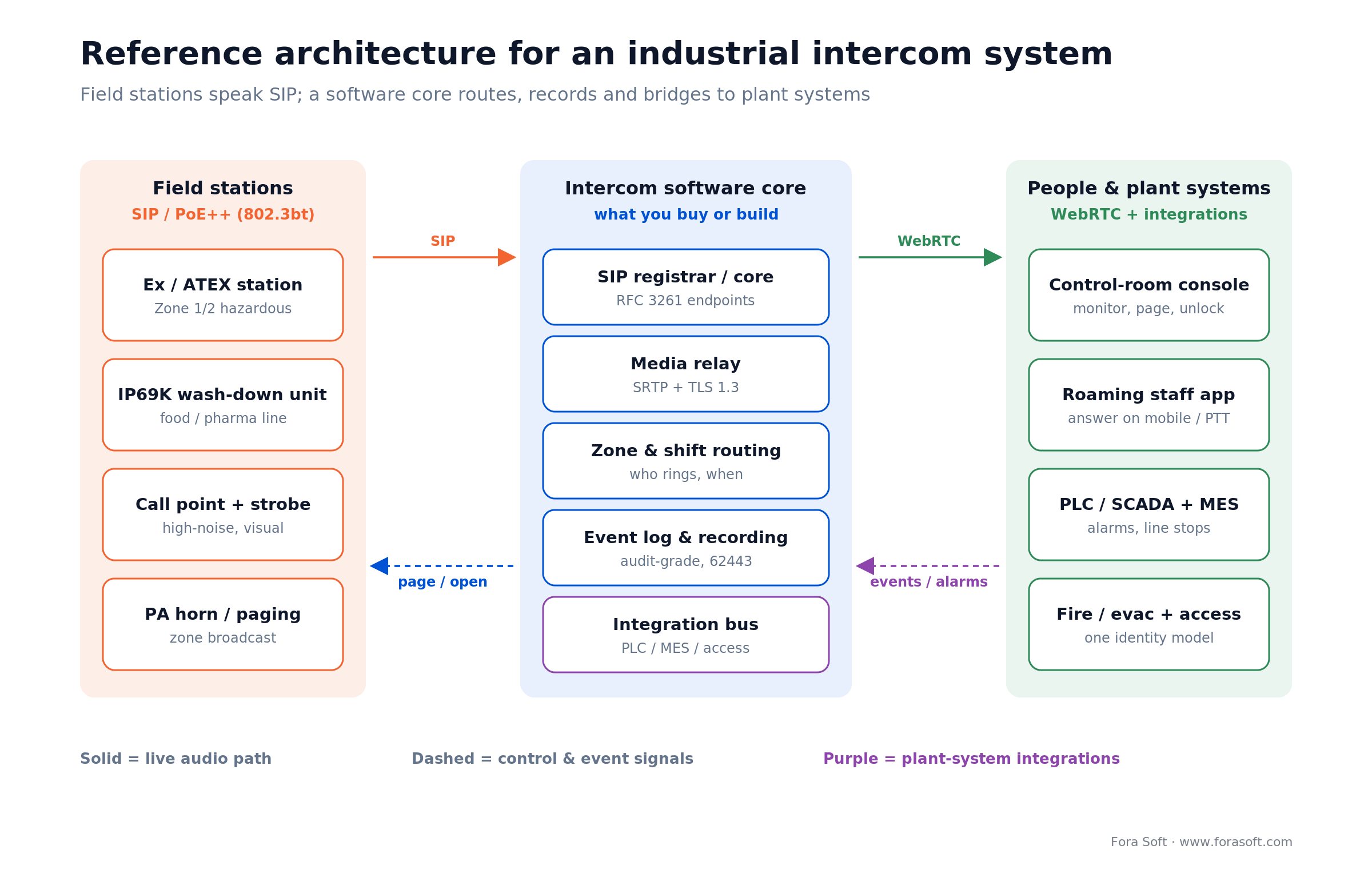
Figure 1. An industrial intercom system in three layers: hardened SIP field stations, the software core you buy or build, and the people and plant systems it connects to.
Hardware: ATEX and IP69K stations for the plant floor
Buy the hardware. Building custom intercom stations is a multi-year certification project with no payoff, because the field problems, dust, water, noise, hazardous gas, are already solved by vendors who do nothing else.
Ingress and impact ratings you will actually be asked for
Station enclosures carry IP ingress ratings. IP66 (defined in IEC 60529) keeps out dust and heavy rain and covers most factory and yard installs. IP69K (defined in ISO 20653) adds close-range, high-pressure, high-temperature wash-down, which is why food and pharmaceutical lines specify it: the station gets hosed down with the equipment. If a line is sanitised daily, IP66 will not survive it, and that single detail changes your station shortlist.
Hazardous areas: certified, not custom
Where flammable gas or dust can be present, stations must be explosion-protected. Under ATEX and IECEx, a Zone 1 area (an explosive atmosphere likely to occur occasionally in normal operation) needs Category 2G equipment at protection level Gb, using methods like Ex d (flameproof) or Ex e (increased safety). Zone 2 (unlikely, and brief if it happens) accepts Category 3G at level Gc. The important part for your budget: certified stations already exist, from Zenitel’s Turbine TFIX and Exigo Ex range to Commend’s EX 7000 series and Gai-Tronics’ (Hubbell) Auteldac Ex telephones. You do not build these. You specify the zone, gas group and temperature class, and buy the matching box.
Power is the other hardware decision. Modern IP stations pull power and data over one cable using PoE, and the higher-draw units, heaters, beacons, high-SPL horns, want PoE++ (IEEE 802.3bt), which delivers up to ~71W at the station. Size the switch and the UPS for that, or the loud stations brown out first, exactly when you need them.
Reach for off-the-shelf Ex stations when: any part of the plant is a classified ATEX/IECEx zone. Certification is the vendor’s problem, not yours, specify the zone, gas group and temperature class, and put the engineering budget into the software instead.
Protocols and ratings in your RFP
The protocol list decides whether your stations are interchangeable or a lock-in trap. Standardise on open protocols and any vendor’s station becomes a line item you can swap; accept a proprietary bus and you have married one supplier for a decade.
Signalling should be SIP (RFC 3261), the same protocol that runs VoIP phones, so every station registers to your core as a standard endpoint. Media should be encrypted with SRTP, keyed over DTLS, riding on TLS 1.3 for signalling. Physical layer is PoE++ (802.3bt) over Cat6. Enclosures carry the IP66/IP69K and, where needed, ATEX/IECEx markings above. Put those in the RFP and score every vendor against them.
| Layer | Specify | Why it is in the RFP |
|---|---|---|
| Signalling | SIP (RFC 3261) | Stations register to your core like any VoIP phone; no proprietary bus |
| Media security | SRTP + DTLS, TLS 1.3 | Audio is encrypted end to end; anything less is an IEC 62443 finding |
| Power/data | PoE++ (IEEE 802.3bt) | One cable powers heaters, horns and beacons; size the switch for ~71W |
| Ingress | IP66 (yard/floor), IP69K (wash-down) | Wrong rating fails the first sanitation cycle on a food line |
| Hazardous area | ATEX/IECEx Zone 1/2, gas group, T-class | Certified stations exist; match the zone, do not build |
Beating the noise floor: OSHA, dBA and paging
Start every industrial intercom design with a sound-level survey, because the noise floor decides everything downstream: station placement, speaker power, whether you page by zone, and whether you need visual signalling at all.
The numbers are unforgiving. OSHA 29 CFR 1910.95 sets a permissible exposure limit of 90 dBA over an 8-hour shift and an action level of 85 dBA that triggers a hearing-conservation program. Every 5 dB above that halves the allowed exposure time. A warehouse aisle runs around 80 dBA; a working plant floor sits near 90; stamping presses and pneumatic tools push past 100. A spoken page has to clear the ambient level by roughly 10–15 dB to stay intelligible, which is why you cannot just turn up a normal speaker.
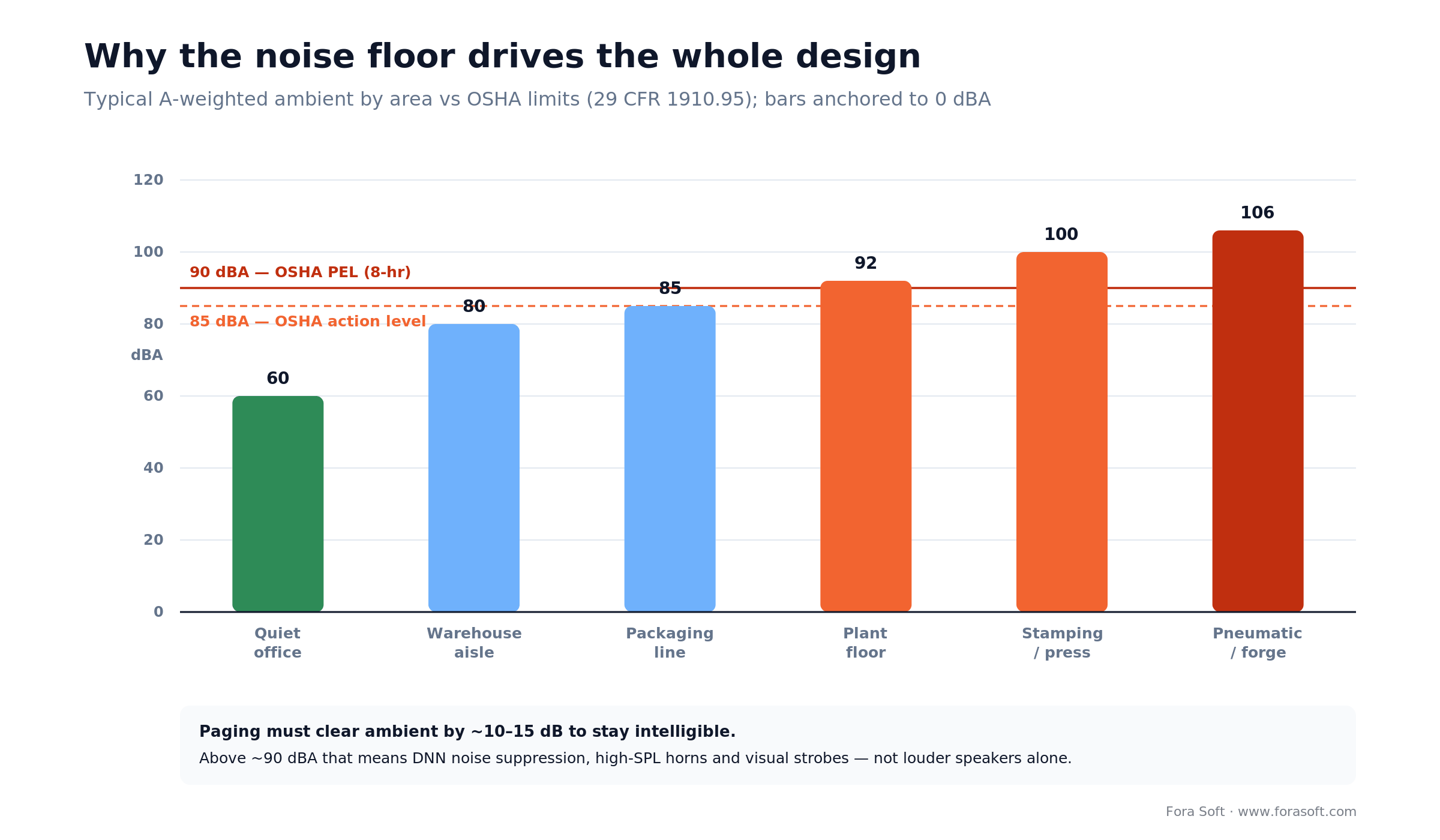
Figure 2. Typical plant-floor ambient against the OSHA limits. Above ~90 dBA, intelligible paging needs noise suppression and visual signalling, not just louder speakers.
So the software has to do three things the hardware cannot. It suppresses the noise the microphone picks up so the far end can understand the talker. It pages by zone, so a message plays where it matters at a power level that clears that area’s floor without deafening the next one. And it fires visual alerts, strobes, screen banners, because above 100 dBA in hearing protection, no audio page is reliable. This is where a custom layer starts paying for itself.
Reach for zoned paging + strobes when: any work area exceeds ~95 dBA or crews wear hearing protection. Audio alone stops being reliable, so the design has to combine targeted high-SPL paging with visual signalling driven from the same event.
What does the intercom have to integrate with?
Integration is where the budget actually goes, realistically 60–75% of a serious build, and it is the work that off-the-shelf systems quietly leave to you. The intercom is only valuable when it is wired into the systems that run the plant.
Five integration targets show up on almost every project. The PLC and SCADA layer lets a call point stop a line or raise an alarm, and lets a machine fault ring the right crew. MES and WMS tie a message to a work order or a pick task, so context travels with the call. Fire and evacuation is life-safety and regulated: the intercom feeds or defers to it, and you do not improvise here. Access control shares one identity model with the intercom, so a badge, a door and a call point agree on who someone is. And an identity provider gives you single sign-on and clean audit trails.
Each of these is a real interface with its own protocol, failure modes and testing. That is the honest reason industrial intercom quotes vary by 5x: two of them count the stations, and one of them counts the integrations.
Reach for a custom integration bus when: you have more than two plant systems to connect (PLC, MES, fire, access, IdP). Point-to-point wiring between every pair does not scale; a single event bus that each system publishes to and subscribes from does.
AI features that earn their keep on a noisy floor
AI is now baseline on a noisy floor, not a differentiator, but only two or three features actually earn their place, and the rest are demo candy. Judge each by whether it works at 95 dBA, because that is the environment.
Deep-neural-network noise suppression is the one that matters. A model trained on machinery, air tools and alarms strips the floor out of the talker’s mic so the far end understands the words, classic spectral gates cannot. Emergency keyword spotting is the second: an always-listening model that flags “help” or “man down” and escalates without anyone pressing a button. Compliance transcription is the third, turning recorded calls into searchable, timestamped text for audits. We build these on the same ground as our AI-for-video-engineering work, and deploy them through our AI integration practice.
Where AI is overhyped: sentiment analysis of shop-floor chatter, “predictive” conversation routing, and voiceprint identification in a 95 dBA room. They demo well and fail in production. Spend the model budget on suppression and keyword spotting, and skip the rest until someone proves it on your floor.
Reach for on-device DNN suppression when: talkers work above ~85 dBA. Cloud round-trips add latency a live page cannot afford, and the model has to run even if the uplink drops, so the inference belongs at the edge, on the station or a local node.
Security and compliance you cannot skip
Treat intercom security as a standard you pass, not a feature you add. In an industrial network the reference is ISA/IEC 62443, which expects segmentation, authenticated access and encrypted communication across the control system, and an intercom that ignores it becomes the soft entry point auditors look for.
The controls are specific. Encrypt signalling with TLS 1.3 and media with SRTP, so a tap on the network yields noise. Put the intercom on its own segment with controlled routes to plant systems, never flat on the OT LAN. Force credential rotation and disable default passwords, which are still the single most common finding. Keep firmware patched and signed. Most intercom breaches are not broken cryptography; they are a default admin login on an unpatched station reachable from the office network. Our secure intercom systems guide goes deeper on the threat model.
Reach for network segmentation first when: the intercom touches any OT system. A dedicated VLAN with an audited gateway to PLC/SCADA contains a compromised station; a flat network lets one cheap door unit become a path to the line controllers.
Three architecture patterns that pass an audit
Three deployment patterns pass an audit, and the right one is set by a single question: what has to keep working when the network drops? Cloud is simplest to run, on-premise survives isolation, and hybrid tries to get both.
| Criterion | Cloud | On-premise | Hybrid |
|---|---|---|---|
| Survives WAN outage | No | Yes | Yes (local core) |
| Ops burden | Lowest | Highest | Medium |
| Data ownership / air-gap | Limited | Full | Full at the edge |
| Multi-site management | Native | Per-site effort | Central + local |
| Best fit | Small, connected sites | Regulated / isolated plants | Multi-site with local safety |
For most multi-site manufacturers the answer is hybrid: a local core at each plant keeps door release, paging and call points alive during an outage, while a cloud plane handles configuration, reporting and cross-site management. Life-safety paths stay local by design. Pure cloud is fine for a small, well-connected site; pure on-premise is right for a regulated or air-gapped plant that cannot depend on anything off the property.
The custom software layers we build on top
When buying stops being enough, this is the software we build on top of the SIP stations, the layers that turn hardware into an industrial intercom system a plant actually runs on.
Zone and shift routing. A call point rings the crew on duty now, not a fixed desk, following the shift calendar and escalating if no one answers. Off-the-shelf systems ring a static list; a plant runs on rotations.
Control-room console and mobile app. One screen to monitor stations, page a zone, take a call and release a door; a push-to-talk mobile app so roaming supervisors answer from anywhere on site. This is the daily interface, and generic vendor apps are where deployments stall.
Audit-grade event log and recording. Every call, page and door release timestamped, recorded and searchable, the record an incident review or a regulator asks for. It is the same discipline we apply to video and audio recording on VALT.
Integration bus and reporting. The single spine that carries events between the intercom and PLC, MES, fire and access, plus the dashboards that turn those events into response-time and uptime numbers management will ask for.
What does an industrial intercom system cost in 2026?
Here is the honest cost shape for an industrial intercom system in 2026, split the way projects actually get quoted: hardware per station, one-time software or build, and three-year run cost. Numbers are conservative and meant for sizing, not a fixed quote.
Hardware runs roughly $600–$1,800 per standard IP station and $2,500–$6,000+ for an ATEX/IP69K station, plus $300–$1,200 install per point for cabling and mounting. That part is similar whichever software path you take. The software is where the paths diverge.
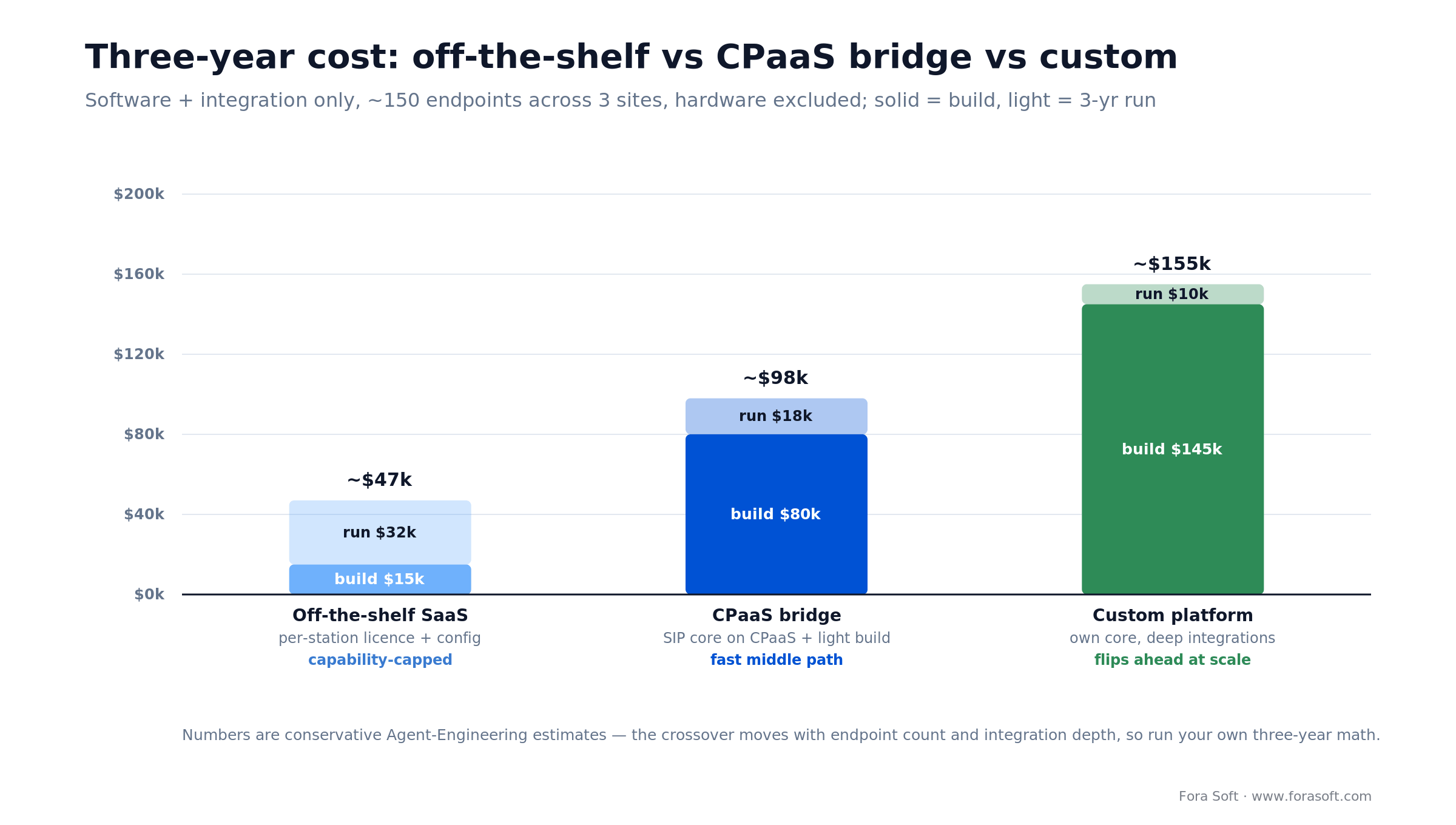
Figure 3. Three-year software-and-integration cost for ~150 endpoints across three sites. Off-the-shelf is cheapest upfront; custom flips ahead as endpoints and integration depth grow.
Take a worked example: 150 endpoints across three sites, software and integration only. Off-the-shelf SaaS at about $5–$8 per station per month is roughly $15k to configure plus ~$32k over three years, near $47k, but capped at the vendor’s feature set. A CPaaS bridge (a SIP core on a communications platform plus a light custom layer) is about $80k to build plus ~$18k of usage, near $98k. A full custom platform is about $145k to build plus ~$10k of hosting over three years, near $155k.
At 150 endpoints, off-the-shelf is the cheapest and custom is the most expensive, and that is the honest answer. On price alone, per-station licensing only overtakes a flat custom platform at high station counts, well past a few hundred endpoints. What justifies custom earlier is capability: deep PLC/MES ties, your own app, data ownership, or outage survival that a packaged system cannot give you. Run your own three-year math against your real endpoint count before anyone quotes you a platform.
Want the three-year number for your plant?
Send us your site count, station count and the systems you need connected. We’ll come back with a buy-vs-bridge-vs-build comparison and a cost range you can budget against.
Build vs buy vs bridge
Three paths, and the choice is not about ambition, it is about integration depth, survivability and unit economics. Buy off-the-shelf, bridge with CPaaS, or build custom.
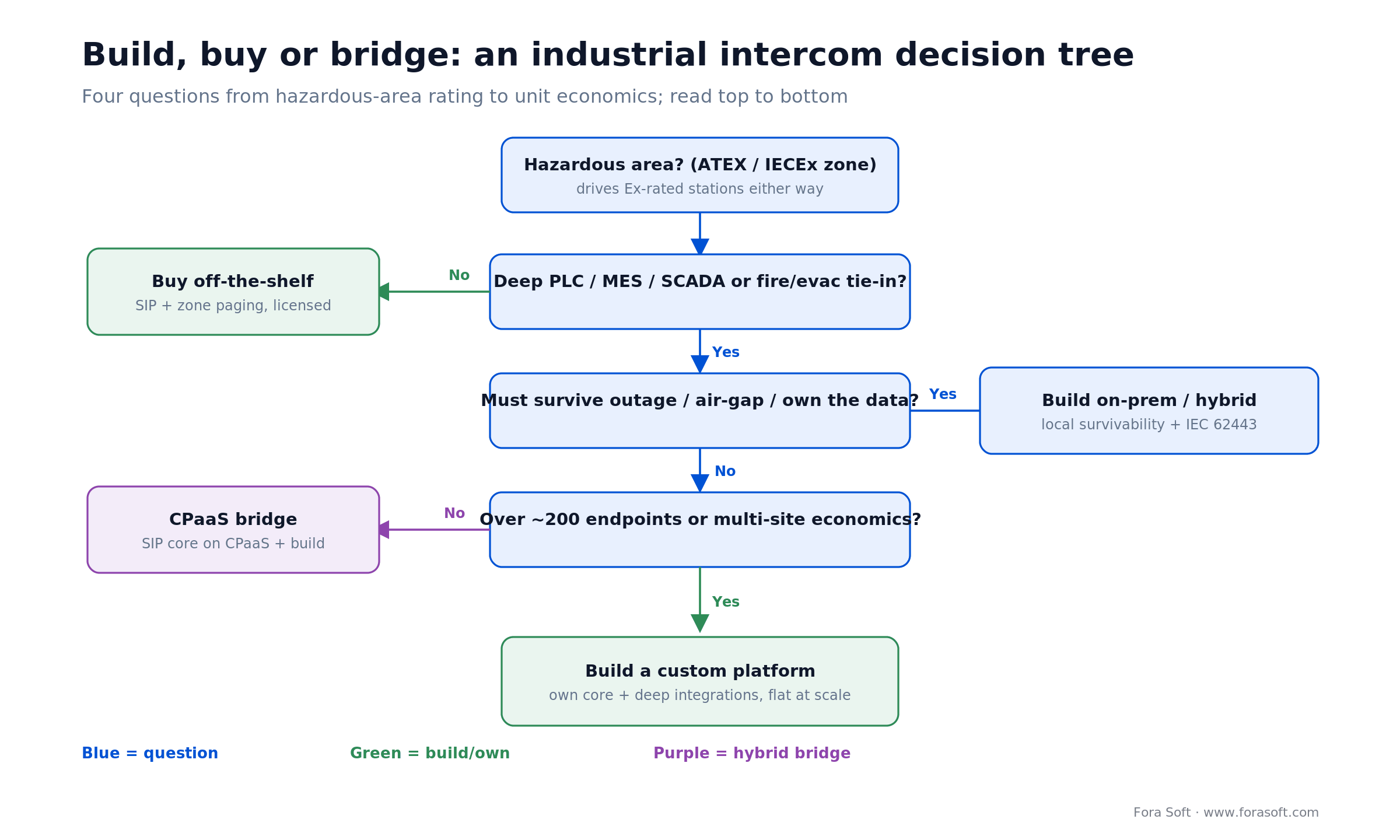
Figure 4. The build-vs-buy-vs-bridge decision as four questions, from hazardous-area rating down to endpoint count and unit economics.
Reach for off-the-shelf when: one site, standard needs, light integration. A packaged SIP-plus-paging system with per-station licensing is the fastest path and you should not out-engineer it.
Reach for a CPaaS bridge when: you already own SIP stations and need your own app or a couple of integrations, but not a full platform. A SIP core on a communications platform plus a thin custom layer is the fast middle path.
Reach for a custom platform when: you have deep PLC/MES/fire integration, need local outage survival or data ownership, or run enough endpoints that per-station licensing wrecks your unit economics. That is the point where building pays for itself.
Mini-case: a SIP intercom-to-mobile bridge
A concrete version of the bridge path: we were asked to connect existing SIP door and gate stations to the people who actually move around a site, without ripping out the hardware or marrying a single vendor.
The plan was a SIP-to-WebRTC bridge. We stood up a core that treats every station as a standard SIP endpoint, then bridged its audio and video to a mobile app over WebRTC using LiveKit’s SIP integration, so a call from any station rings a phone in someone’s pocket. Remote door release runs over DTMF straight from the app, and because the bridge speaks plain SIP, it works with any compliant station, no lock-in to one manufacturer.
The result is the template an industrial retrofit wants: keep the certified field hardware, add a modern software layer, and reach roaming staff on the device they already carry. It is the same architecture in the diagram above, hardened for the plant floor. Want a similar assessment of your own stations? Book a scoping call and we’ll map it in 30 minutes.
A decision framework in five questions
Five questions get you to the right architecture faster than any feature list. Answer them in order.
1. What is the noise floor, by area? If any work zone exceeds ~95 dBA or crews wear hearing protection, budget for DNN suppression, high-SPL zoned paging and visual strobes from day one. This drives more of the design than any other answer.
2. Are any areas classified hazardous? ATEX/IECEx zones force certified Ex stations. That is a hardware line item, not a software one, but it also rules out cheap consumer gear entirely.
3. What must keep working during a network outage? If door release, call points or evacuation paging must survive isolation, you need a local core, on-premise or hybrid, never pure cloud.
4. How many plant systems must it touch? Zero or one integration favours buying; three or more (PLC, MES, fire, access) favours a custom integration bus, because point-to-point wiring stops scaling fast.
5. How many endpoints, across how many sites? A single site with standard needs favours buying. Multiple sites, deep integration, or station counts high enough that per-station fees compound over three years tip the economics toward custom. If you are near the line, have us run the three-year math before you sign a per-station contract.
Five pitfalls we clean up on rescue projects
Five failures we see on nearly every rescue project. None is exotic; all are avoidable.
1. Treating evacuation as a feature. Life-safety paging is regulated and must not be an afterthought bolted to a general intercom. Design it as its own path that the intercom feeds or defers to, and get it signed off early.
2. Default passwords and a flat network. The most common breach path is an unpatched station with a factory login, reachable from the office LAN. Segment the intercom and rotate credentials before go-live, not after the audit.
3. Wireless in an RF-hostile plant. Metal racking, motors and thick walls murder Wi-Fi and unlicensed radio. Wired PoE stations are the reliable default on a plant floor; treat wireless as the exception you prove, not the assumption you start with.
4. Ignoring the noise survey. Speccing station power and placement without measuring dBA by area guarantees pages nobody can hear. Measure first; it is a day of work that saves a re-install.
5. Per-station licensing at scale. A per-door monthly fee looks cheap at 20 stations and ruinous at 300. Model the three-year cost at your real endpoint count before you commit, because that is where buy quietly loses to build.
KPIs your plant-IT lead should watch
After launch, three buckets of numbers tell you whether the system is working. Instrument them from the start; retrofitting metrics is painful.
Reliability KPIs. Station uptime (target 99.9%+), call setup success rate, mean time to recover after a network blip, and the percentage of pages delivered during a simulated outage. These prove the survivability you paid for.
Safety and compliance KPIs. Emergency-call acknowledgement time, evacuation-page coverage (share of zones confirmed audible/visible), and completeness of the audit log. If a regulator asks who acknowledged an alarm and when, the answer must be one query away.
Business KPIs. Response time from call point to crew arrival, downtime minutes saved by faster fault-to-crew paging, and integration reliability with PLC/MES. These are the numbers that justify the next site’s budget.
When not to build a custom system
Do not build a custom industrial intercom system if the honest answer to the framework is “small and standard.” A single site, a few dozen stations, no hazardous zones, and one or zero plant integrations is a buy, not a build. A packaged SIP-plus-paging system will be live in weeks and cheaper for years, and out-engineering it wastes money.
Skip custom, too, when you have no team to own it. A platform needs maintenance, patching and support; if you cannot staff that or contract it, a vendor’s managed system is the safer call. And if life-safety is the only requirement, buy a certified fire and evacuation system directly rather than stretching an intercom to do a regulated job. Honesty here is why clients trust the rest of the guide, and when the answer does point at building, our team is ready.
Frequently asked questions
What is an industrial intercom system?
It is a network of hardened audio or video stations across a plant or warehouse, tied to a software core that routes calls, pages zones, records for audit and connects to plant systems like PLC, MES, fire and access control. The stations survive the environment; the software makes it a communication system.
Wired or wireless industrial intercom, which is better?
Wired PoE stations are the reliable default on a plant floor, because metal, motors and thick walls degrade wireless badly. Wireless suits temporary sites, yards or areas where cabling is impractical, but treat it as the exception you test and prove, not the starting assumption.
How much does an industrial intercom system cost in 2026?
Budget roughly $600–$1,800 per standard IP station and $2,500–$6,000+ per ATEX/IP69K station, plus $300–$1,200 install per point. Software ranges from ~$5–$8 per station per month off the shelf to an ~$80k CPaaS bridge or a ~$145k custom platform. Integration, not stations, drives most of the variance.
What makes an intercom explosion-proof for hazardous areas?
Explosion protection is certified under ATEX and IECEx by zone. A Zone 1 area needs Category 2G equipment at protection level Gb (methods like Ex d flameproof or Ex e increased safety); Zone 2 accepts Category 3G at Gc. Certified stations already ship from Zenitel, Commend and Gai-Tronics, you specify the zone and buy the matching unit.
Can an industrial intercom integrate with our PLC and SCADA?
Yes, and it should. A call point can stop a line or raise an alarm, and a machine fault can ring the right crew. This is custom integration work with its own protocols and testing, and it is where most of the project budget goes, typically 60–75% of effort across PLC, MES, fire and access.
How do you make paging audible over machinery noise?
You clear the ambient level by 10–15 dB with zoned, high-SPL paging, suppress mic-side noise with a DNN model so the talker is intelligible, and add visual strobes or screen banners where the floor exceeds ~100 dBA or crews wear hearing protection. Louder speakers alone do not solve it.
Should we buy an off-the-shelf system or build a custom one?
Buy for a small single site with standard needs and light integration. Build when you need deep PLC/MES integration, local survival through outages, data ownership, or enough endpoints and sites that per-station fees compound over three years. On price alone the crossover sits at high station counts; capability and multi-site economics usually justify custom before that. A CPaaS bridge is the middle path if you already own SIP stations.
Is a modern industrial intercom system secure?
It can be, if built to ISA/IEC 62443: TLS 1.3 signalling, SRTP media, its own network segment, rotated credentials and signed firmware. Most breaches are not broken encryption, they are default passwords on unpatched stations sitting on a flat network reachable from the office side.
What to read next
Build
Custom Intercom Software: A CTO Playbook
When and how to build an intercom platform end to end.
Security
Secure Intercom Systems: 2026 Playbook
Encryption, credentials and firmware, locking the system down.
Architecture
IoT Intercom Systems: Vendors & Costs
Connected-station architecture, vendor options and cost detail.
AI
Smart Intercom Systems: AI & Software
How noise-aware AI and IoT reshape intercom software in 2026.
Analytics
Data Analytics in Smart Intercoms
The KPIs, architecture and compliance behind intercom data.
Ready to build your industrial intercom system?
An industrial intercom system is a software project wearing hardware’s clothes. Buy the certified stations (ATEX, IP69K, PoE++, SIP) and put the engineering where it counts: zoned paging that beats the noise floor, DNN suppression and strobes, an audit-grade log, and integrations into PLC, MES, fire and access.
The judgment calls are the ones we walked through. Cloud loses to on-premise the moment the floor must survive an outage. Off-the-shelf loses to custom once you need deep integration, data ownership, or better unit economics past a few hundred endpoints. Run the five questions, do the three-year math, and decide with numbers rather than a brochure.
When the answer points at building or bridging (the core, the app, the integrations, the compliance), that is exactly the work we do, and have done in production for two decades.
Ready to build your industrial intercom system?
Book a 30-minute scoping call. We’ll turn your plant layout, station count and integration list into an architecture, a buy-vs-build number, and a timeline you can plan around.

