

Key takeaways
• A nurse call system is a patient-safety lever, not a comfort item. Communication failures show up in about 30% of malpractice claims: 1,744 deaths and $1.7 billion over five years (CRICO Strategies). The call layer is where most of those handoffs happen.
• The 2026 baseline is IP, not analog. IP nurse call + smartphone app + EHR (Epic, Oracle Health) + RTLS is what “good” looks like now; analog or RF-only is technical debt on day one.
• Compliance is designed in, not bolted on. UL 1069 Ed. 8 (90 dB ±3, ~15 min battery), NFPA 99/70, and HIPAA AES-256 are table stakes, and the proposed 2025 HIPAA Security Rule would make encryption and MFA mandatory.
• Buy vs build is a scale question. Below ~300 beds, TekTone, Rauland, or Ascom usually win on cost and speed. Above ~300–500 beds, or with non-standard workflows, a custom build beats per-bed licensing inside five years.
• Alarm fatigue, not hardware, is the real risk. 85–99% of hospital alarm signals need no clinical action (Joint Commission). Intelligent escalation, not another buzzer, is what keeps alerts credible.
Why Fora Soft wrote this playbook
Fora Soft has built HIPAA-grade communication products since 2005 — 250+ projects, 50 in-house engineers — including CirrusMED (telehealth for ~1,500 patients across 40+ U.S. states), Cloud Doctors (national telehealth in Brazil), MyOnCallDoc (thousands of daily on-demand consults), and Video Interpretations for hospitals and law enforcement. Across those builds we have wired up Epic, Cerner/Oracle Health, Athena, FHIR R4, HL7v2, and a long list of legacy DICOM and lab systems. We know where healthcare integrations actually break.
A nurse call system sits at the same intersection as our on-premise, SOC II / HIPAA comms work on Nucleus and our real-time stack for TransLinguist. This playbook distills what those builds taught us, plus the published patient-safety, alarm-fatigue, and UL 1069 research, into a decision framework you can act on this quarter — whether you end up buying off the shelf or building. If you want that conversation now, our healthcare lead runs a 30-minute scoping call.
Planning a nurse call system build or replacement?
We’ll scope your facility, EHR, and compliance bar in 30 minutes — no pitch deck, just the next concrete steps.
Why a nurse call system is a patient-safety lever, not a comfort item
It is tempting to file the nurse call layer next to lighting and HVAC: quietly important, rarely strategic. The published numbers say otherwise.
CRICO Strategies analyzed 23,000+ malpractice cases (2009–2013) and found communication failures contributed to roughly 30% of claims — linked to 1,744 deaths and $1.7 billion in costs. The Joint Commission puts about 80% of serious medical errors on miscommunication during patient handoffs. The nurse call system is the substrate where most of those handoffs and emergency calls actually happen.
Get it right and you compress code-blue response, lift the HCAHPS “Responsiveness of Hospital Staff” score (a CMS payment input), and cut malpractice exposure. Get it wrong and you import alarm fatigue, dropped calls, and EHR integration debt that takes 18 months to dig out of. Here’s the catch: the hardware is rarely the problem. The routing logic, the escalation rules, and the EHR context are.
Reach for an IP nurse call upgrade when: response times trend above 4 minutes, your handoff-error rate is unmeasured, or your current vendor cannot push call events into Epic or Oracle Health without a five-figure custom adapter.
The 2026 market in one snapshot
The nurse call systems market sits at roughly $2.5–2.7 billion in 2026, growing ~9.9% a year toward ~$4 billion by 2029–2031 (MarketsandMarkets, Mordor Intelligence). The growth is not new construction. It is IP migration, smartphone integration, and EHR-aware escalation in existing facilities. If your hospital still runs analog or RF-only nurse call, you are in a shrinking minority that vendors will push off support windows within three to five years.
The vendor map is consolidating fast. Stryker bought Vocera (2022); Baxter absorbed Hillrom and its Voalte nurse call line (2021). Rauland (AMETEK), Ascom, and TekTone increasingly integrate with each other rather than compete head-to-head. Good news for buyers: interoperability is now table stakes. Bad news if you locked into one ecosystem before the integration era.
Six benefits that move the patient-safety needle
We keep this list short on purpose. Anything you cannot tie to a metric your CFO and CNO already track is fluff. Each benefit below maps to a number.
1. Faster response to call lights and code blue
A modern IP nurse call system plus a smartphone app and RTLS routes each call to the nearest available nurse, not the rotation default, and auto-clears the call when a badge enters the room. RTLS integrators (Midmark, Securitas Healthcare, Sonitor) report real response-time and documentation gains; few publish audited before/after minutes, so treat vendor case numbers as directional and measure your own baseline first.
2. Lower handoff and miscommunication risk
When calls, escalations, and acknowledgments are logged in a structured stream that syncs with the EHR, the “I assumed you saw it” class of error shrinks. That matters because handoff miscommunication is behind roughly 80% of serious medical errors (Joint Commission) — and a nurse call system with a tamper-evident audit trail is where you close that gap.
3. Quantifiable alarm-fatigue reduction
In ICUs, nurses field on the order of 1,000 alarms a shift, and 85–99% of alarm signals need no clinical action (Joint Commission Sentinel Event Alert #50). Intelligent escalation — suppress duplicates, raise priority on physiological context, route only to the assigned nurse. That is the single biggest lever between credible alerts and ignored noise. Figure 4 shows the logic.
4. HCAHPS and reimbursement gains
CMS withholds 2% of base operating DRG payments and redistributes it through the Hospital Value-Based Purchasing program; the patient-experience domain — which includes “Responsiveness of Hospital Staff” — is 25% of a hospital’s Total Performance Score for FY2026. Drop average response below 3 minutes and missed-call rate below 1%, and that dimension is where the movement shows up.
5. Hands-free operation in sterile environments
Voice-activated calling and badge-based hands-free systems remove the physical button-press from ORs, ICU isolation rooms, and dementia-care units. Vocera (now Stryker) and Ascom lead here; custom builds typically piggy-back on a Whisper-class speech model plus a small local wake-word model on a sub-$250 patient station.
6. Operational data the unit manager can actually use
Historical call patterns expose understaffed shifts, single-nurse hot spots, and rooms where a patient calls a dozen times a shift without a meaningful answer. That data is the lever for staffing arguments, and it is impossible to produce on a 1990s analog system.
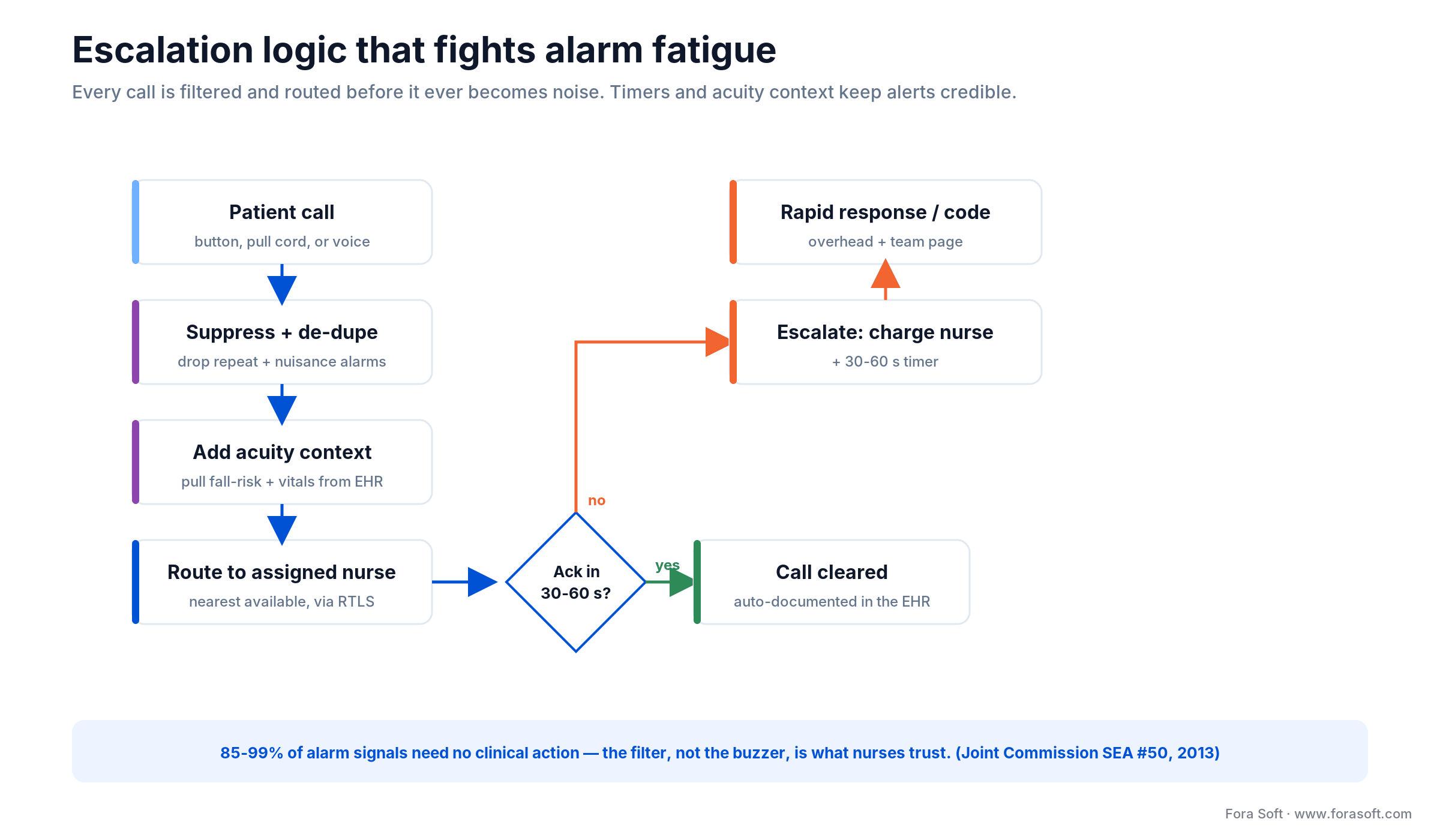
Figure 4. How a nurse call system filters and escalates a call so alerts stay credible instead of becoming alarm-fatigue noise.
Reach for benefit-driven justification when: your CFO needs a payback story. Tie each capability to one KPI (response time, HCAHPS responsiveness, missed-call rate) and one dollar number (avoided agency-nurse hours, HCAHPS reimbursement delta, malpractice premium).
The 2026 baseline feature set — what good looks like
A nurse call system in 2026 should clear all of the following. If a vendor demo skips three or more of these, walk.
Connectivity and core call flow
- IP-based call delivery over a QoS-protected VLAN, never shared with imaging or guest Wi-Fi.
- Patient stations with tactile call confirmation (UL 1069 mandatory).
- Two-way talk-back so staff can triage before walking the room.
- Wireless / mesh coverage validated by a site survey (ORs, basements, lead-lined suites).
- 90 dB ±3 audible alarm plus a visual indicator at each nurse console.
- Battery / UPS backup of at least 30 minutes for network and console equipment.
Mobility and staff workflow
- iOS / Android app with caller ID, room number, and one-tap accept or escalate.
- Hands-free wearable badge support (Vocera, or a custom BLE badge).
- RTLS integration so calls route to the nearest available nurse and auto-clear on arrival.
- Staff-assignment sync with the shift schedule and on-call rotation.
- Configurable escalation: no acknowledgment in N seconds → escalate to charge nurse.
Clinical integration
- Epic (Care Everywhere plus its FHIR R4 / HL7 interfaces) and Oracle Health / Cerner (Ignite + FHIR R4) bi-directional sync.
- Patient-monitor and bedside-device feeds so vitals contextualize alarm priority.
- Building-management hooks for code-blue door release, OR routing, and lighting.
- Dual-purpose patient station: nurse call plus TV / entertainment control where appropriate.
Compliance and security
- UL 1069 Ed. 8–2024 certification, NRTL-tested.
- NFPA 99 and NFPA 70 conformance for installation.
- AES-256 encryption in transit and at rest for any voice or call-log data carrying PHI.
- Role-based access control and MFA on every admin surface.
- Tamper-evident audit log of every call, acknowledgment, escalation, and admin action.
- A signed Business Associate Agreement with the vendor — no exceptions.
Nurse call systems compared
A directional comparison of the systems we see most in RFPs. Per-bed pricing is order-of-magnitude (hardware + software, before installation), drawn from public sources and procurement disclosures — a sanity check, not a quote. Figure 3 is the quick-scan version; the table has the detail.
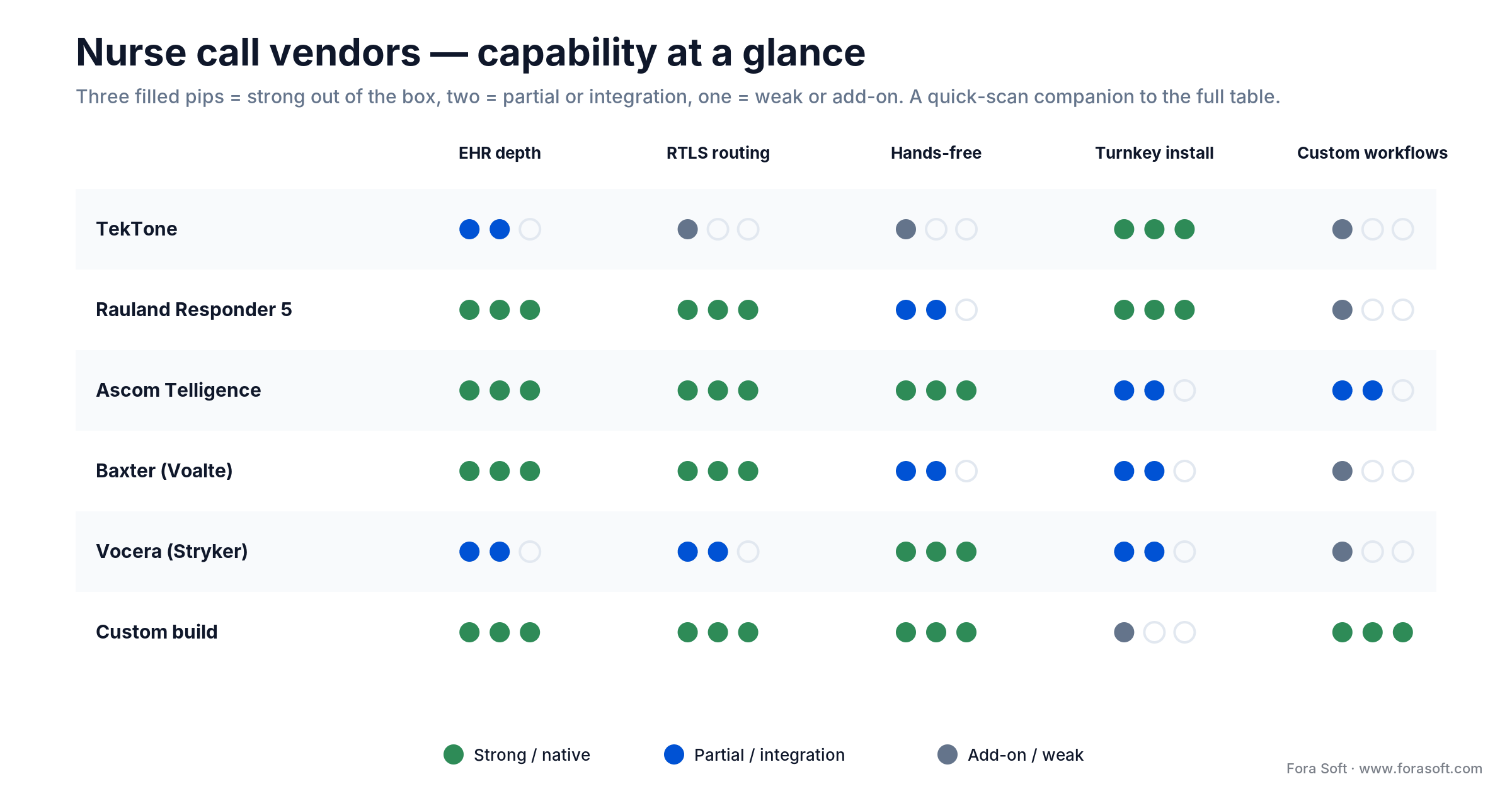
Figure 3. Capability at a glance across TekTone, Rauland, Ascom, Baxter (Voalte), Vocera (Stryker), and a custom build.
| System | Best for | EHR depth | RTLS | ~Per-bed cost | Limit |
|---|---|---|---|---|---|
| Rauland Responder 5 (AMETEK) | Large acute care, 300+ beds | Open APIs, Epic/Cerner certified | Native | $2,500–$5,000 | High licensing & lock-in |
| Baxter Voalte (ex-Hillrom) | Bed-centric med-surg workflows | Strong, tight smart-bed integration | Native | $2,500–$4,500 | Best ROI if you already run Baxter beds |
| Ascom Telligence | Modular, EU-strong, multi-site | 150+ integrations, FDA-registered | Native | $2,000–$4,000 | Configuration-heavy |
| Vocera (Stryker) | Hands-free badge workflows | 150+ integrations | Optional | $1,800–$3,500 | Pairs with Rauland/Baxter; not a full nurse call |
| TekTone | Mid-market, assisted living | Basic HL7; limited acute | Add-on | $500–$2,000 | Acute-care EHR escalation is weak |
| Custom build (Fora Soft) | 300+ beds, specialty units, lock-in escape | Whatever you spec — FHIR/HL7/Epic/Oracle | Whatever you spec | Capex-amortized; no per-bed fees | Higher upfront, longer time-to-pilot |
Reach for Rauland or Baxter when: you are 300–800 beds, already standardized on Epic, and want a vendor-supported install with predictable timelines and a long warranty — not an R&D project.
Reach for Ascom Telligence when: you run multi-site internationally, need 100+ device integrations out of the box, and value modular FDA-registered components over a single-vendor walled garden.
Reach for a custom build when: you are a 1,000+ bed system, run specialty units (psych, pediatric, trauma) with non-standard escalation, or are escaping a vendor that quotes five to six figures per integration request.
Reference architecture for a 2026 nurse call system
Below is the architecture we use as a starting point on custom builds. It is deliberately conservative: well-known components, well-understood failure modes, no exotic protocols. Four layers, one compliance spine.
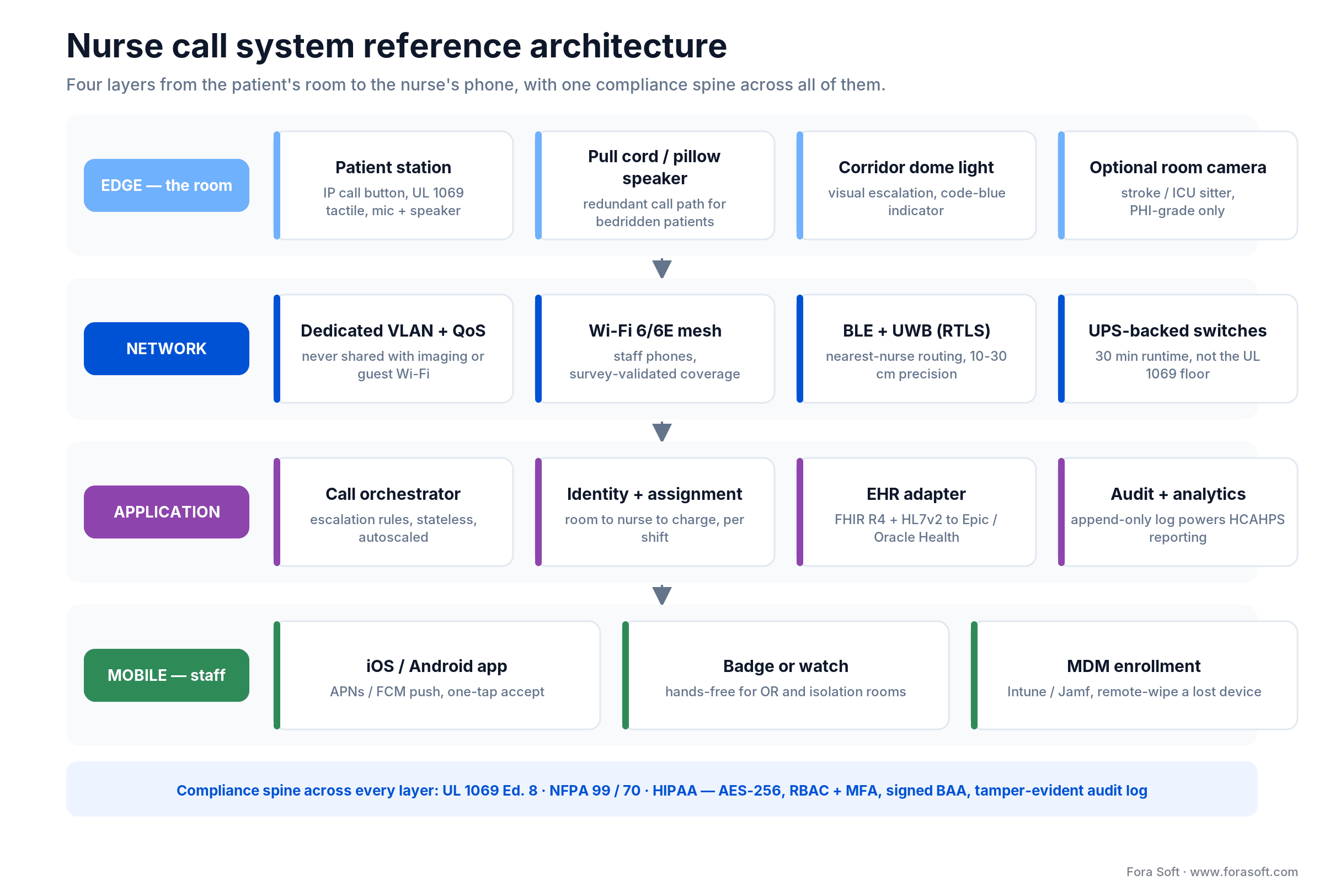
Figure 1. The four layers of a custom nurse call system, from the patient’s room to the nurse’s phone, with compliance across all of them.
Edge layer (the room)
- Patient station. PoE-powered IP device with a UL 1069 tactile call button, microphone, speaker, optional touchscreen.
- Pull cord / pillow speaker. A redundant call path; bedridden patients should not have to reach the wall.
- Corridor dome light + door card. Visual escalation, mandatory for code situations.
- Optional room camera. Stroke care and ICU sitter use cases — PHI-grade encryption only.
Network layer
- Dedicated VLAN with QoS for nurse call traffic; never shared with imaging or guest Wi-Fi.
- Wi-Fi 6/6E mesh for staff phones, plus a parallel BLE / UWB network for badges and RTLS.
- UPS-backed switches and APs with at least 30 minutes runtime — the UL 1069 floor is shorter, but real outages are not.
Application layer
- Call orchestrator. Receives every call, applies escalation rules, dispatches to phones, badges, and consoles. Stateless, horizontally scalable on Kubernetes or ECS.
- Identity & assignment service. Maps room → nurse → on-call → charge nurse, refreshed every shift change.
- EHR adapter. Bi-directional FHIR R4 + HL7v2 to Epic / Oracle Health / Meditech. Pulls acuity, allergies, and fall-risk; pushes call events back as observations.
- Audit & analytics store. Append-only log of every call, ack, escalation, and override — the source for HCAHPS reporting and incident review.
Mobile layer
- iOS / Android nurse app. Push via APNs/FCM for low latency, with an in-app polling fallback.
- Wearable badge or watch companion for hands-free environments.
- MDM enrollment (Intune, Jamf) so a lost device can be remote-wiped in minutes — a standing OCR audit topic.
Want this architecture sized for your facility?
Send your bed count, current EHR, and existing vendor. We’ll return a one-page reference architecture and a build-vs-buy break-even within 48 hours.
HIPAA, UL 1069, and the compliance map you cannot skip
A nurse call system touches three regulatory regimes. None are optional, and each has cost a hospital the equivalent of an enterprise licence in fines or remediation in the past 24 months.
UL 1069 Ed. 8–2024 — the safety floor
UL 1069 is the safety standard for hospital signaling and nurse call equipment. The 8th edition (published February 2024) tightens audible-alarm performance (90 dB ±3 measured at the console over 300–3000 Hz), immediate tactile feedback on the call button, and battery backup (the industry settles around a 15-minute practical floor). Certification requires evaluation by a Nationally Recognized Testing Laboratory. Retrofitting a UL 1069 audit onto an already-shipped product is months of rework — plan for it from the first sprint.
NFPA 99 and NFPA 70 — the facility codes
NFPA 99 (Health Care Facilities Code) covers system design, installation, and inspection; NFPA 70 (National Electrical Code) covers wiring and power. Both are usually the contractor’s problem — but if your software vendor cannot produce documentation that matches NFPA labelling and zoning, the authority having jurisdiction can hold up the certificate of occupancy.
HIPAA & HITECH — and what is changing in 2026
Voice traffic that carries a patient name, room number, or condition is PHI. That means AES-256 in transit and at rest, RBAC + MFA on the console, an audit log of who heard what, and a signed BAA with any cloud component. HITECH penalties are tiered and scale into the millions per violation category per year. The bigger 2026 signal: the proposed HIPAA Security Rule overhaul (published January 2025, not yet final) would make encryption and MFA mandatory rather than “addressable,” and add network segmentation and annual vendor certification. Build to that bar now and you skip a re-platform later.
FCC and state consent law — if you record
Many hospitals record codes and incidents for after-action review, which triggers state wiretap law — some states are one-party consent, others (California, Florida, and more) are all-party. Build call recording so it is opt-in by unit and policy-driven, never always-on.
Reach for compliance-by-design when: you have HITRUST CSF, SOC 2 Type II, or a HIPAA OCR audit on the roadmap. Bolting these on afterward typically costs 6–9 months and one full re-platform. See our HIPAA-compliant platform playbook for the voice/video version of this.
Build vs. buy — an honest break-even
There is no universal answer; the right call depends on bed count, vendor lock-in, and how unusual your workflows are. Figure 2 shows the shape of it: commercial cost climbs with every licensed bed, while a custom build is mostly capex up front and then close to flat.
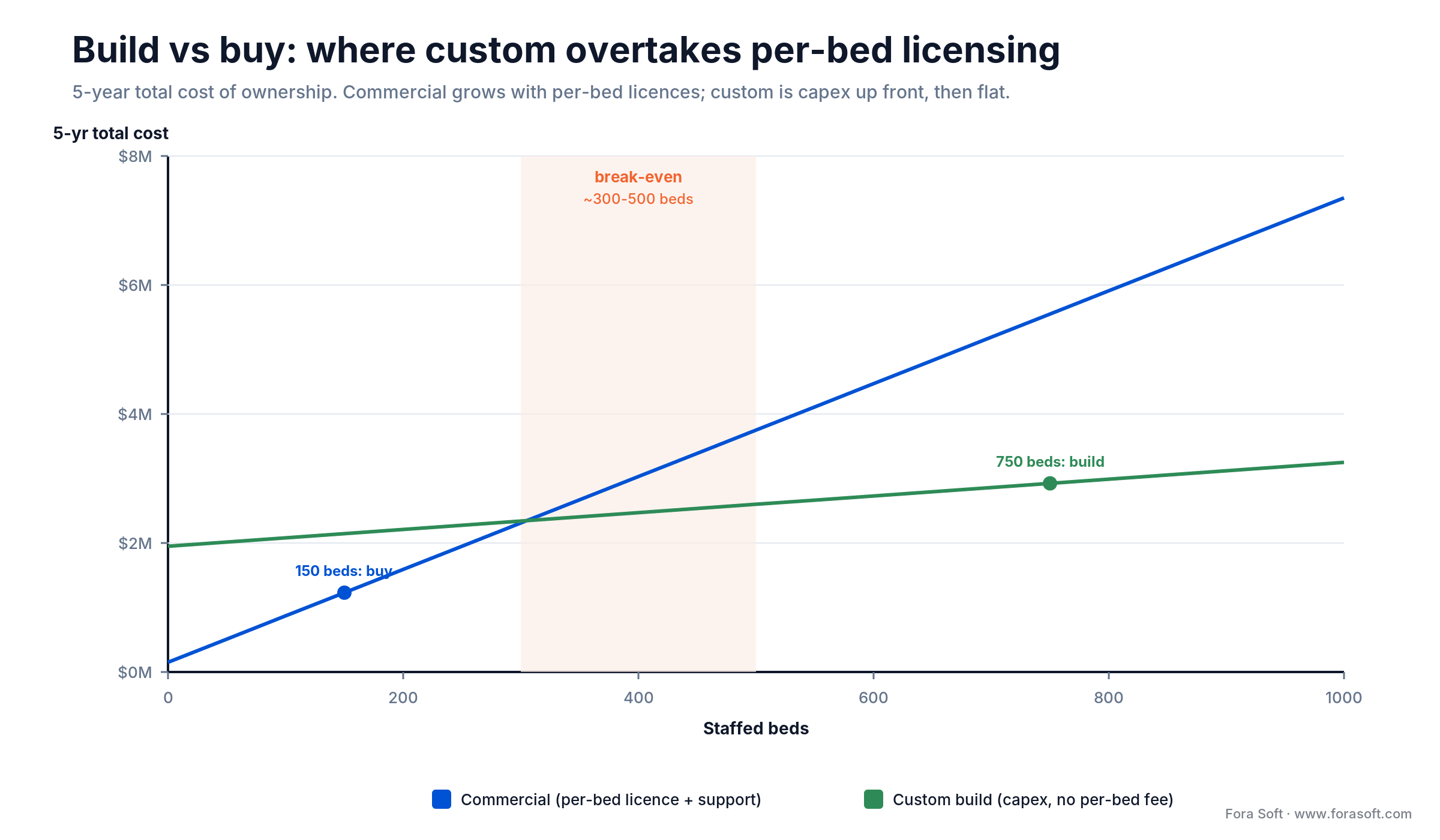
Figure 2. Five-year total cost of ownership. Custom overtakes per-bed licensing somewhere around 300–500 beds.
A worked break-even
Take a 400-bed hospital over five years. A commercial system runs roughly $3,500/bed of hardware and software ($3,500 × 400 = $1.4M up front), about $800/bed to install (~$0.32M), and around 18% of the capex a year in licence and support ($252K × 5 ≈ $1.26M). That is about $3.0M over five years, and it keeps climbing with every bed you add. A custom build lands near $2.5M for the same period: a larger capex to design and ship, then a small product team and a cloud bill, with no per-bed fee. The lines cross around 300–500 beds (Figure 2). Below that, buy. Above it, especially with specialty units, building usually wins and you own the roadmap. We publish the shape, not a hard quote: with our Agent Engineering practice the build number is typically lower than a traditional shop’s, and any figure is misleading without your specifics.
Buy commercial when
- You are under ~300 beds with standard med-surg / ICU workflows.
- Your EHR is Epic and you want a pre-built connector, not an integration project.
- You need to be live within 6–9 months and your IT team has no spare capacity.
- Vendor support, warranty, and certification continuity matter more than long-term cost.
Build custom when
- You run 300+ beds, especially across multiple facilities, where per-bed licensing compounds.
- You operate specialty units (psych, NICU, trauma, behavioral health, hospice) with non-standard escalation.
- Your vendor quotes five to six figures per integration request and you have ten queued.
- You want IP ownership and an in-house team that can extend the platform without per-feature surprises.
Realistic custom timelines, on the back of recent builds: a single-unit pilot (50–100 beds, basic escalation, one EHR, mobile app) in 4–7 months; a hardened multi-unit production system with RTLS and analytics in 9–14 months; a full multi-facility platform in 14–20 months; then a 3–5 engineer product team for ongoing integration work.
Mini-case — what a HIPAA-grade comms build looks like in practice
The closest proxy for nurse call work in our portfolio is Nucleus, an on-premise communication platform for high-security teams, built against the same HIPAA + SOC II controls a hospital nurse call system needs.
Nucleus runs entirely inside the customer’s perimeter, with no shared multi-tenant cloud, and end-to-end-encrypted voice, video, chat, and file transfer. We layered in role-based access control, tamper-evident audit logging, MFA, and an admin console that meets the access-review bar an OCR auditor expects. The pattern is a near drop-in for a nurse call backplane: swap the chat client for the call orchestrator and the EHR adapter, keep the security spine.
Our healthcare-specific work is just as relevant. CirrusMED delivers HIPAA-grade telehealth across 40+ states; Cloud Doctors runs a national telehealth service; and MyOnCallDoc handles thousands of daily on-demand video consults. All three shipped with the BAA, audit-log, and encryption posture you need before plugging into a clinical environment. Want a similar assessment for your facility? Our team runs one in a 30-minute call.
KPIs — the three buckets to instrument from day one
If a vendor demo cannot show live dashboards on these, ask why. If your custom build does not log them by design, you will rebuild it in year two.
1. Quality KPIs. Average call response time (target < 3 min), code-blue arrival time (target < 2 min), missed-call rate (target < 1%), false-alarm rate in ICU (target < 20%). This is the patient-safety dial.
2. Business KPIs. HCAHPS “Responsiveness of Hospital Staff” score, agency-nurse hours displaced, malpractice premium movement, and bed-turnover time. This is the CFO and CNO dial. It justifies the spend.
3. Reliability KPIs. System uptime (target > 99.5%), EHR integration latency (target < 10 s from call event to EHR observation), wireless coverage gaps detected per week, and UPS test pass rate. This is the IT and biomed dial. It keeps the system trusted.
Five pitfalls we see on almost every nurse call project
1. Underestimating wireless dead zones. Concrete shear walls, lead-lined imaging suites, and basement laundry rooms eat RF and Wi-Fi. Walk the building with a survey kit before you sign the install, never after.
2. Treating alarm fatigue as a clinical problem. It is a software design problem. Suppress duplicates, contextualize on acuity, and route only to the assigned nurse before you add another alarm. If you cannot tune escalation rules, you bought the wrong system.
3. Trusting the EHR integration story without a contract clause. Epic and Oracle Health ship API changes on a cadence. Without an SLA on integration compatibility, you will spend two months a year fixing what the vendor broke. Negotiate version compatibility into the master agreement.
4. Skipping the staff-training budget. Adoption stalls at 60–70% if nurses do not get structured hours and a unit champion. The system is not the limiting factor — trust in the system is.
5. Forgetting the BAA and the audit log. No vendor without a signed Business Associate Agreement should touch PHI in your environment. No system that cannot answer “who acknowledged this call at 3:14 a.m.” should pass a security review.
Reach for a phased rollout when: you are replacing a system that is currently doing its job. Pick one med-surg unit, run for 6–8 weeks, harvest the alarm-tuning data, then expand. Big-bang nurse call cutovers are how patient-safety incidents happen.
A 12-month migration roadmap from analog to IP
Most hospitals do not get a greenfield build. Here is the sequence we use to move from a 1990s analog or hybrid nurse call system to a 2026 IP platform without taking patient safety offline.
Months 0–2, baseline and survey. Measure current response time, missed-call rate, and HCAHPS responsiveness by unit. Run a wireless site survey. Inventory every integration point (EHR, BMS, RTLS, paging, badges). Sign the BAA with whichever vendor you choose.
Months 2–4, pilot a single unit. One med-surg or ICU unit: replace patient stations, deploy the mobile app, wire the EHR adapter for patient context. Run in parallel with the legacy system for four weeks and capture every alarm-tuning lesson.
Months 4–7, expand to a floor or wing. Add RTLS, code-blue routing, and escalation rules tuned from pilot data. Train 100% of nurses on the floor, assign one or two unit champions, and run a weekly retro on false positives.
Months 7–10, full facility cutover. Decommission the legacy console room by room, never floor-by-floor in a single weekend. Keep analog fallback for two weeks per unit. Run the UL 1069 NRTL audit at the end of this stage.
Months 10–12, analytics and tuning. Roll out dashboards, lock down audit-log retention, baseline the new HCAHPS scores, and hand off to the steady-state engineering team.
When you should NOT replace your nurse call system this year
It is honest to admit the ROI does not always pencil. Three patterns where we tell prospects to wait:
You are mid-EHR migration. Replacing nurse call and swapping Epic for Oracle Health at the same time multiplies risk and integration debt. Sequence it: EHR first, nurse call second.
You are under 100 beds with a working analog system. The ROI is in handoff data, escalation rules, and HCAHPS movement. At 80 beds with one corridor and three nurses a shift, analog is still rational. Revisit when you grow or the vendor drops support.
You have not measured your current response times. Without a baseline you cannot prove ROI to your CFO and you cannot tune the new system. Spend a quarter measuring before you spend a year replacing.
Not sure a nurse call upgrade pencils for you?
A 30-minute call with our healthcare lead is the fastest way to find out. We’ll run your numbers, point you at the right vendor (commercial or custom), and tell you if you should wait.
A decision framework — pick your approach in five questions
Print this and bring it to the next steering committee. The combination of answers tells you whether you are buying Rauland, buying Ascom, or building.
Q1. How many staffed beds across all facilities? Under 200 → commercial. 200–500 → commercial-plus-customization. 500+ → custom is on the table.
Q2. What EHR are you on, and how often does it change? Epic, stable for 5+ years → commercial connectors are fine. Mid-migration or hybrid Epic/Oracle Health → a custom adapter buys flexibility.
Q3. How standard are your unit workflows? Med-surg and ICU only → commercial. Behavioral health, NICU, hospice, ED fast-track → expect heavy customization; lean custom.
Q4. What does your vendor charge for an integration request? Under $25K on a quarterly cadence → live with it. Five to six figures and a six-month wait → the vendor is the bottleneck, not the budget.
Q5. What is your tolerance for per-bed licensing escalation? Predictable opex acceptable → commercial. Need to amortize as capex with no surprises → custom.
Where a nurse call system plugs into the smart hospital
A 2026 nurse call system is not a closed box. It is one node in a clinical IoT mesh with patient monitors, infusion pumps, smart beds, RTLS, building management, and the EHR.
Patient monitors and pumps. Vital-sign trends are the best signal for prioritizing alarms. An SpO2 drop of 6% over 90 seconds should raise that patient’s call light from amber to red automatically.
Smart beds. Baxter and Stryker beds expose exit-detection, tilt, and weight-on-bed sensors. Surface those into escalation logic and fall rates drop measurably within a quarter.
Building management. Code blue can auto-open the right doors and route elevators to the right floor. We have built variants of this in our comms-control work on Nucleus.
Visitor and access control. The same intercom hardware at ward entrances can authenticate visitors against patient consent in the EHR — useful for psych, NICU, and behavioral-health units. See our secure intercom and custom intercom guides for the access-control patterns.
What is changing in 2026 and beyond
Voice-first interfaces. Whisper-class speech recognition plus a small wake-word model now run locally on a sub-$250 patient station. Expect “help, my IV is beeping” to become a routed call in mid-tier vendors within 18 months. Our AI intercom voice-recognition guide covers where this is reliable and where it still fails.
Predictive escalation. Vital-sign trends plus call-pattern history give a 5–10 minute lead time on deterioration. The nurse call system becomes an early-warning system, not just a pager replacement. See our telemedicine engineering hub for the clinical-AI patterns.
RTLS as a default. Bluetooth LE plus Ultra-Wideband make per-room location accurate to 10–30 cm (UWB) versus roughly meter-level for BLE alone. Most health systems deploy both; “nearest available nurse” routing becomes table stakes.
Vendor consolidation. Stryker (Vocera) and Baxter (Voalte) are buying and bundling. Expect more pre-integrated suites, and more lock-in if you commit to one ecosystem.
Cybersecurity scrutiny. 2024–2025 saw ransomware take nurse call offline for days at several hospitals. Expect OCR and state regulators to treat nurse call cybersecurity the way they already treat the EHR — another reason the proposed HIPAA Security Rule matters.
FAQ
What is a nurse call system?
A nurse call system is the equipment and software that lets a patient summon staff and lets staff route, escalate, and document that call. Modern systems go beyond the bedside button: IP call delivery, a smartphone or badge app, RTLS routing to the nearest nurse, EHR-aware escalation, and an audit log. A “healthcare intercom” is the broader term — nurse call plus overhead paging and room-to-room talk-back.
How much does a nurse call system cost?
Commercial systems land at roughly $500–$5,000 per bed for hardware and software, plus $400–$1,200 per bed for installation, plus 10–20% of capex a year in licence and support. Small wireless kits start under $250 per station. Custom builds shift cost into capex and engineering payroll and usually break even at 300–500 beds.
Is a nurse call system HIPAA-compliant out of the box?
No vendor is automatically compliant because they say so. HIPAA requires AES-256 encryption in transit and at rest, RBAC + MFA, audit logging, and a signed BAA. Most off-the-shelf systems support these but need configuration; a custom build is designed against your security posture from the start. The proposed 2025 HIPAA Security Rule would make encryption and MFA mandatory rather than addressable.
What standards does a hospital nurse call system need to meet?
UL 1069 Ed. 8–2024 (signaling and nurse call equipment), NFPA 99 (Health Care Facilities Code), NFPA 70 (electrical), and HIPAA / HITECH for PHI. FCC rules and state wiretap consent law apply if you record. Local authorities can add requirements on top.
Can a nurse call system integrate with Epic or Cerner?
Yes. Epic integrates via its FHIR R4 APIs, HL7 interfaces, and Care Everywhere; Oracle Health (Cerner) via Ignite APIs and FHIR R4. Rauland, Ascom, and Baxter ship pre-built connectors; custom builds use FHIR R4 + HL7v2 directly. The hard part is not the protocol — it is the data-model alignment and an SLA on version compatibility.
Wireless or wired nurse call — which is better?
Wired (IP over structured cabling) is the standard for new acute-care construction: predictable latency, power over Ethernet, no battery churn. Wireless nurse call is faster and cheaper to retrofit into older buildings and assisted living, at the cost of RF survey work and battery maintenance. Most 2026 systems are hybrid — wired backbone, wireless badges and RTLS.
How long does a nurse call deployment take?
Commercial deployments run 4–8 months from contract to full go-live for one facility. Custom builds run 4–7 months for a single-unit pilot, 9–14 months for a hardened multi-unit system, and 14–20 months for a full multi-facility platform. Phased rollouts are mandatory — never big-bang.
How do we reduce alarm fatigue with a new system?
In order: suppress duplicate alarms, prioritize on patient acuity (pull from the EHR), route only to the assigned nurse, escalate after 30–60 seconds, and let nurses tune thresholds at the unit level with an audit trail. With 85–99% of alarm signals needing no clinical action, this filtering is the whole game — if your system cannot do it, fix that first.
Does Fora Soft replace vendors like Rauland or Ascom?
Not always — we are honest about when commercial is the right call (under 300 beds, standard workflows, Epic-only). We come in when you have outgrown the commercial playbook: 300+ beds, specialty units, multi-EHR, vendor lock-in escape, or a specific compliance posture you cannot get off the shelf.
What to Read Next
Custom intercom
Custom intercom software development — a full guide
When the off-the-shelf vendor cannot bend, what a custom build actually looks like.
Security
Why security matters in modern intercom software
The HIPAA, SOC 2, and encryption posture every clinical comms system needs.
HIPAA
How to build a HIPAA-compliant video platform
Voice and video on the same compliance bar — the architecture playbook.
Healthcare
Healthcare software development — compliance and security
The pitfalls that turn a healthy build into a 9-month remediation project.
AI intercom
AI intercom software — voice recognition that works
Where Whisper-class speech recognition is good enough today, and where it still fails in clinical settings.
Ready to give your facility a faster, safer comms backbone?
A nurse call system is no longer optional infrastructure. The patient-safety case is documented (communication failures in ~30% of malpractice claims, 1,744 deaths in five years), the technology has matured (IP, RTLS, smartphone, EHR-aware escalation), and the regulatory bar (UL 1069 Ed. 8, HIPAA, NFPA 99, and a tougher Security Rule coming) is rising.
Your decision is not whether — it is buy or build. Under 300 beds with standard workflows, the commercial playbook (Rauland, Ascom, Baxter) is usually right. Above that, with specialty units or vendor frustration, custom development pays back inside five years and hands you the roadmap.
Either path, the discipline is the same: survey the wireless, design for alarm fatigue from day one, treat compliance as architecture instead of paperwork, and instrument response time, HCAHPS, and uptime from the first pilot ward.
Want a defensible build-vs-buy answer this week?
Tell us your bed count, EHR, current vendor pain, and target go-live. We’ll respond with a one-page reference architecture, a realistic timeline, and a frank recommendation. No deck, no chase.

