


The best AI tools for lesson planning in 2026 aren’t the ones with the slickest demo. They’re the ones a district will let teachers log into without a six-month privacy review. The serious question stopped being “which one writes the best outline?” a while ago. It’s now “which one signs a data-privacy agreement, tags the right standard, and fits the tab a teacher already has open.” The eight that clear that bar are MagicSchool, Diffit, Curipod, Eduaide.ai, Brisk Teaching, Education Copilot, Khanmigo, and Flip Education. We’ve built AI planning engines and integrated these products into larger platforms, so this reads like an architect’s memo, not a listicle.
Key takeaways
• The shortlist. For most teams: MagicSchool for breadth, Diffit for differentiation, Curipod for live engagement, with Eduaide, Brisk, Education Copilot, and Khanmigo as specialists.
• Compliance decides adoption, not model quality. A signed DPA and FERPA/COPPA posture gate district rollout. The amended COPPA rule hit its April 22, 2026 compliance deadline and is now in full effect.
• Prices moved in 2026. Diffit is now $14.99/mo or $149.99/yr (not the $89 you’ll see repeated everywhere); Khanmigo is free for all US teachers; Eduaide Pro is $5.99/mo.
• Teachers who use AI weekly save 5.9 hours a week, about six weeks a year (RAND/Gallup, 2025). Lesson prep is one of the three tasks where it saves the most.
• Building? Don’t rebuild these. Wrap a model with your own curriculum RAG and a compliance posture a district CTO will sign. We show the buy-vs-build cost math below.
Why Fora Soft wrote this comparison
Fora Soft has built software since 2005: 21 years, 250+ shipped products, 50 people who specialize in multimedia and AI. We’ve written the production RAG layer that keeps generated lessons grounded in a client’s real curriculum instead of plausible-sounding invention, and we’ve integrated MagicSchool-style toolkits into LMS platforms for EdTech clients. On ALDA, our AI curriculum engine, we cut faculty rewrite rate from about 60% to under 15%. That’s the vantage point here: we’ve built the thing these eight products are, and we’ve shipped the compliance work that decides whether a district ever turns them on.
We link our EdTech work throughout — the virtual-classroom build for BrainCert, the education platform for Tabsera, and the way we think about AI-crafted personalized learning materials. None of that is theory. It’s what we ship.
Reach for auto-generation when: you have standards alignment and a teacher-in-the-loop edit step. Miss either one and the output won’t survive a department chair’s review.
Building an EdTech product with AI lesson planning inside?
We’ll map your curriculum model, pick the right vendor or decide to build, and scope the RAG and compliance layer. 30 minutes, no commitment.
The 2026 lesson-planning reality, in numbers
Adoption is no longer the question. In the RAND/Gallup study “Teaching for Tomorrow” (surveyed March–April 2025, n=2,232 US K-12 teachers), 6 in 10 teachers had used AI that year and about 32% used it weekly. The weekly users saved an average of 5.9 hours a week — roughly six weeks over a school year. The tasks where AI saved the most time were creating worksheets and assessments, admin work, and preparing lessons. So the tool you pick isn’t buying novelty. It’s buying back the single scarcest thing a teacher has.
Here’s the catch that the demos skip: those hours only show up if the workflow survives contact with a real classroom and a real procurement office. A generated plan that ignores the state standard, or a vendor that won’t sign a data-privacy agreement, produces zero of those six weeks. The workflow below is where the time is actually won or lost.
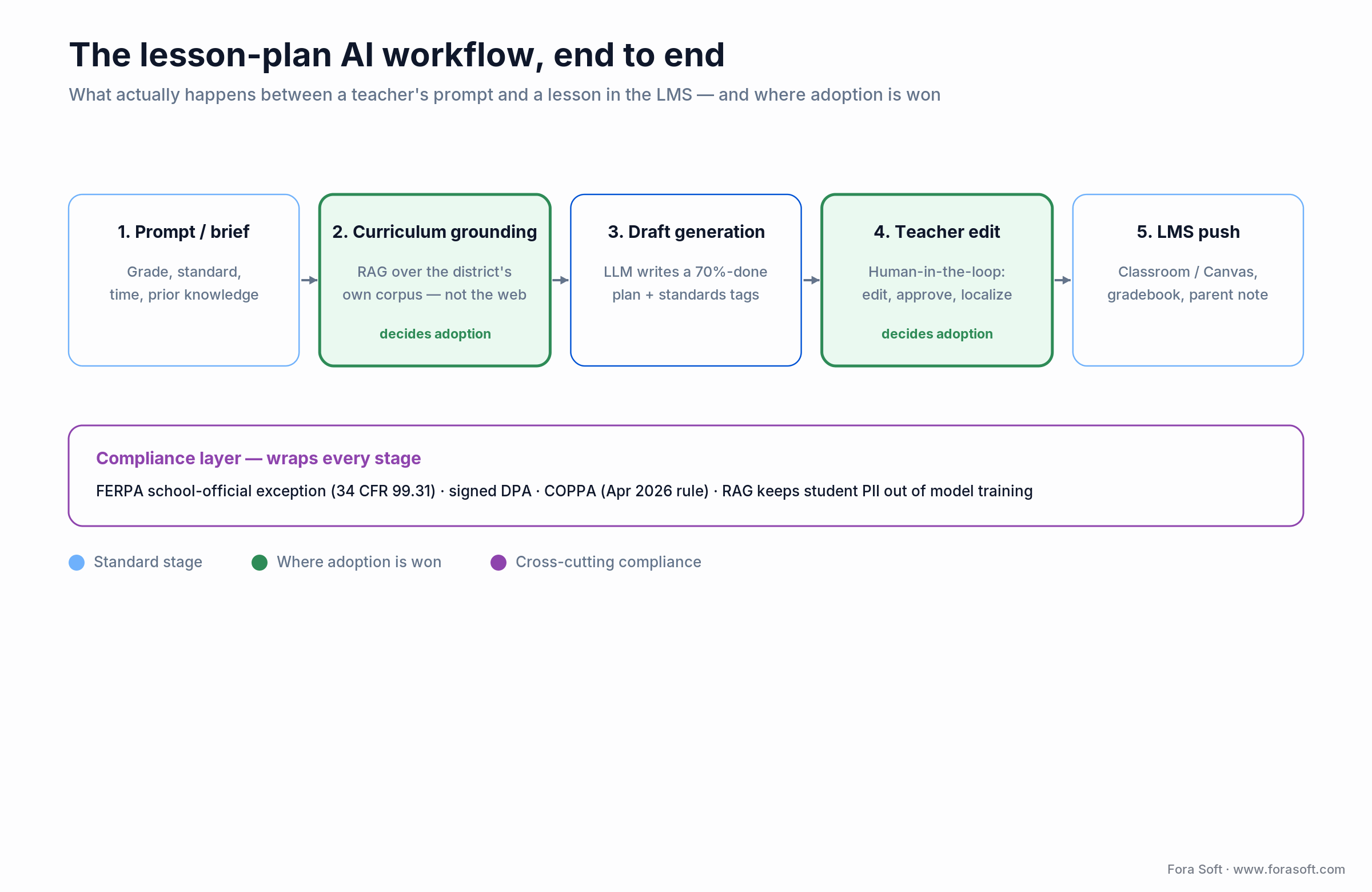
Figure 1. The two stages that decide adoption are curriculum grounding and the teacher edit — not the model that writes the draft.
How we ranked these tools
Every serious shortlist of AI tools for lesson planning is shaped by six constraints. Fail one and the tool stalls at pilot:
1. Compliance posture. FERPA, COPPA, and state student-data-privacy statutes (SOPIPA in California, Ed Law 2-d in New York). No signed DPA, no district deal.
2. Workflow fit. Does it live in Google Docs, Classroom, Canvas, or Schoology — or does it demand a new tab and a new habit?
3. Pedagogy, not just prose. Does the output carry differentiation, scaffolding, assessment, and a named standard, or just a pretty outline?
4. Curriculum grounding. Can it anchor to this district’s curriculum, or does it invent content that sounds right?
5. Unit economics. Free-for-teacher is table stakes; district pricing runs roughly $3–$15 per teacher per month at the paid tier, custom at enterprise.
6. Integration. SSO (Google, Microsoft), rostering (Clever, ClassLink), and Classroom/Canvas push are non-negotiable at scale.
MagicSchool AI — the district default
MagicSchool is the most-deployed AI teacher platform in US K-12. As of early 2026 it had crossed 5 million educator sign-ups across 13,000+ schools in 160 countries, bundling 80+ teacher tools (lesson plans, rubrics, IEP drafting, unit planners) plus student tools behind one interface with admin guardrails.
Pricing (2026)
Free forever for individual teachers. Plus is $8.33/mo billed annually ($12.99 monthly) and lifts generation limits, adds output history, AI editing, and 1-click Google/Microsoft export. Enterprise is a custom quote and adds SSO, rostering, a signed DPA, and district dashboards. Confirm current numbers on the MagicSchool pricing page.
Where it wins, where it breaks
Wins: one vendor covers the whole teacher surface, and hundreds of districts have already signed its DPA, so procurement time, the real cost, drops. Breaks: there’s no public developer API in 2026. For a white-label product, MagicSchool is a use-it-directly tool, not a build-on-top platform. Depth per tool is good, not specialist; differentiation, for one, is thinner than Diffit’s.
Reach for MagicSchool when: you’re a district (or sell into districts) and need one signed vendor to cover lesson plans, assessments, and IEP work at once.
Diffit — differentiation as a first-class output
Diffit does one job better than anything else: take any source (an article, a paragraph, a YouTube URL, a PDF) and produce reading-level-adjusted versions, vocabulary lists, comprehension questions, and summaries in under a minute. Leveling spans roughly grade 2 through high school, strongest in ELA, social studies, and science.
Pricing (2026)
Here’s a correction worth making loudly: Diffit’s Individual Teacher plan is now $14.99/mo or $149.99/yr, per the Diffit pricing page, not the “~$89/year” figure still copied across 2024-era listicles. Schools is a custom annual rate by enrollment. Premium-only features include Google/Microsoft export, standards alignment, graphic organizers, and longer inputs (novels, chapters).
Where it wins, where it breaks
Wins: IEP and multilingual-learner support is the hardest thing for a general model to do well, and Diffit’s reading-level output passes an ELA specialist’s review more often than raw ChatGPT. Breaks: it’s a differentiation layer, not a full planner — pair it with MagicSchool rather than expecting it to replace one.
Reach for Diffit when: IEPs, 504s, and multilingual learners make differentiation the #1 workload. We’d pick it for the adapted-text layer, and it’s not close.
Curipod — lessons students act on live
Curipod turns a prompt like “60-minute 8th-grade lesson on photosynthesis, NGSS MS-LS1-6” into a full interactive slide lesson with polls, drawings, and word clouds that students answer live on their devices. The teacher hits play and gets a formative-assessment-rich period with almost no prep. It’s Norwegian-built, and search interest for it climbed sharply into 2026.
Pricing (2026)
Free plan is usable: AI-generated lessons, polls and drawings, basic reports, a 1,000-character cap on student responses, weekly session limits, and three standards-aligned test-prep lessons. School & District is a custom quote that lifts the limits and adds SSO, unlimited translations, and shared district folders.
Where it wins, where it breaks
Wins: the real product isn’t the slide deck, it’s the engagement data. Curipod’s logs show exactly when a student stopped participating, which a static plan never will. Breaks: it replaces the live slide deck, not the planning doc. If your problem is documentation and standards mapping, this is the wrong tool.
Reach for Curipod when: your problem isn’t “teachers need planning help” but “students aren’t participating.”
Eduaide.ai — the pedagogy power tool
Eduaide.ai gives 75+ resource generators covering lesson plans, assessments, questioning frameworks (Socratic, Bloom’s, Webb’s Depth of Knowledge), IEP goals, and project scaffolds. Its edge is choice: it grounds output in an internal knowledge graph of educational research and can align lessons to named frameworks: 5E Inquiry, Universal Design for Learning, Backward Design, Gagné’s Nine Events.
Pricing (2026)
Free plan gives 15 generations a month. Pro is $5.99/mo or $49.99/yr for unlimited generations and enhanced feedback — the cheapest monthly tier of the eight. School bundles are available.
Where it wins, where it breaks
Wins: its Teaching Assistant mode asks clarifying questions (grade, standard, time, prior knowledge) before generating, like a coach’s workflow rather than a button. Breaks: that depth is wasted on a teacher who just wants a fast draft; the option surface can feel heavy for casual use.
Reach for Eduaide when: your users are experienced educators who want to dial in pedagogy (DOK levels, specific frameworks), not press one generate button.
Brisk Teaching — AI where teachers already work
Brisk is a Chrome and Edge extension that injects AI into Google Docs, Slides, Classroom, YouTube, and any page. It writes leveled passages, rubrics, quizzes, and feedback without the teacher leaving the tab. Its Boost feature turns existing content into interactive student activities. The company raised a $15M Series A led by Bessemer Venture Partners in 2025 (about $21.9M total), which matters for a tool you’re betting a rollout on.
Pricing (2026)
Free tier for individual teachers with daily caps. The paid individual tier adds unlimited generations, advanced feedback, and AI-writing detection signals. School and district pricing is by quote.
Where it wins, where it breaks
Wins: Brisk won early adopters because it demanded zero workflow change — any product building a planning feature should study its interaction design. Breaks: it’s tied to the browser and the Google/Microsoft ecosystem; outside that, the value drops fast.
Reach for Brisk when: your schools are Google Workspace shops and the #1 barrier to adoption is “another tool to learn.”
Education Copilot — structured, print-ready plans
Education Copilot is more opinionated than MagicSchool. It produces structured, consistently formatted lesson plans, unit plans, syllabi, and writing prompts — output that looks like something you could hand a substitute without edits.
Pricing (2026)
Free plan to generate plans with no card, then $9/mo for the teacher tier after a 30-day trial, with team, school, and district plans above it.
Where it wins, where it breaks
Wins: the structure is the feature — ideal for tutoring centers, homeschool co-ops, and charter networks that need uniform documentation across instructors. Breaks: it’s built for the PDF deliverable, not live interaction, and the breadth doesn’t match MagicSchool’s.
Reach for Education Copilot when: uniform, review-ready lesson documents matter more than interactive engagement.
Khanmigo — student tutor with a teacher mode
Khan Academy’s Khanmigo, built on OpenAI’s GPT-4 for tutoring (Khan runs a multi-model stack), is the only tool here that’s a real student-facing tutor: it asks Socratic questions and won’t just hand over answers. Teacher mode generates lesson plans, leveled passages, rubrics, and feedback aligned to the Khan library.
Pricing (2026)
Free for all US teachers, funded through Khan Academy’s Microsoft-supported rollout; learners and parents pay $4/mo (or $44/yr), per the Khanmigo pricing page. Full classroom/district integration is a separate custom tier.
Where it wins, where it breaks
Wins: if you serve students directly, Khanmigo’s Socratic behavior is the reference implementation, and teacher mode covers both sides of the room. Breaks: it’s anchored to Khan’s content and US teachers; planning is the supporting act, not the headline. Be honest about impact, too: Khan Academy’s Sal Khan called the student-tutor results “a non-event” for most learners in 2026, even as usage grew past 2 million.
Reach for Khanmigo when: the classroom already runs on Khan content, or student-facing tutoring is the goal and planning rides along.
Flip Education — the printed lesson, not the screen
Built around the printed artifact rather than the screen: pick a methodology and Flip generates a complete paper kit — teacher briefing, student cards, facilitation guide, debrief slips — sized to the lesson length and class size you enter. Its own framing is the accurate one: the app is where you generate, the classroom is where the lesson lives. Generating and printing needs a connection; the lesson itself needs nothing, with no student accounts, no student devices, no scanning, and no student data collected.
The catalogue runs to 64 active-learning methodologies, and Flip’s own platform data (719 lesson configurations from 361 verified teachers across 18 countries, March to August 2026) shows teachers reached for 57 of them, the most popular accounting for only 10.6% of lessons. That data also explains the shape of the product: 50.8% of lessons in the dataset were planned outside school hours, before 08:00 or after 16:00 local time, and 23.8% were planned at night, between 20:00 and 05:59. Source: Flip Education, What Teachers Teach: 2026 Active-Learning Trends.
Pricing (2026)
$7.99/mo for one subject to $21.99/mo for all, 25% off annually; schools of 20–99 teachers pay $149 per teacher per year, districts of 100+ pay $119, per Flip Education. These are US list prices; Flip bills in local currency, so buyers outside the US see their own.
Where it wins, where it breaks
Wins: zero student screen time by design, and genuine methodology breadth — 57 of the 64 methodologies see real use, so the catalogue is not shelfware. Breaks: a mission cannot be edited before printing; individual handouts do have an editor, but it is a pencil icon almost nobody finds; the student role cards currently print blank — every copy of both role cards, which Flip has fixed but not yet deployed; and per seat it costs more than MagicSchool’s Plus tier while doing one job rather than sixty.
Reach for Flip Education when: the lesson has to run on paper, with no student devices or accounts anywhere in the flow.
The 8 tools side by side
Pricing and posture at a glance. The coverage map below the table scores the seven district-focused tools on the six buyer criteria — it complements the numbers rather than repeating them.
| Tool | Best for | Pricing (2026) | DPA / SSO | Where it wins |
|---|---|---|---|---|
| MagicSchool | Districts, broad toolkit | Free / $8.33 Plus / Enterprise custom | Yes (Enterprise) | 80+ tools, IEP drafting, guardrails |
| Diffit | Differentiation, MLLs, IEPs | Free / $14.99 mo or $149.99 yr / Schools | Yes (Schools) | Reading-level output in under a minute |
| Curipod | Live engagement, formative data | Free / District custom | Yes (District) | AI lesson + live polls in one flow |
| Eduaide.ai | Pedagogy-forward power users | Free / $5.99 mo or $49.99 yr / School | Yes (School) | 75+ resource types, DOK, frameworks |
| Brisk Teaching | Google Workspace shops | Free / paid individual / District | Yes (District) | Chrome extension, zero workflow change |
| Education Copilot | Tutoring centers, charters | Free / $9 mo / School & district | Yes (School) | Consistent, print-ready documents |
| Khanmigo | Student tutoring + teacher mode | Free for US teachers / District custom | Yes (District) | Socratic tutor, Khan library alignment |
| Flip Education | Paper-first lessons, no student devices | $7.99–$21.99 mo / $149 per teacher yr (schools) | No student data collected | Complete printed kit per methodology |
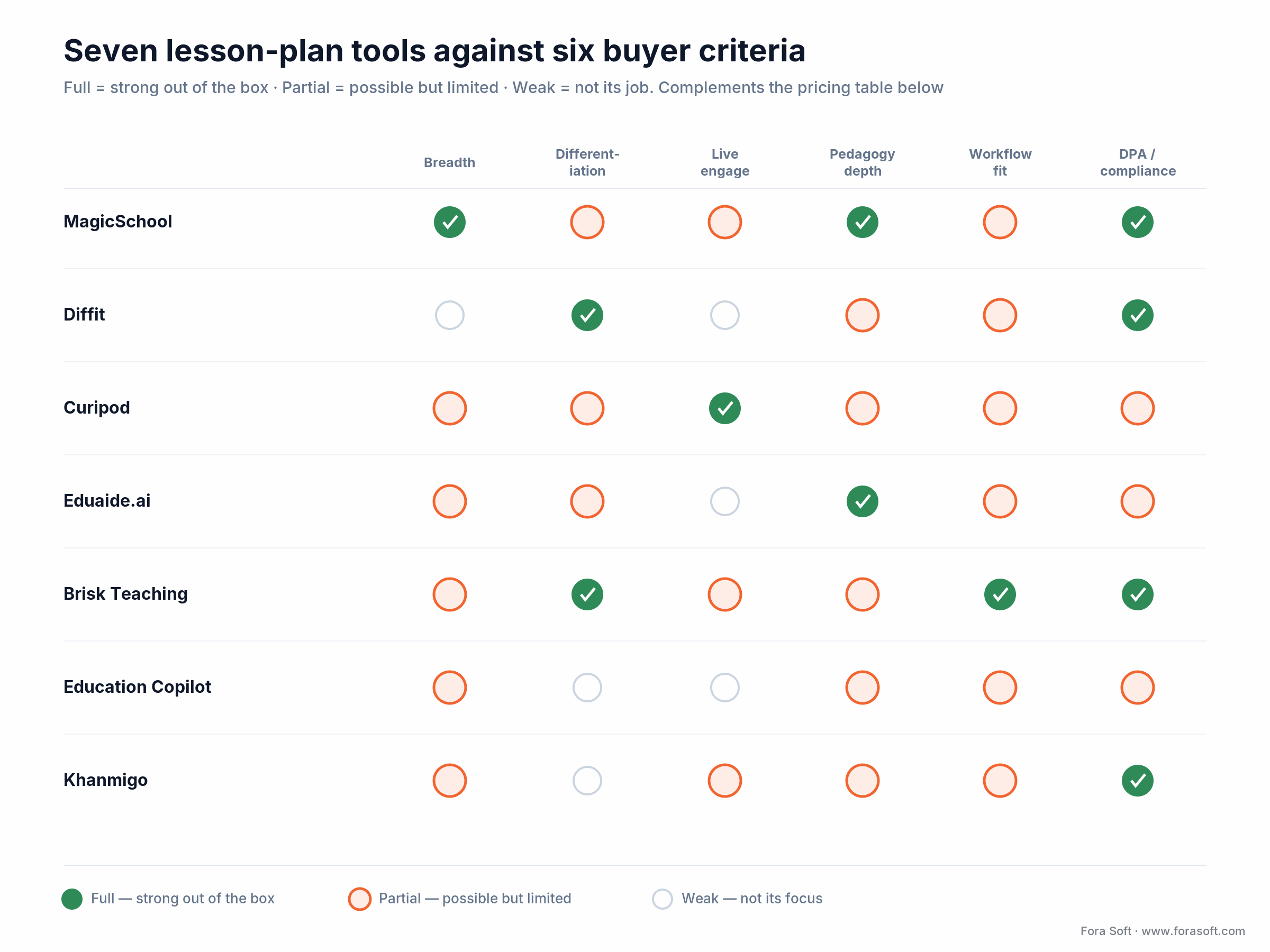
Figure 2. No single tool is full across all six criteria — which is why the winning setup is usually two or three of them, not one.
The compliance layer — FERPA, COPPA, and DPAs
This is the section most listicles skip, and it’s the one that decides whether any of the eight ever go live in a district. Get it wrong and the best AI tools for lesson planning stay stuck at “pilot with three teachers.”
1. FERPA and the school-official exception. Under FERPA (20 U.S.C. § 1232g), a school can share student records with a vendor only under the school-official exception (34 CFR 99.31): the vendor performs a function the school would otherwise do, stays under the school’s direct control, follows FERPA, and doesn’t re-disclose the data. In practice that means a signed Data Privacy Agreement. The US Department of Education’s Student Privacy office is the primary reference here.
2. COPPA is now in full effect. The FTC’s amended COPPA rule was published April 22, 2025, took effect June 23, 2025, and reached its compliance deadline on April 22, 2026 — see the Federal Register notice. It expands “personal information” to include biometric and government identifiers, and requires separate verifiable parental consent before disclosing a child’s data to third parties. Any tool touching under-13 students has to meet it today.
3. The AI sub-processor trap. Here’s the 2026-specific catch a lot of buyers miss: when a lesson tool sends a student’s writing to an LLM API for feedback, that model provider becomes a sub-processor with its own privacy exposure. The vendor’s DPA has to flow retention, use, and re-disclosure terms through to the model provider — and “direct control” is weak when the API contract, not the school, sets the terms.
4. Architecture that satisfies the lawyers. The pattern we ship: RAG so student PII never enters a training set, SOC 2 Type II with AES-256 at rest and TLS 1.3 in transit, and a clear answer to “do we process student PII at all?” If yes, budget two to three months of legal time before launch. If your build touches this, our AI integration team handles it as part of scope.
Stuck on the DPA and data-flow questions?
We’ll audit your student-data flow, name the FERPA/COPPA gaps, and hand you the architecture that closes them. 30 minutes, no obligation.
Build vs. buy — integrate, wrap, or build
Every product team asks the same thing: license one of the eight, rebuild something like it, or wrap a foundation model? In 2026 the answer is usually “buy the toolkit and build the thin layer that makes it yours.” The logic we use with clients:
You run an LMS or SIS. Don’t rebuild MagicSchool’s breadth. Integrate via SSO and deep links, and spend your engineering on curriculum grounding and analytics instead.
You sell to higher-ed or corporate training. None of the eight fit; they’re K-12-shaped. Wrap GPT-5 or Claude with your own curriculum RAG and a compliance posture tuned to your vertical (HIPAA for med-ed, SOC 2 for corporate).
You’re a K-12 vendor under $5M ARR. Don’t out-MagicSchool MagicSchool. Find the niche they haven’t saturated: subject-specific, modality-specific (special ed, MLL), or workflow-specific (sub plans, field trips).
You’re a publisher with proprietary curriculum. This is where the build case is strongest. Your moat is the corpus — a custom RAG-plus-LLM layer generates standards-aligned lessons from your content, which MagicSchool can’t do without licensing it. See how we frame this in our guide to e-learning platform development.
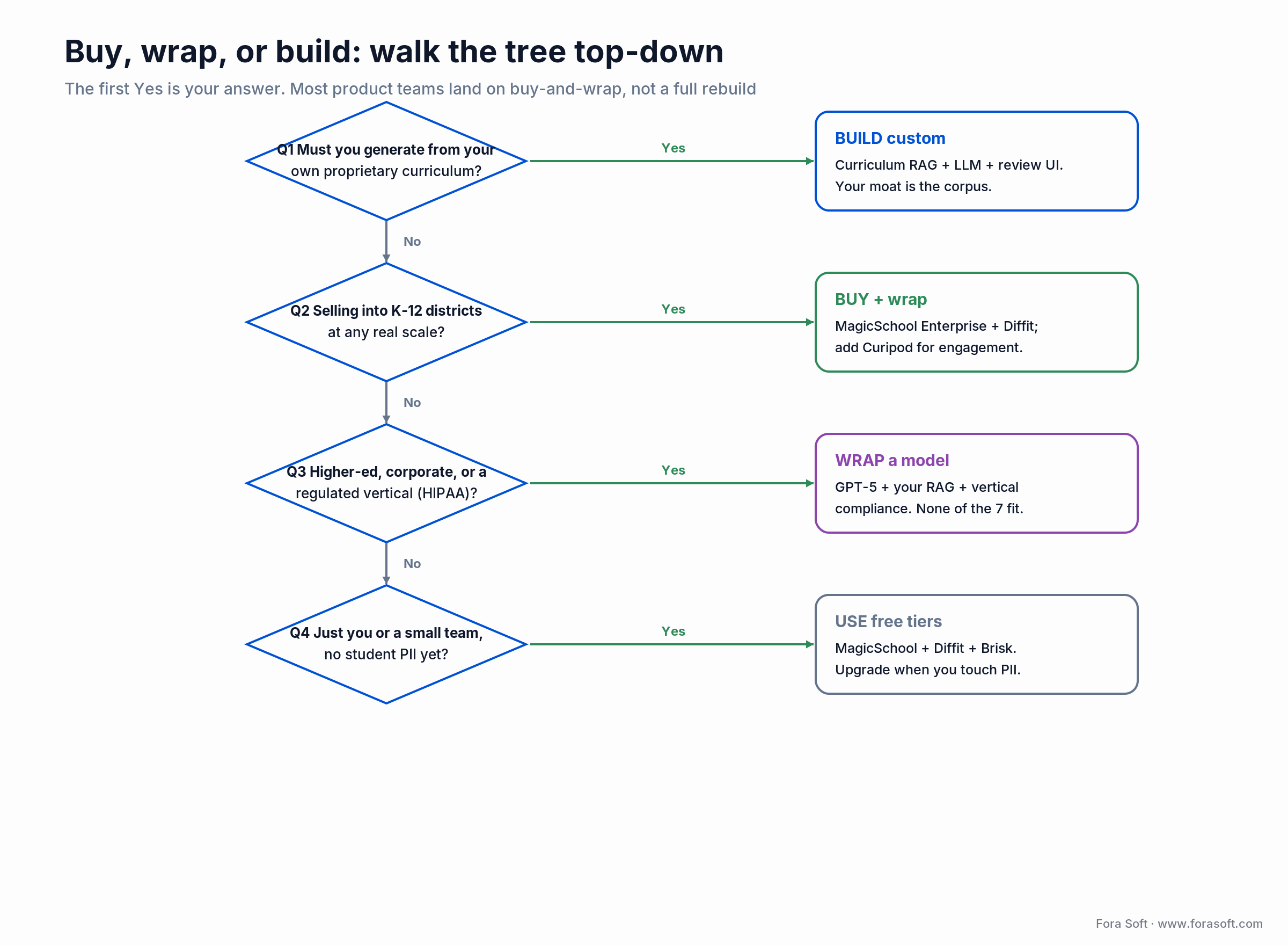
Figure 3. Walk it top-down; the first yes is your path. Most product teams land on buy-and-wrap.
Cost math: a 500-teacher district for a year
Concrete numbers make the decision honest. Take a 500-teacher US district over a full year. Buying a stack of MagicSchool Enterprise plus Diffit, and optionally Curipod, lands around $58k–$95k in year one including setup. Building your own comes in higher up front and only pays back later.
The build side is where people guess wrong, so here’s the arithmetic out loud. Assume 500 teachers × 80 generations per month × ~4K tokens each (3K in, 1K out). On GPT-5.4 at $2.50 / $15 per million tokens (2026 OpenAI pricing): input is 120M tokens = $300/mo, output is 40M tokens = $600/mo, so ~$900/mo ≈ $10,800/yr in model spend. Add ops and monitoring and the run cost is roughly $17k–$25k/yr. The one-time MVP (curriculum RAG, prompt scaffold, standards tagging, teacher review UI, SSO) runs about $90k–$160k with our Agent Engineering approach, which keeps that build faster and cheaper than a typical hand-rolled quote.
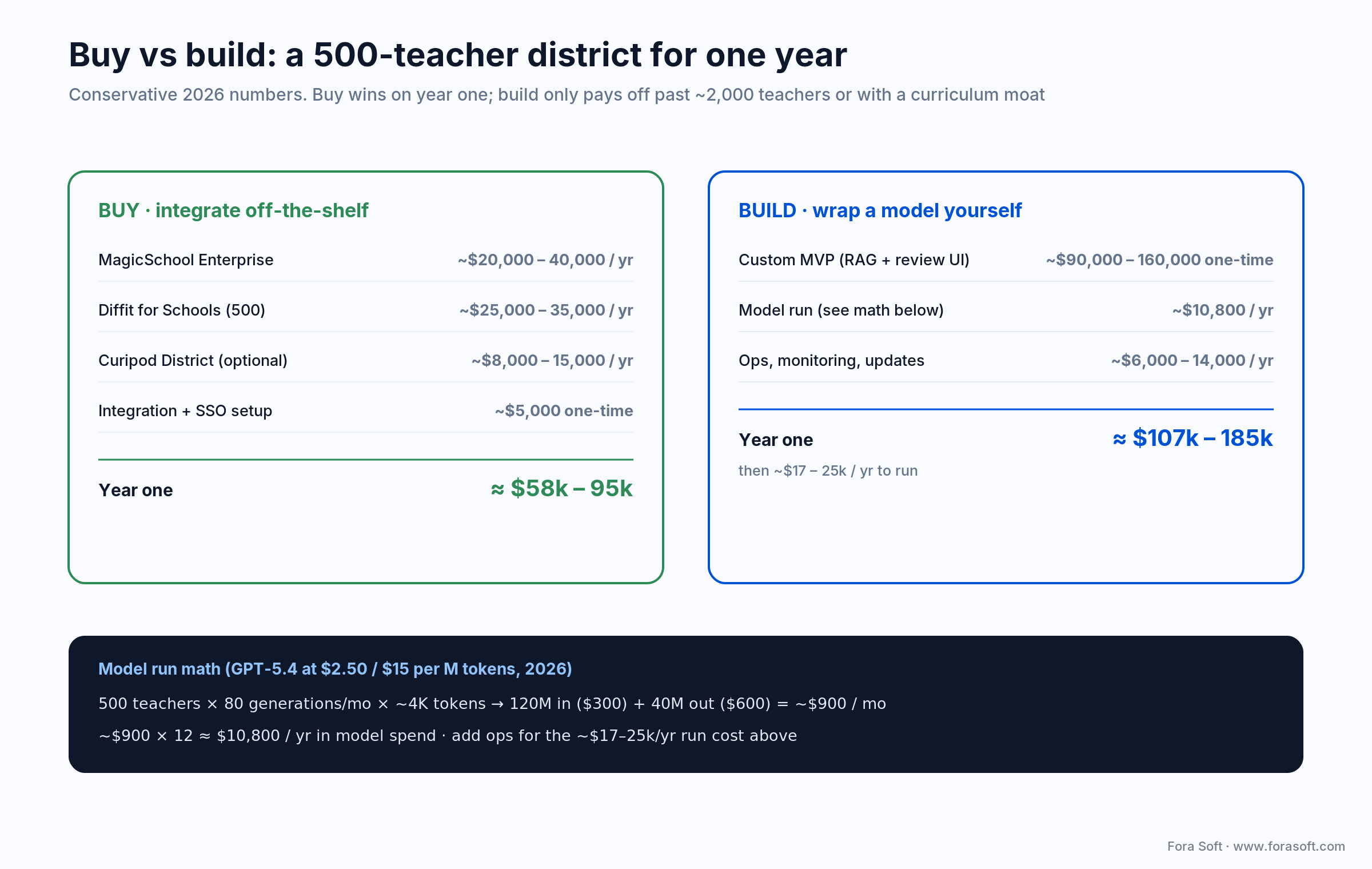
Figure 4. Buy wins in year one. Build pays off past roughly 2,000 teachers, or when a proprietary curriculum is the whole point.
Mini case — the ALDA curriculum engine
Situation. A higher-ed group needed to generate standards-aligned university courses from a short brief — subject, level, duration, outcomes. Generic ChatGPT produced plausible but unrooted outlines, and faculty rewrote roughly 60% of every draft before it was usable. That rewrite tax erased the time savings the tool was supposed to create.
Plan. We built ALDA as a three-layer pipeline on OpenAI Assistants (GPT-4 originally, since moved to GPT-5-tier models): a curriculum RAG over the institution’s own catalog and textbook corpus; a prompt scaffold enforcing Bloom’s progression and explicit outcome mapping; and a faculty review loop where each module surfaces alongside its source citations, with edits feeding back into the tuning set.
Result. Faculty rewrite rate fell from ~60% to under 15%. Course build time dropped from 6–8 weeks to under 10 days. Amortized across the first 40 courses, cost per course landed near $220 versus $4,000–$6,000 for fully manual development. The lesson for anyone picking from the eight: your users don’t need “an AI planner,” they need one that cites their curriculum and fits their review workflow. Want a similar assessment for your product?
A decision framework — pick in five questions
1. Do you generate from proprietary curriculum? If yes, build custom — a RAG-plus-LLM layer over your corpus is your moat, and no off-the-shelf tool can match it.
2. Are you selling into K-12 districts at scale? If yes, buy: MagicSchool Enterprise plus Diffit, adding Curipod where engagement drives the budget.
3. Higher-ed, corporate, or a regulated vertical? If yes, wrap a model with your own RAG and vertical compliance — none of the eight are shaped for you.
4. Is the real problem engagement, not planning? If yes, Curipod (or Khanmigo for tutoring) beats another planning generator.
5. Just you or a small team with no student PII yet? Stack the free tiers — MagicSchool, Diffit, and Brisk cover most needs at zero cost. Upgrade the moment you touch PII. If two answers point in different directions, we can settle it in one call.
Five pitfalls that stall lesson-plan AI
1. Shipping without standards alignment. A plan that doesn’t name the standard (NGSS, CCSS, or state code) won’t clear a department chair. Every output has to tag it — and a validator should confirm the tag actually appears.
2. Designing for autonomy instead of editing. No teacher wants a button that emits a final lesson. They want a 70%-done draft they can shape. Build for the edit, not the magic trick.
3. An undersized safety posture. A generic model will write an example sentence on “symbolism” using adult themes. K-12 needs classroom-tuned prompts, blocklists, and a human-review path — not default settings.
4. Treating the DPA as an afterthought. You will not sell into a single US district without a signed Data Privacy Agreement covering student data. Decide up front whether you process PII at all, and if so, plan the legal runway.
5. Trusting the citation the model gives you. Models will confidently cite the wrong standard, which is worse than none. Cross-check every generated standard code against a source list before it reaches a teacher.
KPIs to track before and after rollout
Quality KPIs. Teacher edit distance (how much of the draft survives), standards-tag accuracy against a validated list, and the rate of flagged unsafe outputs. Aim for edit distance trending down week over week as your prompts improve.
Adoption KPIs. Weekly active teachers, generations per teacher, and D7/D30 retention. Tie them to the RAND/Gallup benchmark: if your tool isn’t returning something close to those hours, adoption will stall regardless of features.
Reliability KPIs. p95 generation latency, model/API error rate, and cost per generation against your budget. Watch cost per generation especially — it’s the number that decides whether the build stays economical as you scale.
When NOT to add another AI tool
Honesty sells better than another logo. Skip the new tool when your teachers already have two they haven’t learned — tool sprawl kills adoption faster than any missing feature. Skip a custom build when a $9/mo product already does the job; the ROI math almost never favors rebuilding a commodity. And skip student-facing AI entirely if you can’t staff the safety review and sign the DPA. A tool you can’t govern is a liability, not a feature. The strongest move is sometimes to consolidate on MagicSchool plus Diffit and put your energy into training, not procurement.
FAQ
What are the best AI tools for lesson planning in 2026?
For most teams: MagicSchool for breadth, Diffit for differentiation, and Curipod for live engagement, with Eduaide.ai, Brisk Teaching, Education Copilot, and Khanmigo as specialists. Your role sets the pick: solo teachers, districts, and EdTech product teams weight compliance and workflow fit differently, and those matter more than raw model quality.
Which AI lesson-planning tool is best on a free plan?
MagicSchool Free is the most generous, covering 80+ teacher tools with no time limit. Add Diffit Free for differentiation and Brisk Free if you live in Google Docs. A teacher using all three covers most 2026 planning needs at zero dollars — and Khanmigo is fully free for US teachers.
Are these tools FERPA and COPPA compliant?
All seven of the US district tools above publish FERPA and COPPA statements, and MagicSchool, Diffit, Curipod, Brisk, and Khanmigo will sign district Data Privacy Agreements at the paid/enterprise tier. Free tiers usually don’t carry a signed DPA, which is why procurement offices require paid tiers for district-wide use. The amended COPPA rule reached full compliance on April 22, 2026, so confirm current posture — including state laws like SOPIPA and Ed Law 2-d.
Can teachers just use ChatGPT or Claude for lesson planning?
For a single teacher’s own planning, yes: good prompts go a long way. For anything student-facing, no: the specialized tools ship content filters, age-appropriate defaults, standards tagging, and signed DPAs that consumer ChatGPT and Claude don’t carry at a teacher’s price point. Generic models also won’t reliably tag standards or produce IEP-aligned output.
How much does a custom lesson-plan AI cost to build?
A focused MVP — curriculum RAG, prompt scaffold, standards tagging, teacher review UI, SSO — typically runs $90k–$160k with our Agent Engineering approach. Model run costs at a 500-teacher pilot are about $10,800/yr on 2026 pricing, or roughly $17k–$25k/yr including ops. The build case strengthens past ~2,000 active teachers or when the curriculum itself is proprietary.
Do these tools have an API for EdTech integration?
Most don’t expose a public REST API in 2026. Integration is via SSO (Clever, ClassLink, Google, Microsoft), deep-linking from your LMS, and rostering sync. For embedded or white-label integration, contact the vendor’s partnerships team; for full API flexibility, you’ll wrap a foundation model directly.
How do AI tools keep lessons aligned to state standards?
The reliable pattern is RAG over a standards corpus (NGSS, CCSS, your state frameworks) plus an explicit tagging step: the model lists every standard the lesson addresses with its exact code, and a post-generation validator confirms the requested standard appears. Tools that skip the validator produce lessons that sound right but cite the wrong standard.
Is Khanmigo really free for teachers in 2026?
Yes — Khanmigo is free for all US teachers, funded through Khan Academy’s Microsoft-supported program. Learners and parents pay $4/mo (or $44/yr), and full classroom/district integration is a separate custom tier. Access outside the US is more limited.
What to read next
AI · EdTech
10 Best AI Tools for Educational Content Creation
The wider content stack that sits around lesson planning.
Architecture
AI-Crafted Personalized Learning Materials
The RAG + prompt + review stack that powers custom lesson AI.
Teachers · AI
AI-Generated Educational Resources for Teachers
How teachers use generative AI to produce lesson materials.
Case study
AI Learning Platform: Scholarly for 15,000 Users
What we learned shipping an AI learning platform at scale.
Ready to ship lesson-plan AI teachers keep using?
The 2026 answer to “what are the best AI tools for lesson planning?” is MagicSchool for breadth, Diffit for differentiation, and Curipod for engagement, with the other four as specialists. Pick by workflow fit and compliance posture, not the demo. For product teams the job is rarely to rebuild one of these — it’s to integrate the right toolkit, layer curriculum grounding and a signed-DPA compliance posture on top, then ship a workflow teachers actually keep opening.
If you’re staring at a roadmap and deciding which tools to bundle, or whether to build, talk to us. We’ve shipped both paths, including our own e-learning development work, and we can tell you in one call which one fits your economics.
Ship an AI lesson-planning feature teachers actually use
21 years of EdTech and AI. We architect the integration, handle the FERPA/COPPA posture, and ship it with your brand on the outside. 30 minutes, no obligation.
References: MagicSchool, Diffit, Curipod, Eduaide.ai, Brisk Teaching, Education Copilot, and Khanmigo pricing/product pages (2026); RAND/Gallup “Teaching for Tomorrow” (2025); FTC amended COPPA rule, Federal Register (April 22, 2025); FERPA, 20 U.S.C. § 1232g and US Dept. of Education Student Privacy; OpenAI API pricing (2026). Fora Soft ALDA project data. Vendor pricing and features verified as of July 2026 and subject to change.

