

Key takeaways
• Developer onboarding is delivery insurance, not paperwork. A structured program can pull time-to-first-commit down from an industry median of 2–3 weeks to days. Brandon Hall Group found strong onboarding lifts new-hire retention by 82% and productivity by 70%+.
• “Buddy” is not enough. Buddies answer questions; mentors own the development plan, track velocity, and guarantee a shippable engineer at the end of probation.
• Two stages, one standard. Probation mentoring (0–3 months) is mandatory; post-probation mentoring continues as long as the engineer wants growth pressure, not just feedback.
• Mentors earn the seat. Only middle+ engineers with 6+ months at Fora Soft can mentor. They are evaluated, trained, and paid for the role — not volunteering after-hours.
• Clients buy the output, but pay the program. This is why Fora Soft engineers on your project carry senior-level judgment regardless of seniority label — and why our 250+ projects since 2005 ship on schedule.
Why we wrote this developer-onboarding playbook
Developer onboarding is the process of turning a newly hired engineer into a productive, autonomous contributor, and at a software agency it is the difference between a project that ships and one that drifts. Every custom software shop says they have “senior engineers.” The question clients should ask is how the company produces a senior engineer, because that is what actually decides whether your project ships on time and survives the first year after launch. This playbook describes how Fora Soft mentors its developers — not as HR marketing, but because the program is one of the biggest reasons our 50-engineer in-house team’s 250+ delivered projects since 2005 keep landing.
If you are evaluating a custom software development partner, this is the part of the operating model that usually decides whether you get a shipping team or a drifting one. Read on for how the program is structured, why it works, the metrics we watch, and the trade-offs of building it this way.
Background reading on the selection side: how Fora Soft selects top developers. Mentoring picks up where hiring stops.
Need a team that ships on schedule from week one?
Our mentored engineers come onto your project fully briefed, with senior judgment backing them. Book a call and we will scope it properly.
Mentoring is delivery insurance, not a perk
Most software companies treat developer mentoring as a nice-to-have tucked into People Ops. In an agency that ships client work, it is actually infrastructure. A new engineer dropped onto a paid project without structured support burns through three client budgets to break even: one on bugs, one on rework, one on the client trust you have to earn back. Formal mentoring replaces that loss with a fixed internal cost that scales predictably with headcount.
The ROI is measurable, and the numbers are not subtle. Across the industry, Brandon Hall Group found a strong onboarding process improves new-hire retention by 82% and productivity by over 70%. Yet Gallup finds only 12% of employees strongly agree their company onboards well — and that when managers take an active role, people are 3.4× as likely to call the experience exceptional. On retention, the landmark Sun Microsystems mentoring study clocked mentees at 72% versus 49% for those with no mentor. In a services business where engineer-weeks are the unit you sell, a 20-plus-point retention gap compounds fast.
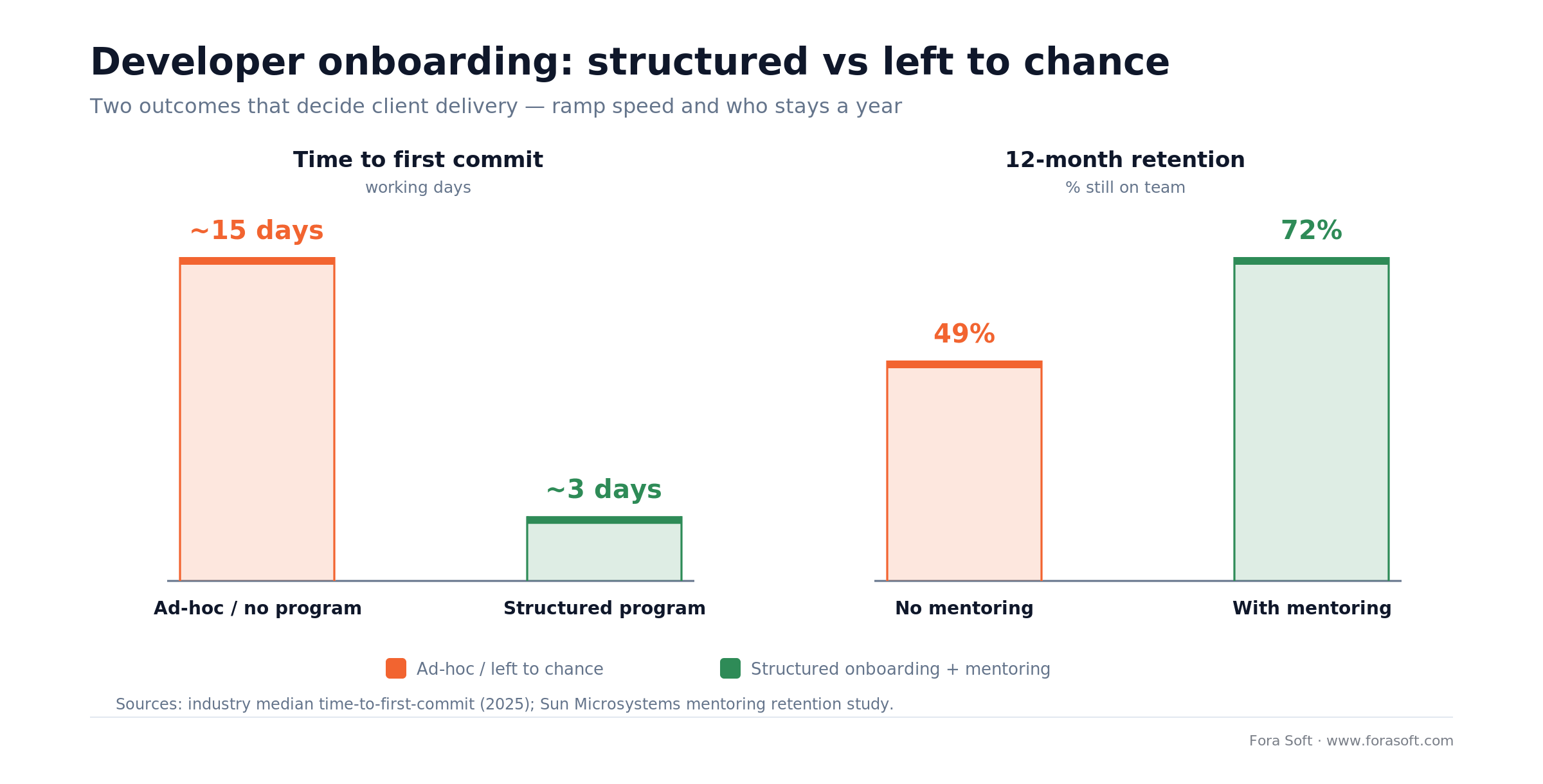
Figure 1. The two outcomes buyers actually feel: ramp speed, and who stays a year. Structured onboarding compresses time-to-first-commit and widens 12-month retention.
Why a “buddy” system was not enough
When we formalized the program, the obvious first move was a buddy system — pair every newcomer with a friendly peer who answers onboarding questions. It has real benefits: lower anxiety, faster first-week velocity, casual culture transfer. But it solves the wrong half of the problem.
A buddy answers “where is X?” A mentor decides “what does good look like at month six, and how will we know you are on track?” Those are different jobs requiring different seniority. Conflating them creates buddies who feel responsible for outcomes they cannot shape, and newcomers who have someone to chat with but nobody accountable for their growth.
Reach for a buddy system when: your company is <20 engineers, onboarding is simple, and culture transfer is your main risk.
Reach for formal mentoring when: engineers bill clients, technical standards matter, and somebody has to be accountable for whether a new hire levels up on schedule.
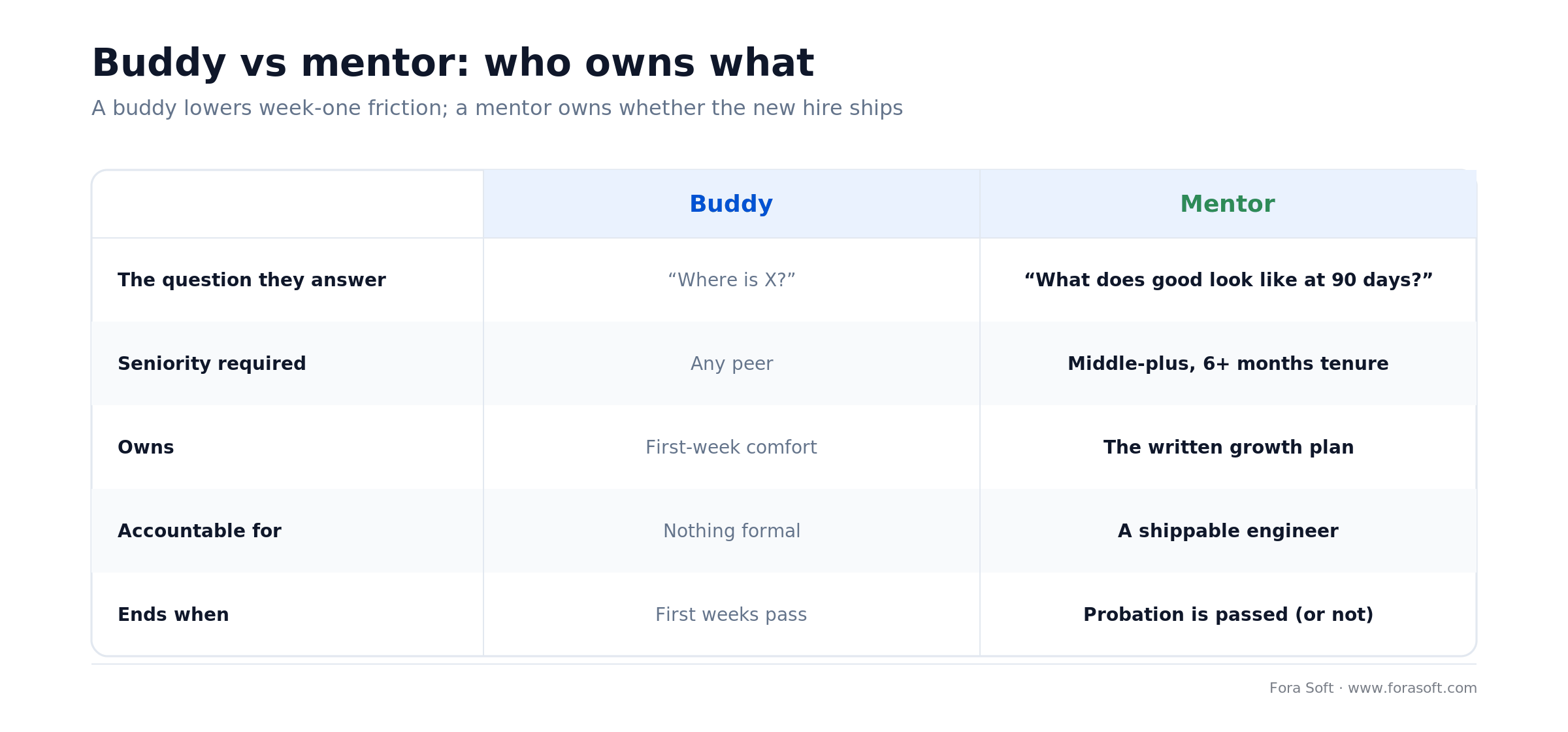
Figure 2. A buddy and a mentor solve different problems. Only the mentor is accountable for whether a new hire becomes shippable.
What a Fora Soft mentor actually does
A mentor owns one outcome: the newcomer is a shippable engineer by the end of probation. That is the headline. Everything else is the instrumentation that makes the outcome visible.
Seven responsibilities, none optional
1. Onboarding to processes. Walk the newcomer through Fora Soft’s delivery model, tooling, code review rules, QA handoff conventions, sprint cadence and client-communication norms. No new engineer touches client code before this step is done.
2. Project assignment fit. Decide which internal project or R&D track the newcomer joins first. A well-matched first project is one of the biggest levers on whether the hire stays.
3. Development plan. Co-create a written 3/6/12-month growth plan with specific skills, deliverables and review dates. Not a vague “learn React better” — more like “ship three features using the client’s state-management pattern and explain the trade-offs in a guild talk.”
4. Bi-weekly 1:1s. Every two weeks at minimum during probation, monthly after. The meeting has a structure: progress against plan, blockers, code-review feedback trends, client feedback trends, next two-week commitments.
5. Velocity and quality tracking. The mentor reviews the newcomer’s pull-request cadence, review-comment density, defect-escape rate, and estimation accuracy, the skill behind why developer time estimates so often miss. A bad trend line triggers intervention before the project manager notices.
6. Problem-solving partnership. Technical stuck-points, client-relationship friction, career confusion — the mentor is the first call. Fast unblocking is the cultural habit we protect most.
7. Exit readiness. At the end of probation, the mentor writes an assessment: proceed, extend probation, or part ways. This assessment feeds our hiring calibration loop back to the selection process.
Two stages of mentoring — probation and growth
Mentoring at Fora Soft is split into a mandatory stage and an opt-in stage. Splitting them is important: one is a delivery guarantee; the other is a growth amplifier. Treating them the same creates the wrong expectations on both sides.
| Aspect | Stage 1 — Probation | Stage 2 — Growth |
|---|---|---|
| Duration | 0–3 months | As long as the engineer wants it |
| Who opts in | Every new hire, mandatory | Any engineer who wants continued growth pressure |
| Frequency of 1:1s | Bi-weekly minimum | Monthly |
| Primary output | Shippable engineer, ready for client projects | Next-level engineer on the career ladder |
| Mentor accountability | To the company (retention, quality, time-to-productive) | To the engineer (growth plan execution) |
| What ends it | Probation completion, pass/fail | Engineer’s choice, or mentor rotation for fresh perspective |
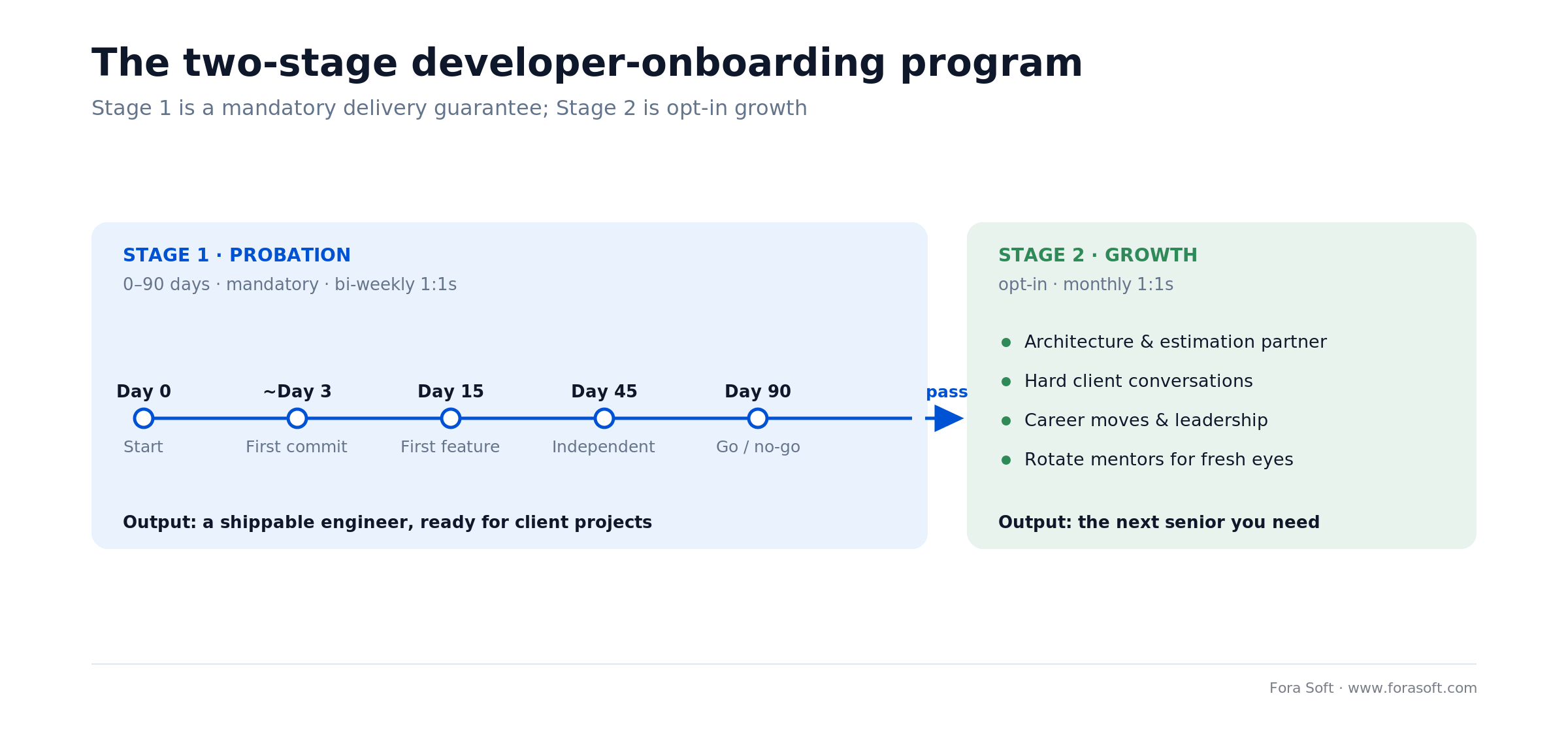
Figure 3. Stage 1 is a mandatory 90-day delivery guarantee with hard milestones; Stage 2 is opt-in growth that runs as long as the engineer wants pressure.
Stage 1 — probation: the delivery guarantee
During probation the mentor runs the program as a delivery project. Introduce the company and processes. Confirm understanding with practical exercises rather than paperwork. Give feedback in the moment on every pull request and again in structured 1:1s. Build the development plan. Watch speed and quality indicators week over week — the first useful signal is time to first commit, where the industry median for a new hire on an unfamiliar codebase runs 2–3 weeks and a structured onboard targets days. Intervene the moment something slows down.
By day 90 the newcomer understands how we build, has real working artifacts behind them, and has survived at least one client interaction under supervision. If not, probation is extended or ended — the mentor is honest because the next client project depends on it.
Stage 2 — growth: the long tail
After probation, the mentor relationship stops being mandatory and starts being valuable. The mentor becomes a thinking partner: debating architecture decisions, stress-testing estimations, helping negotiate difficult client conversations, unblocking career moves. The development plan evolves from “learn our basics” to “become the senior we need next year.”
Engineers can choose to rotate mentors for fresh perspective or stay with the same one for years. Both happen. What does not happen: drifting engineers with no mentor conversation for six months. Managers flag that quickly.
A 30/60/90-day developer-onboarding plan
A developer-onboarding plan sets explicit goals for the first 30, 60, and 90 days so nobody is guessing what “on track” means. Here is the shape we run during probation; adapt the deliverables to your stack.
| Window | Focus | Deliverable | Success signal |
|---|---|---|---|
| Days 0–30 | Environment, codebase and process orientation | First commit, then a first small feature | Ships a low-risk change through the full PR and QA flow |
| Days 31–60 | Own a feature end-to-end with review | A merged feature built on the client’s patterns | Review-comment density trending down |
| Days 61–90 | Work independently; first supervised client interaction | Independent delivery plus a written probation assessment | Go / no-go: shippable on client projects |
Want mentored engineers on your next project?
Every Fora Soft engineer we staff on your team has been through this program. Share your scope and we will propose the fit.
Who gets to be a mentor
The quality of the program is gated by the quality of the mentor pool. Three requirements, no exceptions.
Middle level or higher. A junior cannot reliably separate their own uncertainty from a newcomer’s and tends to over-teach or under-correct. Middle+ engineers have the technical judgment and the social authority the role needs.
Six months minimum tenure. Culture, processes and client relationships all take six months to understand well enough to transfer. A new middle engineer who just joined cannot yet explain why we ship the way we ship.
Explicitly trained. We run short internal workshops on feedback, 1:1 structure, coaching vs. managing, and writing development plans. Good engineers do not automatically become good mentors; the skills overlap but are not identical.
Mentors are paid for the responsibility — it is allocated capacity, not evening heroism. A burned-out mentor produces burned-out mentees.
How mentoring drives growth in practice
A mentor program works through a few specific mechanisms. If any are missing the benefits collapse.
1. Skill and knowledge transfer. The compressed, contextual transfer of tacit knowledge — how we estimate, how we argue, how we push back on scope — is the thing classrooms cannot deliver. New hires absorb this quickly through direct apprenticeship and slowly through bulletins.
2. Accelerated integration. Mentors decode the cultural signals a newcomer misses. Who approves PRs quickly? Which client channels are for escalations? When should you interrupt vs. write things down? Without a mentor, each of these takes weeks of trial and error.
3. Confidence as an engineering variable. Engineers who feel unsupported ship safer code, meaning slower code. Mentoring removes that drag. Confident engineers ask better questions, propose sharper solutions, and push back on ambiguous requirements earlier.
4. Early detection of drift. A mentor who knows someone’s normal can feel when things are slipping — motivational, technical, interpersonal — two months before the PM would notice. This saves entire projects.
5. Retention compounding. Engineers who have a mentor stay longer. Engineers who stay longer become mentors themselves. The program becomes self-sustaining inside ~18 months.
What mentoring looks like from the client’s side
Clients almost never see the program directly. They see its outputs. Four of them are worth calling out.
Lower variance in quality. An agency where every engineer has been trained through the same mentor program ships much more uniformly than one that relies on raw talent distribution. You do not get “great weeks with the senior, rough weeks with the junior.”
Faster ramp onto your codebase. A Fora Soft engineer joining your project has already been through the muscle memory of onboarding into complex codebases. They know what questions to ask, what to read first, and how to make themselves useful by day five.
Smoother handovers. Every engineer has seen how to hand off a feature cleanly — documentation patterns, client-communication handoffs, code review expectations. When team rotations happen, the client barely feels them.
A second opinion one desk away. Your project engineer has a mentor they can consult for architecture calls, difficult design decisions or tough client moments. You effectively get a senior consultant bundled with the engineer, at no markup.
Evaluating software partners for a new build?
Ask every shortlisted vendor how they produce senior engineers. Then compare the answers — it is the cleanest signal you can get in a 30-minute call.
Mini case: mentoring carrying a complex multimedia project
Situation. A secure, real-time video product built on production WebRTC architecture, the kind of multi-year engagement behind projects like VALT (a video platform for regulated and public-sector clients), needed continuity as scope grew. Several engineers rotated through the project as the scope grew. Without program-wide standards, that rotation usually torches velocity.
What mentoring did. Every engineer who joined the project had passed probation mentoring and kept a post-probation mentor during the project. When a new engineer ramped in, their mentor pre-briefed them on the codebase, the client’s communication style and the tricky architectural decisions. First-commit-to-production time stayed under two weeks despite the complexity, fast for a codebase of that size and sensitivity. The mentor also caught the one burnout trajectory that emerged and rotated the engineer off before the client ever noticed.
Outcome. The project shipped on its original timeline, the client extended twice, and three of the engineers who went through it went on to become mentors themselves. That is how the system sustains: every shipped project grows the next year’s mentor pool.
Five pitfalls that kill a mentoring program
1. No paid time for mentors. If mentoring is after-hours volunteering, good engineers quietly refuse. Allocate 10–15% of a mentor’s capacity for the role. Track it like any other work.
2. Pairing by vibes instead of fit. Mentor-mentee chemistry matters, but technical alignment matters more. Pair deliberately; allow fast no-fault rematches within the first two months.
3. Mandatory in perpetuity. Making post-probation mentoring compulsory turns it into a chore. Opt-in preserves the energy that makes it useful.
4. No development plan. “Mentoring” that never produces a written plan degenerates into weekly venting. The plan forces specificity.
5. Mentors who cannot say “no.” A mentor who has not said “this engineer is not ready” in three years is not mentoring — they are approving. Build calibration sessions with HR so the standard does not drift.
Tooling we use to run the program
Tools are not the program, but they reduce friction. Our working set is boring on purpose.
Development plan template. A shared Notion or Confluence doc with a consistent structure: goals, target level, skills to acquire, deliverables, review dates, mentor notes column.
1:1 agenda. Bi-weekly recurring calendar event with a templated agenda: progress since last meeting, blockers, feedback trends, next-two-week commitments, open questions.
Engineering metrics dashboard. Pull requests, review comments, CI flakes and defect-escape data available per engineer so the mentor sees numbers, not just feelings.
Probation review form. A short structured assessment at day 90: technical, client-facing, cultural, growth trajectory. Three reviewers minimum (mentor, project lead, hiring manager).
A decision framework — should your team run a mentor program?
Q1. Do your engineers bill clients by the hour or by the deliverable? If yes, every week of mentoring ROI is directly measurable on client margin. Build the program.
Q2. Do you hire juniors? If yes, a formal program is not optional — juniors without it either churn or ship quality issues. If you hire only seniors, a lighter growth-stage mentor ecosystem is often enough.
Q3. How many new hires per year? Below ~5 hires per year, a formal program is overkill. Above ~15, you cannot afford to leave onboarding unstructured.
Q4. Do you have at least three middle+ engineers who have been at the company for 6+ months? If no, the mentor pool is not yet deep enough. Use an interim lead-mentor-per-new-hire model first and grow the program.
Q5. Are you willing to pay for mentor time? If the answer is “we will ask seniors to do it on the side,” do not start. A half-hearted program is worse than none.
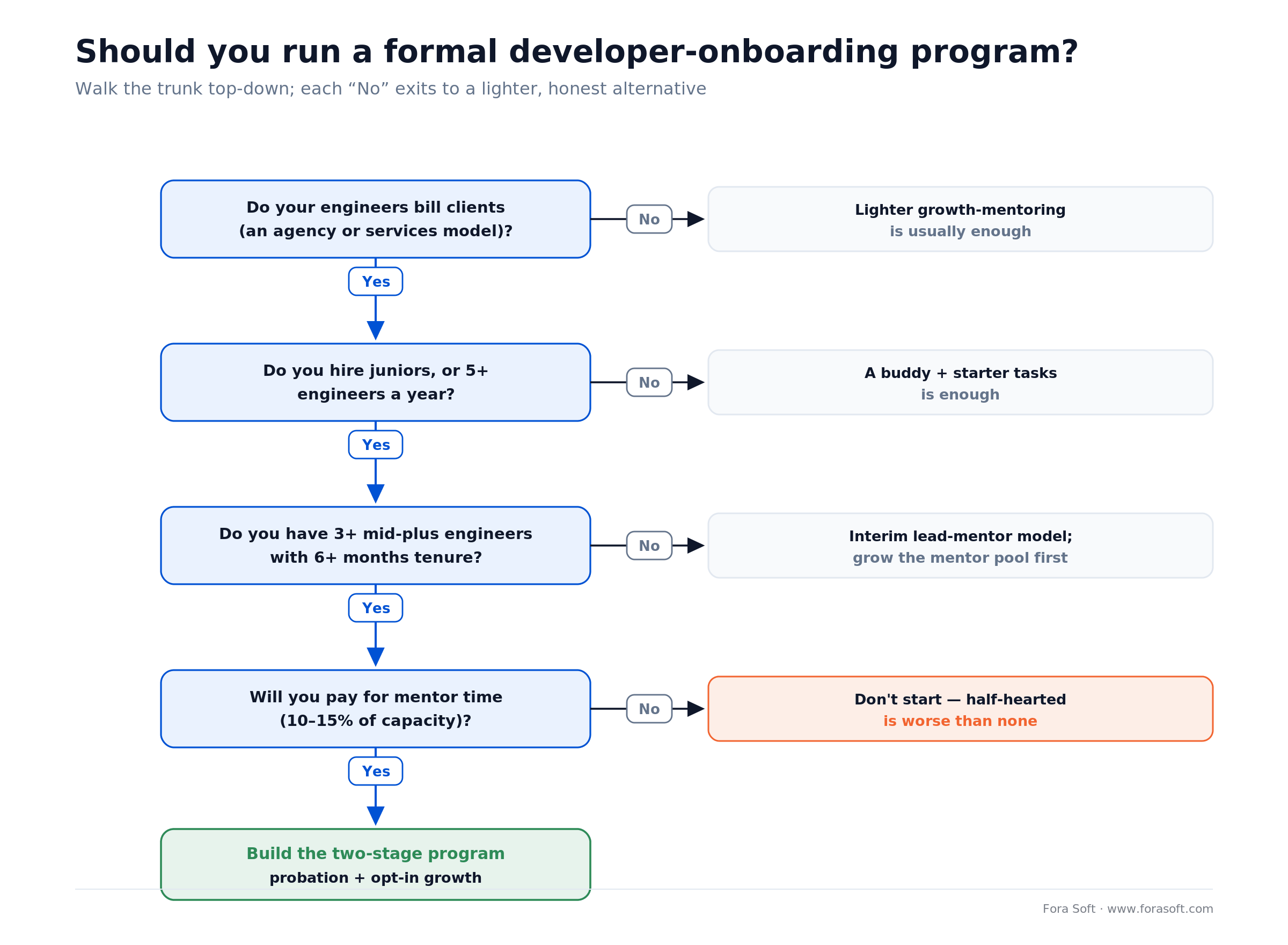
Figure 4. A five-minute test for whether a formal program pays off. Each “No” routes you to a lighter model instead of over-investing.
When you should NOT run a formal mentor program
It is an expensive operational asset. Skip it if any of the below apply.
You are a <10-person startup with no juniors. You do not yet have the mentor pool, and a founders-doing-mentoring shortcut is fine at this scale. Revisit at 15 engineers.
Your engineers are short-term contractors. Mentoring presumes retention is desirable. For true gig work, pair seniors with contractors for knowledge transfer but skip the growth-plan layer.
Your product is at existential risk in the next quarter. If survival is 12 weeks away, you staff for the week, not the year. Re-introduce mentoring after the emergency.
KPIs we watch — three buckets
Quality KPIs. Probation pass rate >85%; defect-escape rate on mentored engineers’ first three sprints <1 per engineer-month; code-review comment density trending downward after the first month; client-flagged issues <0.5 per engineer-month by sprint six.
Business KPIs. 12-month retention of mentored engineers ≥85% (industry average sits closer to 65–75%); time-to-first-billable <8 weeks; internal promotion rate on growth-stage mentoring roughly double the unmentored baseline.
Reliability KPIs. 1:1 attendance rate >95% during probation; development-plan completion rate ≥80% at six months; mentor and mentee satisfaction both ≥8/10 in quarterly pulse surveys. A program where either score drops below 7 for two quarters in a row gets re-designed, not ignored.
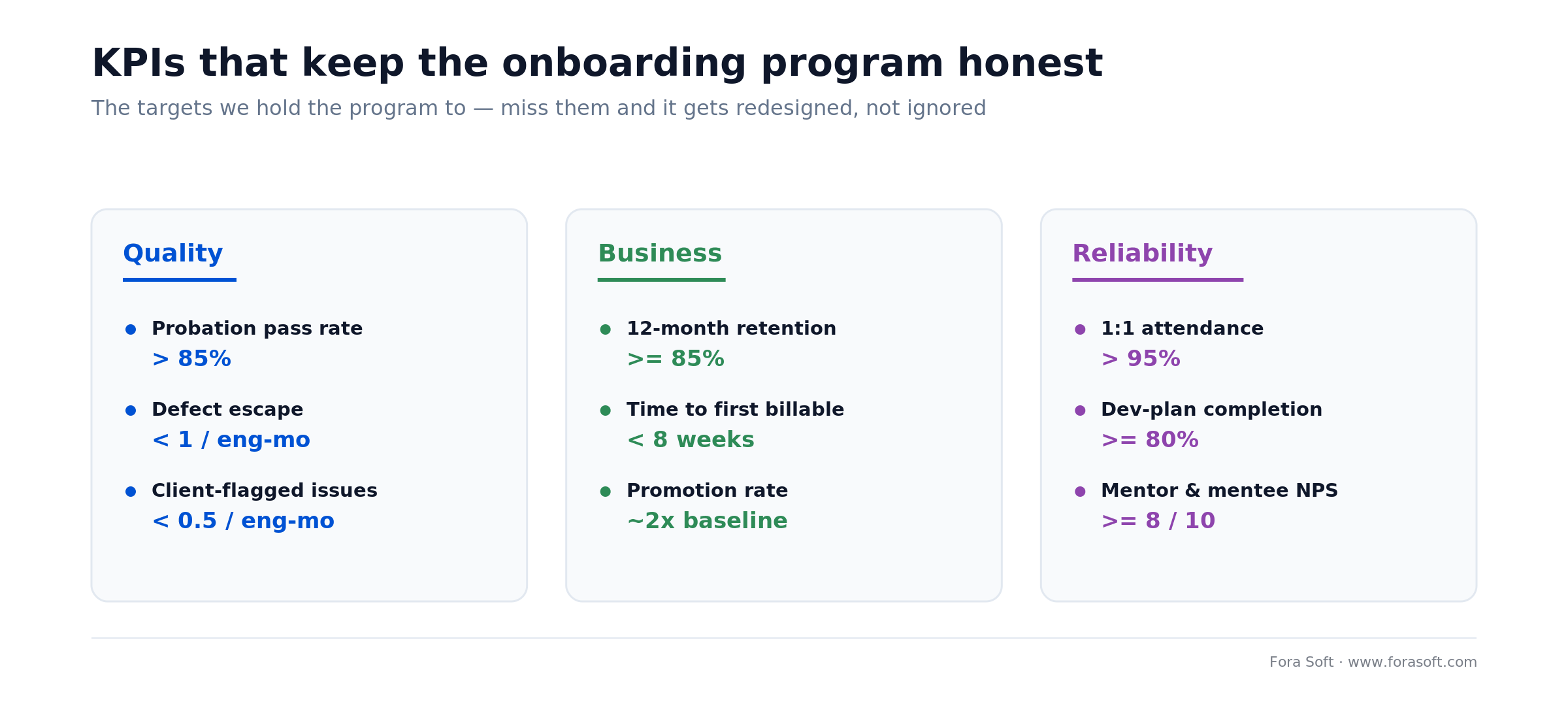
Figure 5. The targets we hold the program to. A mentoring program without numbers becomes a vibes program.
How agent-engineering reshapes the mentoring conversation
AI-assisted development changes the shape of what newcomers need to learn. Boilerplate, test scaffolding and routine bug fixes get compressed. What remains — and gets more valuable — is judgment: picking the right abstraction, designing the right API surface, choosing which review comments to push back on, and knowing when a generated patch looks right but is subtly wrong.
This is the same shift behind our move to spec-driven agentic engineering and how we fold AI into the software-development process. So the mentor conversation shifts. Less “here is how to set up a webpack config,” more “here is how to read the AI’s suggestion, here is why I would not ship it, here is how to have that conversation with the client.” The probation timeline compresses in straightforward skill areas and stretches a little in judgment-heavy ones. Net, mentored engineers hit billability sooner and with better defect profiles.
Reach for AI-augmented mentoring when: your teams ship client code daily, routine tasks are already automatable, and the skills gap you care about is judgment, not syntax.
Growing the mentor pipeline as the company scales
The bottleneck in a mentor program is rarely money or process — it is the supply of people qualified to mentor. A few rules of thumb that keep the pipeline healthy as the team grows.
Plan the mentor pool 12 months ahead of hiring. If you expect 15 new hires next year, you need at least 8–10 active mentors, which means starting growth-stage mentoring on candidates 12 months before you need them to carry a newcomer.
Rotate explicitly. Good mentors should rotate mentees every 12–18 months to avoid fatigue and to expose mentees to different styles. A program that locks pairs forever eventually calcifies.
Reach for external mentors when: your internal pool is shallow, a specialized domain needs fresh perspective, or a senior engineer has plateaued on internally-sourced feedback.
Invest in mentor training. Running two or three internal workshops per year on feedback, coaching and plan-writing keeps the mentor standard rising. A stagnant mentor becomes a liability; an improving one becomes a force-multiplier.
Measure the program, not the mentor. Mentor performance is hard to evaluate fairly and easy to game. Evaluate the program outcomes — retention, pass rates, client satisfaction on mentor-sourced engineers — and fix weak parts of the pipeline rather than fingering individuals.
FAQ
How long does mentoring last at Fora Soft?
The mandatory probation stage lasts the engineer’s first three months. The optional growth stage can continue for years — some of our engineers have been in growth-stage mentoring since they first joined, just with a rotating mentor bench.
Is mentoring the same as management?
No. A manager owns performance, compensation, hiring and firing decisions. A mentor owns growth: plan, feedback, coaching, technical calibration. The two roles share information (often daily) but the accountability is different. Keeping them separate prevents the mentor conversation from becoming a performance review.
Who picks the mentor for a new hire?
Engineering leadership, in consultation with the hiring manager, picks an initial pairing based on technical alignment, availability and personality fit. The newcomer can request a rematch within the first two months, no questions asked. We would rather rematch than let a bad fit degrade six months.
How does mentoring affect the clients Fora Soft works with?
Clients see the effects indirectly: lower quality variance across engineers, faster onboarding onto client codebases, smoother team rotations, and a second-opinion senior one seat away from their project engineer. It is not a feature we charge for separately — it is why the work lands the way it does.
Do seniors need mentoring?
Yes, but differently. For seniors the mentor is often a peer from a different part of the company, or a mentor chosen specifically to push them on leadership or architecture. A senior without a mentor tends to stop learning new things past the second year — we watch for that plateau.
How do you prevent favoritism?
Mentors do not make compensation or promotion decisions alone. Assessments are calibrated across mentor, project lead and hiring manager. Mentor rotations are encouraged so no one engineer is “only visible” through one mentor’s eyes. This is a common failure mode in less-structured programs.
Does agent-engineering change how you mentor?
It changes the pace. AI-assisted delivery compresses the timeline on routine work, so mentors focus more on judgment, architecture trade-offs, client communication and the parts of software engineering that do not automate. Mentorship becomes even more valuable, not less.
How does this relate to the hiring process?
Selection and mentoring are paired. The hiring process sets the floor on who walks in; mentoring sets the ceiling on how far they climb. Each feeds the other: post-probation assessments surface patterns we then correct in hiring. Read the companion selection playbook.
What is developer onboarding?
Developer onboarding is the structured process of getting a newly hired engineer from day one to productive, autonomous work on real projects. It covers environment setup, codebase and process orientation, a first shipped task, and a written growth plan — usually measured across the first 90 days.
How do you onboard remote developers?
The same two-stage program, run asynchronously: a documented environment setup, a buddy for week-one questions, a mentor who owns the growth plan, bi-weekly video 1:1s, and a small low-risk starter task in the first days. Remote developer onboarding lives or dies on written documentation and a clear first task, not on desk-side osmosis.
What to Read Next
People
How Fora Soft Selects Top Developers for Your Project
The selection side of the same pipeline: how we filter candidates before mentoring begins.
Process
The Role of a Customer Success Manager
Why a dedicated CSM shortens the distance between client intent and engineering execution.
Trust
Is it a Good Idea to Share Source Code with a New Developer?
How we handle source-code trust boundaries when bringing new engineers into client projects.
Services
Custom Software Development
What Fora Soft’s mentored engineers actually build — across web, mobile, AI and multimedia.
Portfolio
Fora Soft Project Portfolio
250+ delivered projects since 2005 — what mentored engineers produce at scale.
Ready to work with mentored engineers on your next project?
A mentoring program is not what you put on a careers page — it is how you guarantee the engineer you put on a client’s project next month will still be shipping in two years. Fora Soft treats mentoring as infrastructure: two stages, paid mentor time, written development plans, measured outputs, rotated assessments. That is why our client engagements stick and our engineers keep levelling up past the point where most shops lose theirs.
If you are sizing up a software partner, ask them this question and see if they have a real answer. If you want to talk through your project with our team, we are a call away.
Let’s scope your project with mentored engineers
30 minutes with Vadim. We will walk scope, team shape and delivery cadence — the kind only a mature mentor pipeline makes predictable.

