

Key takeaways
• The anonymous voice chat app is a narrow but durable market. Clubhouse crashed 80% in six months, Yik Yak died twice, but BlaBlaPlay, Airchat, and swipe-based voice social apps are still adding users — because voice-only + anonymous solves a real problem text chat doesn’t.
• Trust & safety is the product, not a feature. UNC banned Yik Yak on every campus in 2024 and COPPA penalties now reach $53,088 per violation in 2025. You cannot ship an anonymous mobile voice app without real-time AI moderation.
• Voice AI moderation now costs cents per minute. Deepgram or AssemblyAI STT ($0.0025–$0.0035 per minute) piped into a moderation API or on-device CoreML classifier lands well under 15 cents per 10-minute call. That’s small enough to ship to day-one users.
• BlaBlaPlay is our in-house proof. We built an iOS + Android voice app with swipe discovery, AI prompts, on-device CoreML moderation, and an auto-escalation admin flow. It launched in months, not years, using the same playbook below.
• The winning architecture in 2026 is LiveKit + OpenAI + on-device ASR. Sub-second voice, under $0.20 for a 10-minute call end-to-end, and a clear path to add AI hosts, live translation, and voice agents without rewriting the app. That headroom is the point: it is what makes generative AI in a voice product an increment rather than a rewrite.
Why Fora Soft built BlaBlaPlay — and why it matters to you
For more than two decades we’ve shipped real-time video, voice, and AI products for clients — 250+ delivered projects and a 100% Upwork job-success score. After so much client work we wanted a product we owned, one that would let us stress-test every pattern we recommend to founders: anonymous onboarding, voice-first UX, AI moderation, swipe discovery, and neural-net ranking. That product is BlaBlaPlay on iOS and Android.
This article is a playbook built around that experience. If you’re weighing an anonymous voice chat app, social audio product, or swipe-based communication app, you’ll get the exact architecture, the real costs, and the compliance map we now use on client projects — not the glossy version. We also use BlaBlaPlay as the running example because it lets us be specific about what actually worked, what we removed, and what a 2026 launch should include from day one.
Building an anonymous or voice-first social app?
Tell us your concept. We’ll map it to a stack, a cost model, and a moderation strategy that keeps you compliant with COPPA, DSA, and App Store review — free, on a 30-minute call.
What BlaBlaPlay actually is
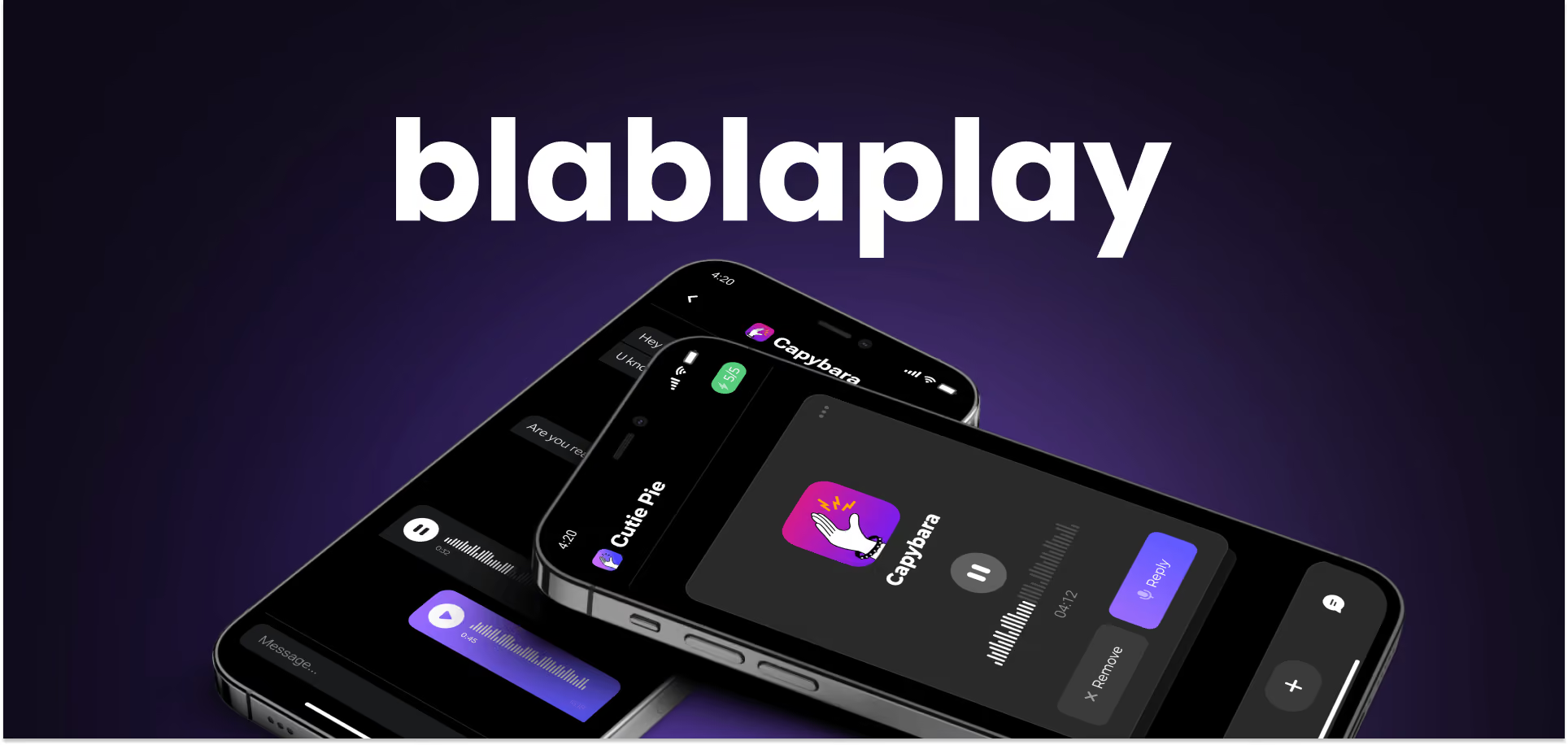
BlaBlaPlay is a mobile, anonymous, voice-only social app with a Tinder-style discovery feed. Users record short voice cards, swipe through other users’ cards, and reply to the ones that resonate — by voice or text. Sign-up is reduced to Apple ID or Google login; no name, no phone, no email visible. The app generates the nickname (one of thousands of options like “Batman” or “Slim Shady”) and a “chattering hand” avatar from 7,000+ accessory/background combinations.
Three behaviour archetypes emerged in week one: active chatters (post cards daily, respond to most feeds), observers (swipe a lot, reply rarely), and modest ones (listen to cards without engaging). The feed, moderation, and AI-prompt system all needed to work for each archetype, or you lose two thirds of your users.
Three product decisions carry the whole app:
1. Voice-only, no video. Voice-only lowers the barrier to post. ChatRoulette-style video requires lighting, camera quality, and social risk most users don’t want. Voice turns a 4am thought into a 15-second card.
2. Anonymous by default. No profile photos, no full names, no friend graph import. Anonymity is exactly what lets strangers have the conversations they won’t have on Instagram.
3. Tinder-like swipe discovery on voice cards. Swipe-to-skip is the only UX that scales a voice feed without algorithmic chaos. The card either hooks you in the first three seconds or you flick past.
Why voice-only social is a real market in 2026, not a 2021 fad
Social audio looked dead after Clubhouse lost roughly 80% of its audience from peak 10M users to about 3.5M in six months. Spotify shut down Greenroom. Twitter Spaces plateaued. The takeaway isn’t “voice is over” — it’s that live, long-form, panel-style audio was a pandemic-specific behaviour.
What survives and grows in 2026 is the opposite shape: short, asynchronous, anonymous voice messages embedded in social feeds. Airchat (voice-first microblogging), Yubo voice rooms, swipe-based voice apps in Japan and Southeast Asia, and BlaBlaPlay itself all fit the pattern. Voice gives texture that text can’t; anonymity removes the social tax of “being on”; async removes the scheduling problem that killed Clubhouse.
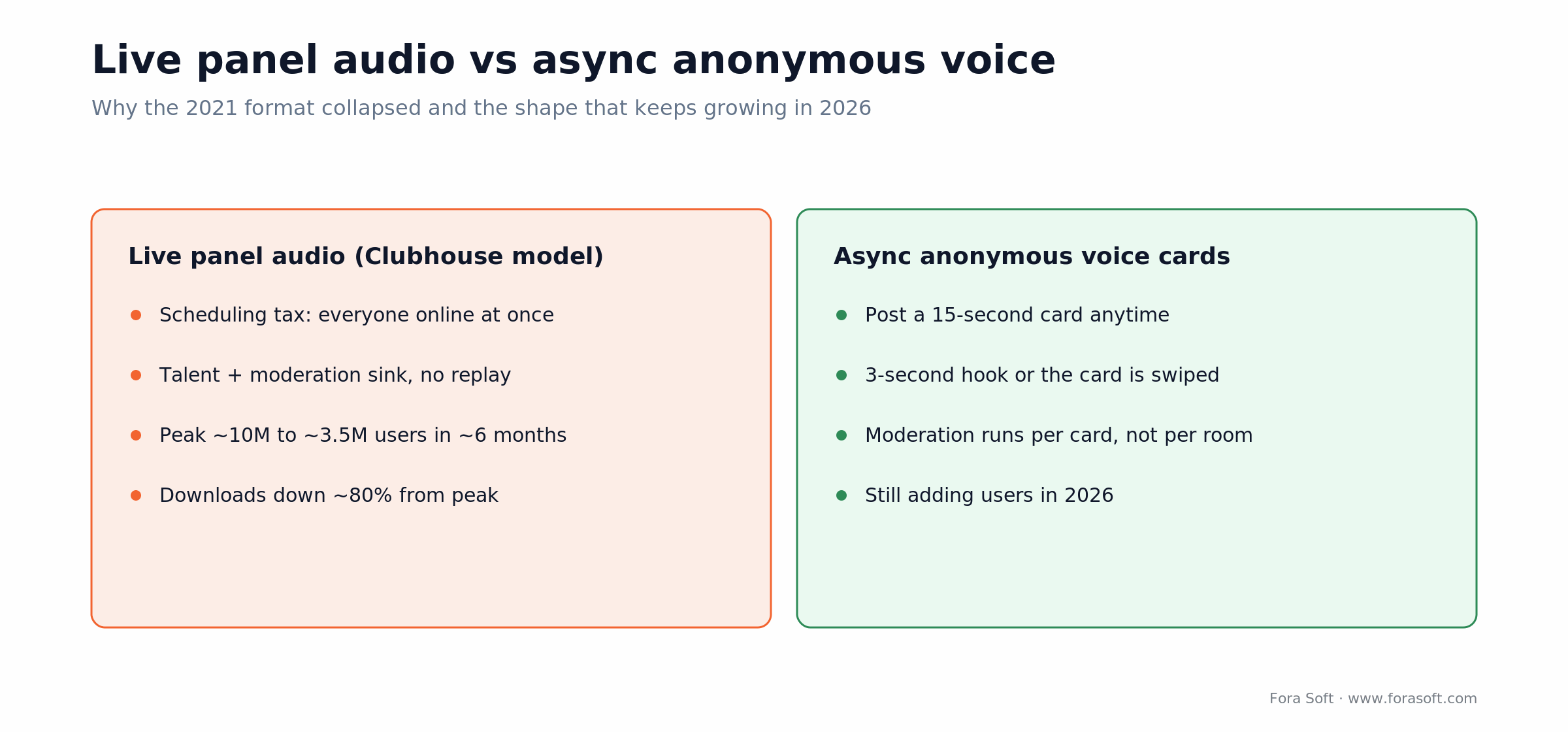
Figure 1. The format that collapsed vs the one that keeps growing: live panels died on the scheduling tax; async voice cards moderate per card and post anytime.
If you’re evaluating the space, the bar is clear: ship moderation before growth, ship voice quality before features, and ship discovery UX before anything else. For the transport layer underneath all three, our guide to voice chat APIs for games and social apps compares the SDKs and the build-vs-buy math.
The anonymous social app hazard list
Anonymous apps collect a specific set of failure modes. The ones that survived (Whisper, Reddit in spirit, some regional apps) did one thing: they adapted trust & safety faster than growth. The ones that died (Yik Yak twice, Secret, Sarahah, NGL, Sendit) didn’t.
Harassment and bullying. Anonymity is a bullying accelerant unless you make reporting one-tap and escalation automatic. The UNC System banned Yik Yak, Fizz, Sidechat, and Whisper on every campus in March 2024.
Minors. The FTC’s 2025 COPPA amendments reaffirmed that voice recordings count as personal information requiring verifiable parental consent, and the maximum civil penalty rose to $53,088 per violation (inflation-adjusted, January 2025; up from $51,744 in 2024). Without a real age gate, you can ship the app once.
App Store removal. Apple and Google both pull anonymous apps whose UGC moderation response time is too slow. Apple expanded age ratings to 13+/16+/18+ with a January 31, 2026 recertification deadline.
Regulatory exposure. EU’s DSA requires transparent moderation reporting and a privacy-preserving age verification path. FTC enforcement against NGL in 2024 ($5M settlement) is now the template.
The takeaway: an anonymous voice chat app in 2026 needs a moderation stack that is literally part of the core product, not a service you bolt on after a PR incident.
Rule of thumb: if you can’t describe — to an Apple reviewer — how you detect and remove a racist voice message within one minute, you’re not ready to launch.
The swipe-based voice feed: mechanics that actually retain
Swipe discovery is, at heart, variable-reward psychology: every card might be great or terrible, and that unpredictability drives the loop. Tinder co-founder Jonathan Badeen put it plainly — “unpredictable yet frequent rewards motivate users to keep moving forward.” Our job in BlaBlaPlay was to apply the same loop to voice without devolving into noise.
Two iterations we shipped are worth copying:
1. We started with an “energy” scale, then killed it. Each swipe cost one of ten energy units, replenishing hourly. It nudged posting behaviour, since you earned energy by posting, but it capped exploration. We raised the cap to 100, then removed it entirely in favour of a like-button. Lesson: artificial scarcity kills discovery engagement before it kills posting engagement.
2. The three-second rule. The card must hook within three seconds of auto-play, or it’s swiped. We tuned the audio trim, the waveform preview, and the auto-play start point to honour that window. Cards that fail the three-second rule silently get deprioritized.
Those two calls — no friction on exploration, fast audio hook — did more for retention than any notification strategy. For broader retention patterns we used the Hook Model, which is still the cleanest framework for consumer social products.
AI moderation: how BlaBlaPlay keeps voice cards clean without humans-in-loop everywhere
The BlaBlaPlay moderation stack has three stages, each cheap and fast enough to run on every card:
1. On-device transcription via CoreML. We run speech-to-text on the iPhone itself using CoreML and a distilled speech model. No audio leaves the device for simple cases, which cuts latency, cost, and privacy risk.
2. A neural classifier for offensive language. We trained a lightweight text classifier on a domain-specific dataset (slang, multilingual slurs, thinly coded harassment) to flag a card the moment the transcript is available. Cards that cross a confidence threshold are auto-queued for human review; cards that cross a hard threshold are auto-muted pending that review.
3. Admin escalation + community reports. A one-tap report button surfaces cards to moderators. After three valid complaints, the account is permanently disabled. This is the only place with guaranteed human-in-loop; everything upstream is automated.
We’ve since added cloud-based checks for multilingual edge cases using the same pattern our clients use on video content — see our work on speech recognition accuracy in noisy environments for how we tune ASR when device audio is mediocre. Wiring this pipeline into a product is the core of our AI integration work.
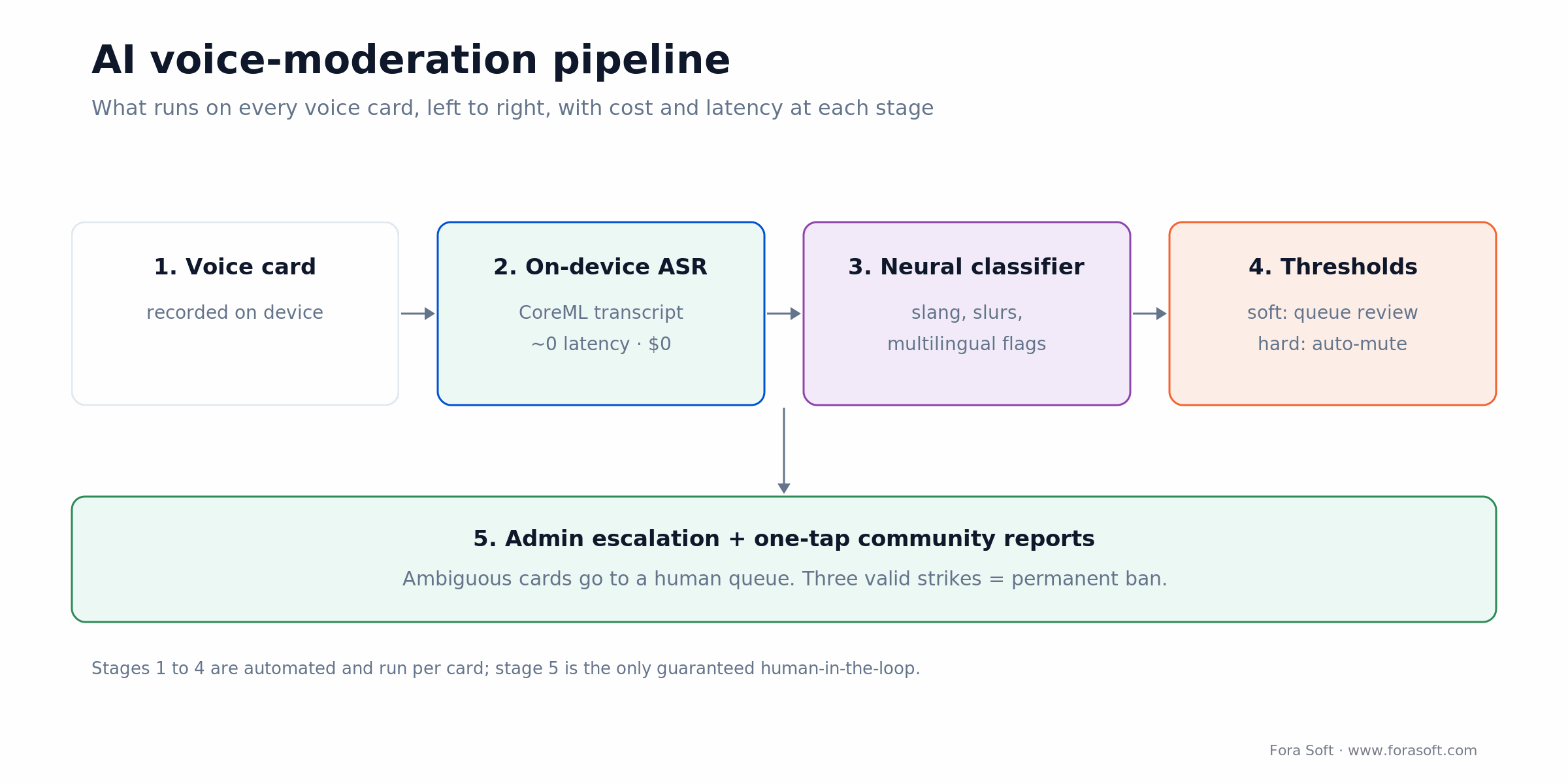
Figure 2. The four automated stages run on every card; only ambiguous cases and repeat offenders reach a human.
AI prompts: beating the silent-reply problem
Early in BlaBlaPlay’s life we saw a pattern that kills social audio: users would listen to a card, want to reply, freeze, and swipe. We tried a chatbot first. Users rejected it as robotic and off-topic. The version that stuck is simpler: when a user hovers on reply, we transcribe the source card, ask ChatGPT for three conversation starters grounded in that card’s content, and surface them as optional prompts. The user can tap one, record their own reply, or skip.
Reply rate on cards with AI prompts enabled rose noticeably versus the non-prompt control. More importantly, conversation depth (average replies per thread) improved, because the prompts nudged users toward specific, answerable threads rather than generic “nice card.”
This pattern — a small, contextual LLM assist that reduces a single user friction — is one of the most underused AI primitives in consumer apps. If you’re building any voice or chat product, you should scope it before you scope a chatbot.
Want AI prompts or voice moderation in your app?
We’ll scope the cheapest way to add contextual AI assists and on-device moderation to your mobile product, and hand you a rough cost shape before you commit.
Voice infrastructure: LiveKit vs. Agora vs. Twilio in 2026
Most voice-social apps pick between three providers. BlaBlaPlay uses a voice stack built on proven SFU patterns; for new 2026 client projects our default is LiveKit because of its AI-agents ecosystem. Here’s how they compare when you actually price them out (rates from LiveKit’s pricing page, checked July 2026):
| Provider | Per-minute cost | Self-host? | AI-agents ecosystem | Best for |
|---|---|---|---|---|
| LiveKit Cloud | ~$0.0005/min, 5K free (Build) | Yes (open source) | Richest (Agents framework) | Voice AI, moderation, self-host path |
| Agora | $0.99 / 1K min voice | No | Moderate | Global reach, SD-RTN <40ms |
| Twilio Programmable Voice | $0.0040 / min | No | Limited | PSTN dial-in, SIP, telecom |
| Self-host (Pion, mediasoup) | Infra-only | Yes | You build it | Deep customization at scale |
Reach for LiveKit when: you’re starting a voice-social or voice-AI product in 2026 and expect to add AI agents, transcription, or moderation within six months. See our LiveKit AI Agents guide and the deeper LiveKit for AI agents course for the full stack.

Figure 3. Cost against AI-agents ecosystem. LiveKit sits in the cheap, agent-rich corner — the reason it’s our default for new voice work.
A realistic AI-moderation cost model
The number that usually scares founders — “AI moderation will eat my margin” — is not supported by 2026 pricing. Here’s the bottom-up build for a 10-minute voice call processed end-to-end:
| Layer | Provider | Per-minute cost | 10-min call |
|---|---|---|---|
| Speech-to-text (cloud) | Deepgram Nova / AssemblyAI | $0.0025–$0.0035 | ~$0.03 |
| Speech-to-text (on-device) | Apple CoreML / Android NNAPI | Free (compute only) | $0 |
| Text moderation | OpenAI Moderation / Hive / Spectrum Labs | $0.001–$0.01 | $0.01–$0.10 |
| Voice transport (SFU) | LiveKit Cloud | ~$0.0005 / conn-min | ~$0.01 (2 legs) |
| AI conversation prompts | OpenAI gpt-4o-mini | ~$0.01 / prompt | ~$0.03 (3 nudges) |
| Total per 10-min call | — | — | $0.08–$0.17 |
For a short voice card (15–30 seconds), the full stack costs fractions of a cent. Even at Clubhouse-era concurrency the numbers work. The catch is that your ad, subscription, or premium tier must still out-earn them. A full breakdown for AI voice products is in our multimodal agents cost model.
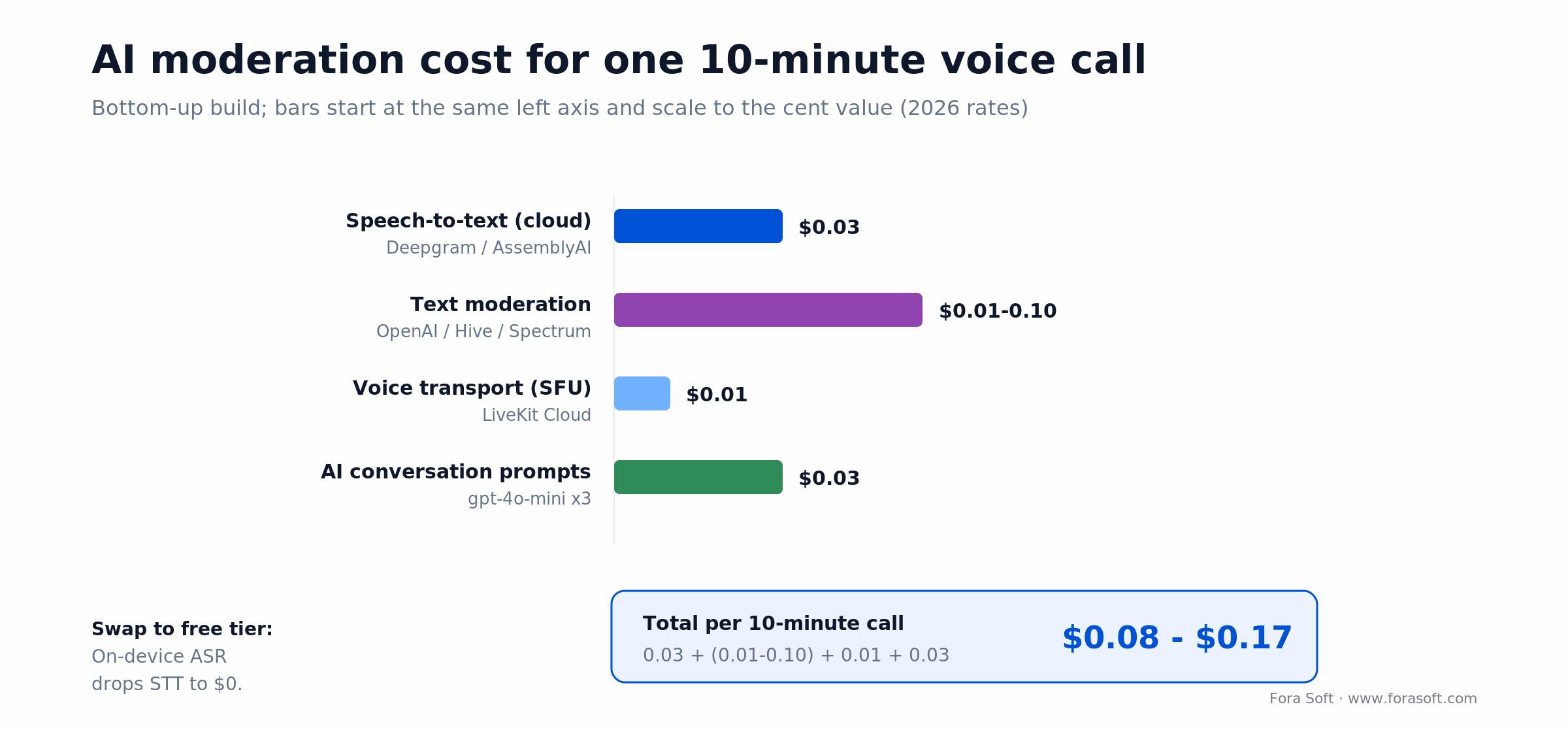
Figure 4. The full moderation-plus-transport stack for a 10-minute call lands between 8 and 17 cents — and on-device ASR drops it further.
Retention mechanics that work for anonymous voice apps
1. Smart recommendations over chronological feed. BlaBlaPlay’s feed surfaces fresh and popular cards more than reported ones. This is the single biggest lever on D7 retention; chronological feeds expose users to too much noise.
2. Contextual push, not generic push. Apps with contextual notifications see open rates near 14.4% versus 4.19% for generic sends; more than six pushes per week multiplies the uninstall rate by 3.4 (Airship 2026 benchmarks). The rule is fewer, more specific, tied to actual replies and matches.
3. Push primer before the native permission. An in-app screen that asks “enable notifications?” before iOS/Android shows the real prompt lifts opt-in by 20–40%. iOS opt-in averages 56–58%, Android 67% with the 13+ permission model, so the primer matters on both sides now.
4. Reply-completion rituals. Every card has exactly one next action: reply, like, or swipe. No mid-feed settings screens, no interstitial ads, no side-panel explorations. A clean ritual is a retention mechanic.
5. Weekly high-quality recap. A once-weekly “top cards you missed” push gets a sleepy user back in the app without training them to check for drops.
Reach for this when…
…your D7 is under 18% and your team is tempted to bolt on badges, streaks, and notification spam. Before adding more mechanics, audit push cadence and feed ranking first — the two levers that move retention the most on anonymous voice apps.
Monetization paths for an anonymous voice social app
Most social apps try to monetize too early and kill growth; the good ones wait for retention then layer value. Four patterns fit BlaBlaPlay-style products without breaking anonymity:
1. Premium subscription. Unlimited swipes (we removed energy, so this is symbolic), longer voice cards, background themes, priority visibility. $2.99–$5.99/mo hits a reasonable LTV without alienating free users. Our app-revenue breakdown covers the SaaS and IAP mix.
2. Consumable in-app purchases. Premium cosmetic hands, custom background sets, voice filters. Consumables outperform subscriptions in casual social apps because they feel like a one-time treat.
3. Creator tips. A tiny tip button on cards lets listeners reward strong voices; the platform takes a small cut. This only works once you have enough concurrent listeners that the tip has reach.
4. Native ads between cards. Ad load in swipe-style feeds is an art. Every third or fourth card turns the experience hostile; every seventh or eighth feels fair. Ads are the last lever to pull, not the first.
Pricing sanity check
Benchmark your blended ARPU against the free-social median (roughly $0.30–$1.20/month/MAU depending on geography). If your projection needs ARPU above that range to hit break-even, either the monetization stack is too thin or the cost model is too fat — don’t ship until the unit economics fit.
Compliance map: COPPA, KOSA, DSA, App Store in 2026
COPPA (US). The COPPA Rule (16 CFR Part 312) treats voice recordings as personal information; collecting them from anyone under 13 without verifiable parental consent risks a $53,088-per-violation penalty. The cheap answer: age gate at signup, reject under-13 accounts, and route any voice data accordingly.
KOSA (US). Passed the Senate in July 2024; still in legislative limbo at the time of writing. Assume a duty-of-care framework will land within the product’s lifetime and ship with moderation logs that can survive audit.
EU DSA. The Digital Services Act requires transparency reports, a contactable trust-and-safety point, and a risk assessment if you hit large-platform thresholds. For sub-threshold apps, the DSA baseline (clear terms, fast takedown, appeals) is enforceable on every app touching EU users.
Apple and Google Play. UGC apps must provide a report/block button, fast removal, and transparent moderation. Apple extended age ratings (13+/16+/18+) with a January 31, 2026 recertification deadline; anonymous apps need unambiguous classification. Our app-store approval guide covers the reviewer’s full checklist.
Realistic 2026 budget to build a BlaBlaPlay-style app
We scope bottom-up and accelerate with Agent Engineering (AI-assisted design, code, and tests), which is why our custom software development estimates tend to land below typical agency rates. Rough ranges for comparable projects in 2026:
Lean MVP. iOS + Android, anonymous login, swipe feed, voice recording/playback, basic moderation, 1 AI feature. 10–14 weeks, roughly $55–$95K. Good enough to test retention with 1K–10K DAU.
Production-ready. Add neural-classifier moderation pipeline, LiveKit-class transport, AI conversation prompts, push orchestration, age gate, reporting, analytics, and admin tooling. 16–22 weeks, typically $110–$180K.
Scale-ready. Add real-time AI translation, multilingual moderation, creator tip rails, subscription + IAP, A/B framework, and regional compliance (DSA, COPPA workflows). 6–9 months, $220–$380K. This is where we help clients mature a BlaBlaPlay-grade product into a growth platform.
For the estimation method we use, see our software estimation guide; for mobile-specific cost drivers, the 2026 mobile app cost guide.
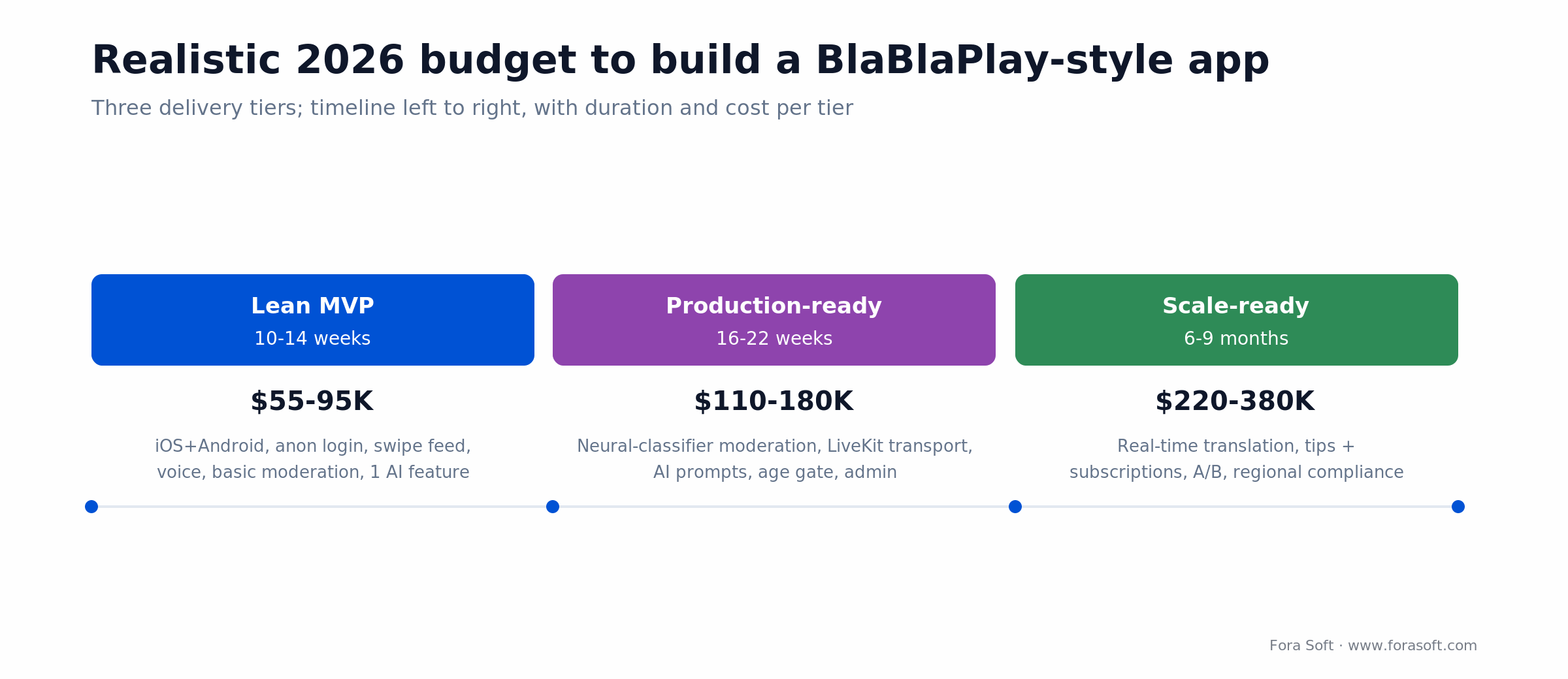
Figure 5. Three tiers, from a retention-test MVP to a compliance-ready growth platform, with duration and cost for each.
Need a grounded estimate for your voice-social app?
Send us your feature list. We’ll walk through the moderation stack and a realistic range based on what we built on BlaBlaPlay and comparable client projects.
Mini-case: BlaBlaPlay from concept to shipped in months
Situation. We wanted a product of our own that would test anonymous voice, swipe discovery, and AI moderation at real mobile latency — the primitives we keep being asked to build on client projects. The hypothesis: voice-only, no personal data, swipe UX, and a real AI moderation pipeline is a viable consumer shape in 2026.
12-week plan. We shipped an iOS + Android app with anonymous Apple/Google login, nickname and avatar generation (7,000+ combos), voice card recording with compression tuned for spoken cadence, a Tinder-style swipe feed, ChatGPT-driven conversation prompts, a CoreML-powered on-device moderation classifier, and an admin escalation flow with a three-strikes auto-ban.
Outcome. In under a quarter, BlaBlaPlay went from concept to a fully operating mobile product with unique features, a working content-safety stack, and swipe-based engagement mechanics. We killed the “energy” meter after the first growth cohort; we added AI prompts after watching users freeze on reply; we re-ranked the feed once the moderation data gave us clean signals. The product is still live and shipping improvements. Want us to run a similar 12-week shape on your voice-social idea?
A decision framework: should you build a voice-first social app?
Q1. Is voice actually better than text for your use case? If the content is informational or transactional, text wins. If it’s emotional, confessional, or performance-led, voice wins.
Q2. Can you enforce real moderation at the speed of growth? If your moderation relies on humans-only, you can’t. Start with on-device ASR + classifier + report loop before DAU 1,000.
Q3. Are you willing to block under-13 users outright? COPPA doesn’t offer a graceful middle. Block and move on, or go all-in on verifiable parental consent — the middle path is the expensive one.
Q4. Do you have a distribution story that survives no-personal-data? No friend graph import, no contact matching, no Facebook-style growth. Anonymous apps grow via TikTok, paid social, referral incentives, or community seeding.
Q5. What is your stance when Apple pulls the app for a moderation incident? You need an incident playbook, a transparency report cadence, and an escalation channel with the reviewer. That conversation should happen before launch.
Five pitfalls we see on voice-social apps
1. Treating moderation as a phase-two project. Every failed anonymous app did this. Ship moderation before growth, or don’t ship.
2. Copying Clubhouse’s live-audio format. It’s a talent-and-moderation sink with no async replay. If you must include live rooms, bolt them onto an async feed — not the other way around.
3. Letting the voice card run longer than 30 seconds by default. Discovery dies past ~30s. Offer a “long-form” variant if you must, but keep the feed cards short.
4. Shipping chatbots before shipping prompts. Users reject chatbots in creative contexts; they accept contextual AI suggestions. Do the latter.
5. Ignoring push notification fatigue. Six or more pushes a week triples uninstalls. Keep them contextual, short, and infrequent, and prime the permission before you ask for it.
KPIs: what to measure so you know it’s working
Quality KPIs. Cards posted per DAU, reply rate, average reply depth, completion rate of auto-played cards, and moderation false-positive rate (flagged but clean) versus false-negative (missed offensive content). False-negative is the one that gets you banned; keep it under 0.5%.
Business KPIs. D1 / D7 / D30 retention, ARPDAU from subscriptions + IAP + ads, cost per install across channels, and net promoter among active chatters (your evangelists). Premium conversion target for a voice-social app at scale is 3–6% of MAU.
Reliability KPIs. Voice card upload success (>99%), median card-to-feed latency (<5s), moderation decision latency (<1s on-device, <3s in cloud), and admin ticket backlog (< 8 hours). DAU patterns drive every infra decision upstream of these.
When to not build a voice-social app
You’re chasing the Clubhouse wave. Gone. The behaviour changed. Chase async voice with strong moderation, not live panels.
Your audience is under 13. The regulatory surface is too hostile for anyone but an established kidtech company with parental-consent infrastructure.
You can’t fund moderation. If the budget won’t cover ASR + classifier + admin tooling, the product will fail publicly. Pick a smaller shape.
Your differentiation is “anonymous.” Anonymous is a wrapper, not a value prop. Your differentiator is what users do once they’re anonymous — debate, confession, expert Q&A, late-night company. Pick that and reverse-engineer the app.
FAQ
How is BlaBlaPlay different from ChatRoulette or Clubhouse?
BlaBlaPlay is voice-only (no video), fully anonymous (no personal data), and asynchronous — users swipe through recorded voice cards rather than joining live rooms. That removes the lighting, scheduling, and performance pressure that killed live social audio, while keeping the intimacy voice gives you over text.
How does AI moderation work for voice content?
The standard 2026 stack is speech-to-text first (Deepgram, AssemblyAI, or on-device CoreML), then a text-moderation classifier (OpenAI Moderation, Hive, Spectrum Labs, or your own neural net trained on slang and multilingual slurs). Cards that cross a confidence threshold get auto-queued for human review; those that cross a hard threshold get auto-muted. In BlaBlaPlay we run CoreML on-device to keep latency and cost low, then escalate ambiguous cases to the cloud.
How much does it cost to moderate voice content per user?
Cloud ASR runs around $0.0025–$0.0035 per minute; on-device ASR is effectively free. Text moderation is $0.001–$0.01 per request. Together, a 10-minute voice call’s full moderation pipeline costs roughly 3–10 cents. For short voice cards (15–30 seconds) it’s a fraction of a cent.
Is an anonymous voice chat app still viable after Yik Yak and NGL?
Yes, but only with serious trust & safety from day one. Yik Yak was banned by the UNC System across every campus in 2024; NGL settled with the FTC for $5M in 2024 over deceptive practices. The surviving anonymous apps shipped fast moderation, clear reporting, and good age gates early. Ship those and anonymity is still a valuable primitive.
Which voice infrastructure should I pick for a new app?
For most consumer apps in 2026 we recommend LiveKit — open source, self-hostable, with the richest AI-agents ecosystem and predictable pricing (~$0.0005 per connection-minute, 5,000 minutes free on the Build tier). Agora is the right call when you need sub-40ms SD-RTN performance across 200+ countries. Twilio is still the choice for telecom and PSTN. Self-hosting Pion or mediasoup makes sense at very large scale or when you need deep customization.
What do Apple and Google require for an anonymous UGC app in 2026?
Fast in-app reporting, transparent moderation, a block function, a clear privacy policy, account deletion, and an appropriate age rating under Apple’s 13+/16+/18+ scheme (recertification deadline Jan 31, 2026). Google Play has a similar UGC policy. Any app that fails these gets pulled without warning. Full review checklist: our app-store approval guide.
How long does it take to build a BlaBlaPlay-style app?
A lean MVP (iOS + Android, swipe feed, voice record/play, basic moderation, one AI feature) ships in 10–14 weeks with a senior team. Production-ready (neural-classifier moderation, LiveKit-class transport, AI prompts, push, age gate, admin tooling) is 16–22 weeks. Scale-ready with translation, monetization, and regional compliance is 6–9 months.
Can AI prompts replace a chatbot inside a social app?
They should. In our own tests, users rejected chatbots as robotic inside a creative-social context but accepted short, contextual LLM-generated conversation starters that built on the other user’s voice card. The difference is whether AI replaces a human or lowers the friction of one — users reward the second, reject the first.
What to read next
Voice AI
LiveKit AI Agents Guide 2026
The voice-AI stack we recommend for new mobile voice products: Deepgram, OpenAI, Cartesia end-to-end.
Cost model
Multimodal AI Agents on LiveKit: Cost & Compliance
A bottom-up build of per-call economics for voice and vision agents, plus EU AI Act and HIPAA notes.
Retention
App Abandonment: Why Users Leave and How to Retain Them
The Hook Model applied to mobile social apps, the framework behind BlaBlaPlay’s feed mechanics.
Compliance
How to Get Your App Approved on Google Play and App Store
The reviewer’s checklist that matters when shipping a UGC app with anonymous accounts and voice.
Cost guide
2026 Mobile App Development Costs
What a realistic budget looks like when AI, real-time voice, and compliance all land on one mobile app.
Ready to ship a voice-first social app that survives 2026?
Anonymous voice chat is a narrower market than Clubhouse promised, but a more durable one than 2021 assumed. The winners don’t look like panel rooms — they look like short, voice-only feeds with aggressive moderation, cheap AI assists, and discovery UX that respects the user’s attention. BlaBlaPlay is our bet that the shape is still wide open for new entrants who take moderation and cost seriously from week one.
If you’re evaluating a voice-first or anonymous social idea, the three things we’d push you on are: pick LiveKit-class infrastructure, run AI moderation from day one using on-device ASR + cloud escalation, and design the swipe feed so the card hooks in three seconds or it’s gone. The rest is product craft and consistent shipping.
Want us to ship your voice-social idea?
Talk to the team that built BlaBlaPlay. We’ll map your concept to an architecture, a realistic timeline, and a moderation strategy that clears App Store review on the first try.

