
Key takeaways
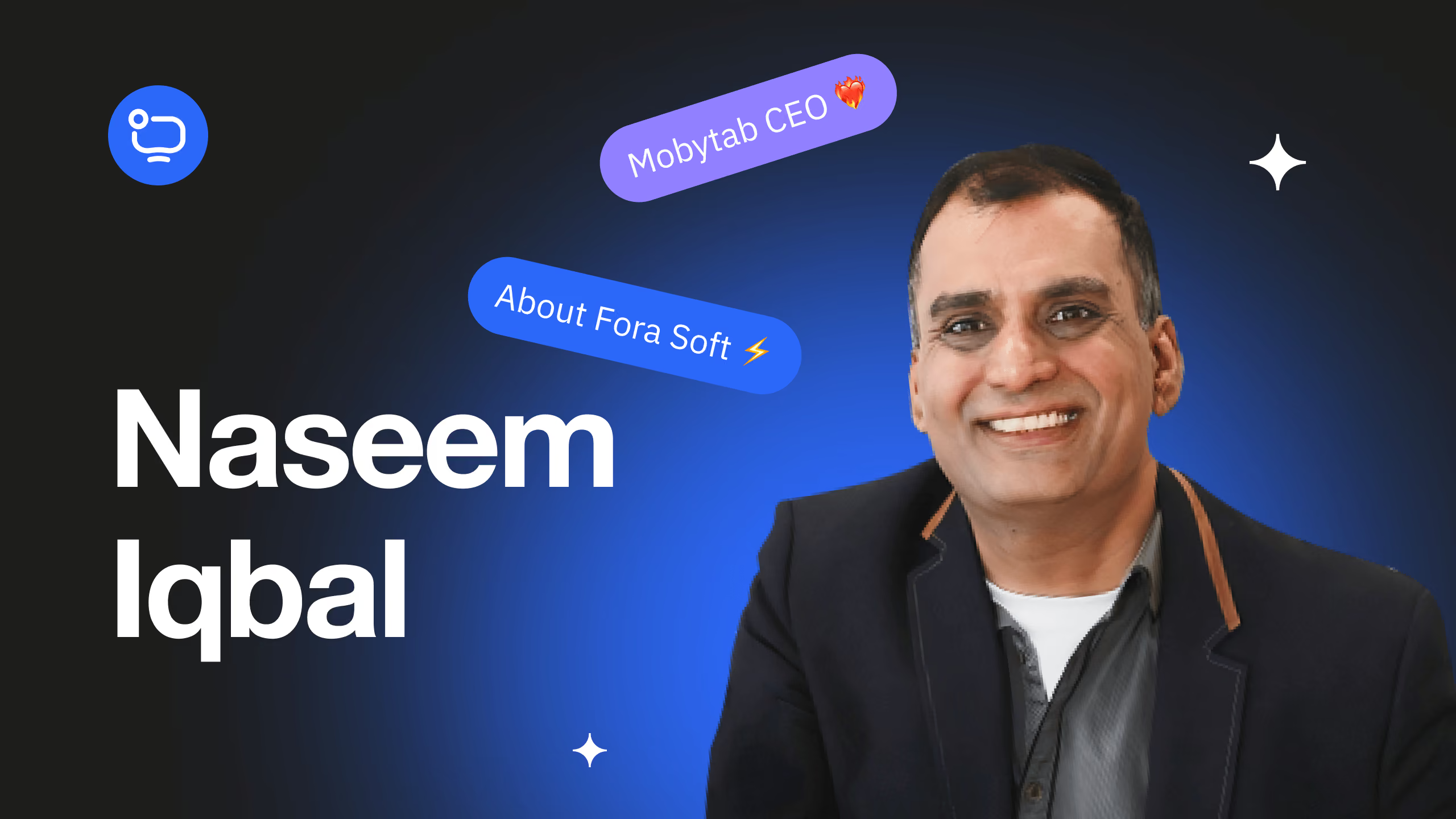
• Five years of partnership, one 10/10 rating. Naseem Iqbal, CEO of MobyTap, switched from another vendor to Fora Soft in 2016 and stayed for 5+ years across a full video-review platform build on iOS, Android and Web.
• “Several months of work saved.” MobyTap was stuck 4–5 months on a “find any business in the world by domain” feature. Our team proposed integrating Google’s fresh Android Places SDK — problem solved, budget preserved, feature shipped.
• Aftercare is the differentiator most vendors miss. “You’ve raised the bar so high now, I expect it from every company” — Naseem’s verdict after five years, contrasting us with UK-local competitors.
• Verified 30-second video reviews still differentiate today. MobyTap lets consumers record short verified video reviews; businesses gather authentic feedback and build trust — a format that pre-dated TikTok UGC reviews and still converts.
• The pattern repeats across 250+ products we’ve shipped since 2005. Budget-appropriate scope, first-principles problem-solving, long-running aftercare — the combination that turns “a dev agency” into a named referral engine.
Why this testimonial matters to buyers
If you’re evaluating a software development partner, a five-year client relationship with a clean 10/10 rating and a detailed public interview is rarer than a G2 badge. Naseem Iqbal came to Fora Soft in 2016 from a different vendor mid-build, stayed through the launch and through years of iteration, and agreed to record the conversation below on camera.
This page is more than a testimonial. It’s a breakdown of the specific decisions that turned a recycling entrepreneur’s first app idea into MobyTap, a verified-video-review platform that still ships on iOS, Android and Web. Every lesson below repeats on the projects we ship this year.
Want the same experience Naseem had?
30 minutes with Vadim — the same person Naseem says “swooped in and won me with his personality.”
Meet Naseem — a recycling veteran with a first-time app idea
Naseem Iqbal spent 15 years in the recycling business before the idea for MobyTap came. His customers loved his company; short verified video reviews looked like the most honest way to capture that. He had no app-development background, no technical co-founder, and a budget that had to do real work.
He started with another vendor through an online auction platform. They were local, they had offers on the table, the contract was already signed. Our Head of Sales Vadim still reached out. What followed became a five-year story about how a serious partner plus small-budget discipline can outperform a bigger-budget mistake.
The first conversation — why Naseem switched mid-build
In Naseem’s words: “Amazingly it was Vadim who found me. I was on an online auction platform; I had lots of offers, and I chose my company. But when Vadim approached me, I was like, okay, let’s chat. His personality and everything he did was professional. I thought ‘even though we’ve done the contract with somebody else, why not.’ He asked me to give Fora Soft an opportunity, and I did. And that’s where the ball got rolling.”
Vadim showed Naseem a curated set of relevant prior work — not a generic deck. That’s how our first calls still start today. We don’t carry a 60-slide capabilities deck; we carry the three to five projects that look most like yours.
Lesson 1 — You’re allowed to change vendors mid-build
This is the lesson we hand most often to prospective clients who think they’re locked in. If the current vendor is burning months without shipping — Naseem had lost “a lot of time” and had been “messed up” by his first team — changing is the rational move. The sunk cost is already sunk.
How we de-risk a switch. We start with a paid audit of the existing codebase, a realistic re-scope, and an honest assessment of what’s salvageable. In MobyTap’s case we rewrote the app and Naseem cancelled the previous contract; in other cases we keep the existing code and ship from where it sits. The decision is always the client’s, with our numbers on the table.
Reach for a mid-build switch when: the current vendor has missed two consecutive milestones, communication has degraded to weekly async updates, and the codebase review by an independent team shows fundamental rework is required.
Lesson 2 — First-time founders need a partner, not a contractor
Naseem: “It was my 1st time developing an app. I’ve been in the recycling business for the past 15 years. So when the idea came to me, I thought recycling and video apps are worlds apart. … Sounds simple, but when you get into it, you realise that it’s not as simple.”
First-time founders don’t need somebody to turn a Figma into Swift. They need a partner who can push back on scope, translate between business goals and engineering trade-offs, and own the quality bar when the founder is learning the vocabulary. That’s why our custom software engagements default to a product-shaped team with a dedicated project manager, not a bucket of hours.
The hardest technical problem — the whole world’s domain names
MobyTap needed to let a reviewer type any company’s name, detect their location, and resolve the correct local business automatically. In 2016 that problem genuinely had no good off-the-shelf solution.
Naseem: “We got stuck where we needed to make it simpler for the users to input the domain name of any company in the world. If you’re doing a review, the app would find where you’re located and find the local business you’re reviewing. Nobody in the world had done that. … We were stuck for 4–5 months.”
Our engineers noticed that Google had just shipped their Places SDK for Android. One suggestion later: “We could do it.”
Lesson 3 — First-principles engineering saves months and budget
Naseem: “You guys literally saved me a fortune by coming up with an idea of how to get the whole world’s domain names into the app.”
The pattern generalises. Most app-development problems are solved faster by stepping back than by pushing harder. A new SDK, a different protocol, a platform feature that landed last quarter — these are usually the difference between “impossible” and “shipping next sprint.” Our engineers are rewarded for watching the platform release notes and asking “does this change the problem?” before coding anything.
Stuck on a problem for months?
Sometimes the answer is a new platform SDK nobody on your team has tried. Let us take a fresh look.
“It was all about communication” — why process matters more than hours
Naseem again: “Not many crashes. It’s just been a continuous improvement. So all we’ve been doing is improving the app, making it better. And your team is fabulous. It was all about communication, and getting my message to you. You guys made life very easy, and that’s what the business is about.”
Our engagements run on a small set of communication patterns: a dedicated PM who owns the translation from business to engineering, two-week sprints with live demos, a shared Jira/Notion workspace where every decision leaves a trace, and direct access to the engineers who wrote the code. Nothing glamorous; just the discipline most clients realise they had been missing only after they leave a previous vendor.
Aftercare — the feature Naseem says raised the bar for every vendor after us
Naseem: “The best thing with Fora Soft is aftercare. You’ve raised the bar so high now, I expect it from every company. The aftercare was so great, and the communication was amazing, it blew me away. Even in the UK here, in England, we don’t get that aftercare.”
That’s now a productised service — software product maintenance and support. Monthly retainers that cover crash monitoring, App Store / Play Store submission support, dependency updates, security patches and feature-sized upgrades. Most clients who stay past year one move onto this track.
10/10 across professionalism, communication and dedication
Asked to rate on the three standard agency dimensions, Naseem’s answer was: “Not even thinking about the score. It’s 10/10 straight up.”
That rating appears verbatim on the MobyTap project page and is published in structured data on our site so search engines and AI answer engines can surface it. It’s part of a larger body of evidence: we were named a top iOS app development company for 2026 by Techreviewer, and we’ve shipped 250+ products across 21 years.
What to take away if you’re evaluating a partner
1. The sales call is a preview of the project. If it’s generic, the project will be generic. Naseem switched to Fora Soft after a single conversation where Vadim showed relevant examples rather than reading from a deck.
2. First-time founders deserve an opinionated partner. Scope push-back, honest trade-offs and transparent numbers matter more than “yes to every request.”
3. Small budgets can still ship great products. “If you got a small budget or a high budget, you’ve managed it perfectly.” The difference sits in prioritisation, not in total hours.
4. Aftercare compounds. Five years of continuous improvement is possible; five years of feature-freeze is the common default. Pick a partner who plans for year two on day one.
5. Referrals are the honest marketing channel. Naseem’s closing line — “if somebody needs a video app, I instantly think of you and pass them your number and details” — is the kind of growth a services business works for.
Who Fora Soft is today — 250+ products, 21 years of video specialisation
Since 2005 we’ve shipped 250+ software products, specialising in real-time video, AI, WebRTC and mobile. We’ve built platforms at the scale of BrainCert (500M+ classroom minutes, 99.995% uptime), TransLinguist (NHS UK contract, 30,000+ interpreters, 75+ languages), TradeCaster (22k+ trading-community users) and dozens of other named projects.
MobyTap was one of the projects that taught us the shape of the work we do best: first-time founders with distinctive ideas, budget discipline, long runways, and a clear commercial intent. That’s still who we ship for today.
What we offer today that MobyTap didn’t have in 2016
Ten years of platform improvements add up. The core offering that worked for MobyTap is still custom software development with a dedicated team. What’s new since 2016:
Agent-Engineering. Our Agent-Engineering practice makes builds 30–40% faster than 2024 benchmarks, especially for video and AI-heavy projects.
AI integration. AI integration services ship OpenAI, Anthropic, Deepgram, ElevenLabs, custom Core ML models — features that didn’t exist when MobyTap launched.
Real-time video at scale. WebRTC, LiveKit, MediaSoup, Twilio and Agora specialisation through dedicated service pages for each.
Dedicated-team model. A dedicated team engagement when the client already has a product person and just needs engineering horsepower.
How to start the conversation Naseem had in 2016
The 2016 conversation happened over email and a cold call. The 2026 version is simpler. Book 30 minutes with Vadim directly through Calendly — he’s still the first person you speak to. Bring one or two questions, a rough budget idea, and the deadline you care about. You’ll leave the call with a concrete next step.
If your current vendor is stuck and you want a fresh read, we’re happy to do a one-hour code review before any commercial conversation. The pattern Naseem followed — “even though we’ve done the contract with somebody else, why not” — is how most of our long-running engagements begin.
Looking for the “you guys know what you’re doing” feeling?
Five years of referral-driven growth didn’t happen by accident. Bring us your project; we’ll show you how.
A decision framework — pick your next vendor in five questions
Q1. Did the first call show relevant work, or a capability deck? If it was a deck, keep looking.
Q2. Will you speak to the engineers who will write the code? If not, the communication layer is already broken.
Q3. Can the vendor describe what aftercare looks like in year two? If “we’ll see,” they’ll disappear at launch.
Q4. Do they publish named client references that pick up the phone? Anonymous quotes don’t count.
Q5. Are they willing to say ‘no’ during scoping? Yes-vendors ship bloated products that don’t retain users.
Pitfalls to avoid when picking a development partner
1. Optimising on hourly rate. The cheapest team is usually the most expensive one by launch. Naseem paid twice because his first choice was the cheapest.
2. Asking for a fixed price before scoping. Fixed prices encode the vendor’s worst-case assumption. Time-and-materials with a capped scope is almost always cheaper.
3. Ignoring geographical overlap. You need four hours a day of working-hours overlap. Zero overlap turns two-day tasks into two-week tasks.
4. Skipping the post-launch SLA. Crash, dependency-security and store-compliance support has to be contracted before launch, not negotiated from the hospital bed.
5. Not asking who your PM will be. The PM is 80% of the delivery experience. Names, not roles.
KPIs to track with any development partner
Quality KPIs. Crash-free session rate ≥99.9% (iOS) / ≥99.5% (Android); P95 critical-path latency; App Store rating trend; MetricKit / Firebase Crashlytics velocity.
Delivery KPIs. Sprint completion rate ≥85%; story-point variance <15% per sprint; number of release cycles per quarter.
Relationship KPIs. Founder NPS on quarterly cadence; share of feature ideas that originate from the engineering team; referral velocity once the product is live.
When we are not the right partner
If you need a pure staff-augmentation shop with five developers by Monday and no product involvement, we’re the wrong fit. If your product is a commodity CRUD back office with no real-time, video, audio or AI component, we’ll under-earn our specialisation. And if the founder’s expectation is a weekly “yes,” the honest push-back in our scoping calls will feel like friction rather than help.
Any of those three? We’ll say so on the first call and recommend someone else. Five years of MobyTap started because we said yes; plenty of relationships in our pipeline start because we said no to a mismatched scope.
FAQ
How did Naseem find Fora Soft in 2016?
Vadim, Fora Soft’s Head of Sales, found Naseem on an online auction platform for development services and reached out — even though Naseem had already signed with another vendor. One conversation, a curated set of relevant prior work, and Naseem gave us a chance. Five years later, a 10/10 rating.
Is it really possible to switch vendors mid-build?
Yes, and we do it several times a year. We start with a paid audit of the existing codebase, assess what’s salvageable, and quote a realistic re-scope. Sometimes the answer is a full rewrite (that’s what MobyTap needed); sometimes we keep the existing code and ship from where it sits. The client always makes the call with our numbers on the table.
What is “aftercare” exactly, in engineering terms?
A monthly retainer (or time-and-materials pool) that covers crash monitoring, dependency and SDK updates, App Store / Play Store submission support, security patching, minor UI fixes and small feature work. It keeps the app alive between major releases and prevents the slow decay most indie apps suffer a year after launch. See our maintenance and support service page.
Do you still work with first-time founders in 2026?
Yes. Roughly a third of our new engagements each year come from first-time founders with a clear commercial idea and limited dev experience. They get the same product-shaped team Naseem had — dedicated PM, senior engineers, sprints with live demos, honest scope push-back.
What industries does Fora Soft specialise in?
Real-time video and audio (streaming, conferencing, events, interpreting), AI (agents, voice, recognition, content generation), healthcare video, e-learning, video surveillance, fintech trader communities, and mobile-first consumer apps. The projects page has 30+ named case studies across these verticals.
How do I get a realistic estimate for my project?
Book 30 minutes with Vadim. Bring a product brief (even a one-pager), any wireframes or competitor apps you like, and a rough budget envelope. You’ll leave with a stage-by-stage timeline, a team composition and a transparent rate card. For quick self-serve numbers, try our build calculator.
Is MobyTap still live?
The iOS, Android and Web apps were live for years on Naseem’s brand. You can see the full project write-up on our MobyTap case page, including the verified 30-second video review format and the “find any business in the world by domain name” feature we unlocked in 2016.
What to Read Next
About us
21 Years of Fora Soft — 250+ Shipped Products
How a video-first specialisation compounded into two decades of referrals.
Testimonial
Michael from ALDA App on Custom AI-Powered Development
Another founder story, this time an AI-first app partnership.
Recognition
Fora Soft Named a Top iOS App Development Company in 2026
Independent validation of the pattern Naseem describes.
Process
Why Every Custom Software Product Needs a Customer Success Manager
The aftercare role in Fora Soft projects, explained.
Ready to have your own “you guys know what you’re doing” moment?
Naseem’s five-year story with Fora Soft is one of 600+ we could tell. The pattern is the same in most of them — a careful first conversation, a product-shaped team, a hard technical problem solved by reading the platform release notes, and an aftercare layer that keeps the app alive for years. It’s the reason referrals still generate the majority of our new business.
When you’re ready to start your version of that story, we’re one call away.
Let’s start your five-year story
30 minutes with Vadim — same person who made the first call to Naseem in 2016. Bring your project idea; leave with a concrete next step.

