


A mistranslated sentence in a sales call loses a deal. A mistranslated sentence in a telehealth consent conversation loses a lawsuit. In 2026 nearly every video platform can translate a call, so the hard question isn’t whether yours can. It’s whether it does so under one second, in the languages your users actually speak, with speaker turn-taking, domain vocabulary, and the compliance paperwork to back it up. Most tools clear two of those five. We’ve shipped multilingual video features since 2005, and this is the honest breakdown of the seven we integrate today, plus what each one costs once your call volume grows.
Key takeaways
• Two architectures decide your latency. Cascaded speech-to-text→translate→speech runs 800 ms–2 s and stays auditable; end-to-end speech-to-speech runs 400–700 ms and keeps the speaker’s voice.
• If you already pay for Teams, Meet, or Zoom, start there. All three shipped real-time voice or caption translation in 2025–2026 at no extra per-minute cost on business tiers.
• Consumer apps still can’t translate live calls. WhatsApp translates messages, not calls; Skype shut down in May 2025. Link-based tools fill the gap for one-off calls.
• Build only when you own the product or the compliance surface. A custom stack on Google Cloud runs about $18k/month at 300K minutes; self-hosting drops it near $10.5k after a one-time build.
• Compliance is the silent tiebreaker. HIPAA BAAs that cover the translation path, EU data residency, and the EU AI Act Article 50 disclosure rules (in force 2 August 2026) decide enterprise bids.
Why Fora Soft wrote this playbook
We’re a software company that has built real-time video products since 2005: 250+ shipped projects, 50 engineers, and one flagship (VALT) running for 770+ organizations and 50,000+ active users. Multilingual calls run through a lot of that work: virtual classrooms, telemedicine, cross-border legal depositions. We’ve integrated every tool on this list at least once and migrated between them at least twice, usually because a compliance clause or a latency number that looked fine in a demo fell apart at production volume.
One example we keep coming back to: BrainCert’s WebRTC virtual classroom serves 100K+ customers and has handled 500M+ classroom minutes, a lot of them multilingual. That volume teaches you fast which vendor promises survive contact with real users. This guide is a procurement playbook, not a listicle: for each tool we tell you where it wins, where it quietly breaks, and what year-two costs look like. For the architecture underneath it all, see our deeper real-time speech translation guide.
Adding translation to your video product?
Book a 30-minute architecture call — we’ll map the right latency, language, and compliance stack for your use case.
How video call translation actually works
Every tool in this guide is one of two shapes under the hood, and the shape sets your latency ceiling before you write a line of code.
Cascaded pipeline (speech-to-text → translate → speech). Audio hits a speech-recognition model (Whisper, Google Chirp, Deepgram), the transcript is translated (DeepL, Google, Meta NLLB), and an optional text-to-speech layer speaks it out. Getting that first stage right is the foundation of any speech-to-text development effort. It’s mature, composable, and easy to audit, since you can log every stage. The catch: errors compound across three models, the latency floor sits around 800 ms–2 s, and it throws away the speaker’s voice and intonation.
End-to-end speech-to-speech. One model takes audio in and emits audio in the target language. Google’s Gemini 3.5 Live Translate (June 2026) and Meta’s open-weights model sit at this frontier. The payoff is 400–700 ms latency and preserved prosody: the translated voice sounds like the person, not a robot. The cost is fewer language pairs, harder debugging, and heavier infrastructure.
In 2026 enterprise defaults are still cascaded, because auditability matters and a human interpreter can slot in cleanly. Consumer products and AI assistants are moving to end-to-end. If your product is both, run cascaded for the caption track and speech-to-speech for the voice track. Here’s the short version in one picture.
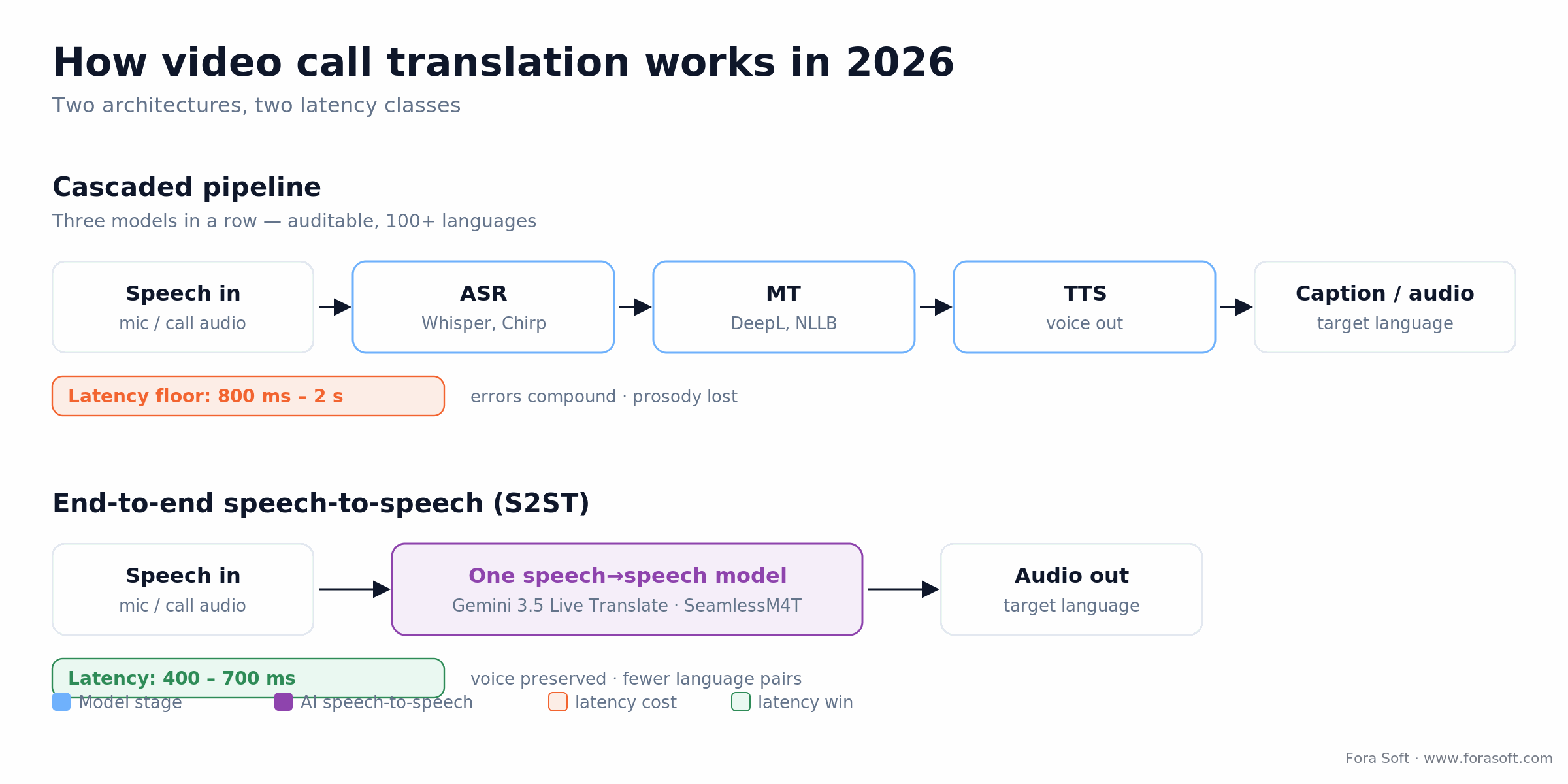
Figure 1. The two architectures behind every video call translation tool, and the latency each one buys you.
Reach for end-to-end speech-to-speech when: your latency budget is under 700 ms and preserving the speaker’s voice matters: live events, telehealth, customer-facing calls. Otherwise a cascaded caption track is cheaper and easier to audit.
Do you need an app, a seat plan, or a custom build
Before comparing vendors, answer one question: who has to understand whom? The answer sorts you into one of three lanes, and picking the wrong lane is the most expensive mistake we see.
A one-off personal call. You want a “video call translator” app and nothing more. Here’s the reality most search results skip: WhatsApp still does not translate live voice or video calls in 2026. It only auto-translates some text messages in some regions, and both sides hear the original audio. Skype, the classic answer, shut down on 5 May 2025. So the working options are link-based tools (iTour, Utell, Transync) that let one person share a translated-call link without the other installing anything. Fine for a single call; not something you’d put a business on.
Your team already lives in Microsoft 365, Google Workspace, or Zoom. Turn on the native translation you’re already paying for. No integration project, no second vendor. Nine times out of ten this is the right call for internal meetings.
You’re shipping your own product, or you carry a strict compliance surface. Now you build a cascaded API stack or a self-hosted model, because you need to own the data path, the BAA, and the user experience. That’s where the rest of this guide earns its keep.
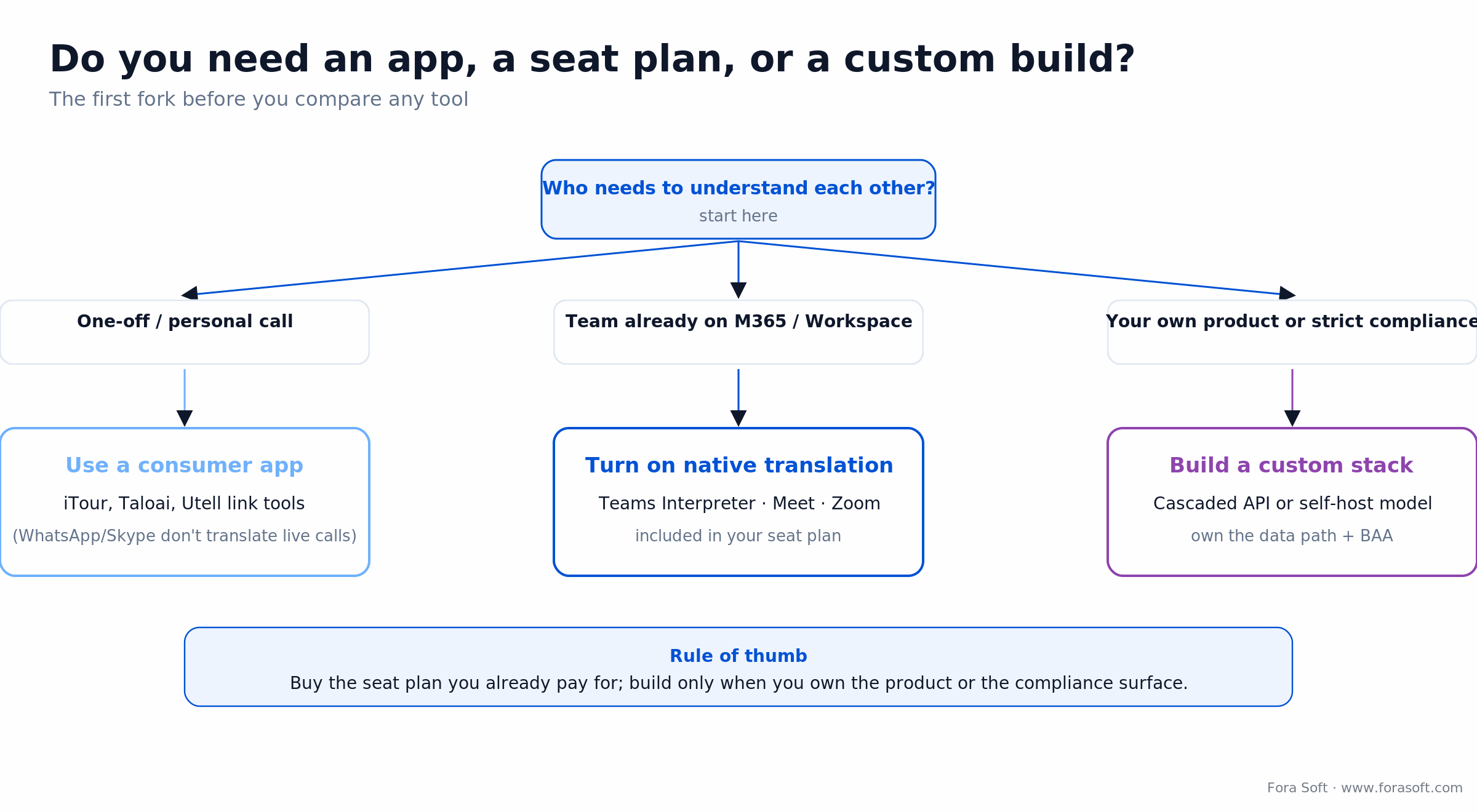
Figure 2. The first fork — app, seat plan, or custom build — before you compare any single tool.
The rest of this guide ranks the seven tools worth integrating in 2026. We keep our own build service out of the numbered ranking and flag it separately so the comparison stays fair.
1. DeepL Voice for Meetings
DeepL spent a decade as the quality leader in text translation, then shipped DeepL Voice. In 2026 Voice for Meetings runs live inside Microsoft Teams and Zoom, showing captions in 100+ languages from spoken input in 16+ languages. On European language pairs its output still reads a notch more natural than the general-purpose engines. The difference shows up in idiom and register, not raw accuracy scores.
Pricing (2026): DeepL Voice is sold on enterprise, contact-based pricing. There’s no public per-seat number, and the widely-quoted $22.49/user figure is the DeepL Pro text plan, not Voice. Enterprise adds custom glossaries, single sign-on, and EU data residency.
Reach for DeepL Voice when: you run European multilingual meetings across 5–10 languages, care more about nuance than breadth, and want a plug-in inside Teams or Zoom rather than a whole new platform.
2. Interprefy: interpreter platform with an AI mode
Interprefy is the largest remote simultaneous interpretation platform by volume. It runs translation for the UN, the World Economic Forum, and thousands of corporate events. Its AI mode adds machine translation in 80+ languages for lower-stakes sessions and routes to human interpreters for high-stakes ones through the same interface. That handoff, mid-meeting, from AI to a certified human is the feature nobody else ships this cleanly.
Pricing (2026): event-based — an AI-only small meeting starts around $190, a hybrid AI-plus-interpreter session from roughly $900, and enterprise API access or dedicated interpreter rosters are quoted per engagement. Interprefy also white-labels for software vendors.
Reach for Interprefy when: a single session mixes casual and high-stakes moments (conferences, diplomatic meetings, legal proceedings, medical interviews) and you need a certified human on standby in the same call.
3. KUDO AI: purpose-built multilingual conferencing
KUDO started in remote interpretation and pivoted to AI Meetings, a full multilingual conferencing product with real-time translation, transcription, and summaries. It advertises AI speech translation across 200+ languages, with speaker-segmented transcripts, glossary import, and enterprise SSO/SCIM. Latency sits around 1.2–1.8 s. That’s fine for structured meetings and too slow for fast back-and-forth.
Pricing (2026): a team tier from roughly $15/user/month, a business tier near $40/user/month with the full language set and analytics, and enterprise plans with data residency, audit logs, and white-label embedding.
Reach for KUDO when: you want a dedicated multilingual conferencing product instead of bolting translation onto a general call app: international associations, regulated industries, cross-border sales teams.
4. Microsoft Teams Interpreter agent
The Interpreter agent does real-time speech-to-speech translation in Teams, built on Azure. It went generally available in meetings in February 2025 and expanded to Teams calls between late January and early February 2026. It covers nine languages (Mandarin Chinese, English, French, German, Italian, Japanese, Korean, Brazilian Portuguese, and Spanish) and can simulate the speaker’s own voice, or use a preset (Ava, Andrew, or the neutral Fable Turbo).
Pricing (2026): live captions and caption translation come with Teams from the low tiers up. The Interpreter agent (voice-level) needs a Microsoft 365 Copilot license and includes 20 hours of interpretation per person per month; the meeting organizer needs Copilot or Teams Premium.
Reach for Teams when: your organization already runs Microsoft 365, your need is meeting-room scale rather than public events, and compliance posture (Purview, data residency, audit) has to be enterprise-grade.
Native platform or specialist tool?
We’ve integrated every option on this list at least once — a 30-minute call and we’ll tell you which fits your stack and which is overkill.
5. Zoom Workplace: AI Companion and Voice Translator
Zoom splits translation into two features. Translated captions, driven by AI Companion, cover 46 languages and read spoken audio into the viewer’s language in real time. Voice Translator, launched in April 2026 for paid US accounts, adds spoken output in five languages (English, Chinese, French, Japanese, Spanish). Zoom’s voice track leans on the same caption engine, so on long uninterrupted stretches the translated audio can lag until the speaker pauses.
Pricing (2026): translated captions are included on Zoom Workplace Business Plus and the Enterprise tiers; smaller plans need the translated-captions add-on. The Translator and Summarizer APIs (released 18 May 2026) support nine output languages for transcript-based outputs.
Reach for Zoom when: your calls already run on Zoom and caption-level translation for a global audience is enough — and you want the transcript APIs to feed summaries into your own tools.
6. Google Meet with Gemini 3.5 Live Translate
Google’s 2026 flagship is Gemini 3.5 Live Translate, announced 9 June 2026: a streaming speech-to-speech model covering 70+ languages and 2,000+ language-pair combinations, generating translated audio continuously a few seconds behind the speaker while preserving intonation and pitch. In Google Meet it expands spoken translation from the earlier five languages to 70+; at launch it’s in private preview for selected Workspace customers, with broader rollout later in 2026. The same model already runs worldwide inside the Google Translate app.
Pricing (2026): translated captions ride existing Workspace Business and Enterprise plans; Gemini meeting features (summaries, translated notes) sit on the higher Workspace tiers. There’s no per-minute translation meter.
Reach for Google Meet when: you need the widest language coverage, you’re already on Workspace, and you want Gemini’s natural-sounding voice translation plus post-call summaries: global education, NGOs, teams spanning 30+ markets.
7. Meta’s open-weights model for custom builds
SeamlessM4T-v2 is the reference open model for multilingual speech translation. It does speech-to-speech from 100 source languages into 35 target speech languages, and speech-to-text from 100 into 95 text languages, with streaming and expressive (voice-preserving) variants. If you’re building your own product and want to own the whole pipeline, this is the foundation everyone benchmarks against.
The catch that trips up builders: the weights are released under CC-BY-NC 4.0, which is non-commercial only. You can prototype and research freely, but you cannot ship it in a commercial product without a separate arrangement with Meta. For a production build, teams typically use it to validate the approach, then run a commercially-licensed cascade (Whisper plus NLLB or a cloud API) in production. Inference infrastructure runs roughly $0.035/minute self-hosted.
Reach for an open model when: you’re building a custom video product, need voice-preserving output for brand or accessibility, and have an ML-ops team. Just confirm the commercial-license path before you plan a launch on it.
The 2026 comparison matrix
Same seven tools, side by side. Read the “where it breaks” column first — it’s the one that saves you a migration.
| Tool | Languages | Latency | Entry price (2026) | Where it breaks |
|---|---|---|---|---|
| DeepL Voice | 100+ captions / 16+ spoken | ~0.8–1.1 s | Enterprise quote | No standalone voice output; price opaque |
| Interprefy | 80+ (AI) | 1.5–2 s (AI) | ~$190/event | Event pricing; not built to embed |
| KUDO AI | 200+ (claimed) | 1.2–1.8 s | ~$15/user/mo | Latency too high for fast dialogue |
| Microsoft Teams | 40+ captions / 9 voice | 0.8–1.5 s | Copilot add-on (voice) | Won’t embed in third-party apps; 9 voice langs |
| Zoom | 46 captions / 5 voice | ~1–1.5 s | Business Plus and up | Voice lags on long monologues |
| Google Meet | 70+ (Gemini 3.5) | A few seconds | Workspace Business+ | Live Translate still preview-gated in Meet |
| SeamlessM4T-v2 | 100 in / 35 voice out | ~2 s streaming | Free weights + infra | Non-commercial license; you run the ops |
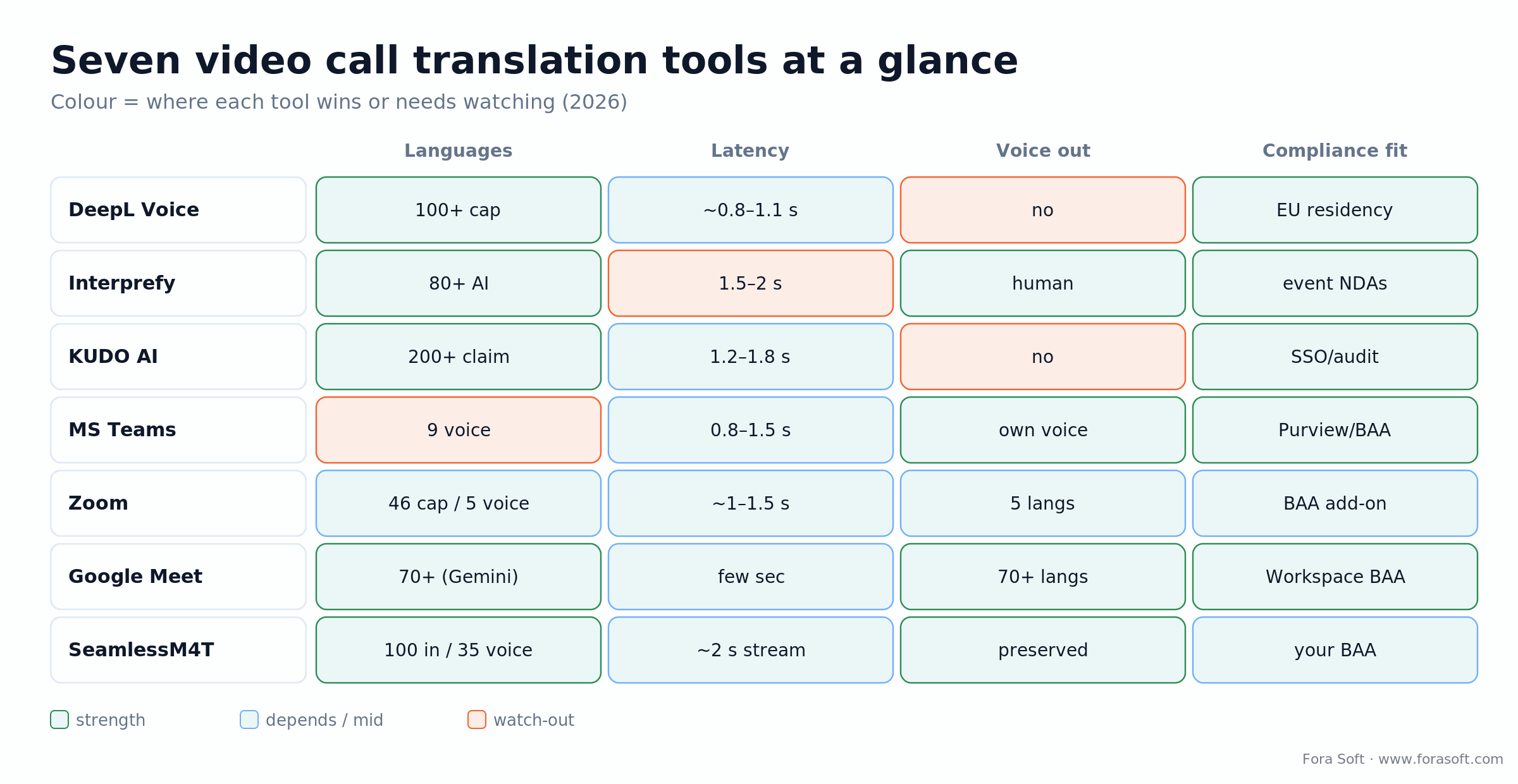
Figure 3. Where each tool is a strength, a maybe, or a watch-out across the four axes that decide procurement.
Build vs buy: the 2026 unit economics
Take a concrete workload: a telehealth product running 10,000 sessions a month at 30 minutes each — 300,000 translated minutes — across 8 languages, US and EU users, HIPAA and GDPR required. Here’s what each path costs, with the arithmetic shown.
Google Cloud cascaded (speech-to-text + translation + text-to-speech). Roughly $0.024 + $0.02 + $0.016 = $0.06 per minute. $0.06 × 300,000 = $18,000/month. A HIPAA BAA is available and you maintain the plumbing.
Self-hosted open model. About $0.035/minute of inference — $0.035 × 300,000 = $10,500/month — plus a one-time build we’d scope near $60k and ongoing ML-ops. Break-even against the cloud cascade lands early in year two. (Remember the non-commercial license note above: for production you run a commercially-licensed model on the same architecture.)
Managed interpretation (Interprefy-style). Event pricing around $900 per hybrid session doesn’t map to always-on embedded translation; at this volume it runs $30–50k/month and isn’t the right shape for a product. It’s the right shape for scheduled high-stakes events.
The pattern: the cloud cascade wins year one on total cost of ownership; self-hosting wins year two once the build is amortized. If voice preservation is a product differentiator, the self-hosted route wins regardless. We use Agent Engineering on builds like this, so our estimates tend to come in below the figures above — but we’d rather quote you a real number after a scoping call than inflate one here.
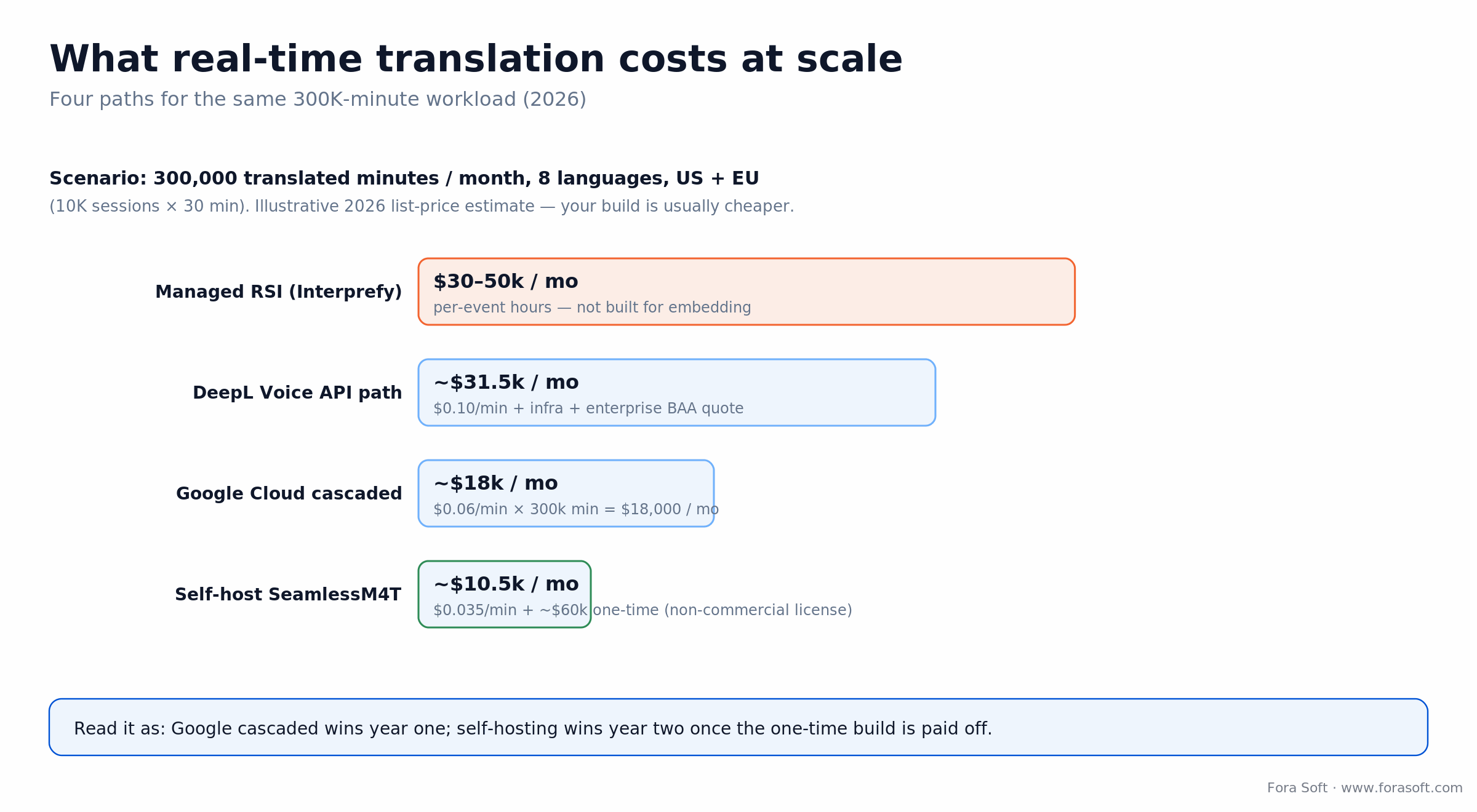
Figure 4. Four paths for the same 300K-minute workload, with the one-line arithmetic behind each.
Mini-case: cross-border telehealth at 12K users
A US-EU telehealth platform we work with serves Spanish, Portuguese, French, German, Italian, and Polish speakers; clinicians speak English. Requirements: HIPAA and GDPR, sub-1-second caption latency, voice interpretation for consent sections, and a full audit trail.
What failed first. They started on a video SDK with built-in translation. It failed the HIPAA audit — the vendor’s BAA didn’t cover the translated-caption data path. Clinician satisfaction with the captions sat at 64%.
What we moved them to. A custom WebRTC stack on LiveKit, Google Cloud speech-to-text and translation for live captions, an Interprefy hybrid AI-plus-human channel for consent sections only, and a full audit log inside their own HIPAA-covered AWS account.
Outcome. 12K monthly users, 180,000 minutes/month, caption latency around 850 ms, human-interpreter escalation in 2.1% of sessions (consent only), and a clean HIPAA audit. Blended cost about $12,300/month. Clinician satisfaction with translated captions climbed from 64% to 91%. Want a similar assessment of your stack? Book a 30-minute call and we’ll walk your data path.
Compliance: HIPAA, GDPR, and the EU AI Act
Translation data is a compliance surface most teams discover the hard way. Three rules to check before you ship.
HIPAA. If any call touches protected health information, the vendor’s Business Associate Agreement has to cover the translation pipeline specifically, not just the video. Many default BAAs don’t. Get it in writing before you build on the vendor.
GDPR and data residency. For EU users, know where audio is processed and stored. DeepL and the big platforms offer EU residency; a self-hosted model lets you pin the region yourself.
EU AI Act Article 50. Transparency obligations take effect 2 August 2026. AI-generated or AI-manipulated content — which includes machine translations that materially change meaning — may need to be disclosed to users and machine-readably marked. Systems already on the market before that date have until 2 December 2026 to add the machine-readable marking. Plan a disclosure line in your UI now rather than retrofitting it.
Pick your tool in five questions
1. Are you buying for meetings or building into a product? Meetings → a seat plan (Teams, Meet, Zoom). A product → an API or self-hosted model.
2. What’s your latency budget? Under 700 ms and voice matters → end-to-end speech-to-speech (Gemini 3.5, self-hosted model). One second of caption lag is acceptable → a cascade.
3. How many languages, and which? A handful of European pairs → DeepL Voice. Broad global coverage → Google Meet or KUDO.
4. Do you need a human in the loop? Legal, diplomatic, or medical-consent moments → Interprefy or KUDO with interpreter routing.
5. What’s your compliance surface? HIPAA or strict residency → a stack where you control the BAA and the region, which usually means a custom build. Need help deciding? Our AI language interpretation team does exactly this.
Five pitfalls we’ve paid for
1. Assuming the vendor BAA covers translation data. It often doesn’t. Confirm in writing which data paths the BAA covers before shipping a HIPAA product.
2. Single-speaker models in multi-speaker rooms. Most consumer tools assume one mic, one speaker. Three people in a room turns into word salad. Use speaker-aware captions or per-speaker audio streams.
3. No glossary for domain terms. Medical, legal, and technical vocabulary is exactly what general translation mangles. DeepL, KUDO, and open models all support custom glossaries — use them.
4. Codec collapse on phone dial-ins. PSTN and VoIP codecs strip 30–40% of the acoustic detail good recognition needs. If callers dial in by phone, accuracy craters. Route them to a wideband SIP trunk or warn them in the UI.
5. No fallback path. Cloud APIs go down and vendors have outages. Plan a degraded mode — English-only captions, or a cached interpreter track — that kicks in within 30 seconds.
The KPIs to track before and after shipping
Quality KPIs. Caption latency at p95 (target under 1 s), word error rate per language, and translation quality drift week over week. Track the worst language, not the average — the average hides the one that’s failing.
Business KPIs. Adoption rate week over week, session retention (D1/D7/D30), and revenue impact measured against a clean hold-out group. Skip the hold-out and you can’t prove the lift is real.
Reliability KPIs. Uptime of the translation path, fallback activation rate, and human-interpreter escalation rate. If escalations climb, your AI tier is failing a language or a domain — go find which.
When NOT to add real-time translation
Sometimes the right answer is no. If your users share a common language, real-time translation adds latency, cost, and a failure mode for zero benefit — ship better captions instead.
If your calls are legally binding in a single jurisdiction — sworn testimony, regulated financial advice — a certified human interpreter is the requirement, not an AI convenience layer. Use AI for the prep and the summary, not the record.
And if you can’t yet answer the compliance questions above, don’t ship translation into a regulated product on hope. A clean audit is cheaper than a breach.
FAQ
What’s the best video call translator app in 2026?
For a one-off personal call, link-based tools like iTour, Utell, or Transync let you share a translated-call link without the other person installing anything. For team meetings, use the translation already built into Microsoft Teams, Google Meet, or Zoom. For a product you’re building, you integrate an API or self-hosted model rather than an app.
Can WhatsApp translate video calls in real time?
No. As of 2026 WhatsApp does not translate live voice or video calls — both sides hear the original audio. It can auto-translate some text messages in some regions, but live-call translation needs a third-party tool or a custom build.
What happened to Skype’s call translation?
Skype shut down on 5 May 2025 after 22 years, and Microsoft moved users to Teams. Skype Translator no longer exists; its successor is the Teams Interpreter agent, which does real-time speech-to-speech translation in nine languages.
What’s the minimum latency for “real-time” translation?
Captions under one second feel natural. Voice-level translation runs 400–700 ms with end-to-end speech-to-speech models and 1–2 s with cascaded pipelines. Above about 2 s, participants start talking over each other.
Can AI translation replace human interpreters yet?
For general meetings, sales calls, and internal communication, yes. For legal proceedings, diplomatic meetings, and medical consent, no — the cost of a misinterpretation is too high. Use a hybrid platform (Interprefy or KUDO) that escalates to a human in the high-stakes sections.
Which platforms support HIPAA-compliant translation?
Microsoft Teams (with an M365 BAA that covers the translation path), Google Workspace Enterprise (BAA available), and custom stacks on Google Cloud or a self-hosted model under your own BAA. Confirm the BAA covers the translation data path specifically, not just the video.
Can I integrate real-time translation into my own app?
Yes — through Google Cloud speech-to-text plus translation, the DeepL API, Microsoft Speech services, or a self-hosted model. Budget 6–12 weeks for a production cascaded pipeline plus ML-ops for monitoring and fallback. Fora Soft builds these regularly.
Does the EU AI Act affect call translation?
Yes. Article 50 transparency rules take effect 2 August 2026 and can require disclosing and machine-readably marking AI-generated or AI-manipulated content, including translations that materially change meaning. Systems already live before that date have until 2 December 2026 to add machine-readable marking.
What to read next
Comparison
3 Best Real-Time Meeting Translation Platforms in 2026
A tighter three-way comparison focused on interpreter-grade meeting accuracy.
Integration
Real-Time Video Translation: Integration Guide (2026)
The WebRTC integration patterns behind adding translation to a call.
Build guide
Video Call With Translator: Architecture & Cost Model
SDK choices, code patterns, and the cost model for a built-in translator.
Live streaming
AI Language Translation for Live Streaming in 2026
Captioning, dubbing, and the real-time pipeline for one-to-many video.
Which one should you pick
In 2026, real-time translation in video calls stopped being a technology problem and became a product-and-compliance one. If you meet inside Teams, Meet, or Zoom, the translation you already pay for is good enough — turn it on. Need European nuance across a handful of languages? DeepL Voice. Need a human interpreter on standby mid-call? Interprefy or KUDO. Building your own product? Prototype on an open model, ship on a commercially-licensed cascade, and own your compliance surface.
Accuracy is converging across all of them. What decides procurement now is latency under a second, coverage beyond Europe, compliance you can prove, speaker-aware audio in group rooms, and a graceful fallback when the model has a bad day. That last mile, everything around the model, is where products win or lose, and it’s what we build. For the wider context on shipping ML into live media, see our AI for video engineering guide and our AI integration services.
Let’s design your multilingual video stack
30 minutes with our video-stack lead. We’ve integrated every tool in this guide and shipped multilingual video since 2005.

