

Key takeaways
• Engineering culture is not soft — it predicts delivery performance. Google’s Project Aristotle named psychological safety the single biggest predictor of team effectiveness; DORA’s decade of data shows generative cultures correlate with elite delivery metrics.
• Turnover is the hidden tax on every project. Replacing a senior engineer costs 50–200% of their annual salary plus 6–12 months of lost productivity, and burns the institutional context that keeps your codebase shippable.
• Async-first beats meeting-heavy. roughly 7 in 10 managers say remote and hybrid work raised team productivity (Owl Labs 2025). 87% of tech firms in 2025 are maintaining or expanding remote/hybrid setups.
• Burnout is the industry baseline now. Stack Overflow 2024: only ~20% of professional developers are happy at work — the rest are complacent or unhappy. Partner culture is what separates teams that ship from teams that grind out and quit.
• If you are choosing a software development partner, evaluate culture as rigorously as you evaluate code. Ask about turnover, on-call practice, retro cadence, onboarding plans, and 1:1 culture. Use the eight questions in the partner-culture checklist.
Why Fora Soft wrote this playbook
Fora Soft has been a custom software development partner since 2005 — 250+ projects and 50 in-house engineers, mostly on year-long real-time and AI builds. Two decades of remote-and-hybrid practice has taught us that the partner’s culture is invisible on the proposal slide but determines almost everything about a year-long engagement: how fast the team picks up your domain, how cleanly the codebase ages, how often a key engineer disappears at the worst moment, and how reliably product quality survives the third roadmap change.
This playbook is two articles in one. The first half is for engineering leaders building their own team and looking for evidence-based rituals that lift delivery performance. The second half is for founders and CTOs who are evaluating a development partner and need a checklist for separating consultancies that ship from consultancies that churn. Both halves draw on the same body of public research — Google’s Project Aristotle, the DORA / Accelerate work, GitLab’s open handbook, the Stack Overflow developer survey, and the McKinsey and Gallup engagement data.
Where we cite our own practice we use observable patterns and ranges, not specifics, to respect client NDAs. Our internal teams have averaged under 8% annual voluntary attrition over the past decade — well under the industry baseline — which is the single statistic we are proudest of and the one we recommend founders ask any partner to share before signing.
Evaluating a development partner and want to compare cultures honestly?
Book a 30-minute call and we will walk you through our team rituals, attrition numbers, on-call posture, and the eight culture questions to ask any vendor before you sign.
Why culture is a delivery metric, not an HR metric
There is a long-standing argument that engineering culture is “people stuff” that does not belong in a serious procurement conversation. The data has settled the argument. Google’s two-year Project Aristotle study of 180+ teams found that psychological safety — the shared belief that the team is safe for interpersonal risk-taking — was the single most powerful predictor of team performance, ahead of seniority, headcount, and team composition.
The Accelerate / DORA research (Forsgren, Humble, Kim) extended that finding to software specifically. Westrum’s “generative” culture — characterised by high cooperation, message-flow across boundaries, and bridging behaviour — correlates with elite DORA delivery metrics: lead time under one day, deploys on demand many times a day, change-failure rate under 15%, and MTTR under one hour. Bureaucratic and pathological cultures score in the bottom quartile on those same metrics.
Translated for founders: a partner with the right culture ships more, breaks less, and recovers faster than a partner that treats culture as a recruiting deck. The cost difference shows up in the third quarter, not the first.
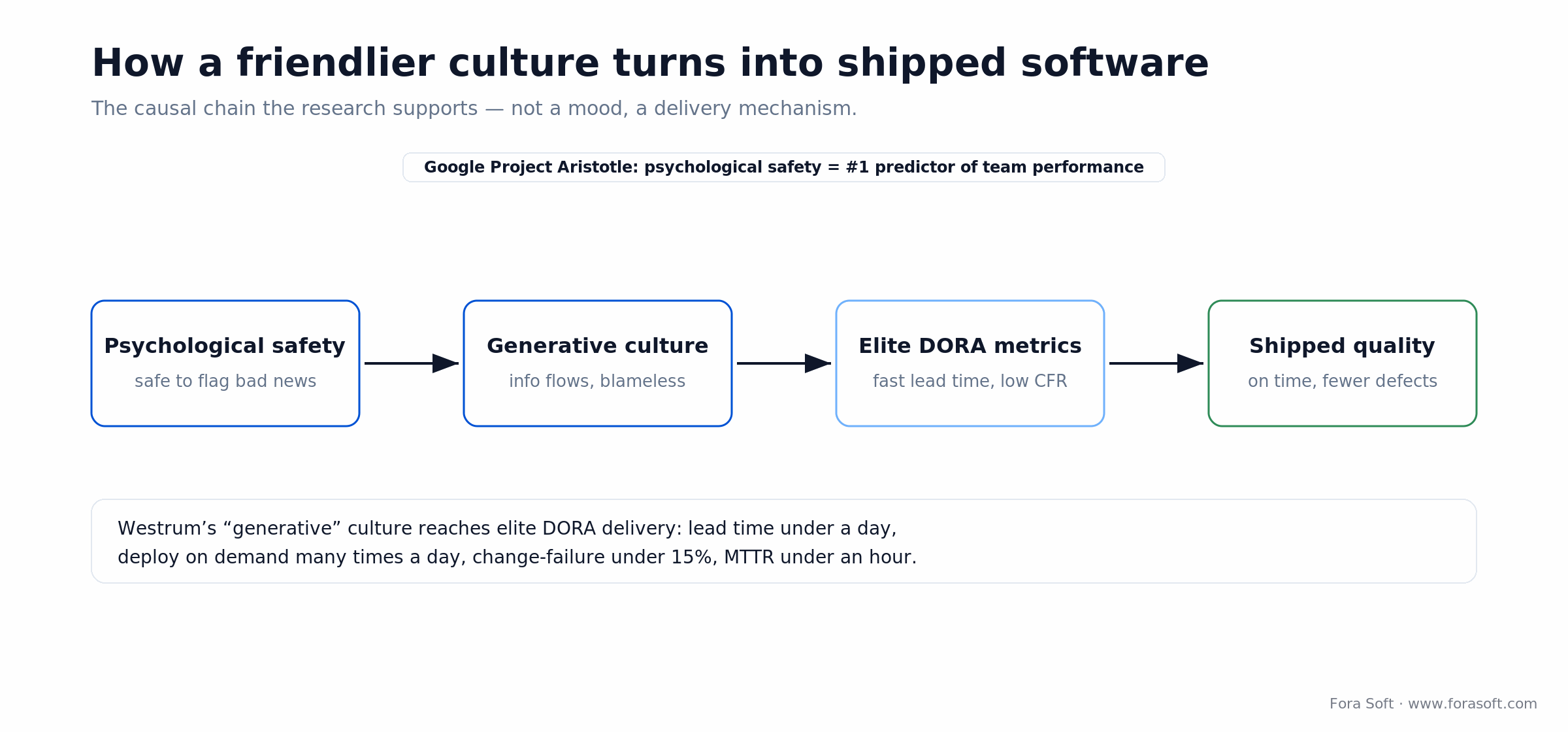
Figure 1. How a friendlier engineering culture becomes shipped software — the chain the research supports.
What bad culture costs (industry numbers)
Three numbers anchor every culture-investment conversation.
| Lever | Industry data point | Why it bites a project |
|---|---|---|
| Cost to replace an engineer | 50–200% of annual salary | Lost recruiting cycle, ramp-up, context loss across 3–6 months. |
| Time to full productivity | 3–6 months baseline, 12 months to match a tenured engineer (McKinsey) | Mid-engagement turnover compresses sprints and reopens shipped features. |
| Stack Overflow 2024 unhappiness | only ~20% of pro devs are happy; 48% complacent (2024) | Burned-out teams ship more defects and skip security reviews. |
| Engagement-to-productivity gap (Gallup) | +18% productivity, +23% profitability (top vs bottom quartile) | A two-engineer team with engagement = a three-engineer team without. |
| Manager impact on engagement | 70% of variance comes from the direct manager (Gallup) | Hire for engineering managers as carefully as for principal engineers. |
A vendor with 25% annual attrition on a 10-engineer pod silently rotates 2.5 people per year off your project. That is one quarter of your context evaporating every twelve months. Compounded across a three-year engagement it is a near-total team replacement.
What a friendlier culture is worth — the retention math
Answer first: on a 10-engineer pod, cutting voluntary attrition from 25% to 8% keeps roughly 1.7 more engineers — and their context — on your project every year. Here is the arithmetic, kept deliberately conservative.
Start with turnover. A 10-engineer pod at 25% attrition loses 2.5 engineers a year; at 8% it loses 0.8. That is 1.7 fewer replacements annually. Replacing one mid-to-senior engineer costs 50–200% of salary in recruiting, ramp and lost context. On a $120,000 salary, even at the 50% floor: 0.5 × $120,000 = $60,000 per departure. So 1.7 × $60,000 ≈ $102,000 a year saved on replacement alone — before you count the 3–6 months each new hire needs to reach full speed.
Now the delivery side. Gallup’s Q12 meta-analysis puts engaged (top-quartile) teams at +23% profitability, +18% productivity, 78% lower absenteeism and 21% lower turnover than disengaged ones. You do not need the whole gap to justify the rituals in this playbook — a few points of productivity on a six-figure engineering payroll pays for every 1:1, retro and learning day many times over.
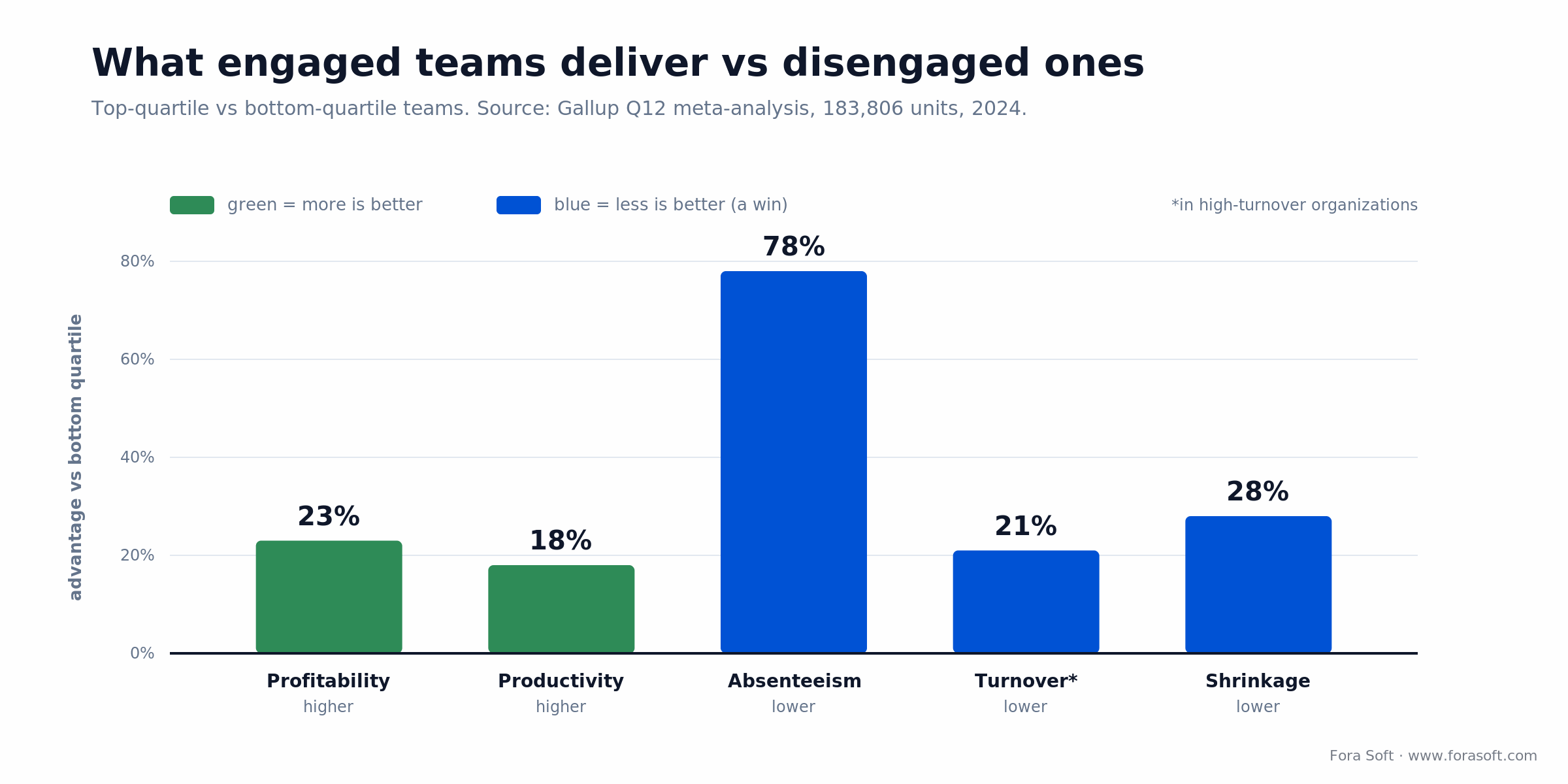
Figure 2. Engaged vs disengaged teams, top-quartile advantage. Source: Gallup Q12 meta-analysis (2024).
Reach for a retention audit when: voluntary attrition tops 15%, or when a single pod has rotated more than a third of its engineers in a year. Put a dollar figure on it using the math above before you argue for headcount — the replacement cost is almost always larger than the culture fix.
Psychological safety as a daily practice, not a poster
Psychological safety is not absence of conflict; it is the freedom to disagree, surface bad news, and admit a mistake without status loss. Edmondson’s original research showed that high-safety teams report more errors, not fewer — because people are willing to flag problems instead of hiding them. The teams that ship the safest software talk about bugs the most.
Concrete practices we use day-to-day. Blameless postmortems after every customer-impacting incident, focused on the system not the operator. Retros that produce action items with owners, not generic complaints. Pull-request culture that praises good catches, not just code. And the simplest: managers asking “what could I have done better this week?” in every 1:1 and listening to the answer without a defence.
Reach for a blameless postmortem when: any incident lasts more than 30 minutes, any release rolls back, or any customer escalates. Within 48 hours, written, attended by everyone who touched the system, and shared internally without redaction. The point is to fix the system; the worst penalty for honesty is more honesty being expected next time.
Eight team rituals that make a workplace friendlier and faster
Culture is downstream of habits, not of mission statements. Eight rituals show up in every high-performing engineering team we have worked with or studied.
1. Daily 10-minute async or sync standup. Three questions, no status theatre: what did I ship, what am I shipping, what is in my way. Done in ten minutes, it replaces a dozen scattered “any update?” pings across the day.
2. Sprint retrospective every two weeks. What worked, what did not, one experiment for next sprint. Skip retros and you skip the only mechanism that lets the team improve itself.
3. Weekly 1:1s between every engineer and their lead. 30 minutes, the engineer’s agenda, not the manager’s. Skip-level 1:1s once per quarter. Gallup attributes 70% of engagement variance to the direct manager — the 1:1 is the lever.
4. Demo day at the end of every sprint. Whatever shipped, shown to anyone who wants to watch. Public wins compound. New hires see what good looks like; long-tenured engineers feel seen.
5. No-meeting Fridays (or one no-meeting day per week). Maker time has to be defended; otherwise meetings expand to fill all available calendar. The day-of-week is less important than the consistency.
6. Onboarding buddy programme for the first 90 days. Zapier’s “Zap Pals” programme reportedly cut first-90-day turnover 70% and lifted productivity 65%. The mechanism is brutal in its simplicity: every new hire has someone to ask “dumb” questions without judgement.
7. Learning days — one Friday per month. Daniel Pink’s “mastery” pillar in practice. Engineers pick what to learn; the company pays for the day, and we turn some of that into public engineering education — our video-engineering Learn course is one output. The compounding effect on retention dwarfs the lost capacity.
8. Casual rituals that are actually optional. A pizza Friday, a virtual coffee, a Slack channel for non-work hobbies. The mistake is making them mandatory; that turns a friendly ritual into a tax. The discipline is creating the space and trusting people to use it.
Reach for a demo day when: a sprint ends. Whatever shipped gets shown to anyone who wants to watch. It is the cheapest morale and alignment ritual on this list — new hires see what good looks like, and long-tenured engineers feel seen.
Remote and async by default — the 2026 baseline
The remote-versus-office debate is over for software engineering. 87% of tech firms in 2025 maintain or expand remote and hybrid setups (industry survey averages). 69% of managers report hybrid and remote work increased productivity (Owl Labs 2025). The interesting questions are no longer about location; they are about the operating model.
Async-first communication. Decisions are written down, then discussed, then revised — not the other way around. GitLab’s 2,000-page open handbook is the public reference. Time-zone-spread teams that cannot rely on real-time sync develop better documentation muscle by necessity, and that documentation pays interest forever.
Two-pizza teams. Bezos’ rule (six to eight engineers, no team larger than two pizzas can feed) survives because communication overhead is quadratic in team size. Spotify’s squad model (six to twelve people with a single mission) is the same idea applied at scale. Beyond ten engineers, sub-teams form whether you sanction them or not.
Meeting hygiene. Default 30 minutes, not 60. Agenda or no meeting. Decisions captured in writing within 24 hours. The single biggest meeting-time win is killing recurring meetings that have no clear ownership — quarterly “is this still useful?” audit.
Tooling that supports async. Slack and Discord for chat, Loom for short async video, Notion or GitLab handbook for documentation, Linear or Jira for tickets, GitHub PR-first review culture, Geekbot or Tidbits for async standups. Tool stack matters less than the discipline of using whichever stack is chosen.
Reach for async-first when: your team spans more than two time zones. Write the decision down, then discuss, then revise — the documentation you are forced to produce pays interest on every future onboarding and every incident review.
Manager practice: the 70% lever
Gallup’s most cited statistic is that 70% of variance in employee engagement is attributable to the direct manager. That puts engineering manager hiring and training above almost every other lever in this article. Five things every engineering manager owes their team.
1. Weekly 1:1s, owned by the engineer. The agenda comes from them, not from you. Career conversations live here, not in once-a-year reviews.
2. Public credit, private feedback. Praise in standup, demos and Slack channels. Critique in 1:1, with a clear behavioural example and a path forward.
3. Transparent levels and salary bands. The Stripe and Buffer playbook. Engineers should be able to see what the next level requires and what each level pays. Opacity breeds the suspicion that something unfair is happening, even when nothing is.
4. Defended deep-work time. The manager’s job in a meeting culture is to push back on meetings that should be a doc, not the engineer’s job. Block calendar Fridays, decline recurring meetings nobody runs, route status updates to async.
5. Career growth that does not require management. A staff-engineer track to senior-staff to principal that pays the same as the management ladder. Forcing growth through people-management is the fastest way to lose your best ICs and create your worst managers.
Looking for a partner whose engineers actually stay?
We have averaged under 8% voluntary attrition over the past decade and built calling, video, e-learning and telemedicine products with the same core team that started them. Let us show you the rituals behind the number.
Onboarding: the first 90 days decide retention
Most attrition that looks like a culture problem is really an onboarding problem. The new hire never feels productive, never bonds with anyone, and quietly starts re-opening their LinkedIn before month four. The fix is mechanical.
Day 1. Working laptop, accounts, repo access, a team channel introduction, a written 30/60/90 plan, a buddy. Goal: one tiny PR merged on day one (typo fix, doc update). The dopamine of a green CI is worth a week of meetings.
Week 1. Pair with the buddy on a real ticket. Read the handbook, the architecture overview, the on-call runbooks. Sit in on every standup, demo, retro.
Month 1. Own a small feature end-to-end with mentorship. Drive the PR review thread; read other people’s reviews; learn the codebase’s conventions through repetition.
Month 3. Carry the on-call pager (with a paired senior). Lead a sprint demo. Run a retro. Have a written 90-day check-in with the manager and skip-level.
Time-to-first-PR under one week and time-to-first-on-call under three months are the two retention-correlated metrics worth tracking.
Reach for a written 30/60/90 plan when: you onboard anyone onto an existing codebase, remote or not. If a new hire cannot merge a tiny PR on day one and own a small feature by month one, the onboarding is broken — not the engineer.
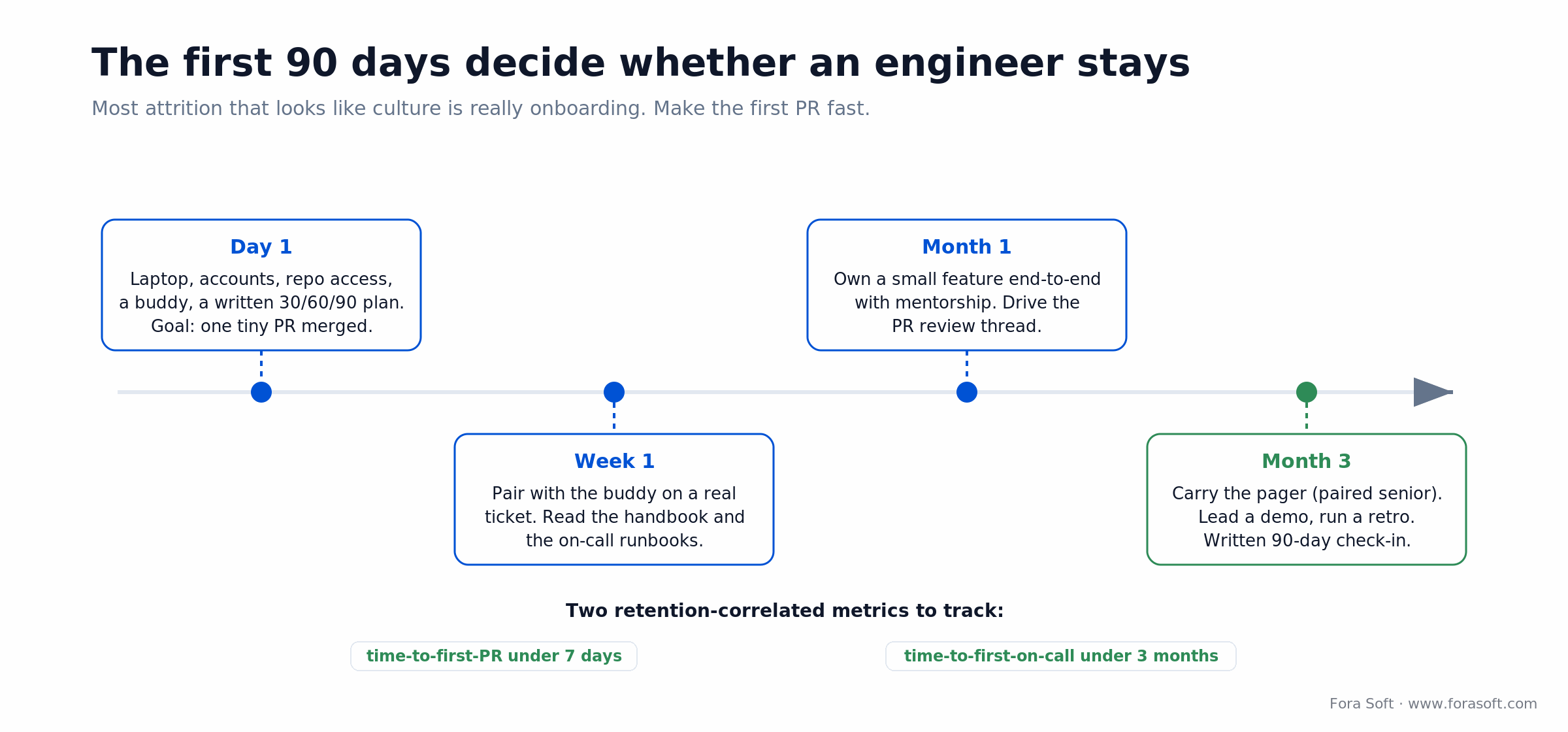
Figure 3. The first 90 days, mapped to the two metrics that predict whether a new engineer stays.
Five famous engineering cultures and what they teach
Public engineering culture writeups are the cheapest education a founder can get. Five worth reading in full.
| Company | Headline idea | What to copy |
|---|---|---|
| Spotify | Squads, tribes, chapters, guilds. | Small autonomous teams aligned around a single mission. |
| Netflix | Freedom and responsibility; high talent density. | Hire fewer, more senior, more autonomous; remove process for them. |
| GitLab | All-remote handbook-first. | Document by default; transparency reduces meeting load. |
| Basecamp / 37signals | Shape Up: 6-week cycles, no estimates, fixed time variable scope. | Bet on appetite, not estimates; shape the work before committing. |
| Stripe | Operating principles and writing-first decision making. | Decisions captured in memos; reviewed asynchronously; default to action. |
No serious engineering culture is identical to any other. The patterns rhyme, but the right culture for a product depends on stage, domain and team. The danger is copying rituals without copying the underlying intent.
Five anti-patterns that wreck engineering culture
1. Mandatory fun. Forced team-building, mandatory virtual happy hours, retros that are really “tell us why we are amazing” sessions. Anything mandatory is read as work; the friendly atmosphere disappears the day attendance is tracked.
2. Hero culture. Praising the engineer who pulled the all-nighter without praising the engineer who designed the system that did not need an all-nighter. The first message you reward is the message you scale.
3. Postmortems with blame. “Who pushed the bad config?” turns the next mistake into a hidden mistake. Once people learn that admitting an error has career consequences, they hide errors. The system gets worse silently.
4. Status-meeting calendar. Eight one-hour status meetings per week. Each meeting was added by someone with a real reason; no meeting was ever audited. The fix is a quarterly “is this meeting still earning its time?” review and aggressive deletion.
5. Promoting your best engineer to manage. The Peter Principle on rails. Most great engineers do not want to manage; many that do want to are not good at it. Run a separate management interview track and pay both ladders equally.
Mini case: how a culture habit shipped a video product on time
A real-time video product on our roster, similar in profile to ProVideoMeeting, hit a fork in the road three months in: the original architecture would not scale past 200 concurrent participants and the founder needed 1,000+ for the launch. Shipping the launch on the existing architecture meant a public failure; rebuilding meant slipping the launch by six weeks and risking the marketing window.
What made the call doable was a culture habit, not a technical insight. The team ran a blameless retro on the original architecture decision (which one of our principals had championed), surfaced what we had missed, agreed on the rebuild scope in a written memo within 36 hours, and committed to a daily decision-velocity check-in for the rebuild sprint. The original principal led the rebuild, not because we punished anyone but because she had the most context. The launch shipped four weeks late, hit 1,400 concurrent participants on day one, and the team came out of it stronger than it went in.
The cultural pre-condition was that admitting the original architecture was wrong was cheaper than defending it. Without psychological safety the conversation would have taken three weeks of corridor politics instead of 36 hours of writing.
KPIs: what to measure once you start investing in culture
People KPIs. Voluntary attrition rate (target under 12% annually for software, under 8% for elite). Manager NPS (anonymous quarterly survey). Time-to-first-PR for new hires (target under 7 days). Engagement score (Gallup Q12 or equivalent quarterly).
Process KPIs. Retrospective action-item completion rate (target over 80%). Meeting hours per engineer per week (target under 10). Pull-request review latency p50 (target under 4 hours during working hours).
Outcome KPIs. DORA metrics (deployment frequency, lead time, change-failure rate, MTTR — see our crash-proof software guide). Customer-impacting incidents per month. Quarterly product OKR attainment.
A decision framework — what to invest in first, in five questions
Q1. What is your annual voluntary attrition? Above 20% → manager hiring, 1:1 cadence, exit-interview culture. Under 10% → invest in growth ladders and learning days.
Q2. How many meeting hours does your average engineer log? Above 15/week → meeting audit, async pivot, no-meeting day. Under 8 → the rituals are working; defend them.
Q3. When something breaks, do people talk about it openly? No → introduce blameless postmortems and a public incident channel. Yes → codify it; write it into the handbook.
Q4. Can your engineers describe their next promotion clearly? No → transparent levels and bands. Yes → invest in the staff-engineer track if it does not exist yet.
Q5. Are you in growth mode or steady-state? Growth → over-invest in onboarding (buddies, 30/60/90 plans, written handbook). Steady-state → over-invest in retention (career growth, learning days, sabbatical policy).
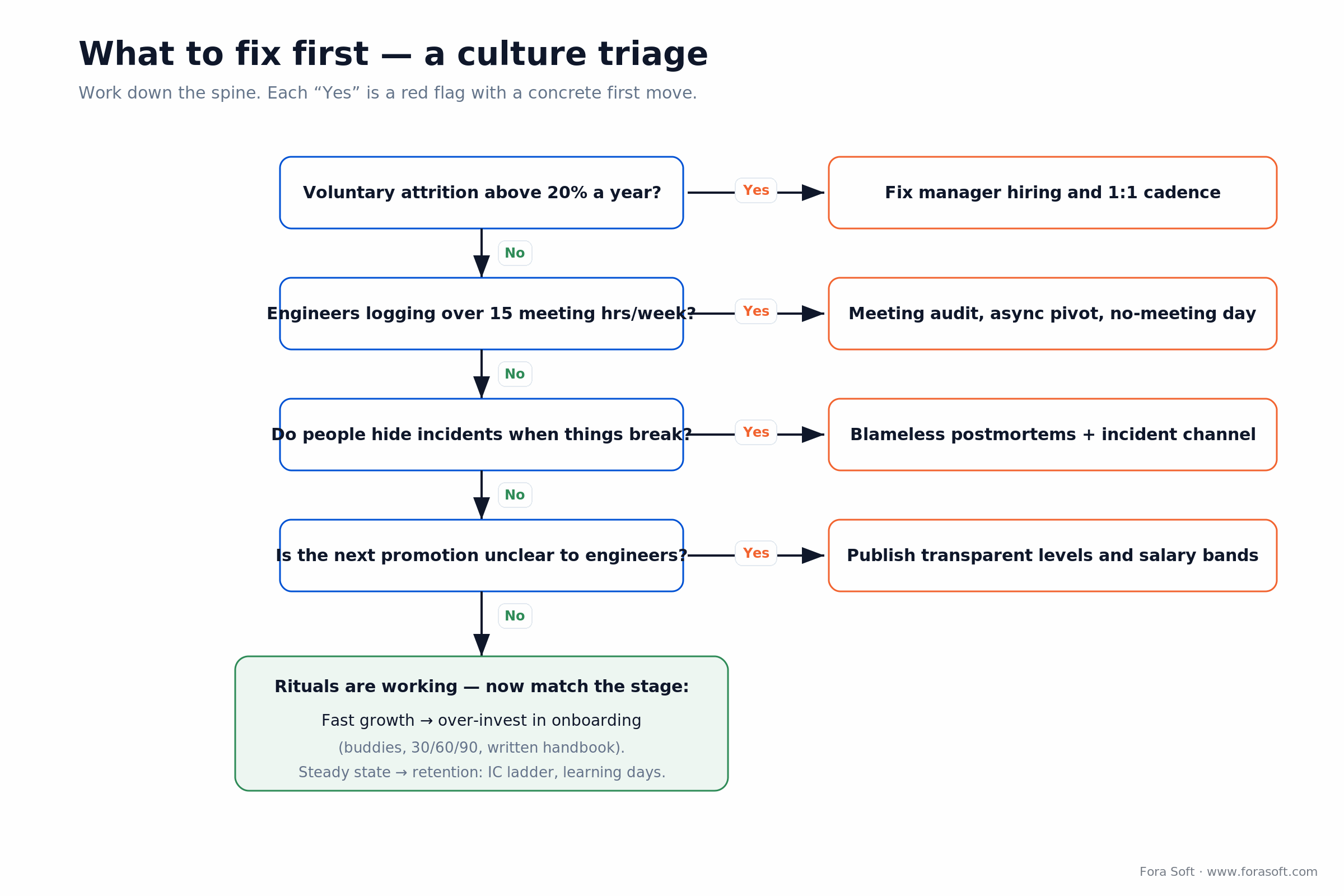
Figure 4. Culture triage: work down the spine, and fix the first “Yes” before anything else.
Evaluating a development partner’s culture — eight questions to ask
If you are choosing a software development partner, the questions below separate vendors that talk about culture from vendors that practise it. Ask all eight on the first call. Vague or evasive answers are a signal in themselves.
1. What is your voluntary attrition rate over the last 12 months, and how does it compare to your three-year average? Specific numbers, not adjectives.
2. How long has the average engineer on your typical project pod been with the company? Tenure correlates with context and quality.
3. Show us a recent blameless postmortem (redacted if needed). If they cannot, they probably do not run them.
4. What rituals run on every project — standups, retros, demos, 1:1s? Cadence and ownership matter, not the existence of the meeting.
5. How do you onboard a new engineer onto an existing project? Look for written 30/60/90 plans, buddies, and a target time-to-first-PR.
6. What does your on-call rotation look like, and how do you protect engineers from burnout? If “the team is always on,” back away.
7. Can engineers grow without becoming managers? A real staff/principal track keeps senior ICs and the codebase quality they bring.
8. Can we speak to two engineers (without their manager) before signing? A vendor that says yes confidently is a vendor that has nothing to hide.
When NOT to over-invest in culture programmes
Three cases where heavy culture investment is the wrong move. First, pre-product-market-fit teams under five engineers. Most rituals make sense at scale and feel like overhead at five. Run weekly 1:1s, blameless postmortems and async-first writing; defer the rest.
Second, organisations that have not fixed compensation. No amount of culture programme survives systematic underpayment. Fix the bands first.
Third, in moments of clear delivery crisis. A burning incident or a missed launch is not the moment for a new ritual; it is the moment to ship and stabilise. Schedule the culture work for the calmer week that follows.
Adjacent reads worth your time
Three companion topics that round out the partner-evaluation conversation.
Reliability engineering. Culture and reliability are linked — blameless postmortems live in both. See our crash-proof software guide for the SLO and DORA framing.
Build vs hire. The team-model decision precedes everything else. Our low-code/no-code vs hiring developers piece is the right starting point if you are still deciding between in-house and partner.
QA & process. Culture without rigorous QA is sentiment. The QA testing guide covers the test pyramid and shift-left strategies that protect a friendly team from grinding incident response.
FAQ
What is psychological safety in an engineering team?
Psychological safety, defined by Amy Edmondson, is the shared belief that the team is safe for interpersonal risk-taking. In practice it means engineers can disagree with the lead, admit a mistake, ask a basic question, or surface bad news without status loss. Google’s Project Aristotle identified it as the single biggest predictor of team performance.
What is a healthy attrition rate for a software engineering team?
Software industry averages run 13–25% annual voluntary attrition depending on segment and geography. Under 12% is healthy, under 8% is elite. Above 20% is a red flag worth investigating — usually a manager problem or a compensation problem rather than a culture problem alone.
Are mandatory team-building events worth the time?
Almost never. The moment a team event is mandatory it becomes work, and the friendly atmosphere it was supposed to create disappears. Optional rituals (pizza Friday, virtual coffee, hobby Slack channels) outperform mandatory ones consistently. The discipline is creating space and trusting people to use it.
How does remote work affect engineering culture?
When done well, async-first remote culture removes meeting drag, and roughly 7 in 10 managers report higher productivity on hybrid and remote teams (Owl Labs 2025). The trade-off is that remote teams have to be more deliberate about psychological safety, ritual cadence, and onboarding. Remote does not weaken culture; it reveals which culture practices were always weak.
How do I evaluate a software development partner’s culture before signing?
Ask the eight questions in the partner-culture checklist: voluntary attrition with numbers, average tenure on a typical pod, a recent blameless postmortem, ritual cadences, onboarding plan, on-call rotation, IC career ladder, and a conversation with two engineers without their manager present. Vague answers are a signal in themselves.
What is the most important manager habit for a friendly atmosphere?
Weekly 1:1s, owned by the engineer (not the manager). Gallup attributes 70% of engagement variance to the direct manager, and the 1:1 is where that lever lives. Skip-level 1:1s once per quarter add a safety valve when the immediate manager is the problem.
How does culture affect software quality and security?
Burned-out and disengaged teams skip security reviews, take shortcuts and leave bugs unfiled. Edmondson’s research showed psychologically safe teams report more defects, not fewer, because people surface them instead of hiding them. Gallup data: engaged teams have 28% less internal theft and better compliance posture.
How does Fora Soft maintain low engineering attrition?
A combination of weekly 1:1s, blameless retros, transparent IC and management ladders, defended deep-work time, learning days, and small autonomous project pods. We have averaged under 8% voluntary attrition over the past decade. The single biggest lever has been hiring and training engineering managers carefully — the 70% Gallup statistic.
What to read next
Reliability
Building reliable, crash-proof software in 2026
SLOs, error budgets, DORA metrics — the practice that turns a friendly culture into shipped quality.
QA testing
Why every software project needs QA testing
The upstream prevention layer that protects friendly teams from grinding incident response.
Build vs buy
Low-code/no-code vs. hiring software dev pros
The team-model decision that shapes every culture conversation downstream.
Process
How to plan a software project — a guide for founders
Personalised planning, requirements clarification, and visualisation — the rituals before the build.
Cost planning
2025 mobile app development costs explained
Where culture and process investment fit inside a typical product’s budget.
Ready to work with a partner whose engineers actually stay?
A friendlier work atmosphere is not a perk; it is a delivery metric. Psychological safety predicts shipped quality, manager 1:1s drive 70% of engagement, async-first lifts productivity by double digits, and onboarding programmes cut first-90-day attrition by half. The data is clear and the rituals are not expensive — they are operational, not heroic.
If you are evaluating a development partner, ask the eight questions in the partner-culture checklist before you sign. If you would rather work with a team that has been answering those questions for two decades and has the portfolio to back it up, we are a 30-minute call away.
Ready to talk to a partner whose culture survives a roadmap pivot?
Tell us about your product. We will return a written team proposal that includes our attrition numbers, ritual cadence, and on-call posture — not just rates and headcount.

