

Key takeaways
• Real-time video analytics is the gap between a camera that records and a camera that acts. Production pipelines detect, track, and classify at sub-200 ms glass-to-event, fast enough to close a loop with a guard, a dashboard, or a gate while the scene is still live.
• Four verticals carry most of the shipped value. Retail (out-of-stock detection 85–92% vs 40–60% manual), security (60–80% fewer false alarms), manufacturing (94–99% inline defect detection on 100% of parts), and smart city / traffic (8–15% less corridor travel time).
• Edge, hybrid, or cloud is the first architectural decision. Edge wins on latency and privacy; cloud wins on scale; hybrid is what most enterprise deployments actually pick. Get it wrong and you pay for it in bandwidth bills for three years.
• The model layer has stabilised. YOLO11 or YOLO26 for detection, ByteTrack for tracking, served through DeepStream or OpenVINO on a Jetson Orin Nano Super or Hailo-8 edge box, covers 90% of real production needs.
• Compliance and ROI are the two board-level blockers. GDPR, BIPA, CCPA, and the EU AI Act shape what you can build; a payback inside 8–14 months decides whether you get to build it. Plan both from day one, or neither ships.
Most enterprises already have hundreds of cameras. Very few have cameras that do anything beyond record to disk. Real-time video analytics (RTVA) is the layer that turns those streams into events — a car in the loading bay, a pallet in the wrong aisle, a queue building at the till, PPE missing on the factory floor — fast enough for someone, or something, to act while the scene is still live.
This guide is written for CTOs, security heads, and operations directors who are buying an RTVA platform or weighing whether to build one. It covers the four applications where real-time video analytics pays back fastest, the architecture choices that drive every downstream cost, the 2026 model and hardware stack, and the pitfalls that turn a promising proof-of-concept into a stalled 18-month program. Every benchmark here is current for deployments we and our peers are shipping in 2026.
Why Fora Soft wrote this playbook
Fora Soft is a software development company that has built video-heavy products since 2005: 250+ projects delivered by 50 in-house engineers, with computer vision and real-time video analytics as a core competency. We are the sole development team behind VALT, a professional video surveillance and review platform trusted by 770+ US organizations and 50,000+ users — police departments, medical institutions, and child-advocacy centers — where analytics run on every stream and the event audit trail is evidentiary. We shipped Speed.Space, a remote video production platform that moves 1080p streams for productions that ship to Netflix, HBO, and EA.
That background matters because real-time video analytics is a systems problem, not a model problem. The team that wins is the one that can move a stream through capture, decode, inference, tracking, rule evaluation, and event delivery under 200 ms while keeping the lights on for 99.5% of the quarter, passing a GDPR audit, and not blowing the bandwidth budget. That is the same muscle we have built for twenty years, and it is what our video surveillance development and AI integration teams do every week.
We work with Agent Engineering — AI agents alongside our senior engineers on every build, so our MVPs ship in weeks rather than quarters, and our estimates on an RTVA pipeline tend to come in leaner than traditional agency quotes. Where we are not sure of a figure, we say so rather than dress it up.
Scoping a real-time video analytics build?
Bring the cameras you already have and the events you actually need. We will map it to an edge / cloud / hybrid architecture and a week-level estimate in 30 minutes.
What real-time video analytics actually does
An RTVA pipeline is five stages, each with its own latency budget and failure mode. Miss the budget on any one and the end-to-end number slips past the 200 ms bar where “real-time” stops being real.
1. Ingest
Cameras push RTSP streams or ONVIF-compliant feeds into an ingest layer (GStreamer, FFmpeg, or a managed service). This is where the first 40–80 ms goes: network jitter plus decode. Skipping hardware-accelerated decode on the ingest node is the most common early-architecture mistake.
2. Inference
Detection (YOLO11, YOLO26, RT-DETR) runs on decoded frames on a GPU or NPU: 30–80 ms per frame on a Jetson Orin, 10–25 ms on an RTX-class data-center GPU. A second classification or segmentation head adds 10–40 ms. This is where accuracy and latency trade off hardest.
3. Tracking
ByteTrack or DeepSORT stitches detections into persistent IDs so the analytics layer sees objects, not blobs. Adds 3–8 ms per frame. ByteTrack is the production default in 2026: it is lighter, handles occlusion reasonably, and does not need a separate re-identification model for most retail or traffic cases.
4. Rule engine
Zones, crossings, dwell, density. Typically a stream-processing layer (Flink, Kafka Streams) or a lightweight in-process engine on the edge. 1–3 ms. Do not put real-time rules into a general-purpose Python loop; that path ends in garbage-collection spikes.
5. Event delivery
Kafka, RabbitMQ, or a managed queue, into a VMS (Milestone, Genetec, Avigilon) or a custom dashboard. 20–80 ms end-to-end. If the VMS is the source of truth, ONVIF Profile M is how the event gets there cleanly.
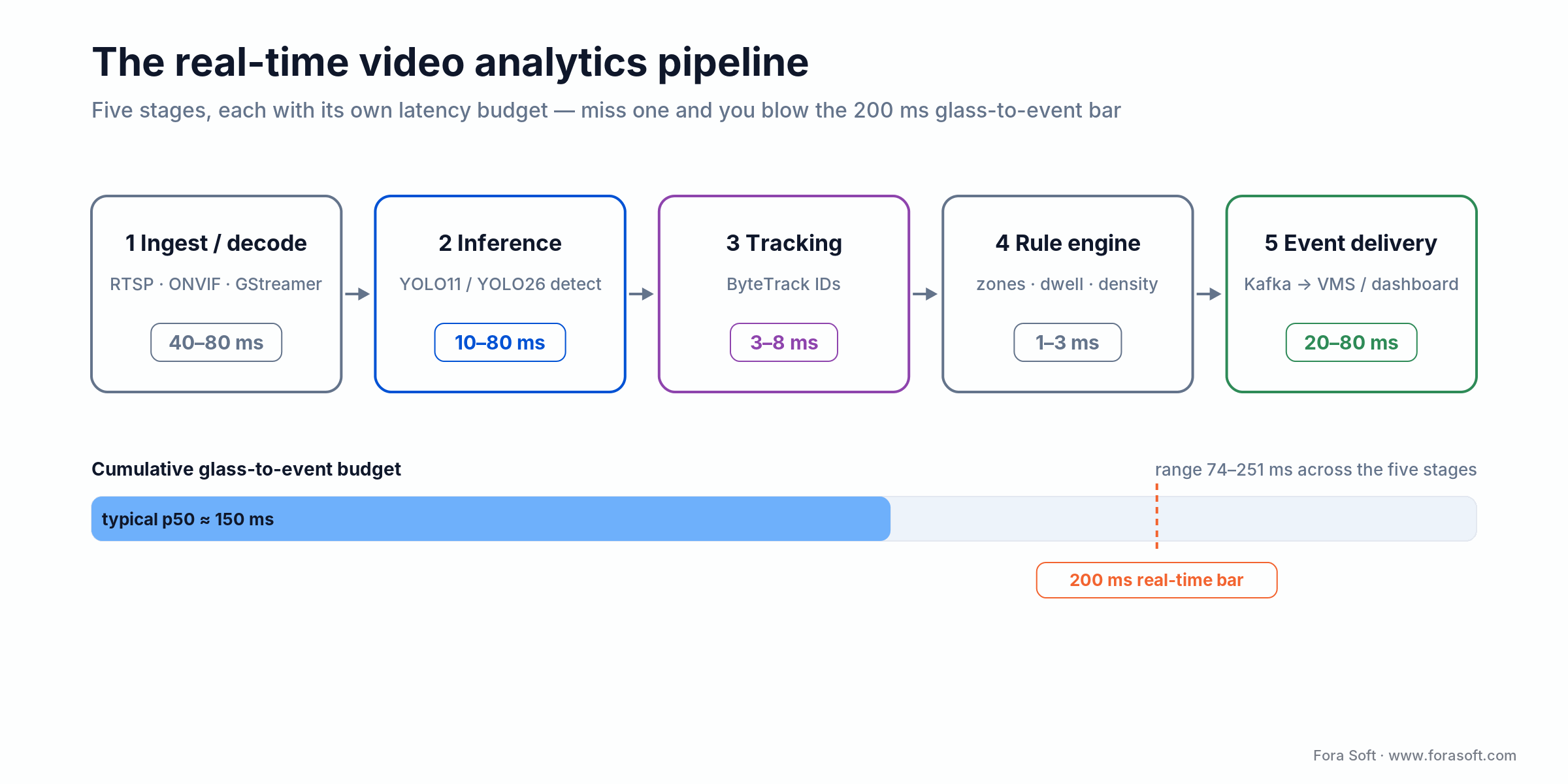
Figure 1. The five-stage RTVA pipeline. Add the stage budgets and a typical run lands near 150 ms — comfortably inside the 200 ms glass-to-event bar, with headroom only if every stage stays on budget.
The 2026 market snapshot: where the money is going
Analyst estimates for the video-analytics market cluster around 14.6 to 15.0 billion USD in 2026 — 14.65B from MarketsandMarkets, 14.81B from Fortune Business Insights, 15.04B from Mordor Intelligence, growing at roughly 20 to 23% a year through the end of the decade. Definitions vary: broader “AI video analytics” scopes reach about 27.6B (Research and Markets). Treat the exact figure as directional. The signal that matters is the double-digit growth rate and where the spend concentrates by vertical:
- Security and surveillance: 35–40% of spend. Intrusion, perimeter, VMS-native analytics.
- Retail: 20–25%. Shrinkage, queue, out-of-stock, heatmaps.
- Manufacturing and logistics: 15–18%. Defect detection, PPE, pick accuracy.
- Smart city and transportation: 10–12%. Traffic, parking, incidents.
- Healthcare: 5–8%. Fall detection, hand hygiene, OR workflow.
- Proptech and facilities: 5–10%. Occupancy, access-control overlays, amenities monitoring.
Application 1: Retail — shrinkage, queues, and conversion lift
Retail is where RTVA pays back fastest, because loss, labour, and abandonment are all measurable down to the till. Four wins dominate production deployments.
1. Shrinkage reduction. Sweethearting, scan-avoidance, and return-fraud detection at the self-checkout cut inventory loss by 15–40% in mid-tier retailers. Payback runs 6–12 months on a 50-store rollout when loss sits above 1.5% of revenue.
2. Queue monitoring. Real-time queue depth with an alert threshold (typically 3+ customers waiting) cuts queue abandonment by 8–12%. Operators close the loop by re-routing staff from the floor to the tills via handheld alerts.
3. Out-of-stock detection. Automated shelf audits push detection accuracy to 85–92%, where manual audits land at 40–60%. The operational gain is not just the rate — it is the frequency, running continuously instead of twice a day.
4. Conversion lift from heatmaps. Heatmap-informed layout changes lift conversion 5–12% on average. The trick is treating heatmaps as input to a merchandising experiment, not as a dashboard to admire.
Retail has enough depth to be its own build; our retail video analytics playbook works the store-intelligence numbers and the self-checkout loss-prevention math in detail.
Reach for edge-first retail RTVA when: you run more than 30 stores, connectivity is intermittent, and you cannot afford to ship in-store video to the cloud for every shrinkage event.
Application 2: Security and surveillance — cutting the false-alarm tax
The single biggest win in enterprise security RTVA is not detecting intruders; cameras have always done that. It is cutting false alarms by 60–80% against legacy PIR and magnetic sensors, so guards and police stop ignoring the feed.
Concrete production numbers from 2025–26 deployments our teams and peers ship:
- True-positive rate on intrusion: 92–97% at up to 200 m range with a well-tuned YOLO11 or YOLO26 deployment.
- Alert latency to operator: 50–100 ms; human response time then dominates.
- VMS compatibility: Milestone XProtect, Genetec Security Center, and Avigilon Control Center all support ONVIF Profile M events natively.
- Cost per valid event: 0.10–0.50 USD at scale, driven mostly by compute, not software licences.
The ONVIF side matters more than most buyers appreciate. Profile M is the metadata-and-events interface that lets a third-party analytics engine push structured events into a VMS without vendor lock-in. If you are specifying an RTVA stack on top of existing cameras, make ONVIF compliance a contract requirement, not a nice-to-have. For the detection side of this — how the anomaly and intrusion models are built and tuned — see our real-time anomaly detection playbook.
Reach for a dedicated analytics layer on existing cameras when: your VMS already ingests video but your guards have stopped trusting it. An engine that only raises high-precision events is cheaper than replacing the camera estate.
Application 3: Manufacturing and quality control
Manufacturing produces the cleanest ROI stories, because defects have a dollar value and sampling rates have a measurable ceiling.
1. Inline defect detection. Computer vision hits 94–99% accuracy on surface and assembly defects; manual inspection lands at 80–90%, with fatigue-driven variance. Inline vision also inspects 100% of parts, not the 2–5% a human line samples.
2. PPE and safety compliance. Hard-hat, vest, and safety-glass detection with real-time alerts cuts audit violations sharply on the rollouts we have seen. It is also the quickest win in a first RTVA project, because the rules are simple and the model is nearly off-the-shelf.
3. Anomaly and predictive maintenance. Spill, smoke, unusual motion, or bearing-vibration anomalies trigger maintenance 25–35% earlier than reactive workflows. Combined with a small process-control IoT feed, it shifts unplanned downtime into planned downtime.
Payback. Automotive and electronics lines typically see 8–14 month payback on inline vision, faster when the line already has controlled lighting and fixed camera mounts.
Reach for custom models in manufacturing when: your defects are proprietary or rare. No-code tools get you to a pilot; bespoke fine-tuning earns its keep once you have under ~500 sample images per defect class.
Application 4: Smart city, traffic, and public safety
Public-sector RTVA is dominated by four use-cases, and procurement cycles there push architecture decisions as much as technology does.
1. Traffic flow. Congestion detection plus dynamic signal timing cuts average travel time 8–15% in corridors with coordinated signals. It is the easiest political win because it is quantifiable and non-intrusive.
2. Parking occupancy. Real-time spot availability cuts cruising for parking by around 30%, which in turn trims urban emissions in the affected districts.
3. Incident detection. Accident or debris detection pushes alert response below one minute, from the usual 5–10 minutes, with a direct effect on secondary-incident rates.
4. Crowd density. Density thresholds at transit hubs, stadiums, and events flag crush risk early. This is one area where EU AI Act transparency rules bite — plan the compliance UX in from the start.
A 100-camera district-scale deployment typically runs 50K–200K USD in hardware plus integration, with annual software and support layered on top.
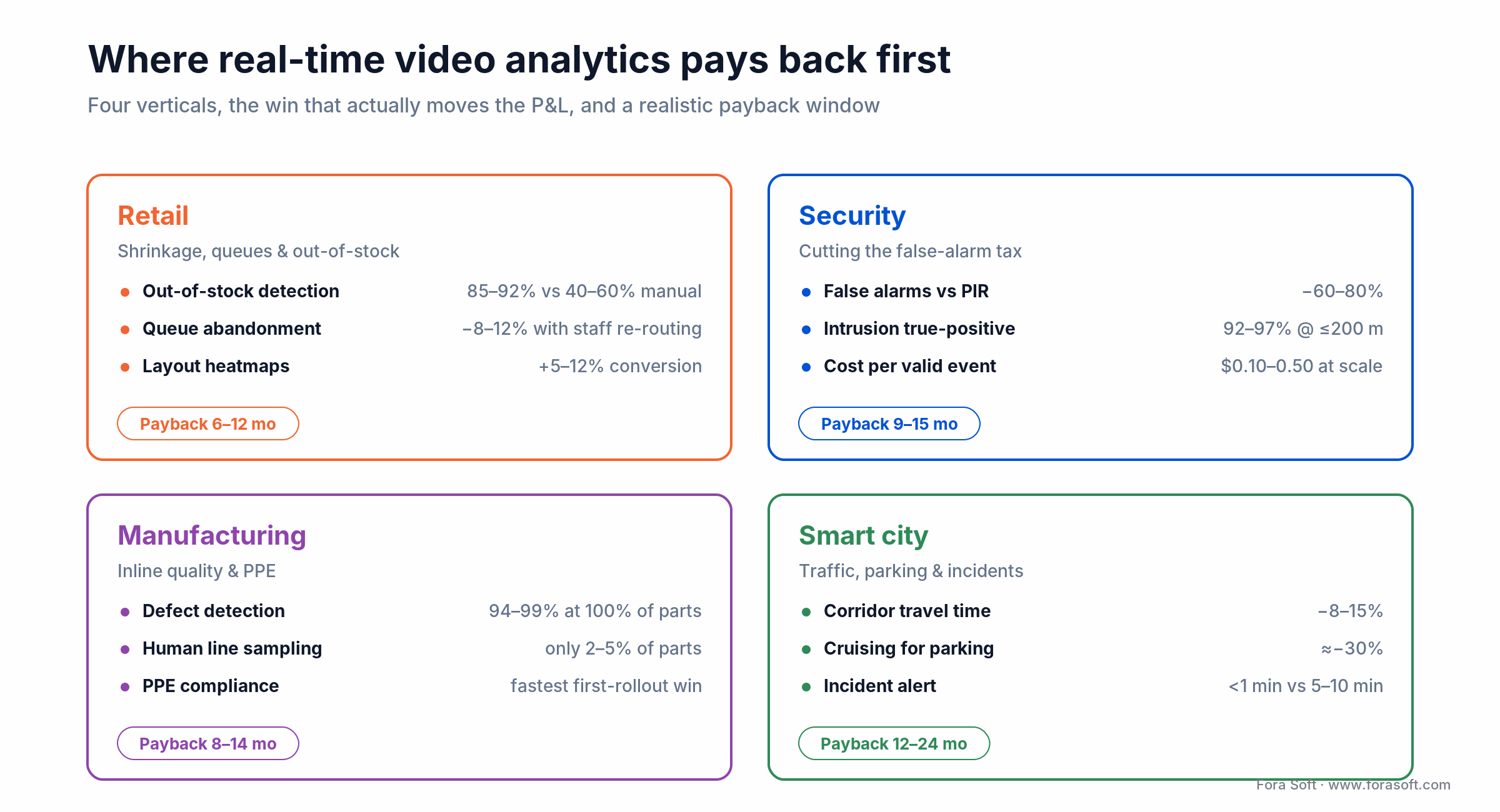
Figure 2. The four highest-ROI verticals side by side — the win that moves the P&L in each, and a realistic payback window. Retail clears fastest; smart-city projects take longest, mostly on procurement, not technology.
Reach for federated learning in smart-city RTVA when: you have a multi-district rollout and cannot legally centralise raw video. Model updates aggregated across districts keep inference accurate without the privacy exposure.
Platforms and vendors compared
The 2026 vendor field clusters into three tiers: camera-plus-analytics all-in-one (Hikvision, Axis, Verkada, Avigilon), analytics-only specialists (BriefCam, Rhombus), and developer platforms (NVIDIA Metropolis, Intel Geti, Viso Suite). Most enterprise builds mix tiers.
| Vendor | Strength | Deployment | Typical price (per cam / mo) | Best fit |
|---|---|---|---|---|
| Hikvision AcuSense | Cam + analytics | On-cam + on-prem | $20–80 | Large estates (NDAA-restricted in the US) |
| Axis | Premium cams + ACAP apps | On-cam + cloud | $30–100 | Corporate security |
| BriefCam (Milestone) | Video search + analytics | On-prem / hybrid | $100–300 | Law enforcement, retail |
| NVIDIA Metropolis | Edge platform + DeepStream | Edge / hybrid | $0–50 (SDK) | Custom pipelines |
| Intel Geti | No-code model builder | On-prem / cloud | $500–2,000/mo | Custom use cases, SMB |
| Verkada | Cloud-native cam + analytics | Cloud | $30–60 | Retail SMBs |
| Avigilon (Motorola) | End-to-end, NDAA-compliant | On-prem | $50–150 | Retail, healthcare |
| Custom (Fora Soft) | Bespoke, IP ownership | Any | Project-based | Proprietary events, own VMS/ERP |
Two ownership facts to keep straight when you shortlist: Avigilon is a Motorola Solutions brand and is NDAA Section 889-compliant, while BriefCam is now part of Milestone Systems (Canon group). Hikvision is the caveat — its gear is barred for US federal agencies and contractors under NDAA Section 889, and the FCC has moved from blocking new equipment authorizations to restricting sales of already-approved models, with a tighter covered-use definition still under review in early 2026. If your deployment touches US public money, specify NDAA-compliant cameras (Axis, Hanwha, Avigilon, Verkada) from the start.
Edge, hybrid, or cloud: the first architectural decision
Hybrid is the default: detect on the edge for latency and privacy, enrich in the cloud for scale, and drop to pure edge or pure cloud only when one attribute dominates. Architecture drives every downstream cost (bandwidth, hardware, licensing, compliance), and four attributes pick your tier: latency sensitivity, camera count, privacy posture, and the analytics mix you need.
Edge. Inference on the camera or a Jetson Orin Nano Super / Hailo-8 box on the same network. Latency 20–50 ms with a model tuned for the box (say YOLO26n on the Orin Nano Super), uplink 2–10 Mbps (metadata plus compressed review clips), roughly 150–250 USD per node once. Wins when privacy, connectivity, or sub-100 ms latency are non-negotiable.
Hybrid. Detect on the edge, enrich in the cloud for things like face or licence-plate recognition or cross-site analytics. End-to-end latency 100–200 ms. Typical spend 50–150 USD per camera per month. The right default for most enterprise retail and security deployments.
Cloud. Full video streams to AWS, Azure, or GCP. Latency 200–500 ms, bandwidth-heavy, 10–100 USD per camera per month. Wins at 100+ cameras when the analytics mix benefits from shared models and you can live with the latency.
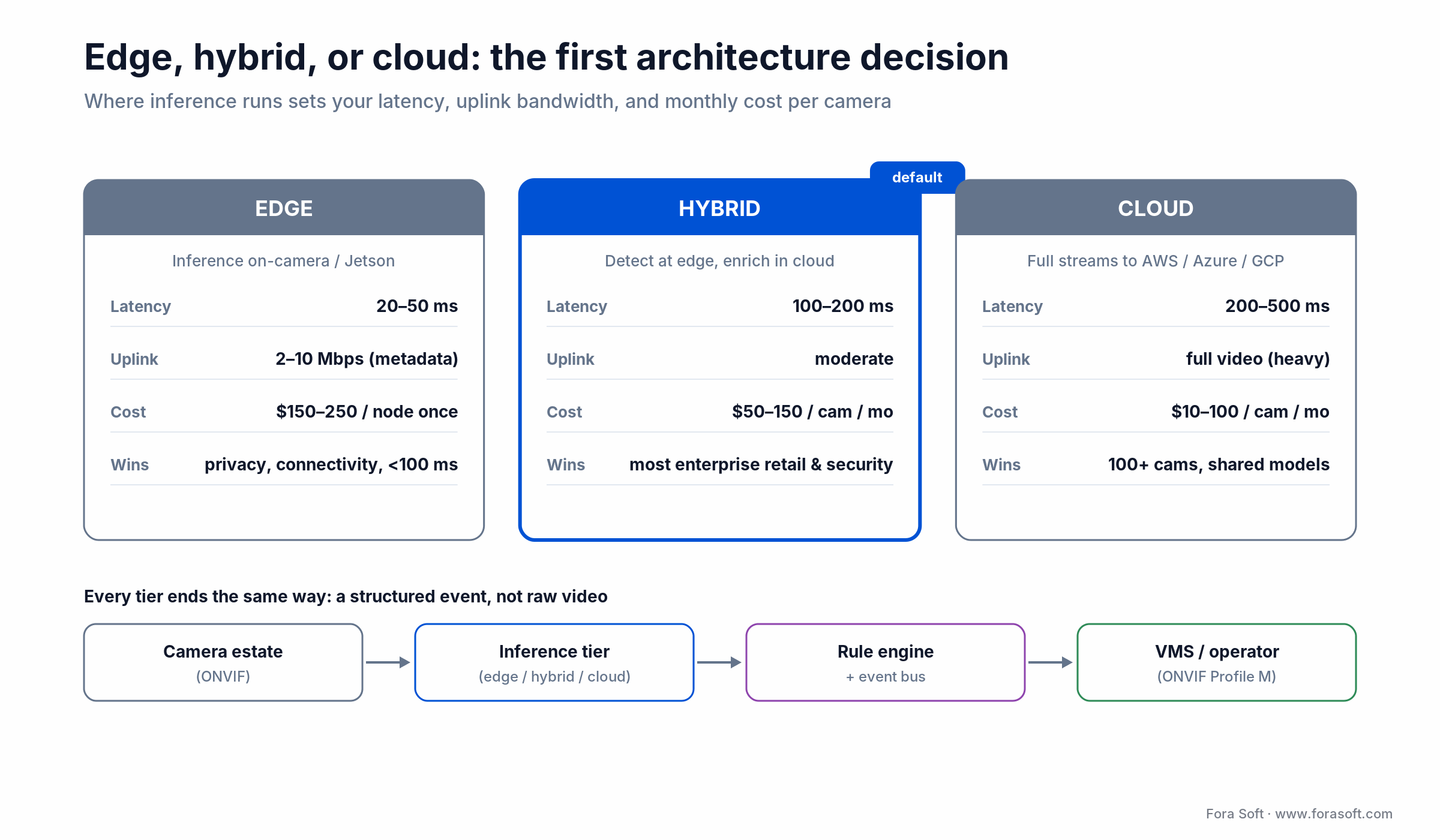
Figure 3. The three deployment tiers by latency, uplink, and monthly cost. Whichever you pick, the pipeline ends the same way — a structured event into the VMS over ONVIF Profile M, not raw video.
Our edge-computing guide for live streaming covers the placement rules we use for sub-400 ms glass-to-glass delivery; the same logic applies to RTVA event delivery.
Mini case: video analytics at evidentiary scale
Situation. VALT, the video surveillance and review platform we build, is used by 770+ US organizations and 50,000+ users — police departments, medical institutions, child-advocacy centers, where footage is evidentiary and audit trails are mandatory. The analytics layer had to flag events at more than 95% precision; a false positive in a forensic context is a disclosure problem, not a user-experience one.
Plan. We cut the analytics pipeline into ingest, edge inference, a tracking layer, and an evidentiary event log. The heaviest engineering load landed on false-positive suppression: audio cues plus a motion-context model brought precision from an out-of-the-box 82% to a sustained 96%+ across varied lighting. The VMS integration used ONVIF Profile M events, so agencies did not have to change the front-end their staff already knew.
Outcome. That precision jump cut false positives by roughly three-quarters (an 18% to 4% false-positive rate), so operator workload on the review queue dropped and the chain of custody survived audit without escalations. The lesson for enterprise RTVA buyers: precision matters more than recall once operator trust is on the line. Want a similar precision assessment on your video feed?
Want a precision-first RTVA pilot?
We scope a 4–8 week pilot on your existing cameras, with a real precision / recall report at the end — not a demo reel.
A decision framework — pick your RTVA path in five questions
1. What is the event latency budget? If a human closes the loop in seconds, 200–500 ms is fine. If a gate has to open or a belt has to stop, under 100 ms is the floor and you are on the edge.
2. How many cameras, and how scattered? Under 50 on one site: on-prem or edge-first. 50–300 across a network: hybrid. 300+ with shared models: cloud gets attractive despite the latency.
3. What is the privacy posture? Healthcare, schools, courts: keep inference local. BIPA or EU AI Act zones: face blurring at the edge is non-negotiable. The cloud-first play is hard to justify once you read the DPIA (data-protection impact assessment).
4. How bespoke are the events? Cars and people are commodity. A specific SKU on a specific shelf, or a specific defect class on a machined part, is not — plan for dataset collection and custom training.
5. Which VMS are you integrating into? If Milestone, Genetec, or Avigilon already runs the security operations centre, push events via ONVIF Profile M. If there is no VMS, budget for a lightweight operator UI.
Five pitfalls that burn RTVA quarters
1. Treating RTVA as a model problem. It is a systems problem. The model is 10% of the effort; ingest, tracking, rule engine, event delivery, monitoring, and retraining infrastructure are the other 90%.
2. Under-budgeting false-positive cleanup. Out-of-the-box detection at 85–90% is demo-grade; production security needs 96%+ precision. That delta is weeks of dataset curation, not a configuration toggle.
3. Ignoring model drift. Seasonal, lighting, and camera-angle changes degrade a model 3–10% per quarter in retail and traffic. Plan a retraining cadence from day one.
4. Thermal and power oversights on edge boxes. A Jetson in a warm ceiling enclosure throttles after 30 minutes. The fix is passive heatsinking at spec, not in the field.
5. Forgetting the consumer-camera gap. Wyze, Ring, and similar consumer feeds add 5–10 s of latency and limit codec control. They are not suitable for real-time analytics — specify enterprise ONVIF cameras.
Compliance: GDPR, BIPA, CCPA, and the EU AI Act
GDPR (EU). Face blurring for non-consented biometric processing; a defined retention period (30 days is a common default); and a DPIA for systematic monitoring. Biometric data is a special category under Article 9, so the bar for lawful processing is higher.
CCPA / CPRA (California). Notice at collection, deletion rights, and limits on sensitive personal information. Less strict than GDPR, but still a design input, not a footnote.
BIPA (Illinois). Written consent and a public retention policy before you collect biometric identifiers; statutory damages run 1,000 USD (negligent) to 5,000 USD (reckless) per violation. Since SB 2979, signed 2 August 2024, the same identifier collected from the same person by the same method counts as a single violation, not one per scan, and the Seventh Circuit held in April 2026 that the cap applies retroactively. It is still the most litigated biometric regime in the US; treat Illinois deployments as their own review.
Sector-specific. HIPAA requires encryption and audit trails in clinical areas; PCI DSS sets retention rules for payment environments; SOC 2 Type II is the attestation enterprise buyers ask cloud vendors for.
EU AI Act. The picture shifted in 2026, so get the dates right. The Article 5 bans — including real-time remote biometric identification in public spaces by law enforcement, with narrow exceptions — have applied since 2 February 2025 and were left untouched by the Digital Omnibus; breaching them risks fines up to 35 million EUR or 7% of global turnover. The Digital Omnibus (in force 27 July 2026) pushed the compliance deadline for standalone high-risk systems under Annex III (where biometric categorisation and post-event identification sit) from 2 August 2026 out to 2 December 2027. Transparency duties under Article 50 still apply from 2 August 2026. Crowd-density and queue monitoring are usually limited-risk (transparency); defect detection and traffic flow, minimal-risk. Classify your use-case before you scope, because the risk tier drives the whole compliance bill.
KPIs: what to measure after you ship RTVA
Quality KPIs. Precision at or above 95% for security events; true-positive rate at or above 90% for retail; false-alarm rate under 1% for operator trust; p95 latency under 200 ms glass-to-event. Track these per camera, not per site, or you will miss the bad camera dragging the average down.
Business KPIs. Alert-resolution time (target under 5 min for security, under 30 min for retail); shrinkage reduction year over year; conversion-lift delta; defects escaping per million parts. Feed these into a board-ready dashboard from quarter one.
Reliability KPIs. System uptime above 99.5% for mission-critical deployments, camera-hour cost under 0.10 USD (cloud) or 0.01 USD (edge), and a weekly retraining cycle with drift scores. Without these, an RTVA deployment quietly degrades by the end of year one.
Cost model: what realistic RTVA deployments budget
Three worked examples, order-of-magnitude — real numbers depend on site specifics, compliance review, and integration depth.
Retail, 50 cameras. Hardware 15–40K USD one-time. Software 25–80 USD per camera per month. Cloud storage 200–500 USD per month. Annual TCO 30–65K USD.
Security, 100 cameras, cloud-led. Cameras 30–80K USD one-time. Platform SaaS around 50 USD per camera per month. Annual TCO 60–140K USD.
Manufacturing, 20 cameras, edge. Hardware 10–15K USD. Software licences 500–1,500 USD per month. Annual TCO 16–33K USD.
Worked example: buy vs build for a 50-camera estate. On SaaS at about 55 USD per camera per month, 50 cameras cost 2,750 USD a month — roughly 33K USD a year, nothing upfront. A custom build that lands the same events might run about 66K USD upfront plus a 1,150 USD/month run-rate (edge boxes, monitoring, retraining). Set them side by side and the lines cross near month 41: before that, SaaS is cheaper; after roughly three and a half years (or immediately, if your events are proprietary and off-SaaS) the build wins, and you own the IP.
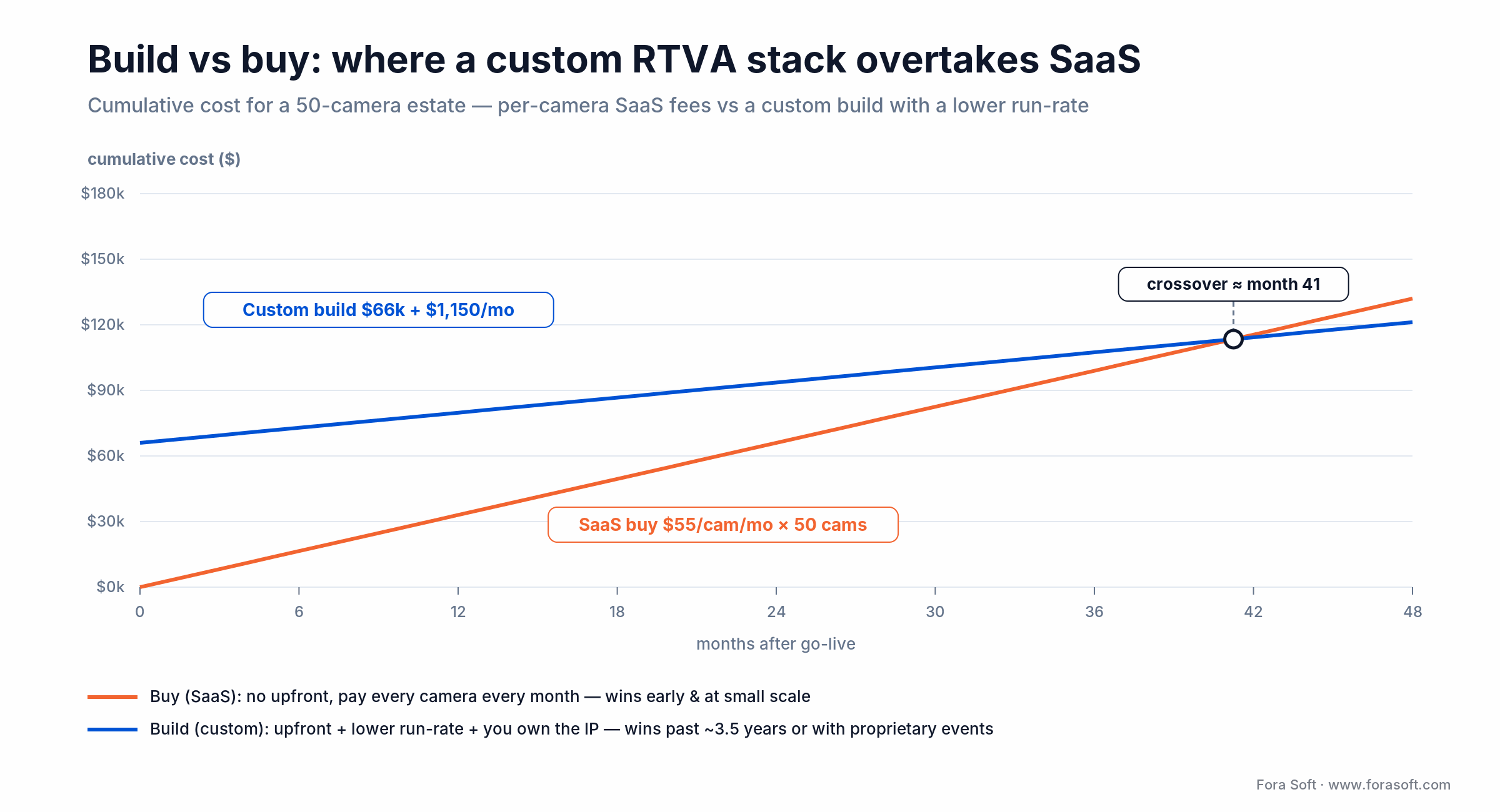
Figure 4. Cumulative cost for a 50-camera estate. SaaS has no upfront but never stops charging per camera; a custom build starts higher and rises slower, overtaking SaaS around month 41 — sooner if your events are proprietary.
A custom build earns its keep when the events are proprietary (specific SKUs, defect classes, workflow patterns), when IP ownership matters, or when the integration into your own VMS or ERP sits outside what SaaS platforms offer. With Agent Engineering we compress the build time on these projects, and the engineering line-item usually comes in below equivalent traditional quotes — ballpark ranges, not promises.
When RTVA is not worth building
Not every camera estate benefits from RTVA in the next cycle. Four patterns where buy-or-wait wins:
1. Fewer than 10 cameras and no multi-site ambition. An off-the-shelf Verkada or Avigilon licence gets you most of the value for a fraction of the integration cost.
2. Commodity events on commodity hardware. If the outcomes are already in AcuSense or an Axis ACAP app, pay for the product; custom development is a distraction.
3. No appetite for a retraining loop. RTVA models drift. Without ownership of the retraining cadence, accuracy degrades and operator trust evaporates in 12–18 months.
4. Privacy-sensitive environments with no compliance owner. If no one is accountable for GDPR, BIPA, or the EU AI Act, slow down — the compliance overhead will blow the timeline before the model does.
Second opinion on your RTVA architecture?
We have shipped this stack — detection, tracking, VMS integration, compliance — at evidentiary scale. Tell us your bottleneck.
The 2026 production model stack
The novelty spike in detection models has flattened: 2024–26 production deployments cluster around a handful of battle-tested stacks.
Detection. YOLO11 (Ultralytics, September 2024) is the mature, widely-deployed default, with a good accuracy / speed balance and a broad export ecosystem (DeepStream, OpenVINO, TensorRT). YOLO26, released January 2026, is the edge-first successor: it drops the Non-Maximum Suppression post-processing step for native end-to-end inference (one box per object), which simplifies deployment and runs up to 43% faster on CPUs. RT-DETR (Baidu) still wins on small-object accuracy. For most retail, security, and traffic work, YOLO11 or YOLO26 plus ByteTrack covers the job.
Tracking. ByteTrack is the lightweight default. DeepSORT still earns its place where re-identification across camera zones is a primary use-case.
Segmentation. SAM 2 for few-shot or zero-shot cases (rare manufacturing defects, irregular shapes); YOLO11-seg for high-throughput production.
Edge hardware. A Jetson Orin Nano Super (67 TOPS, about 249 USD, launched December 2024) runs several camera streams per node; a Hailo-8 module (up to 26 TOPS) is the low-power alternative when you are adding AI to an existing box.
Serving. DeepStream on NVIDIA edge, OpenVINO on Intel, TensorRT for data-centre GPUs, Triton for multi-model serving. Picking the right serving layer for your target hardware saves more latency than picking a “better” model. For the wider picture of where AI earns its keep on video, see our AI for video engineering hub and our real-time video processing with AI best practices.
Integration checklist: VMS, ONVIF, and the event bus
Lock these decisions before engineering begins, or expect each to cost weeks mid-project. Our video surveillance learning hub goes deeper on the ONVIF and VMS layer.
- ONVIF profile. Profile S for plain streaming, Profile T for advanced streaming (H.265) and thermal, Profile M for analytics metadata and events. If your VMS speaks Profile M, use it.
- VMS target. Milestone XProtect, Genetec Security Center, Avigilon Control Center, or custom. Check version compatibility early; older VMS releases sometimes need connector shims.
- Event bus. Kafka or RabbitMQ for scale, a managed queue for small estates. Encode events as a stable JSON schema, versioned from day one.
- Retention and redaction. Encrypted at rest, role-based access, and automatic face or plate redaction where compliance requires it.
- Observability. Per-camera metrics (latency, fps, precision score) fed into whatever monitoring stack owns your uptime.
Emerging trends that will reshape RTVA through 2027
Federated learning. Model updates aggregated across edge nodes without pulling raw video to the cloud — a hard requirement for healthcare and schools, increasingly the default for multi-tenant retail.
Synthetic data. Generative models produce thousands of labelled edge cases for long-tail defects, unusual lighting, and rare events, cutting bespoke-dataset collection time.
Multimodal analytics. Audio plus video (glass breaking, a shout, a specific machine signature) beats either stream alone. Expect hybrid audio-plus-video rule engines to become standard in premium RTVA stacks by 2027.
On-device vision-language models. As edge NPUs clear 30–60 TOPS, VLMs start running locally, enabling free-text queries over camera feeds (“show me every time someone left the stockroom door open”) without cloud calls.
Live WebRTC analytics. Streaming analytics-enriched feeds to operators over WebRTC — the transport we cover in our WebRTC architecture guide for 2026 — lets remote operators collaborate on events as they happen.
FAQ
What is real-time video analytics in practical terms?
A pipeline that ingests camera streams, runs detection and tracking on each frame, applies business rules (zones, dwell, density), and pushes structured events to a VMS or dashboard within about 200 ms of the scene happening. The camera becomes a sensor; the operator becomes a decision-maker rather than a watcher.
How fast does RTVA have to be to count as real-time?
Sub-200 ms glass-to-event is the industry bar. Security targets 100–150 ms; retail heatmaps tolerate 200–500 ms. Anything above 500 ms is near real-time at best, and loses its closed-loop value for gates, belts, or alerts that need to change behaviour in the scene.
Should we run RTVA on the edge or in the cloud?
Edge when privacy, connectivity, or sub-100 ms latency matters. Cloud when you have 100+ cameras, a shared-model advantage, and can tolerate 200–500 ms. Most enterprise builds end up hybrid: detection on the edge for latency and privacy, enrichment in the cloud for advanced models and fleet analytics.
What does an RTVA project cost for a 50-camera retail deployment?
Typical annual TCO is 30,000–65,000 USD for a 50-camera retail estate using off-the-shelf vendors. On SaaS at about 55 USD per camera per month that is roughly 33,000 USD a year with nothing upfront; a custom build runs about 66,000 USD upfront plus a lower monthly run-rate and overtakes SaaS around month 41. Agent Engineering compresses the engineering bill on custom work.
Which detection model should we use in 2026?
YOLO11 is the mature production default: strong accuracy / speed balance, mature tooling, and good export paths to DeepStream and OpenVINO. YOLO26 (January 2026) is the edge-first successor — it removes Non-Maximum Suppression for native end-to-end inference and runs up to 43% faster on CPUs. RT-DETR suits small-object scenes; SAM 2 covers few-shot segmentation for rare defects.
Does the EU AI Act block real-time face recognition?
Real-time remote biometric identification in public spaces by law enforcement is prohibited under Article 5, in force since 2 February 2025, with narrow exceptions. Other high-risk biometric systems under Annex III now have until 2 December 2027 to comply after the Digital Omnibus deferral, and Article 50 transparency duties apply from 2 August 2026. Classify your specific use-case before you scope the build.
How do we stop false alarms from drowning our operators?
Tune for precision, not recall. Add a motion-context model on top of the primary detector. Curate negative examples from your actual site footage. Ship with a human-in-the-loop review for the first quarter so the team can tag false positives back into retraining. Operators switch off feeds with false-alarm rates above ~5%, so the 1% mark is the right internal target.
Can we layer RTVA on top of existing cameras?
Yes, provided the cameras are enterprise ONVIF-compliant. Consumer feeds (Wyze, Ring) add 5–10 s of latency and limit codec control — unsuitable for real-time analytics. For most enterprise estates, an analytics engine plus an ONVIF Profile M integration into the existing VMS is cheaper than refreshing the camera fleet.
What to Read Next
Retail
Retail Video Analytics: 2026 Store-Intelligence Guide
The retail deep-dive — self-checkout loss prevention, shrink math, and store-intelligence ROI.
Security
Real-Time Anomaly Detection in Video Surveillance
How the intrusion and anomaly models behind the security section are built and tuned.
AI & Video
Real-Time Video Processing with AI: Best Practices
The detect-track-enrich patterns that sit at the core of every RTVA deployment.
Infrastructure
Edge Computing for Live Streaming
Where to place encoders and inference to keep glass-to-event under 200 ms.
Ready to turn cameras into sensors?
Real-time video analytics is what separates a camera that records from a camera that acts. Retail, security, manufacturing, and smart-city use-cases each offer 8–14 month paybacks when the architecture is matched to the latency, privacy, and camera-count profile. The model stack has settled on YOLO11 or YOLO26 plus ByteTrack plus DeepStream; the hard engineering has moved to ingest, false-positive suppression, and compliance.
If you are scoping an RTVA build, the fastest move is a 30-minute call with a team that has shipped this exact stack under evidentiary constraints. We will look at your cameras, VMS, event wiring, and compliance profile and tell you where to build, where to buy, and where the hidden weeks of engineering time are.
Talk to engineers who have shipped RTVA at scale
30 minutes, no slides. Bring your cameras and your event list; we will map it to a week-level plan.

