


Key takeaways
• AI textbook creation is a pipeline, not a prompt. The winning pattern is human-in-the-loop drafting grounded in your sources, not one-shot generation. AI compresses the author’s cycle from months to days; it does not replace the author.
• The AI is rounding error; review is the bill. Tokens and images run $2–$4 per chapter. Subject-matter-expert (SME) review runs $200–$400 per chapter. That is the number you optimize.
• RAG grounding is necessary, not sufficient. Retrieval cut hallucinated steps from 21% to under 7.5% in one 2024 study, yet retrieval-grounded legal tools still hallucinated up to 33%. A human gate stays mandatory.
• 2025–26 compliance is architectural. The European Accessibility Act (in force 28 June 2025), EU AI Act Article 50 (2 August 2026) and the US Copyright Office’s 2025 authorship ruling all shape the build. Retrofitting sinks projects.
• A full pipeline ships in 8–14 weeks. With Agent Engineering we hit that window at roughly half the cost of a classical stack, same editorial standard.
Why Fora Soft wrote this playbook
We have built edtech products since 2005: virtual classrooms, AI tutors, assessment engines, learning platforms. We built the AI content pipeline behind Scholarly, an AI learning platform that runs 2,000-seat live classes for 15,000 users. Across 250+ shipped projects and 21 years, one lesson keeps repeating: the hard part of AI textbook creation is never the drafting. It is the review, the citations, the accessibility, and the compliance paperwork that has to survive an auditor.
This is the answer we give on scoping calls when a publisher or edtech founder asks whether AI can cut a 12-month textbook build to a quarter. The short answer: yes, if you treat it as an engineering problem with a human gate, not a magic button. We ship with Agent Engineering, senior engineers driving AI coding agents across design, RAG indexing, prompt work and QA, so we deliver production content pipelines in 8–14 weeks at a smaller headcount. See our AI integration service and eLearning development practice for the wider approach, and our note on how we engineer AI features for the method behind it.
What follows is the practical playbook: what belongs in the pipeline, which model to pick, where quality breaks, what it truly costs, how to stay compliant in 2026, and the honest cases where a custom build is the wrong call.
Shipping an AI content pipeline for your publishing house or edtech?
Book a 30-minute call and we’ll map your content workflow to the right model, RAG and review stack. No upsell, just an architecture.
What is AI textbook creation?
AI textbook creation is the use of large language models and image models, grounded in a cleared source set, to draft, illustrate, assess and format a textbook, with human subject-matter experts reviewing every chapter before it ships. It is not a chatbot writing a book alone. The AI handles the mechanical bulk: turning an approved outline into grounded prose, generating figures and exercises, running accessibility checks, and exporting to a learning management system. Humans own the outline, the standards alignment, and the final sign-off.
The distinction matters because the failure modes cluster on the human side. A model can draft a plausible chapter in seconds; it cannot tell you whether that chapter meets your state’s curriculum standard, respects a reading-level target, or cites a source you actually hold rights to. That judgment is the product. Everything in this playbook is built to give the model less room to be confidently wrong and to give your experts more time to catch what remains.
Why AI textbook creation took off in 2026
Three lines on the chart crossed. First, inference got cheap: GPT-3.5-level output fell from $20 per million tokens in November 2022 to $0.07 by October 2024, a roughly 280x drop in 18 months, per the Stanford AI Index 2025. Per-chapter drafting stopped being a line item worth counting. Second, models got good enough to draft when grounded: today’s frontier models produce 5,000-word chapters at a target reading grade with a consistent voice, provided you run them over retrieval, not from memory.
Third, the evidence arrived. In September 2025, Google Research published Learn Your Way, a randomized study where students learning from AI-transformed textbook material scored 11 points higher on a retention test 3 to 5 days later (78% versus 67% for a standard digital reader). Publishers noticed. Wiley reported $49M in AI licensing revenue for the fiscal year ending April 2026, up from about $44M in 2024. Researcher AI use jumped from 57% to 84% in a single year on Wiley’s own survey of 2,430 people. The appetite is real, and so is the caution: a September 2025 Book Industry Study Group survey found roughly half of book professionals now use AI, while 98% still report significant concerns about it.
The bottleneck moved. It is no longer writing. It is reviewing, fact-checking, keeping a house voice, and shipping accessibly under new law. That is exactly where a software partner adds value.
The end-to-end AI textbook pipeline
A production pipeline has ten defined stages. Every team we work with runs some variant; what differs is which stage they automate first. The rule that never bends: stage 8, human review, is a gate, not a suggestion.

Figure 1. The ten stages of an AI textbook pipeline. Stages 1–7 automate; stage 8 (SME and editorial review) stays human; stages 9–10 ship and maintain.
- 1. Outline and learning objectives. Model-assisted brainstorming, SME sign-off on outcomes and standards alignment. Humans decide scope here.
- 2. RAG ingestion. Load curricula, reference texts and rights-cleared material into a vector store (Qdrant, Weaviate, Pinecone).
- 3. Chapter drafting. The model writes narrative, worked examples and explanations grounded in the retrieved context, steered by a tone guide.
- 4. Fact and citation check. Automated re-retrieval for every factual claim; human verification of the risky passages.
- 5. Illustrations and diagrams. Image generation for concept figures, diagram-as-code for flowcharts, licensed stock for photography.
- 6. Exercises and assessments. Quiz, code and simulation items wrapped in QTI, H5P or xAPI so they plug into any LMS.
- 7. Accessibility pass. Auto alt-text, multi-language captions, reading-level checks, a WCAG 2.2 audit that runs in CI.
- 8. SME and editorial review. Human gates on tone, bias, curriculum fit and learner readiness. Never optional.
- 9. Publish. Export to EPUB 3, EDUPUB or proprietary channels (VitalSource, D2L, Kortext); push interactive assets over LTI 1.3.
- 10. Update loop. Versioning, errata capture, per-chapter analytics, and a scheduled regeneration cycle.
For a closer look at stages 3 and 4, see our guide to AI-driven educational content creation.
Core AI capabilities that earn their keep
RAG-grounded chapter drafting
Retrieval plus a language model is the core of any serious workflow. The model produces the draft; the retrieval layer forces every factual claim to trace back to a vetted chunk. This is where most of the accuracy comes from, and where the honest limits live, covered in the next section.
Image and diagram generation
Use general image models (GPT-native image gen, Imagen, Stable Diffusion) for illustrations, and diagram-as-code for technical figures because text-based diagrams version, translate and regenerate cleanly. A warning worth stealing from Google: on Learn Your Way, general-purpose image models proved too weak for educational visuals, so the team fine-tuned a dedicated model just for illustrations. Do not trust raw image gen for a physics diagram without a human eye on it.
Interactive exercises and adaptive paths
Multiple choice, cloze, drag-and-drop and live code sandboxes are all generable now, wrapped in H5P or QTI. Adaptive pathing fires once a learner clears a short cold-start window of interactions. Our intelligent tutoring systems guide walks the mechanics.
Accessibility automation
AI-generated alt-text, auto captions, on-demand translation, reading-level scaling. The payoff scales with your compliance scope: the more jurisdictions you sell into, the more an automated accessibility pass pays for itself, and after June 2025 the EU made that pass mandatory for e-books.
Fact-check and originality
Re-retrieval per claim, semantic similarity to the source corpus, and an originality check (Copyscape, Turnitin) on human-facing prose. Never ship a chapter that has not passed all three.
RAG grounding: how it works, where it fails
Retrieval-augmented generation ties each claim to a cleared source, but it reduces hallucination, it does not erase it. Here is the flow: you index your licensed corpus, retrieve the top-k chunks per section and per claim, draft with those chunks in context, then re-retrieve to verify each fact before a human signs off.

Figure 2. How RAG grounds a draft, and the measured limits: grounding helps a lot but never reaches zero, so the human gate stays.
The numbers are encouraging and sobering at once. A 2024 structured-output study cut hallucinated steps from 21% to under 7.5% with a retriever. A healthcare study lifted GPT-4 accuracy from 80.1% to 91.4% on preoperative instructions once RAG was added. But a Stanford study the same year found retrieval-grounded legal research tools still hallucinated up to 33%. Grounding is the biggest single quality lever; it is not a guarantee. For textbook-grade accuracy you pair RAG with a human SME gate, full stop.
A minimal grounded-drafting loop looks like this:
chunks = retriever.search(section_brief, k=8)      # top-k from your cleared corpus
draft  = model.write(section_brief, context=chunks, style=house_guide)
for claim in extract_claims(draft):
    if not retriever.supports(claim, threshold=0.82): # re-retrieve every fact
        flag_for_human(claim)                          # SME decides, not the model
publish_if(all_claims_supported and sme_approved)
Reach for stronger retrieval when: your subject carries legal, medical or safety weight. Raise k, add a re-ranker, and route every flagged claim to a named reviewer before the chapter moves.
The model stack: which AI to pick for what
Pick for the job, and keep providers swappable behind a config flag. Prices below are list rates per million tokens as of mid-2026; treat them as directional, since vendors move them often.
| Tool | Best at | Where it breaks | List price (in/out) |
|---|---|---|---|
| Claude Opus 4.8 | Pedagogical structure, long-form coherence | Priciest of the set for bulk drafting | $5 / $25 |
| GPT-5.4 | Multimodal chapters, native image gen | Voice drifts on very long books | $2.50 / $15 |
| Gemini 3 Pro | Search grounding, STEM, time-sensitive topics | Data-residency setup takes work | ~$2 / $12 |
| Gemini 3 Flash / Haiku 4.5 | Cheap bulk passes, classification, checks | Thin on nuanced pedagogy | $0.50–$1 / $3–$5 |
| NotebookLM | RAG over your own sources, audio summaries | Limited structural control | Consumer / research phase |
| Diagram-as-code + image gen | Versionable figures, concept art | Style drift across batches; weak on precise visuals | ~$0.04–$0.10 / image |
| H5P + LTI 1.3 | Interactive exercises, LMS embed | Styling customization | Open source / infra |
Reach for Claude Opus 4.8 as the primary drafter when: chapter coherence and pedagogy matter more than token cost, and route cheap Flash or Haiku passes to the checks and classification work around it.
Reach for Gemini 3 Pro when: your subject changes fast and you need search grounding for currency, for example a business or technology title that dates within a semester.
Quality risks and how to kill them
Hallucinations. Ungrounded output invents plausible, wrong facts. Ground every passage in RAG, require inline citations, and run a second checker per claim. Grounding plus a human gate is the floor, as the numbers above show.
Outdated information. Models trail reality by months. Layer a search-grounded model, time-stamp every source chunk, and run a quarterly refresh pass on the book.
Biased content. Training data carries bias; textbook content must not. Keep diverse-prompt test sets, run a bias audit before editorial review, and staff a reviewer panel that reflects the student body.
Copyright contamination. Output can leak near-verbatim from training data. Run an originality check on all prose, prefer models with transparent training disclosures, and never fine-tune on unlicensed corpora. The US Copyright Office confirmed in its January 2025 report that purely AI-generated output is not copyrightable; only the human contribution is protected.
Tone drift. Long books lose their voice chapter by chapter. Codify a written style guide, feed it into every prompt, and run a tone-consistency pass before ship.
Compliance in 2026: EAA, EU AI Act, FERPA
Treat compliance as input to architecture, not a footnote. Two regimes changed the ground under AI textbooks in the last year, and both carry hard dates.
| Regime | What it forces | Key date |
|---|---|---|
| European Accessibility Act | E-books sold in the EU must be accessible: WCAG 2.1 AA + EPUB Accessibility 1.0, plus an accessibility statement. Backlist included. | In force 28 Jun 2025 |
| EU AI Act, Article 50 | AI-generated text and images must be machine-readable and detectable as AI-made. Not limited to high-risk systems. | Applies 2 Aug 2026 |
| US Copyright Office | Purely AI output is not copyrightable; keep a documented human editorial chain per chapter. | Report Jan 2025 |
| FERPA / COPPA (US) | No identifiable student records into a third-party model without a DPA; COPPA consent for under-13 interaction. | Ongoing |
| GDPR + WCAG 2.2 / 508 | Data residency, DPIA, right to erasure; alt-text, captions, contrast, keyboard nav, semantic EPUB 3. | Ongoing |
Two practical consequences. Under the European Accessibility Act, an inaccessible EPUB is no longer just poor practice; it is unsellable in the EU, which is why the accessibility pass belongs in CI, not at launch. Under EU AI Act Article 50, the synthetic text and figures in an AI-made textbook need machine-readable AI-generated marking; systems already on the market get a short grace window to 2 December 2026 for the marking obligation. On licensing, Creative Commons (OER, the kind OpenStax publishes) speeds adoption and reuse, while proprietary rails support institutional sales; many publishers run both on the same content.
Worried your AI content pipeline won’t pass an EAA or AI Act audit?
Send us your title count and compliance scope. We’ll come back with a one-page architecture and accessibility plan.
Cost model: what a chapter and a book cost
Here is the arithmetic, shown out loud. A 5,000-word chapter is roughly 6,700 output tokens; a grounded draft pass pulls in about 30,000 input tokens of retrieved context. On Claude Opus 4.8 at $5 per million in and $25 per million out, that is 30,000 × $5/1,000,000 = $0.15 input, plus 6,700 × $25/1,000,000 = $0.17 output, so about $0.32 per draft pass. Three or four passes with checks lands near $1–$2 in tokens per chapter. Add roughly $0.50–$1 for figures. The AI total is $2–$4 a chapter. SME review at $200–$400 is a hundred times larger.

Figure 3. Per chapter the AI is a rounding error; SME review dominates. Per 20-chapter book, AI-assisted still undercuts a classical build several times over.
| Line item | Per chapter (~5k words) | Per 20-chapter book |
|---|---|---|
| Model drafting tokens | $1–$2 | $20–$40 |
| Image / diagram generation | $0.50–$1 | $10–$20 |
| RAG / retrieval infra | < $0.20 | ~$4 |
| SME / editorial review | $200–$400 | $4,000–$8,000 |
| Accessibility pass | $40–$100 | $800–$2,000 |
| Total | $240–$500 | ~$5,000–$10,000 |
A classical human-only pipeline typically runs $25,000–$80,000 per textbook, depending on domain and review depth. The AI line items are not the story. The story is that SME time falls from weeks to days per chapter, which is where the saving lives. Building the pipeline itself (indexing, drafting console, review UI, publish-to-LMS) is 8–14 weeks with our Agent Engineering approach; see the framing on our AI integration service.
LMS integration and distribution
A textbook stuck in a PDF silo wastes half the AI investment. Modern pipelines ship into learning platforms and analytics back-ends over open standards:
- LTI 1.3 embeds interactive components inside Canvas, Blackboard, Moodle and D2L Brightspace with single sign-on and grade passback.
- xAPI streams granular learner events to a Learning Record Store for per-chapter analytics.
- QTI 3.0 keeps assessment definitions portable across platforms.
- H5P gives you an open interactive-content library, LRS-ready and LTI-friendly.
- SCORM is legacy but still demanded by corporate L&D; keep it as an export option.
- EPUB 3 / EDUPUB is the open, reflowable, accessibility-native distribution format, and the one the EAA effectively requires.
- VitalSource / Kortext / D2L are the commercial rails when DRM and institutional sales are on the table.
Build vs buy: tools or a custom pipeline
Do you need a custom pipeline at all? Under about four titles a year, no: an off-the-shelf generator plus freelance editors will cover you. Between four and twelve, a hybrid of SaaS tools with light custom glue tends to win. Above twelve titles, or when brand voice and compliance are non-negotiable, a custom build starts paying back inside 6 to 9 months. The decision tree below is the version we sketch on calls.
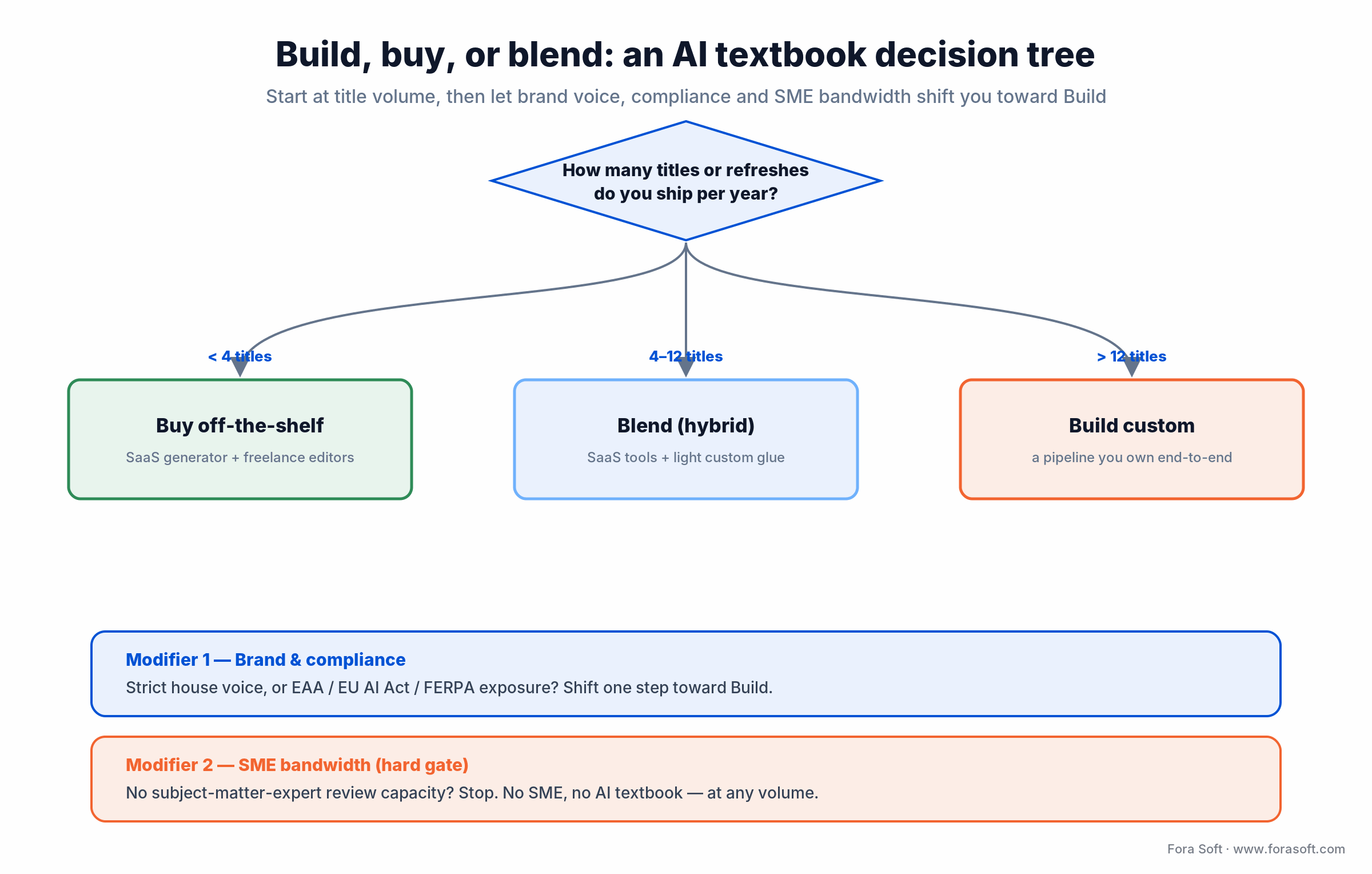
Figure 4. Start at title volume, then let brand voice, EU/US compliance and SME bandwidth shift you one step toward Build.
Off-the-shelf generators win on speed to a first draft and lose on house voice, rights control and audit trails. A hybrid wins when a couple of workflow steps are custom (say, your citation format or your LMS export) and the rest is bought. A custom pipeline wins on control, brand consistency and compliance, and costs more up front. Most publishers we work with land in hybrid first, then graduate to custom once volume justifies it.
Reach for a custom pipeline when: you ship more than a dozen titles or refreshes a year, enforce a strict house voice, or carry EAA, AI Act or FERPA exposure that a generic tool cannot document.
Mini case: shipping an AI content workflow
A publisher came to us with 120 legacy textbooks that needed an annual refresh. The classical process took 7 to 9 months per book, most of it author and editor time. They wanted to compress to 8 to 12 weeks per book without dropping their editorial standard or shipping prose that reads like a machine wrote it.
Our 14-week build delivered a Claude-driven RAG pipeline fed by their licensed corpus, a drafting console with inline citation anchors, an image queue tied to a strict house style guide, an automated accessibility pass emitting WCAG 2.2 artifacts, and a review UI that lets editors approve or reject by paragraph. Agent Engineering generated most of the microservice scaffolding, UI and integration tests in parallel with senior review, which is how we held the timeline.
Outcome: chapter turnaround dropped from about 4 weeks to about 5 days. Editor hours per chapter fell from roughly 40 to 10. The final-QA error rate came in below the human-only baseline, thanks to automated fact re-retrieval. Book a 30-minute call if you want a similar assessment on your titles.
A decision framework in five questions
Run these before you pick a tool or brief an engineering team.
1. What is your throughput target? Under four titles a year, off-the-shelf plus freelance editors wins. Above that, a pipeline pays back inside 6 to 9 months.
2. How strict is your tone and brand? A strict house voice needs a style-guide layer or prompt battery. Generic prose does not.
3. What licensing applies to your sources? Proprietary sources narrow your provider choice; OER content opens it up.
4. Which compliance regimes bind you? The union of EAA, EU AI Act, FERPA, COPPA, GDPR and Section 508 sets your data residency, marking and accessibility cadence.
5. Do you have SME review bandwidth? No SMEs, no AI textbook. The pipeline amplifies expert capacity; it does not replace it.
Five pitfalls on AI textbook projects
1. Shipping without RAG. Ungrounded prose hallucinates at a textbook-unacceptable rate. Always ground.
2. Skipping the SME layer. An AI-drafted book without editorial gates will embarrass you in public within six months. Build the reviewer UX as seriously as the drafting UX.
3. Inconsistent figures. Different prompts produce different art. Codify a house prompt template and enforce it in CI.
4. Retrofitting accessibility. After the EAA, an inaccessible EPUB is unsellable in the EU. Put alt-text, captions and reading-level checks in the pipeline, not a post-hoc audit that doubles the budget.
5. Auto-generating quizzes without review. Models produce superficial or wrong questions often enough to matter. Sample-review at least 10% and keep an errata pipeline open.
KPIs to track on a textbook pipeline
Quality KPIs. Fact-check pass rate at or above 98% after SME review, bias audit pass rate 100%, tone-consistency score at or above 0.85 on your rubric, WCAG 2.2 AA audit pass rate 100%.
Business KPIs. Chapter turnaround under 7 days, editor hours per chapter under 12, cost per finished chapter under $500, revision cycles per chapter at or below 2.
Reliability KPIs. RAG retrieval success at or above 99%, model-provider SLA adherence at or above 99.5%, LMS export failures under 0.1%.
When AI textbook creation is the wrong answer
Sometimes the right answer is not a pipeline. Skip it when any of these hold:
- Your whole catalogue is under three books and rarely updated. Freelance editors are cheaper.
- You sell on author brand alone. Readers buy the voice; AI amplification dilutes it.
- Your subject changes faster than your RAG index refreshes. Hallucination risk outweighs the speed gain.
- You have no SME review capacity. AI-drafted books ship fast and fail faster without human eyes.
FAQ
How much does it cost to create a textbook using AI?
The AI line items (tokens, images, retrieval) run under $80 for a 20-chapter book. SME and editorial review is the real cost at $4,000–$8,000, plus $800–$2,000 for accessibility. Total is roughly $5,000–$10,000, versus $25,000–$80,000 for a classical human-only build. The saving comes from compressed review time, not cheaper drafting.
Which AI model should we use for textbook drafting?
Claude Opus 4.8 for pedagogical structure and long-form coherence, GPT-5.4 for multimodal chapters, Gemini 3 Pro when you need search grounding for currency. Build the pipeline so providers swap via config; model-specific lock-in is the most common mistake we fix.
How do we stop an AI textbook from hallucinating?
Ground every paragraph in a RAG index of your cleared sources, require citation anchors, run an automated claim-verification pass, and keep an SME gate before publication. Grounding measurably cuts hallucination but never to zero, so the human gate is not optional.
Is an AI-generated textbook copyrightable?
Per the US Copyright Office’s January 2025 report, purely machine-generated output is not copyrightable on its own; the human creative contribution is what carries copyright. For publishers, that means keeping a documented human editorial chain per chapter, which is what protects the final work.
Do we have to label AI-generated textbook content in the EU?
Yes. EU AI Act Article 50, which applies from 2 August 2026, requires AI-generated text and images to be marked in a machine-readable way and detectable as AI-made. Systems already on the market get until 2 December 2026 for the marking obligation. Bake the marking into your export step.
Can AI generate exercises that LMSs understand?
Yes. Models can emit QTI, H5P or xAPI items that embed into Canvas, Moodle, Blackboard, Brightspace and Open edX over LTI 1.3, with grade passback and event streaming. Sample-review the questions before they ship.
How long does it take to build a production AI textbook pipeline?
With Agent Engineering, 8–14 weeks from kickoff to the first production-grade chapter, depending on source-rights complexity, compliance scope and how many LMS targets you need. Classical delivery is typically 16–28 weeks for the same scope.
Do we still need editors and subject-matter experts?
More than ever. AI compresses drafting, not judgment. Plan for 8 to 12 editor hours per chapter even with an optimized pipeline. Skipping this step is the single most common failure mode we see.
What to Read Next
Content
AI-Driven Educational Content Creation
How to ship AI-drafted lessons with editorial control.
Study Guides
AI Tools for Creating Study Guides
Condense large materials into guides, the right way.
AI Tutors
Intelligent Tutoring Systems for Educators
RAG-grounded tutors that wrap your textbook content.
Adaptive Learning
AI Study Guide Maker: The 2026 Playbook
Where content pipelines meet adaptive study tools.
Multimedia
AI-Powered Multimedia for E-Learning
Captions, translation and video to wrap your books.
Ready to build an AI textbook pipeline that ships?
AI did not remove the textbook author; it changed what their week looks like. The 2026 pattern is plain: RAG-grounded drafting, a disciplined SME gate, accessibility baked into CI, and LMS-native distribution under the new EU and US rules. Pick models you can swap, wire them into a pipeline your editors actually want to use, and measure the KPIs that matter.
If you want an AI content pipeline that passes editorial review, ships to every major LMS, and stands up to an EAA or AI Act audit, the next step is a 30-minute scoping call. We’ll map your catalogue, compliance and team to an architecture, and leave you with a realistic plan.
Let’s build your AI textbook pipeline
Fora Soft ships AI content workflows with Agent Engineering: faster, leaner, production-ready. Your editors will thank you.

