
There are hundreds of AI study tools in 2026, and most of them are the same GPT wrapper wearing a different logo. Pick the wrong one and a student memorises a confidently wrong chemistry mechanism, or a school kills a district pilot over a missing data agreement. We've built e-learning products since 2005 — 250+ projects, including platforms used by hundreds of thousands of learners — so this guide skips the marketing and ranks the tools that actually hold up in production, with the trade-offs as we see them.
The short answer: NotebookLM and ChatGPT Study Mode win for college and self-study, Quizlet and Knowt own K-12, Brainscape and Anki carry high-stakes exam prep, and Khanmigo or Microsoft Copilot for Study fit institutions. Here's how to choose — and, if you're building, what a serious AI study product actually costs to ship.
Key takeaways
• The 2026 winners are voice-first, source-grounded and spaced-repetition-aware. NotebookLM, ChatGPT Study Mode, Quizlet, Brainscape, Khanmigo, StudyFetch, Knowt, Anki and Microsoft Copilot for Study cover >90% of real-world use cases.
• Pick by learner profile, not feature list. K-12 belongs to Khanmigo and Quizlet/Knowt; college and self-study to NotebookLM and ChatGPT; medical/law/cert prep to Brainscape and Anki; STEM-heavy users to ChatGPT and StudyFetch.
• Five features actually move outcomes. Source-grounded summaries, multi-format ingestion (PDF/video/audio/image), high-quality flashcard generation, real spaced-repetition scheduling, and a verifiable evaluation suite.
• Build vs buy is a budget question, not an ego question. A credible MVP (LLM + RAG + multi-format ingestion + SM-2 scheduler + FERPA basics) takes a small senior team three to four months.
• The ship-killers are predictable. STEM hallucinations, copyright on training data, FERPA/COPPA gaps, and shipping engagement metrics instead of learning-gain metrics. Plan for these on day one.
Why Fora Soft wrote this guide
Fora Soft has been shipping e-learning products and AI integrations since 2005. We’ve built or rebuilt platforms used by hundreds of thousands of learners — including BrainCert (live virtual classrooms with AI grading), Instaclass (instructor-marketplace tutoring), Scholarly (AI-driven study assistant) and The Language Chef (gamified language learning).
This piece is for the founder, head of product or curriculum lead trying to answer one question: which AI study tool should we standardise on, integrate with, or out-build? No vendor sponsorships. No hand-waving. The picks below are the ones that show up in our client engagements again and again, with the trade-offs as we see them in production.
Building or rebuilding an AI study product?
30 minutes with a Fora Soft architect — we’ll map your use case to the right buy/integrate/build path, with a realistic cost envelope.
The 2026 AI study-tool market, in five shifts
1. Voice-first formats are mainstream. NotebookLM’s Audio Overviews proved that learners will listen to podcast-style summaries on commutes. Most tools now ship audio in some form.
2. Source grounding has gone from nice-to-have to table stakes. After well-reported hallucinations on STEM topics, leading tools cite the source paragraph behind every claim. Anything without grounding loses school deals fast.
3. Multi-format ingestion is the new minimum. A 2026 study tool that only takes plain text or PDFs is one generation behind. Lecture videos, audio, photographs of whiteboard notes and direct URL pulls are expected.
4. Spaced repetition is bundled, not bolted on. The SM-2 algorithm or a calibrated derivative now ships inside Quizlet, Brainscape, Knowt and most credible newcomers. Static decks read as dated.
5. Privacy is a sales weapon. Schools ask for FERPA/COPPA documentation up front. Vendors with a signed data-use agreement close institutional deals; vendors without one stay in B2C.

Figure 1. The five capabilities that separate a real 2026 AI study tool from a chatbot wrapper.
The nine best AI study guide tools in 2026
These are the platforms we see most often in client conversations, evaluated by what they’re actually good at — not by their pitch deck.
1. Google NotebookLM — source-grounded summaries and audio
Upload your sources (PDFs, slides, web pages, YouTube transcripts) and NotebookLM produces a chat-style assistant that answers strictly from those sources, with inline citations. The Audio Overview feature turns the same sources into a two-host podcast that’s actually listenable, and 2026 added Video Overviews. The free tier gives 50 sources per notebook and 3 audio overviews a day; paid tiers (Plus $7.99, Pro $19.99, Ultra $99.99/mo) lift the caps — restructured into Google’s AI subscriptions at I/O in May 2026.
Reach for NotebookLM when: you want source-cited summaries from your own materials, audio learning is a real channel, and you don’t need persistent classroom rosters or LMS integration.
2. ChatGPT Study Mode — STEM and conversational learning
OpenAI’s Study Mode walks through problems Socratically rather than dumping answers, with strong math and image reasoning. As of 2026 it’s free on every ChatGPT plan, running on the GPT-5 family — GPT-5.3 Instant on the free tier, GPT-5.4 Thinking on Plus ($20/mo). Strong for explanations, weak on long-term scheduling. Claude and Gemini now ship equivalent guided-learning modes.
Reach for ChatGPT Study Mode when: the learner is already a ChatGPT user, the subject is STEM or open-ended, and they want a tutor that holds a conversation rather than a deck-builder.
3. Quizlet — the mainstream K-12 / college default
Still the largest deck library on the internet. Magic Notes turns lecture notes into flashcards; Q-Chat is a guided AI tutor; spaced-repetition scheduling is on by default in Learn mode. Free tier covers everyday studying; the AI features sit on Quizlet Plus (about $35.99/year).
Reach for Quizlet when: the network effect matters — classmates already share decks, the subject has a public deck library, and you want spaced repetition without configuration.
4. Knowt — for ad-free, budget-friendly Quizlet alternative
Built by ex-Quizlet-power-users, Knowt offers note-to-flashcard conversion, quiz generation and an AI tutor with no ads on the free tier. Smaller deck library, simpler UI, school pricing typically lower than Quizlet’s. Strong Gen-Z adoption in the US.
5. StudyFetch (Spark.E) — for video-first learners
Drop in a lecture video or recording, get summaries, flashcards and an AI tutor (Spark.E) anchored to the source. Strongest video ingestion of the bunch, and currently the #1 organic result for “ai study tools.” Smaller user base means weaker network effects but a sharper product for STEM video courses.
6. Brainscape — medical, law, and certification cramming
The spaced-repetition specialist with a 15-year track record on USMLE, bar exam, MCAT and language certifications. AI now generates cards and explanations on top of the proven scheduling algorithm. UI looks dated next to Quizlet; the algorithm is what learners pay for.
Reach for Brainscape when: the learner is preparing for a high-stakes exam where retention over months matters more than UI polish.
7. Anki + AI plugins — for power users who own their stack
Free, open-source, infinitely customisable. AnkiHub, ChatGPT-card-generation plugins and add-ons turn it into an AI-augmented system. Steep learning curve; ironclad privacy if self-hosted. Beloved by med students and language hackers.
8. Khanmigo (Khan Academy) — K-12 Socratic tutoring
Anchored to Khan Academy’s curated library of videos and exercises. Khanmigo asks rather than answers, which is pedagogically stronger for younger learners. Limited to Khan content, which is also its safety guarantee. Free tier covers most students; Khan Academy Plus removes limits.
9. Microsoft Copilot for Study — for schools already on Microsoft 365
Native Copilot inside OneNote, Word and Teams Education. Generates study guides, quizzes and summaries from class materials, with enterprise FERPA/GDPR posture out of the box. Friction-free if your district is already Microsoft. Less interesting if it’s a Google school.
The comparison matrix — tools, fit, weak spot
Pricing changes constantly — verify before procurement. The qualitative columns are stable.
| Tool | Primary use | Free tier? | Distinguishing feature | Weak spot | Best fit |
|---|---|---|---|---|---|
| NotebookLM | Source-grounded study from your docs | Yes (limits) | Audio Overviews podcast | No real spaced repetition / LMS | College, self-study, auditory learners |
| ChatGPT Study Mode | Conversational tutoring, STEM | Study Mode free on all plans; Plus $20/mo | Multimodal reasoning & voice | No native rosters / scheduling | STEM, professional learners |
| Quizlet | Mainstream flashcards, K-12 + college | Yes | 100M+ public decks & games | AI features paywalled | K-12 default, language learners |
| Knowt | Ad-free Quizlet alternative | Yes (full features) | Cleaner UI, cheaper schools | Smaller library & brand | High school, schools on a budget |
| StudyFetch | Video-first study from lectures | Yes (5 sets/mo) | Lecture-video ingestion + Spark.E | Smaller user base, polish gaps | STEM students with recorded lectures |
| Brainscape | Cert & professional cramming | Very limited | Best-tuned spaced repetition | Dated UX, smaller deck network | Med, law, language certs |
| Anki + AI plugins | Power-user open-source | Free; sync $25/yr | Open-source, infinitely tweakable | Steep curve, you bring the AI | Med students, polyglots, devs |
| Khanmigo | K-12 Socratic tutor | Yes | Anchored to Khan curriculum | Locked to Khan content | K-12, parents, homeschoolers |
| Microsoft Copilot | Schools on Microsoft 365 stack | Free for K-12 Edu | Native OneNote/Teams integration | Microsoft-only ecosystem | M365 schools, IT-heavy districts |

Figure 2. The same nine tools scored on the five capabilities that matter — where each one is strong, partial, or absent.
The five features that actually move learning outcomes
1. Source-grounded summarisation. Every claim links back to a source paragraph or timestamp. Without it, you can’t catch a confident-sounding hallucination on a chemistry mechanism or a court case.
2. Multi-format ingestion. PDFs, DOCX, slides, MP4 lectures, MP3 audio, image-based notes, web URLs. Real students learn from a mess of formats; tools that accept only text lose them.
3. High-quality flashcard and quiz generation. Cards must be precise, single-concept, free of duplicates. Weak generators make 20 cards from a chapter where 8 would have been better.
4. Real spaced-repetition scheduling. SM-2 or a calibrated derivative, not “daily reminders.” The memory science behind SM-2 has been settled for decades; tools that ignore it leave gains on the table.
5. An evaluation suite, not just engagement metrics. Pre/post tests, retention curves, content accuracy spot-checks. Engagement ≠ learning. The vendors who can show you a learning-gain study are the ones to trust.
How to choose — a five-question decision framework
Q1. Who is the learner? K-12 has different safety, pricing and pedagogy needs than college, professional or self-learners. The wrong tier kills adoption.
Q2. What is the dominant input format? If it’s recorded lectures, you need real video ingestion (StudyFetch, NotebookLM). If it’s textbooks and PDFs, almost any tool works.
Q3. Is retention over months critical, or is it a single semester? Long-horizon retention demands real spaced repetition (Brainscape, Anki, Quizlet Learn). Short-horizon study can lean on summaries alone.
Q4. Where do compliance and data-residency obligations sit? Schools subject to FERPA and COPPA, EU users under GDPR, and corporate L&D under SOC 2 all narrow the field. Verify in writing, not on the marketing page.
Q5. Are you optimising for an individual or an institution? Individuals can mix-and-match free tiers. Institutions need rosters, SSO, LMS integration and a real DUA — that pushes you to Quizlet School, Khanmigo, Microsoft Copilot or a custom build.
Need a vendor evaluation matrix tailored to your learners?
We run paid two-week evaluations — pricing, compliance, learning-gain stress tests — and deliver a written recommendation.
Build vs buy — what an AI study product actually costs to ship in 2026
If you’ve decided no off-the-shelf tool fits your domain, here’s the realistic shape of an MVP. Numbers are conservative and reflect the Agent-Engineering acceleration we use internally; they’ll skew higher with traditional teams. The thing worth internalising: the model is the cheap part. Grounding, scheduling and evaluation are the product.

Figure 3. What actually ships inside an AI study product — the eval suite and compliance layer wrap every stage.
| Component | What it does | Stack option | Indicative effort |
|---|---|---|---|
| LLM + RAG core | Source-grounded summaries, Q&A | GPT-5-class or Claude + Pinecone/Weaviate + LangChain/LlamaIndex | 2–3 weeks |
| Multi-format ingestion | PDF, video, audio, image inputs | Unstructured.io, Whisper, OCR (Textract / Tesseract), FFmpeg | 4–6 weeks |
| Flashcards + SM-2 scheduler | Generation + spaced repetition | Postgres + Redis + open SM-2 implementation | 3–4 weeks |
| Hallucination & quality QA | Source-overlap checks, eval suite | Custom + Ragas/TruLens | 4–6 weeks (then ongoing) |
| Privacy & compliance | FERPA/COPPA/GDPR baseline | Cognito/Auth0 + audit logs + DUA template + DPA | 2–3 weeks |
| LMS integration | Canvas, Schoology, Google Classroom | LTI 1.3, OneRoster | 3–6 weeks per LMS |
| UX & mobile | Web + iOS/Android wrappers | Next.js + React Native or Flutter | Parallel with above |
A focused team of three to four senior engineers plus a product lead, using our Agent-Engineering workflow, can ship a credible MVP in 12–16 weeks. Run-rate cost on LLM APIs at modest scale (1k DAU, three summaries each) typically lands in the low four-figures per month and grows roughly linearly with usage. Always model unit economics before raising or signing — a tool that loses $0.30 per active user is fragile.
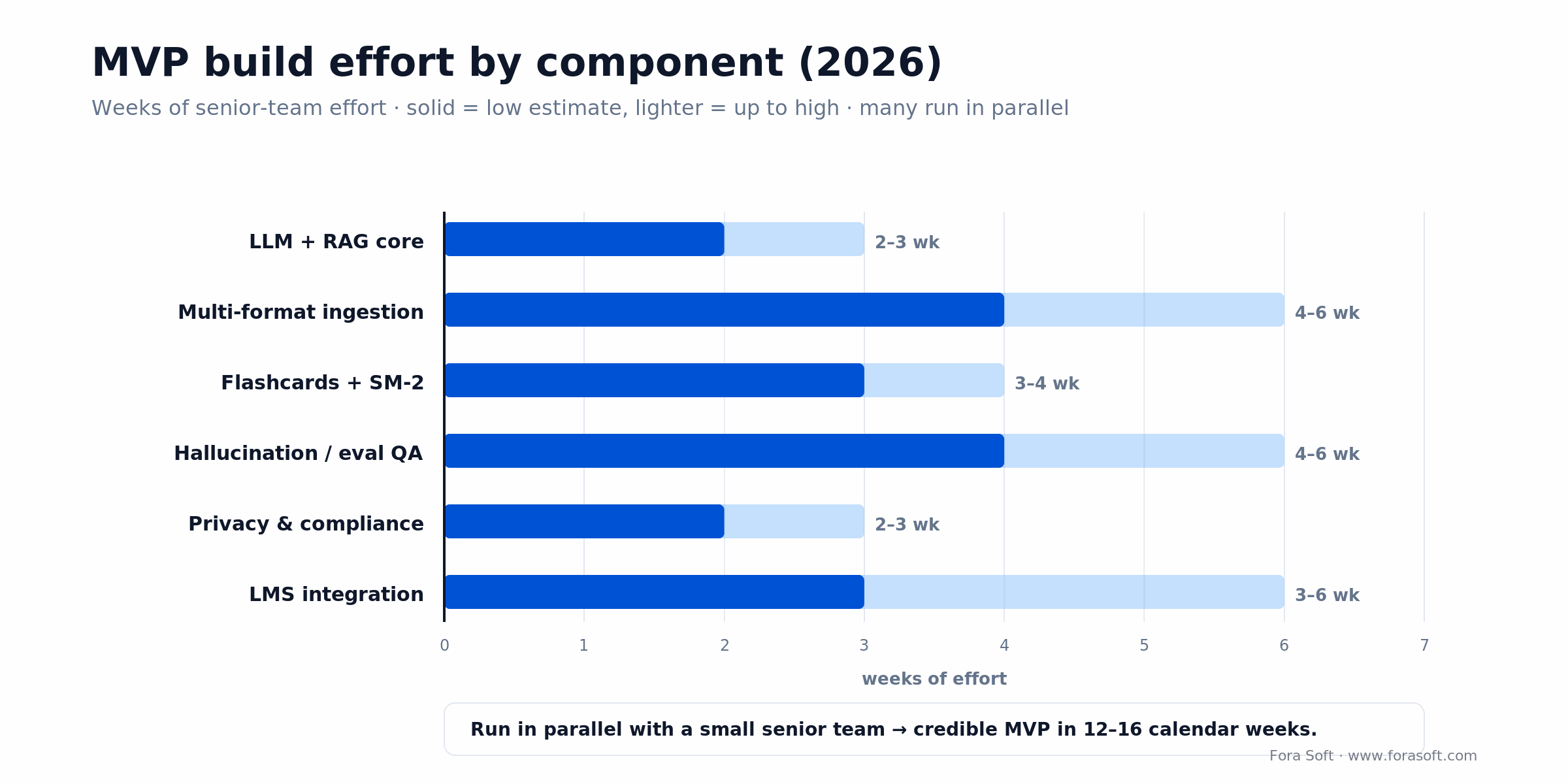
Figure 4. Effort per component in weeks — ranges run in parallel, netting a 12–16-week calendar to a credible MVP.
Five pitfalls that kill AI study products
1. STEM hallucinations. A confidently wrong chemistry equation reaches a student, they fail the exam, the school bans the tool. Always validate factual claims against the source. RAG without source-overlap checks is theatre.
2. Copyright on training and ingestion. Training on copyrighted textbooks invites lawsuits; ingesting a student’s personal materials for personal study is generally defensible. Be explicit about the difference and route everything through user-owned content.
3. Treating FERPA/COPPA as a marketing checkbox. A real DUA, data-minimisation, parental consent flows for under-13 users and audit logs are non-negotiable for school sales. Skipping them stalls every district pilot.
4. Engagement metrics in place of learning metrics. Ten thousand DAU with no measurable retention or score gain is vanity. Ship pre/post-test instrumentation in v1, not v3.
5. Building a generic tool in a saturated market. “Quizlet but with AI” is a tough pitch in 2026. Vertical depth (medical, language, K-12 STEM, legal cert prep) wins.
KPIs that actually mean something for an AI study product
Quality KPIs. Source-grounded answer rate (target >95%), hallucination rate on a curated test set (target <1%), flashcard precision (% correct on a held-out set, target >90%), STEM accuracy (sampled by domain experts).
Learning-outcome KPIs. Pre/post-test improvement (target +10% over control group), 30-day retention of cards (target >80% recall), study-streak completion, passing rates on standardised assessments where applicable.
Business KPIs. Activation rate (signup → first study set within 24 h), 7-day and 30-day retention, conversion to paid, gross margin per active user (LLM costs subtracted), institutional pipeline coverage.
The evaluation suite no AI study product should ship without
If you’re building, this is what separates demos from products. The suite has four layers and runs in CI on every model or prompt change.
Factual grounding tests. A library of (source, claim) pairs — some true, some subtly false. The system must reject the false ones and cite the true ones.
Flashcard quality tests. A held-out chapter graded against a rubric (precision, single-concept, no duplication, answer length). Score must beat a baseline before deploy.
Adversarial / safety tests. Jailbreak prompts, age-inappropriate content, deliberate misinformation injection. The system must refuse or correct.
Outcome tests. A small panel of real learners taking pre/post tests in a dedicated cohort. The slowest signal but the only one that matters to schools.
When AI study tools are the wrong answer
Sometimes the honest answer is a textbook and a quiet room. AI study tools struggle when the source material is highly visual or kinesthetic (lab work, art critique, clinical procedures), when accuracy on niche specialised content matters more than convenience, or when the learner already has access to a strong human tutor or study group.
For very young learners (<9), the best use is parent-mediated and short. Khanmigo’s Socratic style is the safe bet; raw ChatGPT is not.
Mini case — what we ship for AI-assisted study features
A recent client came to us with a niche professional-certification platform, ~40k registered learners, exam-prep heavy. They’d shipped a v1 AI tutor in three weeks using a vanilla GPT wrapper. The result: high engagement, dropping pass rates. Pass rate is the only metric the business sells on.
Three things changed in our 10-week rebuild. First, RAG anchored answers to the certifying body’s own materials with mandatory citations — if the model couldn’t cite, it didn’t answer. Second, we layered a calibrated SM-2 scheduler on top of generated flashcards, with a difficulty estimator trained on the previous two cohorts of pass-rate data. Third, we wired a daily eval suite that scored every prompt change against a panel of 200 anchor questions.
Three months post-relaunch, the cohort using the new tutor outperformed the control by ~9 percentage points on first-attempt pass rate, with no increase in support-ticket volume related to incorrect answers. The lesson: the AI was the easy part. The suite, scheduler and grounding were the product.
Want this kind of rebuild on your AI study product?
We run focused 8–12-week engagements that ship a credible AI tutor with grounding, scheduling and an eval suite from day one.
FAQ
What is the best AI study guide tool overall in 2026?
There is no single best tool — the right answer depends on the learner. NotebookLM is the strongest default for college and self-study; Quizlet wins K-12 and language learners; ChatGPT Study Mode dominates for STEM and conversational tutoring; Brainscape is the choice for medical and certification cramming.
Is NotebookLM free, and where does it cap out?
NotebookLM has a free tier with generous limits for individual study. Heavy users hit per-source and audio-generation caps; paid tiers (Plus $7.99, Pro $19.99, Ultra $99.99/mo) lift them. For a single class, the free tier is usually enough as long as students manage their own notebooks.
Can ChatGPT replace a human tutor?
For explanation, problem-walkthrough and on-demand questions, it’s remarkably effective — especially in STEM. It still falls short on long-term progress tracking, motivation, scaffolding for younger learners and the social element of tutoring. Treat it as a supplement, not a substitute.
What’s the difference between Quizlet AI and NotebookLM?
Quizlet is built around flashcards and a massive community deck library, with AI bolted on for note-to-card conversion and Socratic chat. NotebookLM is built around your sources and produces summaries, Q&A and audio overviews grounded in those sources. Use Quizlet for crowdsourced study sets; use NotebookLM for deep work on your own materials.
Are AI study tools FERPA-compliant?
Khanmigo, Microsoft Copilot for Study and the Quizlet Schools tier publish FERPA documentation and offer Data Use Agreements. Most consumer-facing free tiers do not carry FERPA commitments — if you’re deploying institutionally, request the DUA before signing.
Should we build our own AI study tool or buy one?
Buy off the shelf if your need is mainstream (general K-12 / college study). Build only when your domain is specific (medical, legal, language certification, regulated industries) or your data and integration needs make off-the-shelf untenable. A credible MVP, with the right team, is a 12–16 week project — not a six-month one.
How do I prove an AI study tool actually improves outcomes?
Run a pre/post-test with a control group on at least two chapters of content. Compare learning gains, not engagement. Spaced-repetition-based study has decades of evidence behind it; AI-tutoring effect sizes are still being established and depend heavily on implementation quality.
Can open-source models replace GPT-5 or Claude in a study product?
For some tasks, yes — especially with fine-tuning on your domain. Open models like Llama, Mistral and Qwen now compete on summarisation and basic flashcard generation. They tend to lag on math reasoning and long-context grounding. A hybrid (open models for cheap tasks, frontier models for hard ones) usually beats either extreme.
What to Read Next
Study tools
AI Study Guide Maker: Smart Study Tools That Actually Work
A deeper look at how to build or pick a study-guide generator.
Personalisation
AI-Crafted Personalized Learning Materials — The 3-Layer Stack
The architecture behind adaptive content, with build costs and pitfalls.
Tutoring
AI Tools for Educators: Smart Tutoring Systems
When a tutor is the right answer and how to assemble one.
Lesson plans
7 Best AI Tools for Lesson Plan Generation in 2026
The teacher-side companion piece — planning, not just studying.
E-learning video
AI for E-Learning Video Tools: Cut Costs by 60%
If video is your dominant input, start with this companion guide.
Ready to pick the right AI study tool — or build a sharper one?
If you’re an individual learner, NotebookLM and Quizlet handle most of the work; ChatGPT Study Mode covers the conversational and STEM gaps. If you’re an institution, Quizlet School, Khanmigo or Microsoft Copilot for Study give you mature compliance with minimal lift. Study guides are one surface of a bigger stack — our guide to the 10 best AI tools for educational content creation covers text, video, voice and assessment side by side.
If you’re a founder or product owner, the bar in 2026 is no longer “ChatGPT in a wrapper.” You need source grounding, real spaced repetition, multi-format ingestion, an eval suite and a credible compliance story. Get those right and the AI is the easy part.
Let’s map your AI study product to the right path
30 minutes with a Fora Soft architect — bring your use case, leave with a buy / integrate / build recommendation and a realistic timeline.

