

Key takeaways
• LiveKit hiring is a WebRTC hiring problem in disguise. Miss that and you’ll ship calls that drop in production even with a seemingly senior team. LiveKit hides the plumbing, it doesn’t remove it.
• The 2026 bar is voice AI, not just video rooms. LiveKit Agents 1.x + OpenAI Realtime / Gemini Live is the reason most projects reach for LiveKit today; screen for streaming STT/TTS, LLM tool calling, and sub-500 ms TTFA.
• Rates split cleanly by geography and model. A senior LiveKit engineer runs $120–$200/hr in the US, $75–$125/hr in Eastern Europe, $45–$75/hr in India. The real price difference is debugging time under load, not sticker price.
• Use a take-home test, not another “explain ICE” screen. A 4–6 hour project that joins a room, publishes tracks, handles a disconnect and prints useful metrics filters 80% of false-positive candidates.
• Fora Soft is a LiveKit-ready team, not a recruiter. We’ve shipped WebRTC products since 2005 — classrooms, telemedicine, voice AI agents, social audio — and this guide doubles as our own hiring bar.
Why Fora Soft wrote this playbook
We’ve been building real-time voice and video since 2005 — 250+ projects and a 99% Upwork success score, with more production WebRTC minutes than anyone on the team cares to count. Around 2023 we standardized on LiveKit for most new voice and video builds because the Agents framework and the open-source SFU together collapse the cost of shipping a real-time product from months to weeks. We’ve hired, contracted and rejected a lot of LiveKit candidates since — and we wrote this playbook so you don’t have to learn the same lessons the hard way.
Our BrainCert virtual classroom runs live video and voice at scale for US education customers. CirrusMED routes HIPAA-grade telemedicine calls. We’ve shipped LiveKit-based voice agents, broadcast-grade live streaming platforms, and cross-platform mobile video apps. The recommendations below come out of those projects — not from a LinkedIn recruiter’s cheat sheet. Building LiveKit voice agents is the core of our LiveKit agent development work.
Need a LiveKit team, not a LiveKit hire?
Book a 30-minute call with our real-time lead. We’ll map your use case to a LiveKit architecture, size the team, and quote a realistic delivery window — using our agent-engineering tooling you’ll get a faster and tighter estimate than most independent hires.
Why LiveKit demand is exploding — and why that matters for hiring
LiveKit has grown from a niche open-source SFU into the default infrastructure for voice AI. In January 2026 LiveKit raised $100M at a $1 billion valuation (led by Index Ventures), just ten months after its $45M Series B. That is a blunt signal of how fast real-time AI is scaling. It powers OpenAI’s ChatGPT Voice Mode and counts xAI, Salesforce, Tesla, Spotify and Coursera among its customers, even 911 emergency dispatch, and publicly reports 200,000+ developers building on the platform.
That pull is creating a hiring squeeze. Qualified LiveKit engineers — particularly those who can ship voice AI agents — are routinely booked 6–12 weeks out, and rates on the vetted marketplaces have risen roughly 20% year over year. If you’re staffing a voice product in 2026 you’re competing with well-funded AI-first startups, and you need either a clear recruiting strategy or a pre-formed partner team. This guide is the shortcut.
LiveKit in 2026: three products, one hiring decision
Before you can screen a candidate, know what you’re actually buying into. LiveKit today is three things bundled under one brand:
1. Open-source WebRTC SFU. Written in Go. Horizontally scalable. Rooms, participants, tracks, egress, ingress: the primitives most developers interact with. You can self-host it on your own Kubernetes or pull it off the shelf from LiveKit Cloud.
2. LiveKit Cloud. The managed version — global edge, automatic TURN relay, usage-based billing (WebRTC minutes around $0.0004–$0.0005/min, agent session minutes around $0.01/min on paid tiers). Same APIs as self-hosted, so you can migrate in either direction without rewriting client code.
3. LiveKit Agents framework. The 2025–2026 headline product. A Python/Node SDK that connects streaming STT (Deepgram, AssemblyAI, Whisper), LLMs (OpenAI, Anthropic, Gemini), and TTS (ElevenLabs, Cartesia, Azure) into a voice agent that can see, hear, reason and act — with native integrations for OpenAI Realtime API and Gemini Live. If you’re not hiring for Agents specifically yet, you will be soon.
Your hiring decision should be anchored to which of these you need. A video-chat MVP needs a mid-level WebRTC engineer with React/Flutter chops. A voice agent needs a Python generalist with AI wiring experience and a firm grip on latency budgets. A 100K-participant live stream needs a senior infra engineer who has operated a self-hosted LiveKit cluster and knows TURN sizing.
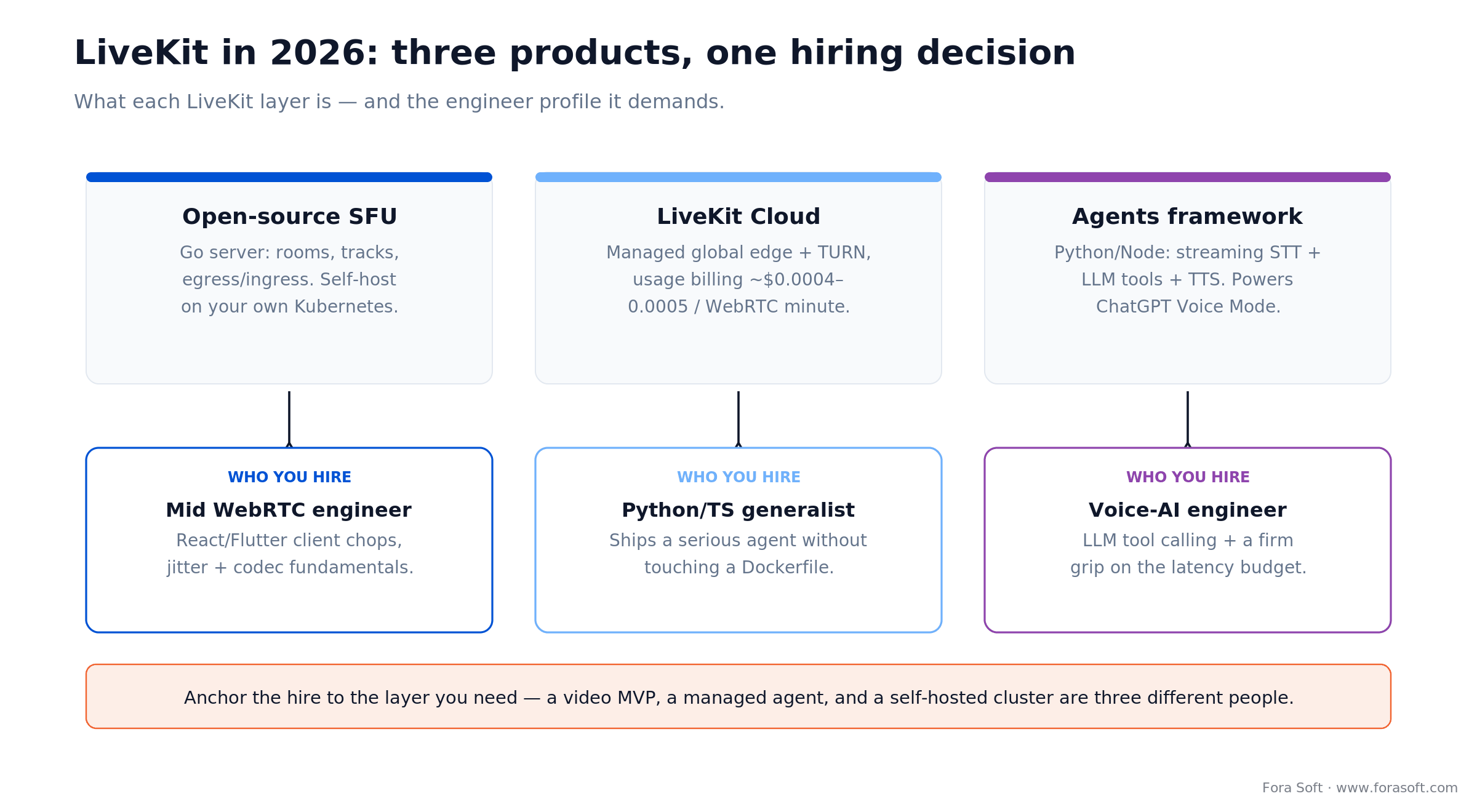
Figure 1. LiveKit’s three products in 2026 — and the engineer profile each one demands.
Hire individually, buy a team, or pull in an agency?
Freelancer / individual contractor. Fast to start (1–2 weeks), cheapest sticker price, lowest commitment. Best for a specific feature with clear acceptance criteria — “wire Agora out and LiveKit in,” “build the iOS client for an existing room,” or a short-term expert for a hard bug. Worst for open-ended roadmaps: context vanishes when they rotate off, and you own the integration risk.
Full-time in-house engineer. Best for core product ownership over 2+ years. US senior ICs land between $180K and $280K/year loaded. Slow to hire (6–12 weeks) and slow to reverse if scope changes — and WebRTC specialists are genuinely scarce, so expect a narrow talent pool.
Dedicated development team / agency partner. The middle path most product companies pick for a 6–12-month build. You get a pre-formed team (architect + engineers + QA + ops) with shared LiveKit muscle memory, an SLA, and the ability to scale up or down. Rates vary by geography but the real value is that the team has already shipped LiveKit to production — you’re not paying for their learning curve. It’s the model behind our LiveKit development team.
Reach for a dedicated team when: you need to ship a voice/video product in 8–16 weeks, want a single throat to choke on SLA and compliance, and prefer a predictable burn rate to a recruiting roulette wheel.
Rate benchmarks — what a LiveKit engineer actually costs
Rates below reflect late-2025 / early-2026 public marketplace data and our own engagements. “WebRTC + AI + voice” specialization adds roughly 30–50% to generic backend or full-stack rates in the same region, and Toptal-tier vetted specialists sit at the top of the US band.
| Region | Junior (0–3 yr) | Mid (3–7 yr) | Senior (7+ yr) | Notes |
|---|---|---|---|---|
| United States | $50–$80/hr | $80–$120/hr | $120–$200+/hr | Toptal senior WebRTC sits at the top end |
| Western Europe | $45–$70/hr | $70–$110/hr | $110–$180/hr | UK, Nordics, DACH; strong compliance fluency |
| Eastern Europe | $25–$45/hr | $45–$75/hr | $75–$125/hr | Our primary delivery region |
| Latin America | $25–$50/hr | $50–$80/hr | $80–$130/hr | Strong timezone overlap with US |
| India / South Asia | $15–$25/hr | $25–$45/hr | $45–$75/hr | Deep talent pool; WebRTC specialists thinner |
| Southeast Asia | $15–$30/hr | $30–$50/hr | $50–$85/hr | Growing; check production-WebRTC depth |
A realistic all-in cost for a small production voice-agent build: about $60k–$120k with an Eastern-European dedicated team, $150k–$260k with a US-heavy mix. Our agent-engineering workflow typically compresses the engineering hours on a LiveKit build by 20–30% compared to a traditional one-hand-at-a-keyboard process, which is where we make up the rate gap against lower-cost regions.

Figure 2. Senior LiveKit engineer rates by region (2026), floor-to-ceiling, USD per hour.
Must-have skills to screen for
The surface area is big, so separate what’s non-negotiable from what’s nice-to-have.
WebRTC fundamentals
Non-negotiable. The candidate must be able to explain ICE candidates (host / srflx / relay), STUN vs TURN, SDP offer/answer, why symmetric NAT breaks direct connections, and which codec choices (Opus, VP8/VP9, H.264, AV1) make sense for which scenarios. Any senior hire who can’t narrate a jitter-buffer tuning story from memory is not a senior hire in this space.
LiveKit primitives
Rooms, participants, tracks, track subscriptions, JWT-based room tokens, egress (recording + RTMP out), ingress (RTMP + WHIP in), and webhook flow. If they can’t draw the room/participant/track diagram on a whiteboard, they haven’t shipped LiveKit.
Languages and platforms
TypeScript/JavaScript for web clients is table stakes. Python for agents. Go for anyone touching the SFU internals or writing custom server plugins. Swift / Kotlin / Flutter / React Native for mobile. Don’t assume one engineer covers all of these; plan the team composition accordingly.
Infrastructure
Kubernetes, Docker, Redis (LiveKit’s default clustering and message bus, with NATS as a supported alternative), TURN server operations (coturn or cloud NAT-based), Prometheus/Grafana for monitoring. For production at scale, experience with regional deployments and edge TURN pools is what separates a senior from a mid.
AI voice agent stack
Streaming STT (Deepgram Nova-3, or the voice-agent-tuned Deepgram Flux, plus AssemblyAI Universal-3 or Whisper wrappers), LLM tool calling with OpenAI / Anthropic / Gemini, low-latency TTS, voice activity detection, barge-in/interruption handling, and a clear grip on the 500–700 ms latency budget that makes a voice agent feel alive. Our LiveKit AI agents playbook and our AI-for-video-engineering knowledge base go deep on this piece — use them as screening references.
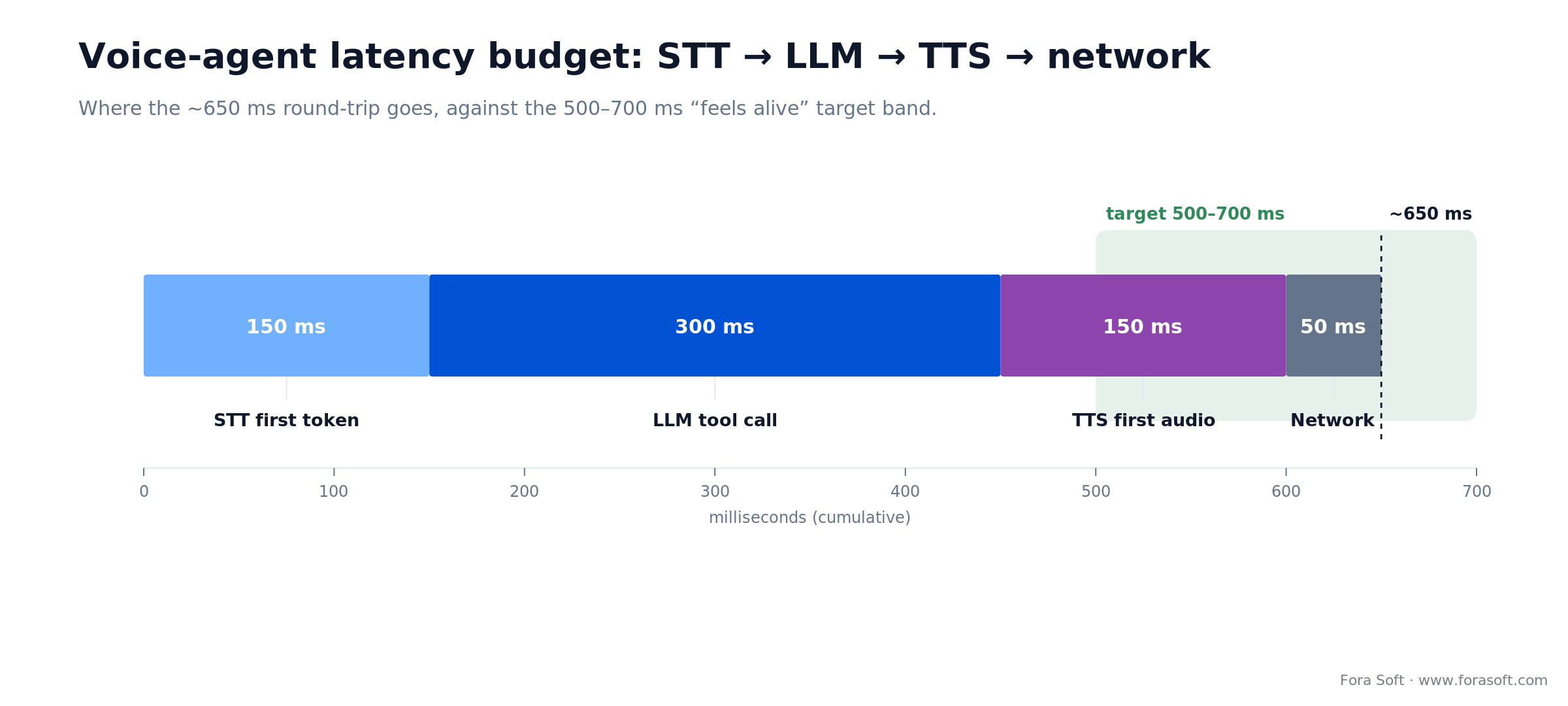
Figure 3. Where a voice agent’s ~650 ms round-trip goes, against the 500–700 ms target band.
Debugging muscle
The single skill that pays back fastest. “The user says audio is choppy after 30 seconds” must produce a methodical answer: check RTT and jitter in chrome://webrtc-internals, inspect packet loss per track, verify TURN relay is actually forwarding, rule out client CPU saturation, correlate with server metrics. A candidate who only reaches for “we’ll restart the session” is not senior.
Want a LiveKit screening rubric for your HR team?
We’ll share the scoring sheet we use to triage LiveKit candidates — 20 questions, weighted, with target answers. 15 minutes of your time to calibrate it to your use case.
Twelve interview questions that actually separate candidates
Forget “tell me about yourself.” These are the prompts we keep coming back to because the quality of the answer maps almost linearly to on-the-job performance.
1. Draw the LiveKit room/participant/track model. If they can’t, they haven’t used it.
2. Walk me through ICE candidate gathering. Look for host / srflx / relay and the order of attempts, not memorized RFC numbers.
3. A user says audio is fine but video keeps freezing. Where do you look first? Good answer: packet loss on video SSRC, simulcast layer falling over, client CPU saturation, TURN forwarding only audio due to port filtering.
4. Explain SFU vs MCU in the context of LiveKit. They should be able to tell you why SFU wins for scale and custom UI, and when MCU-style composition still earns its keep (broadcast-to-browser HLS, for example).
5. How do you authenticate a participant into a room? Expected: signed JWT with room, identity, grants, and TTL. Bonus: mention the grant fields (room join, publish, subscribe), agent dispatch via room config, and webhook validation.
6. Build a voice agent with LiveKit Agents and OpenAI Realtime API — give me the 2-minute architecture. Room connection, audio track pub/sub, Realtime session with function-calling tools, barge-in via VAD, tool response injection, graceful hang-up.
7. Your TURN pool is saturating at peak. Diagnose and fix. Expected: measure relay ratio, add TURN capacity regionally, revisit ICE policies, investigate why direct connections are failing (firewall, symmetric NAT), possibly swap to UDP/443 or TCP/TLS TURN.
8. When do you pick Cloud over self-hosted LiveKit? A credible answer weighs DevOps capacity, minute volume (the crossover is typically 5–10M minutes/month), data residency and compliance needs.
9. What’s a realistic latency budget for a voice agent? ~150 ms STT first-token, ~300 ms LLM tool call, ~150 ms TTS first audio, ~50 ms network — roughly 650–700 ms end-to-end.
10. Walk me through a hard production bug you personally solved. Listen for methodology and honest post-mortem, not heroics.
11. How would you scale an SFU cluster from 1K to 10K concurrent participants? Multi-node SFU with Redis + NATS, load-balanced WebSocket signaling, regional TURN, simulcast and dynamic subscriptions, observability first.
12. Agora just deprecated a feature you rely on. What’s your migration playbook? Tests the ability to reason about vendor risk, which is a senior competency on its own.
Reach for a live whiteboard round when: the candidate’s CV and take-home are strong and you want to verify debugging reflexes — spend 45 minutes on questions 3, 7 and 10 above and watch how they think, not just what they know.
The 6-hour take-home that filters 80% of false positives
A take-home is worth more than any live coding round for WebRTC. Ours:
Prompt. Build a tiny video chat with LiveKit in TypeScript (or Python for agent candidates). Two participants can join the same room, publish audio + video, and see each other. Add a disconnect/reconnect button that exercises the LiveKit client’s reconnection lifecycle. Emit per-track metrics (bitrate, packet loss, RTT) to the console every 2 seconds.
Evaluation. (a) Does it work end-to-end without hand-holding? (b) Is error handling real, or just try/catch-and-pray? (c) Do the metrics reveal understanding of what “bad” looks like? (d) Is the JWT minted server-side, not hard-coded? (e) Code quality: readable, typed, small.
Debrief. 45 minutes pair-programming to extend the test — e.g., “add a third participant and switch to simulcast” or “swap audio for streaming STT into the console.” You’ll learn more about judgment in that debrief than in any prior interview round.
Red flags and green flags on the portfolio
Green flags. GitHub contributions to livekit/livekit, livekit/agents, or livekit/client-sdk-js; shipped products with documented peak concurrency (“we ran 6K participants across 400 rooms”); a blog post or talk where they debug a real WebRTC issue in public; prior experience on at least one competing stack (Agora, mediasoup, Twilio) because it proves they know the trade-off space.
Red flags. “I’ve used LiveKit” with no description of the architecture; inability to name a single production incident they personally triaged; no experience with observability tools (Prometheus, Sentry, OpenTelemetry); dismissive attitude towards mobile clients (“the web version works fine”); and, for senior hires, no opinion at all about self-hosted vs Cloud.
Alternatives — and when they’re the right call
Hiring a LiveKit developer presupposes LiveKit is the right platform. It usually is, but not always. A quick decision map:
Agora
Proprietary SD-RTN with excellent global edge latency. Still a strong choice for massive live streaming or gaming voice chat. Costs more at scale and less flexible for custom UX. Our LiveKit vs Agora cost analysis walks through the crossover math.
Twilio Video
Twilio put Programmable Video through a full end-of-life scare — announced for December 2024, pushed to December 2026, then walked back, so Video now survives as a standalone product. The churn still sent teams shopping, and LiveKit and Daily are the two destinations they land on most.
mediasoup / Jitsi
Lower-level open-source SFUs. Pick them only if you need extreme customization of the forwarding layer and have the team to own it end-to-end. LiveKit is a better default for almost everyone else.
Daily, 100ms, Amazon Chime SDK
Managed platforms with simpler SDKs and fewer knobs. Good for embedded video in a SaaS product where the video is not the core differentiator. Less good for voice AI agents because their AI-agent story is still thinner than LiveKit’s.
Reach for LiveKit when: you’re building a voice AI agent, you want both cloud and self-host options on the same API surface, you need custom UX on web + mobile + native, or you expect scale that makes per-minute pricing hurt.
Team composition for common LiveKit projects
Timelines below assume a team that has shipped LiveKit before. A first-time team should budget 40–60% more calendar time for the learning curve.
| Project | Duration | Team | Key outputs |
|---|---|---|---|
| Voice agent MVP | 4–6 weeks | 1 senior + 1 mid | Agent in a room, STT/LLM/TTS pipeline, 1 tool call |
| Production voice agent | 8–12 weeks | 1 senior + 1 mid + 1 QA | Multi-turn, full tool set, metrics, guardrails, on-call |
| Video conferencing MVP | 6–8 weeks | 1 senior + 1 mid + 1 mobile | Rooms, publish/subscribe, basic UI, recordings |
| Full video platform | 12–20 weeks | 1 architect + 2–3 mid + 1 QA + 1 DevOps | Grid/speaker view, chat, egress, analytics, scaling |
| Live-streaming platform | 16–24 weeks | 2 senior + 2 mid + 1 QA + 1 DevOps | RTMP ingest, HLS egress, regional, chat, monetization |
Mini case — a LiveKit voice-agent rebuild in 10 weeks
A US-based customer-support SaaS came to us with a Twilio-based IVR that couldn’t keep up: rigid menus, no LLM understanding, 14 second average hold times before a human picked up. They had already evaluated LiveKit internally and wanted to move, but their in-house team had never shipped WebRTC at scale.
Our side of the build was a small, senior team: one WebRTC/LiveKit architect, one Python agent engineer, one DevOps engineer, and one QA. We stood up a LiveKit Cloud tenant, wired Deepgram Nova-3 for streaming STT, GPT-4o with six tool calls for the business logic, and ElevenLabs for TTS. Barge-in used LiveKit’s built-in VAD. End-to-end latency landed at ~620 ms on the 95th percentile.
Result after 10 weeks: average time-to-first-response dropped from 14 s to under 1 s, containment rate (calls resolved without a human) climbed to 58%, and Twilio costs fell 62% at equivalent volume. The core insight: the rebuild wasn’t a voice-IVR project, it was a voice-agent project that happened to use LiveKit. The right hiring screen made all the difference. Want a similar assessment? Book a 30-minute slot and we’ll map it to your stack.
Self-hosted vs LiveKit Cloud — hire accordingly
The hire you need depends heavily on where you host. On LiveKit Cloud, you can ship a serious voice agent with a pure Python/TS developer who never touches a Dockerfile. On a self-hosted deployment, you’ll need real DevOps muscle: someone who can run Redis, NATS, multi-region SFU nodes, TURN at scale, and a monitoring stack with the temperament to get paged at 3 AM.
Rule of thumb: stay on Cloud until you cross roughly 5–10 million minutes per month, have a strict data-residency requirement, or want to own the full stack for strategic reasons. Above that threshold self-hosting pencils out. The margins start to pay for the ops headcount.
A decision framework — pick your LiveKit hire in five questions
Q1. Is this an MVP or a scale play? MVP means one senior plus one mid, dedicated for 6–10 weeks, on LiveKit Cloud. Scale play means an architect-led team and a serious ops commitment.
Q2. Is voice AI the product, or a feature? If it’s the product, screen heavily for the LiveKit Agents stack plus LLM tool use. If it’s a feature of a larger app, the generalist profile is fine.
Q3. Regulated industry? Healthcare, finance, government and minors’ apps tilt towards self-hosted or BAA-enabled deployment, and towards a team that has navigated HIPAA / SOC 2 / GDPR before.
Q4. What’s your mobile footprint? If you need iOS, Android and web from day one, a pure backend+agents profile isn’t enough — budget dedicated mobile skill or an agency that bundles it.
Q5. Who owns it in 18 months? If the answer is “us,” plan a handover from agency/freelancer to in-house team early. If “our partner forever,” optimize for continuity and SLA, not for IP transfer.
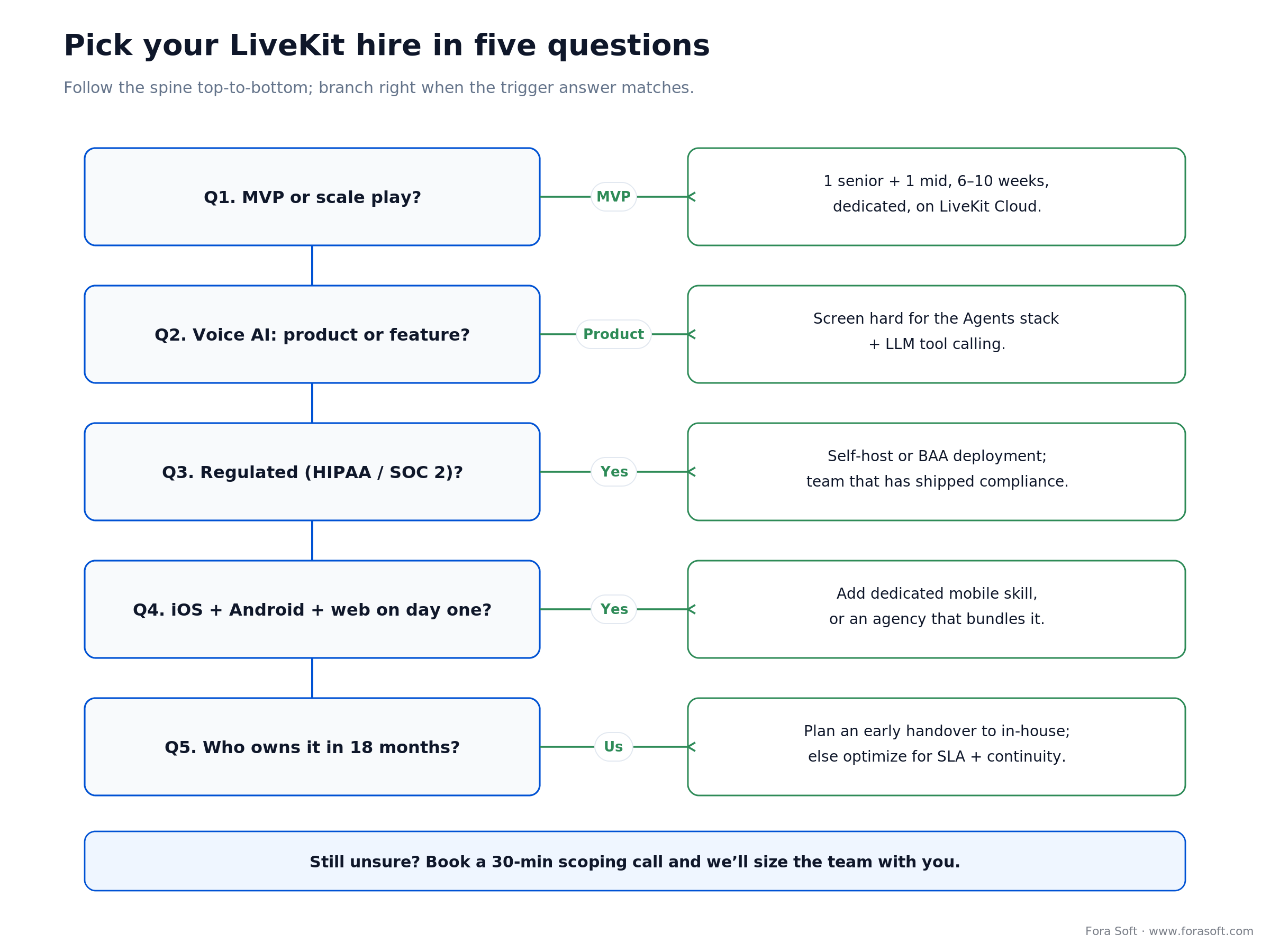
Figure 4. Five questions that map your situation to the right LiveKit hire.
Five hiring pitfalls we see every quarter
1. Hiring a full-stack generalist for a WebRTC problem. LiveKit hides plumbing but doesn’t remove it. A React + Node developer with zero WebRTC background will ship a demo that works in one browser and fails in production. Require real WebRTC fundamentals, always.
2. Skipping the take-home test. Live coding rounds miss debugging skill. A 6-hour project tells you in one artifact whether they actually know the client lifecycle, JWT minting, and reconnection logic.
3. Underestimating the observability bar. If no-one on the team can tell you why a call dropped at 3 AM last Tuesday, you’re one production incident away from a support crisis. Include observability in the JD and the interview.
4. Matching the wrong seniority to the phase. Juniors are fine once an architecture exists. They’re wrong for the first three weeks of any real-time project, because architecture mistakes there cost 10× later.
5. Not stress-testing vendor risk. Every LiveKit developer should have an opinion on self-hosted vs Cloud, on Agora and mediasoup as alternatives, and on what happens if OpenAI Realtime API has a bad week. If they don’t, they’re implementing, not engineering.
KPIs for measuring a healthy LiveKit team
Quality KPIs. Connection-success rate (target >99% of room joins succeed within 3 seconds), call-completion rate (target >98% complete without client reconnect), P95 audio round-trip latency under realistic network conditions (target <250 ms).
Business KPIs. Engineering cost per concurrent participant at peak, cost per minute at steady state, feature throughput in production weeks (target 1 meaningful change every 2 weeks), and mean time from bug report to deploy (target <5 business days for non-critical, <24 hours for critical).
Reliability KPIs. P95 TURN relay latency, TURN saturation (target never above 70% of provisioned capacity), rate of sessions flagged with >5% packet loss (target <2%), and post-incident mean time to recovery.
Reach for a lead engineer before ICs when: this is your first real-time product. The first three weeks of architecture decisions (room design, JWT issuance, agent topology, latency budget) compound through every subsequent release — a senior lead at the front end saves roughly a quarter of rework later.
When not to hire a LiveKit developer yet
Skip or defer the hire if (a) you haven’t validated that real-time voice or video is the next feature most worth building, (b) an embedded managed SDK (Daily, Chime) would get you to market in half the time and you don’t need the flexibility, (c) your team is still learning async programming or streaming architectures in general — LiveKit won’t be gentle on that foundation, or (d) you’re pre-PMF and the voice feature is a distraction from the core value prop. A simple async callback form will beat a half-baked voice agent every time.
Need senior LiveKit talent without the 12-week recruiting cycle?
Our bench is already LiveKit-ready: architects, agent engineers, mobile, ops. We staff within 2 weeks for most briefs and can share a shortlist of past LiveKit deployments on the call.
FAQ
What’s the difference between a LiveKit developer and a WebRTC developer?
A LiveKit developer is a WebRTC developer who has specialized on the LiveKit SDKs and the Agents framework. The WebRTC fundamentals are identical; what differs is knowledge of room/participant/track primitives, JWT-based room tokens, egress/ingress, and the Agents pipeline. A strong WebRTC engineer can pick up LiveKit in 2–3 weeks.
Should I hire freelance or go with an agency?
Freelance for scoped features under two months or a single hard problem. Agency (dedicated team) for anything that needs to run for 6–12 months, that has SLA implications, or that needs multiple skill sets (WebRTC + agents + mobile + ops). Agencies also solve the hand-off risk. A single freelancer going on holiday shouldn’t break your voice product.
How much does it cost to build a production voice agent on LiveKit?
A realistic MVP is 4–6 weeks of a 1.5-person team. Production-ready with tool calls, metrics and on-call usually takes 8–12 weeks. Budget ranges from around $60k at an Eastern-European rate card to roughly $250k at a US-heavy mix, depending on scope. Voice agents that need 10K+ concurrent calls, HIPAA, or deep CRM integrations sit above that range.
How do I tell if a candidate has really used LiveKit in production?
Ask for concurrency numbers, room/participant/track semantics on a whiteboard, a specific production incident they triaged, and the observability tools they used. Combine with a 4–6 hour take-home that forces them to touch JWT, reconnect, and simulcast. Anyone who’s actually shipped LiveKit to production will sail through those checks.
Do I need a senior for an MVP?
Yes, at least one. The first three weeks of a LiveKit project are architecture — room design, JWT issuance flow, agent topology, latency budget. Mistakes there compound through the rest of the build. Senior is not optional for that phase. Once the architecture is set, the rest of the team can skew mid and junior.
Can we self-host LiveKit on AWS / GCP / Hetzner?
Yes — LiveKit is open source and routinely deployed on EKS, GKE, and bare-metal Hetzner. You’ll need Redis for clustering and node-to-node messaging (NATS is a supported alternative), TURN servers (coturn is the common choice), and a monitoring stack. It’s manageable but not trivial; plan for a dedicated DevOps engineer if this is the path.
What’s the fastest way to screen 20 candidates?
Send the take-home test up front with a 4-day deadline. It filters for both skill and communication: candidates who ghost or submit poorly are out, candidates with a tight artifact move straight to a 45-minute pair-debrief. That cycle compresses a 3-week interview pipeline into about 10 days without losing signal.
Is LiveKit the right choice for our project at all?
Default yes if you’re building a voice AI agent, a custom video UX, or anything that needs both managed and self-hosted options under one API. Default no if you need embeddable “video in a box” with zero custom UX (Daily, Chime do that better) or you need global sub-40 ms latency for gaming voice (Agora still wins there). Our LiveKit vs Agora cost analysis covers the numbers.
What to read next
Voice AI
LiveKit AI voice agents — the 2026 playbook
The architecture, latency budget and tool-calling patterns behind a production voice agent.
Cost analysis
LiveKit vs Agora pricing — the real numbers
Minute-by-minute cost comparison with crossover points for MVP vs scale.
Architecture
LiveKit AI agent development guide
End-to-end walk-through of architecture, costs and implementation choices.
Multimodal
Multimodal AI agents with LiveKit
How to combine voice, vision and tool-calling in one agent.
Engineering
LiveKit voice AI — the engineer’s playbook
Practical patterns for making LiveKit voice agents sound genuinely human.
Ready to staff your LiveKit build?
Hiring LiveKit developers is a WebRTC hiring problem with a voice-AI twist. Screen hard for the fundamentals, lean on a take-home test, match seniority to the phase, and be honest about whether you’re hiring an individual or a team. The people who ship these products fastest are the ones who have already shipped them — and the gap between that team and a first-time team is paid for in calendar weeks.
If you’d rather skip the recruiting cycle entirely, our bench is LiveKit-ready: architects, Python agent engineers, mobile, ops, and QA with a shared playbook. We’re happy to scope your build, benchmark the right stack, and share a shortlist of similar deployments we’ve shipped.
The handbook · 7 volumes
Fora Soft Video Engineering Handbook
A good LiveKit hire is judged on what happens under load, not on a whiteboard explanation of ICE. We wrote seven volumes that cover the whole video stack, from encoding and delivery to audio and AI. Start with Volume 3 on WebRTC, SFUs and QoE, then Volume 7 on real-time voice agents and Volume 2 on transport and congestion control. Written by Nikolay Sapunov, CEO at Fora Soft.
Browse the handbook on Amazon →7 volumes · 9,000+ pages · Kindle & paperback
Let’s scope your LiveKit project
Book a 30-minute scoping call: we’ll map your use case to an architecture, size a team, and share benchmarks from comparable LiveKit builds.

