

Key takeaways
• Before you hire an iOS developer, know the 2026 senior bar. Swift 6.3, SwiftUI-first, strict concurrency, MVVM-C, and at least one shipped App Store app. If a candidate can’t talk fluently about Sendable or the Foundation Models framework, they aren’t senior.
• The CV signal that matters most is a live App Store app. App Review, TestFlight, code signing, and App Privacy labels can only be learned by shipping. Everything else on a resume is unverifiable.
• A clean five-stage funnel converts ~1–2% of inbound iOS candidates into offers. CV screen → tech screen → take-home → tech interview → values. We hold that ratio at Fora Soft across 250+ projects since 2005.
• US senior base pay runs $140–185k (total comp $180–250k+ at big tech); a vetted Eastern-European senior runs $70–110k at the same bar. Offshore can cut 30–70% off the rate, but budget the true-cost multiplier, not the sticker.
• When you hire an iOS developer through a partner, audit their funnel, not their slides. Ask how many CVs they screened last quarter, what their take-home looks like, and how mentoring works.
Why Fora Soft wrote this hiring playbook
If you want to hire an iOS developer in 2026 and get it right the first time, you need to know exactly what “senior” means this year — and how to prove it before an offer goes out. Fora Soft has shipped iOS apps since the App Store opened in 2008, and iOS is one of the practices behind our 250+ projects since 2005 with 50 in-house engineers. Recent recognition includes being named a top iOS app development company in 2026, but the more useful number is internal: we send an offer to roughly 1–2 of every 100 iOS candidates we screen.
This playbook is the checklist we use to screen senior iOS engineers, and the same one we hand clients who want to build their own iOS team or vet a partner. The numbers and patterns come from our hiring funnel, our staff-engineer scorecards, and the architecture calls you can see across our shipped projects — from HIPAA-bound healthcare apps to million-line video-streaming codebases.
We run Agent Engineering on every build, so our delivery is faster and our estimates leaner than a typical agency markup. When we name price ranges below, those are realistic Fora Soft numbers, not padded quotes.
Need a senior iOS developer this quarter?
We can plug in a vetted Swift 6 / SwiftUI lead in about two weeks — with App Store, HIPAA, and video-pipeline experience already proven on production apps.
The one-paragraph hiring signal
A hireable senior iOS developer in 2026 has shipped at least one app on the App Store, writes Swift 6.3 with strict concurrency, defaults to SwiftUI but knows UIKit, can sketch an MVVM-C or Clean architecture for a non-trivial app, profiles with Instruments and MetricKit, automates releases through fastlane and a CI of their choice, has touched on-device AI through the Foundation Models framework, and respects App Review and App Privacy rules. If any of those is fuzzy, they’re not senior. Or they’re a CocoaPods-era engineer who stopped keeping up. That single paragraph is the filter; the rest of this guide turns it into a repeatable process.
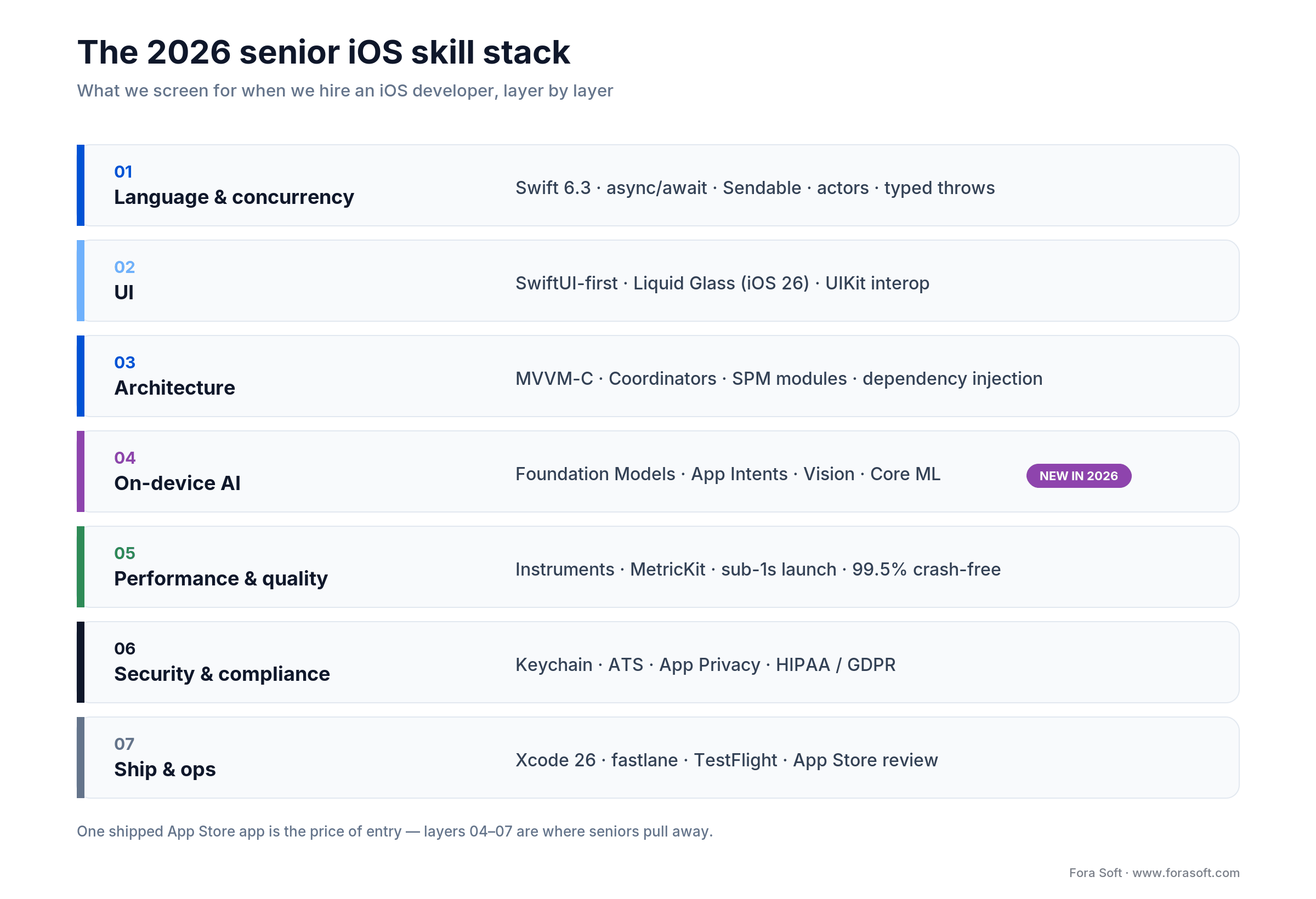
Figure 1. The 2026 senior iOS skill stack, layer by layer — the same map we screen against when we hire an iOS developer.
The minimum technical bar in 2026
These are the skills we screen for at the technical-call stage. A senior candidate should be able to talk fluently about every row, with real project stories behind each one.
| Area | What we expect from a senior in 2026 |
|---|---|
| Language | Swift 6.3 with strict concurrency, async/await, Sendable, actors, typed throws. Reads legacy Objective-C without panic. |
| UI | SwiftUI as default, UIKit when needed, hybrid via UIHostingController. Adopting the iOS 26 Liquid Glass design. |
| Architecture | MVVM-C, Coordinator pattern, modular SPM packages, Clean or TCA when justified. |
| On-device AI | Foundation Models framework, App Intents wired to Apple Intelligence, Vision, Core ML. |
| SDK breadth | Foundation, AVKit, MapKit, CoreLocation, SwiftData / Core Data, WidgetKit, App Intents. |
| Networking | URLSession, REST + JSON Codable, WebSocket, gRPC if relevant. Retry, backoff, offline-first patterns. |
| Testing | Swift Testing + XCTest, snapshot tests, mocked URLSession, coverage targets. |
| Ops | Xcode 26, Swift Package Manager, fastlane, GitHub Actions or Bitrise, TestFlight, App Store Connect. |
| Performance | Instruments, MetricKit, hang detection, cold-launch <1s, 60/120 fps awareness. |
| Security | Keychain, Secure Enclave, biometrics, ATS, App Privacy, Sign in with Apple. |
| Process | Trunk-based or Git Flow, code-review etiquette, App Review knowledge, HIG fluency. |
One practical note on version currency. Since April 28, 2026, App Store Connect only accepts apps built with Xcode 26 and the iOS 26 SDK, per Apple’s developer tooling requirements. A candidate still talking about “Xcode 16” as their daily driver hasn’t shipped this year.
Apple-platform fluency that actually moves shipping
1. Human Interface Guidelines and Liquid Glass. A senior iOS developer makes small product decisions through the HIG daily — spacing, navigation, dark mode, Dynamic Type — and in 2026 that includes adopting Liquid Glass, the unified design language Apple introduced with iOS 26, plus Dynamic Island and the Action Button on Pro models.
2. App Review. Real Apple Review is the cliff that breaks juniors. Disclosures, kid-safe content rules, in-app-purchase honesty, and Guideline 4.8 login parity — getting these wrong delays launches by weeks. We test for it in the values interview.
3. App Privacy nutrition labels. Senior engineers know what data their app collects (and through which SDK) and can produce the App Privacy entries in App Store Connect without guessing.
4. System integration. Push notifications (APNs + UNUserNotificationCenter), Universal Links, App Clips, Share Extensions, Widgets, and App Intents for Siri and Shortcuts are everyday senior territory now.
Quick screen: ask “walk me through your last App Review rejection — what triggered it and how did you resolve it.” If they can’t name one, they likely haven’t shipped enough.
On-device AI — the 2026 skill that separates seniors
The single fastest way to tell a 2026 senior from a 2024 senior is whether they’ve shipped anything with the Foundation Models framework. Introduced with iOS 26, it gives Swift code direct access to the same on-device model that powers Apple Intelligence: a roughly 3-billion-parameter language model running on Apple Silicon, with free, offline inference and no data leaving the device. Apple extended the framework in June 2026 so an app can also call cloud models through a shared protocol when a task needs more horsepower.
What we actually screen for: a candidate who can reason about when on-device inference beats a server round-trip (privacy, latency, cost), who has used guided generation and tool-calling, and who knows the model’s limits well enough to fall back gracefully. If your product has any AI surface, this is now part of the hire, not a nice-to-have. It’s the same instinct our team applies on AI integration engagements.
Reach for on-device AI when: you need private, low-latency, zero-cost inference — summarization, classification, extraction — and can accept a small model. Reach for cloud when the task needs reasoning depth the 3B model can’t give.
Architecture — the seniority differentiator
Anyone can wire a single screen. Senior engineers reason at the level of a 200-screen app with multiple feature teams. The patterns we ship and screen for, with worked examples in our 2026 MVVM-C playbook:
- MVVM-C with @Observable. Default for new apps: clean separation, easy to test, plays well with SwiftUI’s data flow.
- Coordinator pattern. Decoupled navigation lets engineers test screens in isolation and re-route flows without touching view models.
- Clean Architecture. Use it when an app has long-lived domain logic that may move to other platforms.
- The Composable Architecture (TCA). Powerful, but expensive to onboard juniors onto. Use sparingly.
- SPM module split. Each feature a Swift package, the app target stays thin. Build times stay sane past 100k lines.
- Dependency injection. Constructor injection by default, environment-style for SwiftUI, resolver pattern only when you need late binding.
Performance and quality — what they profile, not just claim
Performance is where iOS resumes diverge from iOS practitioners. The right candidate has used Instruments’s Time Profiler, Allocations, and Leaks on real apps, reads MetricKit diagnostic payloads, and knows the basic targets:
- Cold launch under 1 second on supported devices.
- Frame budget 16.6 ms (60 fps) or 8.3 ms (120 fps ProMotion).
- No hangs; main-thread work measured, not guessed.
- Memory under ~200 MB typical, with a documented peak.
- Crash-free sessions above 99.5% (App Store Connect or Crashlytics).
Our iOS optimization playbook shows how we hold those numbers across million-line apps. We test for it on take-home reviews: a candidate’s code should not block the main actor, and it should be measurable.
Quick screen: ask “the last time an app you owned got slow, how did you find the cause?” A senior names a specific Instruments tool or a MetricKit signal. A junior says “I added some caching.”
Security and compliance — the topics juniors miss
1. Keychain and Secure Enclave. Tokens belong in Keychain, biometric secrets in the Secure Enclave. UserDefaults is not a secret store.
2. App Transport Security. HTTPS by default, certificate pinning when the threat model warrants. A senior knows the exemption flags exist and why you usually shouldn’t use them.
3. Login parity (Guideline 4.8). If you offer a third-party or social login, App Review expects a privacy-respecting equivalent — Sign in with Apple, or another option that limits data to name and email, hides the email, and doesn’t track without consent. Senior engineers handle the relay-email and revocation flows correctly. The current rules live in the App Store Review Guidelines.
4. Compliance literacy. HIPAA, GDPR, COPPA, PCI — a senior may not be a lawyer, but they know which regulator your data crosses and which Apple frameworks to consult. On regulated builds like CirrusMED, a HIPAA telehealth app, that literacy is the difference between launch and rework.
Realistic 2026 salary and contractor rates
Numbers below blend public 2026 ranges (ZipRecruiter, Glassdoor, Salary.com, Levels.fyi) with our own contractor benchmarks. US figures split base pay from total comp, because that gap is where hiring budgets go wrong: Glassdoor put the average US senior iOS base near $169k in 2026, while big-tech total comp in high-cost metros clears $220k once equity lands.
| Region | Mid base (2–5y) | Senior base (5–8y) | Contract $/hr |
|---|---|---|---|
| United States (in-house) | $110–150k | $140–185k base ($180–250k+ total) | $80–150/hr |
| Western Europe | €55–90k | €80–130k | €65–110/hr |
| Eastern Europe | $45–75k | $70–110k | $35–70/hr |
| LATAM (Mexico, Brazil, Arg) | $50–85k | $80–130k | $50–90/hr |
| India | $25–50k | $45–85k | $20–45/hr |
Two observations from running this funnel for two decades. First, the tail-end rates rarely map to senior-quality output; the very low hourly numbers are usually pre-senior or staff augmentation. Second, total cost of ownership beats rate every time: a $40/hr engineer who needs daily review from a $90/hr lead is rarely cheaper than a $70/hr engineer who lands clean PRs. That math is the next section.
Want a five-stage iOS funnel that actually filters?
We’ll share the take-home spec, scoring rubric, and live-coding prompts we use internally — or run the funnel for you on a fixed-price hire.
A five-stage iOS hiring funnel that holds the bar
This is the funnel we run internally and recommend to clients. Each stage has a clear pass/fail signal and a strict time budget: run longer than this and you’ll lose strong candidates to faster competitors.
Stage 1, the CV screen (5 minutes). Look for shipped App Store apps, recent Swift 6 work, SwiftUI, evidence of testing, and signed-and-released roles. Reject on no Apple account, no public app, only Objective-C in the last three years, or “wrote unit tests” with zero detail.
Stage 2 — technical screen (45 minutes). Live-code a small networking + list view with retry logic. Pair it with questions on memory ownership (weak/unowned), main-actor isolation, MetricKit, and App Review. Pass on clean reasoning and a correct memory model; fail if they panic on Sendable or can’t explain ARC.
Stage 3, the take-home (2–3 hours, 5 days to submit). Build a single SwiftUI screen against a real public API: list, detail, error states, basic tests, no third-party libraries. Calibrate scope so a senior finishes in 2–3 hours. Don’t ask for 8-hour epics; strong candidates will decline.
Stage 4 — technical interview (60 minutes). Walk through the take-home, add a feature live (a filter or pagination), discuss architecture trade-offs, and debug a crash log together. The signal is reasoning under pressure, not typing speed.
Stage 5, values and lead interview (45 minutes). A CEO, head of mobile, or staff engineer asks scenario questions: “Tell me about an App Review rejection you owned,” or “What was your worst architecture decision and how did you fix it?” The signal is honesty and self-correction.
Realistic conversion math — what 100 candidates becomes
Below is the cumulative pass-through we see in the iOS market in 2026. Our historical iOS funnel matches it within a percentage point.
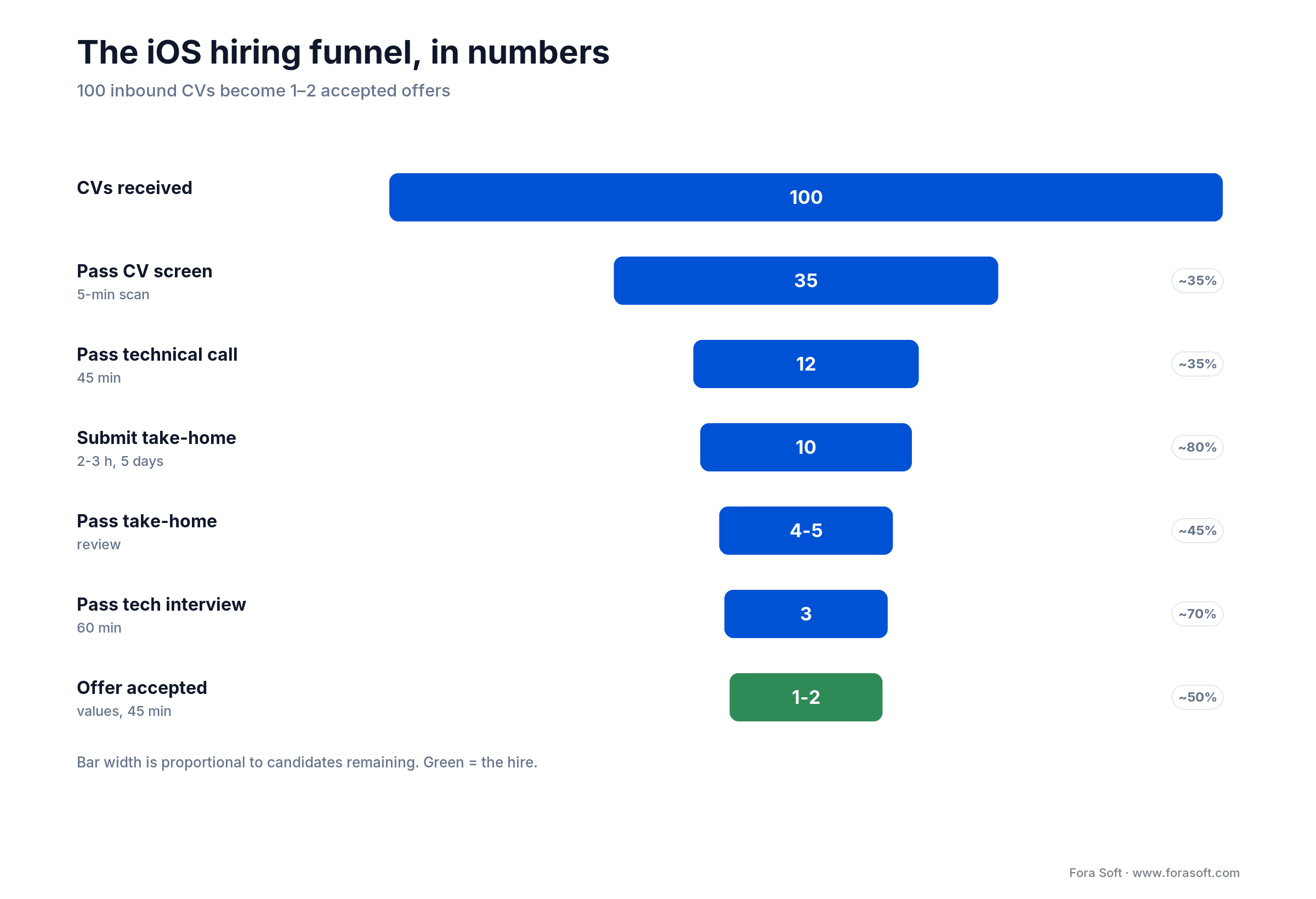
Figure 2. The five-stage funnel in numbers — 100 inbound CVs become 1–2 accepted offers.
| Stage | Conversion | Cumulative |
|---|---|---|
| CVs received | — | 100 |
| Pass CV screen | ~35% | 35 |
| Pass technical call | ~35% | 12 |
| Submit take-home | ~80% | 10 |
| Pass take-home | ~45% | 4–5 |
| Pass tech interview | ~70% | 3 |
| Offer accepted | ~50% | 1–2 |
Two notes. Referrals raise the CV-pass rate to 50–60%, so invest in your network. And the take-home is the most painful step: if your pass rate is much above 45%, the task is too easy; much below, the rubric is broken.
Red flags we use to disqualify fast
1. SwiftUI gap. “I haven’t had a chance to use SwiftUI yet” in 2026 means they aren’t leading new work. UIKit-only is fine for legacy maintenance, never for senior leadership.
2. No published app. If they’ve written iOS code for years but never cleared Apple Review, they don’t know what they don’t know.
3. Memory hand-waving. “Swift handles memory for you,” with no ARC, retain-cycle, or weak/unowned literacy, is a hard fail at senior level.
4. Zero test discipline. No Swift Testing or XCTest in their portfolio, no answer to “how do you mock URLSession,” no view on snapshot vs integration tests.
5. AI-only take-home. Code that clearly came from a chat assistant and that the candidate can’t defend or extend live. We welcome AI as tooling, never as a replacement for understanding.
Mentoring — what makes the hire stick after week one
Hiring is one number; retention is the other. The pattern that works for us, and that we recommend on client engagements, has four pillars.
1. Mandatory senior code review on a separate branch. Every PR ships through a queue, not straight into develop. The volume of feedback drops over weeks — that’s how you measure ramp.
2. Monthly career check-in. A mentor builds a portrait of the new hire across code, communication, and peer feedback, then shares it back. Gaps surface before they fester.
3. Q&A back-channel. A dedicated Slack or Discord channel where the mentor replies within an hour during work hours. It kills the “I’ll figure it out alone” failure mode.
4. Tiered task allocation. Difficulty climbs a visible ladder: bug fix, feature in an existing module, new module, cross-feature refactor, architecture proposal. The mentor decides when each step opens. More on how we structure teams is in our development-team writeup.
In-house vs freelancer vs offshore vs partner agency
There are four ways to hire an iOS developer, and the right one depends on how durable your product is and how much senior review you already have in the building.
| Model | Speed-to-staff | All-in cost | Best for |
|---|---|---|---|
| US in-house | 6–10 weeks | $220–$350k loaded / yr | Core IP, long-horizon products |
| Freelance / contract | 1–2 weeks | $80–$150/hr | Spike work, prototypes |
| Offshore / nearshore team | 2–3 weeks | $35–$90/hr | Sustained 6–12 month builds |
| Partner agency (Fora Soft & peers) | ~2 weeks | Blended team, fixed-price or T&M | Full-stack delivery in AI / video / health |
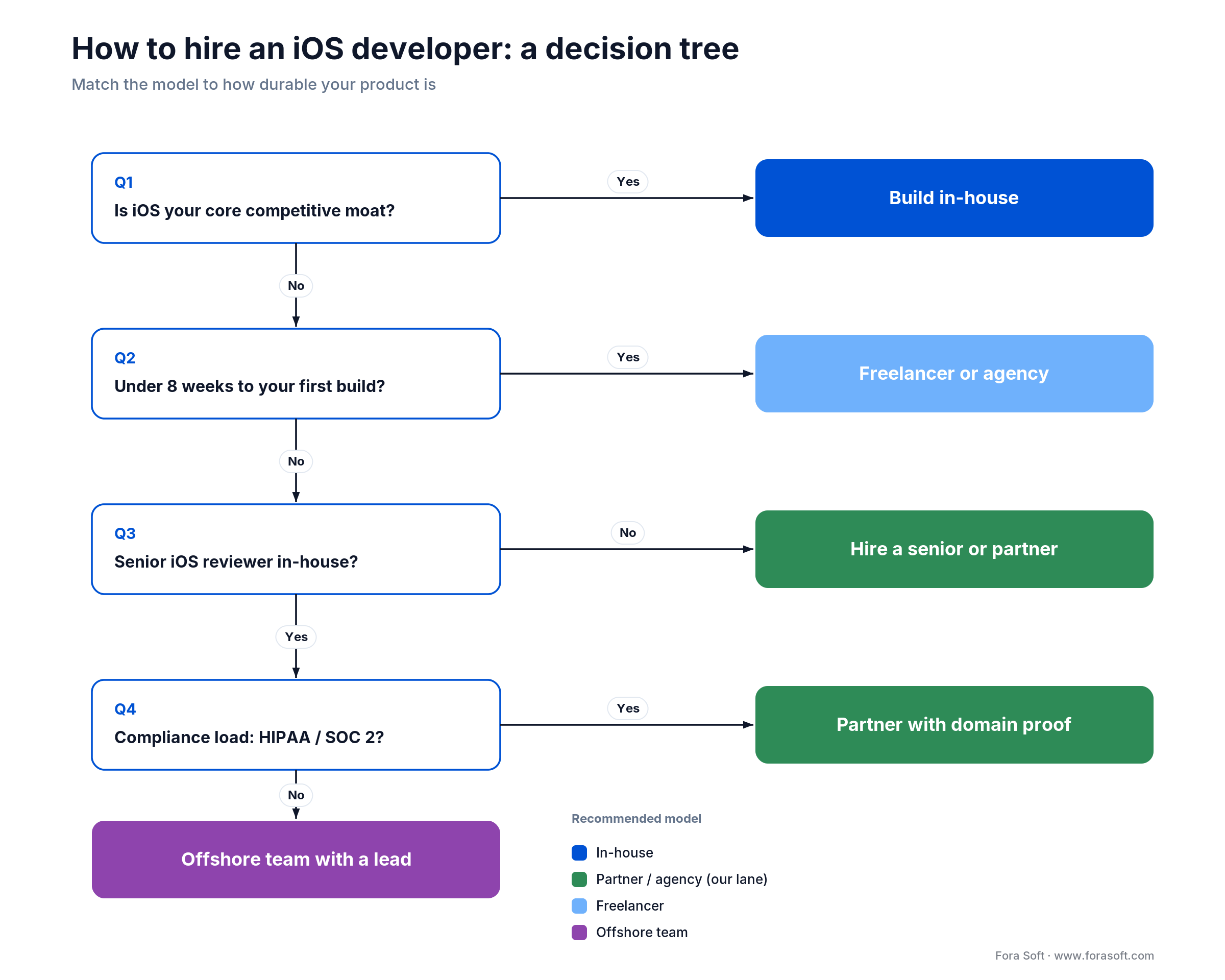
Figure 3. A decision tree for choosing how to hire an iOS developer — from in-house to partner agency.
Reach for a partner agency when: you need a senior iOS team with proven shipping in your domain (video, AI, regulated) and don’t want to build a hiring pipeline from scratch. We stand this up in about two weeks through custom software development.
The true cost of a hire — worked math
The sticker rate lies. A quoted offshore rate ignores project management, senior code review, ramp-up, and rework. Price those in and the effective rate lands roughly 1.4–1.8× the quote. Here’s the arithmetic on a six-month module at about 950 engineering hours.
Offshore senior, quoted $45/hr. Apply a 1.6× effective multiplier for PM, review, ramp, and rework: $45 × 1.6 = $72/hr effective. Over 950 hours, that’s about $68,400.
US senior, $170k base. Loaded at 1.3× for benefits and overhead: $221k / yr ÷ ~1,900 productive hours ≈ $116/hr. Over 950 hours, about $110,200.
The naive comparison ($45 vs $116) screams 61% savings. The honest one ($72 effective vs $116) is about 38%. Still a real saving — but you only capture it if you budget the multiplier and insist on a senior reviewer. That is exactly what a partner team bakes in.
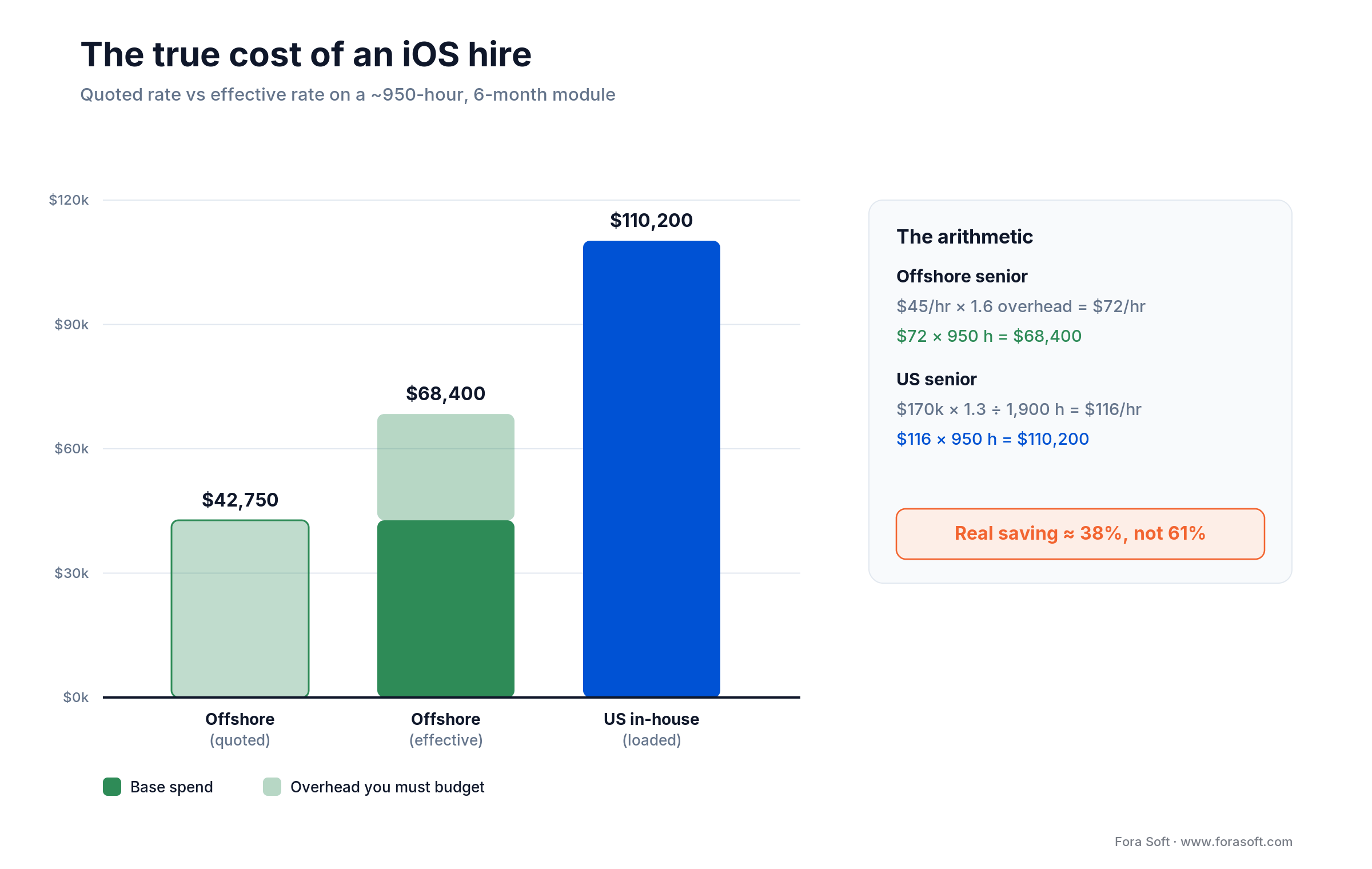
Figure 4. Quoted rate vs effective rate — and why the real offshore saving is ~38%, not 61%.
What an iOS build actually costs in 2026
If you’re hiring to ship a whole app rather than to staff a team, these are realistic ranges from the engagements we run. Agent Engineering shaves roughly 15–25% off comparable traditional-team timelines. We’d rather under-promise here; specific numbers come after scoping.
| Build type | Duration | Team | Indicative range |
|---|---|---|---|
| Small MVP (one core flow) | 6–10 weeks | 1 senior + part-time QA + designer | $30k–$70k |
| Mid-size feature app | 4–6 months | 1 senior + 1 mid + QA + designer + PM | $120k–$280k |
| Enterprise / regulated | 9–12 months | Lead + 2–3 devs + QA + DevOps + designer + PM | $350k–$700k |
For a deeper breakdown across categories — chat, video, marketplace, dating, telemedicine — see our 2026 mobile app development cost guide. If your app leans on real-time video, our video streaming learning hub covers the pieces a senior needs to own.
Mini case: from 50 CVs to one shipped lead
Situation. A US health-tech client needed a senior iOS lead in six weeks for a HIPAA-bound telemedicine product. They’d burned three months hiring in-house in California and lost two finalists to counter-offers.
12-week plan. Week 1: we plugged in our funnel, screened 50 CVs, and shortlisted 17. Weeks 2–3: nine technical screens, six take-homes, three finalists. Week 4: offer accepted. Weeks 5–8: two weeks of pair programming with a Fora Soft staff iOS engineer for the HIPAA on-ramp. Weeks 9–12: shipped the first SwiftUI module.
Outcome. One senior iOS lead onboarded, App Store Connect access transferred cleanly, App Privacy labels reviewed, and the first feature shipped to TestFlight inside the original 12-week window. All-in cost came in about 35% under the original US in-house plan, with no quality compromise. The same HIPAA discipline runs through builds like CirrusMED.
A decision framework — pick a hiring strategy in five questions
Q1. Is iOS your core competitive moat? Yes: build in-house. No: consider a partner agency or offshore team for the iOS layer.
Q2. How time-pressed are you to ship? Under 8 weeks to first build: agency or contractor. 6–12 months: an offshore team can absorb the build with the right lead.
Q3. Do you have a senior iOS reviewer in-house? Yes: you can hire mid-level. No: you need a senior, or you’ll ship debt you can’t see.
Q4. Are there compliance requirements? HIPAA, SOC 2, or FedRAMP: bias toward partners with explicit experience. Asking a generalist contractor to cover compliance is the slowest path.
Q5. What’s your retention horizon? Three-plus years: an in-house equity story matters. Under 12 months: contract or agency wins on flexibility.
Want us to run an iOS hire for you end-to-end?
Funnel, take-home, scoring rubric, lead-engineer interviews, offer support. Fixed price, four-week target, replacement guarantee.
Five pitfalls we see hiring teams hit
1. Hiring rate, not value. Optimising for hourly rate ignores review overhead, churn, and rework. Look at fully loaded delivery cost — the math two sections up.
2. Take-homes that are too big. A four-day project disrespects strong candidates’ time. Calibrate to 2–3 hours and say so up front.
3. Interviewing without a senior reviewer. A non-iOS CTO screening iOS engineers is a coin flip. Borrow or hire a senior reviewer for the tech rounds.
4. Confusing a freelancer with a team. One contractor can build a feature; only a team can ship and run an app. Match the model to how durable the product is.
5. Ignoring App Review experience. A senior who has been through 10+ reviews and rejections is worth two who have never shipped. Apple Review is where the rubber meets the road.
KPIs to track once you’ve hired
1. Quality KPIs. Crash-free sessions above 99.5%, App Store rating at or above 4.5, and App Review rejection rate per submission. The first two come from App Store Connect; the third is your team’s discipline.
2. Velocity KPIs. PR cycle time, bugs per 1k lines, features shipped per quarter, time-to-TestFlight. Healthy senior teams keep PR cycle time under 24 hours.
3. Hiring KPIs. Funnel pass-through (the table above), time-to-offer (target under 4 weeks), and 90-day retention (target above 90%). Track these monthly; they catch a broken funnel before the team feels it.
When you shouldn’t hire an iOS developer at all
Sometimes the right answer is “not yet.” If your audience is 60%+ Android, start there. If you’re a B2B tool with no customer-facing iOS surface, Catalyst or web may serve you better. If you have under 10k monthly active users and three platforms in mind, a single React Native or Flutter engineer may beat two native hires. We’ll tell you when one of those is the right call, even when it costs us the project.
FAQ
What’s the single best CV signal when you hire an iOS developer?
A live, named app on the App Store with their name attached, or a public GitHub project that compiles, ships, and has tests. Everything else, including elaborate descriptions of past work, is unverifiable.
How much does it cost to hire an iOS developer in 2026?
A US senior runs $140–185k base ($180–250k+ total comp), or $80–150/hr on contract. Offshore seniors run $35–70/hr in Eastern Europe and $20–45/hr in India — but budget an effective multiplier of about 1.4–1.8× the quoted rate once review and management are included.
Is Objective-C still required in 2026?
Reading only, for legacy maintenance. Writing new Objective-C is a niche role. Most senior candidates last touched it four to six years ago, and that’s acceptable.
SwiftUI-only or SwiftUI + UIKit?
A senior should be SwiftUI-first but able to drop into UIKit for a tricky animation, table-view performance, or a third-party SDK. Hybrid is the dominant production pattern — see our SwiftUI vs UIKit playbook.
Do I need an iOS senior to evaluate iOS senior candidates?
Yes. A non-iOS CTO can run the values interview but should never own the technical round alone. Borrow a senior from a partner or fractionally hire one for the funnel.
Should candidates use AI on the take-home?
Yes, with a live walkthrough afterwards. We tell candidates to use whatever tooling they’d use on the job; the technical interview is where we confirm they understand and can extend their own code.
What’s a fair Eastern-European senior iOS rate in 2026?
$35–70/hr for a vetted senior. Below $30/hr you’re usually buying juniors or staff augmentation; above $90/hr you’re overpaying outside Western capitals.
When should I hire an agency instead of a developer?
If you’re shipping a whole iOS product rather than adding to an existing team, need senior expertise in a niche (video, AI, healthcare), and don’t want to run a four-week funnel, an agency is faster and de-risks senior-reviewer coverage.
What to Read Next
iOS Architecture
The 2026 iOS MVVM-C Playbook
SwiftUI @Observable, Coordinators, DI, and Swift 6 concurrency.
Swift 6
Swift 6 Explained: Strict Concurrency & More
Swift Testing, typed throws, and the migration story for 2026.
Performance
How to Optimize iOS Apps in 2026
Swift 6, MetricKit, and SwiftUI rendering best practices.
Cost
2026 Mobile App Development Costs
What a real estimate looks like for iOS and Android in 2026.
Ready to hire iOS without burning a quarter on it?
A senior iOS engineer in 2026 ships Swift 6.3, defaults to SwiftUI, owns architecture, touches on-device AI, profiles in Instruments, automates releases, and respects App Review — and they’ve proven all of it on a real App Store app. Build that filter into a five-stage funnel and you’ll convert about 1–2% of inbound candidates into offers, on par with the best teams in the market.
If you’d rather not run that funnel yourself, talk to us. We’ll either embed our senior iOS engineers in your roadmap or run the hire end-to-end against a four-week clock.
Hire iOS the first time, not the third
30 minutes, your roadmap, an honest plan. We can plug a senior in or run the hire for you.

