
Key takeaways
• 2026 is a reset year for iOS buyers. Apple’s iOS 26 minimum-SDK deadline, Privacy Manifests, Swift 6 strict concurrency, and Apple Intelligence APIs change what “top iOS app development company” actually means.
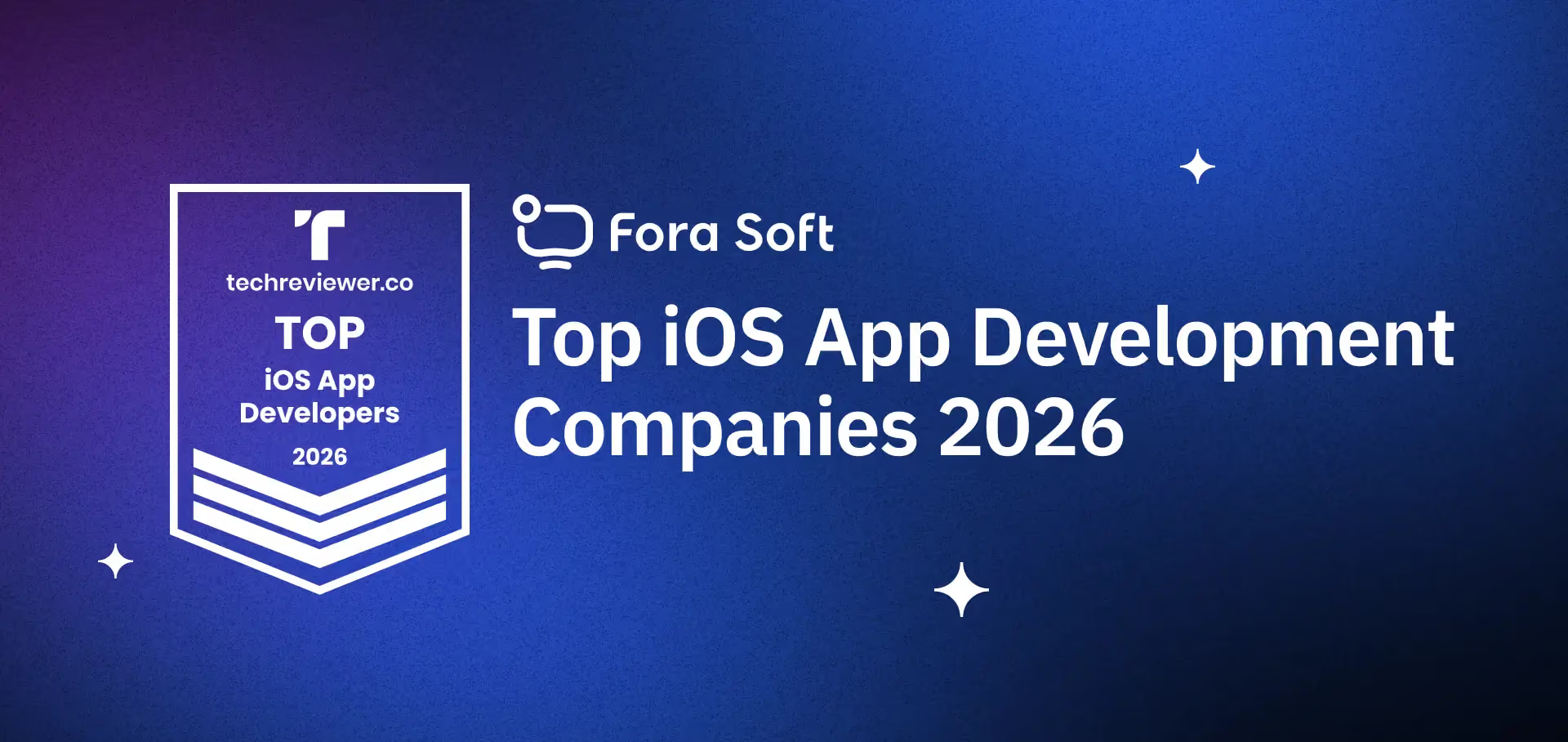
• Fora Soft made the Techreviewer 2026 top iOS list for the second year. The platform screens 9,500+ providers on verified portfolios, client feedback, and delivery maturity — not ad spend.
• Budgets are cheaper in 2026, not more expensive. Agent-assisted engineering trims 20–35% off 2024 baselines. Lean MVPs $25K–$45K, mid-complexity apps $60K–$140K, enterprise and real-time apps $180K–$450K.
• Multi-platform is the new default. watchOS, visionOS, and macOS surfaces ship with the same SwiftUI code when the iPhone app is SwiftUI-native from day one — about 25–40% extra vs a full rebuild.
• Our 2026 production portfolio proves it. Mindwibe (AI-coached dating), Lujo (luxury booking with unified WhatsApp + phone queues), Yard Sale (local marketplace), plus Anime Power FX at 1M+ App Store downloads — all currently shipping.
Why Fora Soft wrote this playbook
This is the second year Fora Soft appears on Techreviewer’s top iOS app development companies list, and our company profile is public if you want to check the review criteria for yourself. But awards are a trailing indicator — the useful question for you as a buyer is: what has actually changed in iOS development in 2026, and how should it change the shortlist you’re building?
Four forces shifted the iOS buyer playbook in the last 12 months: (1) Apple’s iOS 26 minimum-SDK mandate that took effect April 28, 2026, (2) Swift 6 strict concurrency becoming the safe default, (3) Apple Intelligence APIs landing as production features, and (4) Apple Vision Pro and watchOS 26 cementing multi-platform as a real commercial surface. Every one of those shifts has concrete implications for scope, cost, and risk on your next iOS project.
Fora Soft has shipped 250+ products since 2005 — browse the full portfolio. Our 2026 iOS work ranges from AI-coached consumer apps like Mindwibe through luxury booking platforms like Lujo to real-time video apps handling 1,000+ concurrent participants. This playbook is the field guide we wish we’d had when we started benchmarking vendors ten years ago.
Planning a 2026 iOS build?
Book a 30-min scoping call. We’ll benchmark your brief against 250+ shipped products and flag the 2026-specific risks (iOS 26 SDK, Swift 6, Privacy Manifests) your current plan is missing.
What changed for iOS buyers in 2026
1. iOS 26 minimum SDK is now mandatory. Since April 28, 2026, every new app and update submitted to the App Store must be built against the iOS 26 SDK. Studios still on older toolchains can’t ship. Ask every candidate vendor when they moved their CI to Xcode’s iOS 26 SDK — if the answer is “we’ll cross that bridge when we get there,” you’ve found a problem.
2. Swift 6 strict concurrency is safe-by-default. Swift 6’s concurrency checker catches data races at compile time, which eliminates one of the nastiest classes of iOS bugs before they ship. Vendors still defaulting to UIKit/Objective-C on new work are carrying forward 2021 technical debt into 2026.
3. Apple Intelligence APIs are production-ready. On-device Writing Tools, Image Playground, and the Foundation Models framework give iOS apps native AI without the latency and cost of server round-trips — for tasks that fit on-device. Server LLMs (OpenAI, Anthropic) still win for complex generation, but the hybrid is now the default architecture.
4. App Intents and live activities are table stakes. Siri, Spotlight, Shortcuts, Dynamic Island, Control Center widgets, and Live Activities on the lock screen all now expect App Intents integration. Apps that opt out lose visibility to the half-dozen Apple surfaces where users actually live.
5. visionOS and watchOS earn ROI when SwiftUI-native from day one. A SwiftUI-first iOS app can usually fan out to watchOS or visionOS for 25–40% of the iPhone cost. A UIKit app that wants the same reach pays closer to 80–100% of the original build because everything has to be rewritten in SwiftUI anyway.
What Techreviewer measured — and what it should tell you
Techreviewer.co is one of the more rigorous ranking platforms because the core listing is not pay-to-play. They review more than 9,500 IT service providers, verify legal status and service focus, cross-check client feedback, and weigh five signals: technical skills, project results, client feedback, market presence, and delivery methodology.
For you as a buyer, that means the list is a first-pass filter, not a decision tool. It eliminates shops that can’t produce a verifiable portfolio, a named client list, or a delivery process — which is still more than half of the vendors who will pitch you. But the final choice between three shortlisted studios comes down to the rubric below, not the badge.
The 2026 rubric for vetting top iOS app development companies
1. iOS 26 SDK readiness on production
Ask: “What’s your Xcode version on mainline CI, and which of your live apps ship against iOS 26 SDK today?” Good answers cite a named project and a specific date. Bad answers pivot to “we’ll upgrade when you pay us.”
2. Swift 6 strict-concurrency fluency
Probe questions: “How do you handle actor isolation at module boundaries?” and “Show me a codebase you’ve migrated from Combine to async/await.” Candidates that dodge specifics are still on UIKit + delegation, which will cost you velocity all year.
3. App Intents and Apple Intelligence adoption
Have they shipped App Intents to live apps? Do they know when to use Apple’s Foundation Models framework versus server-side LLMs? Hybrid thinking is what separates 2026 iOS shops from 2023 ones.
4. Privacy Manifests & App Store compliance
Privacy Manifests are mandatory for every third-party SDK as well as your own app. Ask for a copy of a Privacy Manifest from one of their production apps. Candidates who don’t have one handy are guessing.
5. Delivery visibility: live Jira/Linear, weekly demos
The project board has to be visible to you at all times, not just during the stand-up. Burn-down charts, sprint velocity, and written change-request templates. Studios that keep their backlog private are hiding drift.
6. UX embedded, not bolted on
Design and engineering in the same sprint from week one. Figma file reviews, accessibility (VoiceOver, Dynamic Type, reduced motion) audits, and AI-assisted UX iteration. See our method in AI-assisted UX in complex digital products.
7. Post-launch SLA and roadmap
Named SLA, on-call rotation for Severity-1, quarterly roadmap review, and a maintenance retainer typically 15–25% of the build budget. This is where vendors that “ship and vanish” get filtered out.
Reach for this rubric when: you have three Techreviewer-listed shops on your shortlist and you need a reproducible way to score them before the CFO asks for a recommendation.
2026 iOS stack comparison — old vs new, what to insist on
Use this as a cheat sheet when vetting a vendor’s tech answers. The “2026 default” column is the expected answer from a top iOS development company.
| Layer | 2023 default | 2026 default | Buyer impact |
|---|---|---|---|
| Language | Swift 5 + Obj-C legacy | Swift 6 strict concurrency | Fewer data-race crashes in prod |
| UI | UIKit | SwiftUI + UIKit bridging | 25–40% cheaper multi-platform |
| Concurrency | GCD + Combine | async/await + actors | Readable async code, fewer bugs |
| Persistence | Core Data | SwiftData (new), Core Data (legacy) | Less boilerplate, faster iteration |
| AI | Server-only LLMs | Apple Intelligence + server hybrid | Lower latency, lower inference cost |
| Surfaces | iPhone only | iPhone + Watch + Vision + Intents | 3–5× the places users engage |
| Privacy | Info.plist strings | Privacy Manifests + ATT | Avoid App Store rejections |
2026 iOS budget ranges with agent-assisted engineering
The ranges below reflect the 20–35% speedup we see when coding agents are wired into code review, test generation, and refactor loops — see our AI in Software Development Process buyer’s guide for the mechanics. Treat these as order-of-magnitude; a scoping call tightens them to ±15%.
| Tier | Example | Budget (USD) | Timeline | Add watch/vision |
|---|---|---|---|---|
| Lean MVP | Single feature, 1 API | $25K – $45K | 6–10 weeks | +$8K–$18K |
| Mid-complexity consumer | Social / marketplace / dating | $60K – $140K | 3–5 months | +$20K–$50K |
| Real-time video / AR | WebRTC/Agora, AR filters | $120K – $280K | 4–7 months | +$40K–$90K |
| Regulated enterprise | Telemedicine / fintech | $180K – $450K | 6–10 months | +$60K–$150K |
| Multi-platform native | iOS + watchOS + visionOS + intents | $250K – $600K | 7–12 months | Included |
Reach for the multi-platform tier when: users live on both iPhone and Apple Watch (fitness, health, productivity), or your product has a visionOS-worthy spatial UX.
Real-time video and on-device AI — where Fora Soft outperforms generalists
Two-thirds of “iOS development company” shortlists we’ve benchmarked for clients struggle the moment the brief leaves CRUD territory. Our concentration is exactly in the two zones that are hardest on iOS: real-time audio/video and on-device AI.
Real-time video. ProVideoMeeting runs iOS clients in video conferences of 1,000+ concurrent participants, blending Zoom-style meetings with Calendly scheduling and DocuSign signatures in a single app. Chillchat pairs 16-bit avatar rendering with WebRTC video chat at consumer scale. We maintain our own Agora and WebRTC specialists — see our WebRTC vs Agora architecture comparison for the technical reasoning we use on client briefs.
On-device AI. We integrate Apple Intelligence (Foundation Models), Core ML, and server-side LLMs (OpenAI, Anthropic, ElevenLabs) depending on latency, privacy, and quality constraints. Mindwibe uses AI-driven coaching flows, Sonar integrates Spotify and Apple Music APIs inside a social discovery UX, and FRP runs music recognition against 720K+ licensed tracks. Full breakdown in our AI mobile app development playbook.
Is your iOS brief hitting Swift 6 or Apple Intelligence walls?
Walk us through it in 30 minutes. We’ll tell you what’s a one-day fix and what’s a two-month rearchitecture — without the sales pressure.
Mini case — Mindwibe: AI-coached iOS dating app
Situation. Mindwibe’s founders wanted a dating app that treated relationship health as a feature, not a marketing slogan. The brief: an iOS app with short coaching courses before matching, Tinder-style swiping for users who completed the courses, chat, in-app payments, and verified identities. A 2023-era dating-app codebase could not ship what they needed.
12-week plan. Built as a SwiftUI-native iOS app from day one so the app could fan out to watchOS later for coaching reminders. Wired Stripe for payments, Twilio for identity verification, and a content CMS so the coaching team could ship new courses without an App Store review cycle. Observability on crash-free rate and funnel conversion from the first sprint.
Outcome. Production iOS app on the App Store, content-agile for the coaching team, and a backend architecture that scales to multi-region rollouts without rewrites. Read the full case: Mindwibe — smart dating iOS app.
Mini case — Lujo: unified comms for luxury travel
Situation. Lujo runs luxury yacht, private jet, and limousine bookings. Operators were losing deals because WhatsApp enquiries, phone calls, and website forms were fragmenting across inboxes — often with the same client asking the same question three times.
Plan. Unified all channels — WhatsApp Business API, inbound phone, web forms — into a single iOS and web console. Added a per-business mobile number inside the platform so each operator had a branded point of contact. Routing, reply templates, booking state, and close-rate analytics in one pane of glass.
Outcome. Operators now reply to enquiries in one place, with full booking context and customer history. The platform shortened first-reply latency and lifted closure rates on the enquiry pipeline. Want the same kind of pipeline audit? Book a 30-minute call.
Mini case — Yard Sale: hyperlocal iOS marketplace
Yard Sale is an iOS-first marketplace for neighborhood commerce. Users search by location, filter listings by category, promote their items to lift visibility, and chat directly with buyers or sellers. Core iOS work: CoreLocation-backed search, push notifications tuned against spam, in-app payments, trust & safety flags, and a listing promotion system. Read the full Yard Sale case for the architecture details.
Industries where we go deep on iOS
Video calls and streaming. Real-time video — from one-to-one telemedicine to 1,000-participant conferences. Video conference development and video/audio streaming.
Telemedicine. HIPAA-compliant iOS apps with secure video, signed prescriptions, and EHR integration. Telemedicine development.
E-learning. iOS learning apps with live classes, recorded lessons, offline download, and DRM-protected content. E-learning development.
AI and machine learning. Apple Intelligence + server-side LLMs, ASR/TTS, computer vision. AI integration and AI mobile app development.
Social and consumer. Mindwibe, Chillchat, Taperealm — consumer iOS with payments, identity, and moderation.
Engagement model — fixed-price, T&M, or dedicated team
Fixed-price. Best for well-scoped briefs — an MVP from an approved prototype, a visionOS companion to an existing SwiftUI app, a watchOS extension with limited surface.
Time-and-materials. Best for discovery-heavy work — consumer apps iterating on weekly usage data, AI features tuning against model outputs, regulated apps responding to audits.
Dedicated team. Best when the roadmap stretches beyond six months and you want the same senior iOS and backend engineers shipping v2, v3, and the multi-platform variants. See how we structure dedicated teams.
Reach for T&M when: your first three releases will pivot on real user data and you want to change scope every two weeks without a new contract.
Five 2026-specific iOS pitfalls we still see
1. Shipping on iOS 17 SDK by mistake. Teams that haven’t moved CI to iOS 26 SDK find out at submission time, two weeks before launch. Confirm the vendor’s CI is on Xcode with iOS 26 SDK in writing.
2. Skipping Privacy Manifests for third-party SDKs. Every analytics, crash, and ads SDK needs its own Privacy Manifest. Missing any one of them fails App Store review.
3. Ignoring App Intents. Apps that don’t expose App Intents are invisible to Siri, Shortcuts, Spotlight, and the Dynamic Island. Users who configure Shortcuts around your domain won’t see you.
4. Under-testing on real devices. Simulator hides thermal throttling, background-execution quirks, and biometric edge cases. A minimum device matrix: iPhone 12, iPhone 15, iPhone 16 Pro, an iPad, an Apple Watch, and the visionOS simulator at minimum.
5. Picking on price, not on TCO. Cheap hourly rates evaporate the first time a HIPAA audit, WebRTC congestion bug, or iOS 26 SDK migration eats six weeks. Total cost of ownership is the only metric that matters.
KPIs for a healthy 2026 iOS build
Quality KPIs. Crash-free users ≥ 99.5%, cold launch < 1.5 s on iPhone 12, SwiftLint/SwiftFormat zero warnings on CI, ≥ 70% unit-test coverage on business logic, UI smoke on every PR.
Business KPIs. D1 retention ≥ 35%, D30 retention ≥ 10% for consumer apps, App Store rating ≥ 4.3, CPI tracked per campaign, funnel step-by-step conversion.
Reliability KPIs. MTTD < 15 min, MTTM < 60 min for Sev-1, rollback-ready build always one tap away in App Store Connect, weekly crash triage on the calendar.
A decision framework — pick your 2026 iOS partner in five questions
Q1. What’s your iOS 26 SDK migration story? Cite a live app. If they can’t, they’ll cost you at App Store submission time.
Q2. Can you show me Swift 6 strict-concurrency code you’ve shipped? Real actor boundaries, real Sendable conformances, real async/await migration notes.
Q3. Which Apple Intelligence or App Intents features have you shipped? “We’re planning to” is not the right answer in Q2 2026.
Q4. Can I see your Jira/Linear and a weekly demo recording? Visibility beats promises.
Q5. What is the support retainer and SLA after launch? Named engineers, documented response times, quarterly roadmap review.
When a top-listed iOS vendor is the wrong choice
If your product is a three-month marketing app, a one-off internal tool, or a prototype that will never see production, a Techreviewer-ranked studio is overkill. Upwork specialists or a solo freelancer will be cheaper and fast enough. If your internal team already has two senior iOS engineers and you just need a SwiftUI coach, hire one part-time instead of a studio. We turn down roughly 30% of inbound briefs for exactly this kind of mismatch — honest fit saves everyone money.
Why buyers pick Fora Soft off the 2026 shortlist
Portfolio you can browse. 250+ shipped products on forasoft.com/projects. iOS highlights: Mindwibe, Lujo, Yard Sale, Anime Power FX (1M+ downloads), Super Power FX (4.6 stars, 8.2K+ reviews), Chillchat, Sonar, Input Logger, Second Phone VoIP, Hitr, Taperealm, FRP.
Depth where generalists struggle. Real-time video (WebRTC, Agora, LiveKit), AI integration (Apple Intelligence, server LLMs), telemedicine (HIPAA), e-learning (DRM, offline), consumer AR (ARKit, Metal).
Agent-assisted engineering built in. Coding agents in code review, test generation, refactor sweeps, observability hooks. That’s the 20–35% cost-and-speed delta versus 2024 baselines.
Third-party validated. Techreviewer.co top iOS (2024 and 2026). Clutch Global and Clutch 1000. Best custom audio & video software. Top education software. The badges are the trailing indicator.
Ready to hand us your 2026 iOS brief?
Send it over. You’ll get a scoped estimate, a named team, reference clients, and a 48-hour turnaround.
iOS-related services we run end-to-end
- Custom software development. Full-stack iOS + backend builds.
- AI mobile app development. Apple Intelligence, Core ML, server LLMs, on-device fallbacks.
- Video conference development. iOS clients for 1,000+ participant rooms.
- Video & audio streaming. Live and VOD, DRM where needed.
- Telemedicine. HIPAA-compliant iOS.
- E-learning. iOS learning apps with live, recorded, offline.
- AI integration. Production AI pipelines.
- Dedicated development team. Long-horizon roadmaps, Apple-ecosystem fluency.
FAQ
What does being named a top iOS app development company in 2026 by Techreviewer actually mean?
Techreviewer.co screened > 9,500 IT providers on technical skills, project results, verified client feedback, market presence, and delivery methodology. The core listing is not pay-to-play, which is why enterprise buyers use it as a shortlist filter. Our 2026 placement is the second consecutive year we’ve made it.
How much does a 2026 iOS app cost?
Lean MVPs run $25K–$45K, mid-complexity consumer apps $60K–$140K, real-time video/AR apps $120K–$280K, regulated enterprise apps $180K–$450K, multi-platform native builds $250K–$600K. Agent-assisted engineering typically trims 20–35% versus 2024 baselines for comparable scope.
Do I need to rebuild my iOS app for iOS 26 SDK?
Every new app and every update submitted to the App Store must be built against the iOS 26 SDK since April 28, 2026. That doesn’t mean a rewrite — usually it means a recompile, Privacy Manifest refresh, and deprecation cleanup. The real question is whether the rebuild is an opportunity to modernise Swift and SwiftUI at the same time.
Should I add watchOS and visionOS to my iOS scope?
If the iPhone app is SwiftUI-native, adding a watchOS or visionOS surface typically costs 25–40% of the iPhone build because you share views and data flows. If the iPhone app is UIKit-only, it’s closer to 80–100% because you effectively rebuild in SwiftUI. The answer depends on how the iOS app is architected today.
What’s the difference between Apple Intelligence and server-side LLMs?
Apple Intelligence runs on-device via the Foundation Models framework. It’s near-zero latency, zero marginal inference cost, and keeps data on the device — at the cost of smaller models and fewer capabilities. Server LLMs (OpenAI, Anthropic) win on reasoning depth, long-context work, and custom fine-tuning. Production apps usually run a hybrid: Apple Intelligence for fast, private tasks; server LLMs for the heavy lifting.
How do you compare to the other Techreviewer-listed iOS companies in 2026?
We’re strongest when the brief involves real-time audio/video, AI integration, telemedicine or e-learning compliance, or consumer-scale iOS shipping. For generic CRUD apps with no media or AI requirements, the list has faster, cheaper options. The fastest way to get an honest read is a 30-minute scoping call.
Is agent-assisted engineering safe for HIPAA or PCI-DSS iOS apps?
Yes, when coding agents stay in the internal loop — code review, test generation, refactor sweeps, documentation — and every change lands through human-reviewed pull requests. No patient data, payment data, or PII touches external model providers. Our HIPAA and PCI engagements follow this pattern and we share the architecture on request.
How fast can you start on a 2026 iOS project?
For most scopes, 1–3 weeks from signed SOW to sprint zero. Book a 30-minute scoping call and we’ll map your brief, propose a team, and send a signed-ready estimate.
What to read next
AI & Mobile
Custom Agora.io Development: A 2026 Playbook for AI Mobile App Companies
How AI-first iOS apps wire Agora.io into production video features without scale traps.
Video & iOS
How to Build a Video Call App with Agora SDK in 2026
End-to-end architecture, iOS client patterns, and cost tuning for a production video call app.
Architecture
WebRTC vs Agora: Architecture Tradeoffs in 2026
When to pick open WebRTC, when to pick Agora, and what each costs at scale on iOS.
Architecture
AI in Software Architecture Design in 2026: A Buyer’s Guide
How AI reshapes iOS and backend architecture choices for 2026 buyers.
Buyer’s Guide
AI in Software Development Process in 2026: A Buyer’s Guide
What agent-assisted engineering actually changes in an iOS build.
Ready to build with a 2026-ready iOS team?
The 2026 iOS landscape rewards vendors that ship against iOS 26 SDK, think in Swift 6 actors, treat Apple Intelligence and App Intents as defaults, and run multi-platform SwiftUI from the first sprint. Budgets are cheaper than they were in 2024 thanks to agent-assisted engineering, and multi-platform ROI is real when the architecture is native-Swift from day one.
Fora Soft’s second consecutive Techreviewer top-iOS listing is the trailing indicator of that work — real production apps in dating, luxury travel, local commerce, AR, and video conferencing that are still shipping today. If your next iOS brief needs that depth, talk to us.
Let’s scope your 2026 iOS project
30 minutes. You’ll leave with a budget range, timeline, team shape, and a clear next step.

