


Key takeaways
• Structure is three decisions. A software development team structure is which roles you staff, how many of each (the ratios), and how you group them. Get those three right and delivery gets predictable.
• Small teams ship faster. The 2020 Scrum Guide says a team of 10 or fewer; Amazon feeds a team with two pizzas. Past ten people you split into squads, you do not add chairs.
• Match the model to the stage. Generalists for an MVP, specialists at scale, a hybrid for most real products. There is no single right chart, only the right one for where you are.
• AI changed the shape, not the judgment. 90% of developers now use AI at work (DORA, 2025, up 14 points in a year). Agents draft; seniors decide. That trims people-hours and tilts the team senior.
• Want the org chart mapped to your product? book a scoping call. You meet the tech lead who would own it, and leave with a staffing plan, not a pitch.
What is a software development team structure?
A software development team structure is the set of roles on a team, how many people fill each one, and how those people are grouped so that work flows without constant hand-offs. Put plainly: who is on the team, in what ratio, reporting how. A five-person startup squad and a forty-person platform org can both be “well structured” if the shape fits the work in front of them. We have assembled that shape across 250+ products since 2005, and this piece is how we decide it in 2026, not a textbook version.
This is written for founders, CTOs, and product leaders sizing up a team, their own or a vendor’s. Below you get the core roles, the ratios that hold up, the three ways to group them, how team size moves by stage, what AI is doing to all of it, and what a team actually costs. For the kind of products these teams ship, see cases like V.A.L.T. and BrainCert, or our custom software development service.
The core roles on a software development team
Every delivery team splits into four jobs: someone leads and plans, people build, someone guards quality, and someone keeps it running in production. Fill those four jobs and you have a team; everything else is a specialist you add when the product earns it. The roles below map to those four groups.
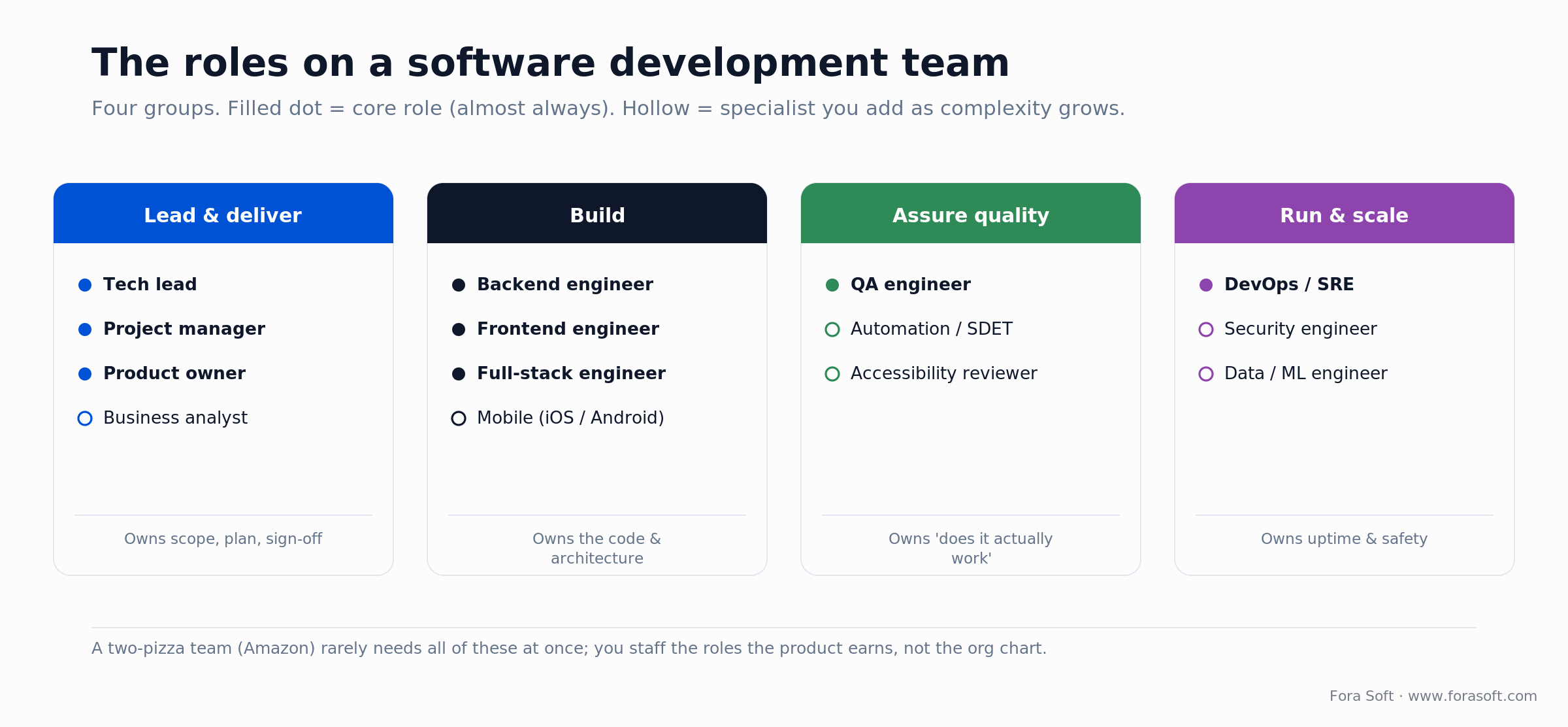
Figure 1. The core roles on a software development team, grouped by the job they own. Filled dots are near-always roles; hollow dots are specialists you add as complexity grows.
Lead and deliver. A tech lead owns architecture and code review. A project manager owns schedule and unblocking. A product owner (or product manager) owns what gets built and why. On regulated or complex work, a business analyst turns fuzzy requirements into specs the team can estimate.
Build. Backend, frontend, and full-stack engineers write the product. Full-stack devs carry lean teams and fast MVPs; dedicated backend and frontend specialists take over as the surface area grows. Mobile engineers (iOS and Android) join the moment a native app is in scope.
Assure quality. A QA engineer owns the question “does it actually work,” with an automation engineer or SDET writing the test suite once the product is big enough to need one. On products with real users to protect, accessibility review belongs here too.
Run and scale. A DevOps or SRE engineer owns uptime, pipelines, and cost. A security engineer joins for auth-heavy or regulated products; a data or ML engineer joins when the product has a pipeline or a model at its core. monday.com’s widely cited list stretches to twelve roles, but most teams run four to nine people, because more roles means more hand-offs to coordinate.
Here is each role, what it owns, and the signal that tells you it is time to add it.
| Role | What they own | Add them when |
|---|---|---|
| Tech lead | Architecture, code review, technical decisions | Always — the first hire on any real build |
| Product owner / manager | What gets built and why; the backlog | Always — someone must own priorities |
| Project manager | Schedule, unblocking, stakeholder comms | The team passes ~5 people or the client needs cadence |
| Backend engineer | APIs, data, business logic | Always |
| Frontend engineer | UI, state, performance in the browser | The interface is more than trivial |
| Full-stack engineer | A vertical slice end to end | Early-stage or lean teams that value speed |
| Mobile engineer | Native iOS or Android | A native app is in scope |
| QA engineer | Test plans and “does it actually work” | Always — not an afterthought |
| DevOps / SRE | Pipelines, uptime, cloud cost | You have real users and a production SLA |
| Security / data / ML | Threat model, pipelines, models | The product is regulated, auth-heavy, or model-driven |
Team size and the ratios that actually work
The single most useful number in team design is the ceiling: keep a delivery team at ten people or fewer. The 2020 Scrum Guide landed on “typically 10 or fewer” after years of larger teams communicating worse; Amazon’s two-pizza rule says the same thing with lunch. Above that line, communication paths explode and the team slows down. You add a second team, not an eleventh seat.
Under the ceiling, the ratios we run across 250+ projects are steady. One tech lead covers four to six engineers before review quality drops. One QA engineer covers three to five developers, tighter on real-time or regulated products where a defect is expensive. One designer supports a small team and goes dedicated on design-heavy work. DevOps runs about half a person to one per active team, embedded rather than sitting in a separate silo. We staff senior-heavy on purpose: most of our engineers have five to twelve years in the domain, and juniors join under a lead in structured apprenticeship, never as the primary implementer on client code.
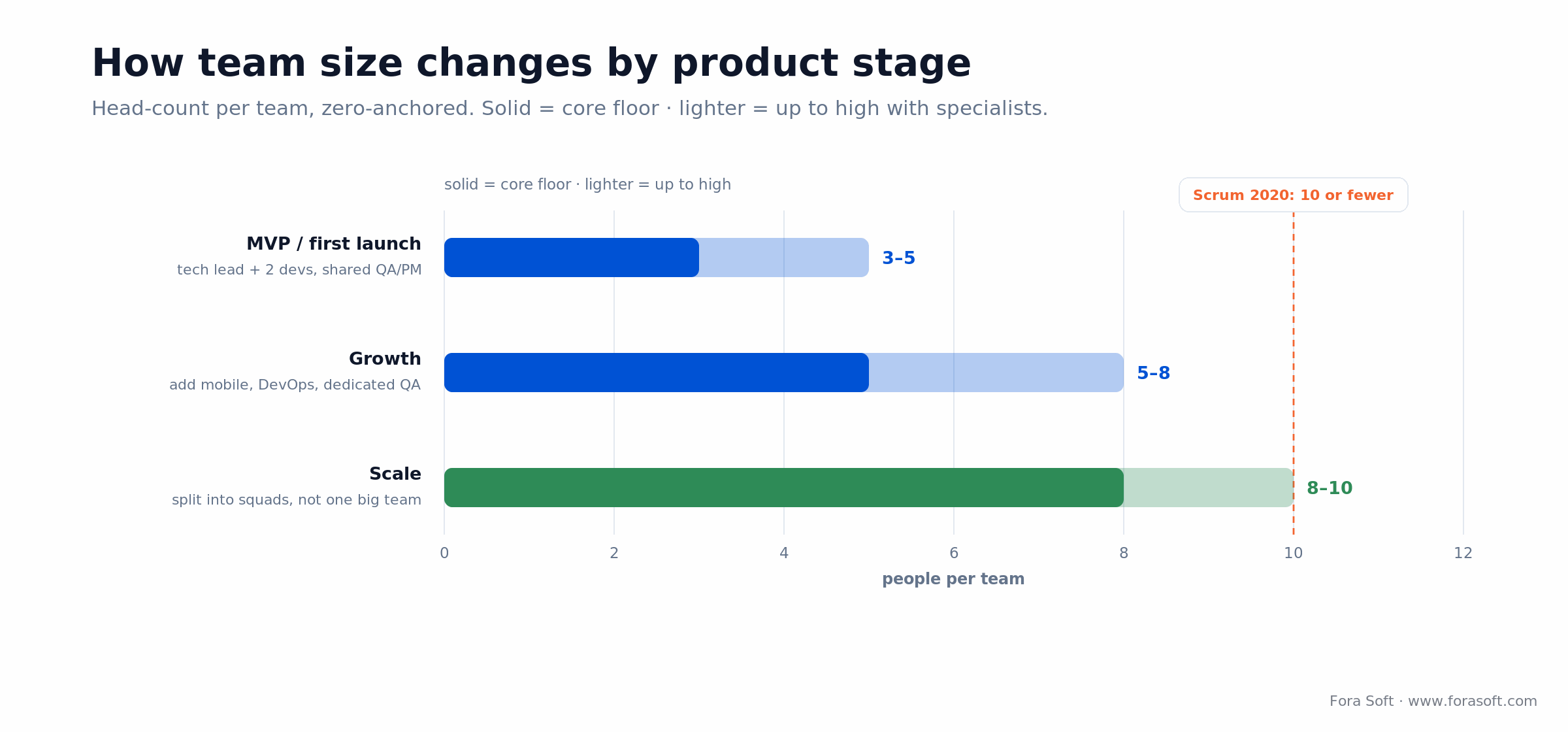
Figure 2. How team size moves by product stage. Bars are zero-anchored: the solid part is the core floor, the lighter part is the range once specialists join.
Read the chart as stages, not a hiring plan. An MVP ships with three to five people. Growth adds specialists and lands around five to eight. At scale you approach ten and then split into squads. The mistake we see most on rescue projects is a single team of fourteen that should have been two teams of seven months ago.
Reach for a second team, not a bigger one, when: one team passes about ten people, or a stand-up runs longer than fifteen minutes. Both are signals the communication overhead is now taxing delivery.
Generalist, specialist, or hybrid: three structure models
Once you know the roles, you pick how deep each person goes. There are three models, and most real products settle on the third.
| Model | How it works | Best for | Main watch-out | Our default |
|---|---|---|---|---|
| Generalist | Everyone can touch most of the stack; full-stack devs cover breadth over depth. | Early-stage startups, MVPs, small teams that need speed and flexibility. | Thin on deep expertise for hard problems (real-time, ML, compliance). | MVP and first launch |
| Specialist | Each person owns a domain: frontend, backend, QA, security, data. | Large or complex products, regulated builds, advanced features. | Silos and hand-offs; needs strong coordination and a tech lead. | Scale, regulated work |
| Hybrid | A senior generalist tech lead plus specialists where the problem demands them. | Growth-stage companies and most production products. | Needs clear ownership so the generalists and specialists do not overlap. | Most engagements |
The industry has converged on the hybrid model for a reason: it buys the speed of generalists on the routine 80% of the work and the depth of specialists on the 20% that is genuinely hard. Our teams run hybrid by default, with a senior lead who can work across the stack and specialists on call for video encoding, WebRTC, ML, and payments.
Reach for a specialist-heavy team when: the product has hard real-time, machine-learning, or compliance requirements where a generalist’s best guess is a liability. Below that bar, a hybrid ships faster and costs less.
Functional vs cross-functional: how to group the teams
Roles and ratios tell you who is on a team. The last decision is how to draw the boundaries between teams, and there are two ways to cut it.
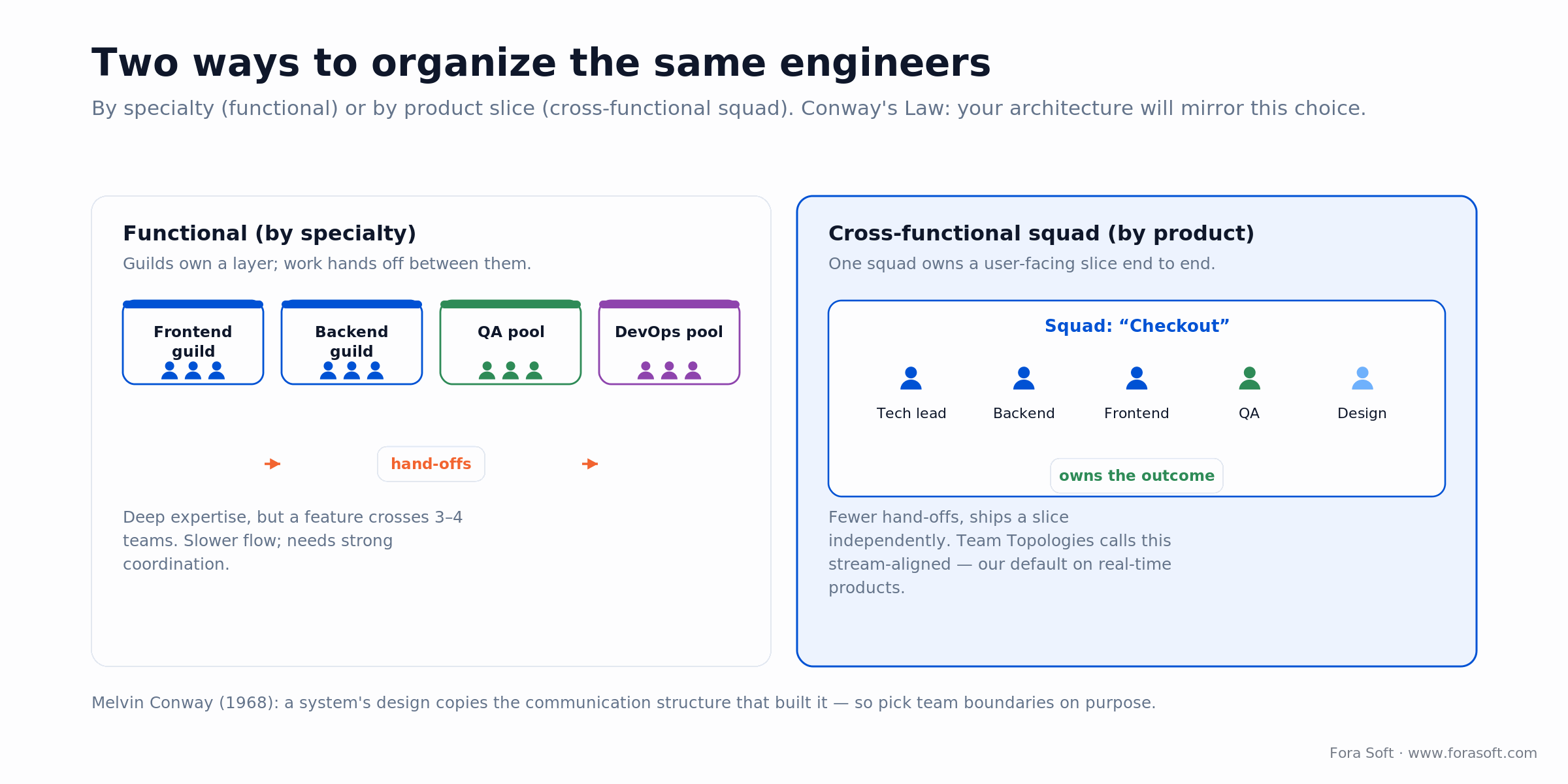
Figure 3. The same engineers, organized two ways. Functional guilds hand work between layers; a cross-functional squad owns a user-facing slice end to end.
Functional groups people by specialty: a frontend guild, a backend guild, a QA pool. Expertise runs deep, but a single feature crosses three or four teams, so flow is slow and coordination is constant. Cross-functional groups people by product slice: one squad with a lead, backend, frontend, QA, and design owns “checkout” end to end. Team Topologies calls this a stream-aligned team, and it is our default on real-time products because it kills the hand-offs that slow real-time work to a crawl.
The reason this choice matters more than it looks: Melvin Conway showed in 1968 that a system’s architecture ends up copying the communication structure of the org that built it. Draw four functional teams and you tend to get four tangled layers; draw product squads and you tend to get clean, independently deployable services. Pick the boundary you actually want reflected in the code.
Not sure which team shape fits your product?
Book a 30-minute call. We map the roles, ratios, and squad boundaries to your roadmap, and tell you where a hybrid team beats a bigger one.
How we structure a Fora Soft team
Our teams run the hybrid model as a cross-functional squad. A senior tech lead owns architecture and every code review. A core build team of two to six engineers, mid to senior, carries the work. Domain specialists (WebRTC, ML, payments, video streaming) come in on call rather than sitting idle on the roster. Above the lead, a head of engineering handles resourcing, coaches craft, and owns the cross-project hardware and cloud decisions.
We stay senior-heavy so review cycles are short and defect rates stay low. You pay for the work the product needs, not for an org chart. If a role would sit idle, it is not on your team. That discipline shows up in the numbers a buyer can check: a 100% job-success score across 935 jobs on Upwork and a 5.0 rating on Clutch.
Which stacks we run, and why
Structure decides who is on the team; the stack decides what they reach for. We are multi-stack by design and pick per problem, not per resume. Fluency across stacks is also what keeps our estimates honest, because we are not selling you the one language we happen to know.
| Stack | Best for | Fora Soft pattern |
|---|---|---|
| TypeScript + Node / NestJS | Web apps, real-time backends, unified full-stack teams | Default for new builds; strict types, Zod at boundaries |
| React + Vite | Modern web frontends, SPAs, admin panels | Vite over Webpack; micro-bundles; Suspense patterns |
| Go | High-throughput services, SFU-adjacent, edge infra | Where Node cannot hold the CPU or latency budget |
| Python | ML/AI, data pipelines, CV and ASR glue | FastAPI for services; Poetry + pyright for discipline |
| Kotlin (Android) | Native Android, real-time SDK integrations | Jetpack Compose, coroutines, custom WebRTC glue |
| Swift (iOS) | Native iOS, AVFoundation, CallKit | SwiftUI + Combine where viable; deep MLX experience |
| PHP (Symfony / Laravel) | Existing estates, long-standing platforms | Used where the current codebase rewards continuity |
| C++ (selective) | Low-level codec work, native video processing | Reserved for performance-critical paths only |
We tell you the trade-offs before you pick. “Use what your team knows” usually wins on maintainability. For real-time video, audio, or ML-heavy backends, the stack choice has real performance consequences, and that is where the specialist on the team earns their seat.
Reach for Go when: you need low p99 latency on a hot path, high goroutine concurrency, or a tight memory footprint. Below that bar, TypeScript and Node is the right default.
Our engineering process, sprint by sprint
Sprint 0, tech architecture (1 week). The tech lead turns the analyst’s deliverables into architecture sketches, decision records, API contracts, an infra plan, and a test strategy. Engineers read; open questions go into the sprint-1 backlog.
Sprints 1 to N, build (2-week sprints). Story pull, pull-request-driven development, CI kept green, daily async stand-ups. Every PR gets at least one senior reviewer plus automated checks for types, tests, lint, and security.
A standing tech-debt budget. Ten to fifteen percent of each sprint goes to paydown: refactors, dependency bumps, test-gap fills. Skipping this is the top reason projects stall in month three.
Pre-launch hardening (1 to 2 weeks). Load tests, security review, accessibility audit, chaos scenarios. Our QA team owns sign-off.
Post-launch cadence. Observability stays live, reliability reviews weekly, roadmap refresh monthly. We do not vanish at launch; most clients keep us on maintenance.
Code quality: what it means operationally
1. Strict types at the boundaries. TypeScript strict mode, pyright strict in Python, runtime validation at ingress with Zod or Pydantic so bad data cannot sneak past the API.
2. Tests as first-class citizens. Unit tests for logic, integration tests for contracts, end-to-end for critical journeys. Coverage thresholds live in CI (typically 70%+ unit, 80%+ on critical paths), because without a threshold, coverage decays.
3. Review discipline. Every PR is reviewed, seniors review seniors, comments are direct but kind, and approved PRs merge through CI rather than a button.
4. Decision records. Every non-trivial architecture choice gets a short markdown record: context, decision, consequences. Six months later, “why did we pick X” has an answer on disk.
5. Observability on day one. Structured logging, tracing, and metrics from sprint 1, not bolted on later. “It works on staging” is not a certification.
Agent engineering: how AI is reshaping team structure
AI is changing the answer to “how many people, and how senior.” In the 2025 DORA report, 90% of developers said they use AI at work, up 14 points in a year. We run coding agents inside a strict review discipline: agents draft, humans decide. The effect on the team is real.
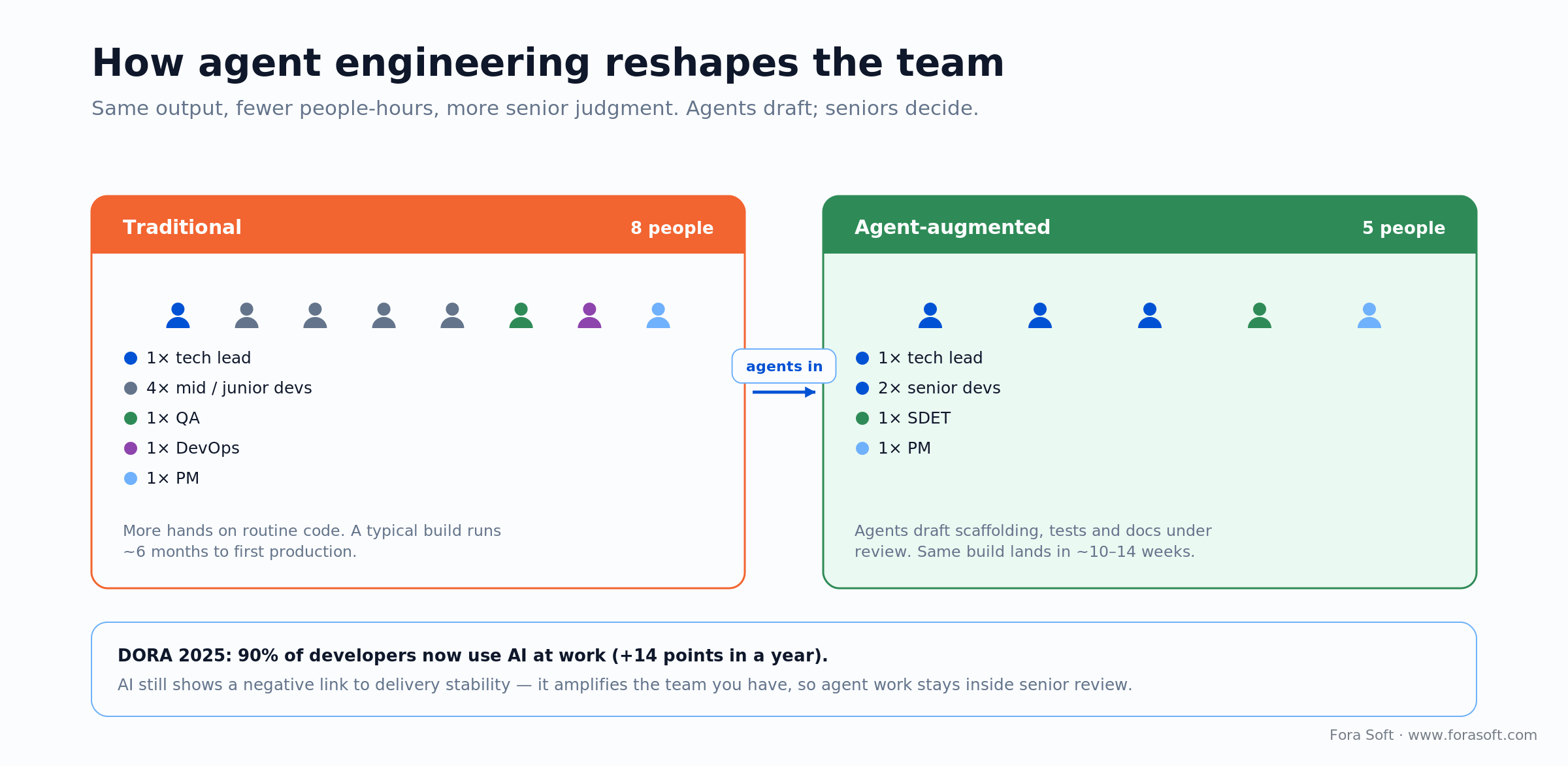
Figure 4. What agents do to team composition: fewer people-hours on routine code, a smaller and more senior team, with agent output kept inside senior review.
Spec-driven generation. Analyst specs feed agents that draft scaffolding, types, service boundaries, and tests; engineers iterate on the draft instead of a blank file. The mechanics are in spec-driven agentic engineering.
Test synthesis. Agents propose edge-case tests from a spec plus an implementation; engineers accept, edit, or reject. More tests, lower cost, no drop in quality.
Review and docs. Agents flag obvious regressions and missing null checks before the human reviewer, and keep API docs and architecture summaries current, which is rare in practice.
There is a catch worth naming. DORA’s 2025 finding is that AI adoption still carries a negative relationship with delivery stability, even after throughput improved that year, and its own summary is blunt: AI amplifies the team you already have. A disciplined team gets faster; a sloppy one ships its mess quicker. That is the whole reason we keep agent output inside senior review rather than shipping it raw. Net effect on a typical build: a six-month timeline lands in ten to fourteen weeks, with fewer people-hours and more senior judgment.
Mini case: real-time audio on V.A.L.T.
Situation. One of our longest-running teams builds V.A.L.T., a video platform used by 770+ U.S. organizations. It needed a Talkback feature: two-way, browser-to-IP-camera audio across a fleet that included older, resource-constrained cameras. Latency had to stay under 300 ms on the hot path, audio needed resampling and noise reduction, and cameras without native WebRTC needed a shim.
Plan. A small, senior squad owned it end to end: one lead, two engineers, and a WebRTC specialist on call. They rewrote the frontend audio-capture pipeline, built a middle-tier processor for resampling and noise reduction, and adjusted the backend for camera compatibility.
Result. Talkback shipped across the client’s full camera fleet. As a side effect, the team migrated the frontend build to Vite and cut it from about 15 minutes to roughly 25 seconds, which lifted productivity on every feature after it. The build time was the invisible win, the kind a cross-functional squad catches because the same people own the whole slice and feel the pain.
Reliability engineering: the boring parts that matter
1. SLOs before features. Availability, latency, and error-rate targets are set with the client; dashboards and alerts are wired before the first user. Deeper notes in how to make software reliable and crash-proof.
2. Blameless postmortems. Every incident gets a five-why and an action list with an owner and a date.
3. Load testing. Before every launch and every major feature, synthetic users hit the paths real users will.
4. Security review. Threat model at architecture time, automated OWASP Top 10 checks in CI (SAST and dependency scanning), and a penetration test before production for anything with auth and sensitive data.
Cloud, infra, and delivery stack
Hosting. AWS, GCP, and Azure across the board; Hetzner AX-series and DigitalOcean for cost-sensitive video workloads; Cloudflare for edge and CDN.
Orchestration and delivery. Kubernetes for multi-service apps, ECS/Fargate for AWS-native teams, GitHub Actions or GitLab CI for pipelines, blue-green or canary deploys for anything with real users.
Observability and data. Datadog or Grafana with Prometheus and OpenTelemetry; Postgres as the default store, Redis for cache, Kafka or NATS for event streams, ClickHouse or Snowflake for analytics.
Reach for Hetzner when: you host heavy 24/7 video workloads and the hyperscaler bill is eating the business. We have seen 50 to 70% savings on bare-metal video infra versus the big clouds.
What a software development team costs
A team’s cost is its size times its rate times its calendar, so the structure you pick is the budget you pick. Three realistic shapes for 2026, grounded in our recent work:
| Engagement | Typical duration | Cost shape |
|---|---|---|
| Focused MVP | 6–10 weeks | $40–90k, fixed |
| Mid-scope build | 10–16 weeks | $90–180k fixed, or T&M |
| Complex platform | 4–9 months | $180–600k+, staged |
| Dedicated team | Ongoing | Per-engineer monthly rates |
Here is the arithmetic behind the MVP row, not a vibe: a five-person hybrid team (lead, two engineers, part-time QA and PM) over eight weeks is about 4 full-time-equivalents, roughly 1,300 engineer-hours; at a senior-heavy blended rate near $50–70 an hour that lands in the upper half of the $40–90k band. A shorter, three-person MVP sits at the bottom of it. We use agent engineering to compress the routine, which is why our fixed-price deals come in below a typical agency quote. When a number is not defensible, we do not publish it. The real figure comes after a one-to-two-week scoping spike.
Reach for fixed-price when: scope is tight, specs are clear, and a scoping spike has converged on a number we can defend. Otherwise time-and-materials is cheaper for both sides.
Want a defensible number for your build?
Bring your brief, stack preferences, and constraints. We size the team out loud and return a cost shape that adds up, or tell you the spike needed to get there.
Decision framework: what team structure do you need?
Five questions get you from “we need developers” to a concrete shape.
Q1. What stage is the product? Pre-MVP wants a small generalist team; a scaling product wants specialists and squads. Stage sets size before anything else.
Q2. Is the hard part real-time, AI, or regulated? If yes, you need specialists on the team and a lead who has shipped in that domain. A generalist’s best guess is a liability here.
Q3. How many independent product areas are there? One area wants one squad; three or more wants cross-functional squads with clean boundaries, per Conway.
Q4. Do you have senior review in-house? If not, a dedicated tech lead is the highest-value hire you can make, because unreviewed code is where velocity goes to die.
Q5. Is the roadmap continuous or one-off? Continuous favors a dedicated team that keeps product memory; one-off favors a fixed-scope build with a clean handover.
Five team-structure pitfalls on rescue projects
1. One team of fourteen. Past ten people, communication overhead outruns output. Split into squads before velocity halves, not after.
2. All juniors, no lead. Cheap on paper, expensive by month three. Without a senior reviewing every PR, defects and rework pile up faster than features.
3. Specialists with no owner. A pool of frontend and backend guilds with no one owning the feature end to end means every story stalls at a hand-off.
4. No QA in the ratio. Teams that treat QA as someone else’s job ship the defects to production and pay for them at the worst possible time.
5. Structure frozen at v1. The team that shipped the MVP is rarely the team that scales it. Re-cut the boundaries when the product outgrows them.
KPIs we hold the team to
Quality. Production defect density (under 3 escaped defects per 10k lines shipped). Mean time to detect (under 5 minutes) and to recover (under 30 minutes for SEV-2). Post-deploy rollback rate (under 5%).
Velocity. PR-open-to-merge cycle time (under 2 days). Deployment frequency (multiple per day on mature products). Lead time for change measured in hours, not weeks.
Cost and people. Estimate-to-actual variance (a ±15% ceiling on fixed-price). Cloud spend per active user trending down after optimization. Engineering retention above 90% a year, because a team that stays keeps the product memory that makes it fast.
When you don’t need a full team
If your product is a simple CRUD app with no real-time, AI, or streaming, and you have a capable in-house team, a full delivery squad is over-qualified. If you need one contractor to make quick changes to a legacy PHP site, a freelancer serves you better than our model.
Where a structured team earns its seat: complex, reliable, multi-domain builds. That is the work where 20 years of portfolio and a disciplined team structure compound, and where agent engineering gives you real speed without cutting corners. Honesty about the fit is part of the pitch; we would rather tell you now than bill for it later.
The dedicated team model
For continuous roadmaps, we run a dedicated development team: named engineers who work as an extension of your org for months or years. We have run three-to-ten-person dedicated teams for the same clients for five years and longer. The model fits when the roadmap never really ends and you want the same senior people holding product memory instead of re-onboarding a new team every quarter. It is the structure behind our steadiest client relationships, including the TradeCaster trading platform now running at 46,000+ users.
How we plug into your team
Your tools. Jira, Slack, GitHub or GitLab, Linear, Notion, PagerDuty. Our engineers show up in your stand-ups and retros, not a parallel universe.
Time zones. We span Europe and MENA, with solid overlap on North American mornings and European hours. Async-first where we can, synchronous where a decision needs it.
Security and ownership. NDA and MSA before any code access, SOC 2-aligned internal controls, and BAAs for HIPAA work. You own the code, with full handover docs at milestones, and we can transition to your in-house team cleanly.
FAQ
What is the ideal software development team structure?
There is no single ideal; the right structure fits your stage and problem. Most production products run a hybrid model: a senior tech lead, a core build team of backend, frontend, and full-stack engineers, a QA engineer, and specialists (DevOps, security, data, mobile) added as the product needs them. Keep the team at ten people or fewer and split into squads beyond that.
How many people should be on a software development team?
Keep a delivery team at 10 or fewer, per the 2020 Scrum Guide and Amazon's two-pizza rule. An MVP runs 3 to 5 people, a growth-stage product 5 to 8, and a scaling product approaches 10 before you split it into multiple squads rather than adding an eleventh person.
What roles are on a software development team?
Four groups: lead and deliver (tech lead, project manager, product owner, business analyst), build (backend, frontend, full-stack, mobile engineers), assure quality (QA, automation/SDET), and run and scale (DevOps/SRE, security, data/ML). The first two groups are near-always present; the rest are added as complexity grows.
What is the difference between functional and cross-functional teams?
A functional team groups people by specialty (a frontend guild, a backend guild), so a feature hands off between teams. A cross-functional (stream-aligned) squad groups people by product slice, so one team owns a feature end to end with fewer hand-offs. Cross-functional squads ship faster on real-time and complex products.
What is the best ratio of QA to developers?
One QA engineer to about three to five developers is a workable default, tightened on real-time or regulated products where defects are costly and loosened where automation carries most of the load. The ratio matters less than QA being in the team's structure at all rather than an afterthought.
How is AI changing software development team structure?
AI is shrinking teams and tilting them senior. With 90% of developers using AI at work (DORA, 2025, up 14 points in a year), agents draft scaffolding, tests, and docs, so a build that once needed eight people can ship with five more senior ones. The catch, per DORA: AI still hurts delivery stability if unreviewed, so agent output belongs inside strict senior review.
Should a startup hire generalists or specialists?
Generalists first. Early-stage products reward full-stack developers who can move across the whole stack for speed and flexibility. Add specialists (DevOps, security, ML) as the product hits problems a generalist cannot solve well, which is usually around the growth stage.
What is a dedicated software development team?
A dedicated team is a group of named engineers who work as a long-term extension of your organization, keeping product memory across a continuous roadmap. It differs from a fixed-scope project team, which forms for one build and hands over at the end. Dedicated teams fit products that keep evolving past v1.
What to Read Next
Agent Engineering
How We Use Spec-Driven Agents
The agent playbook that compresses our 6-month builds into 10 to 14 weeks.
QA Team
Inside Fora Soft’s QA Testing Team
How the QA role sits in the structure and owns sign-off on every release.
Reliability
How to Make Software That Doesn’t Crash
SLOs, observability, blameless postmortems: the boring work that keeps products alive.
Quality
Too Many Bugs in Your Project?
The diagnostics and remediation playbook for a team drowning in defects.
Ready to structure a team that ships?
A software development team structure comes down to three decisions: the roles you staff, the ratios you hold, and how you group people into teams. Keep the team small, match the model to your stage, draw squad boundaries on purpose, and let agents take the routine so the humans stay senior. That is how we have shipped 250+ products since 2005, and how we would shape the team for yours.
If you are sizing a team, the fastest path to a real answer is a 30-minute call with the tech lead who would own the build.
Want our engineers structured around your product?
Thirty minutes, no slides. You meet the tech lead, we map the roles and ratios to your roadmap, and you leave with a staffing plan and a range you can defend.

