

Key takeaways
• Six engines cover almost every real build. Deepgram Nova-3, OpenAI (gpt-4o-transcribe plus the new Realtime models), AssemblyAI Universal-3.5, Speechmatics Ursa 2, Google Chirp 3, and Azure AI Speech are the AI speech recognition software to shortlist first in 2026.
• Benchmark WER lies; test on your own audio. A July 2026 independent comparison of 14 models across 16 datasets put Speechmatics Melia-1 at 6.4% and AssemblyAI U-3.5 at 7.0%, while GPT-4o collapsed to 43.8% on earnings calls. Track keyword recall rate (KRR) on your domain, not a leaderboard.
• Streaming and batch are different products. Voice agents need sub-300 ms streaming (Deepgram, Speechmatics, Azure real-time, and now OpenAI Realtime). Meeting summaries can run batch and pay 3–6× less.
• Prices dropped and went public. Deepgram Nova-3 now lists $0.0043/min batch and $0.0077/min streaming; Google batch can hit $0.004/min. Self-hosting only pays off past roughly 14,000 audio hours a month.
• Compliance narrows the field fast. Only AWS Transcribe Medical, Azure, Deepgram, and IBM watsonx sign BAAs; EU-only workloads usually need a containerized or regional deployment.
Why Fora Soft wrote this playbook
We have built real-time audio and video products since 2005. Most of them end up needing speech recognition somewhere: live captions in a virtual classroom, real-time translation in a contact center, a transcript inside a telehealth visit, voice commands in a meeting tool. Across 250+ projects we have wired that pipeline into e-learning, telemedicine, video conferencing, broadcasting, and enterprise SaaS, and we have run every serious AI speech recognition software vendor against real customer audio, not press-release benchmarks.
One of those products, BrainCert, has delivered more than 500 million real-time classroom minutes across 10 data centers to 100,000+ customers at 99.995% uptime. Another, TransLinguist, runs interpretation across 75+ languages for a marketplace of 30,000+ certified interpreters and won the NHS national framework across the UK. That is why this guide leads with operational trade-offs (cost at scale, diarization purity, streaming latency) instead of vendor brochures. Use it the way our solution architects do: as a checklist that turns "we want voice in our app" into a defensible technical choice in one afternoon.
The market moved a lot since early 2025, so start with the map below, then read the engine-by-engine detail. If you only need the accuracy background first, our companion guide on speech recognition accuracy in noisy environments pairs well with this one.

Figure 1. Where the real-time engines sit on streaming latency versus list price. The bottom-left corner (fast and cheap) is what voice agents want.
Need a second opinion on which AI speech recognition software fits your app?
Bring us your sample audio and your latency, accuracy, and compliance constraints. Thirty minutes is enough to narrow the shortlist to two engines.
The state of AI speech recognition in 2026
The short version: accuracy is close to solved on clean audio, so the decision now turns on latency, diarization, price, and compliance. Four shifts drive every serious choice this year.
1. OpenAI finally shipped streaming. Through 2025 OpenAI had no real-time transcription endpoint. In 2026 it added Realtime speech-to-text (the gpt-realtime-whisper and live-transcribe models) at about $0.017/min, alongside the batch gpt-4o-transcribe at roughly $0.006/min and gpt-4o-mini-transcribe at about $0.003/min. That closes the one gap that used to keep OpenAI out of voice agents.
2. Streaming latency is the real differentiator. Deepgram and Speechmatics deliver sub-300 ms perceived latency end to end; Azure real-time and Google Chirp sit closer to 500–1,000 ms. If your product talks back, this number alone eliminates half the list.
3. Prices fell and became public. Deepgram now publishes Nova-3 rates ($0.0043/min batch, $0.0077/min streaming) instead of hiding them behind sales. Batch keeps undercutting streaming by 3–6×: Azure batch is $0.006/min and Google Dynamic Batch can reach $0.004/min on volume. Architect around batch wherever the SLA allows.
4. Voice agents pulled the enterprise in. Deepgram shipped Flux, the first conversational model with turn-taking built into the recognizer (median end-of-turn under 300 ms, no separate VAD), in late 2025, then added Flux Multilingual with real-time code-switching in April 2026. And IBM named Deepgram its first voice partner inside watsonx Orchestrate in February 2026, which makes Deepgram the safe consensus pick for real-time enterprise voice. Meanwhile the wider market sits around $22–24B for 2026 and is growing about 20% a year (Fortune Business Insights, Mordor), so competition on price keeps working in your favor.
One caution the vendors will not lead with: benchmark accuracy and production accuracy are different animals. The best public numbers come from LLM-fused batch models, but the same model can fall apart on hard audio. Keep that gap in mind through the whole guide.
The five engines that actually matter in 2026
There are dozens of vendors and about five real first choices. Start here; widen the search only if a hard constraint (medical compliance, an existing cloud bill, a research-grade benchmark) forces it.
Deepgram Nova-3 (and Flux) for production voice agents and real-time meeting transcription where sub-300 ms latency and predictable per-minute pricing matter most.
OpenAI gpt-4o-transcribe for cheap, accurate batch transcription, plus the new Realtime models when you want one vendor for both batch and streaming.
Speechmatics Ursa 2 (and Melia) for accuracy-critical, multilingual, diarization-heavy work: legal, medical, broadcast captioning, anywhere a wrong speaker label costs real money.
Google Cloud Chirp 3 for batch-first multilingual workloads at price (Dynamic Batch is the cheapest cloud option per minute) and for teams already on GCP.
Microsoft Azure AI Speech for Azure-native enterprise IT, custom-vocabulary needs, and HIPAA workloads where the Azure BAA already covers compliance. AssemblyAI joins the shortlist when you want transcription plus summaries, redaction, and sentiment in one call.
OpenAI: Whisper, gpt-4o-transcribe, and Realtime
Open-source Whisper is still the default starting point for prototypes and self-hosting. On the API, gpt-4o-transcribe (released March 2025) runs about $0.006/min and gpt-4o-mini-transcribe about $0.003/min. The big 2026 change is streaming: OpenAI Realtime speech-to-text (gpt-realtime-whisper / live-transcribe) now streams at roughly $0.017/min, so OpenAI is finally usable inside a voice agent, not just for offline transcripts.
Why pick it
Strong batch accuracy at the lowest published per-minute price, one SDK shared with the rest of your GPT stack, and open weights (Whisper-large-v3, large-v3-turbo) for self-hosting via Hugging Face and faster-whisper. Now with a streaming path too.
Limits
Accuracy is workload-dependent: independent testing (Artificial Analysis) puts gpt-4o-transcribe near 8.9% WER, well above vendor headline figures, and a July 2026 run saw it fall to 43.8% on long-form earnings calls. Diarization is not first-class (you bolt on Pyannote or NeMo), and OpenAI signs Zero Data Retention addenda but not full BAAs on standard plans.
Reach for OpenAI when: you want the lowest-cost accurate batch transcription (podcasts, video captions, knowledge-base ingestion), or you want one vendor for both batch and a good-enough streaming path without adding a second provider.
Deepgram Nova-3 and Flux
Nova-3 is where most production voice agents land in 2026. Deepgram reports a 5.26% median WER on pre-recorded audio and 6.84% on streaming, publishes its prices openly ($0.0043/min batch, $0.0077/min streaming), and supports 40+ languages at sub-300 ms latency. Domain-tuned variants (Nova-3 Medical, Nova-3 Phonecall) beat the general model on healthcare and contact-center audio. Deepgram's Flux model (launched 2025, with a multilingual, code-switching version in April 2026) folds turn detection into the recognizer and shaves 200–600 ms off agent response time versus a separate speech-to-text plus VAD pipeline.
Why pick it
Lowest end-to-end streaming latency in the cloud-API tier, first-class diarization, smart formatting, language detection, and custom vocabulary. HIPAA-eligible with a BAA, transparent pricing, and a $200 free credit to test before you commit. The IBM watsonx integration makes it the low-risk enterprise choice.
Limits
Smaller language footprint than Google or Azure. Vendor WER figures are self-reported, so results on your audio will vary by accent and domain. And it has no LLM-fused batch mode for the very highest offline accuracy; for that you go to OpenAI or Speechmatics.
Reach for Deepgram when: you are building a voice agent, live captioning for video conferencing, or real-time contact-center analytics, and the product must respond to the user in under one second.
AssemblyAI Universal-3.5 and Slam-1
AssemblyAI moved past Universal-2. Its flagship for pre-recorded audio is now Universal-3.5 Pro (18 languages, with automatic fallback to Universal-2 for 99-language coverage), and Slam-1 is a promptable speech language model in public beta that won about 72% of blind human-preference tests against Deepgram Nova-3. The real draw is the intelligence stack on top: PII redaction, sentiment, topic detection, and summaries in a single API call, plus strong entity recall (Universal-2 already added 24% better rare-word recognition and 21% better accuracy on numeric identifiers like phone numbers and account IDs).
Why pick it
If you were going to run an LLM over the transcript anyway (action items, ticket summaries, lead qualification), AssemblyAI saves you a second model call. Slam-1's promptable output is genuinely useful for domain vocabulary without a full fine-tune.
Limits
Pricing is volume-tiered and sales-led. Streaming latency (roughly 500–800 ms) is not Deepgram-fast, so it is a batch-and-intelligence pick more than a real-time-agent pick.
Reach for AssemblyAI when: you want transcription plus summarization, redaction, and sentiment from one vendor, and you do not need sub-300 ms streaming.
Speechmatics Ursa 2 and Melia
Speechmatics quietly leads where accuracy matters most. Ursa 2 cut WER 18% across 50+ languages versus its predecessor and scored 92% accuracy in the G2 Spring 2026 comparison, five points ahead of Google. Its unified Global English model handles accents without separate models, and a containerized on-prem deployment is available. Its new Melia model adds native code-switching across 56+ languages in a single pass, which is a real edge for Spanglish, Franglais, and other mixed-language audio. An independent July 2026 run put Melia-1 first at 6.4% WER across 16 datasets.
Why pick it
Best diarization in the market. If your transcript needs reliable "who said what" labels (legal depositions, multi-doctor consultations, broadcast captioning), Speechmatics is the safe choice. Strong multilingual quality and an on-prem container for sovereign and EU-only workloads.
Limits
Enterprise-only pricing with a multi-month sales cycle and a higher per-minute rate than Deepgram. Smaller ecosystem tooling around the API than the hyperscalers.
Reach for Speechmatics when: diarization quality, multilingual accuracy, code-switching, or EU/sovereign data residency are non-negotiable and budget is not the binding constraint.
Google Cloud Speech-to-Text and Chirp 3
Chirp 3 is Google's current-generation multilingual model, available through the Speech-to-Text V2 API. It adds a built-in denoiser, automatic language detection, and (new this generation) speaker diarization, which closes an old Google weakness. It still leads on language coverage, and the Dynamic Batch endpoint is the cheapest cloud option per minute, roughly $0.004/min on volume against $0.016/min for standard streaming.
Why pick it
Cheapest at scale for batch, the widest language coverage, native ties to BigQuery, Vertex AI, and Pub/Sub, and regional endpoints in the EU and APAC for data residency.
Limits
Diarization is improving with Chirp 3 but still trails Speechmatics and Deepgram on hard multi-speaker audio. Custom vocabulary needs PhraseSets and adaptation, which is more work than a "just send words" config, and streaming latency is mid-pack.
Reach for Google when: you need cheap asynchronous batch transcription across many languages, or you are already paying for GCP and want one bill.
Microsoft Azure AI Speech
Azure AI Speech costs about $0.0167/min for real-time and $0.006/min for batch, one of the largest streaming-versus-batch gaps in the market. It now covers 140+ languages, adds a Fast Transcription mode for files up to 300 MB, and keeps mature Custom Speech tooling for fine-tuning on your own transcripts. The Microsoft enterprise BAA covers HIPAA workloads.
Why pick it
The easiest path inside Microsoft 365, Teams, and Dynamics, with strong Custom Speech tooling and a good batch price for compliant workloads.
Limits
Real-time pricing is the highest of the top five, the pricing tiers take a day with the calculator to understand, and diarization quality lags Speechmatics.
Reach for Azure when: the rest of your stack is Microsoft, you need an existing BAA, and your workload is mostly batch with custom vocabulary.
Amazon Transcribe and Transcribe Medical
Amazon Transcribe is $0.024/min for both batch and streaming (no batch discount, an outlier in this market), tiered down to about $0.0078/min above 5M minutes a month. Transcribe Medical costs $0.075/min, roughly a 3× premium, and is the only medical-tuned engine with a clean AWS BAA path. It supports 75+ languages.
Why pick it
The easiest integration when you already process media on AWS (S3, MediaConvert, Comprehend Medical). Transcribe Medical is the default for HIPAA-regulated transcription on AWS workloads.
Limits
No batch-versus-streaming discount, steep medical pricing, channel-based diarization rather than true speaker clustering, and mid-pack general accuracy.
Reach for AWS Transcribe when: the rest of your stack is on AWS, or you are building HIPAA-regulated medical transcription and the BAA path matters more than the per-minute price.
Self-hosting: faster-whisper and NVIDIA Riva
Three self-host stacks are worth running in 2026. The legacy options (Mozilla DeepSpeech, CMU Sphinx, and the original Coqui, whose company shut down in early 2024) are unmaintained and should not anchor new builds.
faster-whisper reimplements Whisper on CTranslate2 and runs roughly 4× faster than reference Whisper on the same GPU, which makes it the default open-source choice for batch on a single A10 or L4. Whisper.cpp ports the model to CPU and ARM, including phones, so it is the answer for offline on-device transcription. NVIDIA Riva is the only serious self-host stack for real-time streaming: sub-100 ms latency on a T4 or A10G, custom acoustic and language models, and TTS plus translation in the same container.
Kaldi still runs in large research labs and call centers, but it needs a dedicated speech engineer to operate, so we do not recommend it for new product builds. If you want the on-device and mobile side in depth, see our note on voice-activated mobile apps with AI and NLP.
Reach for self-hosting when: you process more than ~14,000 audio hours a month, you have a hard data-residency or air-gap requirement, or you need on-device offline recognition (mobile, desktop, embedded).
AI speech recognition software compared
A single side-by-side of the engines we evaluate first. Numbers are vendor-published or independently benchmarked in 2026; treat WER as a starting point, not a verdict.
| Engine | WER (vendor) | Languages | $/min stream | Latency | Diarization | Best fit |
|---|---|---|---|---|---|---|
| Deepgram Nova-3 / Flux | 5.3–6.8% | 40+ | $0.0077 | <300 ms | Yes | Real-time agents, live captions, contact center |
| OpenAI (4o-transcribe / Realtime) | ~8.9% (indep.) | 99 | $0.017 / $0.006 batch | ~700 ms | No (bolt-on) | Cheap accurate batch; one-vendor stack |
| Speechmatics Ursa 2 / Melia | ~4–6% | 55+ | Enterprise | <500 ms | Yes (best) | Legal, medical, broadcast, code-switching |
| Google Chirp 3 | ~7–8% | 125+ | $0.016 / $0.004 batch | 500–1,000 ms | Yes (improved) | Cheapest batch, multilingual, GCP-native |
| Azure AI Speech | ~7–8% | 140+ | $0.0167 / $0.006 batch | 500–1,000 ms | Add-on | Microsoft estate, Custom Speech, HIPAA |
| AssemblyAI U-3.5 / Slam-1 | ~7% (indep.) | 99 | Sales-led | 500–800 ms | Yes | Transcription + summary + redaction in one API |
| AWS Transcribe (Medical) | ~6–7% | 75+ | $0.024 / $0.075 medical | ~1,000 ms | Channel-only | AWS-native, HIPAA medical with BAA |
Want this matrix scored against your actual audio sample?
Send us 10 minutes of representative audio and we will run it through the top three engines and report WER, KRR, latency, and cost on a single page.
Reference architecture for real-time transcription
This is the pipeline we deploy when a customer asks for live captions, real-time translation, or a voice agent on top of a video conferencing or telemedicine product. Every block earns its place; remove one and quality drops in a predictable way.

Figure 2. The pipeline behind live captions and voice agents, with the three blocks that most often decide whether it feels good.
Three details usually decide whether the pipeline feels good. First, voice activity detection in front of the recognizer cuts compute and stops the model from inventing words in silence. Second, diarization quality is set by the engine, not by post-processing, so pick the right vendor up front instead of patching later. Third, punctuation matters more than people expect; without it, downstream summaries and search queries break in quiet, hard-to-debug ways.
For the transport layer that feeds this pipeline, see our primer on what WebRTC is and how it works and our walkthrough of integrating the OpenAI Realtime API with WebRTC, SIP, and WebSockets. The audio-quality building blocks (echo cancellation, jitter buffers, codecs) live in our Audio for Video knowledge base.
Cost model: 1,000 audio hours per month
A working number for a mid-stage SaaS: 1,000 hours of audio a month, which is 60,000 minutes. We compute streaming and batch separately because the gap is large, and we use published 2026 list prices.
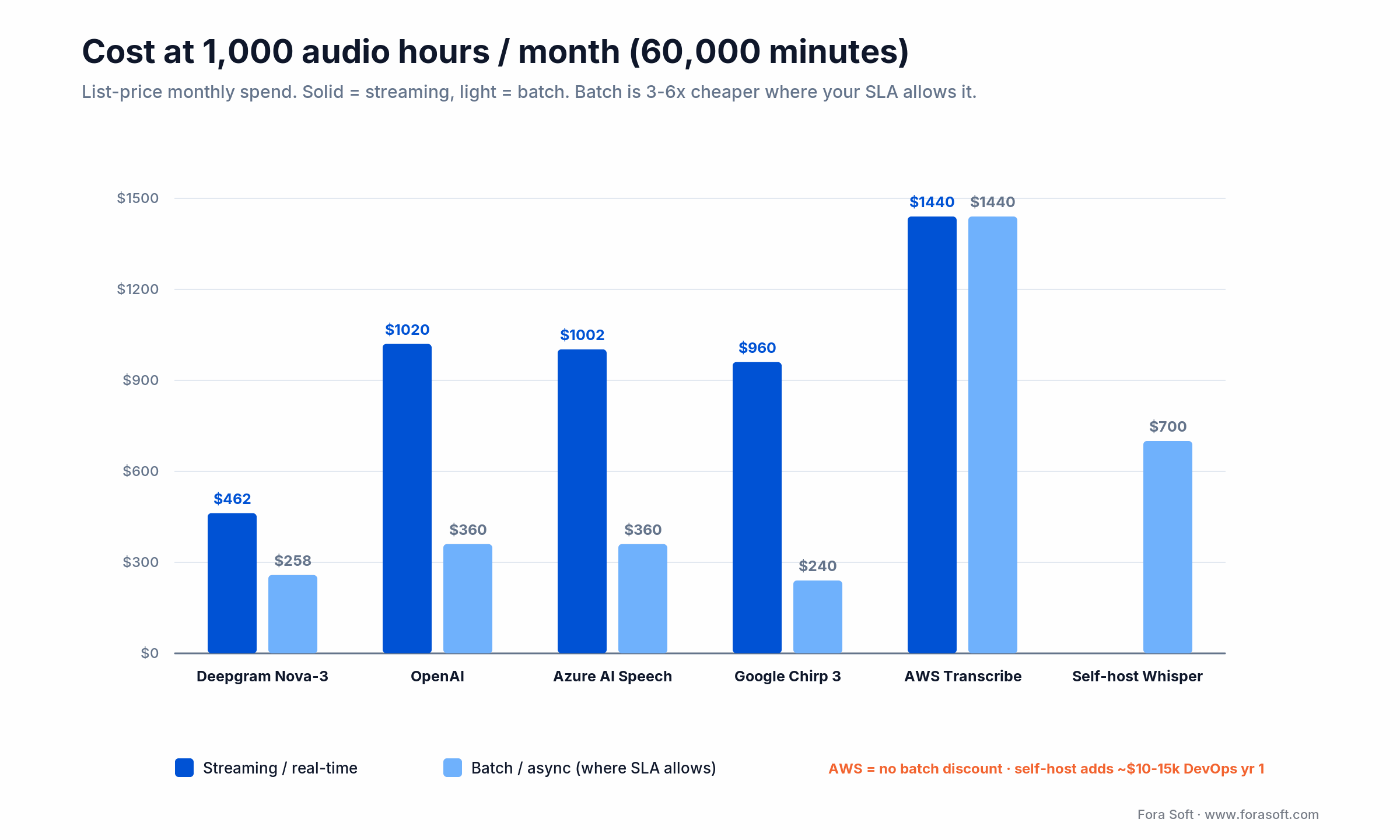
Figure 3. List-price monthly spend at 60,000 minutes. Batch is 3–6× cheaper than streaming wherever your SLA allows it.
| Engine | Streaming /mo | Batch /mo | Notes |
|---|---|---|---|
| Deepgram Nova-3 | $462 | $258 | Public pricing; volume commits cut more |
| Google Chirp 3 (Dynamic Batch) | $960 | $240 | Cheapest batch in market |
| OpenAI | $1,020 | $360 | Realtime stream; 4o-mini batch is ~$180 |
| Azure AI Speech | $1,002 | $360 | Large stream-vs-batch gap |
| Amazon Transcribe | $1,440 | $1,440 | No batch discount; tier-1 list price |
| Self-host Whisper (A10G) | n/a | ~$700 | Plus ~$10–15k DevOps in year one |
The arithmetic is simple and worth doing out loud. Streaming Deepgram at $0.0077/min × 60,000 min = $462/mo; the same volume on batch at $0.0043/min = $258/mo. Google Dynamic Batch at $0.004/min = $240/mo, the market floor. If your SLA tolerates async, batch is a 3–6× saving over streaming, every month.
Self-hosting Whisper does not pay off at 1,000 hours a month once you load engineering time and on-call. Two levers cut the bill further: volume commitments on AWS Transcribe drop the rate from $0.024 to about $0.0078/min above 5M minutes (a 68% cut), and annual commits on Deepgram and AssemblyAI typically take 30–40% off list. Negotiate before launch, not after.
Mini case: real-time captions and translation at scale
Situation. BrainCert, a long-running client, runs a WebRTC virtual classroom serving 100,000+ customers across 10 data centers. As its teacher base went international, it needed live captions in 30+ languages and on-the-fly translation, without changing existing infrastructure or breaking sub-second class latency.
Plan. Over a 12-week engagement we ran a head-to-head test of three engines on real classroom audio (lectures, accented speakers, screen-share narration). We scored keyword recall rate against subject glossaries (chemistry terms, programming syntax, medical Latin) as the primary metric, not LibriSpeech WER. We picked one engine for English-heavy live captions, a second for the long tail of less-supported languages, and built a fallback layer so a regional outage never kills captions for a live class. Translation runs as a separate stage downstream, so it can be swapped without touching the recognizer contract.
Outcome. Captions delivered at sub-300 ms perceived latency on top of a pipeline that has now carried more than 500 million real-time classroom minutes. We cut roughly two months of engineering versus a "pick one AWS service and ship" baseline, mostly because the comparative test caught a vendor weakness on academic vocabulary before launch. Want a similar evaluation against your own audio?
TransLinguist taught the opposite lesson. Running interpretation across 75+ languages for the NHS and 30,000+ interpreters, with rare language pairs and sensitive medical content, no single vendor covers the whole footprint, so we route each language to the engine that scores best on its own test set. The pattern (a vendor-agnostic recognition layer, a language-aware router, translation as a separate service) is now our default starting point. It is the same thinking behind our custom audio and video processing work.
Pick your engine in five questions
Walk these top to bottom. The first "yes" that matches a hard constraint usually settles the choice.

Figure 4. Five questions that map your hard constraints to a shortlist. Default to Deepgram Nova-3 if none of them bite.
1. Is your latency budget under 500 ms? If yes, the field collapses to Deepgram Nova-3 or Flux, Speechmatics real-time, Azure real-time, OpenAI Realtime, or self-hosted NVIDIA Riva. Batch-only paths are out.
2. Do you need diarization (who said what)? If yes, Speechmatics is the safe accuracy pick, Deepgram and AssemblyAI are competitive, and AWS, Google, and Azure should be tested carefully before serious multi-speaker work.
3. Are you bound by HIPAA, GDPR, or sovereign-data rules? If yes, narrow to vendors that sign BAAs (AWS Transcribe Medical, Azure, Deepgram, IBM) and to deployments that keep audio in your residency zone (Speechmatics container, Riva on-prem, GCP regional endpoints).
4. How many audio hours a month at steady state? Below ~1,000, take the cheapest streaming or batch combo that meets quality. Between 1,000 and 14,000, negotiate a volume commit. Above ~14,000, run the self-host calculation seriously.
5. Are you English-only or multilingual? If multilingual, default to Google Chirp 3 (125+ languages), Speechmatics or Melia for code-switching, or Whisper (99). Single-language English workloads have many more good options.
Pitfalls to avoid
1. Optimising for raw WER on a public benchmark. A 6% WER engine that mishears your product names, prices, and account numbers will fail in production. Measure keyword recall rate on your own glossary; it routinely splits vendors that look identical on standard word-error-rate tests.
2. Testing on studio-clean audio. Public benchmarks use clean speech. Production WER is 5–15 points worse on noisy calls, accents, and overlapping speech; the July 2026 GPT-4o result of 43.8% on earnings calls is the cautionary tale. Always run the bake-off on real samples, not TED talks.
3. Self-hosting Whisper to "save money". A single GPU instance plus DevOps, monitoring, and on-call commonly runs $150k+ a year fully loaded. Break-even versus a cloud API now sits around 14,000 audio hours a month; below that you pay more for a worse SLA.
4. Ignoring diarization until launch. Diarization quality is set by the recognizer. You cannot bolt it on later without rebuilding the contract between the model and the transcript schema, so decide it on day one.
5. Treating one cloud as one compliance story. "We are on Azure, so we are HIPAA-compliant" is wrong by default. The Azure BAA does not extend automatically to every service; you opt in per service and verify which models are in scope. The same holds for AWS and Google.
KPIs to measure once you ship
Quality KPIs. Word error rate on a frozen evaluation set of at least 10,000 reference words; keyword recall rate on your domain glossary, target above 95%; diarization purity and completeness, target above 90% for both. Re-score monthly to catch drift.
Business KPIs. First-call resolution or task success for voice agents (target above 85%); transcript-driven metrics such as meeting-summary accept rate, ticket auto-routing accuracy, and lead-qualification correctness. These are the numbers your CEO actually tracks.
Reliability KPIs. Real-time factor under 0.5 to feel responsive; time to recognised speech under 300 ms streaming and under 1 s batch; your own measured uptime (vendor SLAs are aspirational); and alerts when WER drifts more than 2 points from baseline.
Streaming or batch for your workload? Not sure which BAA you need?
We will map your latency target, volume, and compliance needs to a shortlist and a cost model, and show you the architecture we would ship.
HIPAA, GDPR, and data residency
HIPAA. Voice that contains PHI (diagnoses, prescriptions, identifiers) cannot legally go to a vendor that will not sign a Business Associate Agreement. As of 2026, AWS Transcribe Medical, Azure AI Speech (with the Microsoft BAA), Deepgram, and IBM watsonx are the safe BAA-eligible options. OpenAI signs Zero Data Retention addenda but not full BAAs on standard plans, and renewed OCR audit activity means non-compliance now carries audit risk on top of breach risk.
GDPR. Voice is personal data. You need explicit consent, a documented retention window, deletion on request, and data protection by design. Fines reach €20M or 4% of global revenue. US-only endpoints are a problem for EU workloads, so use the vendor's EU region (Google EU, Azure EU, Deepgram EU) or a containerized model (Speechmatics container, Riva on-prem) inside an EU VPC.
Data residency. The cleanest pattern for sovereign workloads is to deploy a vendor container (Speechmatics or Riva) inside your own VPC, in the right region, with audit logging into your SIEM. You keep the encryption keys and the raw audio, and you still get the vendor's model quality. The cost is a higher per-minute rate, usually justified the first time a regulator asks where the audio went.
When not to use cloud ASR
Three cases where a hosted API is the wrong answer. First, on-device offline use: an iOS or Android app that captions locally for accessibility, a device with no reliable connectivity, a privacy-first consumer product. Whisper.cpp on CPU, or Whisper-large-v3-turbo via Core ML, is the right call.
Second, very high volume past the self-host break-even: above ~14,000 audio hours a month, faster-whisper or Riva on your own GPUs is cheaper and more controllable than any API.
Third, sovereign or air-gapped deployments (defence, intelligence, some government workloads) where no audio may leave the customer environment. A containerized Speechmatics or Riva is built for this; cloud APIs are not.
What is coming next
Three shifts are shaping the rest of 2026. Turn-aware streaming models like Deepgram Flux fold end-of-turn detection into the recognizer, so voice agents stop talking over people; expect the other vendors to follow. LLM-fused recognition (NVIDIA Canary-Qwen, Mistral Voxtral) keeps lifting multilingual accuracy on the hardest test sets, though it is still batch-first. Native code-switching is going mainstream: Speechmatics Melia handles mixed-language speech in a single pass, and the rest of the field is chasing it, because accented and mixed-language input is the norm, not an edge case.
For products in voice agents, real-time meetings, and AI conferencing, our review of the AI video conferencing features that actually move the needle shows where transcription, translation, and summarisation pay off, and our AI integration service is where we help teams wire these engines into a product.
Build versus buy: where self-hosting pays off
The most common cost mistake is self-hosting too early. Cheaper public APIs pushed the break-even higher in 2026, not lower. For a real-time workload, a cloud API stays cheaper and lower-risk until you are well into five figures of audio hours per month.

Figure 5. For a real-time workload, the cloud API is cheaper until roughly 14,000 audio hours a month, where fully-loaded self-host cost catches up.
The flat self-host line is the honest part: a GPU fleet, an MLOps engineer, and an on-call rotation cost roughly the same whether you run 2,000 hours or 12,000. That fixed floor is why buying wins for most teams, and why the few that self-host successfully are already running at scale.
FAQ
What is the most accurate AI speech recognition software in 2026?
On a July 2026 independent comparison of 14 models across 16 datasets, Speechmatics Melia-1 led at 6.4% WER and AssemblyAI Universal-3.5 followed at 7.0%. Deepgram Nova-3 and NVIDIA Canary-Qwen lead on clean English (about 5.3–5.6%). No single model wins everywhere, so test the top two or three on your own audio before deciding.
How much does AI speech recognition software cost per minute?
2026 list prices run from $0.004/min (Google Dynamic Batch on volume) and $0.0043–$0.006/min (Deepgram batch, OpenAI, Azure batch) up to $0.024/min (AWS Transcribe streaming) and $0.075/min (AWS Transcribe Medical). Deepgram streaming is $0.0077/min; OpenAI Realtime is about $0.017/min.
Does OpenAI support real-time streaming transcription now?
Yes. In 2026 OpenAI added Realtime speech-to-text (gpt-realtime-whisper and live-transcribe) at about $0.017/min, alongside batch gpt-4o-transcribe (~$0.006/min) and gpt-4o-mini-transcribe (~$0.003/min). Deepgram and Speechmatics still lead on the lowest streaming latency.
Which AI speech recognition software supports HIPAA?
As of 2026, Amazon Transcribe Medical, Microsoft Azure AI Speech, Deepgram, and IBM watsonx Speech sign Business Associate Agreements. OpenAI offers Zero Data Retention but not full BAAs on standard plans, and Google requires the Google Cloud BAA explicitly enabled for Speech-to-Text.
Which engine has the lowest streaming latency?
Deepgram (Nova-3 and Flux) reports the lowest end-to-end streaming latency among cloud APIs, sub-300 ms p95, and Flux adds built-in turn detection. Speechmatics real-time is close behind. Azure real-time and Google Chirp sit around 500–1,000 ms. For sub-100 ms you generally need a self-hosted NVIDIA Riva deployment on a co-located GPU.
How do I evaluate AI speech recognition software for my own audio?
Build a test set of at least 100 minutes of representative audio with hand-corrected reference transcripts. Score each engine on WER, keyword recall rate over your domain glossary, diarization purity, and end-to-end latency. Run the same audio through three engines, not one, and decide on KRR plus latency, not WER alone.
Which industries get the most value from AI speech recognition software?
In our portfolio, the highest-value deployments are in telemedicine (clinical documentation, consultation captioning), e-learning and virtual classrooms (live captions and translation), contact centers (agent assist, post-call analytics), legal and compliance (deposition transcripts), and video conferencing (meeting summaries, action items, accessibility).
Should I build my own recognizer or use a vendor API?
Use an API below ~14,000 audio hours a month. Above that, run the build math honestly: GPU lease, MLOps engineer, on-call, retraining, and regression testing. Most teams that try to save money by self-hosting Whisper end up paying more by month nine. The exceptions are sovereign workloads, on-device use cases, and teams that already have a speech engineer on staff.
What to read next
Implementation
OpenAI Realtime API with WebRTC, SIP, and WebSockets
The exact transport patterns we use to wire recognition into a real-time voice product.
Mobile
Building voice-activated mobile apps with AI and NLP
On-device recognition plus NLP for iOS and Android voice features.
Conferencing
12 AI video conferencing features that actually matter
Where transcription, translation, and summarisation pay off in meetings.
Accuracy
3 strategies for speech recognition in noisy environments
How to keep accuracy up when the audio is far from studio-clean.
Background
Speech recognition plus natural language processing
How to combine recognition with NLP to power voice commands and assistants.
Ready to ship the right AI speech recognition software?
If your product talks to users in real time, start with Deepgram Nova-3 or Flux. If you only need batch and can wait a second or two, start with OpenAI gpt-4o-transcribe. If diarization, multilingual accuracy, code-switching, or sovereign residency are non-negotiable, start with Speechmatics. Then test the top two or three on your own audio before you commit.
The wrong engine is hard to rip out once a transcript schema, a webhook contract, and a downstream LLM pipeline are wired around it. Spend two weeks on a structured bake-off now and you save two quarters of regret later. We have run that bake-off across e-learning, telemedicine, video conferencing, and broadcasting; bring us the constraints and we will run it for you.
Pick your AI speech recognition software with us, not against us
Bring your audio, latency target, and compliance constraints. We return a shortlist, a cost model, and a working prototype within two weeks.

