

Key takeaways
• 2026 changed the rules. After the Epic v. Google injunction was upheld (9th Circuit, July 2025), Google now has to allow rival app stores and outside billing through Play — and on June 30, 2026 it cut its own US service fee to 10%. Shipping through alternative app stores for Android is now a mainstream strategy, not a hack.
• The credible alternative app stores in 2026: Samsung Galaxy Store (80/20 split since May 2025, ~1B devices), Huawei AppGallery (580M+ monthly users, mandatory for China), and direct APK / sideloading. Amazon Appstore is now Fire-only — it shut down on regular Android phones on August 20, 2025.
• Hybrid beats single-channel in every region. Ship Play + 1–2 regional stores + a direct funnel for people already on your website. Expect +8–22% installs and materially higher net margin on high-ARPU subscription apps.
• The fee math flipped — do it before you switch. With Play’s US fee at 10% + 5% billing, alternative billing only wins if your own checkout costs less than 5%. The real money is a direct channel and regional stores where you were paying 30%.
• One codebase, five stores. Gradle product flavors plus billing / push / analytics abstractions build every store artifact from one CI pipeline. With Agent Engineering a full hybrid rollout lands in 4–6 weeks: roughly $18K–$48K for an existing Android app.
Why Fora Soft wrote this playbook
Fora Soft is a software development company that has shipped Android apps since 2005: 250+ delivered projects, 50 in-house engineers, and a 100% Upwork success rate. A lot of that work ships to more than one store. From Franchise Record Pool (a DJ music platform with 720K+ licensed tracks, on Play plus a direct download for the licensed catalog) to BrainCert (a global LMS that ships on Play and AppGallery for its APAC and MENA customers), our engineers have wired most of the Android channels that matter.
This is not a vendor brochure. It’s the internal decision framework we use with clients scoping multi-store or sideloaded distribution — the engineering (signing, updater, Play-Asset-Delivery parity), the money (fees, region mix, FX), and the regulation (the US Epic injunction, EU DMA, China, Russia). We’ve rewritten it for the second half of 2026, because the two things that changed this year (Play’s forced opening and its fee cut) break most of the advice you’ll find elsewhere.
Because we deliver with Agent Engineering — specialist agents running in parallel across CI/CD, store builds, billing, crash analytics, and QA. A typical hybrid rollout lands in 4–6 weeks instead of the 12–16 a sequential team plans. If you want the short version for your own app, our custom software team will scope it with you.
Not sure which stores are worth the engineering?
30 minutes with our mobile distribution architects. We’ll map your regions, revenue model, and a realistic store mix — no sales deck.
Why go beyond Google Play in 2026
Because four forces — two of them brand new this year — make “Play only” a strictly worse default than it was even 12 months ago. The short answer: regulation cracked Play open, Play cut its own fees, the regional stores turned aggressive, and some reach only exists off Play.
1. Regulation cracked Play open. On July 31, 2025 the Ninth Circuit upheld the Epic v. Google verdict and its injunction. For three years Google must let developers distribute rival app stores through Google Play, open the Play catalog to those stores, and allow alternative in-app billing. The EU DMA (in force since March 2024) already forces the same in Europe. Sideloading and third-party stores are now a protected, mainstream product path, not a workaround.
2. Play cut its own fees. On June 30, 2026 Google split its take into a service fee and a billing fee, and dropped the US/UK/EEA service fee to 10% on your first $1M a year. That’s good news — and it quietly rewrites the “escape the 30% tax” pitch every older article still runs. We’ll do the real math below.
3. Regional stores got aggressive. Samsung now pays developers 80% on apps and games and 85% on subscriptions. Huawei AppGallery reports 580M+ monthly active users and runs new-developer fee windows. These aren’t vanity channels; they carry real installs and, in several regions, better margin than Play.
4. Reach Play can’t give you. AppGallery is mandatory inside China and the only store on Google-less Huawei phones. A direct APK reaches the people already on your marketing site at 0% store fee. And several categories (crypto wallets, some adult-adjacent apps) only ship outside Play at all. If any of those describe you, this isn’t optional.
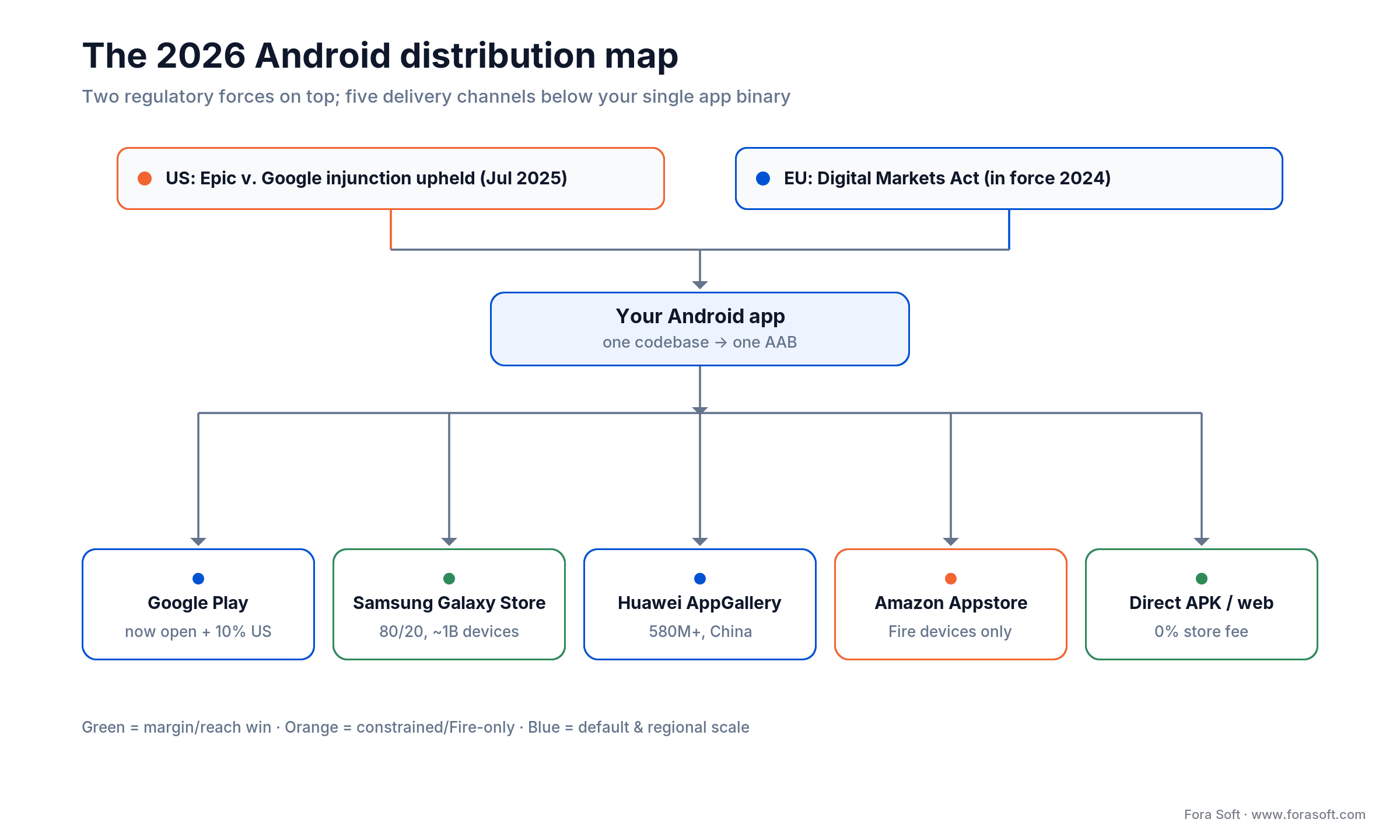
Figure 1. The 2026 Android distribution map — two regulatory forces on top, five delivery channels below your single app binary.
How Google Play itself opened up in 2026
Here’s the part most guides haven’t caught up to yet: the single biggest change to Android distribution in 2026 happened inside Google Play, not outside it. Under the upheld Epic injunction and a redesigned-practices agreement reached in March 2026, Google reworked its US business model and started rolling it out on June 30, 2026.
Alternative billing and external links are live. In the US, UK, and EEA you can now offer your own billing system inside the Play app, or link users out to your website to pay, alongside Google Play Billing. You can even design your own choice screen within Google’s UX rules. This is the exact thing Google spent years blocking.
The fee is now two numbers, not one. Google separated a service fee from a billing fee. The service fee starts at 10% on your first $1M in annual earnings (and applies to all auto-renewing subscriptions). If you use Google Play Billing, a 5% billing fee is added in the US, UK, and EEA. If you use alternative billing or external links, that 5% goes away, and you pay your own processor instead. Enrolled US developers start reporting transactions and paying these fees from October 1, 2026.
Third-party stores can ride inside Play. The injunction requires Google to let rival app stores be distributed through Play and to access its catalog. In practice that means a regional or specialist store can reach users who never leave the Play app, a genuinely new distribution surface that didn’t exist in 2024.
One honest caveat: outside the US, UK, and EEA, the old 15% (first $1M) / 30% (above) model still applies until Google rolls the new structure into more markets. So the “which billing wins” answer is region-specific. Plan per market, not globally.
Reach for alternative billing on Play when: you sell to US/UK/EEA users and your own checkout costs less than Google’s 5% billing fee (raw card processing at ~3%, not a full 6–7% merchant-of-record). Otherwise Play Billing at 10% + 5% is simpler and cheaper.
The realistic shortlist of Android app stores
Six channels cover more than 98% of legitimate Android installs worldwide. Everything else is either micro-niche or piracy-adjacent. Here’s the honest 2026 picture of the alternative app stores worth your engineering time, and the best Google Play alternatives by use case, with fees that reflect this year’s changes, not 2023’s.
| Channel | Reach | Fee (2026) | Best for |
|---|---|---|---|
| Google Play | 2.5B+ users globally | US/UK/EEA: 10% service + 5% billing. Elsewhere: 15% / 30% | Default baseline — always include |
| Samsung Galaxy Store | Pre-installed on ~1B Galaxy devices | 20% apps/games, 15% subscriptions | Gaming, Galaxy-only features, low subs fee |
| Huawei AppGallery | 580M+ MAU; China + MENA/LATAM | ~15% apps, up to 30% games; new-dev windows | China mandatory, Huawei-only users, emerging markets |
| Amazon Appstore | Fire TV + Fire tablets only (Android shut Aug 2025) | 30% (20% small-biz) | Apps that target the Fire ecosystem |
| Direct APK / web | Anyone on your marketing funnel | 0% store fee (2–7% payment/tax) | SaaS, crypto, adult, high-ARPU subscriptions |
| Open-source stores | F-Droid, Aurora, Aptoide, APKPure | 0–low | FOSS, privacy audiences, de-Googled phones |
Sovereign and niche stores worth a case-by-case look: RuStore and Yandex Store (Russia, effectively mandatory there since 2022), ONE Store (South Korea), GetJar and Uptodown (long-tail aggregators), and F-Droid for open-source audiences. None cross ~1% global share, but each can dominate its niche.
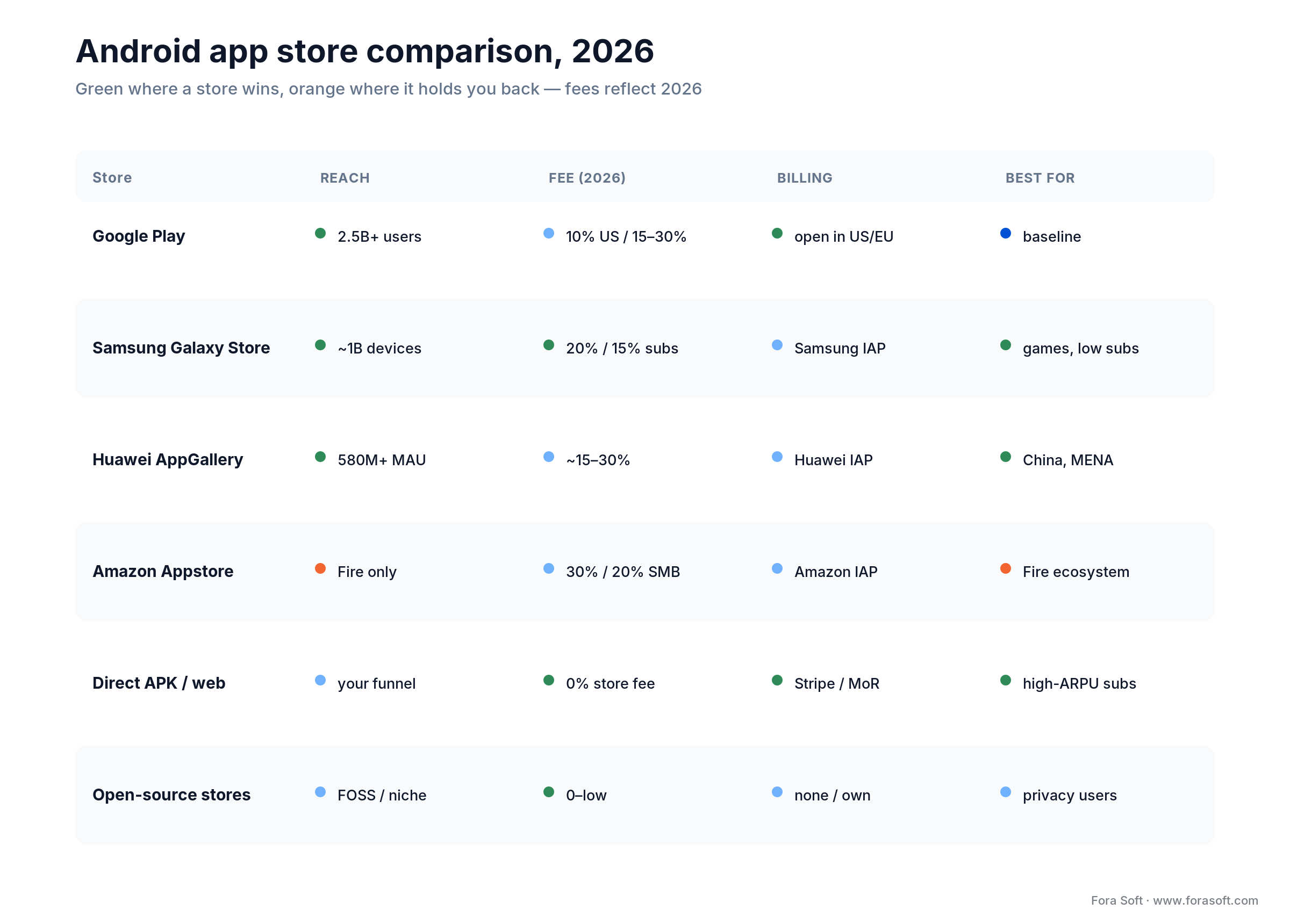
Figure 2. The same shortlist as a scan-in-five-seconds matrix — green where a store wins, orange where it holds you back.
Samsung Galaxy Store: the 80/20 disruptor
Samsung Galaxy Store ships pre-installed on close to a billion active Galaxy devices and sits on Samsung’s own promotional surfaces (Galaxy Themes, GameLauncher, setup flows). In May 2025 it did something no big store had: it cut its cut.
The fee news. Since May 15, 2025, developers keep 80% on apps and games and 85% on subscriptions — down from the old 70/30. Samsung was the first big Android store to drop mainstream commission to 20%, and 15% on subscriptions. For a subscription app, that 15% matches Play’s all-in 15% in the US and beats every 30% tier still in place elsewhere.
What ships well. Gaming (Galaxy Store has a real gamer audience and promo slots), pen-first and foldable-first experiences, Galaxy Watch companion apps, and edge-case categories Play restricts.
Engineering work. Standard APK/AAB with Samsung-specific manifest tweaks if you target Galaxy Watch or Themes. The Samsung IAP SDK is a thin (~200-line) wrapper and coexists cleanly with Google Play Billing inside separate Gradle flavors. Review is usually 1–3 days.
Reach for Samsung Galaxy Store when: you ship a game, a Galaxy Watch companion, or a subscription app that wants a 15% fee — integration is 1–2 weeks and the install base is already on the device.
Huawei AppGallery: 580M users, mandatory for China
Huawei AppGallery reports 580M+ monthly active users, 2.3M+ apps, and 6M+ registered developers — the world’s third-largest app ecosystem. It dominates inside China, is the only store on post-2019 Huawei phones, and is growing across MENA, LATAM, and Southeast Asia. For any B2C app with China, MENA, or LATAM ambitions, it’s the second-most-important Android store after Play.
Engineering: HMS Core instead of Google Play Services. Huawei devices without Google services need HMS Core. Push Kit replaces FCM, Account Kit replaces Google Sign-In, Map Kit replaces Google Maps, plus Location Kit and ML Kit. The APIs mirror Google’s, and Huawei’s HMS Toolkit automates a large share of a typical port. Budget 2–4 weeks for a standard content or streaming app.
Build flavors. Ship a Google (GMS) flavor and a Huawei (HMS) flavor, selected at build time by swapping agconnect-services.json for google-services.json. A third “unified” flavor covers emerging markets where a device might have either.
The China asterisk. Distributing inside mainland China needs an ICP filing, a local business entity, and — for games — a Banhao (版号) license from the regulator. Most foreign developers ship AppGallery to non-China regions first and only take on the China entity once revenue justifies it.
Reach for AppGallery when: you target China (mandatory), MENA, LATAM, or CIS markets — HMS conversion is 2–4 weeks, and new-developer fee windows make year-one margin unusually good.
Amazon Appstore: Fire-only after the 2025 shutdown
If you read an older guide that calls Amazon Appstore a sleeper win on Windows 11, ignore it. Two shutdowns retired that story. Microsoft ended support for the Windows Subsystem for Android on March 5, 2025, which took Amazon Appstore off Windows with it. Then Amazon shut the Amazon Appstore down on regular Android phones on August 20, 2025, and ended the Amazon Coins program the same day.
Where it still lives. Fire TV and Fire tablets are unaffected — the Appstore stays the default store there. So Amazon is now a targeted Fire-ecosystem channel, not a general Android alternative. Amazon stopped accepting new Android submissions ahead of the shutdown, so today only Fire devices keep the store.
The honest call. Unless you specifically sell to Fire tablet or Fire TV users (kids’ content, education carts, living-room apps), Amazon Appstore is no longer worth the integration in 2026. That’s a real change from last year, and it’s exactly the kind of stale advice that will sink an app team’s roadmap if nobody rechecks it.
Direct APK and sideloading: the highest-margin channel
Hosting the APK on your own site and taking payment directly keeps the store’s entire cut. For a $50-ARPU subscription app with 100K subscribers, moving that revenue off a 30% store to a ~6% merchant-of-record is roughly a $1.2M/year swing. The catch is that you inherit two jobs Play used to do for free: updates and integrity.
What ships well. SaaS with a web-first signup funnel (Slack, Notion, and Discord have all run sideload experiments), crypto wallets, adult content, and any app whose audience already lands on your marketing site.
The updater problem. You lose Play’s silent updates, so you ship your own. The clean pattern is a signed manifest the app polls:
{ "versionCode": 142,
  "url": "https://dl.yourapp.com/app-142.apk",
  "sha256": "9f2c…e17b",
  "minSupported": 130 }
The app compares versionCode, downloads the APK, verifies the SHA-256 and the signing certificate, then calls Android’s PackageInstaller with the REQUEST_INSTALL_PACKAGES permission (Android 8+). Kiosk and enterprise fleets can skip the prompt entirely with device-owner (MDM) mode.
Signing and delivery. Sign with APK Signature Scheme v2 + v3 (add v4 for streamed installs), serve the APK over HTTPS with HSTS, and publish the SHA-256 in a signed manifest from a different origin than the binary. Note that Play Asset Delivery is Play-only — for direct distribution you ship a universal APK or generate split APKs from your AAB with bundletool. Most teams keep the universal APK and pay the 30–60MB size tax for simplicity.
Need a self-updater that won’t brick your fleet?
We’ve shipped signed-manifest updaters, MDM silent updates, and entitlement sync across Play + direct. Tell us your setup and we’ll sketch the safe version.
F-Droid, Aurora, and the open-source stores
For privacy-first and de-Googled audiences, the open-source stores matter more than their raw numbers suggest. F-Droid distributes free and open-source apps only (your app must be FOSS to be listed) and its users are loud, technical, and loyal. Aurora Store is an anonymous front-end to Play’s own catalog. Aptoide and APKPure are large third-party aggregators that will index your APK whether you list or not.
You rarely build a flavor for these. The practical move is defensive: if your app isn’t open-source, decide whether you want it on FOSS stores at all, and monitor the aggregators so a stale or tampered copy of your APK isn’t the version users find. We cover that monitoring in the security section.
Hybrid distribution: how to wire it correctly
The goal is one source-of-truth codebase producing several store-specific artifacts from one CI job — not several forks quietly drifting apart. Six pieces make that work.
1. Gradle product flavors. Model each distribution as a flavor: google, samsung, huawei, direct. Flavor-specific source sets override billing, push, and analytics; a BuildConfig field exposes the current store to runtime checks.
2. Billing abstraction. One thin IBillingClient interface with swappable Google Play Billing, Samsung IAP, Huawei IAP, and Stripe (direct) backends. App code never sees the concrete implementation — and this is where you also plug in Play’s new alternative billing for US/EEA builds.
3. Push abstraction. IPushClient with FCM, HMS Push Kit, and a self-hosted (UnifiedPush) backend. Device tokens flow through one server endpoint that routes each send to the right service.
4. Crash and analytics abstraction. Firebase Crashlytics works on Google devices; on Huawei use AppGallery’s crash service or self-hosted Sentry. Sentry is increasingly the portable default across every flavor.
5. CI/CD pipeline. One GitHub Actions or GitLab workflow builds every flavor, runs flavor-specific tests, signs each with the right keystore, and uploads via each store’s API (Play Developer, Samsung Seller, AppGallery Connect). Failed uploads ping Slack; successful ones open a release ticket.
6. Feature flags for store policy. A single ENABLE_EXTERNAL_PAYMENTS flag, flipped per flavor and region, turns the external-checkout link on for US/EEA Play builds and off elsewhere. That one flag saves you from the rejection loops teams hit in 2024–2025.
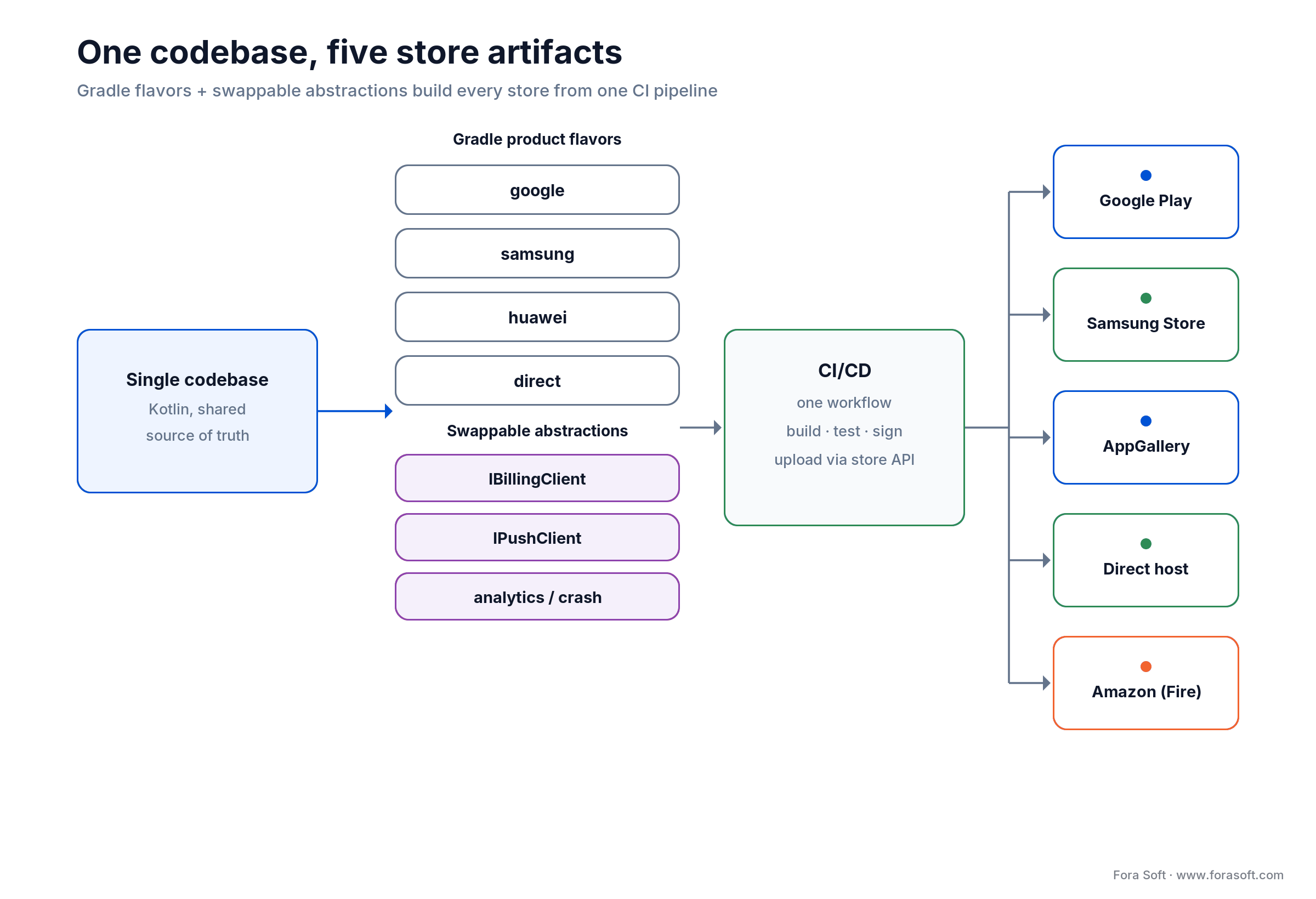
Figure 3. One codebase, four Gradle flavors, three swappable abstractions, one CI pipeline — and a signed artifact for every store.
Billing and compliance: the 2026 landmines
1. Steering rules relaxed — but only in some regions. In the US, UK, and EEA you can now link out to your own checkout from inside the Play app. Everywhere else, Play’s anti-steering rules still bite. Ship flavor- and region-specific copy: an “also available on our site” link where it’s allowed, nothing where it isn’t.
2. Tax on direct sales. When Play charges a user in Germany, Google remits the VAT. Sell directly and that job is yours — or a merchant-of-record’s (Paddle, LemonSqueezy, Chargebee) at ~5–7%. The same applies to Brazilian ICMS, Canadian GST/HST, and Indian GST. A merchant-of-record is usually worth it versus building tax remittance in 40 countries yourself.
3. China: ICP and Banhao. Mainland distribution needs an ICP filing and a local entity; games also need a Banhao license. Non-trivial, so most foreign developers ship AppGallery to non-China regions and skip the mainland until the numbers justify the entity.
4. Russia: RuStore. Since 2022, Russian cards can’t pay Play subscriptions, and RuStore is pushed as the replacement. Most Western developers either exit Russia or ship a free tier; a few with Russian entities monetize through RuStore.
5. Don’t double-bill subscribers. A user who paid on Play and later grabs the direct APK must not pay twice. Account-bound entitlement (not device-bound), reconciled nightly between Play’s purchase receipts and your own payment provider, is the fix. Ship it before you launch any second channel, not after.
Security, tamper-protection, and store fraud
Once an APK is hosted anywhere but Play, copies appear on aggregator and piracy sites within days. You can’t stop that; you can make it expensive and low-value. Four controls do the work.
1. Attestation with Play Integrity. SafetyNet Attestation was fully retired in 2024–2025; the Play Integrity API replaced it and issues device, app, and account verdicts your backend checks. On Huawei, use HMS Safety Detect. Treat a failed verdict as a signal, not an instant ban, because false positives punish honest enthusiasts.
2. Root and emulator detection. RootBeer or commercial tools (Appdome, Promon, Guardsquare) flag rooted devices, known emulators, and patched binaries. Ship them everywhere, but tune thresholds so you don’t block real users on custom ROMs.
3. Server-side receipt validation. Never trust a client-reported entitlement. Every purchase goes through a backend verification call to the Play Developer API, Samsung IAP, Huawei IAP, or your Stripe webhook. Entitlement flips only after the server says yes.
4. Watch the aggregators. Aptoide, APKPure, and Uptodown index your APK automatically, and some third-party mirrors add malware. Monitor for typosquats and tampered copies monthly, and file takedowns when a modified build shows up under your name.
Analytics and attribution across stores
Each store has its own install-referrer mechanism: Play Install Referrer, Samsung’s manifest referrer, Huawei’s AppGallery referrer, and UTM-tagged intent extras for direct links. Attribution aggregators (AppsFlyer, Adjust, Singular) normalize all of them so you don’t hand-wire each one. They cost 1–3% of tracked revenue and usually pay for themselves above $1M ARR.
Report per-store, not just in aggregate: MAU, LTV, crash-free rate, and IAP conversion by store. Each channel has its own device mix and seasonality, and the differences are where multi-store decisions actually get made — a store with great installs but a bad crash-free rate is telling you something about its device population.
Cost model: what multi-store wiring really costs
First, the fee math — because 2026 changed the answer. Say your app clears $1M in annual US subscription sales. Here’s who takes what:
Play Billing (2026 US): 10% service + 5% billing = $150,000 to Google. Play + your own external checkout: 10% service = $100,000 to Google, plus ~3% to your card processor = ~$30,000, and you remit tax. All-in ~$130,000 — you save ~$20K, but only because your checkout beats Google’s 5% billing fee. Route it through a full merchant-of-record at 6–7% and you land back above Play Billing. Direct APK, off Play entirely: $0 to Google, ~$60,000 to a merchant-of-record at 6%. You keep ~$90K more than Play Billing, but give up Play’s discovery, silent updates, and default trust.
The lesson after June 2026: the win from alternative billing on Play is small. The real money is a direct channel for users who already come through your own funnel, plus regional stores (Samsung at 15% subs, AppGallery windows) where you were paying 30%. Now the engineering cost to capture it, starting from a Play-only Android app:
| Scope | Timeline | Deliverables | Budget |
|---|---|---|---|
| + Samsung Galaxy Store | 1–2 weeks | Samsung IAP, Galaxy device QA, store listing | $3K–$8K |
| + Huawei AppGallery (HMS) | 2–4 weeks | HMS Push, Account, Map, Analytics conversions, full QA | $8K–$18K |
| + Direct APK with updater | 2–3 weeks | Self-updater, signed manifest host, Stripe billing, tax layer | $6K–$16K |
| + Alt-billing on Play (US/EEA) | 1–2 weeks | External-links flag, choice screen, reporting hooks | $3K–$8K |
| CI/CD for all flavors | 1 week | Multi-flavor build, store-API uploads, release dashboard | $2K–$6K |
| Full hybrid rollout | 4–6 weeks | All of the above, delivered in parallel via Agent Engineering | $18K–$48K |
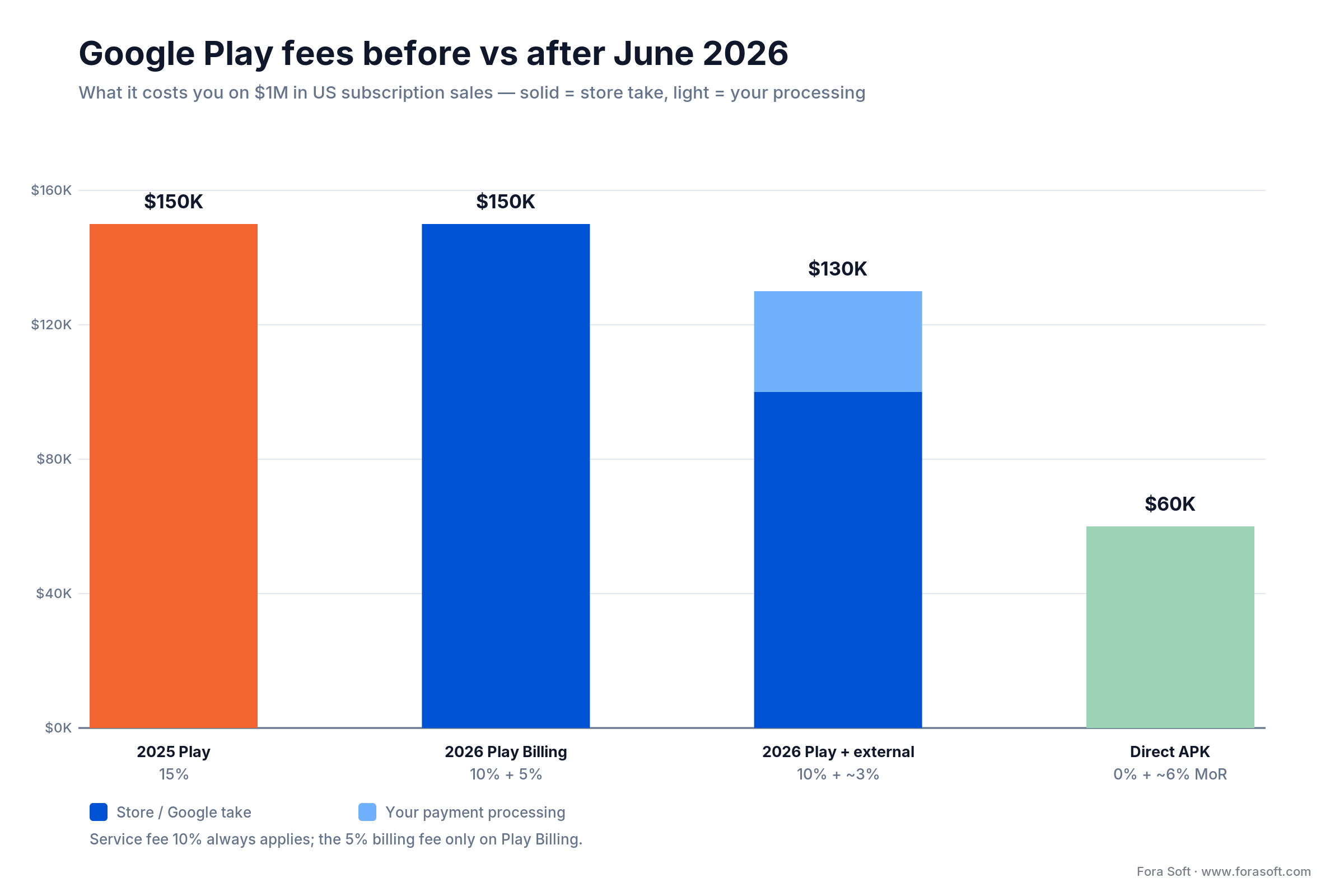
Figure 4. What Google keeps on $1M in US sales, old model versus the June 2026 model versus a direct channel.
A subscription app around $1M ARR usually recovers a full hybrid rollout in 4–12 months through lower fees on direct and regional channels. Above $5M ARR — especially with users still in 30% markets — the payback is fast enough that the harder question is why you waited.
Mini case: +22% installs and +19% margin in 5 weeks
Situation. A video streaming app with 180K MAU and $2.1M ARR, Play-only, wanted to act on the new US billing rules and reach MENA users Play was missing. They needed a hybrid plan live inside a quarter, not a year.
The 5-week plan. Agent Engineering ran the tracks in parallel: Gradle flavors and a billing abstraction; AppGallery + HMS conversion for MENA; a direct APK with a signed-manifest updater and a merchant-of-record; the alternative-billing external link for US and EEA Play builds; and one CI pipeline feeding every flavor. Content design handled the region-specific steering copy so nothing tripped Play review.
Outcome. Week-5 launch across Play + AppGallery + direct, with alt-billing live on US/EEA Play. Over the next 90 days: +22% total installs (AppGallery drove the MENA growth Play couldn’t), +19% net margin on the US cohort that moved to direct checkout, and the ~$40K rollout paid back by month three. The same team now ships to every channel from one codebase. Want a similar plan for your app?
Decision framework: pick your mix in five questions
1. What’s the monetization model? Subscriptions or premium IAP get the biggest upside from a direct channel and regional stores. Ads-only apps get reach, not margin, and multi-store still helps, just for different reasons. A free tool can stay Play plus one regional.
2. Which regions matter in 18 months? China means AppGallery, mandatory. MENA, LATAM, and CIS make AppGallery worth the HMS work. US and EEA are where the new Play billing and a direct funnel pay off first.
3. How technical is your audience? Gamers, crypto users, and power users sideload a direct APK without blinking. Mainstream consumers need Play-dominant distribution with gentle “also on our site” steering, not a raw APK link.
4. Which Play policies constrain you? If Play restricts your category — crypto, adult-adjacent, some gambling — off-Play isn’t a hedge, it’s your whole distribution. Plan for it as the primary channel, not a bonus.
5. What’s your engineering capacity? A three-person team with one Android engineer should ship Play + direct first, then add Samsung and AppGallery next quarter. Six-plus engineers (or an outside team running tracks in parallel) can ship the whole mix in one quarter.
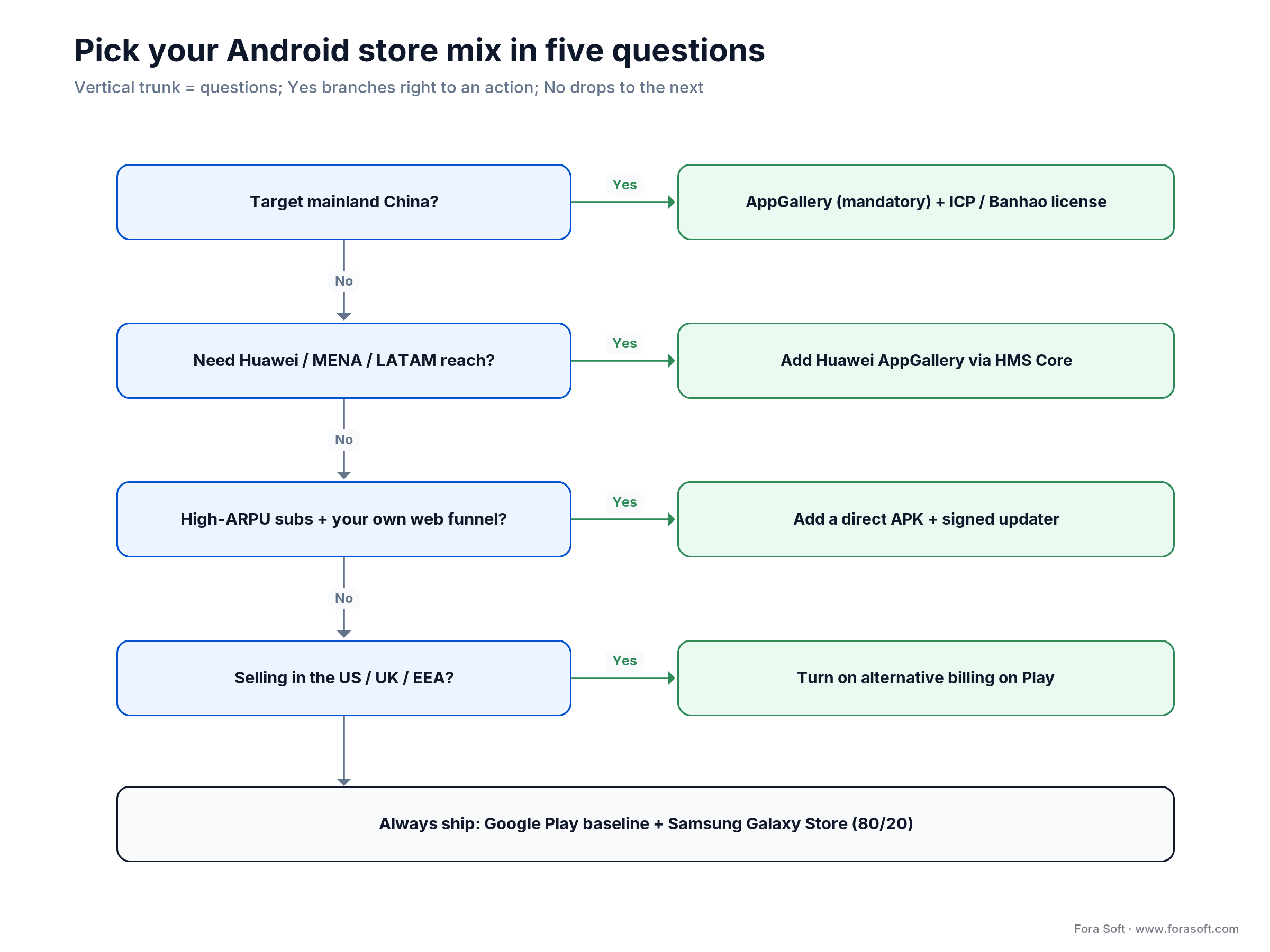
Figure 5. A five-question decision tree that maps your region, reach, and policy needs to a concrete store mix.
Pitfalls that kill multi-store rollouts
1. Forking the codebase. “Let’s make an AppGallery version” becomes a parallel fork that drifts within two releases. Always use Gradle flavors and shared source; never hard-fork per store.
2. Hidden Google Play Services. Firebase, Google Maps, and friends silently pull GMS and crash on Huawei devices. Audit every transitive dependency and move to multi-provider abstractions before you build the HMS flavor, not after QA finds it.
3. Trusting last year’s store list. Amazon Appstore left Android phones in August 2025 and Windows in March 2025. Teams still put “ship to Amazon” on the roadmap and burn a sprint on a dead channel. Recheck store status every planning cycle — this space moves fast now.
4. Double-billing subscribers. A user re-subscribes via Stripe because your backend didn’t recognize the Play entitlement. Ship account-based entitlement across all channels before you launch any new one.
5. Ignoring the updater on direct. Users install the APK and never see v1.1. Ship the manifest-based updater on day one, or the direct experience is quietly broken and your reviews will say so.
KPIs to track per store from day one
Acquisition KPIs. Impressions, install conversion, cost-per-install by store and region, organic share, and ASO rank for your top five keywords. Compare stores on the same cohort, not lifetime totals.
Monetization KPIs. ARPU by store, trial-to-paid by store, churn by store, and the one that decides everything: net-of-fee revenue per user. That’s what tells you whether Play at 15% all-in really beats direct at 9% all-in for a given cohort, or whether Samsung’s 15% subs fee wins outright.
Reliability KPIs. Crash-free rate per store (it differs with device mix), update-adoption rate per store (slow adoption on direct means a broken updater), and review rating plus response latency. A channel’s reliability numbers are the fastest early warning you have.
When NOT to leave Google Play
Multi-store isn’t a religion, and 2026 actually made the “just stay on Play” case stronger for some apps. We tell clients to keep it simple when these hold.
First, when you’re a US/UK/EEA app under $1M and growth is constrained by product, not fees. Play’s own fee is now 10% there, and you can add alternative billing without leaving. The engineering to open more stores buys you little; product work buys you more.
Second, when your audience is US/EU mainstream consumer with no regional or policy driver. Play covers 98%+ of that market; a second store earns its keep only if it reaches someone Play can’t.
Third, when Play policy risk is low and you don’t need an escape hatch. Some apps genuinely never benefit from one. Adding channels you won’t nurture just multiplies your release surface for no return.
A 6-week hybrid-distribution roadmap
This is how we ship a Play + Samsung + AppGallery + direct rollout under Agent Engineering. A sequential team usually runs the same scope in 12–16 weeks.
| Week | Milestone | Deliverables |
|---|---|---|
| 1 | Discovery + flavor setup | Dependency audit, Gradle flavors, billing / push / analytics interfaces |
| 2 | Samsung + alt-billing on Play | Samsung IAP, Galaxy QA, US/EEA external-links flag + choice screen |
| 2–4 | HMS conversion for AppGallery | Push Kit, Account Kit, Map Kit, crash + analytics migration, Huawei QA |
| 3–5 | Direct APK + updater + MoR | Signed-manifest updater, host, merchant-of-record, entitlement sync |
| 5 | CI/CD for all flavors | One workflow, store-API uploads, release dashboard |
| 6 | Launch + analytics | Coordinated multi-store launch, per-store KPI dashboard, 30-day review |
Reach for Agent Engineering when: you want the hybrid rollout in 6 weeks instead of 12–16 — specialist agents on Samsung, Huawei HMS, direct + updater, alt-billing, and CI/CD in parallel rather than one sequential sprint.
FAQ
Is it legal to distribute Android apps outside Google Play?
Yes, almost everywhere. Android supports sideloading and alternative stores by design, and 2025–2026 rulings (Epic v. Google in the US, the EU DMA) actively require the option. A few places (mainland China) demand approved stores with local filings, and a few categories have extra local rules — but off-Play distribution is not itself illegal.
Will Google penalize my Play listing if I ship on other stores?
No — Play explicitly allows the same app on other stores. Since June 2026 in the US, UK, and EEA you can also use alternative billing or link out to your own checkout inside the Play app. Outside those regions, keep the Play build’s in-app billing compliant with local Play rules and you’re fine.
What happened to the Amazon Appstore?
Amazon shut the Amazon Appstore on regular Android phones on August 20, 2025, and ended Amazon Coins the same day. It had already left Windows 11 when Microsoft ended support for the Windows Subsystem for Android in March 2025. The Appstore still runs on Fire TV and Fire tablets, so it’s now a Fire-ecosystem channel only, not a general Android alternative.
How much are Google Play’s fees in 2026?
In the US, UK, and EEA (from June 30, 2026), the service fee starts at 10% on your first $1M a year, plus a 5% billing fee if you use Google Play Billing. Use alternative billing or external links and the 5% goes away — you pay your own processor instead. In markets where the new model hasn’t rolled out, the older 15% (first $1M) / 30% structure still applies.
How does Huawei AppGallery handle apps that use Google services?
Post-2019 Huawei phones ship without Google Mobile Services, so you replace GMS APIs with HMS Core: Push Kit for FCM, Account Kit for Google Sign-In, Map Kit for Google Maps, plus Location and ML Kit. Huawei’s HMS Toolkit automates much of the port. For a standard content or streaming app it’s typically 2–4 weeks of work.
How do I update an app I distribute as a direct APK?
Ship a manifest-based updater: the app polls a signed JSON (version, URL, SHA-256), compares versions, downloads the APK, verifies the hash and signature, and launches Android’s PackageInstaller with the user’s approval (needs REQUEST_INSTALL_PACKAGES). For kiosk or enterprise fleets, device-owner MDM mode updates silently with no prompt.
Can one codebase ship to Play, Samsung, Huawei, and direct?
Yes — it’s standard practice. Gradle product flavors inject store-specific billing, push, and analytics, and one CI pipeline uploads each artifact to the right store via its API. The source stays a single tree; flavor-specific source sets override only what each store needs.
AAB or APK for distribution outside Play?
The Android App Bundle (AAB) is Google Play’s format; Play Asset Delivery only works there. Other stores and direct downloads take an APK. Generate a universal APK, or split APKs by ABI/density/language, from your AAB with bundletool. Most teams keep the universal APK for direct and accept a slightly larger file.
What to Read Next
OTT
How to Develop an OTT Platform Like Netflix
Multi-device distribution for a Netflix-style service — and how OTT economics tie to Android store choice.
Desktop
Publishing Desktop Apps on macOS in 2026
The other side of distribution: notarization and signing for Electron apps on macOS.
Monetization
8 Ways to Monetize Video Streaming with AI
Subscription, ads, and hybrid models — the levers behind multi-store distribution decisions.
Engineering
Streaming App: VOD, Live, and Conferencing
Architecture for video platforms that ship across Android, iOS, and TV stores in parallel.
Android engineering
Android WebRTC Screen Sharing: The Real Stack
Deep Android patterns that translate directly to building store-specific flavors at scale.
Ready to ship beyond Google Play?
Android distribution in 2026 is a pragmatic set of levers, not a fee war. Keep Google Play as your baseline, now cheaper and more open in the US, UK, and EEA. Add Samsung for its 80/20 split and gaming reach, AppGallery for China and emerging markets, and a direct APK for the high-ARPU users already on your funnel. Skip Amazon unless you sell to Fire. One Gradle-flavors codebase, one CI pipeline, the channels that actually earn their keep.
If you’re scoping a hybrid rollout, our 6-week plan is proven across video, e-learning, music, and SaaS apps. If you just need an honest build-or-skip call on AppGallery, direct APK, or the new Play billing, we’ll give you that in 30 minutes — no sales deck. You can also lean on our dedicated development team, or read how we build video apps that ship everywhere in the Learn: Video Streaming hub.
Let’s scope your Android distribution strategy
30 minutes with our mobile architects. We’ll sketch your store mix, 2026 fee math, engineering plan, and a realistic timeline — tailored to your app, audience, and revenue target.

