

Key takeaways
• Fora Soft contributed to the GoodFirms research on app development challenges, tips, and the future of the market. Our contribution centred on AI-augmented delivery and the practical trade-offs founders should plan for.
• The hardest part of turning an idea into an app is not the engineering. It is the discovery: pinpointing the specific user, the smallest valuable feature set, and the constraint that the product has to honour to ship in 12–16 weeks.
• AI has materially compressed delivery time on routine work — not on novel architecture. A 30–40% speed-up is realistic on bottom-up workstreams; 0–5% on the genuinely new.
• Agile and design thinking are now joined at the hip in serious product orgs. A 5-day design sprint feeding 2-week build sprints prevents the most expensive mistake: shipping fast in the wrong direction.
• The future of app development is fewer, sharper apps shipped faster — not more apps. AI lowers the cost of building, which raises the bar for what is worth building at all.
Turning an idea into a shipped product comes down to getting the app development process right. In 2024 GoodFirms ran a research project across software development partners on the challenges, tips, and future of the app development market; Fora Soft was invited to contribute, and we were glad to — the questions they were asking are exactly the ones we run with founders every week. The full GoodFirms research is published on their site; this article is the longer version of what we shared, written for the founders and CTOs who actually have to turn an idea into an app this quarter.
We are going to walk through the whole app development process as we see it in 2026: the real challenges, the practical tips that consistently move outcomes, the role AI is now playing inside our delivery teams, and where the market is heading. This is the playbook version of the GoodFirms contribution — not the press release.
Why Fora Soft wrote this playbook
Fora Soft has been delivering custom software since 2005 — 250+ projects with a 50-engineer in-house team — with a deep specialism in video, audio, AI, and real-time communication products across iOS, Android, web, and desktop. Recent reference points include AppyBee (a fitness booking platform live in 800+ studios across iOS and Android), BrainCert (a virtual classroom platform we have evolved across multiple major releases), Scholarly (a learning platform with 15,000+ users running live classes up to 2,000 concurrent), and VOLO (real-time captioning and translation deployed at Black Hat, HIMSS, and GDC).
We use Agent Engineering internally, which compresses delivery time on most workstreams by 30–40% versus a baseline team. The methodology and the data are documented in our AI software development case study. Our broader process for turning ideas into shipped apps is documented step-by-step across our project planning, product development, and product launch playbooks.
Have an idea you want turned into a real app?
A 30-minute scoping call — we challenge your scope, validate your stack assumptions, and tell you a realistic budget and timeline. No slide decks.
Five challenges that slow the app development process in 2026
Most app development process guides confuse symptoms with causes. Here are the five we actually fight against on real projects.
1. Vague scope dressed up as a product spec. Founders write requirements that read like marketing copy and call them specs. The first three sprints become a discovery exercise the budget did not cover.
2. Picking a tech stack before validating the user. “Should we use React Native or native?” becomes a religious debate before there is a single user interview to inform it.
3. Notification, permission, and privacy regressions. The OS-level changes documented in our mobile dev highlights mean an app shipped in 2024 with sloppy push or permission strategy gets silently demoted in 2026.
4. The store-review surprise. A perfectly built app is rejected by App Review for a tiny policy reason on the day before launch. Plan for one full sprint of post-build polish.
5. Post-launch silence. The team that built the app moves to the next project; nobody owns the bugs, the regressions, the dependency upgrades, or the next feature. The product silently rots within six months.
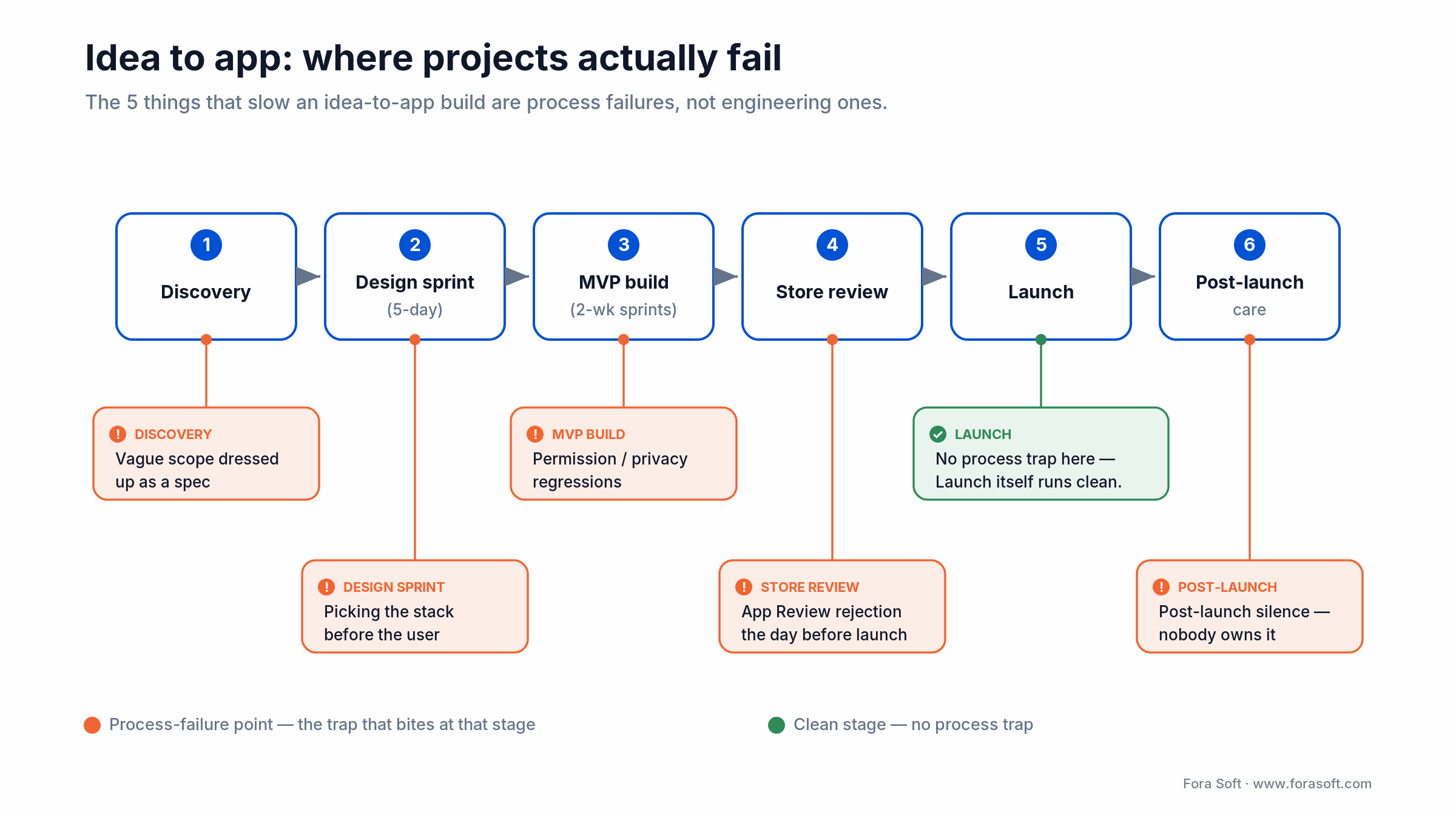
Figure 1. The idea-to-app pipeline. Five of the six stages hide a process trap; engineering is rarely the thing that sinks a build.
The app development process, stage by stage
The app development process runs in six stages: discovery, design, MVP build, store review, launch, and post-launch care. Here is what actually happens in each one, and the single thing that decides whether it goes well.
1. Discovery. User interviews, the smallest valuable feature set, and constraints written down. The whole build is effectively priced here — skip it and the first sprints become discovery the budget never covered.
2. Design. A short design sprint turns the agreed scope into a clickable prototype you can test on real users before a line of production code exists.
3. MVP build. Two-week sprints against a locked scope. AI accelerates the routine work; senior engineers own the novel parts where it cannot be trusted.
4. Store review. Apple and Google review every submission. Budget a full polish sprint so a last-minute policy rejection is a shrug, not a two-week slip.
5. Launch. A controlled rollout with analytics, crash reporting, and a rollback plan wired in before the first real user arrives.
6. Post-launch care. Someone owns the bugs, the OS upgrades, and the next feature. This is the stage where most of the app development process quietly succeeds or fails.
Discovery is the highest-payoff step — how to actually run it
Discovery is the cheapest hour you can spend on app development and the one most often skipped. Done well, it shaves weeks off the build by killing features that should not exist and clarifying the ones that should. Five concrete steps.
1. Five user interviews. Real users, not friends. Twenty minutes each. Ask about the problem, not the solution. If you cannot find five users in two weeks, the audience is not ready for an app.
2. The smallest valuable feature set. What is the minimum the user can do to recognise this product as useful? Strip back until removing one more feature would break the value.
3. Hard constraints listed in writing. Compliance (HIPAA / GDPR / SOC 2), supported regions, must-have integrations, target launch date, budget ceiling. Anything not on this list is negotiable.
4. A clickable prototype before code. Figma, Sketch, or low-fi paper does the job. Watch three users try to use it. Half your assumptions die in this step alone.
5. A one-page scope document. Vision, users, MVP feature list, constraints, success metrics. If you cannot fit it on one page, you have not finished discovery.
Reach for a paid 1-week discovery sprint with a partner when: your scope is large enough that a wrong start would cost more than $10K to correct — the paid sprint is the cheapest insurance you can buy at MVP stage.
Agile + Design Thinking — the integration that actually ships
Design Thinking is how you find the right problem; Agile is how you ship the solution. The integration is concrete: a 5-day design sprint (research, ideate, prototype, test, decide) feeds into 2-week Agile build sprints. Each major feature epic gets its own design sprint before any code is written.
This sounds slower. It is faster end-to-end, because shipping the wrong thing fast costs more than shipping the right thing slowly. The teams who skip discovery typically rebuild within 6–12 months of launch — we walked through that pattern in detail in our PM highlights digest.
AI in app development — what works, what does not
Our position in the GoodFirms research was that AI is materially helping developers, but the gains are not uniform. The independent data backs the split: GitHub’s controlled study clocked 55% faster completion on a routine coding task (2023), while METR’s 2025 randomised trial found experienced developers were actually 19% slower on mature codebases even though they felt faster. Stack Overflow’s 2025 survey puts AI-tool adoption at 84% of developers, yet trust in their accuracy has fallen to 29%. Three honest observations from running Agent Engineering across our delivery teams.
Where AI shines. CRUD endpoints, integration glue, test scaffolding, refactors, documentation, code review assistance, and bottom-up estimates for tasks with clear historical analogues. On these we see 30–40% cycle-time reductions consistently. Tools we rely on include Cursor and Claude Code in different parts of the workflow.
Where AI hurts more than helps. Novel architecture decisions, bespoke domain logic, compliance-sensitive code, and anything where the model has no historical analogue to lean on. AI confidently produces plausible-sounding wrong answers in these zones, and the cost of cleaning that up exceeds any time saved.
What governance to insist on. Mandatory human PR review on every AI-suggested change, security scanning on every merge, license-compliance checks on AI-generated code, and a senior engineer signing off on AI-suggested architectural choices. Without this, AI velocity becomes AI debt.
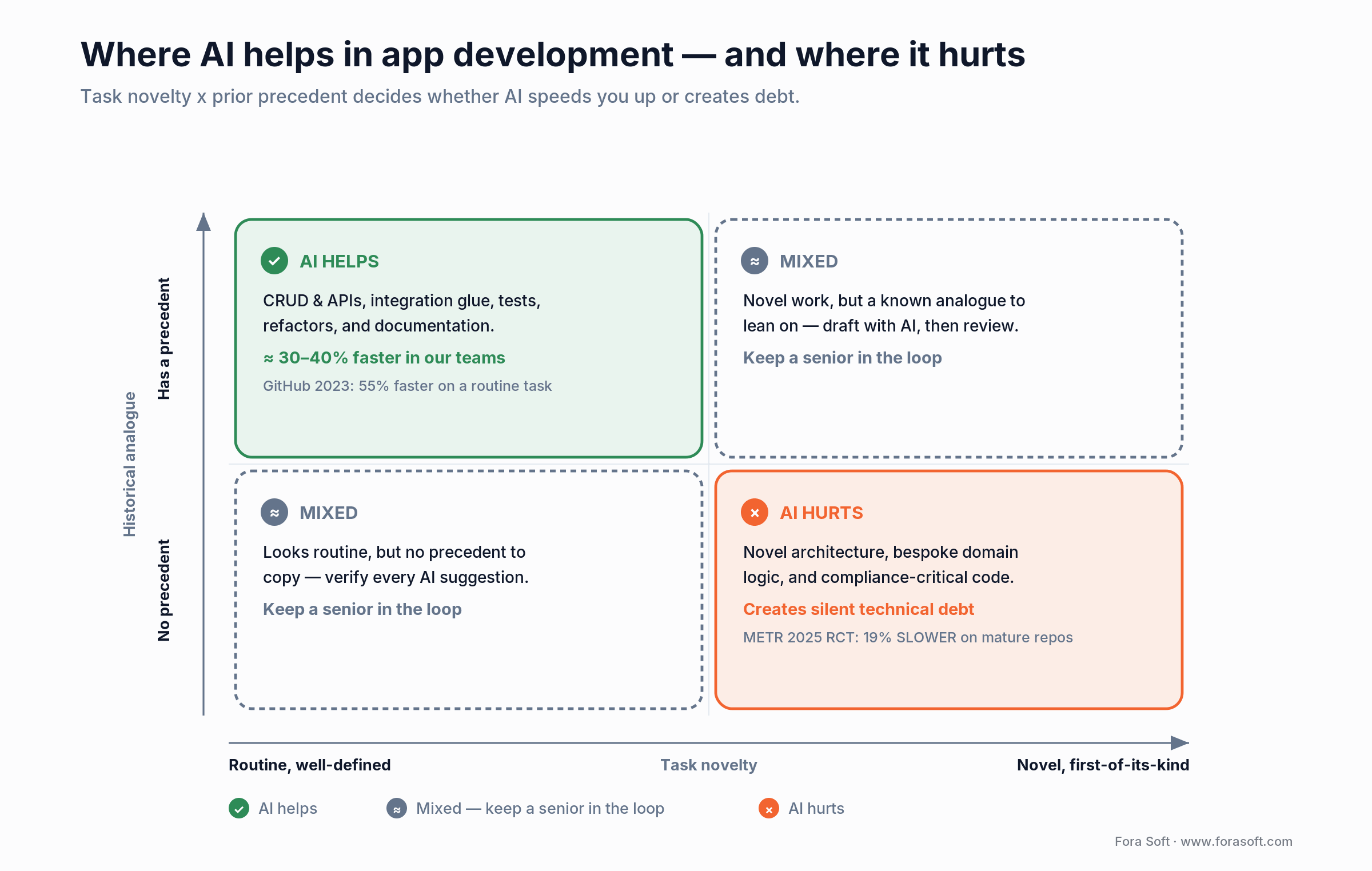
Figure 2. Where AI earns its keep. Routine work with a precedent speeds up 30–40%; novel, first-of-its-kind work is where AI quietly adds debt.
Reach for AI-augmented delivery when: your project has at least one mature codebase to anchor against, your partner can show real cycle-time data before and after AI adoption, and there is a documented governance protocol — otherwise “AI-powered” is a sales line.
Cross-platform vs native — how to actually decide in 2026
The cross-platform vs native decision still bites founders. The 2026 honest answer.
| Approach | Best fit | Strengths | Limits |
|---|---|---|---|
| Native iOS + Android | Performance-critical, deep platform integrations | Best UX, deepest API access, smallest bundle | Two codebases, two teams, longer build |
| Flutter | UI-heavy apps with brand-driven visuals | Single codebase, near-native performance, design fidelity | Larger binary, smaller talent pool than React Native |
| React Native | Teams with strong React/web background | Talent reuse, fast iteration, mature ecosystem | Some native modules still catching up to the New Architecture (JSI/Fabric), now the default; the old bridge was removed in RN 0.85 (2026) |
| PWA | Web-first products, no need for store distribution | Single codebase, instant updates, no app review | Limited iOS support for some APIs |
Our deeper analysis is in cross-platform vs native and native or cross-platform.
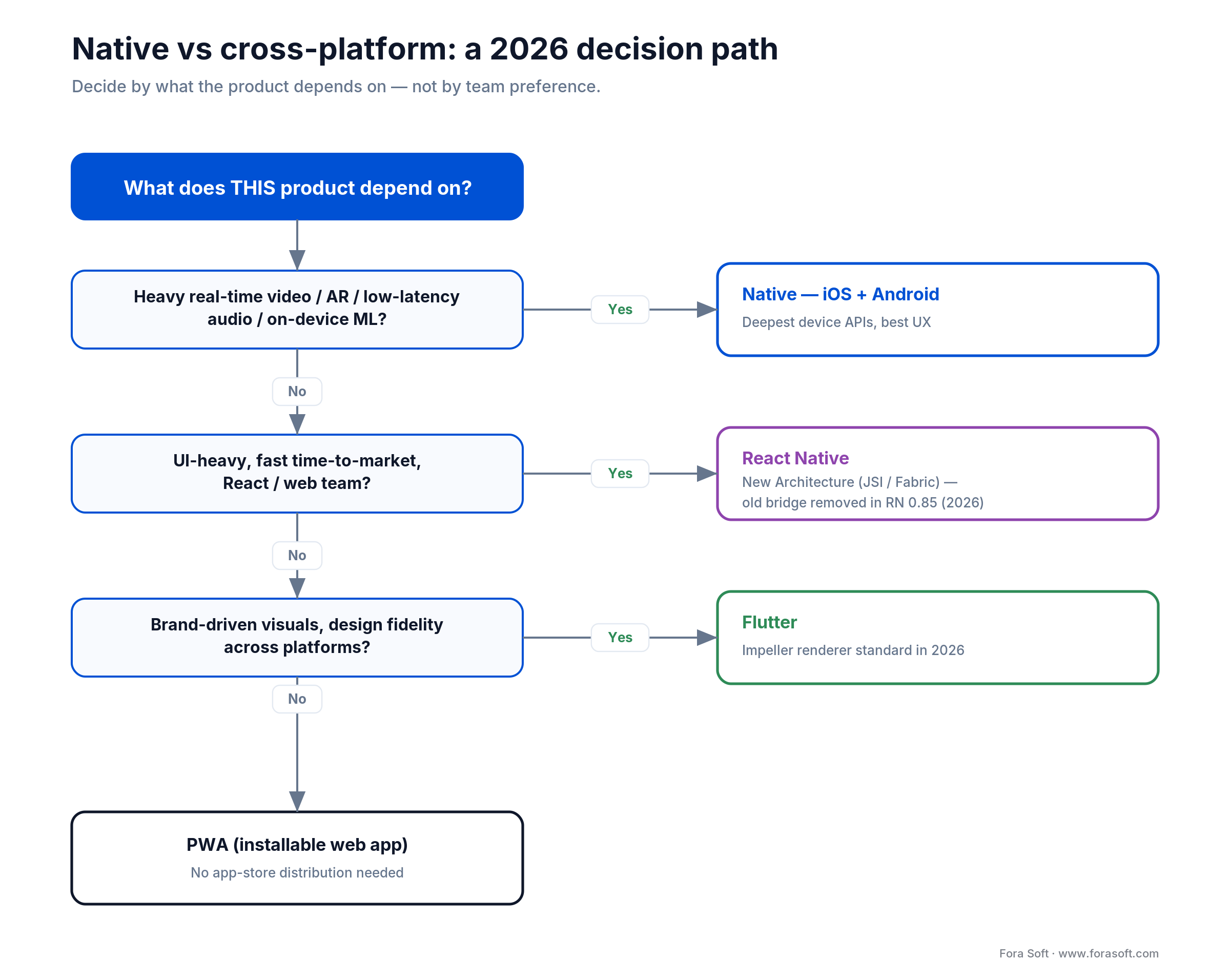
Figure 3. Native vs cross-platform in 2026, decided by what the product depends on rather than by team habit.
Reach for native iOS + Android when: your product depends on heavy real-time video, deep camera or AR APIs, low-latency audio processing, or first-class Apple Intelligence / on-device ML — otherwise Flutter or React Native is usually the right call for time-to-market and team scalability.
Cost and timeline — what an honest MVP looks like in 2026
A credible startup MVP in 2026 lands somewhere in the $20K–$150K range, with the bulk between $35K and $80K. Web MVPs at the lower end (6–12 weeks), dual-platform mobile or SaaS at the higher end (10–16 weeks). AI-integrated MVPs add 15–30%; compliance baseline (HIPAA / GDPR / SOC 2) adds another 20–30%. Those ranges track a real benchmark: GoodFirms’ 2026 survey of 267 app development firms pegs a basic app at $15,000–$40,000 over three to six months. Our own cost band sits in the same territory, and because we run Agent Engineering, our MVP timelines usually come in faster than that industry baseline rather than past it.
Our deeper breakdown is in our mobile app development costs guide and software estimation guide. Because we use Agent Engineering internally, our quotes typically come in faster and cheaper than a baseline team for the same scope — but we are deliberately conservative when there is genuine uncertainty in the work.
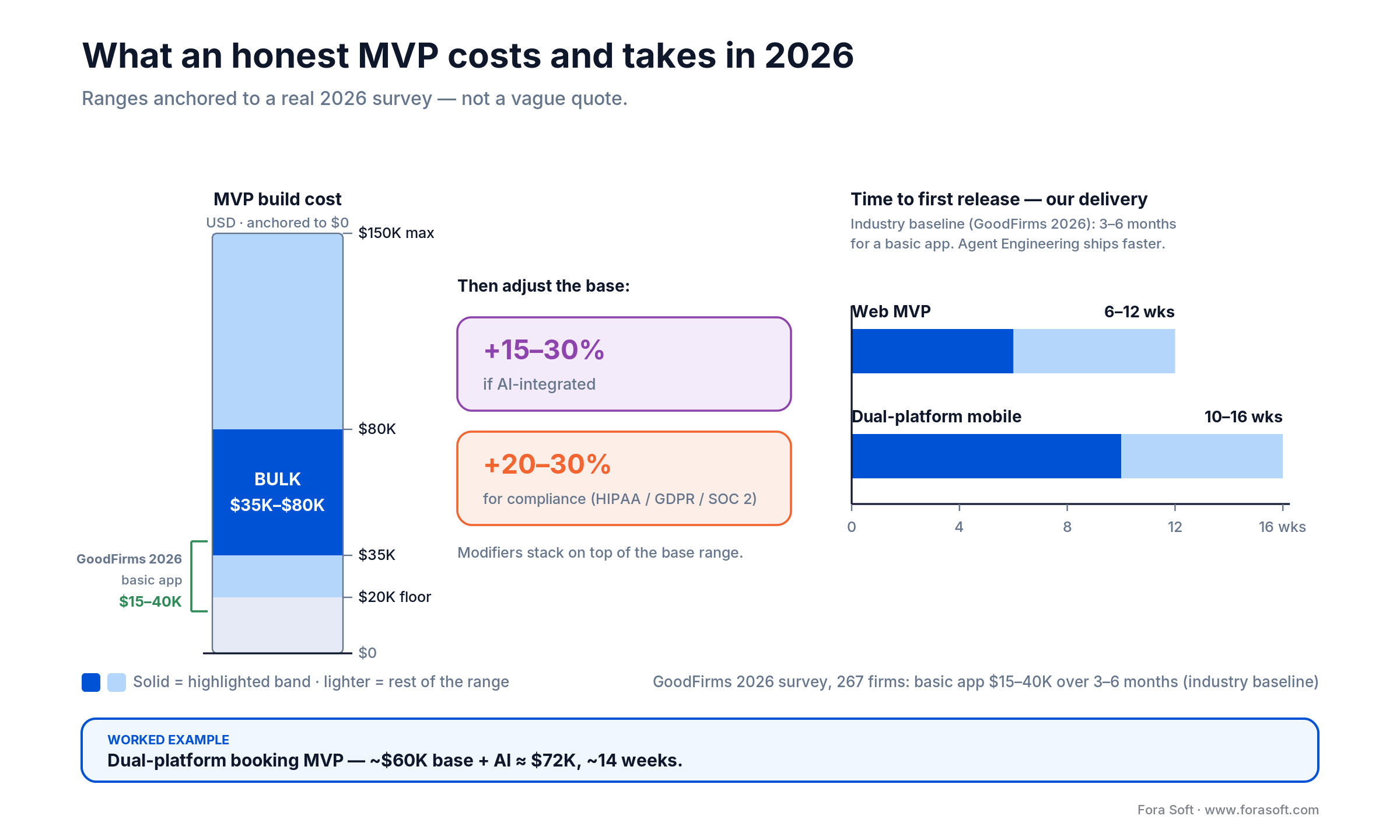
Figure 4. What an honest MVP costs and takes in 2026, with the base range anchored to the GoodFirms 2026 survey.
Want a written budget estimate for your idea?
Send us your one-page brief. Within a business week we’ll send back a written proposal with team, milestones, IP terms, and an honest list of what could go wrong.
The future of app development — six honest predictions for 2026–2028
1. Fewer apps, sharper apps. AI lowers the cost of building, which raises the bar for what is worth building. The market punishes thin apps faster than ever.
2. AI features become table stakes. Smart summarisation, semantic search, voice input, image generation. Users expect these in apps they care about; absence is noticeable.
3. On-device intelligence overtakes “cloud-only” AI for routine tasks. Apple Intelligence and on-device Android ML models handle classification, transcription, and small inference without latency or data-residency cost.
4. Notification economics tighten further. Both stores favour high-quality push and demote low-quality blasts. The competitive moat shifts from “send more” to “send right”.
5. Cross-platform tooling closes more of the native gap. Flutter and React Native are now viable for the majority of consumer apps; native remains the default for performance-critical or deep-OS-integration cases.
6. Compliance and security baseline rise. What counted as “serious” security in 2024 is the floor in 2027. SOC 2-friendly architecture, on-device AI for PII, and explicit consent flows become standard.
Mini case — turning AppyBee from idea to live in 800+ studios
AppyBee started as a focused idea: branded class-booking apps for small fitness studios on iOS and Android. The founder had constrained budget, clear user research, and limited time before re-investing.
We ran a discovery and design sprint with the founder, locked the smallest valuable feature set, and shipped a first version that was small enough to launch but large enough to attract real studios. Engagement T&M kept the work iterative; weekly written updates plus video demos kept the founder in the loop without daily meetings. As studios adopted the platform, we transitioned to a dedicated team to scale features. AppyBee is now live in 800+ studios across both platforms.
The shape generalises. Most successful idea-to-app builds we have run follow the same arc: tight scope, paid discovery, T&M MVP, dedicated team to scale. The teams that try to short-cut the discovery phase consistently end up rebuilding within 12 months.
A decision framework — turn your idea into an app in five questions
1. Who is the marginal user that does not yet have this product? Specific role, specific behaviour, specific pain. Generic answers mean more discovery is needed.
2. What is the smallest valuable thing you can ship in 12 weeks? If the answer requires 24 weeks, you have not stripped the MVP enough.
3. Native or cross-platform — for this specific product? Performance-critical and deep OS integrations push to native; UI-heavy and time-to-market push to cross-platform.
4. Where does AI add value, and where do you refuse to use it? Routine work yes, novel architecture no. Without that distinction the AI claim is a sales line.
5. Who owns the product the day after launch? If the answer is “we will figure that out later”, the product will silently rot within six months.
Five pitfalls in idea-to-app development
1. Skipping discovery to save two weeks. The two weeks come back as twelve weeks of rework.
2. Picking the stack before the user. Flutter vs React Native vs native is a religious debate that should follow user clarity, not precede it.
3. Treating AI as a magic delivery accelerator. AI lifts routine work; it actively damages novel work without governance.
4. Underestimating store review and post-launch polish. Plan a full sprint of post-build polish before public launch on both stores.
5. Neglecting maintenance budget. Plan 15–25% of build cost per year for steady-state maintenance — bug fixes, dependency upgrades, small features.
KPIs to track once the engagement starts
Quality KPIs. Crash-free users (≥99.6% on both stores), p95 cold-start time, escaped-defect rate (<3% of shipped tickets).
Business KPIs. Day-1 install-to-activation conversion, 7-day retention, 30-day retention, and median time-from-install-to-first-key-action.
Reliability KPIs. Sprint commit completion rate (target 80–90%), team turnover (<15%/year for technical roles), and number of retrospective actions actually shipped per sprint (target ≥1).
When NOT to build a custom app at all
If your idea can be tested with a no-code tool (Bubble, Webflow, Glide, Retool) in two weeks, do that first. You may discover that you do not need custom software at all, or only need it for one specific layer.
If your audience does not have a clear job-to-be-done that an app would solve, the right output is more user research, not more engineering hours. Spend two weeks talking to potential users.
If your idea is “the future of [category]” rather than a specific product, the right next step is a positioning workshop and a one-page scope, not a development engagement.
Building user trust into AI features — not after them
Apps that ship AI features in 2026 win or lose on a single dimension: do users trust the output enough to act on it. Trust is not a polish layer; it is an architectural decision made at MVP.
1. Show provenance. Where did the AI suggestion come from? Cite sources, link back to the original data, surface confidence scores when they exist.
2. Always offer the manual path. Every AI-suggested action needs a one-tap escape to do it manually. The user has to feel in control.
3. Be honest about uncertainty. “I’m not sure” or “here are two possible answers” is much better than confidently wrong. Hallucination kills trust faster than slow load times.
4. Disclose data flow. Where does the user’s input go? Local model? OpenAI? Anthropic? Self-hosted? Document this in the app and the privacy policy.
5. Let users correct the model. A simple thumbs-up / thumbs-down on AI output, plus a “why was this wrong” field, gives you both feedback data and a sense of user control.
Reach for explicit AI provenance UI when: the AI output influences a user decision with material consequences (financial, medical, legal, hiring) — otherwise lightweight disclosure is enough, but never zero.
Post-launch care — the phase that decides long-term success
Most failure stories about app development end with launch. The actual fall happens in the first six months after, when a team that built the app moves to the next project and nobody owns the bugs, the regressions, the SDK upgrades, or the next feature.
1. Hand-over discipline. A clean codebase, current README, runnable local environment, deployment script, and a one-page architecture diagram on day one of post-launch. No exceptions.
2. Two-tier SLA. P1 incident response within 1 hour, P2 within 4 hours during business days. Avoid 24/7 SLAs until paying customers demand them.
3. Maintenance budget of 15–25%. Of build cost, per year, for steady-state work — bug fixes, dependency upgrades, OS-version regressions, small feature requests. Below that, the product silently rots.
4. Quarterly health review. Crash-free users, p95 cold-start, retention, NPS, escaped-defect rate. Compare to the prior quarter. Surface regressions explicitly.
Our own approach to this phase is documented in the Customer Success Manager playbook.
UX mistakes that quietly kill new apps
1. Heavy onboarding. The 7-screen tutorial nobody reads. Cut to one screen and let the user start using the product. Show, do not tell.
2. Permission walls before value. Asking for notification, location, and contacts permission on the first screen. The user has not seen the value yet; the conversion drops dramatically.
3. Slow first paint. Cold start over 3 seconds on a recent device is a UX death sentence. Defer non-critical work, lazy-load assets, and instrument cold-start aggressively.
4. Generic error messages. “Something went wrong” tells the user nothing. State what happened, what to do next, and how to contact you if it persists.
5. Ignoring accessibility. VoiceOver, Dynamic Type, contrast, motion reduction. Building for accessibility from day one is much cheaper than retrofitting.
A deeper dive on these patterns is in our mobile app UX design best practices.
Worried about the UX details on your MVP?
A 30-minute call — we run a UX heuristic review on your prototype or current build and tell you the three changes most likely to lift activation and retention.
Where the GoodFirms research sits in our wider review pattern
Recognition is most useful as a pattern, not a single trophy. Recent recognitions for Fora Soft include Clutch Global Award badges in both Spring and Fall 2024 (Top Node.js and Top Smart TV Development among them), TechReviewer’s Top iOS App Developers (2024) and Top Software Development Partner for Startups (2025), plus a 100% Job Success score across 935 completed Upwork jobs. The GoodFirms “Transforming Ideas into Applications” research is part of this broader story — it is one signal among several, all in the same 12–24 month window.
For a buyer, the right read is to look for clusters across multiple specialisms (mobile, video / audio, education, AI), across multiple verified directories, with consistent recency. Single-directory wins are weaker signal than that pattern.
FAQ
What was Fora Soft’s contribution to the GoodFirms research?
We shared our experience with the development, hosting, and deployment of production apps, with a particular focus on the future of AI in the development process. The full research is published on GoodFirms; this article is the longer version of what we contributed, written for founders who actually have to ship in 2026.
How long does it take to turn an idea into a real app?
For a credible MVP, 6–12 weeks for a web product or 10–16 weeks for dual-platform mobile. AI-integrated builds add 2–4 weeks. Compliance baseline (HIPAA / GDPR / SOC 2) adds another 4–8 weeks. Anything dramatically faster usually means cut corners.
Is AI actually making app development faster?
Yes for routine, well-defined work — CRUD endpoints, integration glue, refactors, test scaffolding, documentation, code review assistance. We see 30–40% cycle-time reductions on those workstreams. No for novel architecture, bespoke domain logic, or compliance-sensitive code — AI confidently produces wrong answers there. The right framing is “AI augments senior engineering judgement, it does not replace it”.
What is the biggest single thing founders get wrong?
Skipping discovery. Founders often want to start coding to feel like progress is happening. Discovery feels slow, but it is the cheapest hour of the project. Five user interviews, a stripped-down MVP feature list, a clickable prototype, and a one-page scope save weeks of build time downstream.
Native or cross-platform — what should I pick?
Native iOS + Android for performance-critical or deep-OS-integration apps. Flutter or React Native for UI-heavy products where time-to-market matters and the team has the relevant background. PWA when distribution outside app stores is acceptable. Make this decision after user research, not before.
What does GoodFirms do, exactly?
GoodFirms is a B2B research and review platform used by software buyers worldwide to find vetted partners through verified reviews and curated category lists. They periodically publish thematic research, and Fora Soft was invited to contribute to the “Transforming Ideas into Applications” project.
Where can I read the original GoodFirms research?
The full GoodFirms research on the challenges, tips, and future of the app development software market is published on goodfirms.co. The article you are reading is the longer playbook version of what we contributed, expanded with practical workflow advice for founders.
How do I start a conversation with Fora Soft about my idea?
Book a free 30-minute call via the link below, send us a one-paragraph scope by email, or reach us on WhatsApp. We respond inside one business day with the questions we’d ask on a discovery call — that itself is a useful comparison signal against other partners.
What to read next
Budgeting
Mobile app development costs — 2025 guide
A defensible breakdown of what a serious iOS or Android app actually costs to build and maintain in 2025–2026.
Cross-platform
Cross-platform app development with Flutter — pros and cons
When Flutter is the right call and when native or React Native still beats it for a specific product.
Case study
How AI cut 30–40% off our delivery time
A first-person case study of Agent Engineering on a 1M+ line video streaming platform — numbers, methodology, trade-offs.
AI in mobile
How AI can transform your mobile app
Concrete patterns for adding AI features to an existing iOS or Android app without breaking the user experience.
Process playbook
Our product development process
A step-by-step look at how we plan, build, and ship software products with our clients — the playbook behind the cases above.
Ready to turn your idea into an app worth shipping?
The GoodFirms research confirmed what we see week after week with founders: the hardest part of the app development process is not the engineering, it is the discipline. Discipline in discovery, in scope, in choosing the right stack for the user, in using AI where it helps and refusing it where it does not, and in planning for the day after launch as carefully as the day before.
If you have an idea you want to turn into a real app and would like a second pair of eyes before you commit budget, that is exactly what we do on a 30-minute scoping call. We bring our case studies, our cycle-time data, and our written assumptions about your project — you walk away with a prioritised plan whether you hire us or not.
Let’s talk about your app idea
A free 30-minute call — we challenge your scope, validate your stack, and give you a written priority list whether you hire us or not.

