

Key takeaways
• A software development partner is a team that scopes, builds, and keeps running your product — not a shop you hand a spec to and hope. Choosing the right one is the single biggest predictor of whether an MVP ships.
• An honest startup MVP costs $35K–$80K and takes 10–16 weeks. Cheaper usually means cut corners; much more expensive at MVP usually means over-scoping. Compliance work adds 20–30%.
• Time & Materials beats fixed-bid for MVPs. You do not yet know what you need. Fixed-bid contracts lock you into the requirements you wrote before talking to users.
• Two thirds of software projects come in late, over budget, or cancelled. The causes are predictable: wrong stack, vague specs, weak communication, vendor IP lock-in, missing security baseline.
• AI-accelerated delivery is real but needs governance. Tools like Cursor and Claude Code can shave 10–20% off dev hours when paired with code review and security scanning. Ungoverned, they can make experienced engineers slower, not faster.
Picking a software development partner is the decision a founder is least equipped to make and most punished for getting wrong. Fora Soft was named a Top Software Development Partner for Startups in 2025 by Techreviewer.co, following our 2024 inclusion in their Top iOS App Developers list. We are pleased, and we also know a badge is one input among many, never the whole decision.
So instead of a press release, this is the playbook we wish every founder would read before signing a development contract: how to choose a software development partner without getting burned. Real cost ranges, honest engagement-model trade-offs, the red flags that predict failure, what compliance to build at MVP, when (and when not) to give equity for development, and how to run the discovery call so the vendor cannot bluff you. We use Fora Soft as the running example of a partner that fits — not because we want to be your only candidate. That decision is yours.
Why Fora Soft wrote this playbook
Fora Soft has delivered 250+ custom software projects since 2005 with a 50-strong in-house engineering team, specialising in video, audio, AI, and real-time communication products. We have shipped MVPs and scaled them for fitness, EdTech, healthcare, media, B2B SaaS, and developer-tools clients. Recent reference points: AppyBee, a fitness-booking platform now live in 800+ fitness centres across iOS and Android; Scholarly, a learning platform with 15,000+ users that AWS selected as the most innovative EdTech startup in Asia Pacific; and BrainCert, a virtual-classroom platform we have evolved across multiple major releases.
We run custom software development on Agent Engineering internally, which compresses delivery on most workstreams by 30–40% versus a baseline team. The methodology and the data are documented in our AI software development case study. Our process for startups is written up step-by-step across our project planning, product development, and product launch playbooks. Everything below is what we tell founders on real scoping calls, including the parts that are uncomfortable for vendors to say out loud.
Picking a development partner right now?
A 30-minute scoping call: we challenge your scope, validate your stack assumptions, and give you a realistic budget and timeline. No slide decks.
What an MVP actually costs in 2026
A credible startup MVP in 2026 lands somewhere in the $20K–$150K range, with the bulk of serious product builds clustering between $35K and $80K. The number depends on platform (web vs native mobile vs SaaS), feature complexity, integrations, and whether you need any compliance baked in from day one.
| Category | Realistic budget | Timeline | Why this range |
|---|---|---|---|
| Web MVP | $20K–$45K | 6–12 weeks | Single codebase, instant deploys, no app-store review |
| Mobile MVP (iOS + Android) | $40K–$80K | 10–16 weeks | Two platforms, store reviews, more device QA |
| SaaS MVP | $35K–$80K | 12–16 weeks | Multi-tenant, billing, auth, basic admin |
| AI-integrated MVP | +15–30% premium | Add 2–4 weeks | Data prep, eval suite, guardrails, vendor selection |
| Compliance baseline (HIPAA / GDPR / SOC 2) | +20–30% | Add 4–8 weeks | Architecture, policies, audit trails, encryption work |
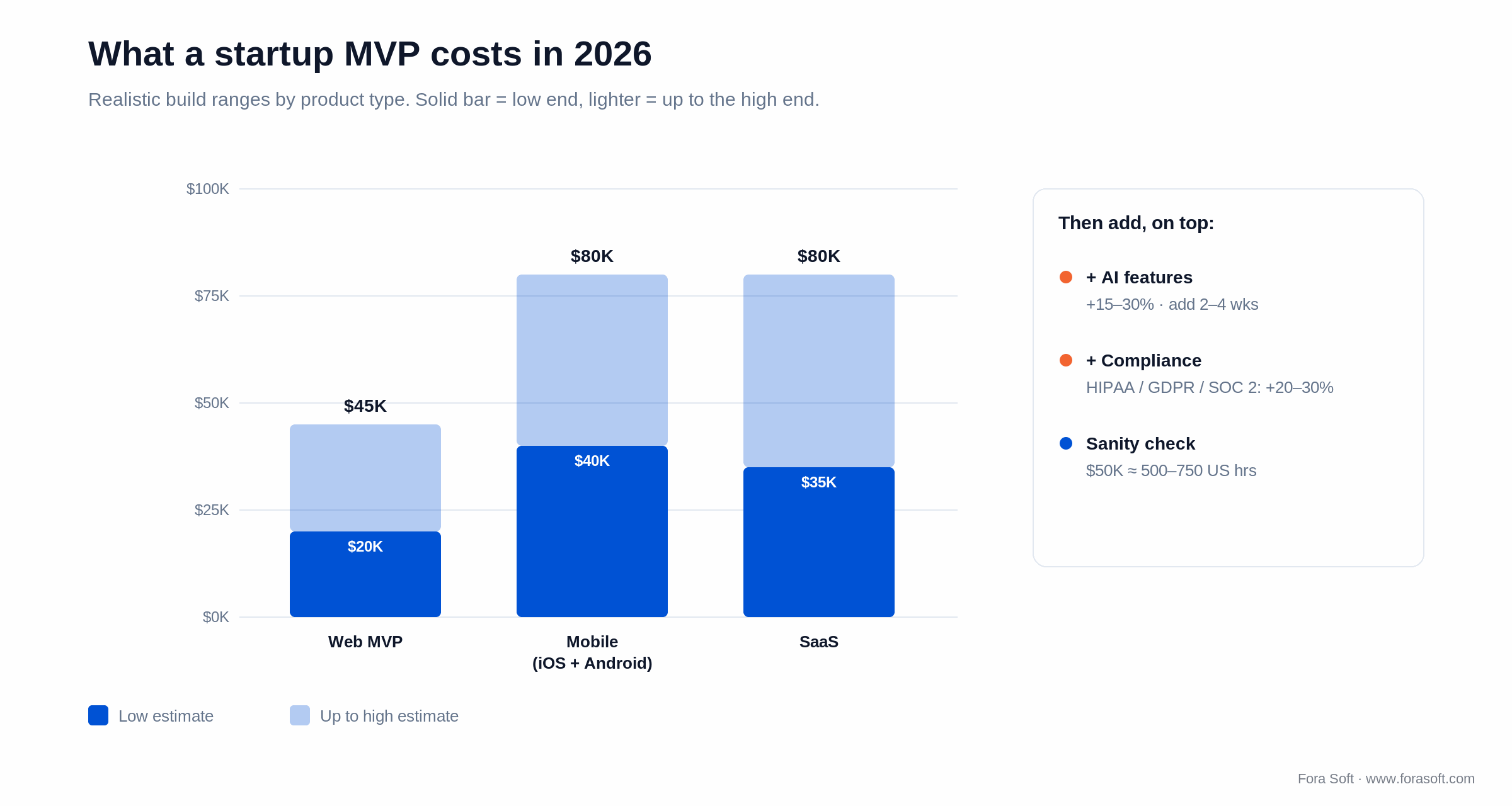
Figure 1. MVP build ranges by product type. The solid bar is the low estimate; the lighter extension shows the top of the range. AI and compliance stack on top.
A useful sanity check: divide the bid by the regional hourly rate to get implied hours, then ask whether that many hours could realistically deliver your scope. US rates run $75–$135/hr, Western Europe $90–$160/hr, Eastern Europe $30–$65/hr, India $15–$65/hr depending on seniority, Latin America $25–$85/hr. A $50K bid is roughly 500–750 US hours or 1,500–3,000 Indian hours. That gap is the whole ballgame: same price, very different amount of senior attention.
Reach for an Eastern Europe / MENA hybrid team when: you want US/EU-grade engineering quality at materially lower cost, the partner uses Agent Engineering or similar AI tooling to compress hours further, and you can manage one timezone offset with structured async updates. This is the model we run at Fora Soft.
For a deeper breakdown by feature area, our mobile app development costs guide, streaming app time estimation, and software estimation guide walk through the methodology we use to scope real client projects.
Engagement model — fixed-bid vs T&M vs dedicated team
Three contract shapes dominate the market. Each is right for a different stage of company.
1. Fixed-bid (fixed price). Total scope and total price locked upfront. Great for budget certainty, terrible for product iteration. Scope changes turn into contract negotiations, which are momentum-killers for early-stage teams. Reach for this only when scope is genuinely stable: marketing sites, integrations to a known third-party API, or phase-2 builds where phase-1 already validated the design.
2. Time & Materials (T&M). Pay for actual hours, scope evolves with learning. This is the right shape for almost every MVP and most early-stage product builds. Trade-off: budget less predictable, requires trust and weekly cadence. Mitigate with capped sprints, clear weekly demos, and time-boxed scopes.
3. Dedicated team. One to five engineers full-time or part-time, embedded with your team. Best after MVP, when you are scaling features and need deep product memory. Higher monthly cost and ongoing commitment, but the team becomes an extension of your org. This is how our dedicated development team engagements are structured.
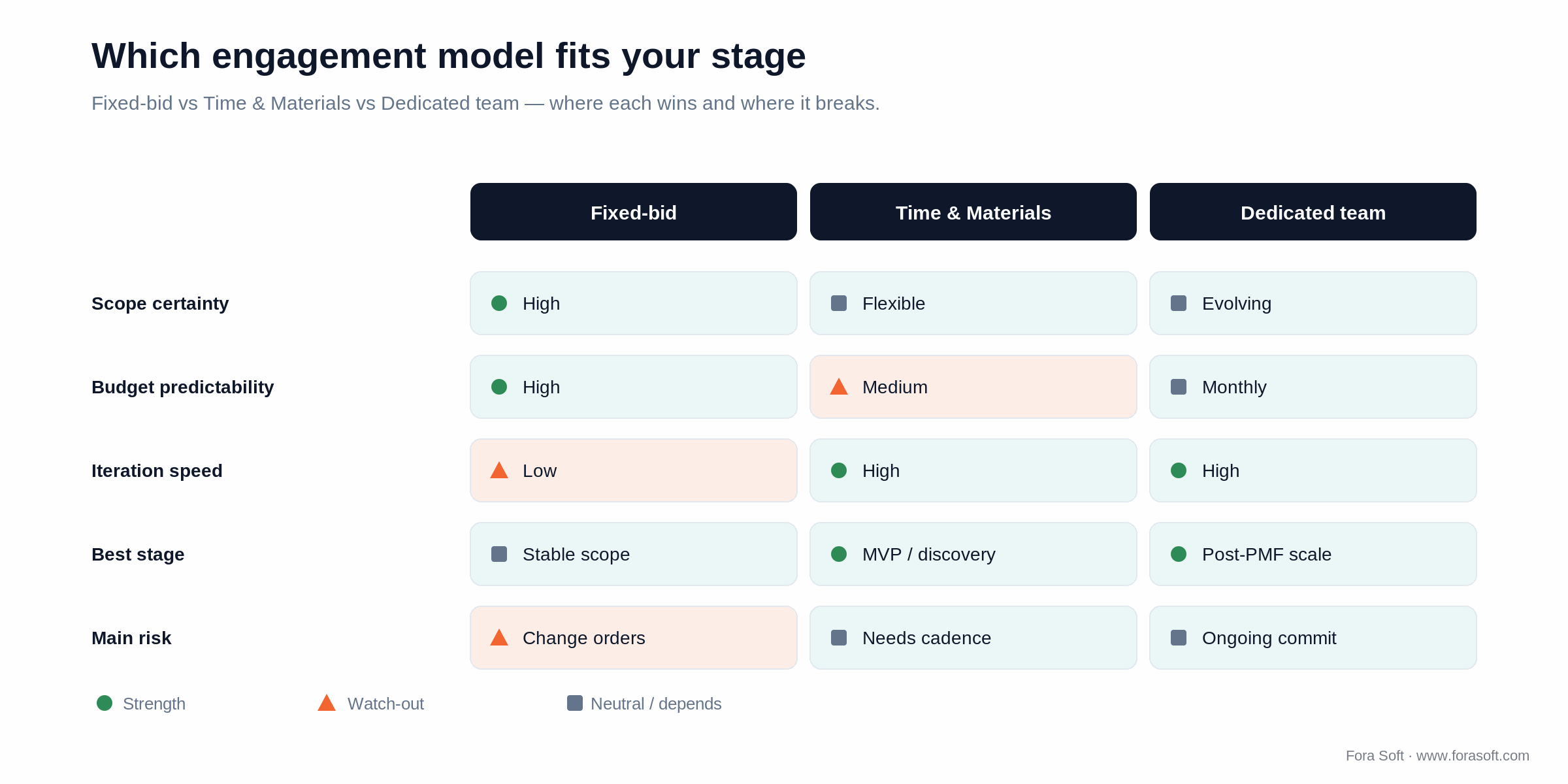
Figure 2. How the three engagement models score against the criteria founders actually weigh: green is a strength, orange is a watch-out, grey depends on your setup.
Reach for T&M for your MVP, then transition to a dedicated team after 2–3 months of product-market signal. Most successful founders we work with go through exactly this shape: T&M to build and learn, then a dedicated team to scale what worked.
Why outsourced builds fail — the real failure modes
The Standish Group's long-running CHAOS research has, for years, put outright software-project failure near 19% and “challenged” (late, over budget, or cut down) around half. Small, tightly-scoped projects succeed far more often (roughly 90%) than big-bang ones (under 10%). Failures are not random. They cluster into five patterns.
1. Wrong tech stack picked too early. The vendor agrees to whatever stack the founder named without asking why. Six months later the product hits a scaling wall and needs a rebuild.
2. Communication breakdown. Slow email replies, missed standups, vague answers during discovery. These are early predictors, not minor irritations.
3. Vague specs and scope creep. The vendor agrees to everything without scrutiny. Three months in, the deliverable does not match the founder’s mental model, and there is no acceptance criteria to fall back on.
4. IP and vendor lock-in. The contract leaves source-code ownership ambiguous. Switching vendors becomes impossible without a rebuild, an asymmetric power problem.
5. No security baseline. The startup ships fast, then a customer sends a security questionnaire or an investor demands SOC 2 readiness, and the team needs $20K–$50K of remediation work.
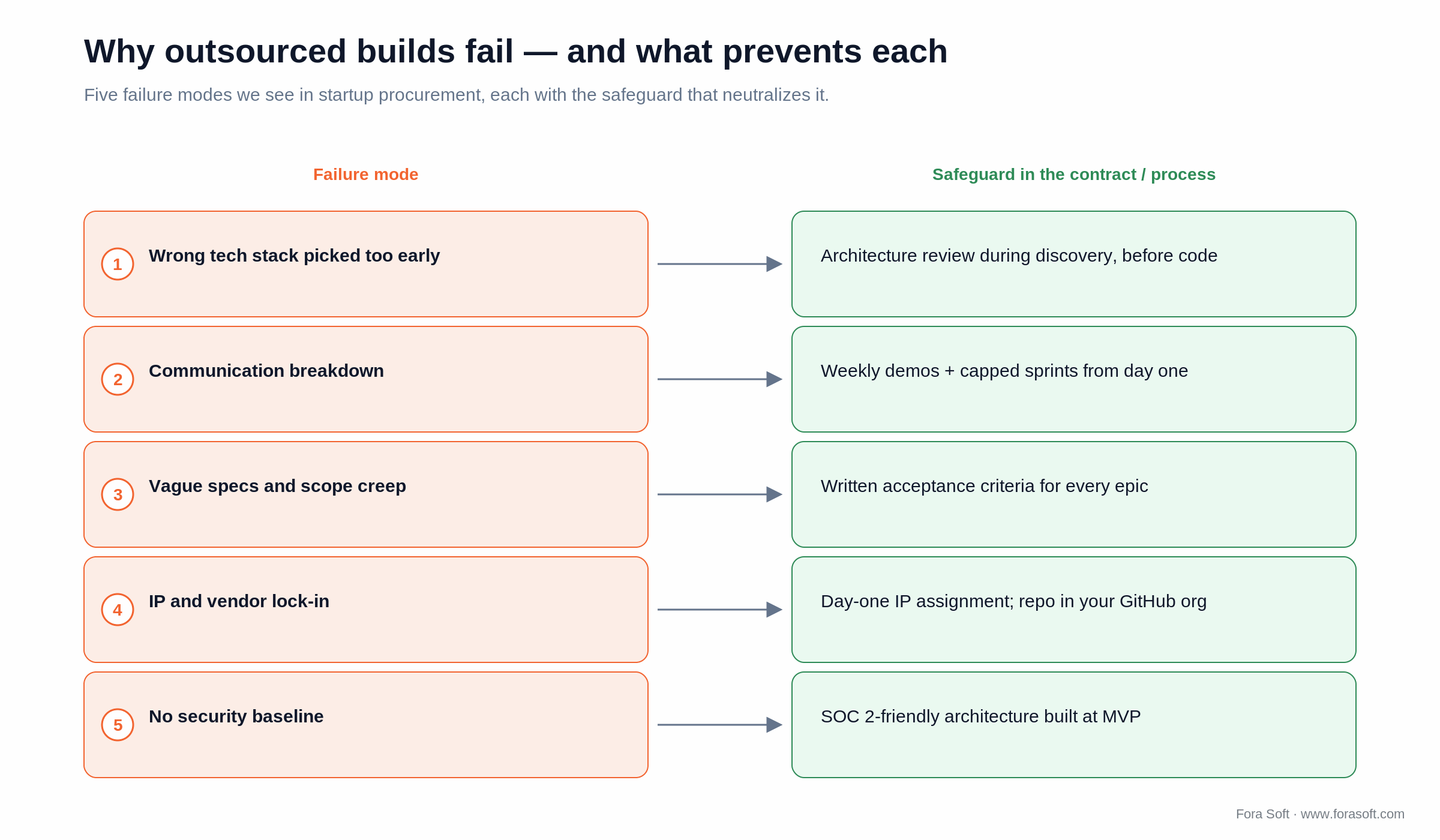
Figure 3. Each failure mode has a specific safeguard you can write into the contract or the process. None of them cost extra; all of them are cheaper than the failure.
Red flags during the sales process
Communication red flags. Days-long response times. Missed scheduled calls. Vague answers when you ask about specific past projects. The behaviour during sales is the best version you will ever see; it gets worse after the contract is signed.
Pitchers who are not the builders. A polished sales engineer and an unnamed “team we will assign” is the oldest bait-and-switch in outsourcing. Ask who writes the code, get their names and GitHub profiles, and put the specific people in the statement of work. If the people who pitch vanish after signing, so does the quality you were sold.
Pricing red flags. A single lump-sum number with no breakdown by workstream. Pricing significantly below market with no clear explanation of how. Pressure for long-term commitments or large upfront payments before any value is delivered.
Scope red flags. The vendor agrees to every request without pushback or follow-up questions. They have not understood the work; they will discover the gaps three months in.
IP and control red flags. Resistance to NDAs. Reluctance to commit to clear IP ownership. Code that depends on proprietary tooling only the vendor understands.
Verification red flags. No verified reviews on Clutch, GoodFirms, or Techreviewer despite years of claimed experience. Refusal to share a current client reference you can talk to directly.
Security red flags. No clear answer about cybersecurity insurance, regular pen testing, or where customer data lives.
Want a vendor stress-test before you sign?
Send us your shortlisted partner’s proposal. We will review it for the red flags above and tell you what to push back on. Free, 30 minutes.
Directories — Clutch, GoodFirms, Techreviewer compared
Three platforms dominate the “find a software development partner” search. Each has different evaluation logic.
| Directory | Verification rigour | Best for | Watch out for |
|---|---|---|---|
| Clutch | High — phone-verified reviews, structured feedback | Shortlisting by region and service line | Top placements are paid sponsorships |
| GoodFirms | Medium — research-driven, lighter verification | Filtering by service type and market | Smaller pool of verified reviews |
| Techreviewer.co | High — verified reviews, legal status, continuous monitoring | Cross-checking after Clutch / GoodFirms shortlist | Smaller catalogue than Clutch |
Use them in combination, not in isolation. Shortlist on Clutch or GoodFirms, cross-check on Techreviewer, then ask for two or three current client references and call them yourself. Vendor-supplied references are biased. That does not make them useless, but you should always ask one off-script question (“What is the one thing you wish they did differently?”) to flush out the real signal.
Compliance you actually need at MVP
Most startups skip security and privacy work at MVP and pay for it later. The honest middle path is a baseline that does not slow you down but does not paint you into a corner.
1. SOC 2 as the practical trust signal. A SOC 2 Type I audit (a point-in-time design assessment, roughly $5K–$20K over a few weeks in 2025–2026) is faster and cheaper than Type II ($20K–$50K over a 3–12 month observation window) and signals to first enterprise customers that you are serious. Architecture decisions you make at MVP either make this trivial later or expensive. Roughly 85% of mid-market buyers and 98% of the Fortune 500 expect Type II before they sign, so build Type I first and upgrade.
2. GDPR / CCPA basics. Even if you are pre-launch, build a consent flow, a documented data-retention policy, and a working “delete my data” pathway. GDPR fines reach €20M or 4% of global turnover, whichever is higher. None of the baseline is hard at MVP; all of it is hard to retrofit at 50K users.
3. Encryption in transit and at rest, plus access logs. HTTPS everywhere, encrypted database storage, audit trails on admin actions. Standard, cheap, and prevents most of the bad-day stories. If you sell into regulated or European enterprises, ISO 27001:2022 is becoming the baseline certification they ask for.
4. Domain-specific compliance only if your domain demands it. HIPAA for clinical data, PCI-DSS for cards, FERPA for K-12 EdTech. Skip these if you do not need them, and pay close attention if you do.
Reach for SOC 2 Type I at MVP when: any of your top 5 target customers have a security-questionnaire process, or you intend to fundraise within 12 months. Otherwise build SOC 2-friendly architecture and defer the audit by 6–9 months.
Equity-for-development — when it works, when it kills the company
Some agencies will accept equity in lieu of part of their fee. It can work, and it has destroyed more startups than most founders realise. The structural risks fall into four buckets.
1. Valuation ambiguity. At what price does the equity convert? Same as the next priced round? Discounted? Capped? Without clear terms you are negotiating in the middle of a fundraise, the worst possible time.
2. Vesting misalignment. Equity should vest with milestones, not on day one. Otherwise the agency walks with stock if the relationship breaks.
3. IP entanglement. Open-source licences and third-party libraries in the codebase can create surprise legal liability if the equity holder is later acquired or shuts down. Document everything in writing.
4. Governance and exit. Even a 5% holder can complicate a sale or major financing. Define clawback, exit, and information rights upfront.
Practical rule: if you take an equity-for-services deal, get a startup lawyer to review the structure ($2K–$5K) before signing. The cost of avoiding a bad deal is much lower than the cost of unwinding one.
Reach for an equity component when: the partner can credibly take material risk with you (small senior team, mission-aligned, prior product wins), and your cap table can absorb a 1–5% allocation without distorting future rounds. Otherwise pay cash.
AI-accelerated delivery — what to demand from a 2026 partner
AI coding tools (Cursor, Claude Code, Devin, GitHub Copilot, internal agents) are no longer experimental. Used well, they shave 10–20% of dev hours on the kinds of work startups actually do: CRUD endpoints, integration glue, test scaffolding, refactors. Used badly, they ship insecure, hard-to-maintain code that costs more to clean up than they saved.
Be honest about the ceiling. A 2025 METR study found experienced engineers were about 19% slower using early-2025 AI tools on large, familiar codebases, even though they felt faster. The lesson is not “avoid AI.” It is that speed comes from governance, review, and knowing where AI helps, not from turning it loose. Our own numbers, on greenfield product work with senior review, are documented in our AI-for-engineering hub.
Three questions to ask any 2026 partner. Do you use AI coding tools in your workflow? If they say no, they are leaving 10–20% efficiency on the table and you will pay for it. What governance is in place? Mandatory PR review, security scanning, license-compliance checks, and a senior engineer signing off on AI-suggested architecture changes. Where do you refuse to use AI? Anywhere with novel architecture, bespoke domain logic, or compliance-sensitive code. If they cannot name those zones, the governance is not real.
At Fora Soft we run Agent Engineering across our delivery teams. The methodology and the cycle-time benchmarks are documented in our AI software development case study and the broader pattern in our AI in software development process guide.
How to run the discovery call so the vendor cannot bluff you
A 30–60 minute discovery call should leave you with a sharper view of the problem and the partner’s ability to solve it. The structure that works is symmetrical: both sides ask hard questions and bring artefacts.
What the vendor should ask. What problem are you solving? Why now? Who exactly is the user (job title, technical comfort, current behaviour)? What are your KPIs? What is your budget and timeline? What have you already learned from users? What is your biggest unknown?
What you should bring. Whatever user research you have, even if it is five customer-interview notes. A technical co-founder or fractional CTO if you have one. A clear MVP scope (what is in, what is out). A written assumption you want to test in the call.
Red flag. A vendor who returns a detailed proposal overnight without a discovery call has guessed, not planned. The proposal will look polished and will be wrong.
Mini case — how a fitness booking startup became AppyBee
AppyBee started as a focused MVP idea: let small fitness studios manage class bookings on iOS and Android with one branded app per studio. The founder had clear user research (interviews with studio owners), a constrained budget, and limited time to test the model before re-investing.
We started with a T&M engagement, ran a discovery and design sprint to lock the MVP scope, and shipped a first version that was small enough to launch but large enough to attract real studios. As the platform proved itself, we moved to a dedicated-team model. It now runs in 800+ fitness centres, holds a 4.6-star rating across 57 reviews, saves owners an estimated 10–15 hours a week on admin, and reports roughly 20% higher member retention. The iOS notification-economics work behind it is covered in our February 2025 mobile dev highlights.
The shape generalises. Most successful startups we have worked with follow the same arc: a tight T&M MVP with a defined scope, a move to a dedicated team after product-market signal, and a partner that grows with the product instead of being replaced every 18 months.
A decision framework — pick a partner in five questions
1. Have they shipped something like your product before? Specific domain experience cuts months off discovery. Generic “custom software” experience is a much weaker signal.
2. Can you talk to a real client without a chaperone? Direct reference calls are the highest-signal step in the entire procurement process.
3. Will they push back on your scope? A vendor who says yes to everything is selling, not collaborating. The right answer to half your asks should be “here is a cheaper way to test that first”.
4. How do they use AI, and where do they refuse to? The presence of AI in the workflow plus clear governance is the 2026 baseline.
5. Who actually owns the code? If the answer is anything other than “you, on day one, no exceptions”, walk.
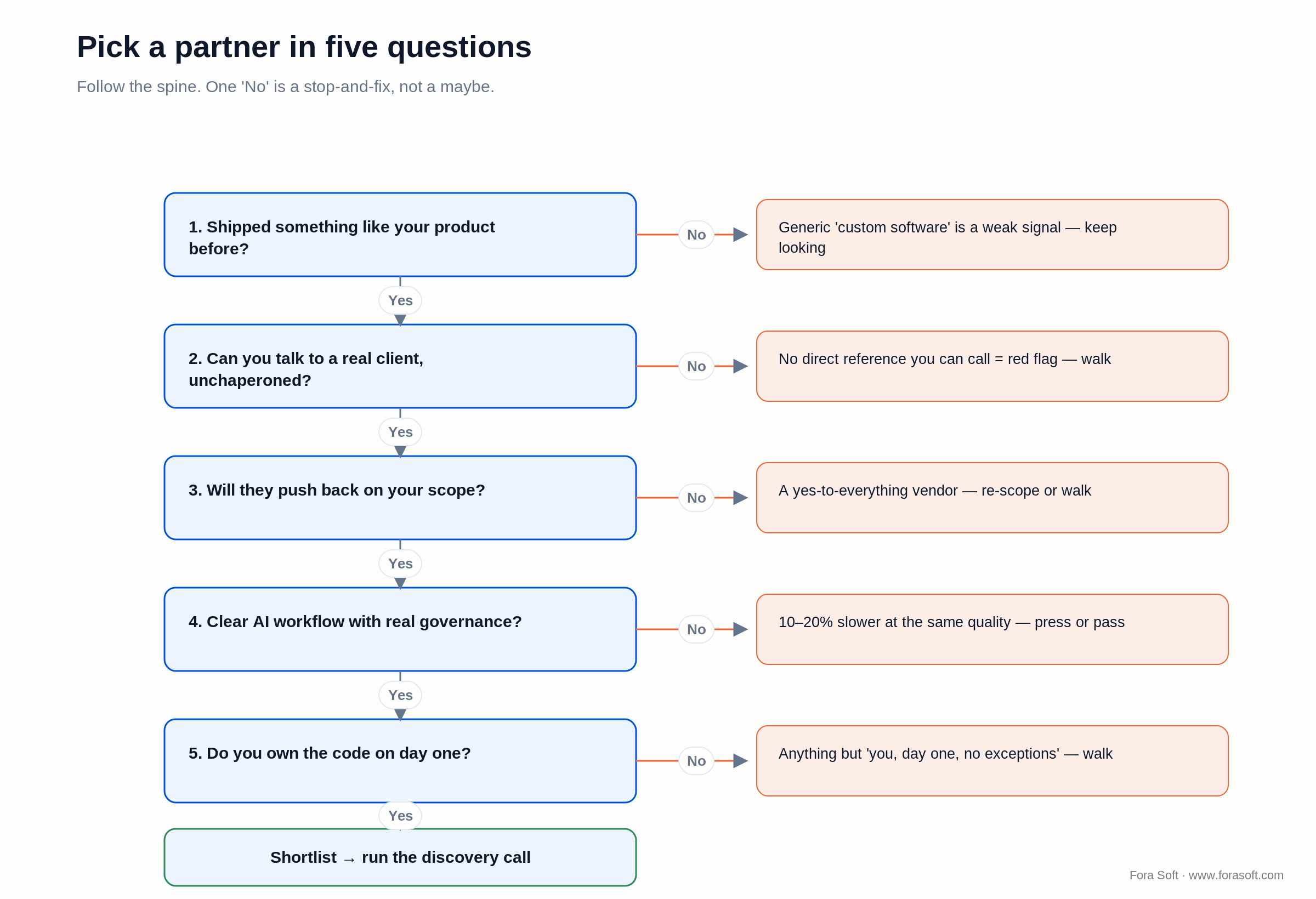
Figure 4. Run every candidate down the same five questions. A single “No” is a stop-and-fix, not something to rationalise away.
Five pitfalls we keep seeing in 2026 startup procurements
1. Optimising the bid instead of the partnership. Saving 20% on a $60K MVP that fails is a worse outcome than spending the full $60K on a build that ships and learns.
2. Locking into fixed-bid before you have validated user demand. Pay for iteration; you will need it.
3. Skipping security baseline because “we are pre-launch”. The cheapest time to add SOC 2-friendly architecture is at MVP. The most expensive time is right before your first enterprise contract.
4. Equity-for-services without legal review. The legal cost is a fraction of the unwind cost.
5. Ignoring how a partner uses AI in 2026. Partners without a governed AI workflow are 10–20% slower at the same quality. A 2-month MVP becomes 2.5 months for the same scope.
KPIs to track once the engagement starts
Quality KPIs. Escaped-defect rate (target <3% of shipped tickets), pull-request review cycle (target <48 hours median), and design-validated features as a share of features built (target 100% for major epics).
Business KPIs. Estimate vs. actual cycle-time variance (target within ±15%), lead time from idea to production, and stakeholder satisfaction score per quarter.
Reliability KPIs. Sprint commit completion rate (target 80–90%; higher signals padding, lower signals chaos), team turnover (<15%/year for technical roles), and number of retrospective actions actually shipped per sprint (target ≥1).
When NOT to hire an external partner
If you have a strong technical co-founder, fewer than five users to talk to, and a 6–12 week MVP scope, build it yourselves. The communication overhead of any partner relationship is real, and at the earliest stage you will move faster on your own.
If your product is genuinely a no-code or low-code use case, prototype in Bubble, Webflow, or Retool first. You may discover that you do not need custom software at all, or only need it for one specific layer.
If you cannot articulate what success looks like in three sentences, do not hire a partner yet. Spend two weeks on user research and scope refinement first. The partner will burn through that work in two days; you will pay them either way.
Contract must-haves — what every dev partner contract should contain
A short, well-written master services agreement plus a per-project statement of work covers most situations better than a 60-page bespoke contract drafted from scratch. Five clauses are non-negotiable.
1. IP assignment. All work product, including code, designs, and documentation, transfers to the client on payment for that work. No carve-outs for “reusable components” without explicit prior agreement.
2. Source-code escrow or repository ownership. The repository lives in your GitHub / GitLab organisation, not the vendor’s. They get contributor access, not ownership.
3. Confidentiality with a clear scope. NDAs that cover not just trade secrets but customer data, roadmap, and meeting notes, with clear carve-outs for the partner’s portfolio rights (so they can name you as a client unless you opt out).
4. Termination for convenience. Either side can end the engagement with 30 days’ notice. No multi-quarter lock-ins. Mature partners welcome this clause; immature ones resist it.
5. Data security and compliance reps. The partner represents that they meet a documented baseline (SOC 2 readiness, encryption in transit and at rest, named providers) and will notify you within 72 hours of any security incident.
Reach for a startup-friendly contract template when: the vendor cannot produce a sensible MSA + SOW skeleton in under a week. That is a procurement-velocity signal you cannot ignore at MVP stage.
After launch — the support and scale-up phase most founders forget
Most procurement conversations focus on the build phase. The partner conversations that matter most usually start the day after launch. That is when bugs surface, customers ask for changes, and one of your investors asks how the system behaves under 10x current load.
Hand-over discipline. A clean codebase, current README, runnable local environment, deployment script, and a one-page architecture diagram. If you cannot get those artefacts on day one of post-launch, you will pay for them in onboarding hours later.
SLA and on-call. A simple two-tier SLA (P1 incident response within 1 hour, P2 within 4 hours during business days) is enough for most early-stage products. Avoid 24/7 SLAs until you have customers paying for them.
Maintenance budget. Plan 15–25% of build cost per year as steady-state maintenance: bug fixes, dependency upgrades, small feature requests. Below that, the product silently rots; above that, you are probably building new features and should treat it as new project budget.
Our own approach to this phase is documented in the customer success manager playbook, the role that owns the post-launch relationship in our shop.
Already shipped an MVP and looking for a partner to scale it?
We will review the existing codebase, suggest a 12-week scale-up plan, and tell you what to refactor first. Free 30-minute call.
FAQ
What is a software development partner?
A software development partner is an external team that designs, builds, and maintains your custom software over time, rather than a vendor you hand a spec to for a one-off delivery. The distinction matters: a partner scopes with you, pushes back on bad ideas, owns quality after launch, and grows with the product. A pure vendor bills for the spec as written and stops thinking when the invoice clears.
How do I choose a software development partner for a startup?
Run every candidate through five questions: have they shipped something like your product, can you call a real client unchaperoned, will they push back on your scope, do they have a governed AI workflow, and do you own the code on day one. Shortlist on Clutch or GoodFirms, cross-check on Techreviewer, and always take a direct reference call. A single “no” on the five questions is a stop-and-fix, not a maybe.
How much does an MVP really cost in 2026?
A credible startup MVP usually lands between $35K and $80K, with web MVPs at the lower end and dual-platform mobile or SaaS MVPs at the higher end. Compliance work (HIPAA, GDPR, SOC 2 baseline) adds 20–30%. Anything dramatically cheaper is usually offshored at quality risk; anything dramatically more expensive at MVP stage is usually over-scoped.
Should a startup go fixed-bid or T&M?
For an MVP, almost always T&M with capped sprints and a written scope. Fixed-bid locks you into the requirements you wrote before talking to users, which are the requirements you most need to change. Reach for fixed-bid only when scope is genuinely stable: marketing sites, well-known integrations, phase-2 builds.
Is offering equity instead of cash to a development partner a good idea?
It can work, but only with milestone-based vesting, clear IP ownership, and explicit governance and exit terms. Get a startup lawyer to review the structure ($2K–$5K) before signing. The cost of legal review is a fraction of the cost of unwinding a bad equity arrangement during a fundraise or acquisition.
How do I tell if a development partner’s AI workflow is real?
Three signals. They name specific tools (Cursor, Claude Code, internal agents) and say where each fits. They describe the governance: mandatory PR review, security scanning, license checks. They name the zones where they refuse to rely on AI: novel architecture, compliance-sensitive code, anything without historical precedent. Vague “we are AI-powered” statements with none of the above are marketing.
Do I need SOC 2 or HIPAA at MVP?
Build SOC 2-friendly architecture (encryption, access logs, documented retention) at MVP; the audit can come later. Pursue a formal SOC 2 Type I once you have an enterprise customer or Series A in sight. HIPAA is required only if you handle clinical data. The pattern is “do not paint yourself into a corner” rather than “ship a fully audited product”.
How do I check that reviews on Clutch / GoodFirms / Techreviewer are real?
Clutch verifies most reviews via phone interviews. Cross-check by asking the partner for two or three current client references you can call directly, not the carefully chosen logos on the website. Ask each reference one off-script question (“What do you wish they did differently?”) to flush out the real signal. If the partner refuses to provide direct references, that itself is a red flag.
Can a small startup work with Fora Soft?
Yes. We work with founders at MVP stage as well as scaled products. The starting point is a free 30-minute scoping call where we challenge your scope, validate your stack assumptions, and give you a realistic budget and timeline. You walk away with a written prioritised list whether you choose us or not.
What to read next
Budgeting
Mobile app development costs — 2026 guide
A defensible breakdown of what a serious iOS or Android app actually costs to build and maintain in 2026.
Estimation
Software estimation — the working guide
How we run estimation on real client projects, including the rules for when AI helps and when it gets the team into trouble.
Build vs hire
DIY vs hiring app development
When to build with a small in-house team and when to bring in a partner, with the trade-offs that actually matter.
Case study
How AI cut 30–40% off our delivery time
A case study of Agent Engineering on a 1M+ line video streaming platform: numbers, methodology, trade-offs.
Process playbook
Our product development process
A step-by-step look at how we plan, build, and ship software products with our clients, the playbook behind the cases above.
Ready to choose your software development partner with eyes open?
Being named a Top Software Development Partner for Startups in 2025 is a useful signal, not the whole answer. The whole answer is process discipline, honest delivery data, AI-augmented workflows with real governance, and a partner who pushes back on your scope when you need it. Choosing a software development partner well is the cheapest insurance a founder can buy.
If you would like a second pair of eyes on a proposal you have already received, or a fresh scoping conversation before you go to market, that is exactly what we do on a 30-minute call. We bring case studies, our cycle-time data, and our written assumptions about your project. You walk away with a prioritised plan whether you hire us or not.

The handbook · 7 volumes
Fora Soft Video Engineering Handbook
Once you know how to pick a partner, the smart founder question is whether they can explain the stack they will build on. We wrote seven volumes covering encoding, delivery, audio and AI; for a video MVP start with Volume 3 on WebRTC, players and delivery costs, with Volume 2 on ingest and HLS and Volume 7 on AI cost per stream-hour. Written by Nikolay Sapunov, CEO at Fora Soft.
Browse the handbook on Amazon →7 volumes · 9,000+ pages · Kindle & paperback
Let’s talk about your MVP
A free 30-minute call: we look at your scope, stack, budget, and timeline, and you walk away with a written priority list.

