


Key takeaways
• A Customer Success Manager is not a project manager with a smile. The PM owns scope, schedule and cost. The CSM owns alignment, adoption and outcomes — the reasons software projects fail even when they ship on time.
• Agencies without a CSM leak revenue and trust. Proactive CS cuts churn 15–25% versus reactive support and adds 20–30% expansion per retained account (2025–26 CS benchmarks). In our experience, fewer than one in ten custom software shops run a real CSM role; that gap is our moat.
• The CSM is the early-warning system. Most startups that fail die from poor product-market fit, not bad code — CB Insights (2024) puts it at the top of the list. A good CSM catches that misalignment 60 days before the renewal call, not at it.
• The math is boring. One CSM can protect $500k–$2M ARR of work; customer-success programs return roughly 107% risk-adjusted ROI over three years (Forrester). You pay for this role whether or not you have it — the only question is who receives the bill.
• Fora Soft builds this into every engagement. The CSM sits next to our agent-engineering delivery loop, protecting the PM from noise and giving founders a human who actually owns the outcome — so product decisions stay crisp and handoffs don’t drop.
Why Fora Soft wrote this Customer Success playbook
We’ve been building custom software since 2005: 250+ projects across video platforms, AI products, and WebRTC systems that run in courtrooms, clinics, industrial sites, and telehealth networks. One of those partnerships, BrainCert, grew into a WebRTC virtual-classroom platform serving 100,000+ customers at 99.995% uptime; the kind of multi-year relationship a customer success function exists to protect. The pattern we see in every failed engagement, though, is the same: the code was fine, the delivery was fine, the outcome was not.
The Customer Success Manager role is how we close that gap. This article is the playbook we hand to founders who are evaluating us (or any other agency) so they can tell the difference between a shop that ships code and a shop that ships product outcomes. It covers what a customer success manager does day to day, how the role is distinct from a PM or account manager, what the economics look like, and the pitfalls we see when agencies skip or half-bake the role.
If you’re a founder, product owner, CTO, or procurement lead comparing development partners, this is for you. For the broader picture of how we build, see our seven-phase product development playbook, our planning and requirements process, and our spec-driven agentic engineering approach.
Evaluating development partners? Meet a real Customer Success Manager.
A 30-minute call with your named CSM. We’ll walk the role, the cadence, and what you actually get on day one. No sales pressure, just the operating model laid out.
The one-line definition worth memorizing
A Customer Success Manager is the person on the agency side whose job is your outcome, not your deliverable. The PM makes sure the sprint ships; the CSM makes sure the sprint was worth shipping. In a custom software engagement, those are different jobs with different KPIs, different cadences, and different failure modes. Conflating them is how founders end up with a launched product that nobody uses.
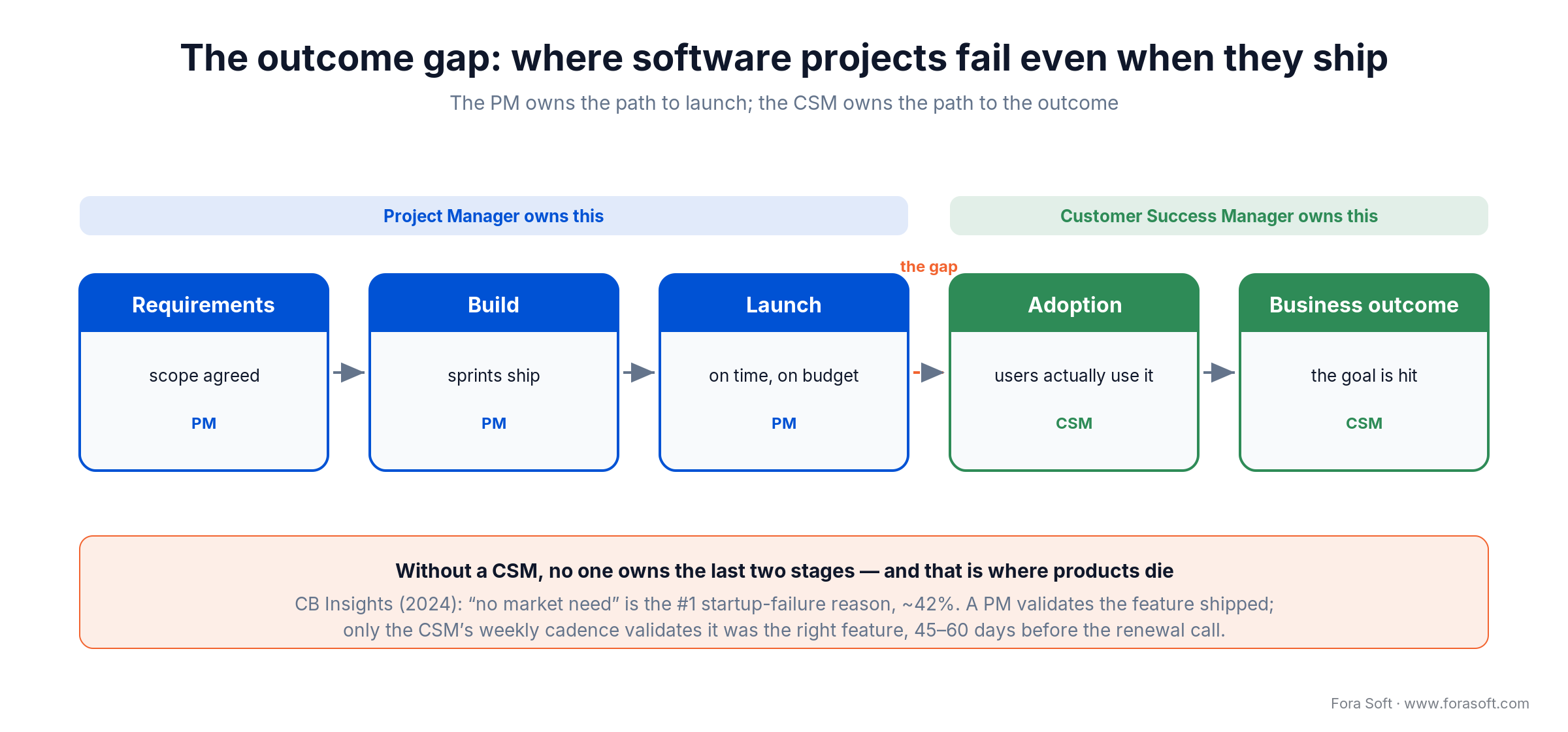
Figure 1. The PM gets a project to launch; the CSM gets it to the outcome. The gap between them is where most products quietly fail.
CSM vs Project Manager vs Account Manager vs Tech Lead
The customer success manager vs project manager question comes up on every serious engagement, and agencies conflate the two roles all the time. Here is the clean split we run at Fora Soft.
| Role | Primary goal | Core metrics | Cadence | Fails when… |
|---|---|---|---|---|
| CSM | Your outcome, adoption, retention | NRR, NPS, CSAT, health score, TTV | Weekly + monthly QBR | Treated as support tier |
| Project Manager | Scope + schedule + cost | On-time delivery, scope creep, defects | Daily stand-up, sprint review | Absorbs CSM work & drops the roadmap |
| Account Manager | Commercial relationship & renewal | Win rate, ACV, renewal rate | Quarterly + annual exec reviews | Becomes the only voice, loses product context |
| Tech Lead | Technical quality, architecture | Defect density, uptime, cycle time | Continuous, issue-driven | Carries product priority calls without PM/CSM |
The fast test: ask your candidate agency who owns “is the client actually achieving their business outcome?” If the answer is “the PM” or “the account manager”, there is no CSM — that function just gets squeezed into someone else’s calendar until it falls over.
Why software products fail after launch and what the CSM catches
CB Insights has tracked startup post-mortems for over a decade. In its 2024 analysis the #1 reason is still “no market need” — poor product-market fit, at roughly 42% of failures. Running out of cash, the wrong team, getting outcompeted, and pricing all rank below it; cash is usually the last symptom, not the root cause.
A Project Manager cannot catch this. PMs validate that the scoped feature shipped; they cannot, by construction, validate that the scoped feature is the right feature. The CSM’s proactive cadence — weekly check-ins, adoption metrics, first-value milestones, QBRs — creates the feedback loop that converts “we built what was asked” into “we built what was needed.”
Two specific patterns we see:
1. Silent drift. Sprint 1 is aligned. Sprint 6, the client’s market has moved and the original acceptance criteria are stale. Without a CSM actively probing this every two weeks, agency and client only discover the mismatch at launch — the worst possible moment. For more on the expectation-reality gap, see what to do when project expectations clash with reality.
2. Adoption failure. The product ships on time, under budget, and end users ignore it. Engineering cannot fix this retroactively — and it is common: Pendo’s 2019 research found 80% of software features are rarely or never used. The CSM is the role who saw it coming at week six and flagged it while it was still cheap. To avoid this class of failure, see our notes on avoiding app abandonment.
What a custom software CSM actually does
1. Success planning. On day one the CSM co-writes a Success Plan with the client: the top three business outcomes, the leading indicators for each, and the trigger thresholds that will fire an alert if they drop. Every weekly call references this plan; every QBR scores against it.
2. Proactive health monitoring. Weekly qualitative check-ins plus quantitative health score (adoption, engagement, escalations, deadline slippage). A score drop below threshold is a 24-hour incident, not a quarterly-review talking point.
3. Stakeholder mapping. Execs, product owners, end users, IT, procurement. The CSM keeps a living stakeholder map and knows who champions and who blocks. When your champion leaves the client org, the CSM is the one who notices in week one — not week ten.
4. Expectation translation. You speak in outcomes; the dev team speaks in tickets. The CSM translates both directions, pushes back on the dev team when a spec is drifting from intent, and pushes back on you when a requested change breaks the underlying architecture. We cover the adjacent PM skill set in why you need a project manager for your software project.
5. Adoption and onboarding. The moment code hits staging, the CSM is already planning the training, the documentation, and the first-week support. A product with a great build and zero adoption is a $500k loss.
6. Expansion detection. Listening for “we’re using this for X now too” — the signal that the product has grown past its original scope. Mid-engagement expansions are 20–30% of retained account revenue in healthy CS organisations.
7. Operational buffer. The CSM absorbs routine questions and training requests so the PM can stay focused on delivery. Without this buffer, PMs field 20+ ad-hoc tickets a week and the roadmap slips.
Reach for a dedicated CSM when the engagement is multi-month, launches to end users you don’t control, or has a plausible phase two. Those are the three conditions where the seven jobs above stop fitting into a PM’s week, and start falling on the floor.
The cadence: from kickoff through renewal
This is the touchpoint rhythm we run on every engagement. Your CSM’s calendar literally looks like this.
| Phase | Owner | Touchpoint | Output |
|---|---|---|---|
| Pre-sale | Sales + CSM observer | Discovery & fit | Draft success criteria |
| Kickoff (week 1) | PM + CSM (joint) | Kickoff meeting, stakeholder mapping | Success plan v1, RACI, health score baseline |
| Build (weeks 2–N) | PM (lead) + CSM | Weekly sprint review & weekly CS check-in | Risk log, health-score update, drift alerts |
| Go-live | PM + CSM (co-facilitated) | Daily standups for launch week | Cutover plan, escalation path, day-7 retro |
| Post-launch (months 1–3) | CSM (primary) | Twice-weekly early, then weekly | Adoption metrics, early-wins doc, QBR #1 |
| Steady state (months 4+) | CSM | Monthly + quarterly QBR | Business review, expansion pipeline |
| Renewal (12 months) | CSM + Account Manager | Monthly reviews, renewal case | Roadmap for next term, expansion scope |
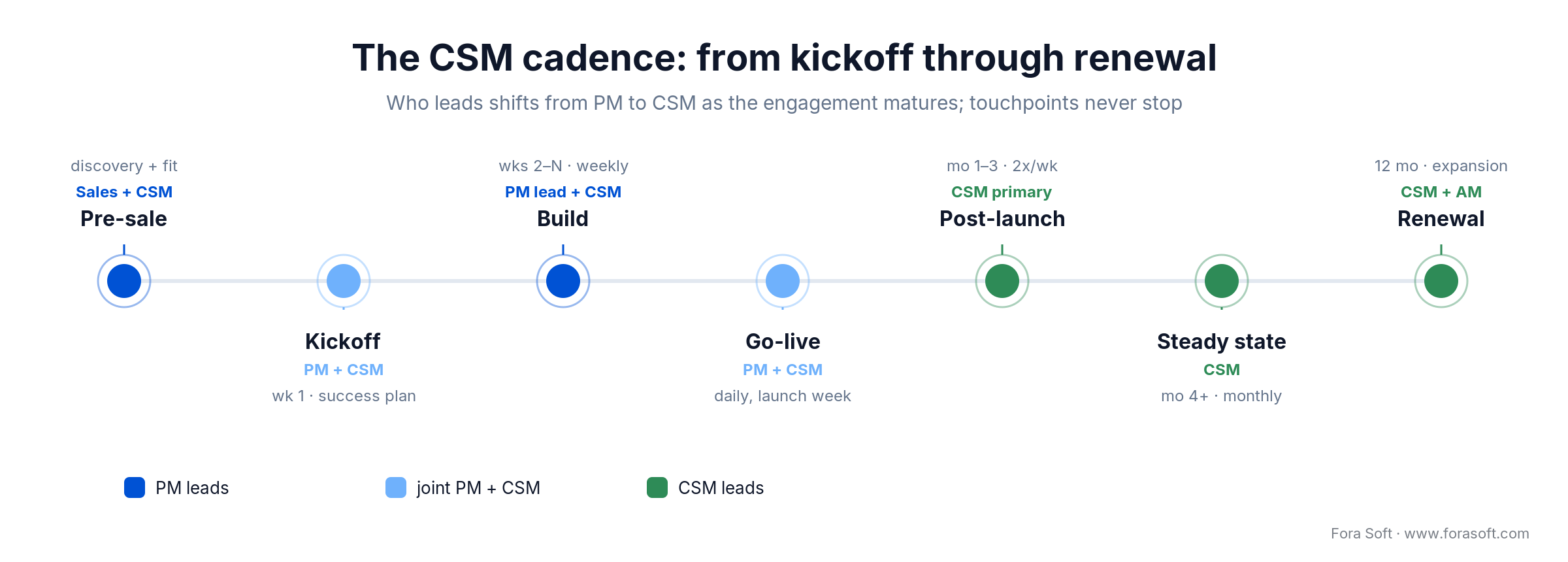
Figure 2. Touchpoints never stop, but the lead shifts from PM to CSM as the engagement matures from kickoff to renewal.
Customer health score: the one number that runs the role
A health score is a weighted sum of five inputs that predicts whether an account is about to churn, renew, or expand. It is computed weekly and reviewed in the CSM’s stand-up with the head of delivery. At Fora Soft we weight it roughly like this.
| Signal | Weight | Green / Yellow / Red |
|---|---|---|
| Feature adoption (core) | 25% | >70% / 50–70% / <50% within 90 days |
| Executive engagement | 20% | QBR attendance >80% / 60–80% / <60% |
| NPS / CSAT trend | 20% | NPS 50+ / 20–50 / <20 |
| Escalation rate | 15% | <1/month / 1–3/month / >3/month |
| Roadmap alignment | 20% | Success-plan refreshed <30 days / 30–90 / >90 |
A score in the red zone triggers a 24-hour incident: CSM + head of delivery + tech lead on a call, root-cause analysis inside a week, corrective plan inside two. Most at-risk accounts we’ve saved were caught by this exact flow, 45–60 days before the renewal conversation.
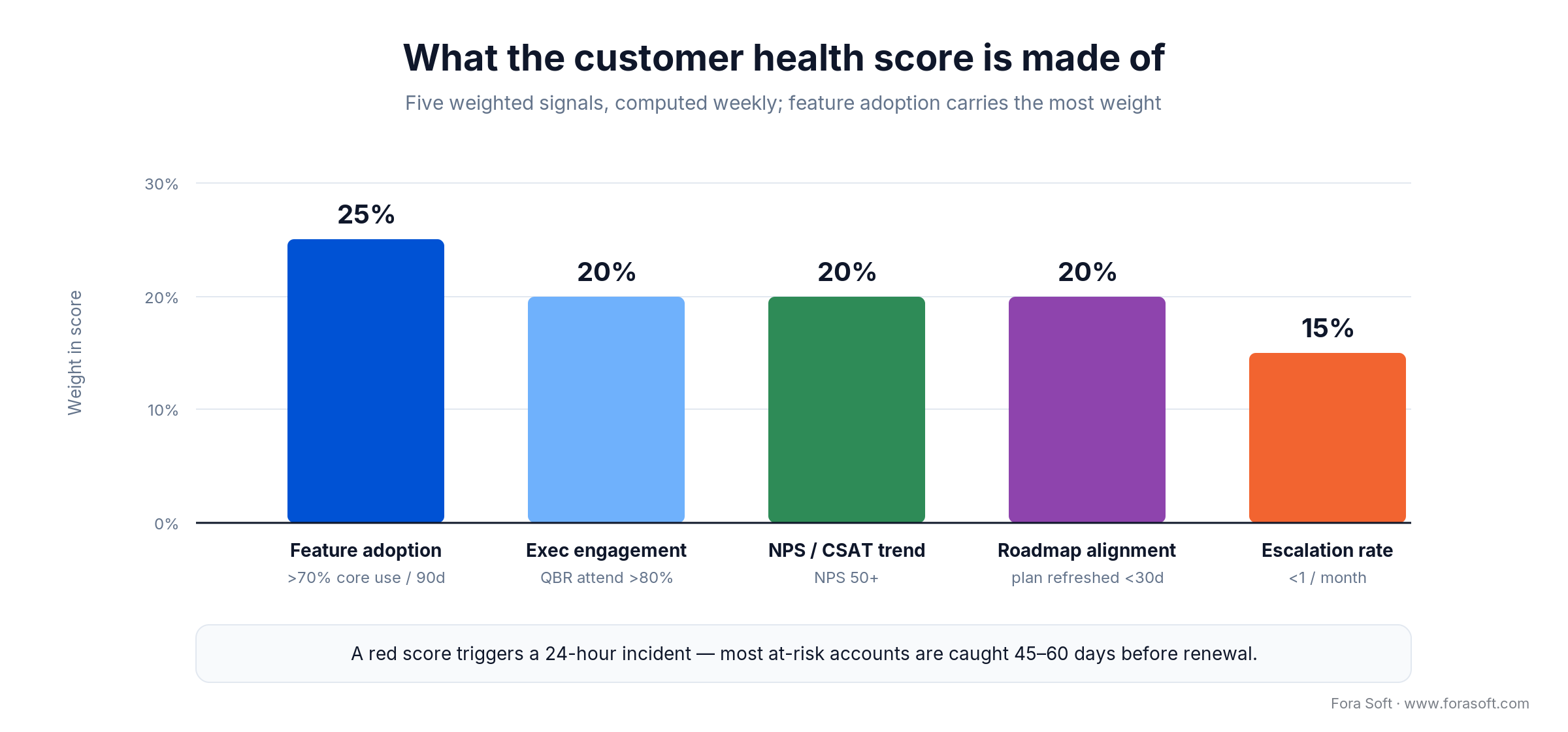
Figure 3. The health score is a weighted sum of five signals, recomputed weekly. Adoption carries the most weight.
Economics: what the CSM saves and what it costs
What CS moves. Proactive CSM reduces churn 15–25% vs a reactive model. In dollars: on a $1M engagement at 85% base retention, a CSM that lifts retention to 94% is worth roughly $90k per year. Expansion revenue — scope add-ons, new modules, adjacent use cases — is 20–30% of retained-account value for well-run CS organisations; on that same $1M account, call it $200k–$300k.
What CS costs. A loaded CSM in the US or EU runs $85k–$160k fully burdened. One CSM can carry $500k–$2M of ARR at high-touch ratios (1:15–1:25), less at higher ratios.
The ROI ratio. Forrester’s Total Economic Impact modelling puts a customer-success program at roughly 107% risk-adjusted ROI by the end of year three. That sits on top of the oldest finding in retention economics: a 5% lift in retention raises profits 25–95% (Bain/HBR), and keeping a customer costs a fraction of winning a new one (HBR pegs acquisition at 5–25× the cost of retention). That gap is why every mature B2B software organisation runs a dedicated CS team.
The hidden cost of skipping it. When an agency has no CSM, that work falls on the PM, the account manager, or — worst — nobody. You still pay for the function, but the form it takes is a support queue, a renewal surprise, or a quiet churn nobody feels until the contract ends.
For broader cost context, see our 2026 mobile app development cost guide and where to actually cut software project costs.
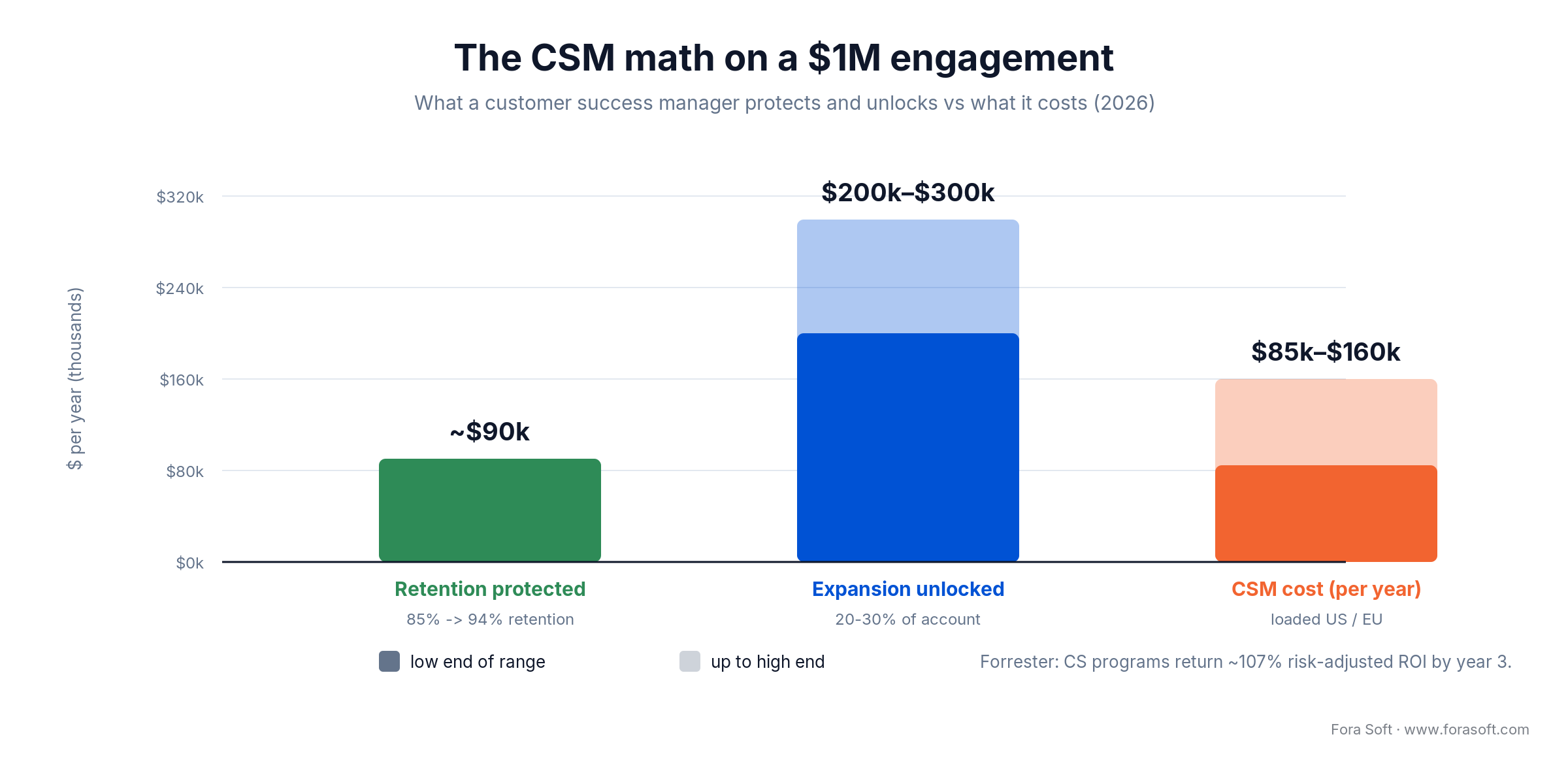
Figure 4. On a $1M engagement, the retention a customer success manager protects and the expansion it drives dwarf its annual cost.
Want a free 30-minute success-plan draft for your project?
Bring the product vision and your top three business metrics. You’ll leave with a written success plan, a cadence, and a health-score model you can hand to whichever agency you pick — us or anyone else.
Mini case 1: the silent-churn save
A mid-market video platform client, six-figure annual scope. Delivery went well: on time, under budget. The CSM’s health score started sliding in week five post-launch — QBR attendance was down, feature adoption was stuck around 40%, the champion’s calendar invites were being declined.
The CSM opened a 30-minute “just checking” call and learned the client had reorganised the team; the original champion was on parental leave; the new team felt overwhelmed by a platform they did not scope. Within two weeks the CSM had run a re-onboarding workshop, simplified the runbook for the new team, and rebuilt the QBR around three metrics the new leader actually cared about. The account re-engaged, renewed, and expanded the following year. Without the proactive health signal this was going to be a quiet non-renewal discovered at month eleven.
Mini case 2: the expansion play
An enterprise client deployed a custom WebRTC + AI product for real-time collaboration. Original scope was transcription and analytics. During a month-four QBR, the CSM surfaced that the client’s legal team had started using the recorded sessions for discovery-adjacent workflows — an unscoped use case with real risk.
The CSM brought this to the PM and tech lead, who put a compliance module on the roadmap; the account manager structured the commercial add-on. The expansion scope landed cleanly, the client got a supported feature instead of a shadow workflow, and the PM never had to re-prioritise mid-sprint. This is textbook CSM-driven expansion — 20–30% of annual account value, triggered by a single well-run check-in.
Mini case 3: the escalation absorber
A launch went live and within a week the PM was fielding 20+ ad-hoc tickets from ten different client-side users. Roadmap velocity dropped, the PM was miserable, and the client thought they were being ignored. Classic post-launch implosion.
The CSM took over ticket triage: training requests were routed into a weekly office-hour, true product gaps were aggregated and brought to the PM as a single prioritised list, and a handful of common questions were turned into a Loom library and a one-pager. Within three weeks the PM’s ticket load was down 70%, CSAT moved from 68% to 92%, and the roadmap was back on the agreed cadence. This is the boring everyday value of the CSM role.
KPIs we hold the CSM to
Quality KPIs. CSAT ≥ 85%, NPS ≥ 50, first-call resolution ≥ 80% for routine requests. If these move down, the CSM owns the recovery plan.
Business KPIs. Net revenue retention ≥ 110%, gross revenue retention ≥ 90%, expansion revenue as a percent of the account 20–30%. For context, 2025 B2B SaaS medians sit near 106% NRR and 90%+ GRR (SaaS Capital, 2025), so these are healthy targets, not fantasy ones. If the account is a fixed-scope build, swap NRR for “% of clients who sign a follow-on engagement within 12 months”.
Reliability KPIs. Time-to-value < 8 weeks for the first business outcome; escalation rate down 40–50% versus the baseline three months before CS engaged; QBR attendance at exec level ≥ 80%.
The uncomfortable truth: you are already paying for customer success. If no one is named to the role, the bill still arrives: a support queue nobody staffed, a renewal that surprises everyone, or a quiet churn discovered at month eleven. The only real choice is whether the function is deliberate or accidental.
Five pitfalls we see when agencies half-bake the CSM role
1. No formal handoff from PM to CSM. “The PM will keep an eye on it.” Two sprints later the PM is drowning; the account has no owner. A Success Plan, an explicit handoff meeting, and a co-owned health score all prevent this.
2. CSM embedded in the support queue. If the CSM’s calendar is 90% reactive ticket work, the proactive part of the role is dead. Agencies skimp here; the entire ROI of CS evaporates.
3. Stretching one CSM across 100+ customers. The right ratio depends on engagement size; for custom software with six-figure annual scope, 1 CSM per 15–25 accounts is the sustainable ceiling. Beyond that the role becomes a newsletter writer.
4. No health score or health-score theatre. A score on a dashboard nobody references is worse than no score — it creates false comfort. Real health scores drive incidents when they go red, feed QBRs, and get re-weighted when the signals prove wrong.
5. CSM with no authority. If the CSM cannot push back on the delivery team or sales, the role becomes a message carrier. Good CS leaders give the role the authority to flag misalignment to the exec team directly. Related reading: why every software project needs QA — same principle, different function.
A decision framework: when to demand a CSM from your agency
Q1. Is the engagement longer than four months or bigger than $100k? If yes, the absence of a dedicated CSM is a red flag. Short tactical builds can run without one; anything strategic should not.
Q2. Will end users outside the buyer’s team use the product? If yes, you need the CSM to drive adoption — PMs do not do this, and sales-side account managers do not have the context.
Q3. Is there a regulated domain (healthcare, finance, legal, public sector)? If yes, the CSM is also your point of contact for compliance drift. We cover the AI-ethics side of this in parallel articles; the structural need is the same.
Q4. Is there a planned phase two? If yes, the CSM owns the bridge. Without one, you will renegotiate the phase two from scratch instead of expanding from signal.
Q5. Do internal stakeholders disagree about what “success” means? If yes, the CSM earns their salary in week one by producing a written success plan that forces the disagreement to the surface. This is also why our planning and requirements process runs as long as it does.
When NOT to pay for a dedicated CSM
Short tactical builds. A three-week integration job, a focused design-system handoff, a PoC. The PM can carry the full relationship; adding a CSM is overhead.
Single-stakeholder buyer. One decision maker, one user, one internal audience. You do not need a role dedicated to navigating stakeholders if there is only one. Keep the PM close and the calls short.
Strict fixed-price, fixed-scope, no phase two. If the commercial construct makes expansion and adoption someone else’s problem after launch, the CSM ROI never materialises. Be honest about this up front.
How to evaluate an agency’s CSM function
Ask to meet the CSM before signing. Not their manager. The human who will show up on your calls. If the agency cannot produce that name, the role does not exist.
Ask to see a redacted Success Plan from a prior engagement. Structure, KPIs, health-score model, cadence. Do not accept “we’ll customise it for you” as a substitute for evidence.
Ask for the CSM-to-account ratio. Over 1:30 and the role is dilute. Over 1:50 and it is theatre.
Ask how the CSM escalates internally. Straight to the CEO or COO is the right answer; through the PM is a red flag because it means the CSM cannot overrule delivery when they should.
Ask about their team structure. You want transparency here. For reference, our dev team structure, QA team structure, and analytics team structure are all public, as is our engineering curriculum — for example the video-encoding learning track. Any agency you’re considering should be able to show its work the same way.
Already burning cycles on a project without a real CSM?
Bring the current state — scope, cadence, escalations, the last three status updates. We’ll diagnose where the role is missing and what to do about it in a single 30-minute call.
Fast agency test: ask to meet the named CSM before you sign, ask for a redacted success plan from a past engagement, and ask for the CSM-to-account ratio. Three questions, ninety seconds, and you’ll know whether the role is real or just a title on an org chart.
Where CS is headed in 2026: AI assistance, not AI replacement
The 2025 and 2026 CS tooling wave pushes AI into two places: health-score prediction and touchpoint automation. Health scores that were manually weighted a year ago are now trained from the same historical renewal data that CS leaders used to gut-feel; predictive churn models flag accounts 30–60 days earlier than a human-only process would.
On the touchpoint side, AI now drafts QBR decks from the live data, summarises weekly calls into action items, and writes the first-pass status report the CSM edits and sends. The effect is the same as agent-engineering for dev teams. It is the discipline behind our AI development work: the CSM spends less time on ceremony and more time on judgment calls that actually move the health score.
What stays human: the call where someone has to tell a client the scope needs to change, the re-onboarding meeting with a team that just reorganised, the frank feedback loop when the product is not solving the problem it was scoped to solve. AI assists; the CSM still owns the relationship.
FAQ
What does a customer success manager do?
A customer success manager (CSM) owns your outcome after the software ships: they drive adoption, track a weighted health score, run the check-in and QBR cadence, and surface churn or expansion signals early. A project manager owns scope, schedule, and cost; the CSM is measured on retention and results, not delivery.
Is a Customer Success Manager the same as a Project Manager?
No. The PM owns scope, schedule, and cost. The CSM owns outcome, adoption, and retention. Different KPIs, different cadence, different failure modes. Conflating them means one of the jobs gets dropped — usually the CSM work, because PM work has deadlines attached.
Do I really need a CSM if my project has a strong Project Manager?
If your engagement is short, tactical, and has a single stakeholder: no, a great PM is enough. If it’s multi-month, multi-stakeholder, launches to actual end users, or has a plausible phase two: yes, the CSM role protects the investment. Treating the PM as “also the CSM” reliably breaks at sprint 6.
How much does a CSM cost — and who pays for it?
A loaded CSM runs $85k–$160k in the US or EU. At Fora Soft the CSM allocation is priced into engagements at or above a threshold size; for smaller fixed-scope work, the PM handles the function with explicit success-plan touchpoints. Either way you are paying for it; the question is whether the role is named and staffed.
What KPIs should I ask my agency’s CSM to report on?
The short list: health score (composite), core-feature adoption, time-to-value, CSAT, NPS, escalation rate, and roadmap alignment. At QBR, add NRR or follow-on engagement rate. If the CSM can’t share these numbers for past clients (redacted), the role is a title, not a function.
How often will the CSM actually talk to me?
Kickoff week: daily. Build phase: weekly + ad-hoc. Launch week: daily. Post-launch months 1–3: twice weekly tapering to weekly. Steady state: monthly plus a quarterly business review. Health-score red flag: within 24 hours.
Can AI replace a CSM?
No, and the 2026 CS tooling wave reinforces this. AI drafts QBR decks, predicts churn signals, and automates status reports — it does not have the hard conversations or the judgment calls. The CSM keeps the relationship; AI gives them more time to focus on it.
What happens if my CSM leaves mid-engagement?
The Success Plan, health score, stakeholder map, and meeting notes live in shared systems, not in one person’s head. A new CSM should be productive within one business week. If the agency cannot name a continuity plan, ask how they plan to not drop your account when life happens.
How do I tell a real CSM role from a relabeled support engineer?
Ask what percent of their week is reactive (responding to tickets) vs proactive (scheduled check-ins, QBRs, success-plan work). Real CS roles are 60–70% proactive. If the answer is “mostly reactive”, you’re looking at a relabeled support queue.
What to read next
Our process
Why You Need a Project Manager
The partner function to CSM — where scope, schedule, and cost actually live.
Playbook
The 2026 Seven-Phase Product Development Playbook
How software gets built end to end — where the CSM plugs into each phase.
Diagnostic
When Project Expectations Clash with Reality
How to reset a software engagement without blowing up the relationship.
Retention
Avoid App Abandonment: Strategies That Work
What CSMs protect against once the product is live — and how to measure it.
Launch
Ready to Launch? A Step-by-Step Guide
The launch checklist the CSM co-owns with the PM.
Ready to hire an agency that actually runs a Customer Success function?
The short version: the CSM owns your outcome; the PM owns your deliverable. Both are required when the engagement is long, multi-stakeholder, or has real adoption risk. Agencies that run a real CSM function are rare — in our experience, fewer than one in ten — and the ones that do protect 15–25% more retention and add 20–30% more expansion on the accounts they keep.
Fora Soft builds this role into every strategic engagement. A named CSM, a written Success Plan, a weighted health score, a cadence that doesn’t drift, and an escalation path that doesn’t go through the PM. It sits next to our agent-engineering delivery loop so the PM stays focused on shipping and you have a human whose KPI is your outcome.
If you’re picking a development partner, picking between partners, or rescuing an engagement that has no real CSM, the next step takes 30 minutes. Bring the context; we’ll bring a named CSM and a draft success plan.
Let’s put a real CSM on your software project
30 minutes, a named CSM on the call, a draft success plan you’ll walk away with. Use it with us or with anyone else.

