
Key takeaways
• Fora Soft was named a Top Education Software Development Company for 2025 by Techreviewer.co — alongside portfolio proof like Scholarly (15,000+ active users, 2,000-student live lectures, AWS “Most Innovative EdTech Startup APAC”), BrainCert (the first LMS built on WebRTC, now a $10M+ platform serving 100,000+ customers), and ALDA (AI syllabus assistant used by 70+ educators at major HBCUs).
• A real education-software specialist handles sub-second live lectures to thousands, gracefully degrades on school Wi-Fi, ships LMS/SIS integrations, and passes FERPA/COPPA/GDPR audit cleanly — not a generalist agency that wraps Zoom and calls it a classroom.
• Expect 2026 buyer pricing of $80k–$160k for focused LMS or virtual-classroom MVPs, $160k–$380k for production learning platforms, and $380k–$750k+ for institution-scale deployments, with agent-assisted engineering trimming 20–35% off 2024 baselines on well-scoped work.
• Use the 7-point rubric, the LMS-vs-custom decision matrix, and the compliance checklist below to pressure-test any shortlist — or book a 30-minute scoping call and we’ll map your learning workload against the right stack.
Why Fora Soft wrote this playbook
Education software is a deceptively hard category. The demo looks like “a video call with a whiteboard” — until you have 2,000 students joining a physics lecture on patchy home Wi-Fi during peak exam week, a state regulator asking about data residency, and a dean who needs the LMS tied to the existing SIS tomorrow. The products we’re proud of all passed that gauntlet.
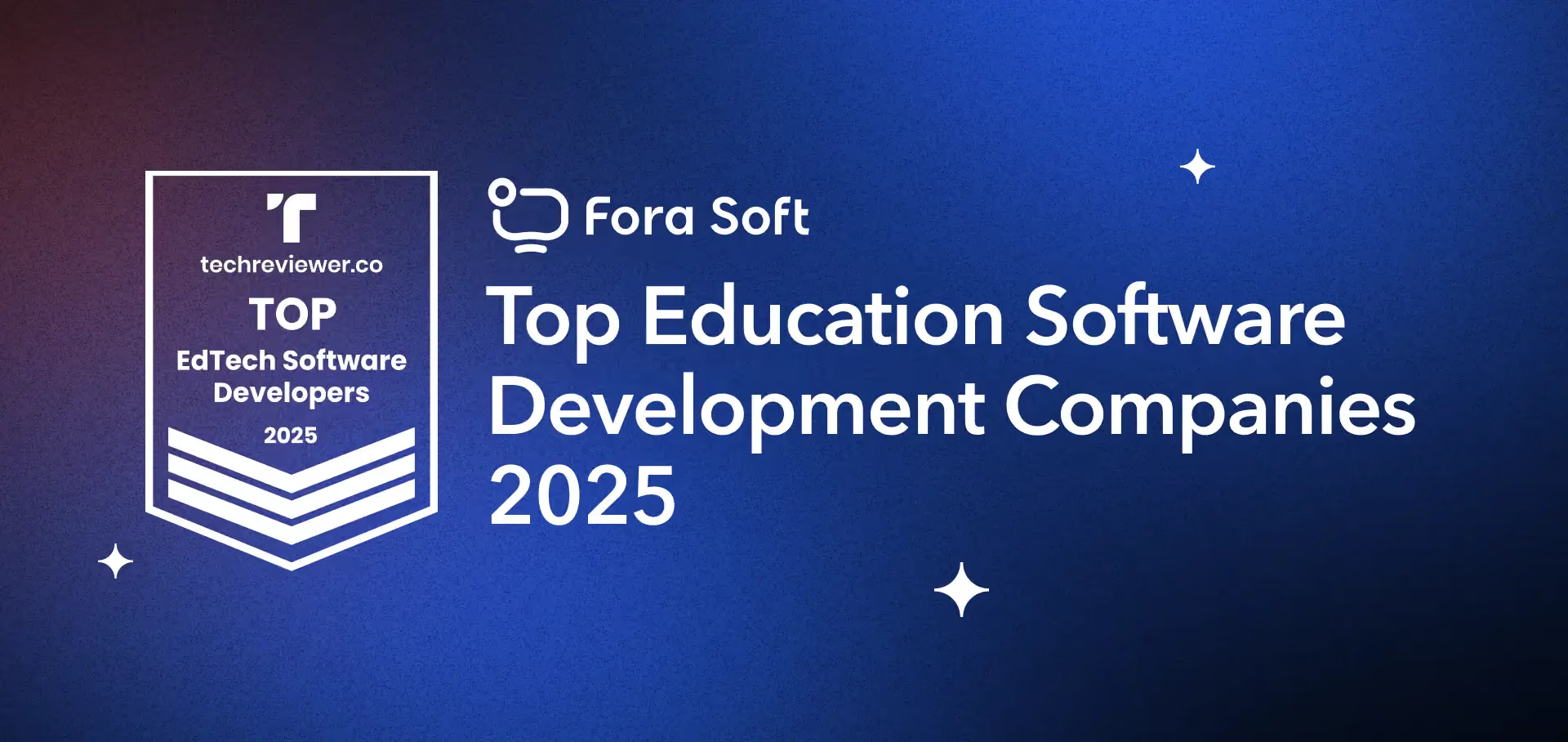
Techreviewer.co’s 2025 Top Education ranking is a useful third-party signal — their editorial team evaluates technical depth, portfolio breadth, and verified client outcomes. But the real evidence is a portfolio that includes Scholarly’s 2,000-student live lectures, BrainCert’s Brandon Hall Awards, and ALDA’s HBCU deployments. This playbook is what we’d tell a buyer who just pulled up that ranking and is trying to figure out who can actually ship.
If you already have a shortlist, skip to the 7-point rubric in section 04 and use it to eliminate pretenders in an hour. If you don’t, start with the LMS-vs-custom decision matrix in section 05.
Talk to an education-software specialist
Bring us your learner count, your integration list, and your compliance footprint — we’ll tell you in 30 minutes whether a custom build or an LMS-plus-layer is the right answer.
What the Techreviewer Top Education 2025 ranking actually measures
Techreviewer.co is an editorial B2B research platform that publishes category rankings based on a multi-signal review: technical depth (stack, engineering practices, architecture patterns), portfolio evidence (named projects, measurable outcomes, client testimonials), team maturity (experience distribution, retention, domain specialization), and industry presence (conference activity, thought leadership, certifications).
Their Education category is narrower than a generic “software development” ranking — the 2025 shortlist is specifically firms with shipped learning products, not firms that occasionally build a course marketplace for an agency client. That narrowness is the value. It eliminates generalists.
What being in the 2025 ranking tells a buyer: Fora Soft’s education portfolio and engineering practice passed independent review during a year when AI-native learning tools, hybrid-class delivery, and district-scale compliance all raised the bar. What it doesn’t tell you: whether our patterns match your institutional constraints. That’s what the rubric and decision matrix below are for.
Why education software is genuinely hard
Four overlapping constraints trip up teams that haven’t shipped education products before.
Peak-load scheduling
Unlike consumer apps with smooth traffic curves, schools and universities generate synchronized spikes. 800 students log in at 09:00 on a Monday. 5,000 take the same online exam at the same time. Your infrastructure has to absorb that without degrading. If the vendor hasn’t handled it before, they budget for average load and everything burns during finals week.
LMS, SIS, and SSO integration sprawl
Real institutions already run Canvas, Blackboard, Moodle, or D2L Brightspace. They have student information systems — Banner, PeopleSoft, PowerSchool. They require SSO via SAML, OIDC, or Shibboleth. LTI 1.3 is the standard deep-integration protocol. A specialist vendor talks about all of this in the first call. A pretender learns it on your dime.
Compliance sprawl
K-12 in the US wants COPPA for under-13s, FERPA for student records, and state-specific student data privacy laws (ex. California SOPIPA, New York Ed Law 2-d). Higher ed wants FERPA, ADA/Section 508 accessibility, and often HIPAA when health data crosses over. Europe wants GDPR with data-residency controls. A real edtech vendor has a compliance matrix in their discovery deck. A generalist is still figuring it out.
Low-bandwidth learners
Students learn on school Chromebooks, parents’ old iPads, and home broadband that doubles as a Netflix fleet for the whole family. Naive WebRTC video dies on those networks. Serious edtech products ship adaptive bitrate, simulcast, audio-only fallback, and offline-capable modes — or they lose the students on the low end.
A 7-point rubric for vetting education software vendors
Apply this to any Techreviewer, Clutch, or GoodFirms shortlist. A real specialist hits 5+; a systems integrator pretending to be an edtech vendor lands below 4.
01 — Can they articulate the LMS-vs-custom tradeoff for your use case?
Ask: “Would you recommend we fork Moodle, build on top of an LMS via LTI, or go custom?” A specialist answers with your learner population, compliance, integration count, and 3-year cost curve. A pretender defaults to “custom is always better.”
02 — Do they speak LTI 1.3, SCORM, and xAPI?
These are the content-interop standards that make learning products portable. LTI 1.3 for deep integration, SCORM for packaged course content, xAPI (Tin Can) for learning-activity telemetry. If the vendor waves these off, they haven’t shipped at institutional scale.
03 — Can they show live-class architecture that scales past 1,000 participants?
Live lectures at 200 students use one architecture. At 2,000 it’s a completely different one (WebRTC ingest + LL-HLS egress, tiered SFU). Ask for capacity planning artifacts, not demos.
04 — How do they handle academic integrity and proctoring?
Online proctoring integrations (Honorlock, Respondus, Proctorio), webcam verification, lockdown browser behavior, plagiarism detection hooks (Turnitin), AI-generated content detection — this is a whole surface. A specialist has opinions.
05 — Can they ship AI features without shipping AI hallucinations to students?
AI-assisted grading, AI tutoring, AI syllabus generation, adaptive learning paths — all useful, all risky. A serious edtech team has guardrails: domain-scoped prompts, human-in-the-loop review, retrieval-augmented generation grounded in the course material, and analytics that flag model drift.
06 — Do they handle the accessibility story proactively?
WCAG 2.2 AA is the 2026 floor for education products. Screen-reader support, keyboard navigation, captioning, transcript generation, dyslexia-friendly fonts, high-contrast modes — all of it needs to be baked in, not bolted on. Ask for their accessibility review process.
07 — What does their compliance matrix look like?
Ask for a table listing FERPA, COPPA, GDPR, CCPA, HIPAA, ADA/Section 508, state student-data laws — and their default posture on each. A specialist shares it without hesitation. A pretender sends marketing language.
Decision matrix — LMS, LMS-plus-layer, or custom build
The single most expensive decision in edtech is the architecture one: adopt an off-the-shelf LMS, extend an LMS with a custom overlay, or build from scratch. Here’s how we advise in scoping calls.
| Pattern | Best for | Watch out for | Typical 2026 cost |
|---|---|---|---|
| Off-the-shelf LMS (Canvas, Moodle, D2L, Blackboard) | Standard-shape coursework, budget-conscious institutions, rapid rollout | Hard to differentiate, UX frozen by vendor, integration quirks | $30k–$80k setup + license |
| LMS + custom layer via LTI 1.3 | Institutions with an existing LMS who need novel features (AI tutor, VR lab, custom analytics) | LTI gaps for rarer data, version lag across LMS platforms | $80k–$220k for the layer |
| Moodle fork or plugin suite | Heavy UX customization with open-source cost model, self-hosting flexibility | Moodle upgrades, plugin compatibility, PHP stack ops burden | $120k–$280k |
| Custom build (like Scholarly, BrainCert) | Novel product categories (AI tutors, VR labs, adaptive-learning platforms, district-specific workflows) | Highest upfront cost, need strong product ownership, longer time-to-value | $220k–$750k+ |
See our deep dive in Moodle or custom LMS development.
2026 cost model for education software
These ranges are what we see in 2026 scoping calls. Agent-assisted engineering (Claude Code, Cursor, Copilot Workspace) has trimmed 20–35% off 2024 baselines on well-scoped work — with the savings reinvested in accessibility testing and telemetry.
| Scope | 2026 range (USD) | Timeline | Example |
|---|---|---|---|
| Virtual classroom MVP (web + mobile, small-group live classes) | $80k–$130k | 3–5 months | Tutor marketplace, small-cohort bootcamp |
| Custom LMS with course authoring, SCORM/xAPI, assessments | $130k–$220k | 5–8 months | Corporate training platform, alt-cred issuer |
| Production learning platform with live classes, LMS/SIS integration, AI features | $220k–$420k | 7–12 months | Scholarly, BrainCert-class platforms |
| District or university-scale platform (1000+ concurrent classes, full compliance) | $420k–$750k+ | 10–18 months | Statewide K-12 rollouts, large-university LMSs |
Two hidden costs buyers miss: peak-capacity headroom (infrastructure sized for exam week, not the monthly average), and accessibility remediation after a launch (much more expensive than building accessibility in from the start).
Mini case — Scholarly: 2,000-student live lectures and AWS EdTech APAC winner
The ask. An Australian client needed a unified learning platform to replace the Zoom + Discord + homegrown LMS stack their top schools were stitching together. Requirements: live lectures for up to 2,000 concurrent students, adaptive streaming for Australian home broadband, virtual whiteboards, quizzes, and tight integration with their existing LMS and CRM.
The build. We built a hybrid ingest-and-egress media stack (WebRTC ingest for the instructor, LL-HLS egress for large audiences) with tiered SFU routing, adaptive bitrate, audio-only fallback for low-bandwidth students, and synchronized whiteboard state over WebSocket CRDTs. Integrations shipped with LTI 1.3 for LMS handoff and custom CRM hooks for student lifecycle events. Infrastructure was sized for exam-week peaks, not averages.
The result. Scholarly supports 15,000+ active users with 2,000-student live lectures, is trusted by Sydney’s top selective schools, and won AWS’s “Most Innovative EdTech Startup in Asia Pacific”. Full story in our Scholarly case study.
Mini case — BrainCert: first LMS built on WebRTC, now $10M+ platform
The ask. A US startup wanted to replace Flash-based virtual classrooms with something browser-native — and turn it into a full LMS capable of corporate training, compliance-grade recording, and feature-rich interactive whiteboards.
The build. We co-built what became the first LMS on WebRTC — custom SFU routing, synchronized whiteboard state, recording pipeline with post-session transcoding, scalable video classes for hundreds of concurrent students per session, and an AI-tutor layer on top. Compliance scope covered GDPR, HIPAA, SOC 2, and ISO 27001 — audited and certified.
The result. BrainCert is a $10M+ platform serving 100,000+ customers, won three Brandon Hall Awards, and ranks as a leader on both G2 and Capterra. Deep dive: BrainCert case study.
Mini case — ALDA: AI syllabus assistant adopted by HBCUs
The ask. Faculty at US colleges and universities needed an AI assistant that could help them build and update syllabi and course materials — without the hallucination risk of a generic LLM and with institutional templates that matched each college’s style.
The build. ALDA generates complete course outlines, lectures, and assessments from short faculty prompts, with institution-specific templates layered on top. The system uses retrieval-augmented generation grounded in the institution’s existing course materials to keep outputs aligned with curriculum requirements, not off-the-shelf LLM priors.
The result. ALDA is used by 70+ educators in an exclusive pilot, backed by sponsors including D2L, VitalSource, and Engageli, and has been adopted by major HBCUs. Faculty report saving hours per week on syllabus prep while improving student engagement with more consistently structured materials.
Education sub-sectors where we go deep
Education is a category with distinct sub-patterns. Each has its own constraints and winning architectures.
K-12 and schools
COPPA, FERPA, and state-by-state student data privacy; Chromebook-first device profiles; parent portals and guardian consent; teacher-workload-aware UX. Classroom engagement tooling often leads, with LMS following.
Higher education
SIS integration (Banner, PeopleSoft, Jenzabar), SSO via Shibboleth or SAML, tight LMS coexistence (Canvas/D2L/Blackboard), accreditation-audit data exports. See e-learning software development.
Corporate training and compliance
SCORM/xAPI-packaged content, single-sign-on against corporate IdPs, audit-grade compliance reporting, role-based learning paths. Most engagements here are LMS-plus-layer or custom LMS.
Tutoring marketplaces and coaching
Matching algorithms, 1:1 and small-group video, scheduling with time-zone support, payments with session-based billing. See our custom e-learning & virtual classroom development practice.
Professional credentialing and alt-cred
Proctoring integrations, fraud detection, credential verification on issuance, badge platforms with Open Badges 2.0 / LER compatibility.
AI-native learning products
AI tutors, syllabus generators, adaptive assessment, AI-content detection. See AI integration and LiveKit AI agent development.
Pick the right sub-sector architecture
Tell us the sub-sector and the learner count — we’ll sketch the architecture, integration plan, and compliance envelope in one call.
Compliance matrix — what serious edtech teams handle by default
This is the minimum compliance surface for a production edtech product in 2026. A vendor should be able to talk through each row without a lawyer in the room.
• FERPA (US higher ed and K-12). Student educational records protected; directory-information opt-outs, parent access rights under 18, eligible-student transition, audit logs for PII access.
• COPPA (US K-12 under 13). Parental consent flows, no behavioral advertising, data minimization, verifiable deletion requests.
• State student data privacy laws. California SOPIPA, New York Ed Law 2-d, Illinois SOPPA, Texas HB 2610 — contract language that survives state procurement review.
• GDPR (EU learners). Lawful basis, data-subject rights workflow, data-processor agreements, data residency controls, cross-border transfer mechanisms.
• ADA / Section 508 / WCAG 2.2 AA. Screen-reader support, keyboard navigation, captioning, color-contrast compliance, periodic accessibility audits.
• SOC 2 and ISO 27001. Security controls that an institution’s IT security team expects before procurement closes — logging, access review, incident response playbooks.
• HIPAA (when health data crosses into ed tech). Business associate agreements, PHI-aware storage/logging, encryption in transit and at rest.
The 2026 edtech stack we deploy
Web and mobile clients
Next.js or Nuxt for instructor/learner web; React Native or native iOS (SwiftUI + Swift concurrency) and Android (Jetpack Compose); WCAG 2.2 AA baked in; offline-first where lessons need to run on patchy connections.
Live-class media plane
WebRTC via mediasoup, Janus, LiveKit OSS, or Agora (per scoping call); hybrid WebRTC ingest + LL-HLS egress for large lectures; simulcast + SVC for adaptive quality; audio-only fallback for low-bandwidth students.
Backend services
Node.js or Go for orchestration; PostgreSQL + pgvector for content embeddings; Redis for rate-limiting and queues; BullMQ for background jobs; OpenTelemetry for observability; Pino for structured logs.
AI layer
LLM-agnostic orchestration (Claude, GPT, Gemini, open-source) with retrieval-augmented generation; guardrails on prompts and outputs; analytics that surface model drift; human-in-the-loop review where stakes are high (grading, content generation for assessments).
Integrations
LTI 1.3 for LMS deep integration; SCORM 1.2/2004 and xAPI for content exchange; SAML/OIDC/Shibboleth for SSO; SIS connectors for Banner, PowerSchool, Blackbaud, PeopleSoft.
Engagement model — fixed-price, T&M, or dedicated team
Fixed-price. Right for tightly scoped MVPs — a single-purpose virtual classroom, a SCORM course authoring tool, a specific assessment module. Wrong for anything with “and eventually we’ll add AI tutoring.”
Time & materials. Right for R&D-heavy work: adaptive learning engines, novel AI features, custom VR/AR labs. Expect weekly burn reports and demo Fridays.
Dedicated team (our most common engagement). Right for institutional-scale products where you own the roadmap and need specialist engineers embedded with your team. Typical 4–10 FTE plus QA, PM, and fractional design. See dedicated development team.
Five pitfalls we see on education builds
01 — Budgeting for average load instead of exam-week peaks
Infrastructure sized for monthly-average traffic collapses when 5,000 students hit the platform at 09:00 Monday after spring break. Size for the peak, not the mean.
02 — Skipping LTI 1.3 because “we’ll bolt it on later”
LMS integration is the single most important distribution surface for education products. Design for LTI 1.3 from day one — retrofitting is painful.
03 — Shipping AI tutors without guardrails
A hallucinating AI tutor that teaches students incorrect facts is worse than no AI at all. RAG grounded in vetted course material, human-in-the-loop review, and drift analytics are mandatory.
04 — Treating accessibility as a launch blocker, not a design constraint
Retrofitting WCAG 2.2 AA after a launch costs 5–10x what building it in costs. Design keyboard-nav, screen-reader, and contrast-aware UI from the first Figma file.
05 — Under-investing in instructor workflow
Learner UX gets 90% of the design budget; instructor UX gets 10%. Then instructors don’t adopt the product. Flip the ratio closer to 50/50 — your distribution depends on it.
KPIs for a healthy education build
• Course completion rate — target >60% for self-paced, >85% for instructor-led cohorts.
• Live-class join success rate — target >99% with graceful audio-only fallback.
• Instructor NPS — target >40; below 20 predicts churn from the institution.
• Assessment integrity flag rate — calibrated; too high means false positives, too low means gaming the system.
• Accessibility audit score — WCAG 2.2 AA pass rate; target >95%.
• Support ticket deflection — AI-assisted self-service should absorb 30–50% of routine questions.
• Media quality (MOS for audio, freeze ratio for video) — audio MOS >4.0, freeze <1 second per minute.
Decision framework — pick your edtech partner in five questions
Question 1: Who are the learners — K-12, higher ed, corporate, consumer? Each implies a different compliance and UX baseline.
Question 2: What’s the largest concurrent-session count you need to handle in the first 12 months? This pins the architecture pattern (single-SFU, tiered-SFU, or hybrid broadcast).
Question 3: Which LMS and SIS are in scope for integration? The answer narrows the vendor pool immediately — not every firm does Banner, not every firm does PowerSchool.
Question 4: What’s the AI ambition — a helper chatbot, an adaptive tutor, a full syllabus generator? Helper-level AI is a weekend project; adaptive tutoring is a full roadmap investment.
Question 5: How regulated is the data? FERPA-only, FERPA + HIPAA, FERPA + GDPR, FERPA + state student-data laws? Each layer adds procurement friction that a specialist vendor already knows how to move through.
When a “top education developer” is the wrong pick
Not every education idea needs a specialist shop. If you’re launching a small tutor marketplace where Zoom embedded is good enough, you don’t need a team that’s architected 2,000-student live lectures. If your MVP is a SCORM content library and a checkout flow, a general SaaS team can ship it.
The line is roughly this: if your product will be judged on live-class quality, compliance posture, or institutional-scale reliability, pay for the edtech specialist. If it’s a content discovery or marketplace UX play that happens to serve students, a general team will do just fine.
Why buyers pick Fora Soft off the Techreviewer shortlist
Three reasons turn up in almost every scoping call we close for education workloads:
Depth across live-class media and LMS. We don’t pick one and outsource the other. Scholarly’s 2,000-student lectures and BrainCert’s compliance-certified LMS run on the same team’s engineering backbone. That’s rare.
AI-native but not AI-reckless. ALDA proves we can ship AI features to faculty at HBCUs without hallucinating course content. Our guardrails — RAG grounded in the institution’s materials, human-in-the-loop review, drift analytics — are operational, not aspirational.
Compliance muscle. GDPR, HIPAA, SOC 2, and ISO 27001 on BrainCert. FERPA and state student-data laws on K-12 engagements. Accessibility built in from the first Figma file. Procurement teams stop asking nervous questions after they see the audit trail.
Shortlist us
Bring the hardest question on your edtech roadmap — scale, compliance, or AI guardrails. We’ll tell you what we’d build and how long it takes, no boilerplate.
Education services we run end-to-end
• E-learning software development — custom LMSs, virtual classrooms, assessments, instructor tooling.
• Custom e-learning & virtual classroom — Scholarly/BrainCert-class architecture.
• Video conferencing — 1:1 and group live classes, branded rooms, breakout sessions.
• Video & audio streaming — hybrid broadcast for large lectures, LL-HLS at scale.
• AI integration — AI tutors, syllabus generators, adaptive assessment, content-detection.
• Dedicated development team — specialist edtech engineers embedded with your product team.
• Custom software development — full-cycle builds across web, mobile, desktop, Smart TV.
FAQ
What does the Techreviewer Top Education 2025 ranking mean for clients?
It means Techreviewer’s editorial team reviewed Fora Soft’s education portfolio and engineering practice and included us in their 2025 category ranking. Treat it as one validation signal among several — pair it with reference calls and the 7-point rubric before shortlisting any vendor.
Should we pick an LMS (Canvas, Moodle, D2L) or go custom?
Off-the-shelf LMSs are right when your workflows fit standard course shapes and budget is the main constraint. An LMS-plus-custom-layer via LTI 1.3 is right when you have an existing LMS and need novel features. Custom is right when you’re building a new category (AI-native tutoring, adaptive learning, VR labs). See our Moodle or custom LMS deep dive.
How much does a production learning platform cost in 2026?
A production learning platform with live classes, LMS/SIS integration, assessments, and AI features typically runs $220k–$420k over 7–12 months. District- or university-scale deployments with full compliance and 1,000+ concurrent classes start at $420k and can exceed $750k. Agent-assisted engineering is shaving 20–35% off 2024 baselines on well-scoped work.
Can you scale live classes to 1,000+ concurrent students?
Yes. Scholarly runs live lectures for up to 2,000 concurrent students on a hybrid WebRTC ingest + LL-HLS egress architecture with tiered SFU routing and audio-only fallback. The architecture scales horizontally — above ~5,000 concurrent students we move to multi-region egress.
Do you handle FERPA, COPPA, and state student-data privacy laws?
Yes. Our K-12 and higher-ed engagements include FERPA-aware data handling, COPPA parental consent flows, and contract language that survives state procurement review (California SOPIPA, New York Ed Law 2-d, Illinois SOPPA, etc.). BrainCert is GDPR, HIPAA, SOC 2, and ISO 27001 certified — the same team runs that practice.
Can you ship AI features without AI hallucinations reaching students?
Yes, and this is where ALDA’s design comes in. Guardrails: retrieval-augmented generation grounded in vetted course material, domain-scoped prompts, human-in-the-loop review where stakes are high (grading, syllabus generation), and drift analytics that flag when model outputs deviate from institutional norms.
Do you integrate with Canvas, Moodle, D2L, Blackboard, Banner, PowerSchool?
Yes. LTI 1.3 for LMS deep integration; SCORM 1.2/2004 and xAPI for content portability; SAML/OIDC/Shibboleth for SSO; custom SIS connectors for Banner, PowerSchool, Blackbaud, PeopleSoft. We scope the integration list in discovery and build the connectors as part of the engagement.
What’s the minimum team for a serious edtech product?
A serious learning platform needs, at minimum: 1 backend/media engineer, 1 frontend/mobile engineer, 1 AI engineer (if AI features are in scope), 1 QA with accessibility specialization, and a fractional PM/designer — roughly 4–6 FTE. Below that, you’re either scoping down aggressively or cutting corners on accessibility, compliance, or telemetry.
What to read next
LMS strategy
Moodle or custom LMS development?
How to decide whether to fork Moodle, extend an LMS, or go custom.
Case study
Scholarly — 2,000-student live lectures, AWS EdTech APAC winner
15,000+ users, adaptive streaming, LMS/CRM integration at scale.
Case study
BrainCert — first LMS on WebRTC, $10M+ platform
Brandon Hall Awards, GDPR/HIPAA/SOC2/ISO certified, 100k+ customers.
AI & voice
LiveKit AI agent development
Real-time voice agents for tutoring and learning applications.
Service page
Custom e-learning & virtual classroom expertise
Full practice overview — stack, portfolio, engagement models.
Sum-up
Techreviewer’s 2025 Top Education ranking is a useful third-party signal, but the real evidence lives in the portfolio: Scholarly’s 2,000-student live lectures and AWS EdTech APAC award; BrainCert’s $10M+ platform with Brandon Hall Awards and GDPR/HIPAA/SOC2/ISO certifications; ALDA’s AI-generated syllabi used at HBCUs with faculty guardrails. Those products passed the gauntlet that separates edtech specialists from generalist agencies.
If you’re building a serious education product in 2026 — K-12, higher ed, corporate training, tutoring marketplace, or AI-native learning — use the 7-point rubric, the decision matrix, the compliance checklist, and the KPI cuts in this playbook to pressure-test any shortlist. And if your hardest architectural question would benefit from a 30-minute second opinion from a team that’s shipped at scale — that’s exactly what our scoping calls are for.
Ready when you are
30-minute scoping call, no slides, no sales rep — a senior engineer from the team that would build your edtech product.

