

Key takeaways
• The 2026 LiveKit pricing model is unbundled; Agora’s is flat. LiveKit Cloud charges $0.01 per agent-session minute plus the LLM, STT and TTS you pick; Agora’s Conversational AI Engine is one flat $0.10 per minute with the models baked in.
• A voice-agent minute runs about $0.038–$0.077 on LiveKit vs $0.101 on Agora. LiveKit lands 25–60% cheaper because you can swap in a cheaper model; Agora’s $0.10 buys simplicity you can’t optimize below.
• LiveKit publishes every rate; Agora routes scale to sales. You can forecast a 12-month LiveKit bill from the pricing page. Agora lists per-minute rates but negotiates volume, so your real number needs a sales call.
• Self-hosted LiveKit wins above roughly 1.5M agent-minutes a month. It trades the $0.01 platform minute for a fixed ~$15.5k/mo of infra plus SRE time, worth it only if you already run Kubernetes.
• Hidden costs decide the invoice. Agora bills every participant minute and adds recording per stream; LiveKit meters egress and inference credits apart from agent minutes. Model both before you commit.
Weighing more than these two? We keep all vendor comparisons in one place, priced the same way.
More on this topic: read our engineer’s guide to LiveKit AI agents and the multimodal LiveKit deep-dive.
Why Fora Soft wrote this playbook
Picking the wrong real-time platform is a five-figure mistake you only see on invoice #2, after the migration is written. We’ve shipped voice and video products on both LiveKit and Agora for production clients, so this LiveKit pricing breakdown is the same math we run during scoping, not a rate-card copy-paste.
The clearest proof is Nucleus, an on-prem communication platform we built for the Canadian telecom Fibernetics. It serves 5,000+ businesses with AI phone agents handling 600 million+ call minutes a month under SOC 2, GDPR and HIPAA. At that volume, a $0.02 difference per minute is $12M a year, so the per-minute mechanics on this page are not academic to us. We’ve also run real-time classrooms at scale on BrainCert (100K+ customers, 500M+ classroom minutes) and shipped AI sales video on Meetric.
Fora Soft has delivered 250+ projects since 2005 with 50 in-house engineers, and LiveKit is our current focus for AI voice and video agents. Read this end to end if you’re choosing a partner; jump to the comparison matrix if you just need the LiveKit vs Agora verdict.
LiveKit vs Agora pricing at a glance
For AI-agent workloads — voice agents, live interpreters, ambient meeting bots, the LiveKit vs Agora pricing question comes down to bundling. Agora’s Conversational AI Engine bills a flat $0.10 per active minute, and that price includes the ASR, LLM and TTS (the same rate even if you bring your own model keys). LiveKit Cloud bills $0.01 per agent-session minute plus WebRTC participant minutes at $0.0004–$0.0005, and you pay for inference separately — usually $0.03–$0.07 a minute depending on the models you choose.
So the plain-RTC picture and the AI-agent picture point different ways. For pure peer-to-peer video with no server-side AI, Agora’s RTC rate ($0.99 per 1,000 audio minutes) undercuts LiveKit’s participant minutes. For anything running a turn-taking agent — which is why most teams reach this comparison in 2026, LiveKit usually lands cheaper once you count inference honestly, and it lets you push that inference cost down.
Reach for LiveKit when: you’re building an AI voice or video agent, you want to shop for cheaper models, you need HIPAA or SOC 2, or you want published rates you can forecast without a sales call.
Reach for Agora when: your traffic is concentrated in APAC or LATAM where its SD-RTN edge presence beats LiveKit’s, your product is pure video calling with no server-side AI, or you value one predictable all-in rate over the flexibility to tune models.
The 2026 verdict in one paragraph
If you’re building an AI voice or video agent in 2026, default to LiveKit Cloud: cheaper per minute once you pick your models, transparent published pricing, a HIPAA BAA on the Scale tier, and a plug-in system that lets you swap the LLM. If your app is pure RTC at global scale and most of your traffic starts in APAC or LATAM, Agora’s edge network is worth paying for. And if you consistently run above ~150 concurrent sessions (about 1.5 million agent-minutes a month) with Kubernetes expertise on staff, self-hosted LiveKit quietly becomes the most profitable path. Everything below is the arithmetic behind that paragraph.
Two-minute rule: multiply your projected monthly minutes by each vendor’s effective per-minute AI rate, then add a 35% buffer for inference and egress. If the gap is under 15% of revenue, latency and features matter more than price.
Burning money on Agora minutes?
Send us your last two invoices and peak concurrency. In 30 minutes we’ll tell you whether a LiveKit migration pays back inside a quarter.
How each platform actually charges you
Before comparing dollar figures, get the billing unit right — a 2× unit error is the usual source of invoice-#2 shock. Both platforms meter participant-minutes, but everything on top (AI agents, recording, telephony, inference) uses a different unit on each.
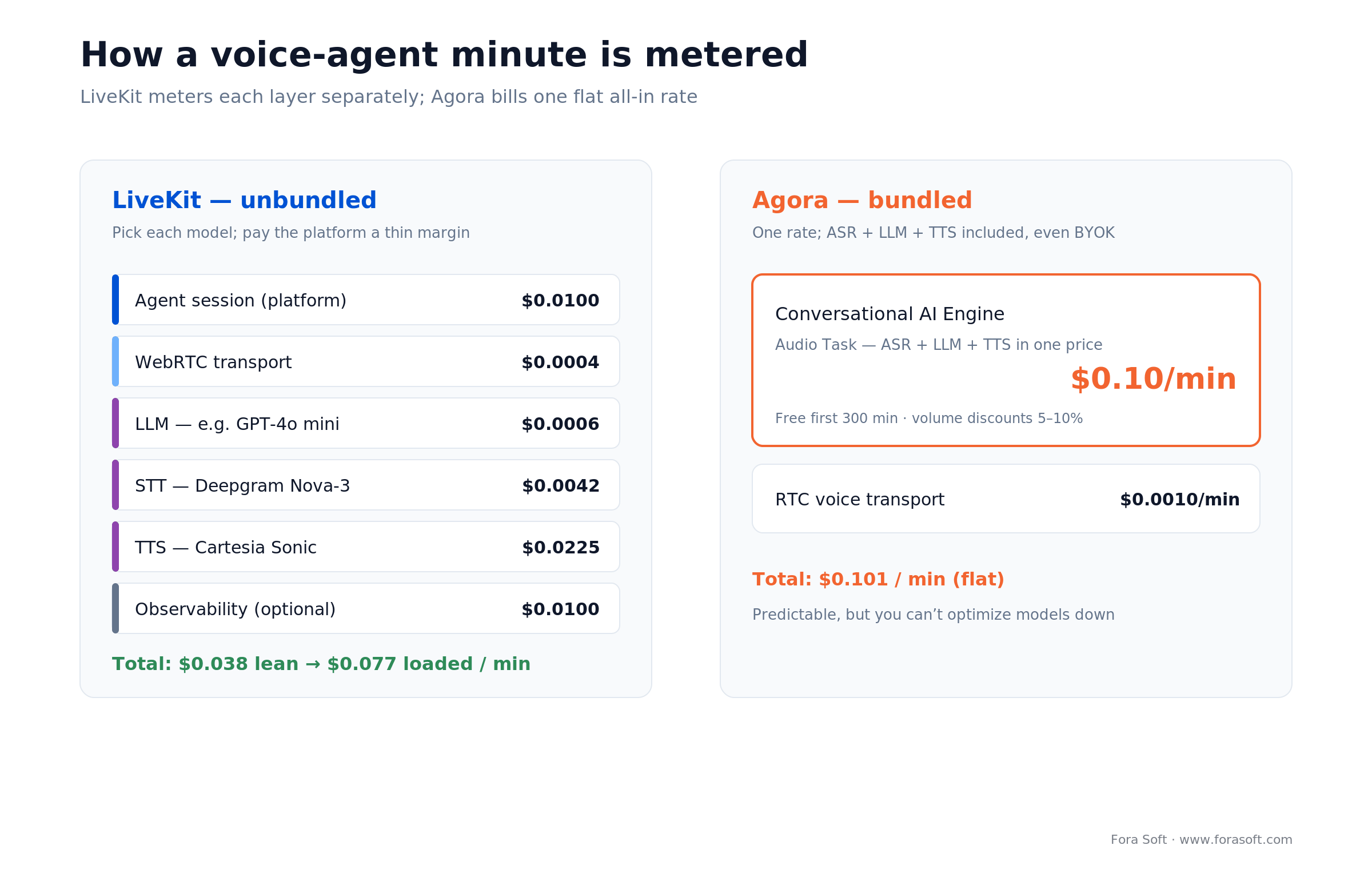
Figure 1. LiveKit meters each layer and lets you pick the models; Agora bills one flat rate with ASR, LLM and TTS included.
LiveKit Cloud: quota plus linear overages
LiveKit Cloud sells a monthly plan (Build, Ship, Scale or Enterprise) that bundles a quota of agent-session minutes, WebRTC participant minutes, downstream bandwidth and LiveKit Inference credits. Anything over quota is metered at published rates. The math is additive and predictable, and per LiveKit’s pricing page the $0.01 agent minute already covers hosting, unlimited data transfer to and from the agent, and observability.
Agora: per-service usage with a bundled AI rate
Agora gives new projects a 10,000-minute monthly free bucket for RTC products. Beyond that, each service — RTC audio, RTC video, Conversational AI Engine, recording, signaling — is billed on its own rate. The 2026 shift is the AI Engine: instead of charging ASR and audio pipeline separately, Agora now bills one $0.10 per-minute Audio Task with the models included (its docs confirm the same price applies even with bring-your-own-key). The CAI free tier is only 300 minutes, separate from the 10,000 RTC minutes.
Self-hosted LiveKit: infrastructure plus operations, no platform fee
The LiveKit server and Agents framework are Apache 2.0. You pay for cloud or bare-metal VMs, bandwidth at raw provider rates (roughly $0.001–$0.09 per GB on Hetzner or DigitalOcean vs $0.10–$0.12 on Cloud), and the engineering hours to run it. You still pay your LLM, STT and TTS vendors, but nothing to LiveKit itself. Agora has no self-host option for its AI Engine.
LiveKit Cloud pricing tiers in 2026
LiveKit pricing splits into four published tiers plus a la carte overages. Every tier includes SFU routing, agent-session orchestration, recording, SIP telephony and the LiveKit Inference gateway for LLM, TTS and STT calls.
| Tier | Monthly fee | Agent minutes | WebRTC minutes | Inference credits | Best for |
|---|---|---|---|---|---|
| Build | $0 | 1,000 / mo | 5,000 / mo | $2.50 (~50 min) | POC / MVP |
| Ship | $50 | 5,000 / mo, then $0.01 | 150,000 / mo, then $0.0005 | $5 (~100 min) | Small production apps |
| Scale | $500 | 50,000 / mo, then $0.01 | 1.5M / mo, then $0.0004 | $50 (~1,000 min) | Growing SaaS, HIPAA |
| Enterprise | Custom | Custom | Custom | Volume, incl. inference | SSO, residency, SLA |
LiveKit overage rates worth memorizing
Agent-session minutes: $0.01 per minute over quota — the number you multiply by projected usage to ballpark a voice-agent bill. WebRTC participant minutes: $0.0005 (Ship) to $0.0004 (Scale) — low enough that most agent apps barely feel it. SIP telephony: $0.003–$0.004 per minute plus pass-through PSTN. Recording: $0.005 per agent-session minute; RoomComposite export runs $0.015–$0.02 per video minute. Downstream bandwidth: $0.10 (Scale) to $0.12 (Ship) per GB, and upstream is now free — a 2026 change that mainly helps voice AI.
HIPAA and SOC 2 Type II sit on the Scale tier ($500/mo) and Enterprise, so regulated workloads have a hard floor of $500 a month before usage. If you need a signed BAA, budget for Scale from day one.
Agora pricing in 2026: RTC plus the AI Engine
Agora sells two things that get conflated: classical RTC (the original product) and the newer Conversational AI Engine. Build an AI voice agent and you pay for both, per minute, stacked.
| Service | Rate | Unit | Notes |
|---|---|---|---|
| Conversational AI Engine | $0.10 | per minute | ASR + LLM + TTS included; same with BYOK |
| RTC audio | $0.99 | per 1,000 min | Participant-minute basis |
| RTC video HD | $3.99 | per 1,000 min | Up to 720p |
| RTC video Full HD | $8.99 | per 1,000 min | 1080p |
| Cloud recording (audio) | $1.49 | per 1,000 min | Billed per stream |
| Real-Time STT (standalone) | $16.99 | per 1,000 min | Only if used outside CAI |
The number that matters for agents is the $0.10 CAI minute. Add the RTC audio minute that carries the caller ($0.00099) and one active agent minute is about $0.101, models included. The free tier softens onboarding — 300 CAI minutes plus 10,000 RTC minutes a month — but neither dents a production bill. Volume discounts of 5–10% kick in above 100,000 CAI minutes a month, and Agora shipped Conversational AI Engine v2.5 on 1 April 2026 with revised preset bundles, so audit your effective rate if your contract predates it.
Not sure which platform your numbers favour?
Send us your projected minutes, peak concurrency and recording policy. We’ll return a side-by-side LiveKit vs Agora cost model — usually within 48 hours.
The comparison matrix, line by line
This is the matrix clients ask for three weeks into evaluation, when they still can’t decide. It compares the seven axes that actually drive a LiveKit vs Agora choice for an AI-agent product.
| Axis | LiveKit Cloud | Agora | Self-hosted LiveKit |
|---|---|---|---|
| AI-agent minute | $0.01 + inference you pick | $0.10 all-in | Infra + inference only |
| Pure RTC audio minute | ~$0.0004 | ~$0.00099 | Bandwidth only |
| Model choice | Plug-in: OpenAI, Gemini, Deepgram, Cartesia… | Preset bundles (BYOK, same price) | Anything you wire |
| Turn-taking latency | Sub-500 ms | ~650 ms | Matches Cloud |
| Compliance ceiling | SOC 2, HIPAA BAA (Scale+) | Enterprise / MSA | Whatever you build |
| Global edge | Growing mesh, sub-250 ms | SD-RTN, 200+ countries | You deploy regions |
| Price transparency | Public, every tier | Public to ~100k min, then sales | Your cloud invoice |
Reach for self-hosted LiveKit when: you already run Kubernetes, your concurrency stays above ~150 sessions (roughly 1.5M agent-minutes a month), and you’d rather pay DevOps salary than platform margin.
What one voice-agent minute really costs
Here is the arithmetic behind the headline. On LiveKit a lean pipeline — GPT-4o mini for the LLM, Deepgram Nova-3 for STT, Cartesia Sonic for TTS, adds up like this at Scale rates: $0.01 agent + $0.0004 WebRTC + $0.0006 LLM + $0.0042 STT + $0.0225 TTS ≈ $0.038 per minute. Swap in premium models plus telephony and observability and LiveKit’s own published example reaches $0.0769 per minute. Agora is a flat $0.101 per minute (CAI plus one RTC minute), models included.
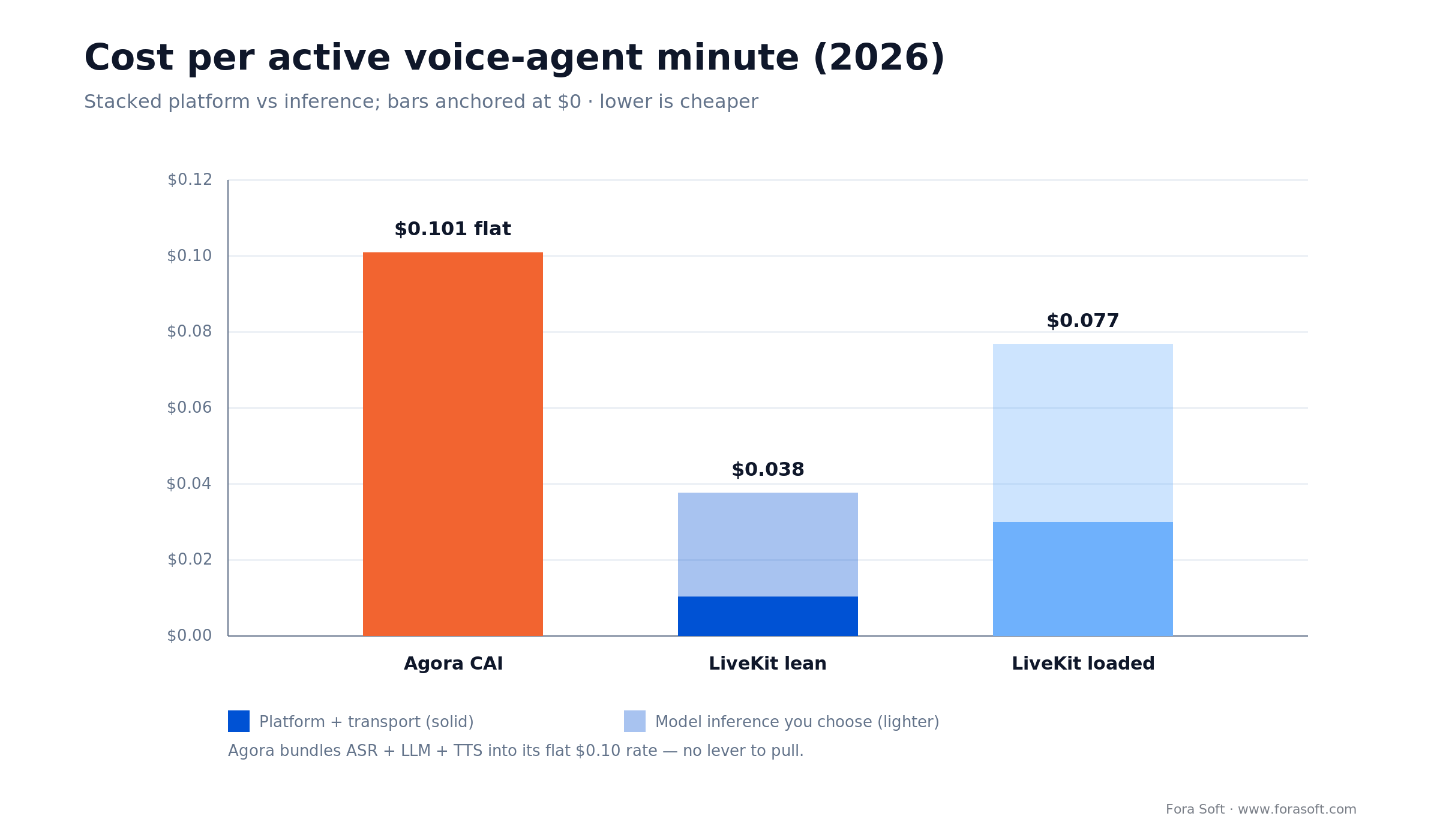
Figure 2. Agora’s flat $0.10 towers over a lean LiveKit pipeline; even a loaded LiveKit stack stays under it. The lighter segment is inference you can tune.
The honest caveat: Agora’s $0.10 buys a curated premium preset, so comparing it to LiveKit’s $0.038 lean stack is not quite apples-to-apples on model quality. Match Agora’s likely GPT-4o-class LLM and a premium TTS and LiveKit lands nearer $0.06–$0.077, still under $0.10, but the gap narrows. The real difference is the lever: on LiveKit you can move it; on Agora you can’t.
Cost model 1: 100 concurrent voice-AI users
Scenario: a mid-market SaaS running an AI support voice line. 100 concurrent sessions, 8 hours a business day, 20 business days a month — 960,000 billable agent-minutes. One human caller and one AI agent per session, so agent minutes match participant minutes 1:1.
Agora: 960,000 × $0.10 = $96,000 CAI, minus the 7% volume discount in the 500K–1M band ≈ $89,280, plus $950 RTC = ~$90,200 a month, models included. LiveKit Cloud Scale (lean models): $500 base + $9,600 agent minutes + $384 WebRTC + $26,200 inference (GPT-4o mini + Deepgram + Cartesia at ~$0.0273/min) = ~$36,700 a month. Move to premium models and LiveKit rises to roughly $65,000 — still below Agora.
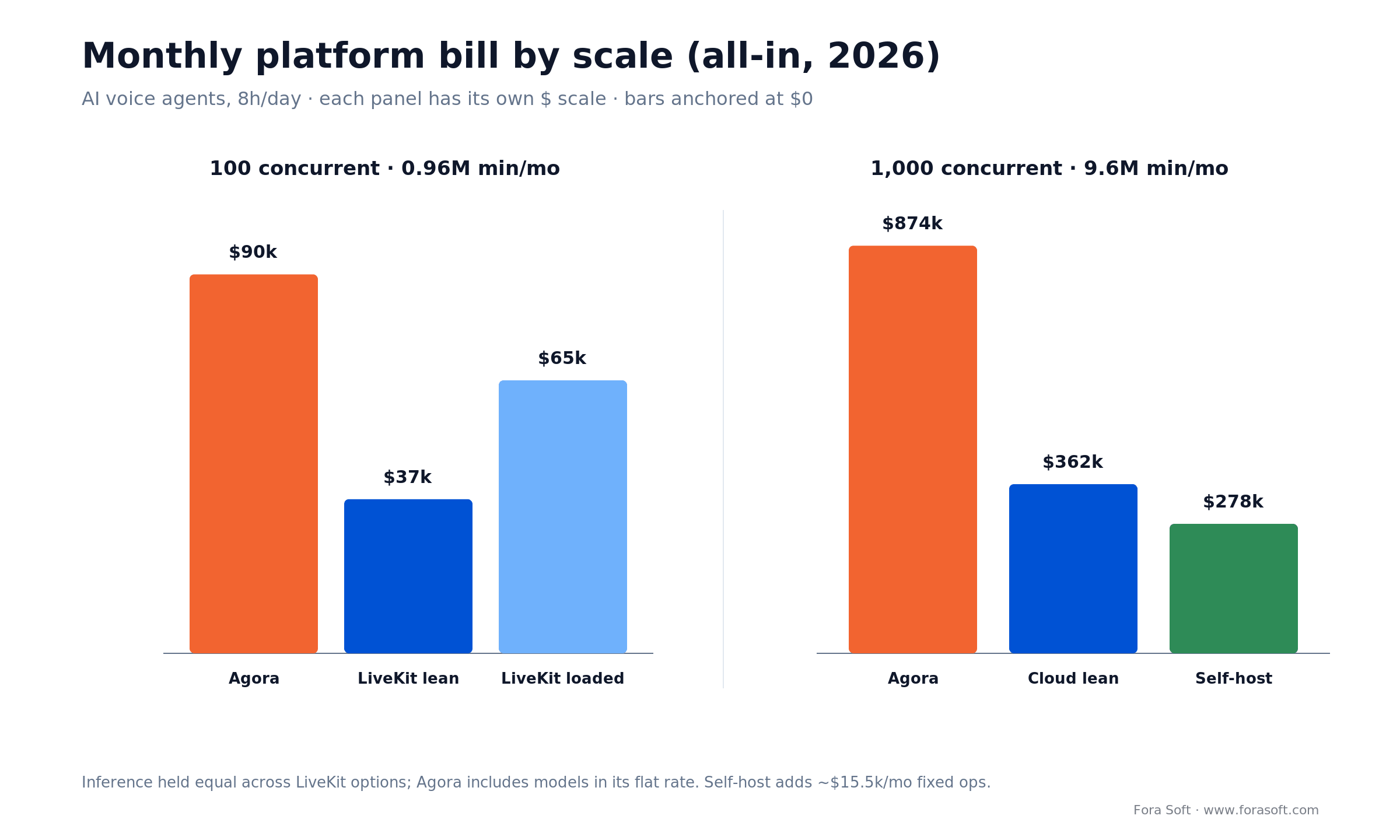
Figure 3. The platform-layer gap widens with scale. At 1,000 concurrent, self-hosting pulls clear of managed Cloud.
At 100 concurrent, LiveKit saves roughly $25,000–$53,000 a month depending on the models you run. Inference is the biggest slice of the LiveKit invoice, so tuning your prompt and picking a smaller model is worth more than switching vendors.
Cost model 2: 1,000 concurrent users
Scale the same scenario 10× — 9.6 million agent-minutes a month — and the structural gap gets loud.
| Line item | LiveKit Cloud Scale | Agora | Self-hosted LiveKit |
|---|---|---|---|
| Platform fee | $500 | $0 (usage MSA) | $0 |
| Agent / CAI minutes | $96,000 | $864,000 (10% discount) | $0 |
| RTC / WebRTC minutes | $3,840 | $9,500 | $0 |
| Infra (VMs, bandwidth) | $0 | $0 | ~$3,500 |
| DevOps (1.0 FTE) | $0 | $0 | ~$12,000 |
| Inference (held equal) | $262,000 | included above | $262,000 |
| Monthly total | ~$362,000 | ~$874,000 | ~$278,000 |
At 1,000 concurrent, LiveKit Cloud is roughly $510,000 a month cheaper than Agora on the all-in number, and self-hosted LiveKit shaves another ~$85,000 off Cloud, but only if your org already handles Kubernetes, multi-region deployment and 24/7 on-call for media servers. Note the honest framing: Agora bundles inference into its rate, so for a fair total we hold inference equal across the LiveKit columns rather than pretending self-hosting makes model calls free.
Staring at a six-figure real-time invoice?
Send us your last two bills and peak concurrency. In 30 minutes we’ll tell you whether a LiveKit migration pays back inside a quarter.
Self-hosted LiveKit: when open source pays off
LiveKit Server is Apache 2.0. You can run it on a single $60/mo droplet for prototyping or a multi-region Kubernetes mesh in production. A 4-core / 8 GB worker comfortably handles 10–25 concurrent agent jobs; a single mid-size cloud VM serves roughly 200 audio-only participants before you scale out.
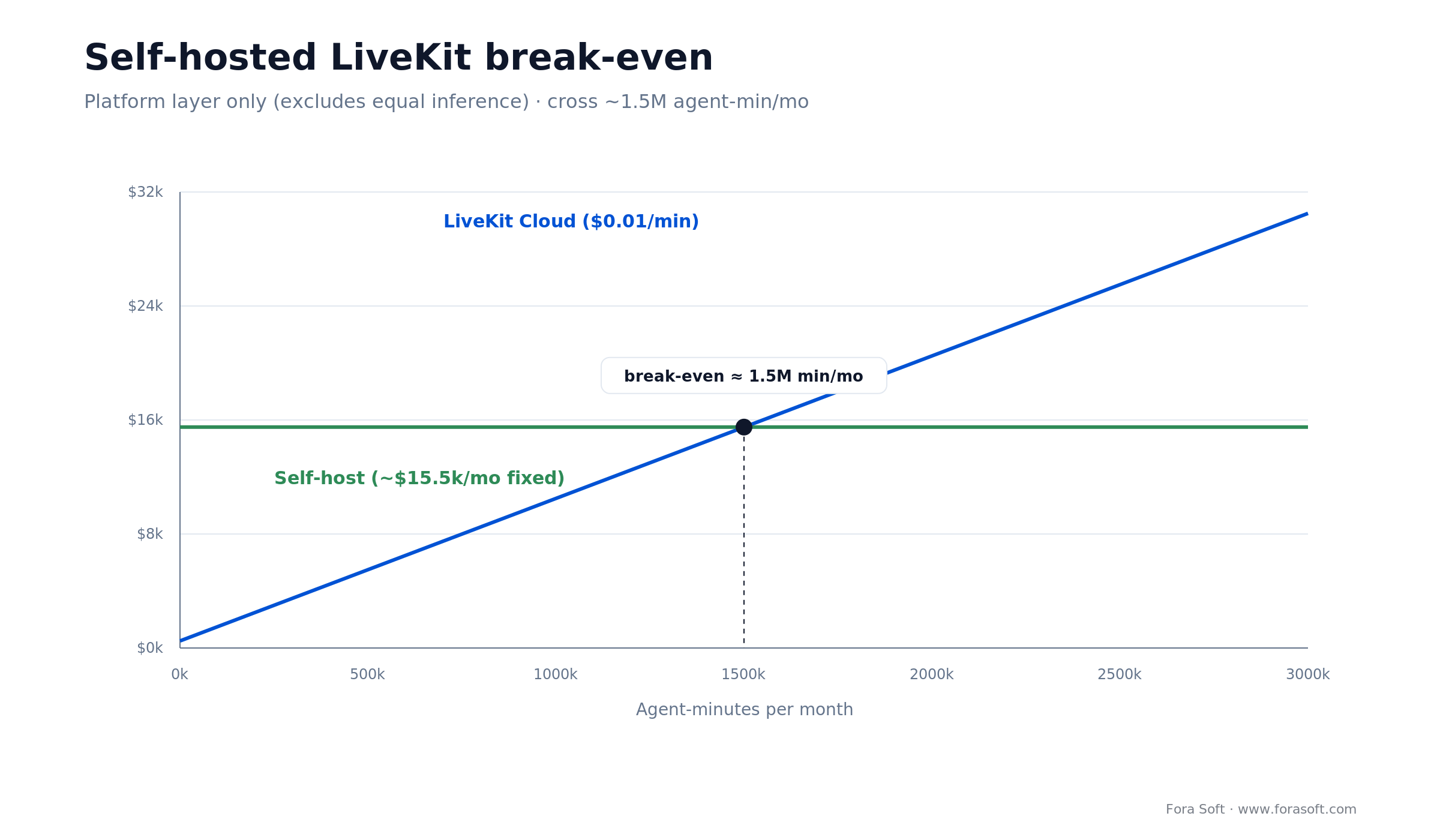
Figure 4. Self-hosting swaps LiveKit’s $0.01 agent minute for a fixed ~$15.5k/mo. Below ~1.5M minutes, Cloud is cheaper; above it, self-host wins.
What self-hosting actually costs
Hosting. On Hetzner AX-series bare metal, bandwidth is ~$0.001 per GB and a 16-core machine is roughly €39/month; a production voice-AI cluster (3–4 mid VMs + Redis + a load balancer) runs $1,500–$3,500/mo for 1,000 concurrent sessions. Engineering. Plan on 0.5–1.0 FTE of SRE time — the line most build-vs-buy spreadsheets forget. At a conservative $150k loaded cost, that’s $75k–$150k a year. Break-even. Self-hosting trades LiveKit’s $0.01 agent minute for ~$15.5k/mo of fixed cost, so it pays off past about 1.5 million agent-minutes a month, roughly 150 concurrent sessions during business hours.
Using Agent Engineering we ship a multi-region self-hosted LiveKit cluster with monitoring, autoscaling and SIP ingress in 4–6 weeks for most clients. See our LiveKit AI agent development service for how we scope these engagements, or the LiveKit development guide for the build view.
Feature parity beyond price
Price only matters if both platforms clear your feature bar. On the core — SFU media, recording, SIP telephony, cross-platform SDKs — they’re close. The differences that move a decision:
Model flexibility. LiveKit’s plug-in system lets you mix OpenAI, Gemini, Deepgram, Cartesia, ElevenLabs and your own endpoints per feature. Agora ships curated preset bundles; you can bring your own keys, but the $0.10 rate holds either way. Live translation splits the same way — Agora sells it as a product, LiveKit expects you to run an agent — and we compare the hook points in our real-time video translation integration playbook.
Edge presence. Agora’s SD-RTN spans 200+ countries and is the reason to pay its premium if your users sit in APAC or LATAM. LiveKit’s mesh is growing and hits sub-250 ms globally, but Agora still owns the hardest last-mile regions.
Compliance. LiveKit puts SOC 2 Type II and a HIPAA BAA on Scale, self-serve. Agora handles the same through enterprise agreements. For a regulated build, LiveKit’s $500 Scale tier is the faster path to a signed BAA. We cover the same ground for streaming stacks in our video & audio streaming service.
Hidden costs and gotchas we hit in production
Agora bills every participant. A 4-person call for 30 minutes is 120 participant-minutes, not 30. Multi-party agent scenarios multiply fast.
Cloud Proxy has a floor. If your users sit behind strict firewalls and you force TCP/TLS 443, Agora’s Cloud Proxy carries a minimum monthly base fee — $500 at up to 200 peak users, rising by tier. Automatic mode is free, so most teams avoid it, but enterprise deployments trip it.
Recording multiplies. On Agora, cloud recording is billed per stream at $1.49–$13.49 per 1,000 minutes; record a busy room and it stacks. LiveKit’s $0.005 agent-session recording is simpler but transcode export is separate.
LiveKit egress and inference are metered apart. The $0.01 agent minute does not include downstream bandwidth ($0.10–$0.12/GB) or inference credits. Send 720p to many receivers and egress, not minutes, becomes your top line item. Budget both.
Agora’s scale pricing is negotiated. Public rates stop around 100,000 monthly minutes; past that you can’t forecast without sales, which complicates board-ready projections.
Pick the right platform in five questions
1. Are you running a server-side AI agent? Yes → LiveKit usually wins on cost and model choice. No, it’s pure calling → Agora’s RTC rate is competitive.
2. Where do your users connect from? Heavy APAC/LATAM → Agora’s edge earns its premium. Mostly US/EU → LiveKit’s mesh is plenty.
3. Do you need a signed HIPAA BAA or SOC 2? Yes → LiveKit Scale ($500/mo) is the fast self-serve path. Agora routes it through enterprise sales.
4. Can you forecast spend without a sales call? Must-have → LiveKit publishes every rate. Comfortable negotiating → Agora’s volume deals can beat list.
5. Do you run Kubernetes and cross 1.5M agent-minutes a month? Both yes → self-hosted LiveKit is the most profitable path. Either no → stay on managed Cloud. Still unsure? That’s exactly the 30-minute call we run, so book a scoping session and we’ll model it with your numbers.
Mini case: scoping a 600-seat AI phone line
Situation. A services company wanted an AI receptionist across 600 concurrent phone lines, 12 hours a day, with HIPAA on the table and a finance team that needed a defensible 12-month number. They had an Agora quote and a gut feeling it was too high.
Plan. We modelled both platforms on their real traffic (~2.6M agent-minutes a month). Agora’s all-in CAI came to roughly $260k a month. On LiveKit Scale with a Deepgram + GPT-4o-mini + Cartesia pipeline we projected ~$110k a month including inference, and flagged that past their volume, self-hosting would drop it under $90k once a half-time SRE was funded. We grounded the numbers in what we run on Nucleus, where AI phone agents already handle 600M+ minutes monthly under HIPAA.
Outcome. They shipped on LiveKit Cloud Scale, kept the option to self-host at the 1.5M-minute line, and cut the projected first-year platform bill by more than half against the Agora quote. Want the same side-by-side on your traffic? Grab 30 minutes and we’ll build it.
Five pitfalls during platform selection
1. Comparing platform rates and ignoring inference. LiveKit’s $0.01 looks 10× cheaper than Agora’s $0.10 until you add the models. Compare all-in per-minute numbers, not headline rates.
2. Forecasting from list price at scale. Agora negotiates above 100k minutes and LiveKit discounts inference on Enterprise. Your real rate is not the pricing page once you’re big.
3. Missing participant-minute multiplication. Group calls multiply Agora minutes by head count. A model built on 1:1 assumptions understates a multi-party bill badly.
4. Forgetting egress and recording. Video-heavy or record-everything products blow past minute costs on bandwidth. Model egress explicitly, especially on LiveKit.
5. Buying HIPAA you don’t staff. A BAA is table stakes, not compliance. Budget the engineering to actually run encrypted, access-controlled, audited media — the platform tier is the cheap part.
KPIs to measure after you pick
Cost KPIs. Effective cost per active minute (target: under $0.05 all-in for a lean voice agent). Inference as a share of the bill (if it’s over 70%, tune models before switching vendors). Cost per completed conversation, not per minute.
Quality KPIs. Turn-taking latency (target sub-700 ms end to end; users stop noticing the AI below that). Word Error Rate on STT (under 5% on clean audio; our audio-for-video primer covers the metrics that matter). Interruption-handling accuracy on barge-in.
Reliability KPIs. Session completion rate (target above 90%; users abandon broken calls fast). Media-server uptime (LiveKit Cloud publishes 99.99%). Cold-start rate on agent workers, which spikes p95 latency if you don’t pre-warm.
When to not pick either platform
If you only need a single 1:1 video call feature. A thin WebRTC wrapper or a cheaper CPaaS may beat both; you don’t need agent orchestration.
If your volume is under ~500 MAU. Validate demand on a managed free tier before optimizing per-minute rates. Engineering time dwarfs the invoice at that size.
Reach for a managed CPaaS or a thin build when: your usage is tiny, occasional, or a single call feature, so the platform margin is noise next to your engineering time, so optimize for speed to ship, not per-minute price.
If you can’t staff ongoing cost ops. Real-time infrastructure needs continuous tuning of model pricing and availability. If your team can’t budget a quarterly review, stay on managed Cloud and skip self-hosting entirely.
FAQ
Is LiveKit cheaper than Agora?
For AI voice agents, usually yes. A lean LiveKit pipeline runs about $0.038 per active minute versus Agora’s flat $0.101, and even a premium LiveKit stack stays around $0.077. For pure RTC audio with no AI, Agora’s $0.99 per 1,000 minutes is competitive with LiveKit’s participant minutes.
How much does LiveKit Cloud cost per minute?
As of 2026, LiveKit charges $0.01 per agent-session minute plus WebRTC participant minutes at $0.0004–$0.0005, and you add the LLM, STT and TTS you choose. A typical lean voice agent lands near $0.038 per minute all-in; LiveKit’s own fully loaded example is $0.0769 per minute.
What does Agora’s Conversational AI Engine cost?
As of 2026, Agora’s Conversational AI Engine is a flat $0.10 per active minute, and that rate includes the ASR, LLM and TTS models — the same price even if you bring your own model keys. The first 300 minutes are free, and RTC transport is billed separately at about $0.001 per minute.
Does LiveKit have a free tier?
Yes. The Build plan is $0 and includes 1,000 agent-session minutes, 5,000 WebRTC minutes and $2.50 of inference credits (about 50 minutes) per month, with no credit card required. It’s enough to prototype a voice agent end to end.
When is self-hosted LiveKit worth it?
In 2026, self-hosting pays off above roughly 1.5 million agent-minutes a month, about 150 concurrent sessions during business hours. Below that, LiveKit Cloud’s $0.01 minute is cheaper than the ~$15.5k/mo of fixed infrastructure and SRE time self-hosting requires.
Is LiveKit HIPAA compliant?
LiveKit offers a signed HIPAA BAA and SOC 2 Type II on its Scale tier ($500/month) and Enterprise. Agora handles HIPAA through enterprise agreements. Either way, the BAA is the start; you still have to engineer encrypted, access-controlled media.
Does Agora charge per participant?
Yes. Agora meters participant-minutes, so a 4-person call for 30 minutes is 120 billable minutes. Factor head count into any group-call estimate — a model built on 1:1 assumptions will understate multi-party costs.
Does LiveKit let you use your own LLM and TTS keys?
On LiveKit, yes: you can route to your own OpenAI, Gemini or other endpoints and pay those vendors directly. Agora supports bring-your-own-key too, but the Conversational AI Engine still bills its flat $0.10 per minute regardless.
What to read next
Framework
LiveKit AI Agents: The Engineer’s Guide
SDK internals, worker patterns and deployment — the build companion to this pricing playbook.
Voice AI
Build a Voice AI Agent on LiveKit
Latency budgets, STT→LLM→TTS pipelines and production hardening for voice agents.
Multimodal
Multimodal AI Agents with LiveKit
Add vision and video to a LiveKit agent, with runnable code and cost notes.
Delivery
LiveKit AI Agent Development
How we scope, build and ship LiveKit agents in weeks, not quarters.
Hire
Work with LiveKit Experts
A senior team that has shipped LiveKit agents under HIPAA and at phone-line scale.
Ready to escape per-minute surprise invoices?
The LiveKit vs Agora pricing choice is really a bundling choice. Agora gives you one predictable $0.10 minute with the models included and an edge network that shines in APAC and LATAM. LiveKit unbundles the stack ($0.01 for the platform plus the models you pick), which lands 25–60% cheaper for most AI-agent workloads and hands you the lever to tune it further.
Above ~1.5M agent-minutes a month with Kubernetes on staff, self-hosted LiveKit drops the platform layer to a fixed cost and wins outright. Wherever you land, model the all-in per-minute number with inference and egress included before you sign anything.
Want a LiveKit vs Agora cost model on your numbers?
Send your projected minutes, concurrency and compliance needs. We’ll return a side-by-side model and a build quote — usually 30–40% under legacy shops because Agent Engineering scaffolds the plumbing for us.

