


Key takeaways
• Telnyx is roughly 40–50% cheaper than Twilio on the line items that matter. SMS, outbound voice, and phone numbers typically drop by half. The bigger your monthly bill, the bigger the absolute savings. Teams at $50k+/month routinely save $150–500k/year.
• The migration is not a weekend project. Typical timeline is 4–8 weeks end-to-end, with number porting (2–4 weeks) and A2P 10DLC re-registration (1–4 weeks) as the longest critical-path items. API changes themselves are usually the cheap part: hours to days, not weeks.
• TeXML makes the code delta small. Telnyx’s TeXML is a near-drop-in for Twilio’s TwiML, so most voice logic ports with an endpoint swap. REST APIs diverge more sharply — auth, pagination, and webhook payloads all differ — but still land in the hours-of-work bucket for a well-tested app.
• Feature gaps exist, and they matter. If you depend on Twilio Flex, Studio, TaskRouter, or Authy consumer, migrating is much harder — those products do not have one-to-one Telnyx equivalents. Everything else (SMS, voice, SIP trunking, Verify/2FA, WhatsApp, Video) ports cleanly.
• Migrate for cost OR control; don’t do it for novelty. Below $5k/month of Twilio spend, engineering time outweighs savings. Above $5k/month, the payback is typically 3–6 months and recurring every month thereafter.
Why Fora Soft wrote this Twilio-to-Telnyx migration playbook
Fora Soft has run CPaaS migrations for clients across video-first SaaS, telemedicine, e-learning, surveillance, and contact-centre products. We have ported blocks of hundreds of phone numbers, rebuilt call flows in TeXML, cut over A2P 10DLC brands, and rescued stuck migrations where a previous vendor flipped the API switch before the numbers finished porting. The playbook below is our internal checklist, lightly cleaned up for public consumption.
A few concrete projects that shape the advice: the BrainCert platform we have maintained for more than a decade handles SMS-based proctoring, 2FA, and WhatsApp notifications for 100,000+ customers running 500M+ classroom minutes; VALT (surveillance SaaS, 770+ organisations) relies on SIP trunking for evidence-grade audio recording; Vodeo’s iOS client leans on programmable voice for subscriber support. The Nucleus communications platform we build carries 600M+ AI phone minutes a month across 5,000+ businesses under SOC 2 and HIPAA, so carrier economics and porting are problems we live in, not ones we read about. Every one of those products has had its CPaaS bill scrutinised at some point.
If you’d rather have our team run the migration end-to-end — audit, port, rebuild, cutover, post-launch monitoring — our custom software development service covers CPaaS migrations specifically. Because we use Agent Engineering for code analysis, webhook diffing, and test-case generation, our scoping and delivery on these projects land 30–40% faster than equivalent agency quotes.
Burning cash on Twilio and unsure where the bill goes?
Book a 30-minute audit with a Fora Soft engineer — bring your last Twilio invoice, leave with a line-by-line mapping to Telnyx equivalents and an honest “migrate vs. stay” recommendation.
Why teams are looking at Telnyx in 2026
Three forces have pushed serious teams to re-evaluate Twilio over the last 18 months. First, the CPaaS price gap has widened: Telnyx, Bandwidth, and Plivo all advertise headline SMS and voice rates at roughly half of Twilio’s equivalents, and volume discounts now kick in at lower thresholds. Second, Twilio has been trimming and reshuffling product lines (Authy desktop apps retired in 2024, Flex Legacy SSO end-of-life January 2026, regional API domains switched off April 2026) — each one forces a re-integration anyway, so teams are asking why not re-integrate onto a cheaper vendor. Third, network ownership matters: Telnyx operates its own private IP backbone and owns carrier relationships, which means fewer hops, lower latency, and more predictable behaviour for voice.
For context on where latency control matters, our guide on minimising latency for mass streams covers the broader patterns; the same thinking applies to voice quality of service.
Reach for a Telnyx evaluation when: your monthly Twilio bill crosses $5k, your SMS/voice volumes have a predictable growth curve, and you have at least one senior engineer who can own a 4–8 week migration.
The hidden cost of staying on Twilio
The sticker-price delta is the obvious cost. The less-obvious costs are the forced re-integrations Twilio has been running through customers over the last 18 months. Authy’s desktop apps shut down in 2024, pushing existing 2FA flows onto the Verify API; the regional API domains (api.ie1, api.de1 and the rest) switch off on April 28, 2026, forcing re-integration for any customer still on a non-US1 domain; Flex Legacy SSO reached end-of-life in January 2026; and A2P 10DLC enforcement against unregistered traffic tightened through 2024–2025, catching customers who had been under-registered for years. Each of these is an engineering sprint you pay for whether or not you were planning one.
The quiet observation: if you are about to do an integration sprint anyway, the marginal cost of re-integrating against Telnyx (where the same work delivers 40–50% cost reduction thereafter) is often less than staying put. Teams that were forced into Verify migration in 2024 and then the regional-domain sunset in 2026 found the compound re-integration cost exceeded a clean one-time Telnyx migration in the first place.
Pricing comparison — where the savings actually come from
CPaaS pricing has three layers: per-message/minute fees, carrier passthrough fees (A2P 10DLC, toll-free, international termination), and phone number leasing. Twilio charges more on all three; Telnyx is consistently cheaper on per-unit and number leasing, and passes carrier fees at cost. Here are the representative US numbers as of 2026:
| Item | Twilio | Telnyx | Delta | Notes |
|---|---|---|---|---|
| Outbound SMS (US) | $0.0079 + carrier | $0.0040 + carrier | ~49% cheaper | Carrier A2P fees identical |
| Inbound SMS | $0.0075 | $0.0035 | ~53% cheaper | Per segment |
| Outbound voice (US) | $0.014/min | $0.0070/min | 50% cheaper | Per minute, rounded per second |
| Inbound voice | $0.0085/min | $0.0055/min | ~35% cheaper | Local numbers |
| Phone number (local) | $1.15/mo | $1.00/mo | ~13% cheaper | Per-number monthly |
| Toll-free number | $2.15/mo | $2.00/mo | ~7% cheaper | Plus per-minute inbound |
| SIP trunk outbound (US) | $0.004–0.013 | $0.0025–0.009 | ~30% cheaper | Tiered by volume |
| AI Voice / TTS | Premium add-on | $0.05/min (Voice AI) | Varies by feature | Compare apples-to-apples carefully |
Two worked examples to make the delta concrete. A mid-market SaaS sending 50M SMS/month pays roughly $395k/month for messaging on Twilio at $0.0079 versus $200k on Telnyx at $0.0040 — about $195k saved every month, or ~$2.3M a year, on the engineering-addressable portion. A contact centre doing 100k outbound voice minutes/month pays ~$17k/year on Twilio vs $8.4k on Telnyx. Adding the carrier passthrough fees (A2P, 10DLC) back in shrinks the ratio (those are identical across providers), but the engineering-addressable portion still drops by roughly half.
Bandwidth, Plivo, Sinch, and Vonage/Nexmo live in broadly the same price band as Telnyx. For US-heavy voice workloads, Bandwidth often has an edge on carrier quality; for global SMS, Sinch and MessageBird compete. The “migrate from Twilio” decision and the “migrate to which provider” decision are two separate questions — answer them in that order. For a wider view across voice, SMS, and AI-agent providers, and when to build your own SIP stack, see our Twilio alternatives for voice AI and telephony comparison.
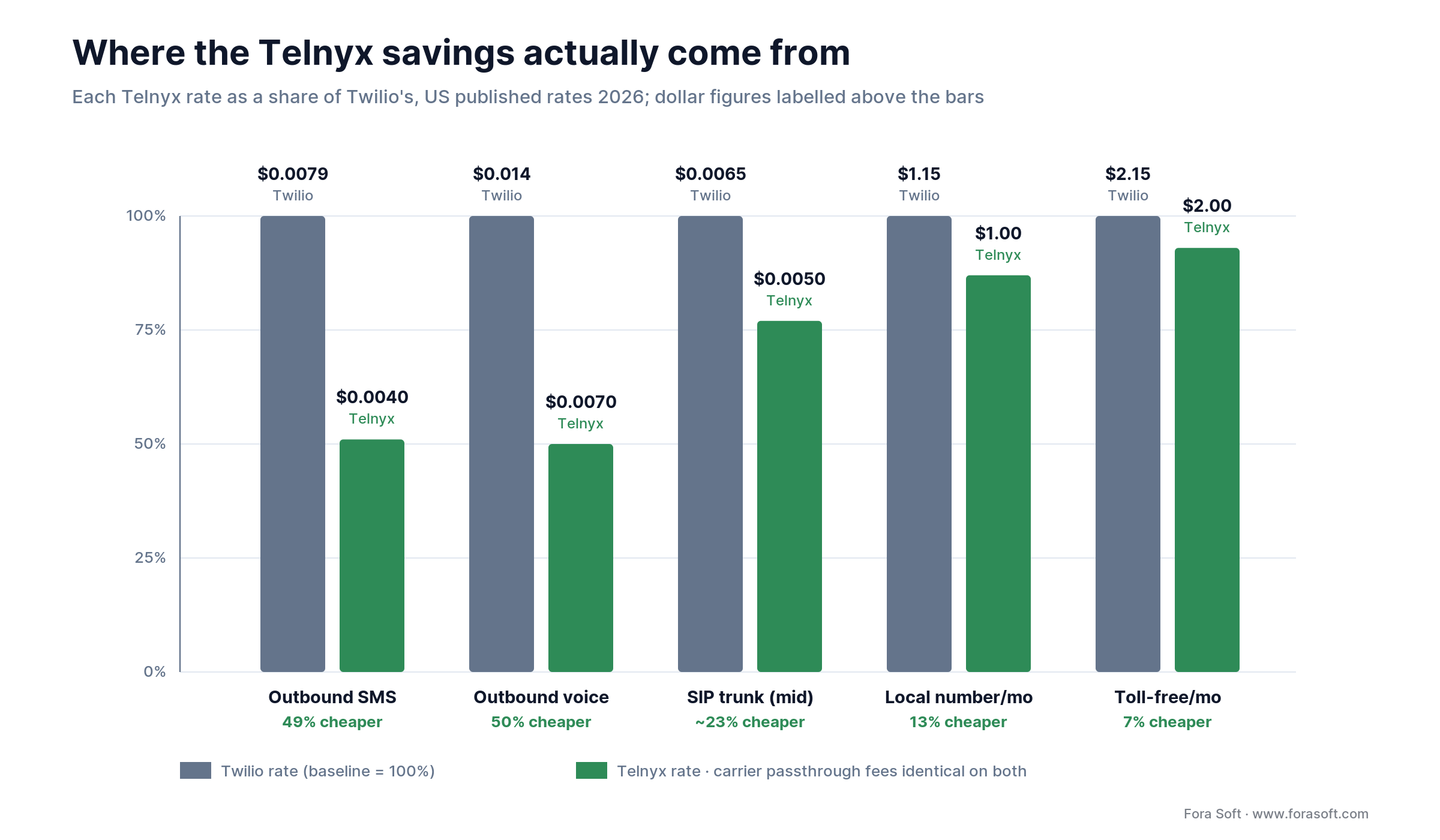
Figure 1. Where the savings concentrate. SMS and voice roughly halve; number leasing barely moves.
Feature parity — and where the gaps break your code
The cost case is the easy part. Feature parity is where real migrations go off the rails, because the two products have genuinely different product philosophies. Twilio is a complete application platform (Flex, Studio, TaskRouter, Segment, Authy); Telnyx is a focused connectivity platform (SMS, voice, SIP, numbers, and modern AI voice — the same real-time voice-agent stack we map end to end in our AI-for-video-engineering guide). That difference matters for exactly four Twilio products:
1. Twilio Flex (cloud contact centre). No Telnyx equivalent. If Flex is the centre of your operation, migration means either rebuilding your contact centre on Amazon Connect / Genesys / Five9 (using Telnyx as the carrier), or staying on Twilio for Flex specifically while moving bulk SMS/voice to Telnyx. Both are workable; neither is cheap.
2. Twilio Studio (visual no-code flow builder). No direct Telnyx equivalent. Flows need to be rebuilt in code or in a replacement tool (Telnyx Call Control + workflow engine, Dialogflow CX for AI-driven flows, or n8n/Retool for the simple ones). Typical rebuild: 1–3 weeks depending on complexity.
3. Twilio TaskRouter. Queueing, skills-based routing, ACD. Partial Telnyx equivalents exist (Call Control queues, hold music, workflow states) but the TaskRouter-style “virtual workforce queue” abstraction is not one-to-one. Rebuild cost depends on how much custom routing logic you have.
4. Authy (consumer app). Retired by Twilio in 2024. If you still have users authenticating against Authy tokens, migrate to Twilio Verify API or Telnyx Verify before migration, not as part of it — Authy end-of-support was the forcing function for many 2025 migrations.
Everything else — SMS/MMS, programmable voice, SIP trunking, WhatsApp Business API, phone number provisioning, Verify/2FA, Programmable Video (if you are using it), IoT Super SIM — has a clean Telnyx equivalent. Port and move on.
Reach for a hybrid split when: Flex, Studio or TaskRouter runs your contact centre but SMS and voice dominate the bill. Keep those products on Twilio and move bulk messaging and voice to Telnyx.
The five-step migration pipeline
Every CPaaS migration we run follows the same five steps, in the same order, with roughly the same time-boxes:
| Step | What happens | Duration | Critical-path risk |
|---|---|---|---|
| 1. Assessment | Inventory numbers, endpoints, campaigns; map to Telnyx | 3–5 days | Missed features |
| 2. Code changes | API client swap, webhook rebuild, TeXML port | 3–10 days | Webhook payload diff |
| 3. Number porting | File LOAs with losing carrier, wait for FOC date | 2–4 weeks | Rejected port, FOC slip |
| 4. A2P 10DLC + compliance | Brand + campaign registration on new side | 1–4 weeks | Campaign rejection, brand mismatch |
| 5. Parallel run + cutover | Percentage-based traffic shift, monitor, switch DNS | 1–2 weeks | Rollback plan, observability |
Total: 4–8 weeks for most mid-sized apps. The steps are serial-with-parallels: code changes can happen while porting is in flight, but you cannot flip a number’s traffic until the port is complete. The parallel-run section below has the phased-rollout pattern; the same staged, percentage-based cutover applies here.
Code delta in practice — SMS
// Twilio (Node)
import twilio from 'twilio'
const client = twilio(accountSid, authToken)
await client.messages.create({
  from: '+15551234567',
  to:   '+15557654321',
  body: 'Your code is 123456',
})

// Telnyx (Node)
import Telnyx from 'telnyx'
const telnyx = Telnyx(apiKey)
await telnyx.messages.create({
  from: '+15551234567',
  to:   '+15557654321',
  text: 'Your code is 123456',    // field rename: body -> text
})
Code delta — voice answer webhook
<!-- Twilio TwiML -->
<Response>
  <Say voice="alice">Thanks for calling Acme.</Say>
  <Dial record="record-from-answer">+15551234567</Dial>
</Response>

<!-- Telnyx TeXML (near-identical) -->
<Response>
  <Say voice="Polly.Joanna">Thanks for calling Acme.</Say>
  <Dial record="record-from-answer">+15551234567</Dial>
</Response>
The voice code ports with an endpoint swap. The bigger code lift is usually around webhooks, where the payload shape and signature scheme differ. Expect to rewrite validation middleware and adapt a handful of field names; this is hours of work for a well-tested app, days for a legacy one.
Want the full migration run by people who have done it before?
Fora Soft runs Twilio-to-Telnyx migrations as fixed-scope 4–8 week engagements: audit, code port, number porting, A2P, parallel run, post-launch monitoring. Agent Engineering handles the webhook-diffing and test-generation, which typically cuts scoping by 30–40%.
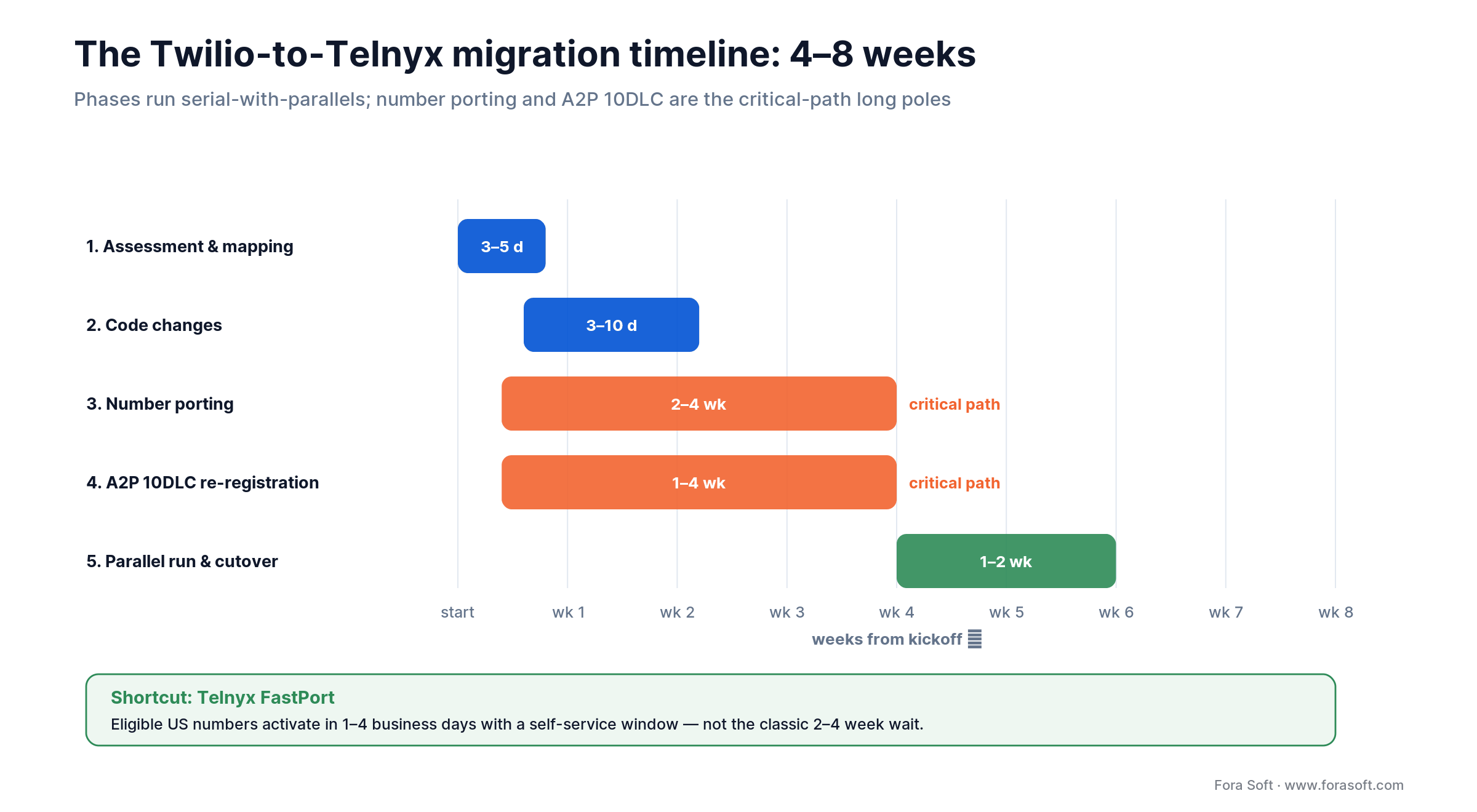
Figure 2. The 4–8 week timeline. Number porting and A2P 10DLC are the long poles; code changes run in parallel.
Number porting — the longest item on the critical path
Porting a block of phone numbers from Twilio to Telnyx takes 2–4 weeks in the US and can run 6–8 weeks internationally. That timeline is set by the losing carrier (Twilio’s underlying carrier partners), not by Telnyx. One 2026 exception is worth checking first: Telnyx FastPort activates eligible US numbers in 1–4 business days through a self-service activation window, which can pull weeks off the critical path. Plan the rest accordingly.
1. File LOAs early. The Letter of Authorisation is a signed document authorising the port. File it with Telnyx on day one of the migration, not after your code is ready. Porting happens in parallel with development.
2. Match CSR data exactly. The Customer Service Record in Twilio must match the LOA field-for-field. Mismatches (company name missing an Inc, address auto-completed differently) are the #1 reason ports reject. Pull the CSR from Twilio and copy it character-for-character.
3. Expect an FOC date 7–14 days after filing. “Firm Order Commitment” is the day the port actually executes. The number is live on Twilio until that morning and live on Telnyx from that afternoon. Cutovers on Tuesdays or Wednesdays are safer than Fridays. If something breaks you have business days to fix it.
4. Do not cancel Twilio early. Keep the Twilio account active and paying for the ported numbers until you have verified end-to-end SMS and voice on Telnyx for every ported block. We have seen clients cancel Twilio a week after porting and lose visibility into straggler traffic still hitting old webhooks.
5. A2P 10DLC is a separate port. 10DLC brand and campaign registration does not transfer automatically. You register the brand on Telnyx (same company EIN, same DUNS) and re-submit campaigns. Allow 1–4 weeks of carrier review, plan the launch accordingly, and critically — keep your sending volume ramped down during the transition to avoid triggering spam flags on the freshly registered campaigns.
Webhooks — where the code delta actually bites
The biggest single source of post-migration bugs is webhook handling. Twilio and Telnyx both POST events to your endpoints, but they differ in payload shape, signature algorithm, header names, and retry semantics. If you copy the Twilio middleware verbatim you will either drop valid events or trust spoofed ones.
Payload shape. Twilio sends application/x-www-form-urlencoded for most events. Telnyx sends application/json with a nested data.event_type / data.payload envelope. Your parsers need a branch per provider during the parallel-run phase.
Signature verification. Twilio uses an HMAC-SHA1 of the request URL + sorted parameters in the X-Twilio-Signature header. Telnyx uses Ed25519 with a rotating public key in the telnyx-signature-ed25519 and telnyx-timestamp headers. Two different code paths; both mandatory.
Retry semantics. Twilio retries on 5xx with a back-off up to 15 minutes. Telnyx retries with exponential backoff up to 24 hours. If your endpoint is sometimes slow, Telnyx will duplicate events over a longer window, so idempotency keys are not optional.
Event types. Name and shape differ (MessageStatus=delivered vs message.finalized; CallStatus=completed vs call.hangup). A provider-agnostic internal event schema with a thin translation layer on ingestion is the cleanest pattern.
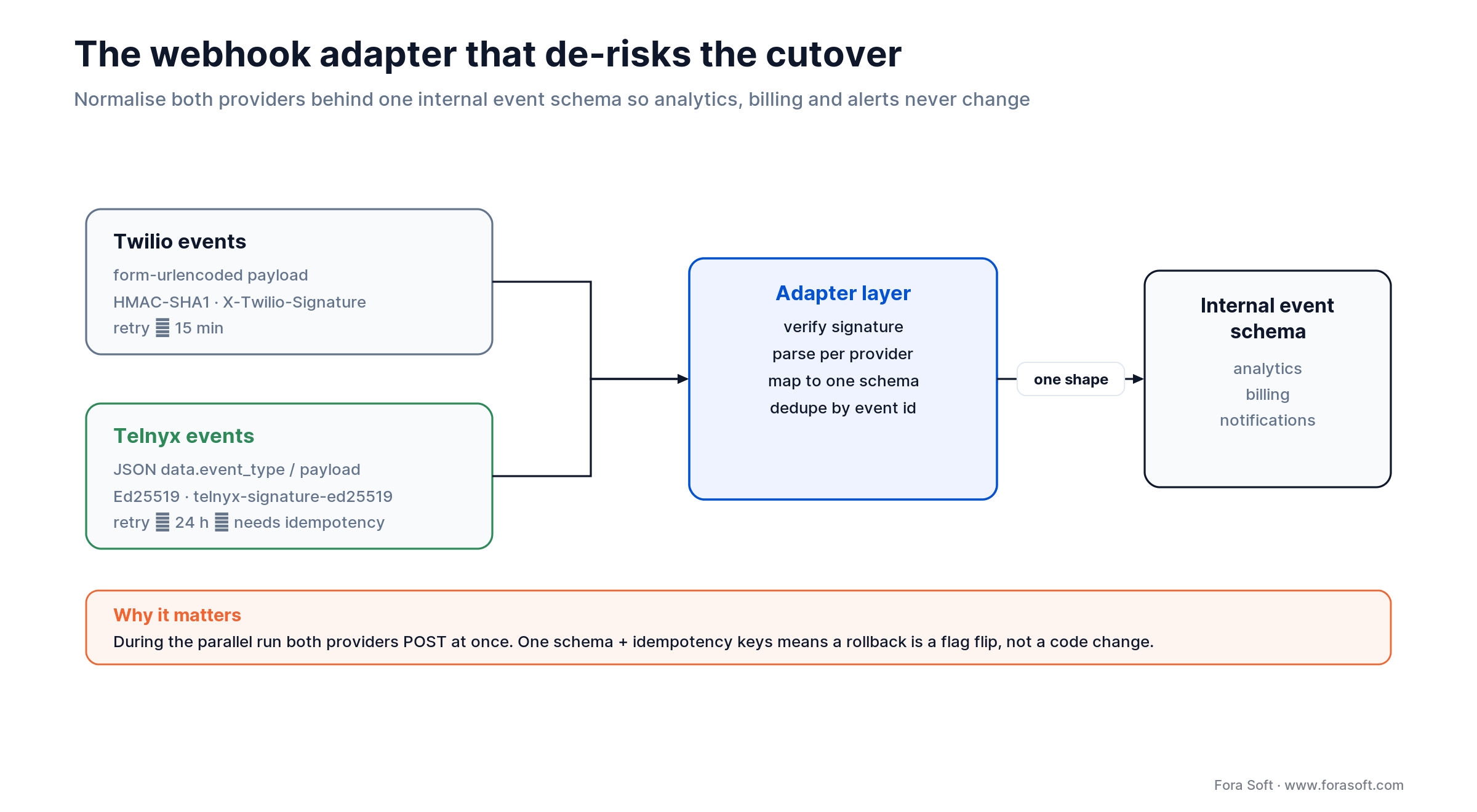
Figure 3. The webhook adapter. Normalise both providers into one schema so a rollback is a flag flip, not a rewrite.
Parallel run — how to cut over without an outage
The safest cutover is a feature-flagged, percentage-based shift that can flip back to Twilio within seconds of a regression. The recipe we use:
1. Dual-client abstraction. Wrap both SDKs behind a single internal interface (SmsProvider.send(), VoiceProvider.answer()). The feature flag picks which implementation handles each request. Keep both SDKs installed during the rollout.
2. Ramp: 10% / 50% / 100%. Day 1: 10% of traffic to Telnyx, monitor for 24–48 hours with per-carrier delivery and webhook-success dashboards open. Day 3: 50%, monitor. Day 5: 100%. Any regression on any dashboard auto-pauses the next stage.
3. Shadow traffic. For voice specifically, a shadow-call pattern (every N calls, also attempt the same call on the non-active provider and compare answer-rate/MOS) catches carrier-quality regressions before they hit 10% of users.
4. Per-number cutover for voice. Since phone numbers port individually on FOC dates, voice cutover happens number-by-number, not globally. Inbound rings hit Telnyx the instant the port completes; there is no mid-call failure mode, but missed calls during the 30-minute porting window are possible — schedule ports for off-peak hours.
5. Observability is mandatory. Log every outbound message and call with provider={twilio,telnyx} as a structured field. Aggregate delivery rate, webhook p95, 2FA-code receipt time, and per-carrier failure rate. Without these, “migration worked” is an opinion, not a fact.
Compliance and regulatory considerations
Regulatory surface is where CPaaS providers look most alike and where the migration can still blindside you. Three items to plan for:
A2P 10DLC (US messaging). Brand and campaign registration transfers are not automatic. Telnyx handles the carrier submission but needs the same TCR-registered brand identity you used with Twilio. Under-tier registrations can reject entire campaigns; over-tier registrations cost more than needed. Match what you had on Twilio unless you have a reason to change.
STIR/SHAKEN (US voice). Outbound caller-ID attestation is required; Telnyx signs at A-level for numbers you own and B-level for re-routed traffic, same as Twilio. If your callers are running display-name operations, re-validate after migration.
HIPAA, SOC 2, GDPR. Telnyx is SOC 2 Type II, will sign a BAA for HIPAA workloads, and operates EU infrastructure for GDPR-sensitive workloads. Re-sign the relevant agreements as part of onboarding; do not assume inherited compliance.
Telnyx vs. the other Twilio alternatives
Telnyx is the most common “leave Twilio” destination but it is not the only one. The table below summarises how the four main alternatives compare for a US-heavy mid-market SaaS workload:
| Provider | Strength | Weakness | Best fit |
|---|---|---|---|
| Telnyx | Owned backbone, modern API, AI voice | Smaller ecosystem than Twilio | Mid-market SaaS moving off Twilio for cost |
| Bandwidth | US voice quality, carrier depth | Less friendly dev experience | Contact centres, E911, US-heavy voice |
| Plivo | Very similar to Twilio, cheap SMS | Smaller team, narrower product | Lift-and-shift Twilio clones |
| Vonage / Nexmo | Global reach, mature platform | Pricing similar to Twilio | Global SMS/voice, enterprise |
| Sinch / MessageBird | Global SMS deliverability | Less cohesive product suite | High-volume international SMS |
| Twilio (stay) | Widest product suite, ecosystem | 40–60% more expensive | Flex, Studio, TaskRouter dependencies |
Reach for Bandwidth over Telnyx when: your workload is US-heavy contact-centre voice, and E911 plus carrier-grade quality matter more to you than a modern API and AI-voice features.
Who should actually run the migration
CPaaS migrations are a bad fit for a part-time side project and an excellent fit for a dedicated 2–3 person squad with clear ownership. Three models we see clients use:
1. In-house squad. Usually one senior backend engineer (owns code port + webhook diff), one DevOps/SRE (owns observability + rollback), and one product/ops lead (owns carrier porting + A2P + timeline). Works well for companies with spare engineering capacity and prior migration experience.
2. Fractional specialist. A contractor who has run 5–10 CPaaS migrations comes in at ~$150/hr for 3–5 weeks to supplement an in-house team. Best when you have engineering but no one on staff has done a migration before.
3. Full outsource. Fora Soft or an equivalent CPaaS-experienced firm runs the full 4–8 week engagement: audit, code port, number porting, A2P, parallel run. Typical cost: proportional to complexity, but routinely less than the first 2–3 months of Telnyx savings. For more on engagement models we offer, see dedicated development team and software troubleshooting & optimization.
The pattern to avoid: a single backend engineer doing the migration around their normal feature work. These never land inside schedule; the serial-carrier parts (porting, A2P) get neglected and slip by weeks at a time.
Reach for a fractional CPaaS specialist when: you have capable engineers but nobody on staff has run a number-porting-and-A2P migration before. Three to five weeks of guidance de-risks the serial-carrier steps.
Mini case — a 6-week migration that paid back in 4 months
Situation. A B2B SaaS client was paying roughly $28k/month on Twilio — ~$22k of that in SMS (2.8M messages/month of 2FA codes, appointment reminders, and notifications), the rest in inbound voice and phone number leases. Usage was growing 20% year-over-year and Twilio cost was eating into gross margin. The team had no Flex or Studio dependency and a modern Node.js codebase.
6-week migration. Week 1: audit, map API calls, identify 48 phone numbers to port, re-register brand on Telnyx, file LOAs. Weeks 2–3: code changes — API client swap, webhook signature validator rewrite, TeXML port for the IVR flow, comprehensive test-suite updates. Week 4: A2P 10DLC campaign re-registration, shadow traffic to Telnyx in staging. Week 5: phased cutover — 10% of SMS traffic to Telnyx, monitor for 48 hours, 50%, 48 hours, 100%. Week 6: voice cutover on ported numbers, Twilio decommission.
Outcome. New monthly bill: ~$13.5k (52% reduction). Annualised saving: ~$174k. Migration cost (6 weeks of a 2-person senior team): well inside the annual savings; payback in roughly 4 months. Crash-free rate of the SMS pipeline went from 99.82% on Twilio to 99.94% on Telnyx, a happy accident of cleaner webhook handling. Want a similar migration scoped for your app?
A decision framework — migrate in five questions
Q1. Is your Twilio bill above $5k/month? Below that, engineering time usually outweighs savings. Above, payback lands inside six months. Above $25k/month, payback is faster than a single quarter.
Q2. Do you depend on Flex, Studio, TaskRouter, or Authy consumer? If yes — stay on Twilio for those products and migrate only the bulk traffic. If no — full migration is straightforward.
Q3. Is your voice quality a regulated requirement? For call-recording in legal, medical, or financial settings, evaluate Bandwidth alongside Telnyx. Both are good; Bandwidth has historically had a slight carrier-quality edge for US voice.
Q4. Do you have senior engineering capacity for 4–8 weeks? Migrations fail when squeezed into background time. Dedicate the people; do not split their attention with feature work.
Q5. What is the rollback plan if Telnyx deliverability drops? Keep Twilio running for at least 30 days after cutover; keep the old client code behind a feature flag; monitor per-carrier delivery rate in parallel. If something breaks, you want one commit to revert.
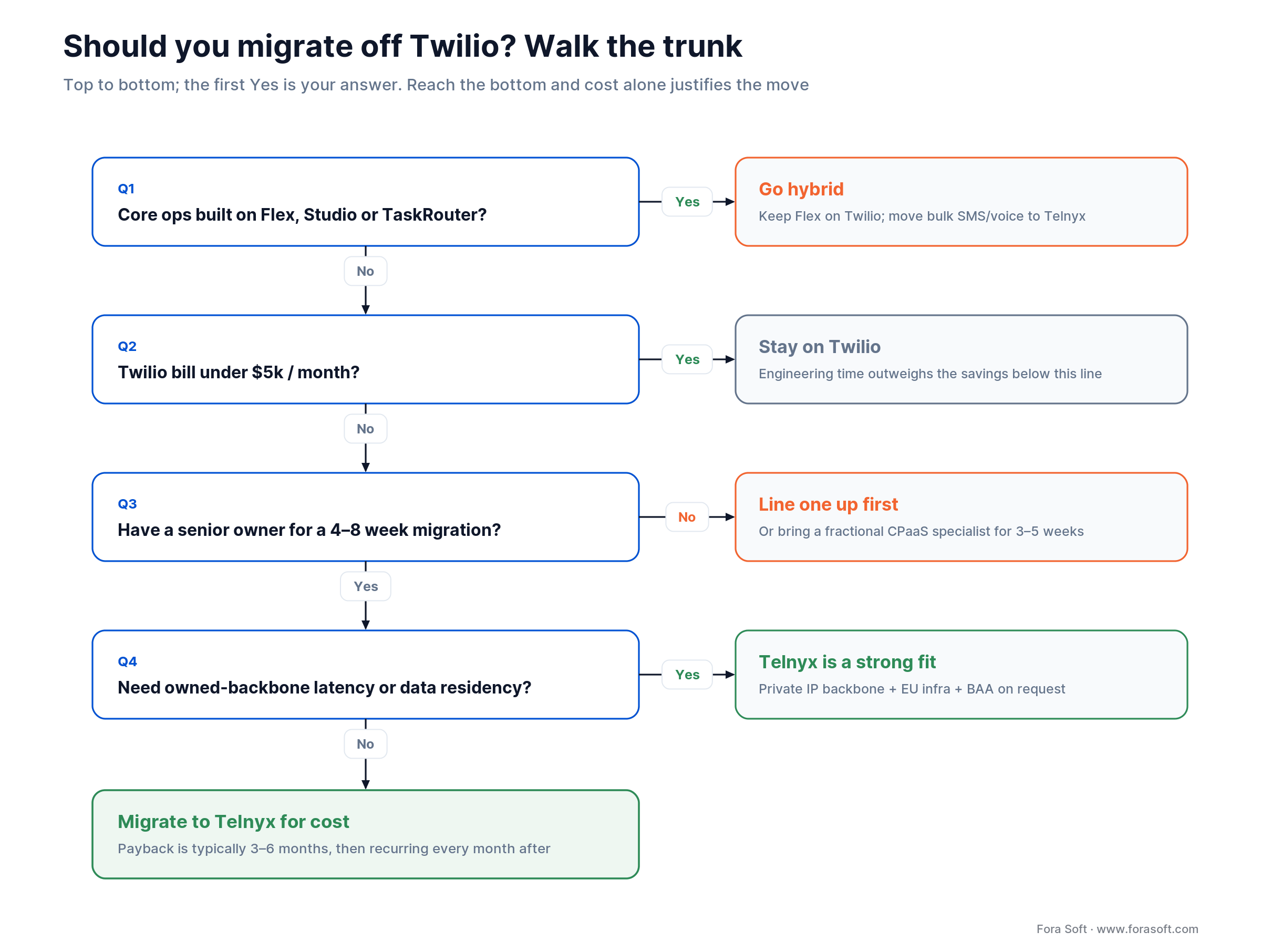
Figure 4. The migrate / stay / hybrid decision, walked as a single trunk of yes-no questions.
Five migration pitfalls to avoid
1. Cancelling Twilio too early. Keep the account paying for at least a full billing cycle after cutover. Straggler traffic, forgotten sandbox numbers, and legacy webhooks all take weeks to surface. Decommission once you have verified zero billable activity for 30 days.
2. Porting numbers without re-registering A2P. A ported number on an unregistered campaign will have its messages blocked. Register first, port second, send third.
3. Skipping the parallel-run phase. Flip all traffic on day one and you are debugging in production with half your users unable to authenticate. Phase 10% → 50% → 100% with deliverability metrics on the dashboard — same staged-rollout discipline as our crash-proof software playbook recommends for any major release.
4. Missing webhook signature verification. Twilio and Telnyx both sign webhook payloads, with different algorithms and header names. Forgetting to update the verification middleware means either spoofable webhooks (security issue) or false-positive 403s that drop legitimate traffic. Test the validator in staging before the first real webhook lands.
5. Not monitoring per-carrier delivery rate. Your aggregate SMS delivery rate on day one might be 98.5%, but if all the failures are on one carrier (Verizon, say) it is a campaign-registration problem that will get worse, not a random blip. Instrument per-carrier delivery rate from day one.
KPIs — measure the migration, not just the invoice
Cost KPIs. Monthly CPaaS spend (post-migration target: 40–55% of pre-migration baseline), per-message / per-minute unit cost, carrier passthrough as a % of total (should be stable — it is identical across providers).
Deliverability KPIs. SMS delivery rate (> 99%), per-carrier delivery rate (Verizon / AT&T / T-Mobile individually > 98.5%), voice answer-seizure ratio (> 99%), average post-dial delay (< 3 s). These tell you whether quality matches or beats Twilio.
Reliability KPIs. Webhook success rate (> 99.9%), p95 webhook latency (< 500 ms), 2FA code-receipt p95 (< 30 s), call-set-up success rate. Our testing-at-every-stage guide covers how to bake these into CI.
When NOT to migrate from Twilio
A few real scenarios where staying on Twilio is the right call:
1. Your bill is under $1k/month. The migration effort (3–5 engineering-weeks) exceeds the annual savings. Revisit at 10× your current volume.
2. You depend deeply on Twilio Flex. There is no Telnyx equivalent. If Flex is your contact centre, migrate the SMS/voice carrier underneath Flex and leave the rest alone — a “carrier-only” migration that still delivers 30–40% cost savings without breaking your agents’ tooling.
3. You ship mission-critical features weekly on Twilio’s stack. Six weeks of engineering time dedicated to a migration is six weeks not shipping features. If your product-market fit is still emerging, deprioritise.
4. You are about to be acquired. Vendor migration is a low-priority item during diligence; deferring until post-close is reasonable.
FAQ
How long does a Twilio-to-Telnyx migration really take?
4–8 weeks for a mid-sized app is typical, with number porting (2–4 weeks) and A2P 10DLC re-registration (1–4 weeks) on the critical path. Code changes themselves are usually hours or days. Complex apps with contact-centre or multi-tenant logic can stretch to 8–12 weeks.
Will I save 50% on my CPaaS bill?
On the line items CPaaS controls (per-message SMS, per-minute voice, number leases), roughly yes — typically 40–55%. On carrier passthrough fees (A2P, toll-free, international termination), not at all — those are identical across providers. Overall invoice reduction is usually 35–50% depending on your mix.
Can I migrate and keep my existing phone numbers?
Yes. Number portability is a regulated US carrier service — you file a Letter of Authorisation, the losing carrier validates, and the number transfers on a Firm Order Commitment date 7–14 days later. International porting is available but slower (4–8 weeks) and more rule-varied by country.
Is TeXML really compatible with Twilio’s TwiML?
Largely yes. TeXML covers the common TwiML verbs (Say, Play, Dial, Gather, Record, Redirect) with the same semantics. Voice names differ (Twilio uses Polly names differently), and a handful of advanced verbs (Enqueue, Pay) are either differently mapped or not supported — check the TeXML docs for parity on any verb you rely on.
What happens if the migration fails?
If you follow the parallel-run model, rollback is one commit — you flip the feature flag back to Twilio and investigate. Numbers already ported cannot be instantly returned (the losing carrier has to accept the port-back) but traffic can route to the original Twilio number until then. Full “port back to Twilio” takes the same 2–4 weeks as the forward port.
What about WhatsApp Business API?
Both Twilio and Telnyx are Meta’s Business Solution Providers for WhatsApp. The per-message fees and template-approval process are similar; Telnyx tends to have a thinner layer of abstraction, which is either an advantage or a tax depending on how much Twilio-specific logic you have. Budget 1–2 weeks for WhatsApp-specific migration work on top of the general timeline.
Is Telnyx HIPAA-compliant?
Yes, Telnyx will sign a Business Associate Agreement (BAA) and supports HIPAA-compliant SMS/voice workflows. As with Twilio, compliance is configuration-dependent: you still need to ensure message content is appropriate, access logs are retained, and PHI-handling endpoints are locked down. Our HIPAA-compliant video platform guide covers the general compliance pattern.
Should I evaluate Bandwidth, Plivo, or Sinch too?
Yes, briefly. For US-voice-heavy workloads Bandwidth is a serious contender; for high-volume global SMS, Sinch has strong carrier relationships; for lift-and-shift of a Twilio clone, Plivo is the closest API-compatible option. Run a 1-week evaluation with each of the top 2–3 based on your workload, then pick. The “migrate from Twilio” decision and the “migrate to which provider” decision are separate — answer them in order.
What to Read Next
Real-time
Minimising latency for mass streams
Sub-second latency techniques that apply equally to voice and live video workloads.
Reliability
Crash-proof software in 2026
SLOs, feature flags, staged rollout — the toolkit we apply to every CPaaS migration.
Architecture
WebRTC vs. Agora architecture tradeoffs
The sister decision for real-time video: own-build vs. managed platform, with numbers.
Vendor pick
Twilio alternatives for voice AI and telephony
Which provider to move to, ranked by use case: the companion to this how-to-migrate guide.
Compliance
HIPAA-compliant video platform guide
PHI handling, BAAs and audit trails — directly applicable to CPaaS migrations in healthcare.
Ready to cut your CPaaS bill in half?
Twilio-to-Telnyx migrations are not complicated, but they are sequential and carrier-gated. The savings are real: roughly 40–55% on the engineering-addressable portion of your invoice, and the engineering lift is proportional to how clean your existing Twilio integration is. If you are above $5k/month and not deeply dependent on Flex or Studio, the payback is almost always inside six months.
The plays are unchanged across every migration we run: audit first, code second, port in parallel, A2P third, parallel-run cutover last. Keep Twilio paying until you are sure nothing still depends on it. Monitor deliverability per-carrier, not just aggregate. And decide “which provider” after you decide “migrate or stay.” If you want a partner who has run this playbook many times — with Agent Engineering accelerating the code-delta and webhook work — that is the shape of what Fora Soft does.
Let’s scope your Twilio-to-Telnyx migration.
30-minute call with a senior Fora Soft engineer — bring your last Twilio invoice, leave with a line-by-line savings estimate and a concrete 4–8 week migration plan, whether or not we end up working together.

