

Key takeaways
• Virtual reality in education is no longer speculative, and neither is AR. The VR education market is $31.3B in 2025 and projected to hit $81B by 2030 (21% CAGR). 50% of universities now run at least one VR course, up from 30% in 2024.
• The learning data is strong where it has been measured. PwC: VR learners train 4× faster than classroom, feel 3.75× more emotionally connected, and are 275% more confident applying skills. Osso VR surgical trainees improved performance by 230%.
• Hardware has crossed the affordability threshold. Meta Quest 3S at $350 and education bundles at $500–$730 put a 30-headset classroom within a $15K–$22K first-year budget — including content and teacher training.
• Platform or custom? Buy off-the-shelf when the curriculum maps to an existing library (ClassVR, Labster, Nearpod, zSpace cover 80% of K-12 needs). Build custom when you have a specific vocational, medical, or brand-tied scenario no vendor serves — typical custom app: $30K–$200K.
• Cost-parity with classroom training hits at ~375 learners per program. Below that, classroom wins on cost. Above it, VR wins — and wins harder as cohort size grows.
Why Fora Soft wrote this playbook
Fora Soft has been building video + AI + immersive education software since 2005. We have shipped Scholarly (an online learning platform serving 15,000+ users), live-stream classrooms integrated with LMS spines, and custom WebXR experiences for training scenarios no off-the-shelf platform covered. Our AR and VR in Education 2026 playbook goes deep on device selection, content strategy, and total cost of ownership. This article is the shorter, decision-oriented companion: how to tell whether AR/VR earns its place in your classroom, and what to buy (or build) if it does.
Evaluating AR/VR for your school, university, or training program?
Tell us the cohort size, subject area, and budget. We’ll come back with a concrete platform recommendation (or a custom-build estimate) — honest about when off-the-shelf wins, and when it doesn’t.
Why AR/VR is finally landing in education
Three things changed between 2022 and 2026 that turned AR/VR education from a conference demo into a line-item on school budgets:
- Price. Meta Quest 3S launched at $349.99 (April 2026), Quest 3 at $599.99. Education bundles are priced $500–$730. That is one-tenth of a 2019 classroom-capable headset.
- Content. ClassVR ships 1,500+ curriculum-aligned experiences. Labster runs 300+ simulated lab experiments. Nearpod embeds VR in existing lesson plans. Zero-from-scratch content burden.
- Evidence. PwC’s 2020 study pinned quantifiable efficacy gains. Since then, North Carolina zSpace K-12 studies, Osso VR surgical trials, and Apple Vision Pro early-adopter data have replicated the pattern across grades and subjects.
What this means for budget-holders: Virtual reality in education is no longer a question of “does it work?” It is a question of “for which students, on which topics, at what cohort size.” That’s a different (and much more answerable) question.
The one-line case: If your program trains 375+ learners a year on the same skill, VR hits cost-parity with classroom delivery — and keeps paying off as your cohort grows.
The 2026 AR/VR education market in one snapshot
The numbers that frame the buying decision:
- Global VR education market: $31.28B (2025), projected $81.13B by 2030, 21% CAGR. (Fortune Business Insights.)
- Metaverse education segment: $4.38B (2025) to $41.6B (2030), 38% CAGR — the fastest-growing slice.
- North America: $6.5B–$7.6B market, ~32% of global. Biggest single region by spend, followed by EU and East Asia.
- University VR course adoption: 30% (2024) → 50% (2026). Medicine, engineering, and business lead.
- K-12 VR hardware shipments: +40% YoY in 2026. Meta for Education’s $500 bundle is doing the heavy lifting.
- WebXR adoption: +40% YoY in 2026. Browser-based AR/VR bypasses the headset-distribution problem for districts that can’t scale hardware.
- Immersive collaboration market: $22B by 2030 (ABI Research). Universities and corporate training converging.

Figure 1. The four figures that frame an AR/VR-in-education buying decision in 2026.
What the evidence actually says about AR/VR learning outcomes
The gold-standard data, 2020–2026:
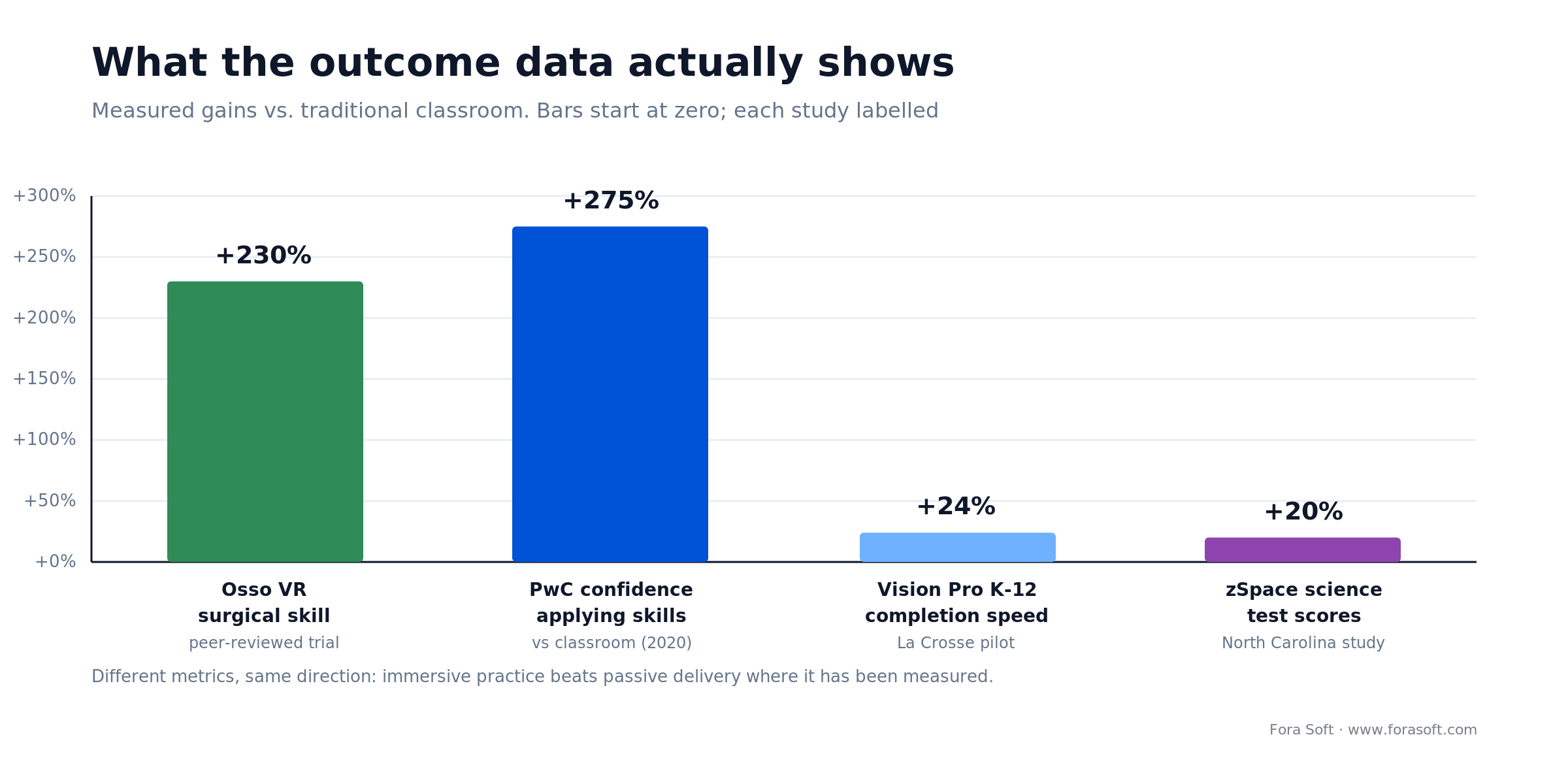
Figure 2. Different studies, one direction: immersive practice beats passive delivery where it has been measured.
PwC 2020 enterprise VR study (soft-skills training)
- 4× faster to train than classroom.
- 3.75× more emotionally connected to content than classroom learners.
- 275% more confident applying skills post-training.
- 4× more focused than e-learners; 1.5× more focused than classroom.
- Cost-parity at 375 learners; 52% cheaper at 3,000 learners.
K-12 evidence
- North Carolina zSpace study: 20% higher science test scores in VR-augmented classrooms vs. control, consistent with peer-reviewed engagement research.
- Inspired Education Group: 90% increase in student engagement after deploying VR content.
- Retention pyramid: 75% retention from VR/immersive vs. 10% from reading, 5% from lecture (classic Edgar Dale framing, reinforced by 2020s replication).
Medical and surgical training
- Osso VR surgical trainees: 230% performance improvement over traditional training in peer-reviewed trials.
- FundamentalVR surgical metrics: sub-millimeter haptic precision, statistically significant reduction in procedure errors.
- Virti nursing and clinical scenarios: 20% improvement in decision-making accuracy under time pressure.
Apple Vision Pro early adopters (2024–2026)
La Crosse School District reported 24% faster course completion across K-12 pilots using Vision Pro. Cost per-device ($3,499) still too high for broad classroom deployment; use case is largely one-to-one (special education, differentiated instruction).
Where AR/VR actually works — use cases by segment
K-12
Virtual field trips (Google Expeditions heir products, ClassVR, zSpace): the Colosseum, coral reefs, human cell interior. Highest-impact use case for under-resourced districts. Math/science visualization: Prisms VR (140 districts, 30 states) turns abstract math into manipulable 3D objects — measurably raises algebra mastery in under-performing cohorts. Special education: immersive social-skills scenarios, autism sensory calibration, dyslexia-friendly reading environments.
Higher education
Engineering + architecture visualization: walk inside the CAD model, spot clashes before fabrication. Medical + nursing: anatomy atlases, surgical rehearsal, virtual patient encounters. Business + psychology: immersive case-study role-plays, distributed cohort discussions in Engage / Spatial. Remote collaboration: satellite-campus students co-present in the same virtual lab as on-campus peers.
Medical + healthcare training
This is where the ROI is cleanest — high-stakes skills, expensive-to-train cohorts. Platforms: Osso VR (orthopedics), FundamentalVR (surgical haptics), Virti (nursing scenarios), Acadicus (multi-user clinical sim). See our healthcare AR/VR playbook for the deep cut.
Vocational / apprenticeship
Welding, construction OSHA, electrical safety, automotive repair, forklift operation, nuclear and hazardous-material scenarios. VR removes material cost (steel, fuel), removes injury risk, and gives you replay + instrumented metrics. Typical payback: 12–18 months on a 200-apprentice program.
Corporate L&D
Soft-skills rehearsal (hard conversations, sexual-harassment training, inclusive leadership), safety onboarding (chemical handling, fall protection), customer-service simulations. PwC soft-skills data is strongest here.
What to buy off the shelf
Before you build, check whether an existing platform covers your curriculum. For 80% of K-12 and most higher-ed introductory courses, it does.
| Platform | Best for | Starting price | Headset required? |
|---|---|---|---|
| ClassVR | K-12, 1,500+ curriculum-aligned experiences | $1,000+ school bundles | Yes (bundled headsets) |
| Labster | Higher-ed biology, chemistry, physics labs | $79–$109/student/year | No (browser + optional VR) |
| Nearpod (with VR) | K-12 lesson integration | $159–$397/year/teacher | Optional |
| zSpace | Headset-free AR/VR; 3,500+ districts | Custom (proprietary hardware) | No (glasses + tracked display) |
| Prisms VR | Math + science, 140 districts | Custom (district license) | Yes |
| Engage / Spatial | Higher-ed collaborative classrooms | $500–$2,000/year per room | Yes (multi-device) |
| CoSpaces Edu | Student-built VR projects | $1–$3/student/year | Optional |
| Osso VR / FundamentalVR | Surgical training | $6K–$40K/year per seat | Yes |
Which headset to buy in 2026
The hardware question has been solved for most classroom scenarios. What to buy, and what each trade-off buys you:
Meta Quest 3S — $349.99 (April 2026)
The default classroom headset. Education bundle at $500 (includes Meta for Education enrollment). Good-enough optics, 128 GB storage, colour passthrough. Pick this if you are deploying 10+ units.
Meta Quest 3 — $599.99
Higher resolution, better passthrough, better optics. Education bundle $730. Pick this for higher-ed labs and serious medical / engineering training.
Apple Vision Pro 2 — $3,499+
Best-in-class optics and passthrough; M5 chip. Expensive enough that K-12 deployment is limited to one-to-one special-ed or premium higher-ed pilots. Pick this only when the optics matter more than the cohort size.
HTC Vive Focus 3 — ~$1,000–$1,200
Enterprise-grade, 5K resolution, strong enterprise MDM support. Pick this for regulated industries (aviation, nuclear, medical device manufacturers) where Meta’s account model is a deal-breaker.
PICO 4 Ultra — $650
Mid-range, strong European availability, solid specs. Pick this when Meta is unavailable or unacceptable (which increasingly matters in EU school procurement).
Microsoft HoloLens 2 — ~$3,500
AR overlay on real world, hands-free. Industrial and medical-surgical use cases dominate. Not a classroom product, but occasionally the right answer for medical or engineering higher-ed.
The headset-free option: zSpace ships laptops + glasses with 3D stereoscopic displays. No headset, no motion sickness, no account sign-ins. Lower ceiling on immersion, far lower floor on logistics. Worth considering for elementary and early middle school where headset management is the dealbreaker.
What a 30-student classroom actually costs, year 1
The honest TCO for a mid-tier K-12 deployment:
| Line item | Year 1 | Year 2+ |
|---|---|---|
| 30 × Meta Quest 3S ($500 bundle) | $15,000 | $0 (refresh every 3–4 yr) |
| Content platform (ClassVR / Nearpod) | $2,000–$5,000 | $2,000–$5,000 |
| Teacher training (1 day PD) | $1,500–$3,000 | Refresh: $500/yr |
| Charging cart + MDM | $1,500–$2,500 | $0 |
| Insurance / breakage (10%) | $1,500 | $1,500 |
| Total | $21,500–$27,000 | $4,000–$7,000 |
For context: one chemistry teacher plus supplies for 30 students runs $60K+/year. A VR classroom deployment is roughly one-third of a single teacher’s fully-loaded cost — and serves 4–6 classes of 30 across the same school year.
Buy a platform, or build custom? How to decide
Off-the-shelf platforms cover the common cases. Custom build wins when you need something vendors don’t have. The honest decision rule:

Figure 3. A three-question path to buy off-the-shelf, build custom, or go browser-based with WebXR.
Buy off-the-shelf when
- Your curriculum maps to an existing platform library (biology labs, US history tours, algebra visualization).
- You need deployment in < 60 days.
- Budget is under $15K for content/software (Year 1).
- You have fewer than 500 learners in the cohort.
- You can live with the platform’s LMS integration (most support SCORM + LTI).
Build custom when
- The scenario is proprietary (a vendor-specific medical device, your company’s unique manufacturing line, brand-tied training).
- You need integration with your own data (patient records, student SIS, sensor telemetry).
- 500+ learners amortize the build cost (typical custom app: $30K–$200K).
- You need repeatable, analytics-rich training with tight KPIs your learning team can instrument.
- Regulatory or compliance scope forces on-premise / private-cloud deployment.
What a custom build actually costs
A clean scope, 8–12 week build, Unity or Unreal, cross-device (Quest + Vision Pro + WebXR): $30K–$80K MVP, $120K–$200K production-grade with analytics + LMS integration. Agent Engineering (our AI-assisted delivery) can compress that by 25–40% on routine 3D and interaction logic. See how we scope and price these on our AR/VR development service.
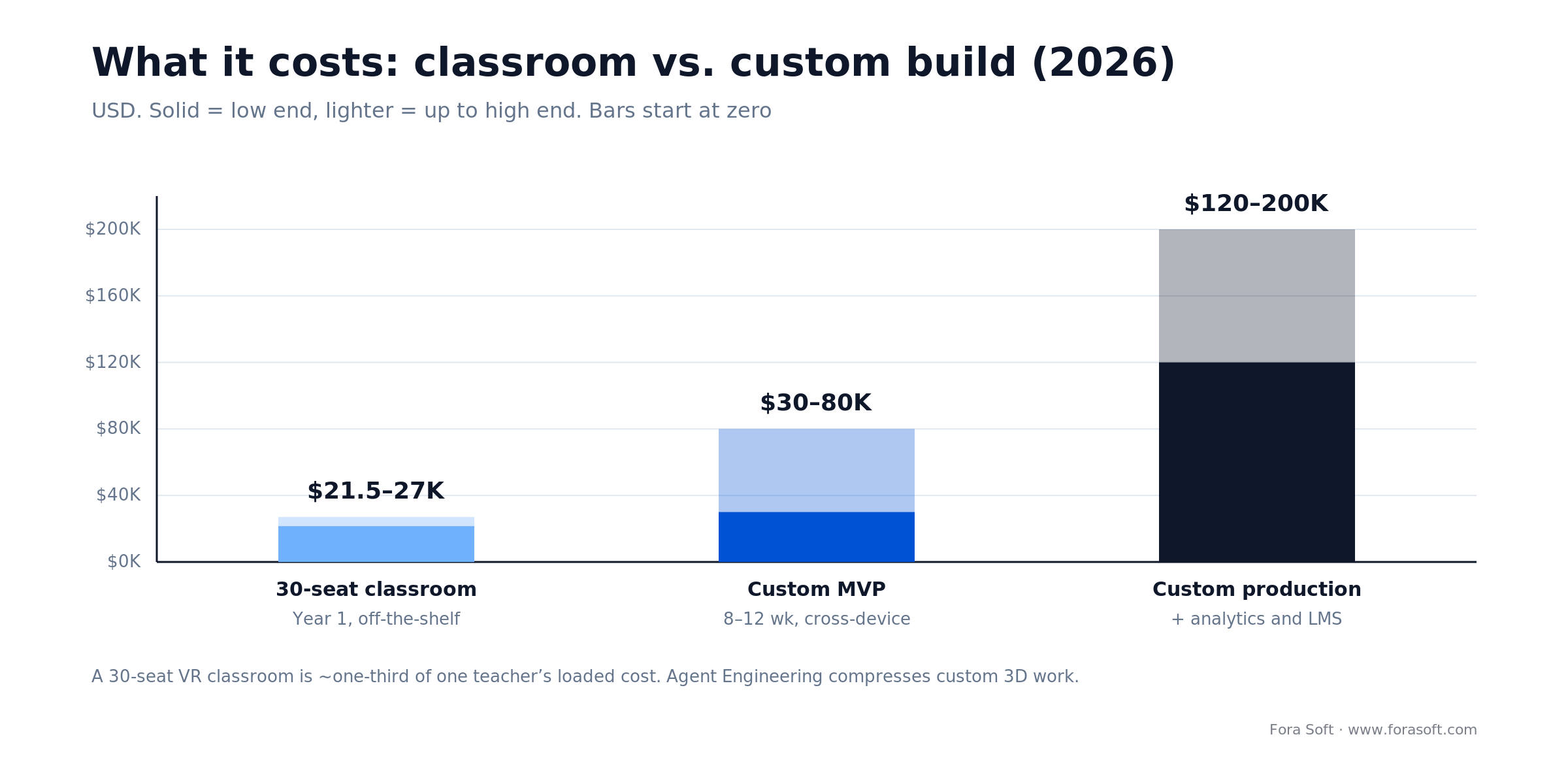
Figure 4. What a 30-seat VR classroom vs. a custom build costs in 2026, low-to-high bands.
Need a custom AR/VR build scoped?
Share the scenario, device target, and cohort size. We’ll return a concrete build estimate, timeline, and a recommendation on whether off-the-shelf would serve you better.
LMS integration — making VR show up in the gradebook
The most common failure mode we see: pilot works beautifully, but completion data lives in the VR platform and never reaches Moodle, Canvas, Blackboard, or Schoology. Teachers give up because grading is manual.
SCORM 1.2 / 2004 + xAPI
The standard. Most reputable VR platforms (Labster, Virti, FundamentalVR, Engage) export SCORM packages and xAPI statements. Your LMS imports them; grades flow through.
LTI 1.3 Advantage
Newer standard, better single-sign-on and deep-link integration. ClassVR, Nearpod, and most 2024+ platforms support it. Check before buying.
The analytics you actually want
Beyond “did the student complete the module”: time-in-simulation, interaction heatmaps, failure-retry counts, confidence scores from pre/post assessments. Custom builds let you instrument anything; off-the-shelf gives you what the vendor gives you.
Test before you sign: Run one real completion end-to-end into your LMS sandbox — SCORM or LTI — before you commit to any platform. If the grade doesn’t land in the gradebook on the first try, budget integration work or pick another vendor. That 30-minute test heads off the most common rollout failure we see.
The real challenges — and how to beat them
Motion sickness
Affects 10–20% of users on longer sessions, especially locomotion-heavy content. Mitigation: cap sessions at 10–15 minutes, use teleport locomotion (not smooth), avoid high-acceleration scenes, run a 3-day acclimation ramp for new headset users.
Teacher adoption gap
The single biggest predictor of a failed deployment. A teacher who hasn’t been trained will not use the $500 headsets. Solution: mandatory 1-day PD session, a peer champion per grade, scheduled check-ins at 30/60/90 days. Without it, usage drops below 10% by term 2.
Content availability gaps
Some curricula are well-served (STEM, history, anatomy). Others are thin (language arts, many humanities). Solution: start where content exists. Build custom only where it’s irreplaceable and the cohort justifies it.
Classroom management
30 students with headsets = 30 students who can’t see the teacher. Solutions: rotation stations (one-quarter of class in VR at a time), casting to a projector (students see peer-eye-view), teacher tablets to push scenes / pause content.
Accessibility
ADA + WCAG 2.1 compliance matters. Not all VR content is accessible. Check for captions, high-contrast modes, one-handed interaction, seated mode, IEP-specific adjustment (for students with motor / cognitive / vestibular conditions). Apple Vision Pro leads here.
Hardware durability
Expect 10–15% annual breakage / loss on K-12 deployment. Budget for it. Tethered straps, protective cases, and printed step-by-step hand-off protocols cut the loss rate roughly in half.
Six pitfalls we see on almost every AR/VR education rollout
1. Skipping the pilot. Districts that deploy 200 headsets district-wide in month 1 almost always see under 20% usage by month 6. Pilot with 1–2 teachers, measure, then scale.
2. Underbudgeting teacher training. $500 headsets with $0 PD = $500 paperweights.
3. Trying to build before buying. 80% of classroom scenarios are covered by existing platforms. Start there. Build when vendors genuinely can’t serve.
4. Ignoring LMS integration. If the grade can’t flow to your SIS, the teacher gives up.
5. Buying Apple Vision Pro for a K-12 classroom. Beautiful optics, wrong cost profile. Use it where $3,500/device is justified: special ed, premium higher-ed, or one-to-one differentiation.
6. Treating VR as a standalone module, not a unit component. The strongest deployments embed a 10-minute VR experience inside a 50-minute lesson — not as replacement, but as the hook or the lab. Nearpod’s integration pattern is the model.
A 5-question decision framework for AR/VR rollout
Q1. How many learners will this serve per year? Under 100: probably skip or use WebXR. 100–500: off-the-shelf platform. 500+: business case for custom scenarios opens up.
Q2. Does the subject match existing content libraries? Yes: buy. No: you’re in custom-build territory; estimate carefully.
Q3. What’s your teacher/facilitator readiness? Pre-trained + enthusiastic: deploy. Unfamiliar + skeptical: invest in PD first, hardware second.
Q4. Do you have LMS + SIS integration requirements? Yes: prioritize SCORM/LTI-capable platforms. Custom builds: budget for integration work.
Q5. What’s your budget line and refresh cycle? <$25K Year 1 for 30 students is realistic. Refresh hardware every 3–4 years; content subscriptions annually.
A realistic 90-day AR/VR rollout plan
What good looks like in each 30-day window:
Days 1–30: pilot with 2 teachers + 1 platform
Buy 6 headsets + 1 platform subscription. Run a 30-minute PD for 2 volunteer teachers. Each runs 2 VR lessons in the month. Measure: session duration, completion rate, student feedback, teacher friction notes.
Days 31–60: expand to grade or department
Add 10 more headsets. Bring in 4–6 more teachers. Run a half-day PD. Start reporting usage to admin weekly. Start tracking which scenarios retain students vs. fizzle.
Days 61–90: full deployment + measurement
Deploy the planned cohort. Run pre/post assessments on at least one unit to capture hard learning data. Present a 90-day retro with data to leadership: continue, expand, or redirect.
Planning an AR/VR pilot this term?
We’ll walk you through a pilot plan on a 20-minute call — device list, PD outline, and a pre/post assessment template you can reuse.
Accessibility and equity — non-negotiables
Three buckets to budget for from day one, not after a complaint:
- Visual + vestibular disabilities: seated mode, teleport locomotion, captions, contrast modes. Students with migraine history or motion-sensitivity need opt-out paths.
- Motor disabilities: one-handed controller mode, voice input, eye-tracking where available (Apple Vision Pro + PICO 4 Ultra excel here).
- Cognitive and neurodivergent learners: adjustable pacing, simplified visuals, sensory-calibration options. VR can be a powerful tool for autism spectrum and ADHD learners — if the platform respects the range.
IEP + 504 compliance: If any student has an IEP or 504 plan, the platform must support their accommodations. Vet accessibility features with your special-ed coordinator before district-wide procurement — not after.
What’s changing in AR/VR education in 2026
Apple Vision Pro is creating a premium tier. Too expensive for K-12 scale but finding a home in medical school and premium higher-ed programs. Our Vision Pro playbook goes deep on the business case.
Meta for Education is becoming dominant in K-12. Aggressive pricing ($500 bundle), a $150M developer fund, and tight Meta Quest 3S integration mean Meta is now the de facto K-12 VR platform in the US.
AI-generated VR content. The biggest 2026 shift. Tools like NVIDIA Omniverse, Microsoft Mesh, and startup content generators cut VR scene authoring from weeks to hours. Custom builds that were $200K in 2024 are $60K in 2026. Our team documents this AI-assisted media tooling in the AI-for-video engineering hub.
WebXR adoption +40% YoY. Browser-based AR/VR bypasses headset distribution. Labster, Mozilla Hubs, and Prisms all run in Chrome/Safari. For districts that can’t afford hardware, WebXR is the pragmatic answer.
Spatial computing in universities. Engineering, architecture, and medicine moving from “occasional VR lab” to “default 3D-native learning environment.”
Accessibility standards crystallizing. WCAG 2.1 guidance for XR is maturing. Procurement RFPs now require accessibility attestation.
When you should NOT deploy AR/VR (at least not yet)
Three honest cases:
Your cohort is under 100 learners/year. Hardware + platform cost doesn’t amortize. Use WebXR if you must, or wait.
Your teachers or trainers are skeptical and un-trained. Invest in PD first. VR-capable teachers drive 10× more usage than reluctant ones.
Your district hasn’t solved basic device management. If you can’t distribute and collect Chromebooks, you can’t do it with $500 headsets either. Fix the ops spine first.
FAQ
At what age can students safely use VR headsets?
Manufacturers mostly recommend 10+ for standard consumer headsets (Meta Quest 3S/3), with supervised use only for younger. zSpace and WebXR browser-based systems are safe for any K-12 age. Session length should be capped at 10–15 minutes for under-13s.
How do you prevent motion sickness?
Cap early sessions at 10 minutes, use teleport (not smooth) locomotion, avoid high-acceleration scenes, run a 3-day acclimation ramp, and keep a no-pressure opt-out available. 10–20% of new users experience mild symptoms; they subside with practice for most.
What does a VR classroom actually cost?
30-student K-12 deployment: $21K–$27K Year 1 (headsets, platform, PD, charging cart); $4K–$7K Year 2+. That’s about one-third of a teacher’s fully-loaded salary, serving 4–6 classes of 30 across the school year.
Is VR training really more effective than classroom?
On measured metrics, yes. PwC: 4× faster to train, 275% more confident applying skills, 3.75× more emotional connection. On subjects (not soft skills), K-12 zSpace studies show 20% higher test scores in VR-augmented classrooms vs. control.
Do you need to build custom content, or can you buy off-the-shelf?
80% of K-12 and most higher-ed intro curricula are covered by ClassVR, Labster, Nearpod, zSpace, or similar. Build custom only when the scenario is proprietary (your company’s unique equipment, a specific vendor medical device, brand-tied training) or regulated on-prem.
Which headset should you buy for a school?
Default: Meta Quest 3S ($500 education bundle). Higher-ed / medical: Meta Quest 3 ($730 education bundle). One-to-one special ed / premium programs: Apple Vision Pro. EU procurement: PICO 4 Ultra. Headset-free alternative: zSpace.
How does VR integrate with your LMS (Canvas, Moodle, Blackboard)?
Via SCORM 1.2 / 2004, xAPI, or LTI 1.3. Most reputable platforms (Labster, Virti, ClassVR, Nearpod) support at least one. Test integration before committing — manual grade-entry kills teacher adoption faster than any other failure mode.
How long to ramp a teacher or trainer to full VR proficiency?
1-day PD gets teachers running basic scenarios. 30 days of practice lets them confidently run a classroom session. 60–90 days before they’re designing their own units around VR content. Plan for this in your rollout timeline.
What to Read Next
Deep dive
AR and VR in Education: The 2026 Playbook
The longer-form companion piece — proof data, device selection, cost models, and deployment case studies in full depth.
Medical vertical
How AR and VR Are Transforming Modern Healthcare
Surgical training, medical education, patient care, and the FDA-compliance angle on immersive tech.
Hardware case
How Apple Vision Pro Can Give Your Business an Unfair Advantage
When $3,499 per headset is justified — and when it isn’t. The premium-tier business case.
LMS foundation
AI Video Analytics for Online Learning
The analytics spine that most VR rollouts should plug into — engagement metrics, compliance, and the integration pattern for SCORM + LTI.
AR angle
ARKit for iOS Virtual Showrooms
The 2026 playbook for native iOS AR — conversion data, SDK selection, and where AR edges VR out.
Ready to put AR/VR to work in your program?
Virtual reality in education has crossed the line from “interesting experiment” to “measurable line item on a budget.” Hardware is affordable. Content covers most curricula. Effectiveness data is solid. The questions now are which platform, which cohorts, how to integrate with your LMS, and when to build custom.
We have shipped education software since 2005 and immersive builds for multiple education and training clients. If you are scoping a pilot, evaluating vendors, or looking at a custom build — we’ll help you think through the decision honestly.
Scoping an AR/VR rollout or custom build?
Tell us subject area, cohort size, and budget range. 30 minutes with us gets you a concrete platform recommendation, a rollout timeline, and a defensible build-vs-buy call — without a sales cycle.

