

Key takeaways
• The engagement numbers hold up. PwC’s study shows VR learners finish 4× faster and rate themselves 275% more confident; Walmart’s Strivr rollout across 17,000 headsets cut training time ~45%. Sourced, not marketing.
• Three headset tiers decide the budget. Apple Vision Pro (USD 3,499), Meta Quest 3 (~USD 499) and the classroom-priced Quest 3S (USD 299 in 2026) each fit a different programme. Pick the tier before the content.
• WebXR reaches Chromebook districts; native VR earns the premium. Browser XR ships with no app-store review; native Unity/Unreal buys haptics and photorealism for surgical and industrial sims.
• Pilots stall on people, not hardware. Most US teachers feel unprepared for XR and only about 1 in 5 have had formal training. Budget 15–20% of year one for enablement or the headsets end up in a cupboard.
• The economics reward scale. PwC’s model breaks even against classroom at ~375 learners and runs ~52% cheaper at 3,000+ — so per-learner cost drops the moment you commit to a real cohort.
Virtual reality in education is past the novelty phase. Labster runs virtual science labs for 3 million students. Nearpod VR sits in roughly one of every ten US schools. Walmart’s VR training, audited by Strivr, compressed an eight-hour Pickup Tower course into fifteen minutes. Apple Vision Pro pilots are live on higher-ed campuses, and Meta for Education shipped to general availability in early 2025. The buyers who lose money here are the ones who buy the headset first and ask what it’s for later.
We’ve built immersive and streaming-first software for two decades. This is the decision-grade version of what we tell education clients before a line of Unity or WebXR code gets written: what the market really looks like in 2026, which “better engagement” evidence survives a CFO’s scrutiny, which headset tier fits which programme, where a custom build beats a catalogue, the cost envelope to plan against, and the five questions that decide whether you should build, buy, or wait.
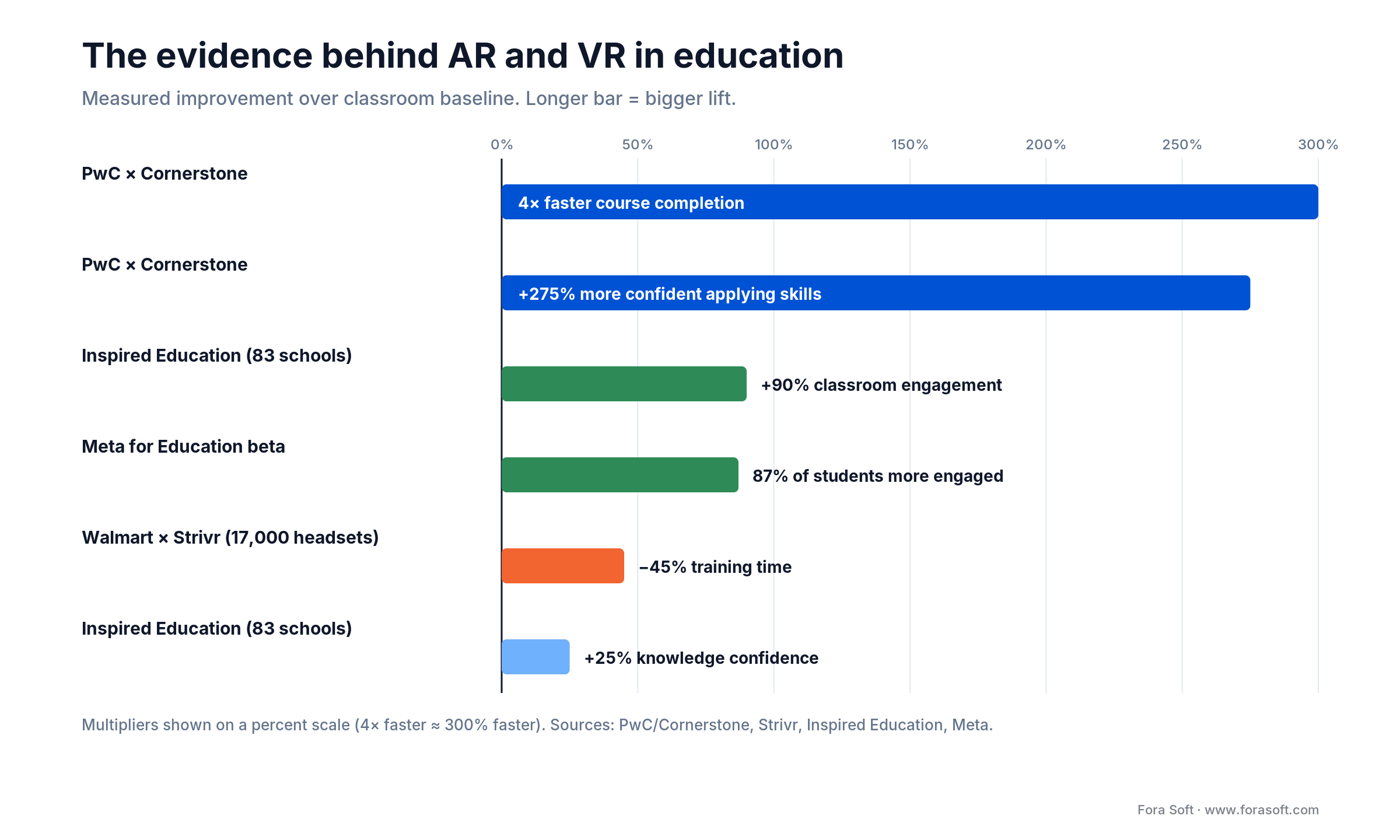
Figure 1. The measured lift behind AR and VR in education, on one percent scale. Sources: PwC/Cornerstone, Strivr, Inspired Education, Meta.
Why education teams trust Fora Soft with XR
Our education track record is operational, not aspirational. BrainCert — a virtual-classroom and LMS platform we engineered and still maintain — serves 100,000+ customers, has streamed more than 500 million classroom minutes, and generates USD 3M ARR for its owners, with four Brandon Hall Excellence awards and users such as UNICEF and BCG. Scholarly, a higher-education collaboration platform with 15,000+ users and live classes up to 2,000 concurrent, won the AWS Most Innovative EdTech APAC award. Our AI course-generation work on Career Point reached 100,000 users in year one.
On top of that we’re a streaming-media company: 250+ projects since 2005, moving video, 3D scenes, spatial audio and hand-tracking in real time — the same plumbing that makes a multi-user VR classroom feel present instead of laggy. We run on Agent Engineering, where most production code is written in tight loops between senior engineers and AI coding agents. That’s how we keep a custom XR MVP inside 3–4 months instead of the usual 6–12, and why our dedicated teams can hit mid-five-figure budgets most agencies can’t.
Why 2026 is the year to commit
Three things line up in 2026 that never lined up before: audited proof, credible devices, and browser distribution. Start with the proof, because it’s the number every board asks about. PwC, working with Cornerstone’s learning data, found VR learners complete courses four times faster than classroom learners, feel 275% more confident applying what they learned, and report being 3.75 times more emotionally connected to the content (2.3× versus e-learners). Walmart’s Strivr deployment — 17,000 headsets across its US stores and training academies, not a lab study — cut per-associate training time by roughly 45% and lifted assessment scores, with the Pickup Tower module dropping from eight hours to fifteen minutes.
On the student side, Inspired Education Group’s rollout across 83 schools measured 90% higher engagement and 25% better knowledge confidence, and Meta for Education’s beta cohort reported 87% of students more engaged than the baseline class. The market backs the pattern: analyst estimates vary widely by scope, but Mordor Intelligence puts VR-in-education near USD 31B in 2025 growing around 21% a year, while the underlying spatial-computing OS market (visionOS, Horizon OS, Android XR) scales into the tens of billions this decade. Treat the exact market number as directional; the direction is not in doubt.
What does the engagement evidence actually say
The short version: five studies anchor almost every serious education-XR business case, and they agree from different angles. We keep them on a one-pager for client kick-offs because most buyers need the numbers in a form they can hand to a CFO or a superintendent.
| Study / context | Population | Headline result |
|---|---|---|
| PwC × Cornerstone (enterprise) | >12,000 learners | 4× faster, 275% more confident, 3.75× emotional engagement |
| Walmart / Strivr (retail ops) | 17,000 headsets | ~45% training-time cut, score lift, 8h→15m on Pickup Tower |
| Inspired Education Group (K-12) | 83 schools | 90% engagement lift, 25% knowledge confidence |
| Meta for Education (beta) | Pilot cohort | 87% of students more engaged than baseline |
| Stanford VHIL (higher ed) | Multi-year academic | Confidence & satisfaction lift; attention plateaus ~45 min |
Two caveats we always add. First, the generalist “VR lifts engagement up to 25%” figure comes from broad K-12 meta-analyses — it’s the right lower bound to show a sceptical board, while the PwC and Walmart numbers are the enterprise ceiling. Second, effect sizes shrink when the content is badly designed, so treat these as what good looks like, not a guarantee. The full method behind each figure is in PwC’s VR learning study.
Stuck picking the evidence for your board?
We keep an up-to-date one-pager of the defensible engagement numbers and cost break-evens — we’ll walk your team through it and map it to your programme.
K-12 use cases that already work
K-12 is where XR education has the densest proof. Labster — virtual science labs — runs in thousands of high schools and universities and has served over 3 million students, aligned to NGSS and AP Biology frames. Nearpod VR drops inside an existing teacher’s lesson flow with 500+ VR lessons and reaches roughly one in ten US schools. zSpace is the desktop-stereoscopic incumbent in 1,800+ US districts, teaching STEM, anatomy and automotive CTE without headsets at all.
RobotLAB Expeditions 2.0, built on Britannica and 360 Cities content, became the default replacement for Google Expeditions (retired June 2021) and ships 700+ field trips out of the box. For maker and soft-skills work, Lens Studio and Meta Spark let teachers build classroom-scale smartphone AR without writing native code.
The pattern is unambiguous: every platform that grew past a thousand schools also has a non-XR mode. The teacher can still run the lesson on a Chromebook when the headset battery is flat. That’s the first question we put to a K-12 client — what does this look like on a bad day? — and the products that answer it well are the ones that win deployments.
Higher ed and medical: where XR earns the premium
Osso VR runs surgical simulation in 100+ medical schools and hospitals; a peer-reviewed PMC study measured higher procedural accuracy and lower training time than the classroom baseline. FundamentalVR adds haptic feedback at sub-surgical latency, which is how you teach force perception for procedures such as needle insertion. Mursion runs AI-driven virtual humans for clinical communication, de-escalation and parent-teacher practice, and is licensed by many US teacher-training colleges.
BodyViz imports real MRI and CT scans for 3D anatomy, and clinical VR environments teach ECG lead placement and rhythm reading. This is the tier that financially justifies custom tooling: the licences institutions pay here (often USD 50K–200K a year per school) fund the custom haptics, tracking and AI-patient integrations that mass-market K-12 catalogues can’t afford to build.
Reach for custom over catalogue when: your curriculum, assessment model or brand is the product, you need haptics or first-party analytics, or a catalogue covers less than about 80% of your learning outcomes.
Corporate training: the commercial engine
The economic centre of gravity for XR education isn’t schools — it’s corporate L&D. Walmart, Verizon, Bank of America and FedEx run production-grade VR training on Strivr; Bank of America alone put 50,000+ employees through it. Chipotle trains food handling in immersive modules, and Boeing has taught assembly with AR overlays since 2018. Safety onboarding, compliance, customer-service role-play and hazard recognition all pay back inside the first year at any company hiring a couple of thousand people annually.
The engineering that corporate needs and K-12 doesn’t: SSO into the enterprise identity provider, SCIM user provisioning, xAPI/cmi5 reporting back into the client’s LMS, device-fleet management (usually ArborXR or ManageXR), and captioning plus localisation for every seat. Our custom builds default to these from sprint one; it’s the difference between a demo and a roll-out.
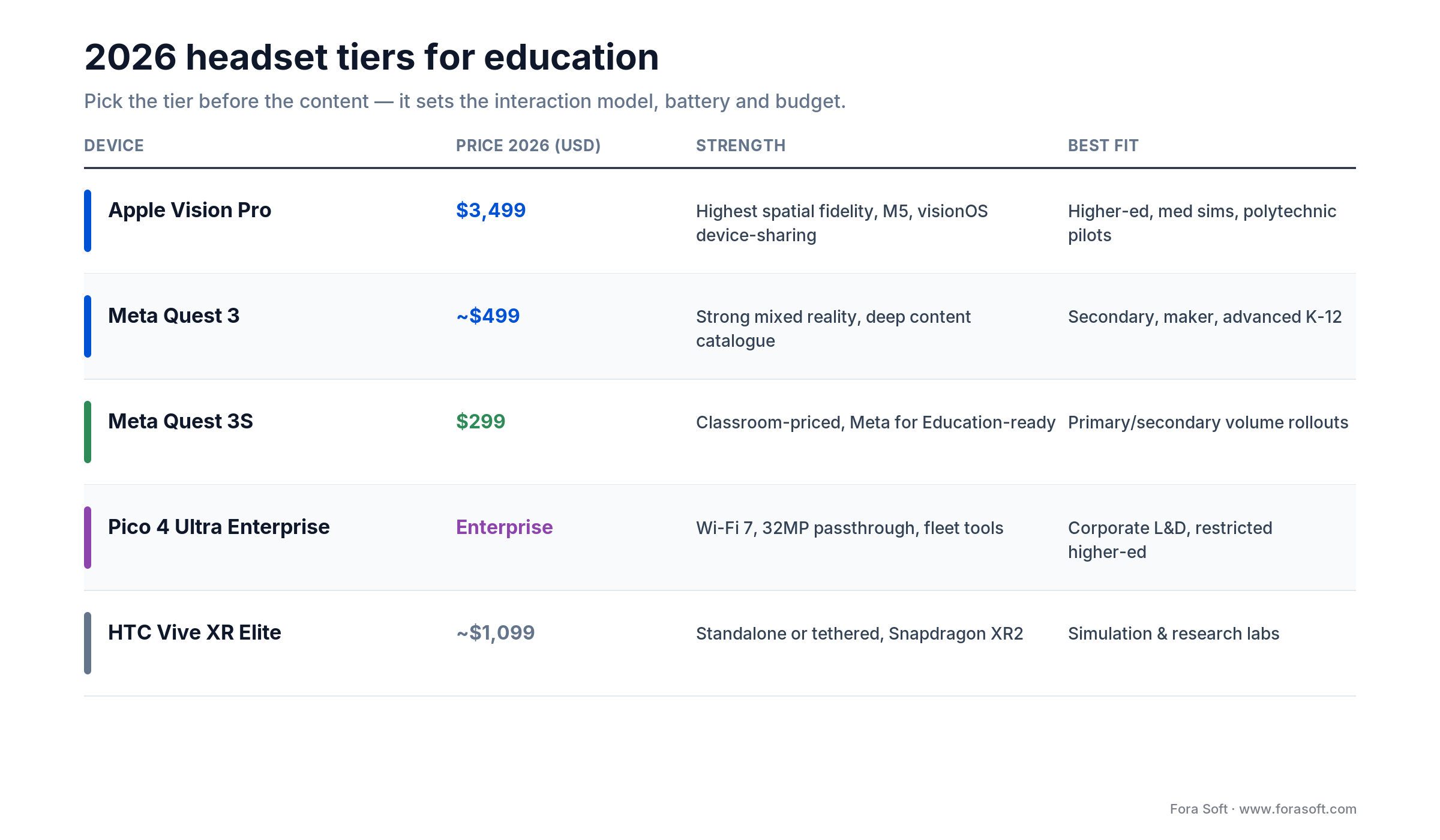
Figure 2. The three device tiers that decide an education XR budget, with 2026 prices and best-fit programmes.
Which headset should you buy in 2026
For most classroom programmes, the answer is the Meta Quest 3S at USD 299 — it’s the price-performance leader with Meta for Education fleet tooling. Move up only when the programme demands it. Pick the tier before the content, because the tier sets the interaction model, the battery envelope and the budget.
| Device | Price 2026 (USD) | Strength | Best fit |
|---|---|---|---|
| Apple Vision Pro | 3,499 | Highest spatial fidelity, M5, visionOS device-sharing | Higher ed, med sims, polytechnic pilots |
| Meta Quest 3 | ~499 | Strong mixed reality, deep content catalogue | Secondary, maker, advanced K-12 |
| Meta Quest 3S | 299 | Classroom-priced, Meta for Education-ready | Primary/secondary volume rollouts |
| Pico 4 Ultra Enterprise | Enterprise tier | Wi-Fi 7, 32MP passthrough, fleet tools | Corporate, restricted higher ed |
| HTC Vive XR Elite | ~1,099 | Standalone or tethered, Snapdragon XR2 | Simulation & research labs |
With Google’s Android XR shipping, 2026 is the first year there are three real mobile-XR operating systems to target: visionOS, Horizon OS and Android XR. That changes build posture. We abstract across all three with Unity’s XR Interaction Toolkit or OpenXR; shipping against a single OS is a planning mistake this year.
Reach for Vision Pro when: the outcome depends on fidelity — medical anatomy, design review, spatial data — and a small cohort can share a few devices. For volume classrooms, the maths almost always points back to Quest 3S.
WebXR or native VR: how to choose
Choose WebXR when reach and zero install matter more than fidelity; choose native VR when the learning outcome needs haptics, photorealism or long immersion. WebXR (delivered via 8th Wall / Niantic Studio, A-Frame or a custom Three.js build) renders in the browser — no app-store review, no per-school deploy, works on Chromebooks. Native VR (Unity or Unreal) gives you haptics, 6DOF, multi-hour sessions, 90+ FPS and lower motion-to-photon latency. Which you pick is a business question, not a technical one.
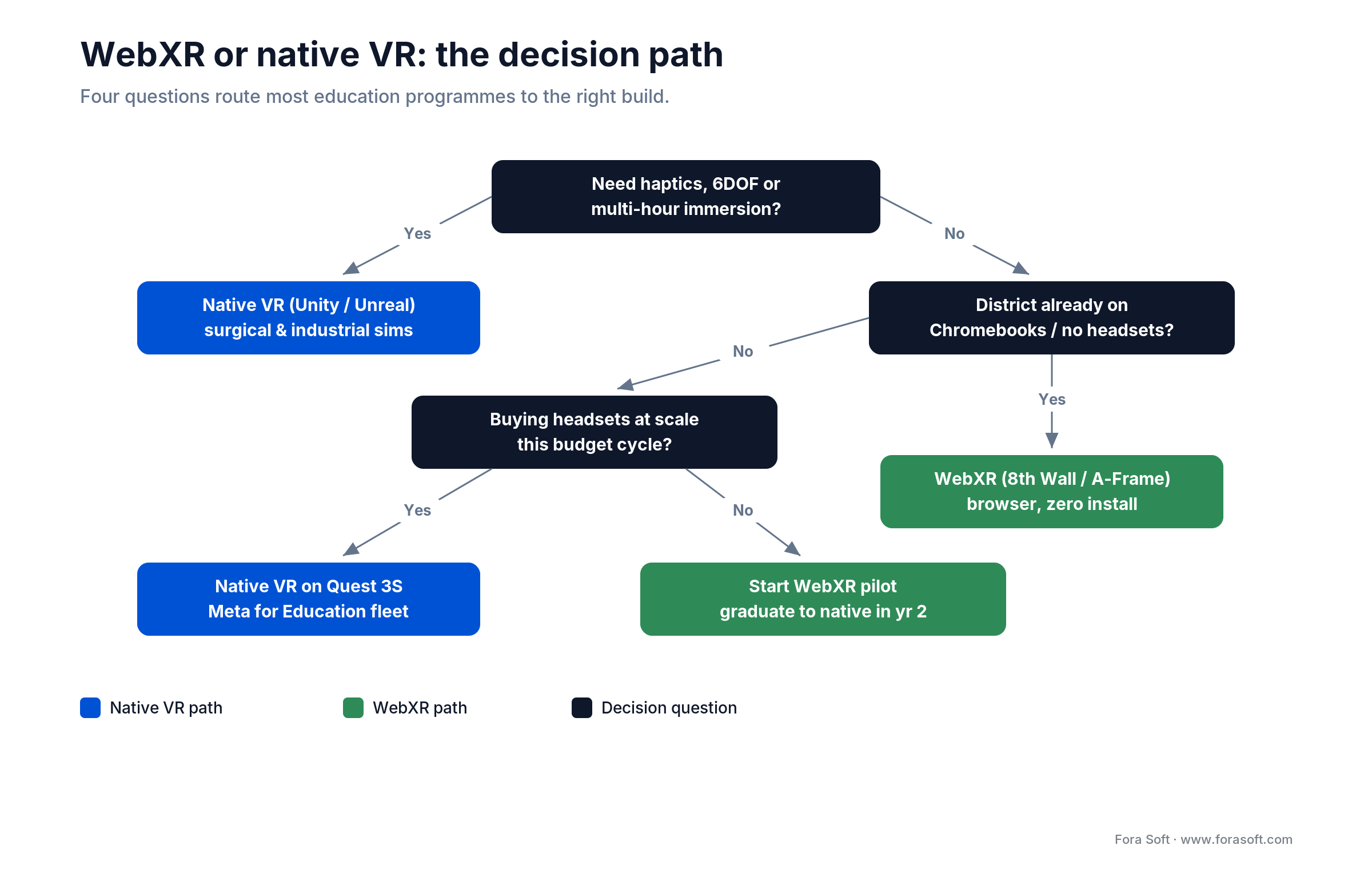
Figure 3. Four questions route most education programmes to WebXR or native VR.
Reach for WebXR when: the district already owns Chromebooks, the lesson fits inside 15–20 minutes, you need one-click teacher access, or you’re piloting content on a marketing site. Native pays off once you own headsets and need haptics or multi-hour immersion.
The tech stack we ship on
Unity carries most K-12 and VR-training work — its XR Interaction Toolkit and AR Foundation give us one codebase across visionOS, Horizon OS, Android XR, ARKit and ARCore. Unreal Engine is our default for high-fidelity surgical and industrial simulation, where photorealism actually changes the learning outcome. For WebXR we build on 8th Wall (Niantic), with A-Frame and Three.js underneath when a case needs custom WebGL.
For mobile AR alone, ARKit (iOS) and ARCore (Android) are the native SDKs, with no-code options for curriculum designers. Multi-user classrooms ride on Engage XR or browser-based venues like Frame VR. Our streaming layer bolts on WebRTC for live teacher audio, spatial audio for presence, and low-latency hand-tracking sync — the same real-time media engineering we teach in our video-streaming course.
The one-OS trap: a build that only runs on Horizon OS or only on visionOS will need a rewrite within about 18 months. Abstract through Unity’s XR Interaction Toolkit or OpenXR from day one, even for a pilot.
Session design and the 45-minute rule
Three design rules survive every review we do. First, keep sessions under 45 minutes — Stanford VHIL’s attention curves plateau there. Second, treat cybersickness as a ship-blocker, not a polish item: once motion-to-photon latency drifts above about 20 ms, nausea rises fast in vulnerable learners, and younger students are the most exposed on poorly tuned builds. Use teleport locomotion instead of smooth movement for anyone under 14. Third, watch headset weight — heavier units drive up neck-strain complaints, so balanced straps matter more than a spec-sheet gram count.
Curriculum alignment is the quiet killer. A large share of VR education apps don’t map to Common Core or NGSS out of the box, and IT directors routinely report weeks of custom modification before an app can go into classrooms. Our builds put a curriculum consultant in the room for the first two sprints — it’s cheaper than retrofitting alignment after the content is built.
Accessibility and equity: designing for every learner
Equity has two dimensions. The access dimension is cost: headsets run USD 299–3,499 per unit and a full content suite can add USD 50K–150K before maintenance, captioning and translation. The disability dimension is that blind and low-vision learners, deaf learners and learners with motor differences still get second-class treatment from most XR apps. Spatial-audio cues, AI scene description, subtitle tracks that render in 3D space, seated-first interaction modes, and avatar palettes that reflect the school’s population are all features clients hesitate to fund — until a procurement team asks for them.
We default builds to WCAG 2.2 plus the W3C’s XR Accessibility User Requirements (XAUR). It adds roughly 8% to build time and is the difference between passing a Title II review and losing the contract.
Design accessibility in from sprint one: retrofitting WCAG 2.2 and XAUR compliance later costs 3–5× more than building it in, and it’s the item most likely to sink a public-sector procurement.
Teacher enablement: the reason pilots stall
The single biggest reason pilots stall isn’t the hardware or the content — it’s that most classroom teachers feel unprepared to teach with XR, and only about one in five have had any formal training (Education Week, 2025). A rollout with no teacher-enablement track is a rollout that ends two semesters later with headsets in a cupboard.
The format that works in our experience: a one-day in-person workshop, four 60-minute live follow-ups over four weeks, a shared teacher channel the vendor moderates, and a non-XR fallback in every lesson plan. We budget 15–20% of first-year cost for enablement, and we’ve watched the same rollouts cost three times that when teams skipped it the first time and had to restart.
What a serious programme actually costs
PwC’s cost model — the most defensible one out there — shows VR breaks even against classroom training at roughly 375 learners and against e-learning at around 1,950. Past 3,000 learners, VR runs about 52% cheaper than classroom. Those are enterprise-training figures; schools have different unit economics, but the shape of the curve holds: high fixed cost, low marginal cost, so the per-learner price falls as the cohort grows.
Here’s the arithmetic for a 30-headset classroom cart. Quest 3S at USD 299 × 30 = USD 8,970 in hardware. Add USD 75,000 of content and licensing amortised over three years, and spread it across, say, 200 students a year (600 over three years): (8,970 + 75,000) ÷ 600 ≈ USD 140 per student per year — before teacher time. Custom platforms sit in wider bands: a lean single-institution WebXR MVP typically runs USD 60K–150K, while a multi-tenant district or corporate platform with SSO, xAPI/cmi5, analytics and a teacher dashboard lands USD 180K–420K in year one. Second-year TCO drops roughly 55–65% because the content library compounds.
Walmart reported its lowest turnover in more than a decade after the VR rollout — the retention story is the ROI most CFOs respond to. Our software cost guide has the full line-item bands if you want them.
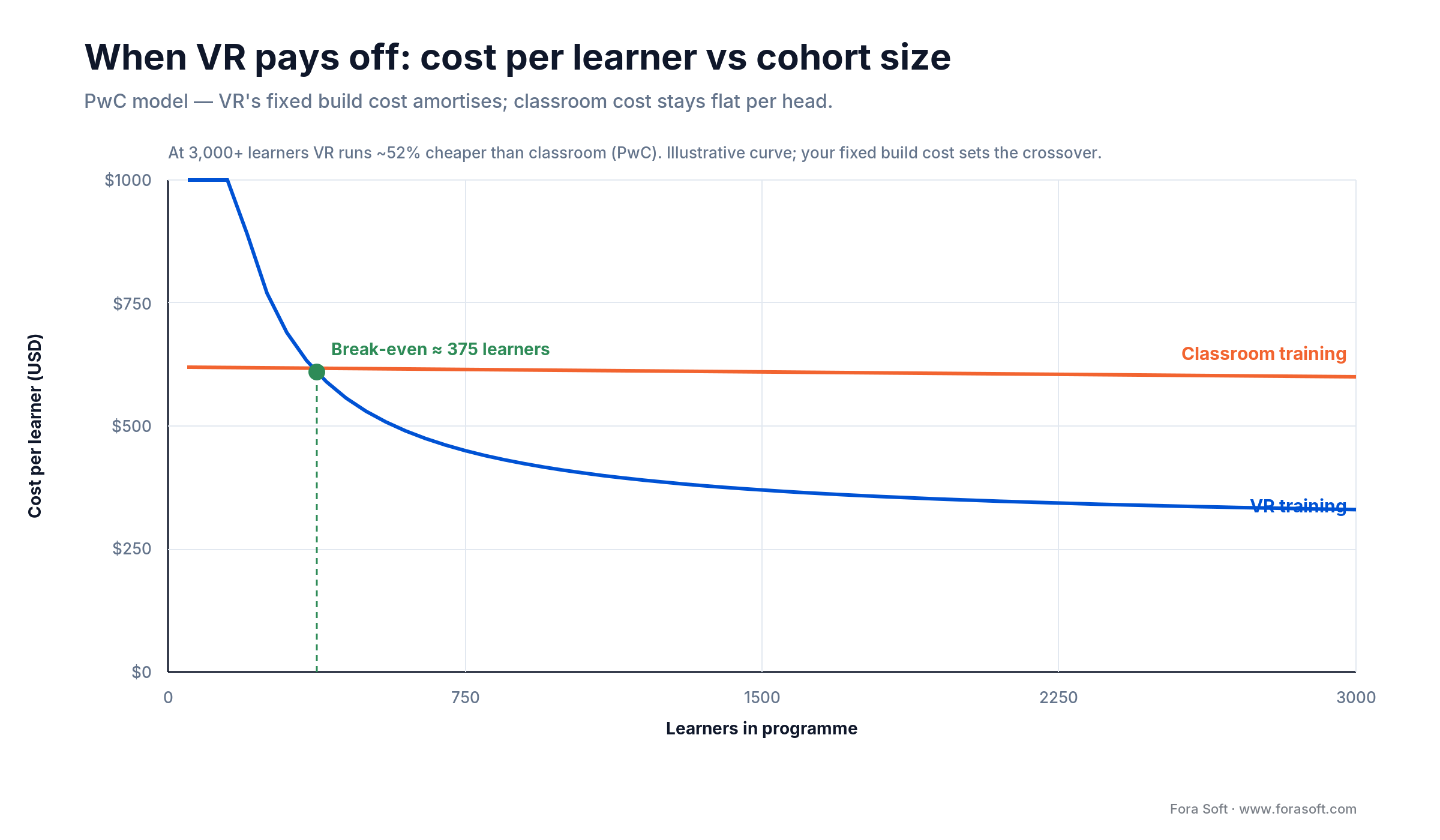
Figure 4. Cost per learner versus cohort size — VR crosses below classroom around 375 learners (PwC model, illustrative curve).
Want a sober cost model for your programme?
Send us your cohort size and learning outcomes and we’ll come back with a one-page budget that separates platform, content, hardware and enablement.
Labster, Nearpod, zSpace, Engage or custom
Off-the-shelf is often the right first move, especially for a pilot or a tight budget. The real decision usually isn’t “build vs buy” — it’s “buy now, custom next year,” once the engagement data is inarguable.
| Platform | Best for | Content model | Where it breaks |
|---|---|---|---|
| Labster | HS & uni science labs | Catalogue (300+ labs) | No custom curriculum or branding |
| Nearpod VR | K-12 classroom lessons | Catalogue (500+) | Light on deep simulation |
| zSpace | STEM & CTE desktops | Desktop stereoscopic | Not headset-mobile |
| Engage XR | Higher-ed live classes | Authoring + venues | Enterprise pricing, learning curve |
| Custom (Fora Soft) | Unique curriculum & brand | Tailored, own IP | Higher up-front cost; needs a real cohort |
Mini case: how BrainCert scaled past 100,000 customers
Situation. BrainCert came to us to build a virtual-classroom and LMS product that could carry live teaching at scale. The hard part wasn’t the course catalogue — it was the real-time layer: an interactive whiteboard and WebRTC streaming engine that stay in sync for a full class without lag.
Plan. We engineered the whiteboard and streaming core, instrumented engagement from day one, and only layered richer collaboration once the usage data justified it. That order — prove the core, then add surface — is exactly what we recommend to XR-education teams entering the market: start with a use-case that already has budget, measure it hard, and add spatial features (avatars, 3D rooms, haptics) only when the numbers earn them.
Result. BrainCert now serves 100,000+ customers, has streamed 500M+ classroom minutes, generates USD 3M ARR for its owners and holds four Brandon Hall Excellence awards, with UNICEF and BCG among its users. Want a similar read on your programme? Grab a 30-minute assessment call.
How AI is changing XR content economics
Four AI-plus-XR capabilities are moving into production in 2026. 1. AI tutors: LLM-driven agents inside Horizon classrooms and in-headset tutors are already demoing to paying customers. 2. Adaptive VR from eye-tracking: Vision Pro and Quest Pro expose fixation and attention signals we feed into models that detect confusion and re-sequence content. 3. Procedural scenes: tools like NVIDIA Omniverse and Niantic Studio generate variations of a lab on demand, turning one scene into fifty. 4. Generative 3D: text-to-3D pipelines (Meshy, Luma) are finally good enough to scaffold lesson assets and cut our production time on early drafts.
This is where our AI-integration practice plugs in. We’re not adding AI because it’s fashionable — we add it because it changes the unit cost of XR content production, and that changes the build-vs-buy maths in your favour.
A five-question decision framework
Before you commission a build or buy a licence, answer five questions honestly. If two or more come back “unclear,” delay the hardware purchase — it’s the most expensive thing to get wrong.
1. Which learning outcome will XR beat the status quo on? Name it, define the measure, baseline it on paper before anyone puts on a headset.
2. Which device tier matches the programme? Vision Pro for fidelity, Quest 3S for volume, Pico 4 Ultra for corporate fleets, WebXR for Chromebook reach.
3. Who pays for teacher and learner enablement? Budget 15–20% of year-one cost, or expect the pilot to stall.
4. Does the lesson still work with the headset in the cupboard? Every rollout needs a non-XR fallback that a substitute teacher can run.
5. What’s the evidence loop for year two? Instrumentation, cohort comparison, and a pre-committed go / no-go date. Without it, you can’t defend the renewal.
Five pitfalls that quietly kill XR programmes
We’ve seen the same five failure modes repeat across rollouts, and almost all of them are avoidable.
1. Buying headsets before content. A 30-headset cart with no lesson plan is a line item on next year’s board audit, nothing more.
2. Skipping teacher enablement. Most teachers feel unprepared; zero enablement means zero adoption, no matter how good the content is.
3. Ignoring cybersickness thresholds. One module that crosses ~20 ms motion-to-photon latency can burn teacher trust for a whole year.
4. Locking into a single OS. Android XR, visionOS and Horizon OS are all shipping — one-OS builds age out inside 18 months.
5. Treating accessibility as Phase 2. Retrofitting WCAG and XAUR compliance costs 3–5× more than designing for it from the start.
The 90-day roadmap we give clients
The version we ship with clients is three 30-day loops. It works for K-12 and corporate L&D alike — the audience changes, the rhythm doesn’t.
Days 1–30 • Proof
Pick the single outcome to beat and baseline it on paper. Select one off-the-shelf platform (Labster, Nearpod, Engage or Osso) or commission a two-week WebXR proof. Buy 5–8 headsets. Run one class or cohort end to end.
Days 31–60 • Instrumentation
Add engagement telemetry, wire xAPI/cmi5 into the LMS, and set up cohort comparison. Survey teachers weekly and track cybersickness incidents. Decide whether the off-the-shelf product covers ~80% of need; if not, commission a custom MVP.
Days 61–90 • Scale or stop
Either scale to the second cohort with a formal enablement track, or hit the pre-committed stop point: headsets return, the licence lapses, and the data goes into a lessons-learned deck.
Want the 90-day plan tailored to your programme?
30 minutes, no slides. We’ll talk through your outcome, cohort size and budget, and tell you whether to start with Labster, WebXR or a custom build.
Frequently asked questions
Is the engagement uplift for AR and VR in education a real, defensible number?
Yes. The strongest sources are PwC (4× faster completion, 275% more confident) and Walmart’s Strivr rollout across 17,000 headsets (~45% less training time). Student pilots run higher still — Inspired Education’s 83-school programme saw 90% higher engagement. Treat the enterprise figures as the ceiling and the ~25% K-12 meta-analysis number as the floor.
Which headset should a K-12 programme start with?
The Meta Quest 3S at USD 299 is the 2026 price-performance leader for classroom deployment, with Meta for Education fleet tooling and a full content catalogue. Vision Pro (USD 3,499) is for higher-ed and polytechnic pilots where fidelity and multi-user visionOS sessions justify roughly 12× the price.
What does a full custom AR/VR education build cost?
A lean single-institution WebXR MVP starts around USD 60K. A multi-tenant district or corporate platform with SSO, xAPI/cmi5, analytics and a teacher dashboard lands in the USD 180K–420K band for year one. Second-year TCO typically drops 55–65% as the content library compounds.
How do we avoid cybersickness in young learners?
Three non-negotiables: keep motion-to-photon latency under ~20 ms, cap sessions at 45 minutes, and use teleport locomotion rather than smooth movement for anyone under 14. Younger learners are the most susceptible on poorly tuned builds, and all three guardrails measurably reduce reported nausea.
WebXR or native VR — how do we pick?
Use WebXR for Chromebook districts, 15–20 minute lessons, no app-install friction and marketing-style demos. Use native VR for haptics, multi-hour immersion, photorealistic surgical or industrial sims, and where you already own headsets. Most mid-market programmes start on WebXR and graduate to native in year two.
Can we plug XR into our existing LMS or do we need a new one?
Your existing LMS is usually fine. xAPI and cmi5 are mature, and Moodle, Canvas, D2L Brightspace, Schoology and SAP SuccessFactors all ingest them. If you run on BrainCert, the hooks are already there. The integration takes 2–4 weeks on a standard build.
What about accessibility compliance?
Default to WCAG 2.2 and the W3C’s XR Accessibility User Requirements (XAUR) from day one: seated-first modes, 3D-space subtitle tracks, spatial-audio cues, motor-alternative inputs and AI scene description. Budget about 8% additional build time. It’s the difference between passing a Title II procurement review and losing the contract.
When is XR the wrong answer?
When the outcome is text-heavy or abstract (macroeconomics, contract law), when the cohort is well under the ~375-learner break-even, or when the real bottleneck is assessment quality rather than engagement. In those cases a better LMS with video and interactive notebooks out-earns XR, and the same USD 80K spent on curriculum moves the needle faster.
What to read next
Case study
BrainCert — 100K+ customers, 500M classroom minutes
The virtual-classroom platform behind UNICEF and BCG — our flagship education engagement.
Case study
Scholarly — AWS Most Innovative EdTech APAC
Higher-ed collaboration: 15K+ users, live classes up to 2,000 concurrent.
Service
E-learning software development
Our full education platform map — LMS, live classroom, XR and AI tutors.
Service
AI integration for education
AI tutors, adaptive sequencing and procedural 3D — where XR economics change.
Retention
Why users leave apps — and the fix
Engagement first, XR second — the playbook that keeps learners past Day 30.
Ready to ship an XR programme that actually lands?
AR and VR in education is finally boring — in the best way. The evidence is audited, the devices span a credible price range, the software stack is stable enough to build durable products on, and the failure modes are well documented. What separates programmes that land from ones that stall isn’t technology — it’s treating teacher enablement, cybersickness, curriculum alignment and accessibility as first-class requirements from day one.
If you’re scoping a K-12 pilot, a higher-ed rollout or a corporate L&D platform, we’ve shipped each of those patterns before. The shortest path to a go / no-go decision is a single 30-minute call, a look at your outcomes, and an honest read on whether Labster, WebXR or a custom build is your right first step.
Let’s build your AR/VR education programme
30 minutes, no slides. We’ll map your cohort, outcomes and budget to the right device tier and delivery pattern, and hand you a 90-day plan you can take to your board on Monday.

