

Key takeaways
• Five machine-learning techniques carry facial emotion recognition in 2026. 2D CNNs for per-frame baselines, 3D CNNs for spatiotemporal context, CNN+LSTM for sequence dynamics, transformers/MAE-DFER for in-the-wild accuracy, and multimodal fusion when audio is available.
• Self-supervised transformers set the pace. MAE-DFER (2023) made self-supervised pretraining the default; 2025 methods like S4D push DFEW to ~77% WAR with little labeled data. Start here for new in-the-wild domains.
• EU AI Act bans emotion recognition in workplace and schools. Effective February 2025. Engagement detection (gaze, head pose) is still allowed and is the safer architecture for B2B SaaS.
• Honest in-the-wild accuracy tops out in the mid-to-high 70s % WAR on 7-class video emotion (2025). Anything at or above 90% is usually a leaderboard artefact. Cross-cultural performance drops another 15–30 points.
• Build vs. buy is volume-driven. Below 100k frames per month, license a commercial API. Above 1M frames per month, self-host MAE-DFER on Jetson or GPU and pay back hardware in 6–9 months.
Why Fora Soft wrote this playbook
We have been building video, AI, and real-time multimedia products since 2005, across 250+ shipped products. Facial emotion recognition has moved from the research lab into our actual scope of work for telehealth, e-learning, market research, and video conferencing customers over the last three years.
Our team has shipped face-pipeline AI on top of V.A.L.T. for medical training rooms, embedded engagement detection into e-learning platforms like BrainCert, and integrated audio + facial signals into AI features described in our guide to emotion detection in audio and video. We have also said no to several builds where the EU AI Act made the scope unworkable — that judgment is part of the work.
This playbook is the compressed version of our scoping conversation: the five techniques that earn their place, when each one fits, the benchmarks that are honest, the regulation you cannot ignore, and how to decide whether to build or buy. For the wider context, our Learn hub on AI for video engineering maps where emotion work sits in a modern video stack. Browse our portfolio to see the kind of products this lives inside.
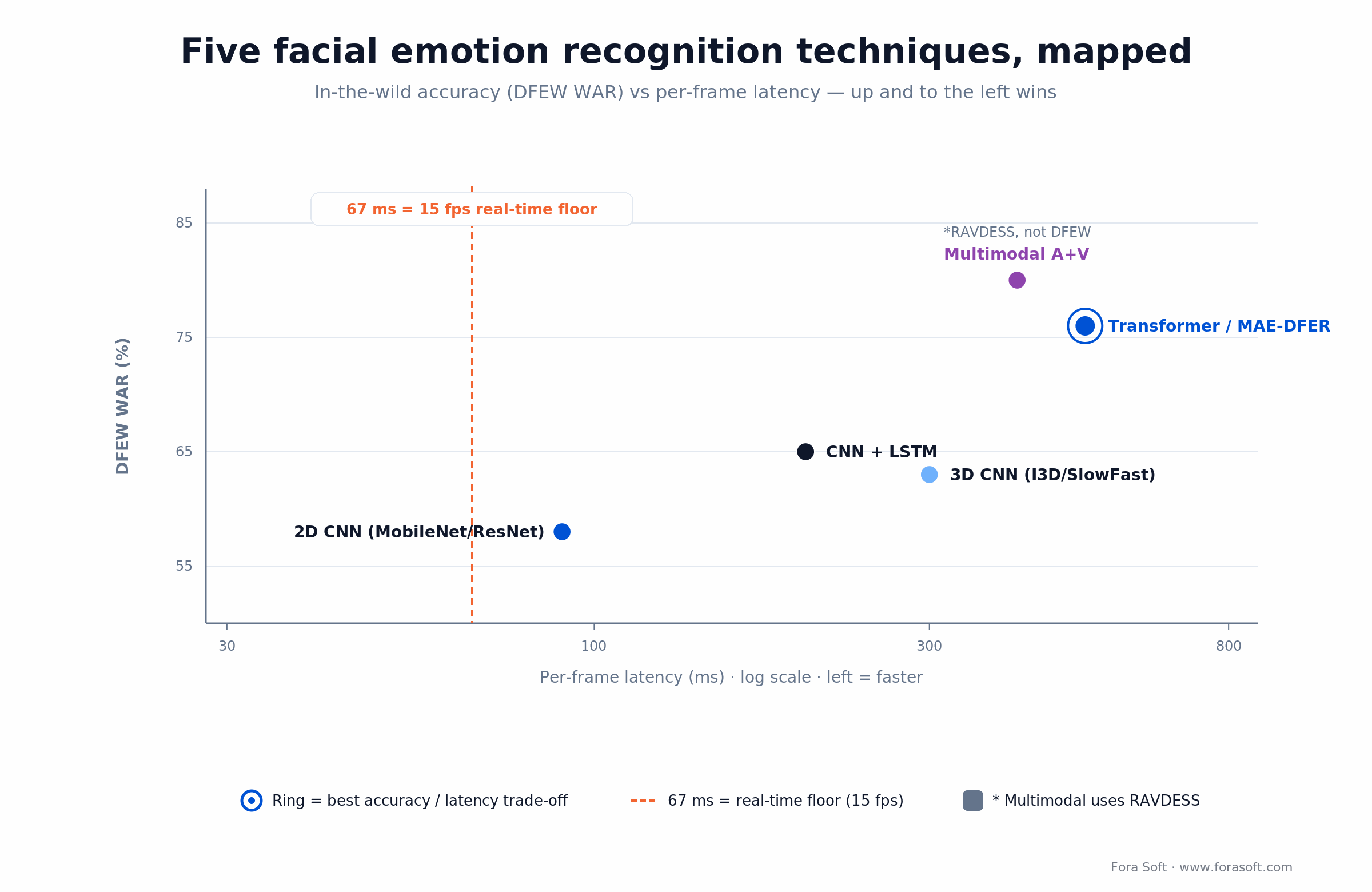
Figure 1. The five techniques on one map. Transformers lead on accuracy, 2D CNNs win on latency, multimodal peaks on clean audio.
Scoping a video emotion analysis build?
30 minutes with a senior engineer who has wired emotion AI into telehealth, e-learning, and conferencing products — including the EU AI Act conversation.
What video emotion analysis actually means in 2026
Facial emotion recognition is the machine-learning task of inferring a person’s emotional state from facial video, either as discrete labels (happy, sad, angry) or as continuous valence–arousal values. In 2026 it is really an umbrella over several distinct tasks that buyers conflate, and that the EU AI Act treats very differently.
Discrete facial expression recognition (FER). Classify each frame or clip into 6–7 basic emotions (happy, sad, angry, fearful, disgusted, surprised, neutral). Grounded in Ekman’s basic-emotion taxonomy. The most common product framing.
Continuous valence–arousal estimation. Predict two real-valued dimensions per frame — positive vs. negative (valence) and calm vs. activated (arousal). More honest than discrete labels for in-the-wild data; benchmarks like AffWild2 evaluate it.
Action unit (AU) detection. Detect 32 anatomical facial movements (e.g., AU 4 = brow lowerer, AU 12 = lip-corner puller) without claiming what emotion they represent. Auditor-friendly because it separates observation from interpretation.
Engagement / attention detection. Estimate gaze direction, head pose, blink rate, and posture — behavioural signals, not emotional inferences. Critical distinction: engagement detection is allowed under EU AI Act in workplace and education; emotion inference is not.
Multimodal affect. Combine facial video with voice (prosody, pitch), body posture, text/transcript, or physiological signals. The most accurate approach in noisy real-world conditions.
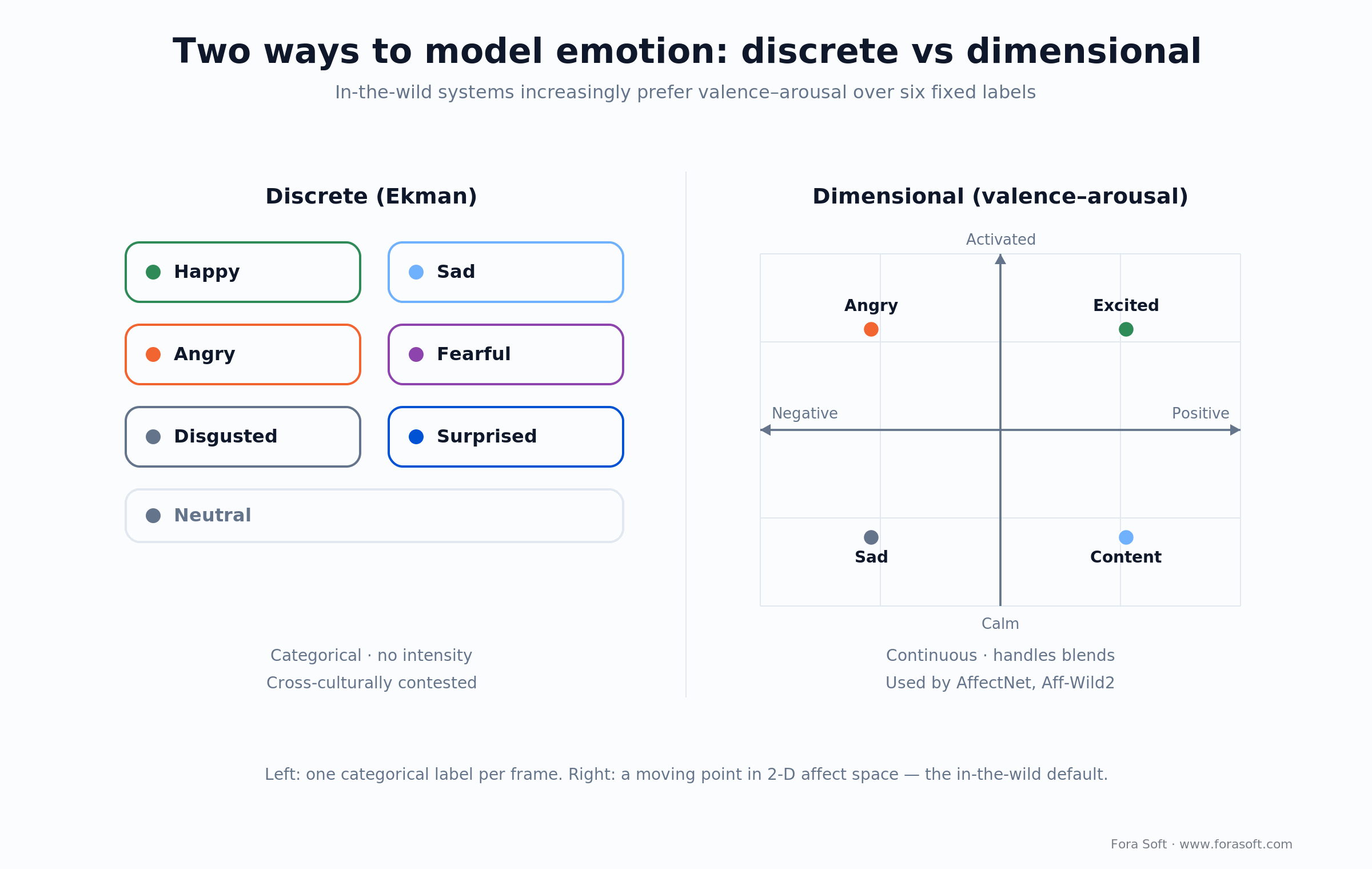
Figure 2. Discrete Ekman labels versus the continuous valence and arousal plane that in-the-wild systems increasingly prefer.
The five machine learning techniques that actually ship
Of the dozens of architectures in the literature, these are the five that consistently survive contact with a production roadmap. Pick the one that matches your latency budget, hardware target, and labeled-data reality — do not start from the leaderboard.
1. 2D CNNs on facial frames (ResNet, EfficientNet, MobileNet)
A facial detector crops each frame, a 2D CNN classifies it, you smooth the output with a temporal filter. ResNet-50 lands around 60–70% on FER2013, EfficientNet V2 reaches the low 70s on cleaner test splits, and MobileNet V2 fits in under 50 MB for in-browser deployment.
Why pick it: the cheapest baseline, the easiest to deploy on edge devices and in the browser, and the one your team already knows how to debug. Limits: no temporal context, sensitive to head pose and occlusion, ceiling around 55% WAR on in-the-wild video like DFEW, even though clean, posed sets score much higher.
Reach for 2D CNNs when: you need a real-time per-frame baseline on edge or in-browser, and a rough per-frame read is enough to validate the product hypothesis.
2. 3D CNNs and spatiotemporal models (I3D, SlowFast)
Replace 2D convolutions with 3D ones that span both space and time, or run two pathways at different temporal resolutions like SlowFast. Captures emotional dynamics — the build-up to a smile, the decay of surprise — that single-frame models miss entirely.
Why pick it: spatiotemporal context matters for short clips (3–10 s) where dynamics carry information. Limits: GPU-only inference, 200–400 ms per 8-frame clip, more than triples training cost over 2D CNN baselines.
Reach for 3D CNNs when: your inputs are short clips with clear dynamics (laughter, anger, surprise), and you have GPUs both at training and inference time.
3. CNN + RNN/LSTM/GRU for sequence dynamics
A 2D CNN extracts per-frame features, an LSTM or GRU learns the temporal sequence on top. The classic pattern from the late 2010s, still competitive when you need explicit temporal modelling but cannot afford full 3D.
Why pick it: a clear gain over a per-frame CNN baseline by modeling temporal dynamics (reported on AFEW-VA and similar continuous benchmarks), lower compute than 3D CNNs, easy to deploy on Jetson Orin NX. Limits: less resilient than transformers on in-the-wild data, harder to scale to long contexts (more than ~30 frames).
Reach for CNN+LSTM when: you have 5–30 second clips, want continuous valence–arousal output, and need to fit on a single edge GPU.
4. Transformer-based and self-supervised (Former-DFER, MAE-DFER, ViT)
Self-attention over space and time, often pre-trained with masked autoencoding so the model learns from unlabeled video before any emotion label exists. MAE-DFER (2023) made this the default; 2025 methods such as S4D now post the top scores on DFEW, FERV39k, and MAFW, the hardest in-the-wild benchmarks.
Why pick it: highest reported accuracy in the wild, holds up under occlusion and head pose, dramatically lower labeled-data requirement thanks to self-supervised pre-training. Limits: 300–800 ms inference, GPU mandatory, harder to interpret than CNN+LSTM.
Reach for MAE-DFER / transformers when: in-the-wild accuracy is the headline KPI, you have GPU at inference time, and labeled emotion data is scarce.
5. Multimodal fusion (audio + video, sometimes text)
Run a video encoder and an audio encoder in parallel, fuse them with cross-modal attention, decode emotion. Recent architectures like AVT-CA and TACFN add 5–15 absolute points over single-modality baselines on RAVDESS, IEMOCAP, and MAFW.
Why pick it: the only architecture that handles ambiguous facial expressions well — voice prosody disambiguates a tight smile from genuine joy. Best fit for telehealth, conversational AI, and call-centre analytics. Limits: highest engineering complexity; needs synchronized audio; voice biometrics regulation adds compliance load.
Reach for multimodal fusion when: audio is available, accuracy of the emotion channel is the product, and you can absorb the compliance load on voice biometrics.
The five techniques compared
| Technique | DFEW WAR | Latency | Hardware | Sweet spot |
|---|---|---|---|---|
| 2D CNN (ResNet, MobileNet) | ~52–56% | 30–150 ms | CPU / mobile / browser | Cheap baseline, on-device |
| 3D CNN (I3D, SlowFast) | ~53–57% | 200–400 ms | GPU only | Short dynamic clips |
| CNN + LSTM/GRU | ~53–56% | 100–300 ms | Edge GPU (Jetson) | Continuous valence–arousal |
| Transformer / MAE-DFER | ~74–77% | 300–800 ms | Server GPU | In-the-wild SOTA |
| Multimodal fusion (A+V) | ~75–82% (RAVDESS) | 200–600 ms | Server GPU | Telehealth, call-centre |
DFEW WAR numbers are conservative published results from major papers; production figures on your own data are typically 5–15 points lower. Treat the table as a relative ranking, not as a guarantee.
Benchmarks worth trusting in 2026
FER2013 numbers above 90% are almost always test-set leakage. The benchmarks that hold up under careful evaluation are these.
DFEW (Dynamic Facial Expression in the Wild). 16,000+ movie clips, 7 emotions, 5-fold cross-validation. 2025 SOTA WAR runs in the mid-to-high 70s (S4D 76.68% WAR), with UAR meaningfully lower because the tail classes stay hard. The cleanest signal of in-the-wild performance.
FERV39k. Roughly 39,000 clips across four scenarios. Larger and more varied than DFEW; useful for cross-domain generalization checks. SOTA in the low-to-mid 50s % WAR (S4D 53.65%), markedly harder than DFEW.
AffWild2. Continuous valence–arousal on 564 in-the-wild videos, about 2.8 million frames. SOTA CCC around 0.50–0.55 valence and 0.35–0.45 arousal. The honest benchmark for continuous models.
RAVDESS / IEMOCAP. Multimodal benchmarks with synchronized audio. RAVDESS is scripted (clean signal); IEMOCAP is conversational (noisy, realistic). Multimodal fusion approaches reach 80%+ on RAVDESS, 75–81% on IEMOCAP.
MAFW. Movie-clip videos labeled with single and compound (multi-label) emotions plus bilingual text descriptions. Recent benchmark; useful as a tiebreaker.
Can facial emotion recognition even be trusted?
Short answer: treat the output as a probabilistic signal, not ground truth. The most-cited review of the field, Barrett et al. (2019), went through roughly a thousand studies and found that facial movements fail the reliability, specificity, and generalizability tests needed to infer an emotion. A scowl is not reliably anger; a smile is not reliably joy. People move their faces for many reasons, and those reasons shift by person, context, and culture.
Vendors noticed. Microsoft retired emotion classification from its Azure Face API in 2022, citing the lack of scientific consensus. The honest product framing is to measure what the camera actually sees, action units (“AU 12 fired”) or continuous valence–arousal, and let a human read intent, rather than stamping a frame “angry.” That is also the framing enterprise buyers and regulators sign off on fastest.
None of this makes the technology useless. It means you scope it as decision support, report confidence on every prediction, and never let one model’s guess decide something high-stakes about a person on its own. We build every emotion feature with that guardrail from day one.
Commercial APIs and SDKs, compared honestly
| Vendor | Modality | Pricing shape | Sweet spot | Watch out for |
|---|---|---|---|---|
| Affectiva (Smart Eye) / iMotions | Video | Enterprise contracts | Market research, ad testing | Opaque pricing |
| Hume AI | Voice + video | Bundled in EVI | Multimodal voice-led | Standalone API closed 2026 |
| AWS Rekognition | Image / stored video | ~$0.10/min video | Batch processing at scale | Coarse emotion labels |
| MorphCast | In-browser video | €5–29/month | Privacy-first, on-device | Accuracy unvalidated |
| Noldus FaceReader | Video, multi-face | License (research) | Academic / clinical | High annual fee |
| Open source (DeepFace, MAE-DFER, py-feat) | Video | GPU hours only | Custom builds at scale | No vendor support |
Microsoft Azure removed emotion classification from its Face API in 2022 over scientific-validity concerns, and Affectiva now ships inside Smart Eye rather than as a standalone SDK. Google Cloud Vision still returns four emotion buckets but is image-only and coarse. For modern builds the practical shortlist is Hume (voice-led, now bundled in its EVI product), MorphCast (privacy-first), Noldus (research-grade), AWS (batch scale), and self-hosted MAE-DFER (custom).
Open-source toolkits worth tracking in 2026
If you are building rather than buying, the toolkits below are the ones we actually pull into our pipelines — not the most-starred GitHub repositories, but the ones that survive contact with a production deadline.
MAE-DFER. Self-supervised masked autoencoder for dynamic facial expression. Near-SOTA on DFEW, FERV39k, and MAFW, and the strongest self-supervised starting point. PyTorch reference implementation, TensorRT-friendly. The default starting point for new in-the-wild builds.
DeepFace. A Python library that wraps VGG-Face, FaceNet, ArcFace, and emotion attribute extraction in one API. Production-ready, well-documented, easiest path from zero to a working baseline.
OpenFace 3.0. Released in 2025; covers facial landmarks, action units, gaze, and head pose in a single multitask system. C++/Python bindings; faster than 2.x. The right choice when you need engagement signals (not emotion labels) under EU AI Act constraints.
py-feat. Research-focused toolkit with action-unit detection, emotion classification, and visualization. Slower at inference than commercial APIs, but the most transparent toolkit for auditor-friendly outputs.
AffectGPT. Multimodal LLM for emotion understanding released in 2025. Promising but still maturing; we use it for explainability layers on top of MAE-DFER rather than as a primary classifier.
Latency reality — the 15 fps threshold
For real-time monitoring in a video product, the operational floor is 15 fps end-to-end — below that, smooth visual feedback breaks down. That gives you a per-frame budget of about 67 ms including face detection, emotion inference, smoothing, and UI delivery.
Practical envelopes: cloud GPU 20–100 ms per frame batched; Jetson Orin NX 5–20 ms with TensorRT optimization; mobile or browser CPU 50–200 ms with quantized MobileNet. Transformers add roughly a 2–3× multiplier on the same hardware.
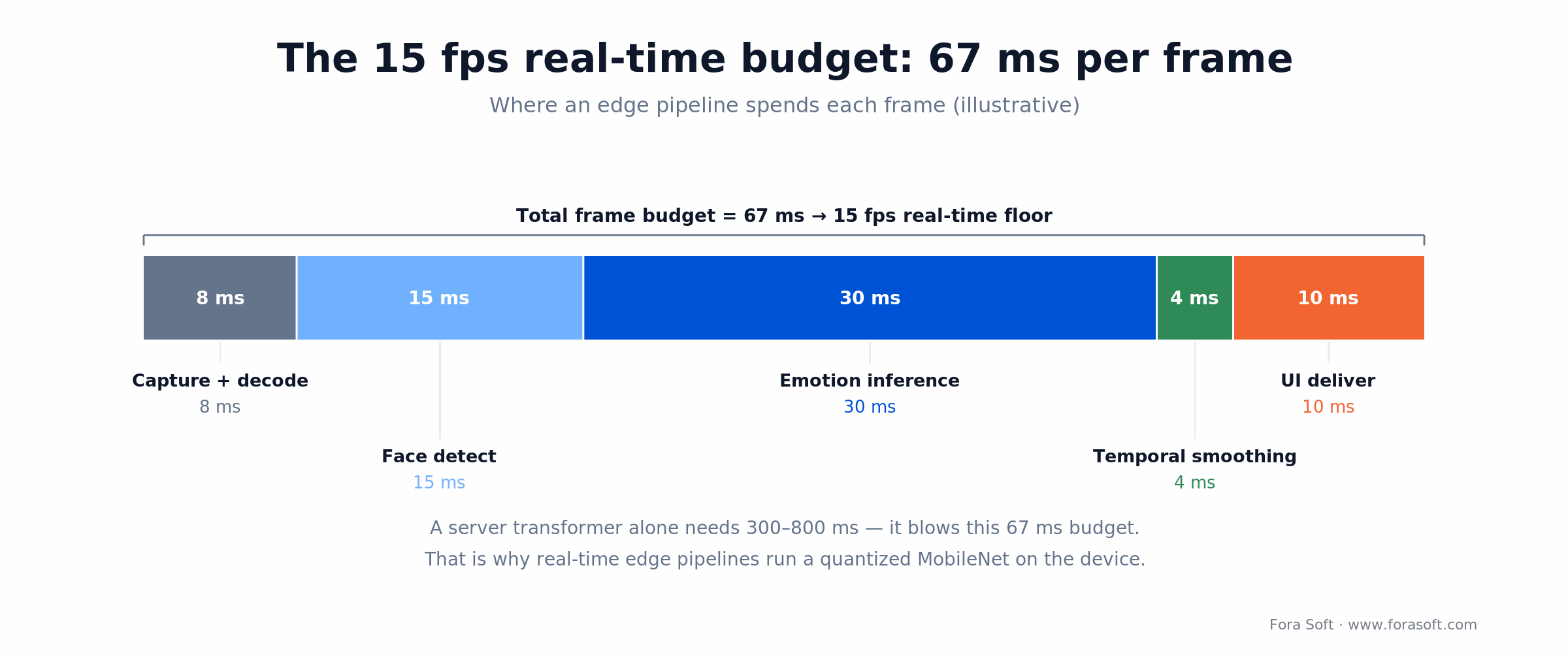
Figure 3. The 67 ms real-time budget for 15 fps, split across capture, detection, inference, smoothing and delivery.
If the use case is post-session review (telehealth notes, market-research ad testing) or batch upload, latency does not matter and you can run the heaviest transformer ensemble you can afford. If it is real-time, MobileNet or quantized MAE-DFER is the realistic ceiling on edge.
EU AI Act — the rule that reshapes scope
Article 5(1)(f) of the EU AI Act, in force since 2 February 2025, prohibits emotion recognition in workplace and education contexts, except for medical or safety reasons. This is not a future obligation — it applies right now to any product reaching EU users.
What is banned: emotion-inference dashboards in HR, call-centre QA tools that score agent affect, classroom systems that label students sad/angry/disengaged. What is allowed under the carved-out exceptions: driver drowsiness detection (safety) and depression assessment under medical supervision (medical).
What is still allowed in workplace and education: engagement detection as long as it does not infer emotion. Gaze direction, head pose, attention duration, blink rate, posture — these are behavioural metrics, not emotion labels, and stay outside the prohibition. Most of our recent e-learning and conferencing builds redesign around this distinction explicitly.
Penalties top out at €35M or 7% of global revenue. Build the architecture that keeps you on the right side of the line from day one rather than retrofitting after a compliance review.
The US has no single federal rule, but state biometric statutes reach facial data directly. Illinois’ BIPA treats face geometry as biometric data needing written consent, with statutory damages of $1,000–$5,000 per violation, and Texas’ CUBI drove settlements of $1.4B from Meta (2024) and $1.375B from Google (2025). Treat US consent and retention rules as seriously as the EU AI Act.
Stuck between “cool emotion feature” and EU AI Act?
We have rescoped half a dozen builds from emotion inference to engagement detection without losing the product story. 30 minutes is usually enough to point the right way.
Reference architecture for embedding into a video product
Three patterns cover almost every build we ship.
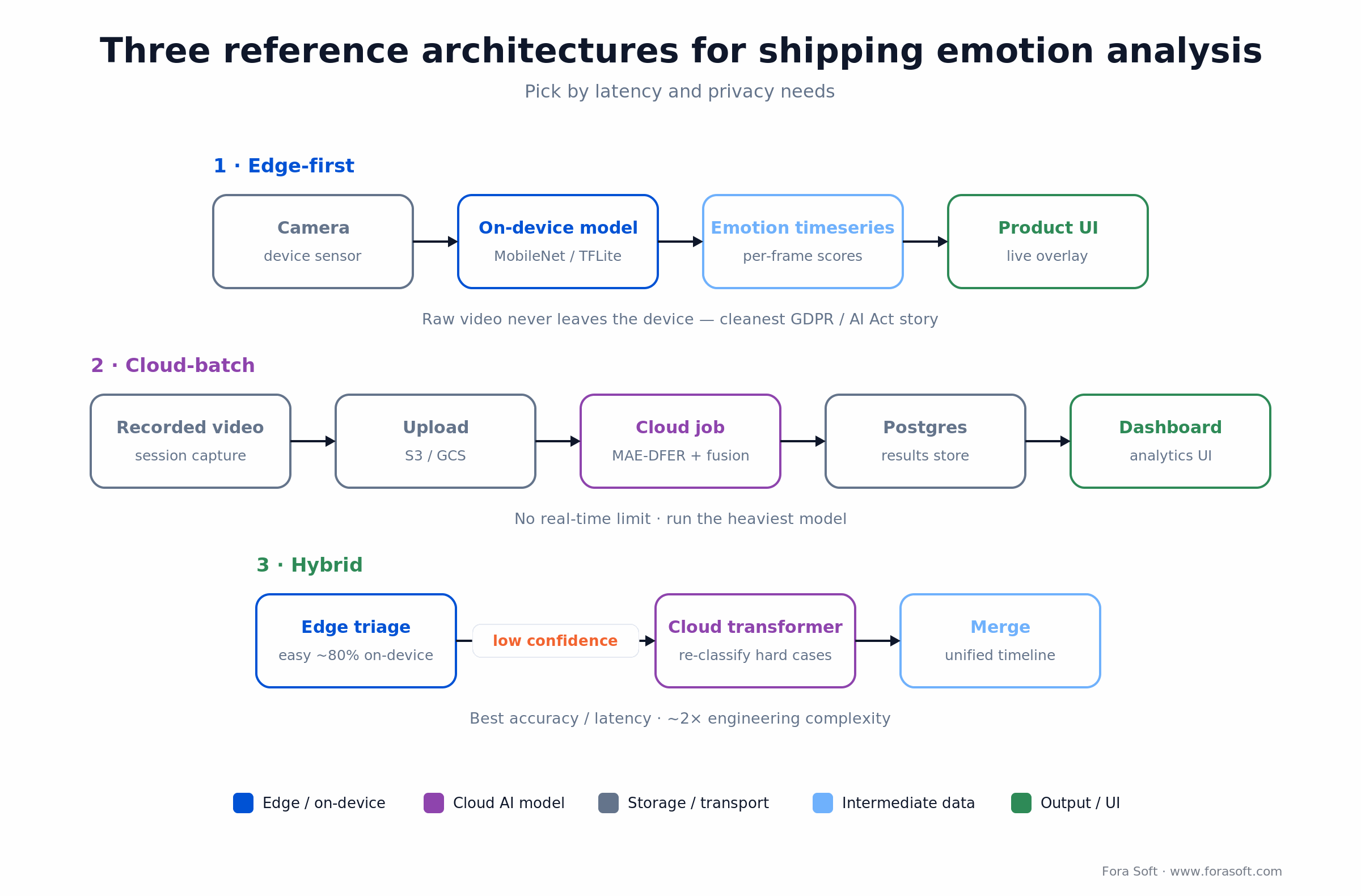
Figure 4. Three reference architectures: edge-first for privacy, cloud-batch for accuracy, hybrid for both.
Edge-first (browser or mobile)
Run a quantized MobileNet or DeepFace model entirely on-device using ONNX Runtime, TFLite, or the browser’s WebGPU. Raw video never leaves the user’s machine; only emotion or engagement timeseries are streamed up. The cleanest GDPR/AI Act story you can give a buyer; latency is constrained by the device.
Cloud-batch (post-session)
Upload the recorded video to S3 or GCS, kick off a Lambda or Cloud Run job that runs MAE-DFER + multimodal fusion, store the timeseries in Postgres, surface in the dashboard. No real-time constraints; you can run the heaviest model. Used in market research, ad testing, and forensic telehealth review.
Hybrid (edge triage + cloud enrichment)
A lightweight edge model handles the easy 80% of frames in real time. When confidence drops below a threshold, the frame plus a 2–3 second window of audio gets uploaded to a cloud transformer that re-classifies. Best of both worlds; doubles the engineering complexity.
Use cases that actually monetize
E-learning engagement. Browser-based engagement detection (gaze, head pose, attention duration) drives adaptive content and personalized study paths. The buyer’s pitch is reduced dropout and improved completion rates. Stays outside the EU AI Act prohibition as long as you do not label student emotions.
Telehealth. Multimodal mood and pain monitoring as a clinical decision-support signal, not a diagnosis (our telemedicine engineering hub covers the wider stack). Falls under the medical exception of the AI Act; HIPAA and GDPR Art. 9 still apply. Strong willingness to pay; long compliance runway.
Market research and ad testing. The most mature commercial use case. Affectiva, iMotions, and Realeyes have run on this for a decade. Cloud-batch architecture, GDPR explicit consent, ROI from creative iteration speed.
Driver monitoring systems (DMS). Drowsiness and attention detection mandated by the EU General Safety Regulation (2019/2144), via its DDAW (2021/1341) and ADDW (2023/2590) rules. AI Act safety carve-out applies. Edge-only architecture; automotive-grade SoCs.
Video conferencing dashboards. Engagement-only is the realistic scope after February 2025. Sentiment heatmaps that infer emotion are off the table for EU customers in workplace contexts.
Content moderation. High-arousal detection on uploaded videos as a triage signal feeding human moderators. Cloud batch, classified high-risk under the AI Act, transparency requirements apply.
Cost model — build vs. buy at honest numbers
Approximate ranges from our recent builds and current vendor pricing. Agent Engineering accelerates several of the line items below; we factor that into our own quotes but show conservative buy-side comparisons. If you would rather not staff this in-house, our AI integration services cover the build path end to end.
| Volume | Buy (cloud API) | Build (self-host) | Verdict |
|---|---|---|---|
| <100k frames/month | $50–500 | ~$3–6k initial + $200/mo | Buy |
| 100k–1M frames/month | $500–5k | $10–25k initial + $500/mo | Hybrid; depends on compliance |
| 1M–10M frames/month | $5k–50k | $30–80k initial + $1.5k/mo | Build |
| >10M frames/month | $50k+/month | ~$80–150k initial + $4k/mo | Build, payback <6 months |
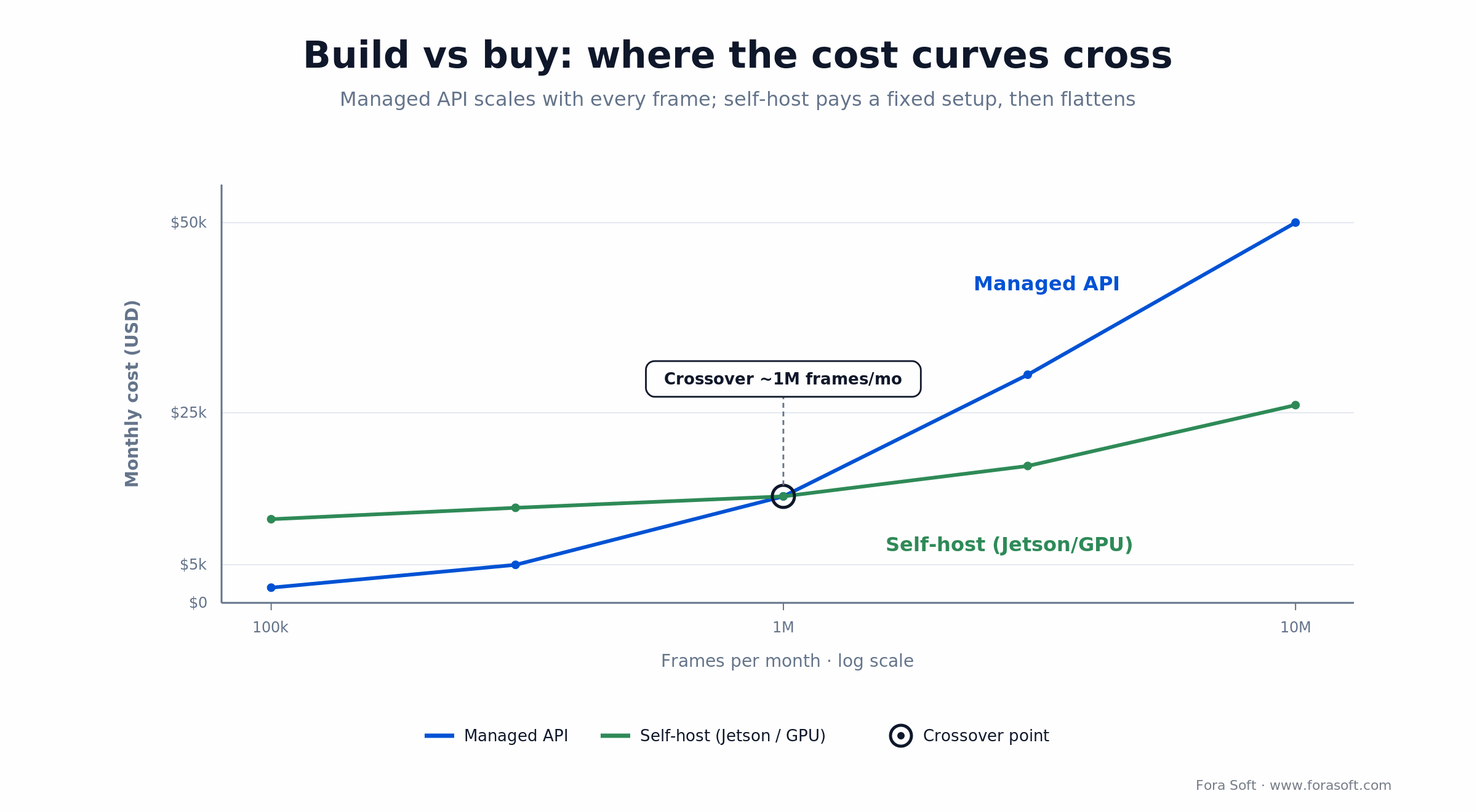
Figure 5. Managed API cost rises with volume; self-host pays a fixed setup then flattens, crossing near 1M frames per month.
Numbers cover engineering, GPU infrastructure, and ongoing model maintenance — not the labeling cost for a domain-specific dataset, which can dominate everything else if your scenes look nothing like DFEW.
A decision framework — pick your stack in five questions
1. Is your product in workplace or education in the EU? If yes, redesign around engagement detection (gaze, head pose, attention) before you go further. Emotion inference is prohibited.
2. Is the use case real-time or post-session? Real-time pushes you to MobileNet on edge or Jetson; post-session lets you use MAE-DFER or multimodal fusion in the cloud.
3. Is audio available and synchronized? If yes, multimodal fusion adds 5–15 points and is worth the engineering. If no, single-modality video is the realistic ceiling.
4. What is your target inference volume 12 months out? Below 100k frames/month, license. Between 100k and 1M, hybrid. Above 1M, self-host MAE-DFER on Jetson or GPU.
5. How important is cross-cultural validity? If your user base is global, plan for domain-adaptation passes per major region and a per-ethnicity QA loop. Vendors rarely report cross-cultural splits; demand them or budget for your own validation.
Mini case — engagement detection inside a live e-learning platform
A recent build: a live cohort-based e-learning platform serving learners across the EU and Latin America. The original brief said “detect when students are emotionally disengaged.” The first thing we did was rescope it.
12-week plan: weeks 1–3 to redesign around engagement (gaze duration, head-pose stability, attention-window proportion) instead of emotion labels, weeks 4–7 for an in-browser MobileNet engagement model running on the student’s device with no raw video uploaded, weeks 8–10 to wire engagement timeseries into the instructor dashboard with consent UX baked in, weeks 11–12 for cross-region validation across European and Latin American learner samples.
Outcome: instructors got a usable real-time engagement signal at 18–22 fps in the browser, the architecture sailed through the customer’s GDPR review because no biometric data left the device, and the EU AI Act question stopped showing up in procurement conversations. The original “emotion detection” feature was never missed in user research.
Want a similar assessment? Grab a 30-minute slot and we will walk through what your roadmap actually needs versus what the brief asks for.
Five pitfalls that derail emotion analysis projects
1. Cross-cultural failure. Models trained on Western datasets drop 15–30 points on African, Middle Eastern, or Indigenous populations. Demand per-ethnicity accuracy splits from vendors; if they cannot provide them, run your own validation before you trust the model.
2. Confusing facial movement with emotion. A grimace is not always anger. Bell’s palsy, Parkinson’s, and trained poker faces all break naive emotion classifiers. Action-unit transparency (“AU 4 + AU 7 fired”) is more honest than a single emotion label.
3. Ignoring lighting, head pose, and occlusion. Sunglasses, masks, sideways faces, and back-light degrade most models by 20–40%. Set a minimum face-quality bar at the detector stage and reject low-confidence frames rather than guessing.
4. Concept drift. Models trained on 2023 data degrade against 2025 user populations. Build a quarterly evaluation loop, monitor per-class precision/recall over time, and budget 10–20% of initial cost for retraining.
5. No human-in-the-loop fallback. Especially in telehealth and education, ship a confidence threshold that abstains rather than guesses, and route ambiguous cases to human review. Saves the product when the model is wrong on the user that matters most.
KPIs to measure — and the thresholds that matter
Quality KPIs. Frame-level accuracy above 70% on your own validation set. CCC above 0.50 for continuous valence, above 0.40 for arousal. Per-ethnicity accuracy gap under 10 points. Inter-rater agreement with human annotators above 0.65 (Cohen’s kappa).
Business KPIs. Cost per inference under $0.001 at target volume. Latency p95 under 100 ms for real-time use cases. Confidence-rejection rate stable around 5–10% (much higher means you are over-reaching; much lower means you should tighten the threshold).
Reliability KPIs. Quarterly drift audit pass rate. Audit-log coverage 100% of inference outputs. Model uptime above 99.5%. Mean time to retrain after a drift trigger under 14 days.
When NOT to build video emotion analysis into your product
Skip it when your product is in EU workplace or education and the use case requires actual emotion inference rather than engagement — the AI Act risk is not worth the feature. Skip it when your user base is highly cross-cultural and you have no budget for per-region validation; you will ship a model that quietly underperforms on the users you most want to acquire. Skip it when the use case is high-stakes (deception detection, employment screening, mental-health diagnosis) and you cannot defend the scientific validity to a regulator.
Build it when emotion or engagement is a clear product differentiator (telehealth, ad testing, e-learning, DMS), when the regulatory carve-out applies, and when you can stand up a continuous evaluation loop. Done well, it can move retention and revenue meaningfully; done lazily, it ships a feature your users do not trust.
FAQ
What is the most accurate machine learning technique for facial emotion recognition in 2026?
On in-the-wild benchmarks like DFEW and FERV39k, self-supervised transformer approaches like MAE-DFER and its 2025 successors sit at the top, in the mid-to-high 70s % WAR. With synchronized audio, multimodal fusion architectures push past 80% on RAVDESS. Anything claimed above 90% on a video benchmark almost certainly reflects test-set leakage or a synthetic dataset.
Can you run facial emotion recognition in the browser?
Yes, with caveats. A quantized MobileNet model in WASM or WebGPU runs at 10–15 fps on a modern laptop and 5–10 fps on a phone, with a 10–15% accuracy drop versus server-side. The big upside is privacy — no raw video leaves the device, which dramatically simplifies the GDPR and EU AI Act conversation.
Is it legal to do emotion recognition under the EU AI Act?
Emotion recognition is prohibited in workplace and education contexts in the EU, with narrow exceptions for medical or safety reasons (driver drowsiness and clinical assessment under medical supervision). Engagement detection — gaze, head pose, attention duration — remains allowed because it does not infer emotion. Most B2B SaaS products redesign around engagement to stay on the right side of the prohibition.
How much training data does a custom emotion model need?
For supervised fine-tuning of a 2D CNN, plan for 5,000–20,000 labeled clips per emotion class. Self-supervised approaches like MAE-DFER cut that requirement by an order of magnitude — pretrain on 100,000+ unlabeled clips from your domain, then fine-tune on 1,000–5,000 labeled clips. Domain adaptation per region or population needs another 500–1,000 labeled clips each.
Affectiva, AWS Rekognition, or self-hosting: which should you choose?
For under 100k frames per month, license a vendor — AWS Rekognition for batch, Hume AI or MorphCast for real-time. Above 1M frames per month, self-host MAE-DFER or DeepFace on Jetson or GPU; the hardware pays back inside 6–9 months. Affectiva via iMotions remains the right answer for market-research-grade validation; their pricing reflects that.
Can these models detect deception or micro-expressions?
Deception detection from facial video has no scientifically validated production-ready model; vendors that claim it should be treated with caution and avoided in regulated contexts. Micro-expression detection (sub-500 ms emotional leakage) needs high-frame-rate capture (the CASME II and SAMM research datasets use 200 fps) and specialized AU models, and even then it is research-grade, not product-grade in 2026.
How do you handle cross-cultural bias in emotion recognition?
Three things. Validate on data from each major region you serve, with at least 1,000 labeled samples per ethnicity. Run domain adaptation passes — fine-tune the model on each population’s data. Report per-ethnicity accuracy publicly so the gap is visible and managed. If the gap stays above ~10 points, switch to engagement detection or a less culture-sensitive proxy.
Does emotion analysis need GDPR explicit consent?
In most cases, yes. Emotion analysis from video typically falls under Article 9 special-category processing (biometric data), which requires explicit, informed, freely given consent or a narrow exception (medical, vital interest). Pre-ticked checkboxes are invalid; consent must be affirmative, specific, and revocable. Edge processing helps because raw video never leaves the device, but the downstream emotion timeseries can still constitute personal data.
What to Read Next
Deep dive
The Ultimate Guide to Emotion Detection in Audio and Video
The end-to-end reference on multimodal emotion detection.
Trends
The Future of AI in Video Streaming
How AI is reshaping streaming, conferencing, and recorded video products.
E-learning
The Ultimate Guide to AI-Assisted Educational Content Creation
Where engagement and AI fit into modern e-learning roadmaps.
Tools
Top 3 AI-Powered Tools for Quizzes and Assessments
Adjacent AI features that often ship alongside engagement detection.
Ready to ship video emotion analysis the right way?
Video emotion analysis in 2026 is a five-technique shortlist, an honest accuracy ceiling, an EU AI Act conversation, and a build-vs-buy decision driven by volume. Teams that win treat it as a product feature with explicit KPIs, design for compliance from day one, and pick the architecture that matches their latency budget — not the one with the highest leaderboard score.
If you are scoping a build, redesigning around the AI Act, or wondering whether MAE-DFER or a commercial API is the better fit for your volume, we have done this enough times to skip the survey phase. Bring an architecture diagram or a vendor quote and we will tell you what we would build instead.
Let’s pressure-test your emotion AI plan
30 minutes, one senior engineer, zero fluff. Bring your accuracy target, your shortlist, or just a sketch.