

Key takeaways
• Moodle vs a custom LMS is a business question, not a tech one. Pick Moodle when the LMS is a cost centre; build custom when the LMS is the product you sell. Everything below is how we decide it on real projects.
• Moodle 5.2 (April 2026) is the right answer for many institutions. Standard courses, email logins, no need to differentiate? Self-host for free or use MoodleCloud, the cheapest and fastest path to a working LMS in 2026.
• Custom wins when the platform is the moat. Selling to learners, monetising content, live AI tutoring, white-label for partners, and Moodle’s plugin ceiling and PHP architecture become a tax that compounds for years.
• Total cost is the wrong question; total trajectory is the right one. Moodle’s year-one cash cost is far lower; custom’s payback shows up in years 2–3 as revenue, retention and exit value.
• The hybrid middle path is real. Hosted Moodle as a backbone with custom React/SwiftUI front-ends and AI services on top ships in 8–12 weeks and keeps a clean migration path off Moodle later.
Why Fora Soft wrote this playbook
We’re a software team that has shipped 250+ projects since 2005 with 50 in-house engineers, and EdTech is one of our deepest verticals. The case studies that anchor this article — Scholarly, BrainCert, Tabsera and ALDA — are custom LMS and EdTech platforms we designed and built from scratch. We’ve also stood up Moodle for clients, integrated it with Zoom and SCORM, written custom Moodle plugins, and helped buyers migrate off Moodle when it stopped keeping up with the product.
We have no axe to grind on either side. We’ll set up a Moodle instance for you in two weeks if that’s the right answer, and we’ll build a custom platform in 12–16 weeks if that’s the right answer. The point of this article is to make sure you pick on purpose, not by default.
Stuck between Moodle and a custom LMS?
Tell us your audience, monetisation and feature wish-list. Inside 48 hours we’ll come back with a build-or-buy recommendation, a budget range, and the trade-offs we’d push back on , free, no obligation.
What Moodle actually is in 2026
Moodle is a 24-year-old open-source learning management system written in PHP, distributed under the GPL, and used by 500 million+ registered users across roughly 150,000 sites in 232+ countries (stats.moodle.org, 2026). The current stable release is Moodle 5.2, shipped April 2026. It comes with course management, quizzes, a gradebook, forums, SCORM/xAPI support, role-based permissions, and a large plugin ecosystem of roughly 1,500 modules, now served through the new Moodle Marketplace that launched in July 2026 (replacing the classic Plugins Directory).
Pricing has three shapes. Self-host for free and pay only for servers and ops. Use MoodleCloud managed hosting, which in 2026 starts around $130–200/year for a 50-user Starter site and tops out around $1,900/year for the Standard plan (up to 750 users, 50 GB, premium mobile app, Stripe course sales). Two caveats catch buyers. MoodleCloud no longer has a permanent free plan, and no MoodleCloud tier allows custom plugins or lets you exceed 750 users. Past that, you self-host or go with a Certified Partner.
The strength is breadth. The weakness is what every general-purpose LMS shares: defaults that feel like a 2010 university intranet, theming that fights you past a point, and plugin quality that varies wildly. If your audience is faculty and students, that’s tolerable. If your audience is consumers comparing you to Duolingo, MasterClass or BrainCert, it usually isn’t.
What “custom development” really means for an LMS
A custom LMS is a product, not a feature list. We pick a modern stack — typically React or Next.js on the web, Swift / Kotlin / Flutter on mobile, Node.js or Python on the server, Postgres + Redis for data, S3-compatible storage for media, plus dedicated services for video (LiveKit / Mux / Cloudflare Stream), AI inference (OpenAI Realtime, Anthropic Claude, Hugging Face) and analytics (Mixpanel, Amplitude). On top of that we build the course model, the learner experience, the instructor tooling and the monetisation flow that match your business, not Moodle’s.
The platform we built for Scholarly includes AI tutoring, adaptive course generation and a credit-based monetisation model that would have been impossible inside Moodle’s plugin sandbox. BrainCert ships HTML5 virtual classrooms, real-time whiteboarding and SCORM/xAPI authoring as one product. ALDA is an AI course generator whose institutions reach 500,000+ students a year. Each one is impossible to build inside Moodle without forking the core. That is exactly when the “cheap” route stops being cheap.
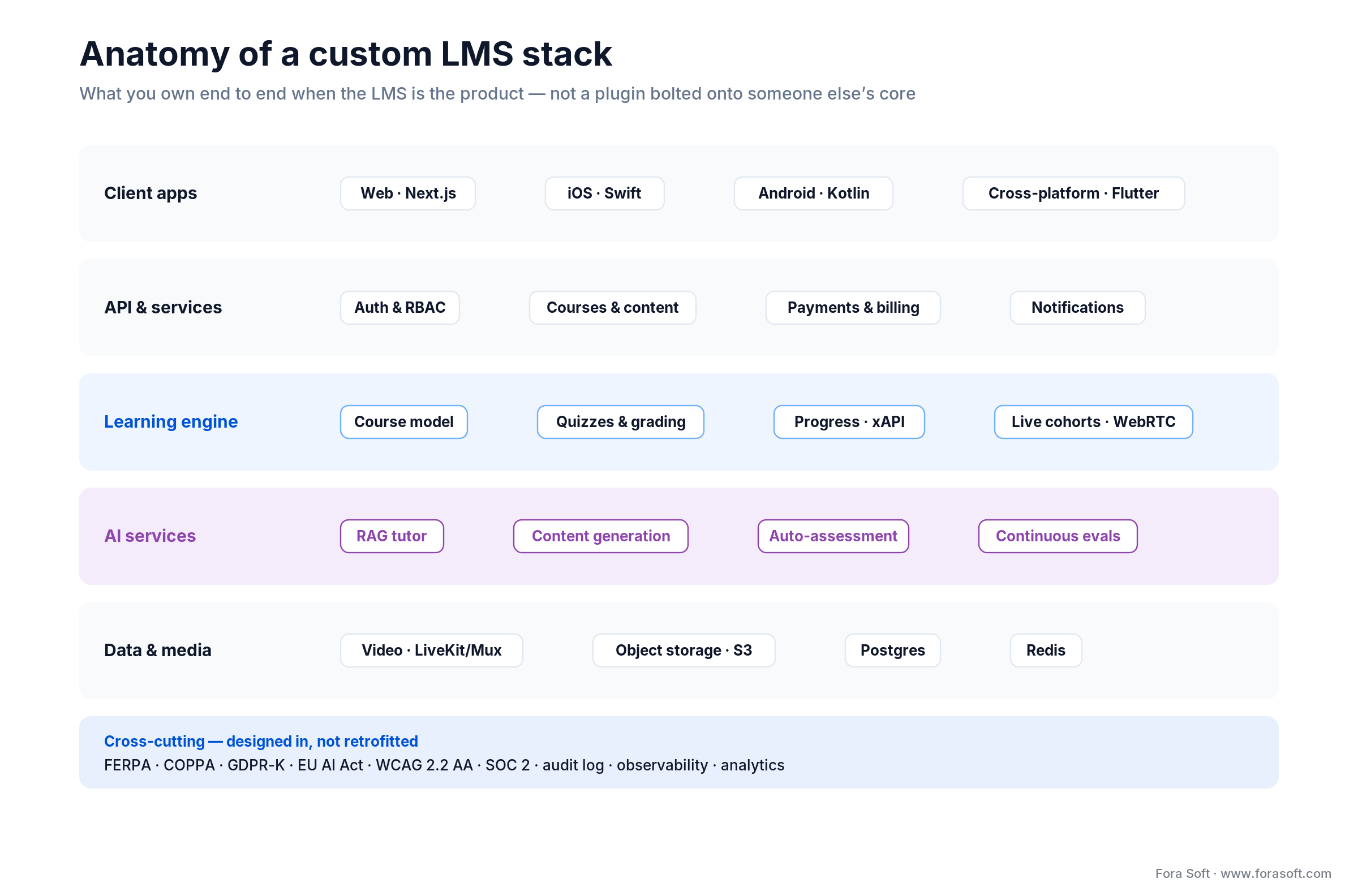
Figure 1. What you actually own end to end when the LMS is the product — seven layers, from client apps down to compliance, versus one plugin bolted onto someone else’s core.
The honest comparison matrix
Cost is one row of eleven that matter. Use this matrix as a starting point, then run the decision tree below.
| Dimension | Moodle (self-host or Cloud) | Custom-built LMS |
|---|---|---|
| Time to value | 2–6 weeks for a working install | 12–20 weeks for a focused MVP |
| Year-1 hard cost | $15–40K incl. hosting + setup | $60–140K (focused MVP) |
| UX / branding ceiling | Themed, but constrained — you can spot a Moodle | Whatever you can design |
| Mobile experience | Moodle App + responsive web | First-class native or Flutter |
| AI features | Plugin-bolted, limited | First-class (RAG tutors, content gen, auto-assessment, evals) |
| Real-time video / classrooms | Zoom or BBB plugin (extra $) | Native LiveKit / Mux / WebRTC SFU |
| Monetisation model | Subscription & payment plugins, simple | Subs, credits, marketplace, B2B seats — whatever you need |
| Compliance fit | FERPA / COPPA / GDPR doable, audit trail variable | Designed-in (FERPA, COPPA, GDPR-K, HIPAA where needed) |
| Vendor lock-in | None on Moodle itself, plenty on plugins | None — you own the IP and the database |
| Long-term scaling | PHP monolith hits ceilings around 100K MAU + heavy media | Designed for the scale you target |
| Exit / acquisition story | Generic, hard to defend | Differentiated IP, defensible valuation |
Reach for Moodle when: the LMS is a cost centre, not the product. Internal training, accredited universities, government compliance courses, partner enablement — pick Moodle and move on.
Reach for custom when: the LMS is the product. Consumer EdTech, B2B2C platforms, AI-first learning, live video tutoring, white-label LMS-as-a-service — you’ll outgrow Moodle in year two.
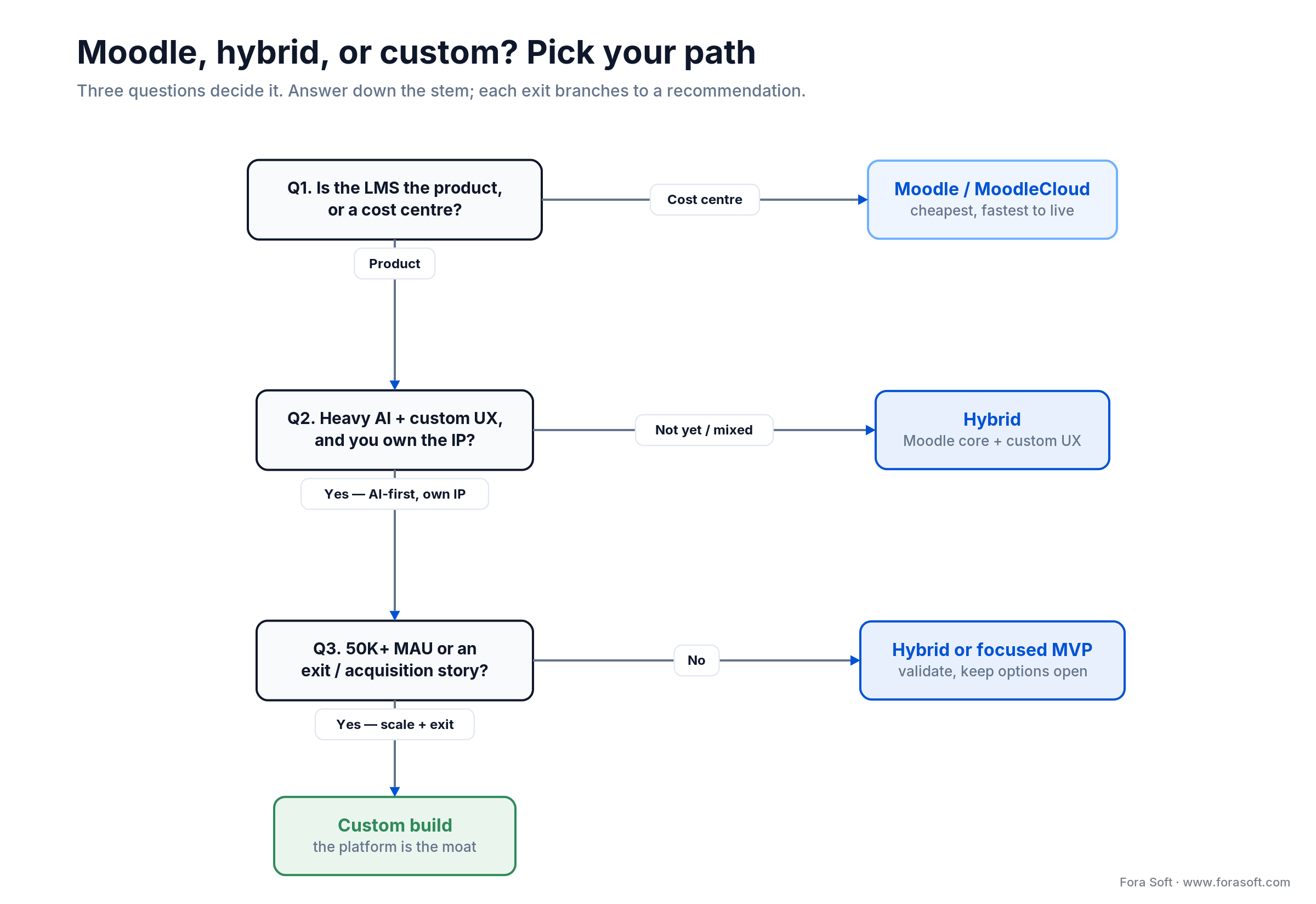
Figure 2. Three questions decide it. Answer down the stem; each exit branches straight to a recommendation.
The honest case for Moodle
Battle-tested core. 24 years of code, used by Open University, MIT Open Learning, the UN and the EU. The course / quiz / gradebook / SCORM model is mature in a way no greenfield product matches in 12 weeks.
Large plugin library. Roughly 1,500 modules in the new Moodle Marketplace — H5P interactive content, Mahara portfolios, BigBlueButton virtual classrooms, Stripe/PayPal payments, Zoom, Office 365, Microsoft Teams, Google Workspace, Turnitin, and a growing set of AI question bots.
Standards out of the box. SCORM 1.2 / 2004, xAPI, IMS LTI 1.3, IMS Common Cartridge, QTI — the alphabet soup that B2B EdTech buyers ask about on day one.
Predictable cost shape. MoodleCloud is a flat subscription; self-host is one VM and a database. No surprise per-seat licences until you outgrow a single instance.
Where Moodle stops being free
1. UX ceiling. The Boost theme is fine. Anything beyond it is a fight with a 2010 information architecture. Course pages still feel like LMS pages, not product pages.
2. Mobile reality. The Moodle App is functional but generic. If your audience expects a Duolingo-grade mobile experience, it will not deliver.
3. Plugin quality variance. A chunk of the plugin catalogue is unmaintained, security-prone, or last updated for Moodle 3.x. Pick the wrong combo and you ship a CVE on day one — a risk the 2026 move to Moodle Marketplace is trying to reduce, not yet eliminate.
4. Performance ceiling. The PHP monolith starts to hurt around 100K MAU on a single instance and at modest video traffic. Scaling means caching, CDN, load balancers and a separate media stack, and suddenly your “free” Moodle is a $5K–15K/month infra bill.
5. AI features. Bolting OpenAI onto Moodle via plugins is fine for FAQ bots; live AI tutors, RAG over course content, on-the-fly assessment generation and continuous evaluation suites need first-class architecture, which means custom.
6. Real-time video. The Zoom / BBB plugins work, but you’re stitching a third-party meeting product into your LMS. A modern platform like the one we built for Scholarly embeds live classrooms in the product flow and bills the minutes itself.
The honest case for custom development
Differentiation. If your pitch is “our AI tutors adapt to each learner” or “our live cohort experience converts at 35%”, the platform is the differentiator. A Moodle skin doesn’t cut it.
IP ownership and exit value. Acquirers value the codebase, the data model, the AI evaluations and the growth curve. None of that translates cleanly if the core is GPL-licensed Moodle code you can’t white-label.
Performance and scale. A modern stack (Next.js + Node + Postgres + Redis + S3 + LiveKit + a CDN) scales horizontally to millions of MAU without a rewrite. PHP-monolith Moodle needs bandages well before that.
AI-first features. Generative course outlines, RAG over textbooks, live AI tutoring, voice-driven practice, continuous assessment generation, anti-cheat: these are first-class concerns in a 2026 build, not plugins. Our piece on integrating AI into e-learning walks through the architecture.
Compliance designed-in. FERPA, COPPA, GDPR-K, the EU AI Act and accessibility (WCAG 2.2 AA) live in the schema and the audit log from day one, not retrofitted through plugins. If any of this is on your procurement form, custom removes a whole class of last-mile surprises, and our e-learning development team designs it in.
A worked cost model — year 1, year 2, year 3
Buyers usually ask for a single number; the honest answer is a trajectory. Mid-case scenario: a B2B2C learning platform with 5 instructor seats at launch, a goal of 25,000 registered learners by year 3, courses with quizzes, live cohorts, payments and an AI tutor.
| Year | Moodle path (plugins, hosting, devs) | Custom path |
|---|---|---|
| Year 1 setup | $15–40K (install, theme, plugins, integrations) | $60–140K (focused MVP, 12–16 weeks) |
| Year 1 ops | $1–3K/mo hosting + part-time admin | $3–8K/mo hosting + retainer |
| Year 2: scale + features | $30–90K (custom plugins, perf work, theme rewrites) | $60–150K (new features, mobile apps, AI iteration) |
| Year 3: AI + premium UX | $80–200K rebuild risk — or migrate | $80–180K (sustained product investment) |
| 3-year direction | Cheaper in year 1, often a migration in year 3 | Higher year-1 capex, defensible IP and exit story |
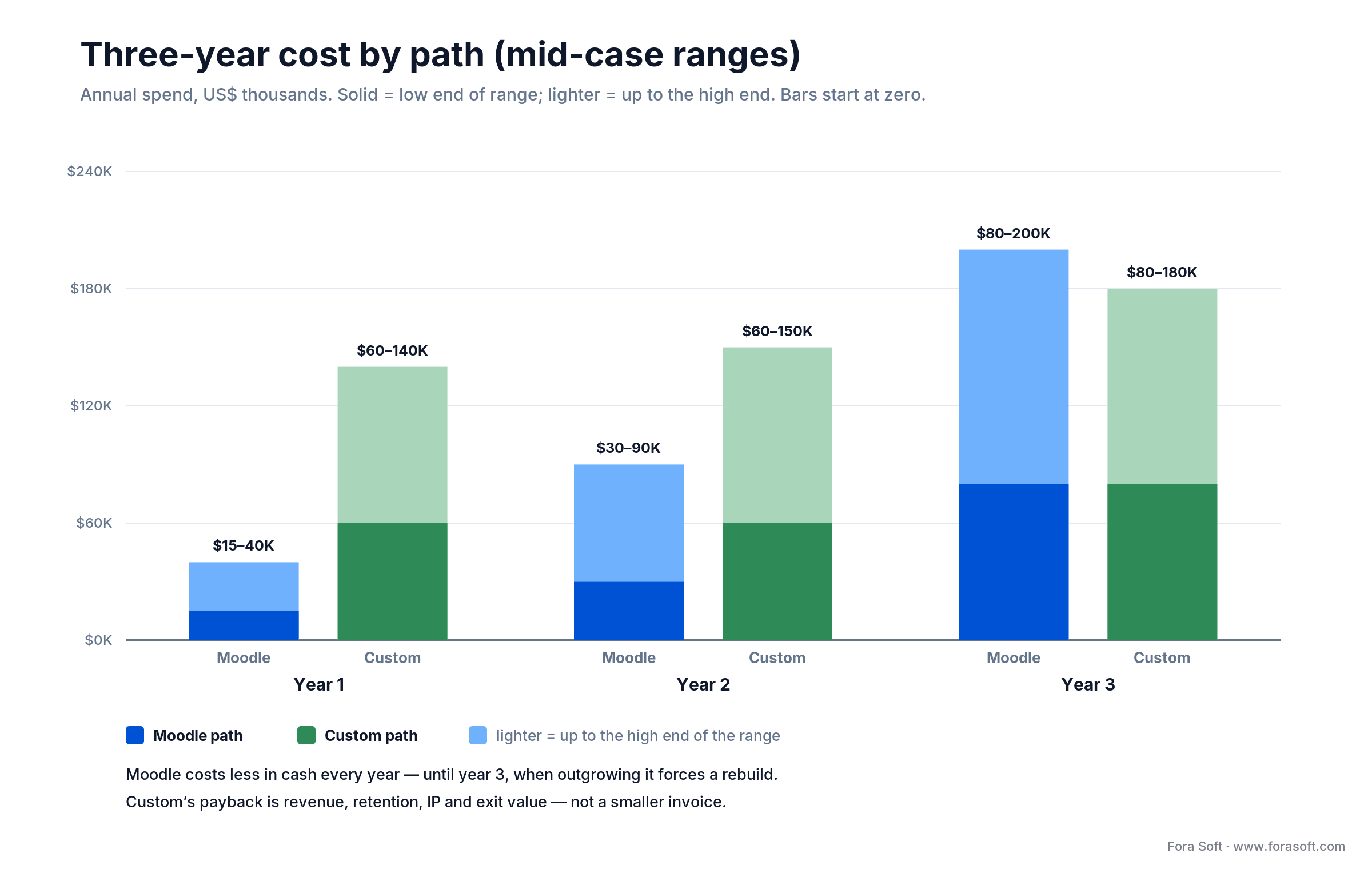
Figure 3. Annual spend by path, mid-case ranges. Solid = the low end of each range, lighter = up to the high end; every bar starts at zero.
Here’s the year-one math, not a vibe. On the Moodle path, MoodleCloud caps at 750 users, so at 25K learners you self-host: budget about $25K for install, theme, plugin integration and a hardened setup, plus a part-time admin and hosting at roughly $2K/month. Year-one cash: $25K + ($2K × 12) = $49K. On the custom path, a focused MVP runs $60–140K; because we use spec-driven agentic engineering we land near the low end, about $90K, plus hosting at about $3K/month: $90K + ($3K × 12) = $126K. That’s well under the $150–400K widely quoted for a full custom LMS in 2026.
So the year-one gap is about $77K. The real question isn’t which invoice is smaller. It’s whether the custom platform earns that $77K back in revenue, retention or valuation across years 2–3. If you expect to outgrow Moodle inside 24 months, you pay for it twice: Moodle now, plus the custom rebuild later. Better to invest in a focused custom MVP up front and skip the double bill.
Need a defensible build-vs-buy number?
A 2–3 week paid discovery turns this framework into a concrete plan: stack, scope, budget, risk register. We’ll tell you to pick Moodle if Moodle is the right answer.
The hybrid path — Moodle as a backbone, custom on top
There’s a third option we recommend more often than buyers expect. Run Moodle as a headless backbone — the source of truth for courses, quizzes, gradebook and SCORM/xAPI — and put a custom Next.js or React Native front-end on top via the Moodle Web Services API or LTI 1.3. Bolt a custom video stack, an AI tutor service and a payments layer alongside.
The hybrid ships in 8–12 weeks, costs less than a full custom build, gives you premium UX where users live, and keeps a clean migration path off Moodle later. The tax is integration: Moodle’s APIs aren’t modern, and its data model leaks PHP-isms into your code. Worth it for many B2B EdTech plays; not worth it if your roadmap is heavily AI-first. We break the trade-off down further in our guide to build vs buy vs extend an LMS.
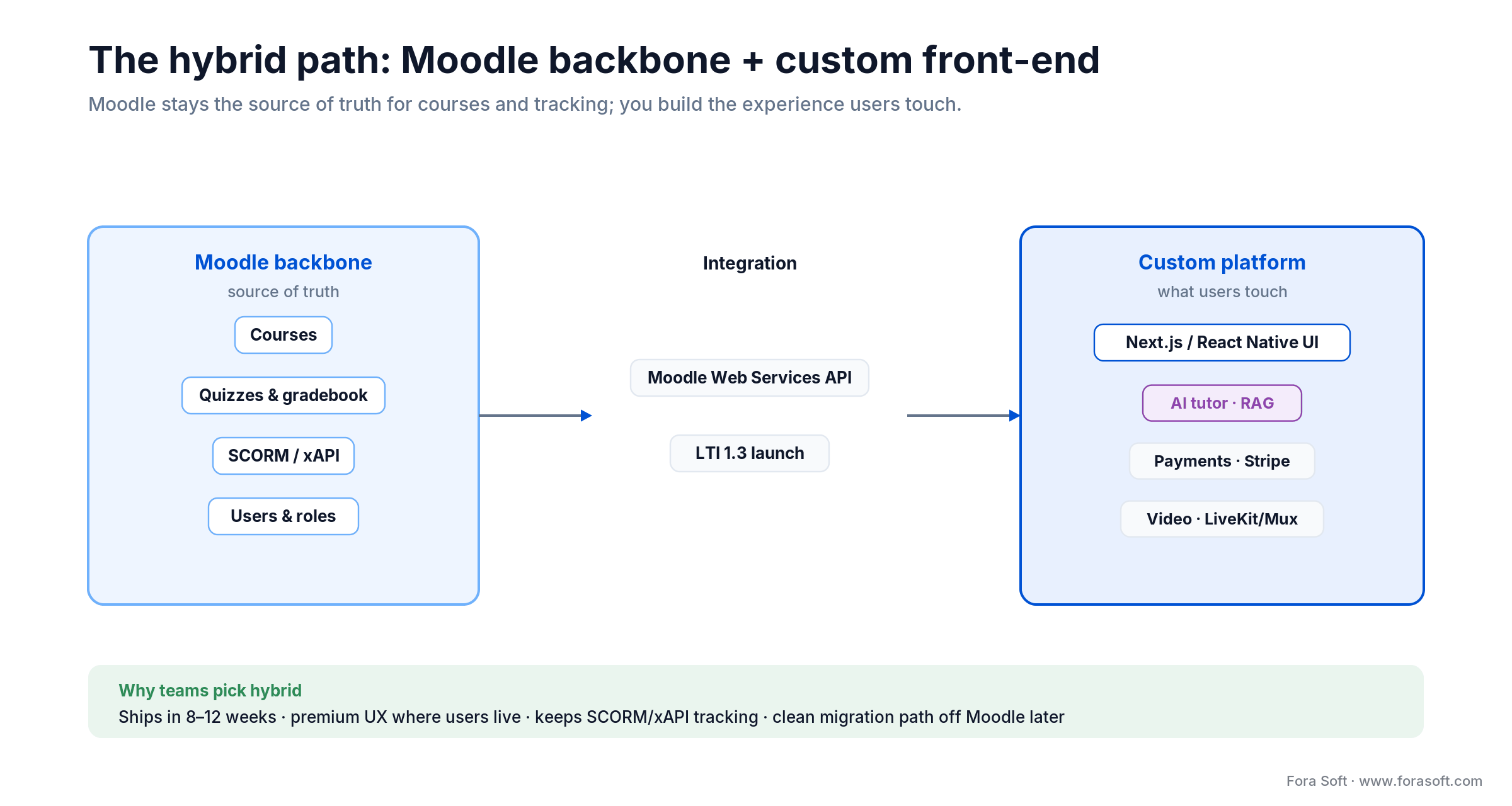
Figure 4. Moodle stays the source of truth for courses and tracking; the custom layer is the experience users actually touch.
Reach for hybrid when: you need a premium learner experience now but aren’t ready to rebuild tracking, standards and admin from scratch — keep Moodle’s SCORM/xAPI engine, ship custom UX in 8–12 weeks, and keep the exit ramp open.
Compliance and accessibility — the part that quietly blocks deals
EdTech sells into schools, universities, enterprises and parents. That puts FERPA (US student records), COPPA (US under-13), GDPR + GDPR-K (EU minors), the EU AI Act and WCAG 2.2 AA accessibility on the procurement form for almost every deal.
The EU AI Act timeline moved in 2026, and it matters here. Its Digital Omnibus amendment came into force on 27 July 2026 and pushed most Annex III high-risk obligations back to 2 December 2027. Education AI covers systems used for admissions, learning-outcome assessment, progression decisions and exam or behaviour monitoring. All of it sits in that Annex III high-risk bucket, so its risk-management, data-quality, logging and human-oversight duties now apply from December 2027, not August 2026. What did take effect on schedule (2 August 2026) is Article 50: transparency and disclosure for AI you talk to, such as tutoring chatbots. AI baked into a regulated product under Annex I is deferred further, to 2 August 2028. The Commission can still pull the Annex III date forward once standards are finalised, so December 2027 is an outer limit, not a snooze button.
Moodle ships reasonable GDPR defaults, but the audit story is often patchy across plugins. A custom build gets to design the audit log, the consent flow, the deletion endpoint and the accessibility attributes from day one — and to document exactly how the AI tutor meets those Annex III duties before the deadline arrives.
A decision framework — pick the path in five questions
Q1. Is the LMS the product or a cost centre? Cost centre → Moodle. Product → custom or hybrid.
Q2. Do you sell to consumers or to institutions? Consumers comparing you to Duolingo or MasterClass → custom UX is mandatory. Institutions buying off RFPs → Moodle is often a feature, not a bug (the SCORM/LTI alphabet soup helps).
Q3. How AI-first is your roadmap? Light (FAQ bot, content suggestions) → Moodle plugins are fine. Heavy (live tutor, RAG, eval-driven content gen) → custom architecture is required.
Q4. What does year 3 look like? Under 10K MAU and a stable feature set → Moodle is fine. 50K+ MAU and a continuously evolving product → custom or hybrid.
Q5. What’s the exit story? Acquirer or PE buyout in 3–5 years → platform IP matters, and Moodle dilutes it. Internal training tool forever → Moodle is the right answer.
Already on Moodle and considering custom? The migration playbook
A clean Moodle-to-custom migration is doable inside one quarter for most mid-sized instances. It runs in 5 steps: (1) export courses as SCORM/xAPI/QTI; (2) normalise the user, role and grade tables out of Moodle’s schema into a clean schema on the new platform; (3) run the new platform in parallel for one term; (4) redirect logins; (5) sunset Moodle. We’ve done it both for clients moving onto a custom Fora Soft build and for clients moving onto modern third-party platforms when that was the better fit.
Reach for a migration when: Moodle’s ceilings show up in your metrics — churn on the mobile app, infra bills climbing past $5K/month, or an AI roadmap the plugin sandbox can’t hold. Plan the export path before you hit the wall.
Mini case — what custom looks like in practice
Situation. Scholarly came to us with an idea: an all-in-one online learning platform where AI tutors generate course content, assess learners and adapt the path on the fly. Moodle was the obvious cheap option; the team already knew it would never deliver the experience they wanted to ship.
What we shipped. A custom platform on Next.js + Node + Postgres + LiveKit + OpenAI/Anthropic, with adaptive course generation, an AI tutor running over RAG-indexed course material, real-time live cohorts and a credit-based monetisation model that maps to learner progress. Mobile is first-class, not a responsive afterthought.
Outcome. Scholarly now serves 15,000+ users with live classes scaling to 2,000 concurrent learners. Those are numbers a Moodle instance would fight you on, and features you couldn’t build without forking the core. It’s the same pattern behind BrainCert, whose custom platform now supports 100,000+ customers and 500M+ classroom minutes. Read the full story on the Scholarly project page, or book a scoping call for a similar assessment.
Five pitfalls we see kill EdTech builds
1. Choosing Moodle for a consumer product. The UX gap shows up in week one of beta and never closes. Fix: if your buyer is a consumer, custom UX is mandatory.
2. Treating AI as a plugin. Bolting OpenAI calls into a Moodle plugin gives you an OK FAQ bot. Real AI tutoring needs RAG, evaluations, prompt-versioning and feedback loops — first-class system architecture, not a plugin.
3. Underestimating compliance. Schools won’t buy without FERPA and a clean data-subject-request flow. Parents won’t buy without COPPA. EU institutions won’t buy without GDPR-K and an EU AI Act plan. Bake them in or lose deals at the last mile.
4. No mobile strategy. Half the global learner base is mobile-first. A responsive Moodle theme is not a mobile strategy. Plan native or Flutter from day one if your audience is consumer.
5. Skipping evaluation suites. AI EdTech without continuous evals goes off the rails inside three months — hallucinated answers, wrong difficulty, unsafe content. Budget the eval infrastructure early; it’s cheaper than the lawsuits.
KPIs — what to measure once you launch
Quality KPIs. Course completion ≥ 50% on paid cohorts. AI tutor answer-correctness ≥ 90% on a graded eval set. Time-to-first-lesson < 90 seconds from signup. Accessibility: WCAG 2.2 AA, no critical issues.
Business KPIs. Activation (first paid course) ≥ 25% within 7 days. D30 retention ≥ 30% on B2C subs. NPS ≥ 40 by quarter 2. CAC payback < 6 months on consumer.
Reliability KPIs. P95 page latency < 500ms globally. Live class join success ≥ 98%. Push delivery ≥ 95%. Crash-free sessions ≥ 99.5%.
What about WordPress LMS plugins and SaaS LMSs?
Moodle isn’t the only off-the-shelf option. WordPress LMS plugins (LearnDash, LifterLMS, Tutor LMS) are popular for solo creators — good UX inside the WordPress ecosystem, simple monetisation, painful past 5K active learners or anything AI-first. SaaS LMSs (Thinkific, Teachable, Kajabi, Podia) suit course creators who want zero ops — you trade monthly fees, per-seat caps and customisation ceilings for instant time-to-market.
The same Moodle-vs-custom logic applies to all of them: if the LMS is a cost centre and the audience is small, off-the-shelf wins; if the LMS is the product or the audience is large, custom wins on a 3-year horizon. We typically see WordPress LMS as the right answer for first-time creators, SaaS LMSs for established creators with one product, and custom for anyone building a defensible EdTech business.
Reach for an off-the-shelf SaaS LMS when: you’re one creator with one product, want to launch this month, and per-seat pricing still pencils out below a few thousand learners. Graduate to custom when the seat math or the roadmap breaks it.
When NOT to build a custom LMS
If your buyer is an HR director who needs a place to upload SCORM compliance modules, Moodle (or one of the many Moodle Workplace partners) ends the conversation. Same for accredited universities running standard credentials, where the LMS is administrative infrastructure. Same for early-stage EdTech that hasn’t validated willingness-to-pay — spend three months on a Moodle MVP, get 50 paying users, then make the build-vs-buy call with data instead of a hunch.
Ready to ship a learning platform people actually love?
Tell us about your audience, monetisation model and year-3 vision. Inside 48 hours we’ll send back a Moodle / hybrid / custom recommendation, a budget range, and a 12–16-week MVP plan , free, no obligation.
FAQ
Moodle or a custom LMS: which should you choose?
Use Moodle when the LMS is a cost centre — internal training, accredited courses, compliance modules — because it’s the cheapest, fastest path to a working system. Build custom when the LMS is the product you sell: consumer EdTech, AI-first tutoring, live video, white-label, or anything where brand, conversion and IP drive the business. If you’re between the two, a Moodle-plus-custom hybrid ships in 8–12 weeks and keeps your options open.
Is Moodle really free?
The software is free under the GPL. The total cost is not. Self-hosting means hosting, backups, security updates, theming, plugin maintenance, support and an admin who knows Moodle — typically $1–3K/month plus $15–40K of setup work. MoodleCloud runs from about $130–200/year for a 50-user site up to roughly $1,900/year for 750 users, and there’s no permanent free plan anymore, only a trial.
How long does a custom LMS MVP take?
A focused MVP — auth, course model, video lessons, quizzes, payments, learner dashboard, instructor tooling and a basic AI tutor — takes 12–20 weeks with a small senior team. We usually come in faster because we use spec-driven agentic engineering. Add 4–8 weeks for native mobile apps and 4–8 weeks for advanced AI features.
Can you start with Moodle and migrate to custom later?
Yes — this is a viable strategy if you need to validate willingness-to-pay quickly with low capex. Plan the export path from day one (SCORM, xAPI, QTI) and keep custom integrations behind clean API boundaries. The migration usually takes one quarter for a mid-sized instance.
Does Moodle support modern AI features?
Through plugins, partially. There are OpenAI question bots, content-suggestion plugins and assessment helpers. What Moodle does not give you natively is RAG over your own course content, eval-driven prompt iteration, real-time multimodal tutoring, or a clean way to ship custom models. If those are central to your roadmap, custom is the path.
Is Moodle GDPR, FERPA, COPPA and EU AI Act compliant?
Moodle ships GDPR tooling (consent, data export, right to be forgotten) and can be configured to align with FERPA and COPPA, but compliance depends heavily on your hosting, plugin choices and operational practice. Under the EU AI Act, education AI is Annex III high-risk; its Digital Omnibus deferred those obligations to 2 December 2027, while Article 50 transparency duties took effect 2 August 2026. You’ll need risk management, data governance and human oversight regardless of platform.
Will custom always cost more in year one?
Almost always. Moodle gets you to a working LMS for $15–40K of setup; a custom MVP starts around $60–140K. The custom case is built on years 2 and 3, when feature velocity, UX and AI capability translate into revenue or valuation that more than pays back the year-one difference.
What about WordPress LMS plugins and SaaS LMSs like Thinkific?
Same trade-off as Moodle, scaled smaller. WordPress LMS (LearnDash, LifterLMS) is great for courses-on-a-blog and small creators, painful past 5K active learners or anything AI-first. SaaS LMSs (Thinkific, Teachable, Kajabi) are great for solo creators; they cap out on customisation, AI features and per-seat economics at meaningful scale. If your roadmap looks like Scholarly, BrainCert or Tabsera, you’ll outgrow them.
What to Read Next
Builder’s playbook
How to Create Adaptive Learning Platforms
Algorithm taxonomy, reference architecture, COPPA/FERPA/GDPR-K compliance, and cost tiers.
AI in EdTech
Integrating AI into E-Learning Software
High-ROI features, RAG over fine-tuning, LTI 1.3 + xAPI, and eval discipline.
Case study
Scholarly: AI-Powered Online Learning
A custom EdTech platform we built from scratch — AI tutoring, adaptive courses, live cohorts.
Architecture
AI-Powered Multimedia for E-Learning
Reference architecture for video-first, AI-first learning experiences at scale.
Buy vs build
Low-Code/No-Code vs Hiring Pros
36-month TCO math comparing no-code platforms to a custom-built application.
Moodle, custom, or hybrid — ready to decide?
The Moodle-versus-custom question is really a question about your business, not your stack. If the LMS is the product, custom or a hybrid almost always wins on a 3-year horizon. If it’s a cost centre, Moodle is likely the right call. Either way, the cost of choosing wrong is bigger than any tool: rebuilding a year in is expensive, and shipping a generic experience into a premium market is more expensive still.
If you’d like a senior team that’s shipped both Moodle integrations and full custom EdTech — Scholarly, BrainCert, Tabsera, ALDA — to walk through the decision against your specific scope, that’s exactly what our 30-minute scoping call is for.
Want a learning platform that beats your category?
Tell us your audience, monetisation and AI ambitions. We’ll come back inside 48 hours with a Moodle / hybrid / custom recommendation and a 12–16-week MVP plan , free, no obligation.

