

Key takeaways
• A smartphone intercom app is a full real-time video product disguised as a doorbell replacement. It needs WebRTC or SIP, push notifications that actually wake a phone, mobile credentials, multi-tenant identity, and the same security posture as a banking app.
• Push-to-talk latency is the product. Door-to-phone call setup under 3 seconds is the usability bar; above 6 seconds visitors give up and residents stop trusting the app.
• BLE and NFC mobile credentials replace the key fob. The best smartphone intercom apps let residents open the door without opening the app — with proper cryptographic binding and revocation.
• Multi-tenant identity is the backend problem. Residents, guests, couriers, property managers, and maintenance all have different rights at different times; the schema has to encode that from day one.
• Regulation scales with audience. Single-family homes are unregulated; multi-tenant buildings trigger GDPR, BIPA, EU AI Act, and ADA accessibility; care homes and hospitals add HIPAA. Scope compliance in with the first architecture draft.
A smartphone intercom app used to be a fancy extra on a premium doorbell. In 2026 it is the intercom — residents, couriers, guests, and property managers expect to see who is at the door, talk, open the door, and grant temporary access from their phone, wherever they are. The hardware side is a commodity; the software side is where the product lives. This playbook covers what it takes to build a smartphone intercom app that actually works — as software, as a product, and as a regulated piece of a building stack.
The audience is founders, product leads, and CTOs building residential, commercial, or vertical (care-home, coworking, hospitality) intercom apps, plus property management platforms adding intercom to an existing app. We cover what the app actually contains, the core call flow and call-setup latency budget, mobile credentials (BLE, NFC, QR), push notification architecture, multi-tenant identity, the security and compliance envelope, vendor comparison, reference architecture, cost math, a decision framework, and the pitfalls that turn a working demo into a churned user base.
Why Fora Soft wrote this playbook
Fora Soft has shipped real-time video and audio software since 2005 — 250+ projects, at a 100% Upwork success rate. Smartphone intercom apps sit at the intersection of three things we do every day: WebRTC and SIP, secure multi-tenant identity, and cross-platform mobile delivery. That combination is rare, and it shows up in how our engagements go.
On Netcam Studio we rebuilt a multi-camera IP surveillance platform with mobile-responsive web control — the same video primitives a smartphone intercom app uses. On ProVideoMeeting we ship enterprise video conferencing with SIP/PSTN dial-in, which is how an intercom bridges a building’s existing phone infrastructure. On CirrusMED, our HIPAA-grade telemedicine platform, we run the same WebRTC stack, RBAC, and audit trails that a care-home intercom needs.
We are deep in the open real-time stack as WebRTC architecture specialists and LiveKit experts. Agent Engineering on our delivery pipeline means we ship these products meaningfully faster and cheaper than a traditional outsourced team — useful if you are racing a vertical-SaaS competitor. Intercom work usually spans our custom software development and AI integration teams — the app, the cloud, and any face- or voice-recognition layered on top.
Building a smartphone intercom app or adding one to your property-tech stack?
Book a 30-minute scoping call. We will map your call flow, credentials design, and compliance envelope — and tell you what a working MVP looks like.
What a smartphone intercom app actually contains
Behind the “answer the door from your phone” headline, a production smartphone intercom app is six services talking to each other. Each deserves its own engineering attention.
1. Real-time call path. A WebRTC or SIP client that handles audio and video with sub-500 ms one-way latency. This is where the product either feels live or feels broken.
2. Push notification pipeline. APNs (iOS) and FCM (Android) delivering high-priority VoIP pushes that wake locked phones within 2–3 seconds. CallKit on iOS and ConnectionService on Android for native call UX.
3. Mobile credentials layer. BLE beacons, NFC emulation, and QR codes that open the door without opening the app, bound cryptographically to a specific user and device.
4. Identity & access backend. Multi-tenant schema mapping residents, guests, couriers, staff, and admins to buildings, units, doors, time windows, and rights.
5. Event log + notifications. Every door release, call, and visitor event captured for audit, push-notified to the right people, and searchable in the app.
6. Integrations. Property management system, building access control panel, video surveillance, smart locks (August, Yale, Latch, Salto), IFTTT / HomeKit / Alexa / Google Home where appropriate.
Reach for a custom smartphone intercom app when: you operate multi-tenant buildings, your product is differentiated by UX or integrations, or an off-the-shelf app cannot satisfy your compliance envelope.
The door-to-phone call flow — where the product lives or dies
When a visitor presses a unit button at the door, a sequence of events has to complete in seconds. Miss the timing and the visitor walks away.
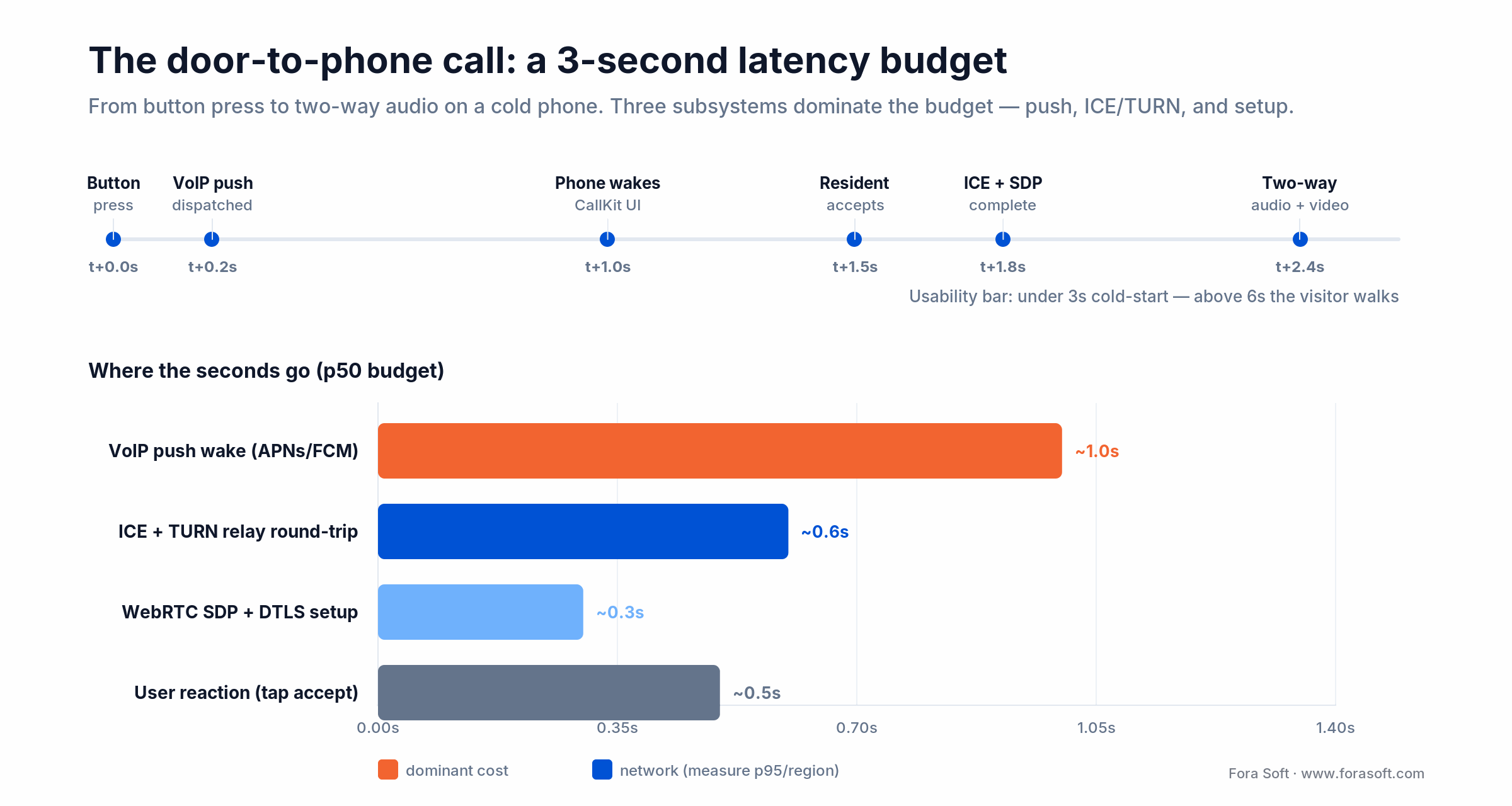
Figure 1. The door-to-phone call has a ~3-second budget. VoIP push wake and the TURN relay dominate it — measure both per region.
t=0      Visitor presses button at door station
t+50ms   Door station calls cloud signalling service
t+150ms  Cloud resolves unit -> resident(s) + device token(s)
t+200ms  APNs / FCM VoIP push dispatched to all resident devices
t+1s     Phone wakes, CallKit / ConnectionService displays call UI
t+1.5s   Resident taps accept
t+1.8s   WebRTC SDP exchange + ICE completes
t+2.0s   Two-way audio + video established
...
t+?      Resident taps "Open door", command signed and sent to door controller
t+?+150ms Door opens; event logged; all parties notified
The whole path from button press to two-way audio needs to land under 3 seconds on a cold phone, with a stretch target of 2 seconds. Three subsystems dominate that budget: VoIP push delivery, WebRTC ICE negotiation, and the TURN server round-trip. Each is a separate engineering problem.
VoIP push — CallKit, ConnectionService, and the APNs PushKit trap
iOS’s APNs PushKit is the only reliable way to wake a terminated or backgrounded app for a real-time call — but Apple mandates that PushKit pushes for VoIP must report to CallKit, and apps that silently drop them are removed from the store. Android’s FCM high-priority data messages and foreground service via ConnectionService give the same capability with more flexibility. Build both paths; test both on Doze mode Android and Low Power Mode iOS — most demos break in those states.
ICE, STUN, and TURN realities
Most smartphone intercom calls happen when the resident is on cellular and the door station is on Ethernet behind a CGNAT — the worst case for direct WebRTC peer-to-peer. Budget for roughly 80 percent of calls needing a TURN server relay. Run TURN in multiple regions close to your user base, and measure call setup p50 and p95 per region — a single bad TURN region anchors the whole product’s quality.
SIP interop for building phone lines
Many buildings still have SIP phones at the concierge desk, or PSTN dial-in for residents without the app. A SIP gateway in front of your WebRTC media server bridges the two worlds — use Kamailio as a SIP proxy and FreeSWITCH or Asterisk as the media layer. Our SIP integration for video platforms playbook covers the plumbing in depth.
Mobile credentials — BLE, NFC, and QR done properly
The best smartphone intercom apps let residents open the door without opening the app. Three primitives dominate.
BLE “tap and enter”
Bluetooth Low Energy advertises a signed token from the phone that the door reader verifies. The phone stays in the pocket. iBeacon and Eddystone are the legacy protocols; modern systems use custom BLE GATT services with per-session ephemeral keys. BLE ranges are 2–10 metres, so geofencing or accelerometer gates (“only release the door if the phone is within arm’s length AND moving towards the door”) prevent accidental triggers.
NFC mobile credentials
Apple opened its Secure Element and Host Card Emulation (HCE) to third-party apps with iOS 18.1 in 2024 — HCE in the EU, Secure Element APIs in the US, UK, Canada, Australia, Japan, Brazil, and New Zealand — so building-access credentials no longer require an Apple Wallet partnership. Android has supported HCE since 4.4. Partners like HID Global, Assa Abloy, Salto, and Kisi issue mobile credentials through their SDKs, and Apple Wallet and Google Wallet already carry hotel keys and building badges. For new builds, HCE- or SE-backed credentials beat BLE on perceived reliability — the phone tap is familiar and deterministic.
QR-code credentials for visitors
One-time QR codes delivered by SMS or email are the workhorse for visitor and package access. The door reader has a camera; the visitor presents the QR. Keep the QR validity window short (15 minutes to 24 hours), bind to a specific door, and log every scan. QR is the most resilient because it works on any phone, including visitors who have never installed the app.
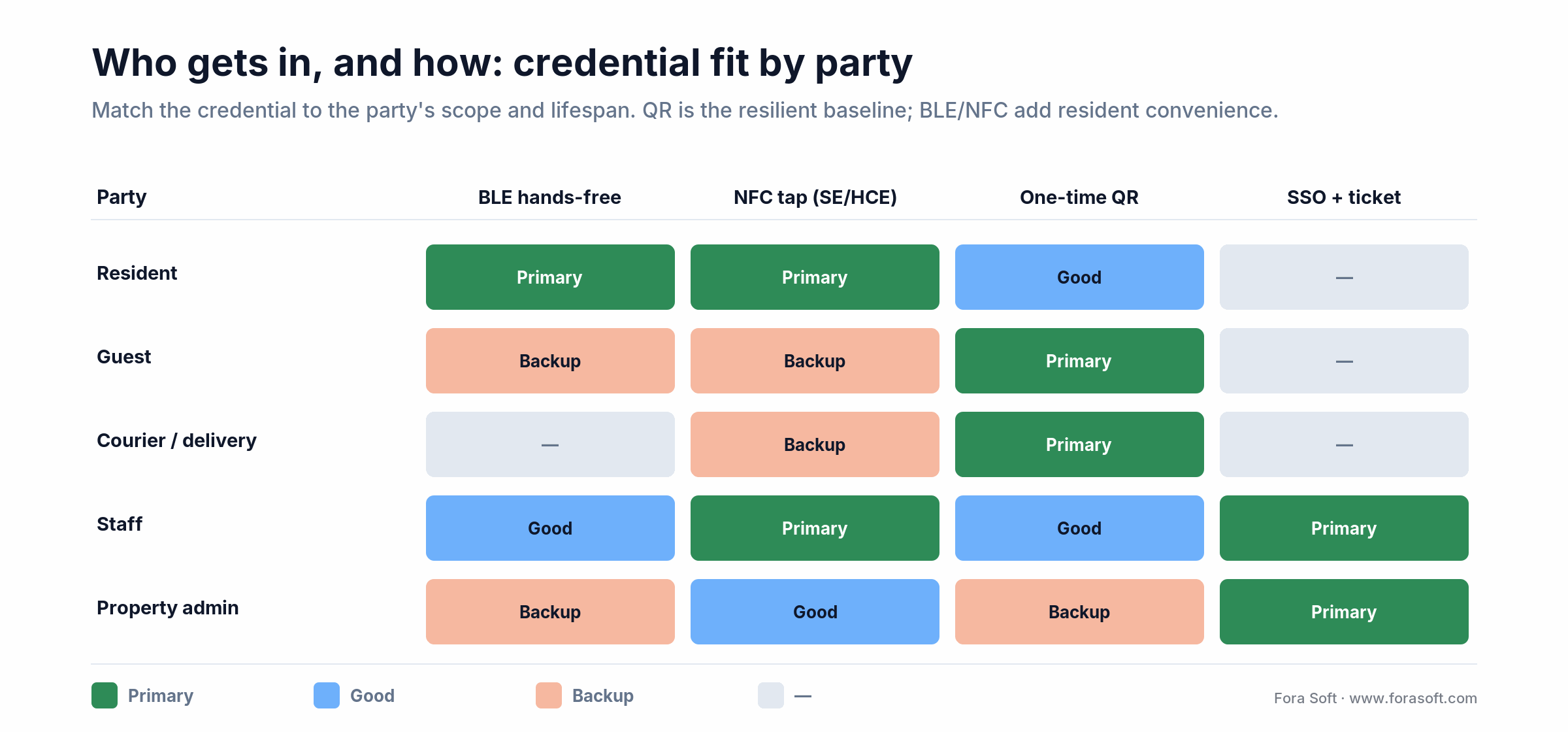
Figure 2. Match the credential to the party. BLE/NFC suit residents and staff; one-time QR is the resilient baseline for guests and couriers.
Reach for BLE or NFC hands-free credentials when: residents cross the same door daily and expect to keep the phone in a pocket; keep one-time QR as the visitor and package baseline, since it works on any phone with no install.
Multi-tenant identity — residents, guests, couriers, staff
Single-family door cam UX is simple: one household, one camera. Multi-tenant buildings multiply every object in the schema. The data model needs to handle at least five party types.
| Party | Typical scope | Lifespan | Must-have controls |
|---|---|---|---|
| Resident | Main door + own unit + common areas | Months to years | MFA on admin actions, mobile credential, self-service |
| Guest | Main door only, specific unit, time-bound | Minutes to days | QR or SMS link, auto-revoke, notifications |
| Courier / delivery | Lobby or drop-box only, narrow window | Minutes | One-time code, audit trail, photo capture |
| Staff | Back-of-house, specific units by ticket | Shifts or tickets | Employee SSO, ticket-scoped rights, ADA compliance |
| Property admin | Everything, with audit | Role-based | MFA, step-up auth for critical actions, RBAC |
Every access event is logged with the party, the door, the time, the credential used, and the result (granted/denied). RBAC governs what each role can do; policy-based access control (Casbin, Open Policy Agent, Cerbos) scales better than hard-coded role checks as the product grows.
Stuck on the multi-tenant data model?
We have designed the schema for residential, care-home, coworking, and hospitality intercom products. Share your context and we will sketch a data model that survives the first 10 edge cases.
Core feature set — what a competitive smartphone intercom app ships
The feature list below is the one we scope from on greenfield engagements. The first eight are mandatory; the rest are table-stakes for competitive products.
1. Two-way audio and one-way video from the door station. The core interaction. Sub-3-second setup; sub-500 ms in-call latency.
2. Remote door release. Primary door, secondary doors, gates, elevators where integrated. Confirm-to-release UX.
3. Call forwarding and fallback. Missed on phone 1 rings phone 2; after N seconds forwards to concierge or voicemail; PSTN fallback for residents without the app.
4. Visitor history with snapshots. Every visit logged with a clip or still; retention tuned to legal limits.
5. Guest passes and delivery codes. QR, SMS, or in-app link with time-bound validity.
6. Mobile credentials. BLE or NFC for hands-free entry; QR for one-time entries.
7. Push notifications with deep links. Every event pushes; tapping the notification opens the exact view needed.
8. In-app management. Residents add and remove household members, manage devices, revoke guest access, silence hours.
9. Parcel and locker integration. Courier drops into a parcel locker; resident gets notified and opens the locker from the app.
10. Smart home integrations. HomeKit, Google Home, Alexa where appropriate (read-only events usually; door release is too risky to expose).
11. Accessibility. Large-type mode, VoiceOver/TalkBack support, haptic entry-granted feedback, sign-language or text-to-speech fallback for deaf residents.
Reference architecture for a smartphone intercom product
The shape below is what we deploy on most smartphone intercom builds — residential, commercial, or vertical care-home or hospitality.
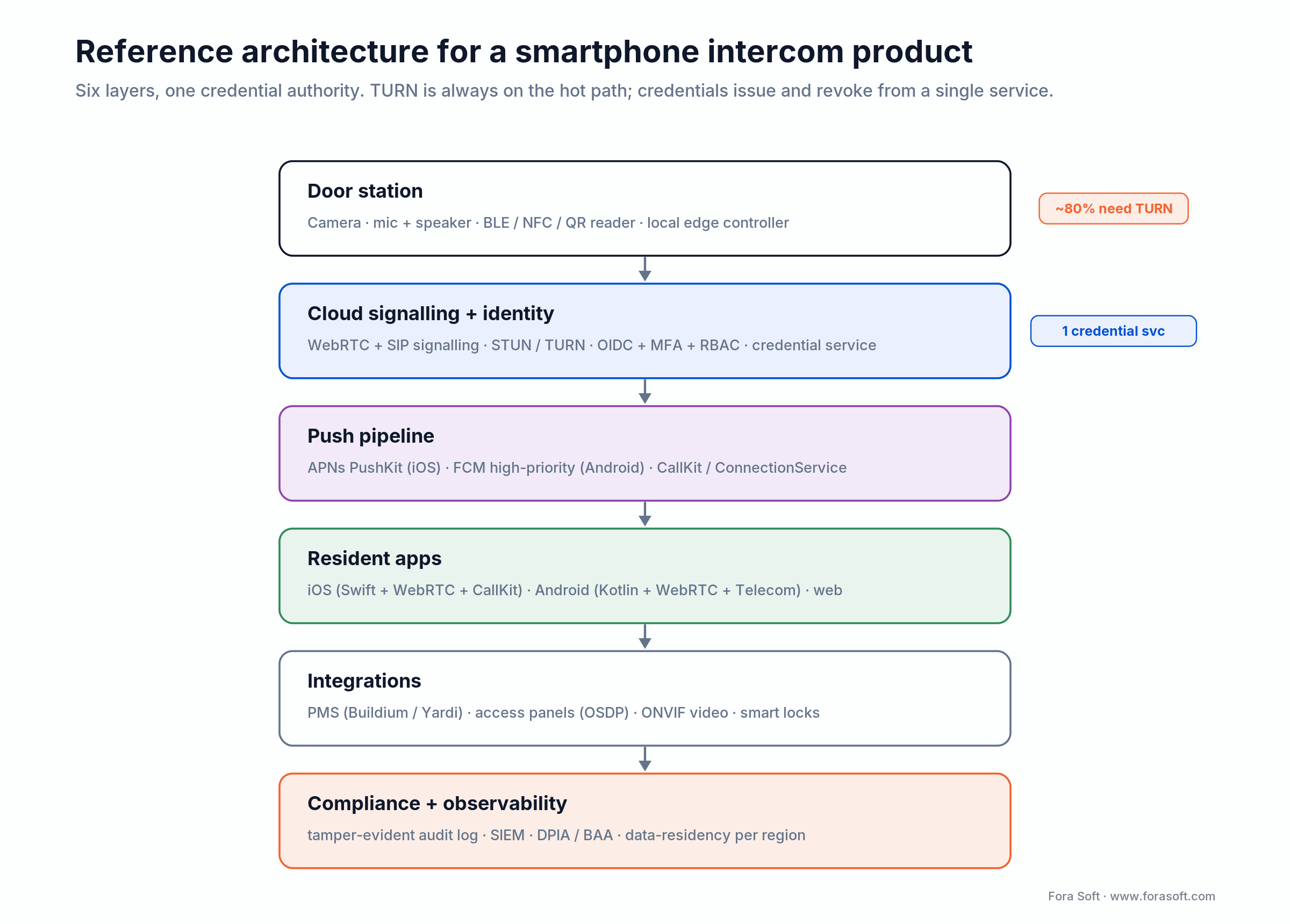
Figure 3. Six layers, one credential authority. TURN sits on the hot path; credentials issue and revoke from a single service.
Door station
  |- H.264 / H.265 camera
  |- Mic + speaker
  |- BLE, NFC, QR reader
  |- Local edge controller
  v
Cloud signalling + identity
  |- SIP proxy (Kamailio) + WebRTC signalling
  |- STUN / TURN (CoTURN, LiveKit, Twilio)
  |- Identity service (SAML / OIDC / MFA, RBAC, OPA / Casbin)
  |- Multi-tenant schema: building -> unit -> resident / guest / staff
  |- Mobile credential service (BLE token, NFC HCE, QR)
  v
Push notification pipeline
  |- APNs PushKit (iOS) / FCM high-priority (Android)
  |- Per-device-token map with TTL renewal
  |- CallKit / ConnectionService integration
  v
Resident phone apps
  |- iOS (Swift + WebRTC.framework + CallKit)
  |- Android (Kotlin + WebRTC + ConnectionService)
  |- Optional tablet / web for concierge
  v
Integrations
  |- Property management (Buildium, AppFolio, Yardi, RealPage)
  |- Access controllers (Assa Abloy, HID, Salto, Latch)
  |- Video surveillance (ONVIF)
  |- Parcel lockers (Parcel Pending, Luxer One)
  v
Compliance & observability
  |- Tamper-evident audit log
  |- SIEM (Splunk, Elastic, Datadog Security)
  |- DPIA, BAA, data-residency per jurisdiction
Three choices in this architecture matter most. First, TURN is always on the hot path — budget for it and measure p95 latency per region. Second, credentials are issued from a single service and revoked atomically; a resident who moves out must lose BLE, NFC, QR, and PSTN dial-in in a single API call. Third, the property management integration is a deep contract, not a nightly CSV — pick the integration partner carefully, because switching costs are high.
Reach for a managed WebRTC media platform (LiveKit, Daily) when: you want production TURN and SFU without running media servers yourself; move to self-hosted CoTURN or LiveKit only once per-minute egress at scale beats the engineering cost of operating it.
Integrations that decide adoption
A smartphone intercom app rarely lives alone. The integrations below decide whether a property manager actually rolls it out — and each is a 4–8 week project, not an afternoon.
Property management systems (PMS). Buildium, AppFolio, Yardi, and RealPage own the resident roster. Sync tenancy start and end dates into the intercom so access provisions and revokes automatically when someone moves in or out. A nightly CSV is not enough — use the webhook or API path so a move-out revokes access the same day.
Access-control panels. Talk to the door controller over OSDP Secure Channel (AES-128, supervised), not legacy Wiegand — Wiegand is unencrypted, unsupervised clock-and-data that can be sniffed or replayed at the reader wire. If you inherit Wiegand hardware, budget an OSDP converter or a reader swap.
Smart locks and video. BLE and Z-Wave locks (August, Yale, Salto, Latch) cover interior and secondary doors; the door camera speaks ONVIF Profile S/T so you can pull the stream into the app and a VMS without a proprietary bridge. Parcel lockers (Parcel Pending, Luxer One) close the delivery loop that drives day-to-day engagement.
Reach for a single integration abstraction layer when: you support more than two PMS or lock vendors; a thin adapter per partner behind one internal API keeps a vendor’s outage or breaking change from rippling through the whole product.
Security and compliance
Treat the smartphone intercom app as a building-security product, not a consumer lifestyle one. Five security layers matter.
1. Encrypted media and control. DTLS-SRTP with AES-256-GCM for media, TLS 1.3 for control and admin APIs. Mutual TLS between cloud services.
2. Hardware-backed credentials. Keys in Secure Enclave (iOS) or StrongBox / TEE (Android). Server side, a FIPS 140-3 validated KMS or HSM.
3. Tamper-evident audit logs. Every door release, credential issuance, admin action, and failed auth is logged to an append-only store and shipped to a SIEM in minutes.
4. Compliance envelope. GDPR Article 9 when face recognition is used, Illinois BIPA for biometric capture, and the EU AI Act’s high-risk rules for biometric identification — standalone Annex III obligations were deferred to 2 December 2027 by the 2026 Digital Omnibus, while the Article 5 ban on real-time remote identification targets law enforcement in public spaces, not a private door app. HIPAA applies when deployed in care homes. Our secure intercom systems playbook walks the full matrix.
5. Mobile app hardening. Certificate pinning, jailbreak / root detection, anti-tamper signatures, obfuscated native libraries, OWASP MASVS Level 2 as a baseline. A smartphone intercom app is attacked like a banking app; defend it like one.
Offline and fail-safe by design
A door is life-safety hardware. The first architecture question is not “what happens when it works” but “what happens when the cloud, the network, or the phone is dead.” Answer it before you write the call flow.
Fail-safe vs fail-secure. Egress and life-safety doors must fail-safe — the latch releases on power or controller loss so nobody is trapped, and fire codes require it. A secured perimeter door may fail-secure (stays locked) to protect the building. Which mode each door uses is a code and liability decision, made per door with the client, and it belongs in the design doc.
Degrade in layers. Keep a local edge controller at the door that caches recent access decisions so known credentials still open the door for a defined offline window (24–72 hours). Add a BLE or NFC path that verifies a signed credential with no internet at all, and keep PSTN dial-in as the last-resort call channel. A cloud-only intercom that locks the building when the internet blips should never ship.
Revoke atomically anyway. Offline caching and instant revocation pull in opposite directions, so bound the cache: a resident who moves out loses BLE, NFC, QR, and PSTN dial-in in a single API call, and the edge cache expires fast enough that a revoked credential cannot open the door past its window. State the window explicitly — it is a security parameter, not an accident.
Vendor and platform comparison
A pragmatic cut by the decisions you actually make — off-the-shelf property-tech, hardware-first vendors, and custom builds. Pricing is indicative.
| Segment | Examples | Pricing shape | Good fit | Watch out for |
|---|---|---|---|---|
| Cloud intercom platforms | ButterflyMX, Swiftlane, Latch, Brivo | $50–$200 per unit / year + hardware | Mid-size residential, small commercial | Data residency, customisation limits |
| Enterprise hardware + their app | 2N / Axis, Doorbird, Commend, Aiphone | $800–$3,500 per unit + subscription | Buildings that prize hardware longevity | App UX often lags hardware quality |
| Access-control led | HID Origo, Assa Abloy, Salto KS, Kisi | Per-door or per-credential | Commercial, hospitality | Video intercom often an add-on |
| Custom / white-label | Built by Fora Soft and peers | Project-based | Vertical SaaS, brand-owned stack | Requires serious engineering investment |
| Real-time media partners | LiveKit, Daily, Agora, Vonage, Twilio Video (EOL Dec 2026) | Usage-based | Under the hood of a custom build | Per-minute cost at scale |
Mini case — the primitives we reuse on intercom builds
From our portfolio, the same primitives drive every smartphone intercom build we undertake. On Netcam Studio we modernised a multi-camera IP surveillance platform with responsive UI, PTZ control, and event-driven recording — the hardening patterns that protect surveillance video apply directly to an intercom app. On ProVideoMeeting we run enterprise video conferencing with SIP and PSTN bridging for compliance-heavy tenants, which maps to how a smartphone intercom talks to a building’s existing phone infrastructure.
On CirrusMED, our HIPAA-grade WebRTC telemedicine platform, we run the audited role-based access primitives a care-home smartphone intercom needs. On MyOnCallDoc we ship on-call scheduling with mobile push — the same CallKit / ConnectionService pattern an intercom call uses.
The repeated pattern: low-latency WebRTC or SIP, VoIP push to wake a cold phone, role-based identity, tamper-evident audit, mobile hardening. We have templated the hard bits — VoIP push, WebRTC media, RBAC, tamper-evident audit — which is why an intercom MVP with us typically ships in 3–5 months rather than the 8–14 a from-scratch build takes.
Cost model — what a custom smartphone intercom app actually costs
Costs split into upfront build, mobile development per platform, and per-door operating. The shape below is realistic for a greenfield multi-tenant product covering 500–5,000 units at launch.
| Line item | Typical range | What drives it |
|---|---|---|
| Cloud signalling + TURN | $500–$3,000 / month | Concurrent calls, regions, egress |
| iOS + Android apps | $60k–$180k per platform | Feature set, hardening, accessibility |
| Backend + admin UI | $80k–$300k | Multi-tenant schema, integrations |
| Integrations (PMS, access panel, lockers) | $20k–$80k each | API depth, partner responsiveness |
| Compliance work (DPIA, BAA, pen-test) | $25k–$100k | Jurisdictions, audit scope |
| Ongoing ops + patching | 12–18% of build annually | CVE SLA, store review cadence |
| Per-door hardware | $500–$3,500 per unit | Outdoor-rated or standard; PoE; access control bundled |
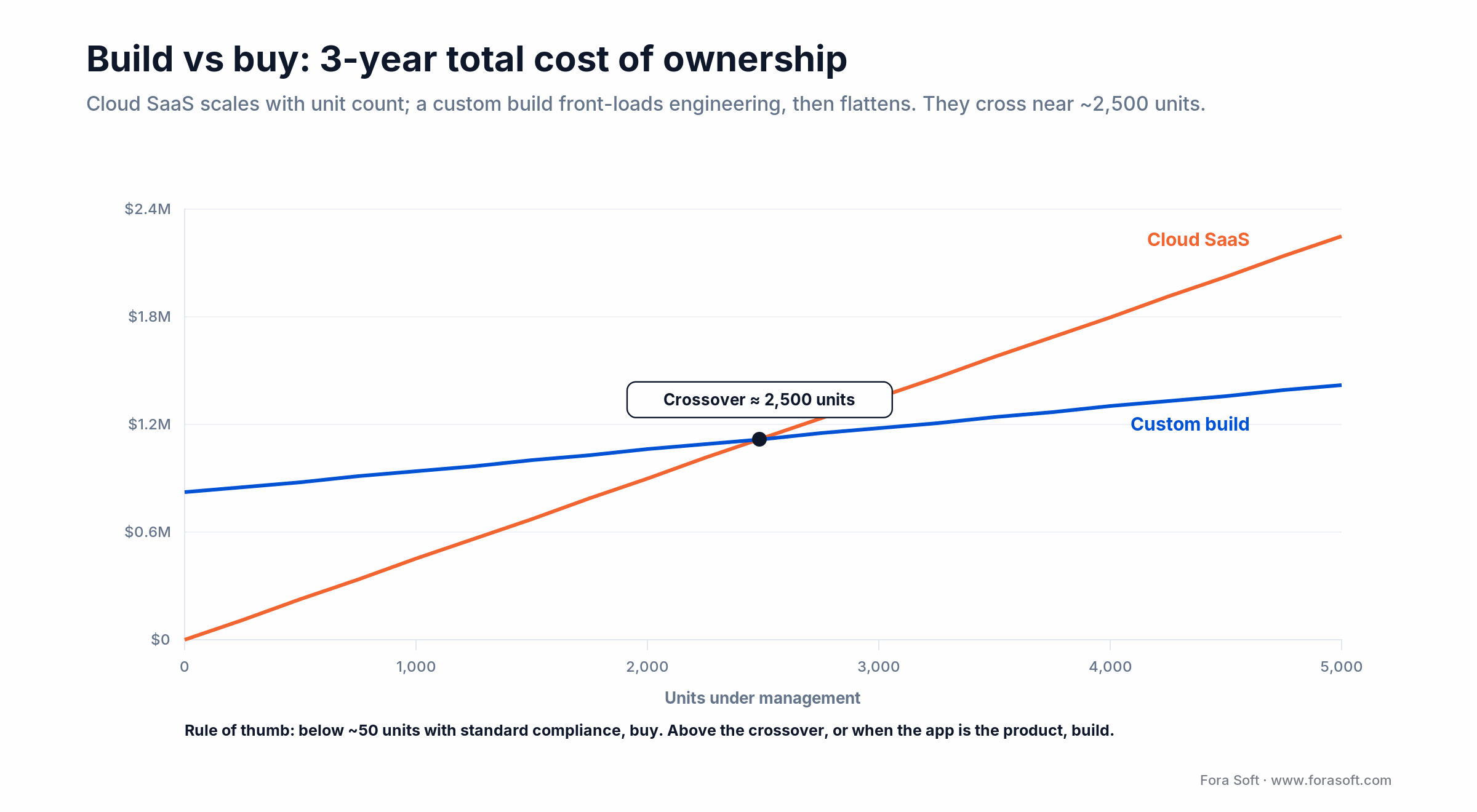
Figure 4. Build vs buy over three years. Cloud SaaS scales with unit count; a custom build front-loads engineering, then flattens.
A realistic greenfield custom build lands in the $250k–$900k range at first deployment with 12–18 percent annual ops. Agent-Engineering-accelerated delivery compresses the build-phase budget meaningfully; specific benchmarks are available under NDA. For small operators (below ~50 units) and no unusual regulatory context, a cloud intercom platform is almost always cheaper total-cost-of-ownership.
A decision framework — scope your app in five questions
Q1. What is my audience shape? Residents only, or residents plus guests, couriers, staff, and property admins? Each additional party adds schema and UI.
Q2. What devices must it target? iOS only, Android only, both, plus tablets and concierge web? Budget each platform as a distinct workstream.
Q3. What integrations are hard requirements? PMS (Buildium, AppFolio, Yardi), access control (Assa Abloy, Salto, HID), parcel lockers, surveillance. Each is a 4–8 week project.
Q4. What is my compliance envelope? Residential US, EU GDPR, Illinois BIPA, care-home HIPAA, defense federal. The envelope sets controls from day one.
Q5. What is the fail-safe behaviour? Cloud outage, phone dead, app uninstalled. If the answer is “the resident is stuck outside,” redesign.
Five pitfalls that sink smartphone intercom apps
1. Push notifications that do not wake the phone. A well-implemented APNs PushKit / FCM high-priority pipeline is non-obvious. Most first-release intercom apps fail in Doze mode or Low Power Mode and residents miss calls silently.
2. No cloud-outage fallback. If the app is the only way to open the door, a cloud outage locks the building. Local edge caching of access decisions, a BLE or NFC fallback that works without internet, and PSTN dial-in for emergencies are all non-negotiable.
3. One-account-per-unit assumption. A family of four with four phones is the norm, not the exception. Multi-device registration per unit, per-device revocation, and notifications to everyone who should know about each event matter from v1.
4. Weak mobile hardening. An intercom app opens doors. Treat it like a banking app: certificate pinning, jailbreak detection, Secure Enclave / StrongBox keys, and obfuscated native code. OWASP MASVS Level 2 or higher.
5. Ignoring accessibility. A door-control app that fails VoiceOver or TalkBack is a compliance risk (ADA in the US, European Accessibility Act) and a UX failure. Design for accessibility from day one; retrofitting is expensive.
KPIs — what to measure
Quality KPIs. p50 call-setup latency under 2 seconds, p95 under 4 seconds. Call-answer rate above 90 percent during waking hours. MOS above 4.0 for in-call audio. Door-release latency under 1 second.
Engagement KPIs. DAU/WAU ratio above 0.5 for residents. Percentage of deliveries handled via guest codes (measure the feature’s adoption). Number of calls per unit per month. Feature activation rates for secondary features (parcel, guest passes).
Operational KPIs. Mean time to patch critical CVE under 30 days. Percentage of fleet on latest firmware within 30 days of release. Support tickets per 1,000 units per month (lower is better). Uptime 99.95 percent inside fail-safe bounds.
When NOT to build custom
Not every portfolio needs a bespoke smartphone intercom app. If you operate fewer than 50 units, have standard residential compliance needs, and no product-differentiation story built around the app, picking an off-the-shelf ButterflyMX, Swiftlane, or Latch deployment will outperform custom on cost and time.
Reach for an off-the-shelf cloud intercom when: you run fewer than ~50 units, need standard residential compliance only, and the app is not your product — total cost of ownership wins before the build-vs-buy crossover.
Custom pays off when the app is the product (a vertical SaaS for student housing, senior living, hospitality, coworking), when you need white-label across many operators, when deep PMS or access-control integration matters, when the fleet is large enough that per-unit SaaS costs dominate, or when your compliance envelope goes beyond what cloud platforms attest to. In those cases this playbook scopes the build.
Building a smartphone intercom app or a vertical property-tech product?
Fora Soft pairs senior WebRTC, SIP, iOS, and Android engineers with your team or builds the stack end-to-end. Senior engineers, Agent-Engineering-accelerated delivery.
FAQ
How fast does a smartphone intercom call need to connect?
Residents and visitors expect answer in under 3 seconds end-to-end from button press to two-way audio on a cold phone. Above 6 seconds the visitor gives up. In-call audio latency should be under 500 ms one-way. Track p50 and p95 per region — a single bad TURN region drags the whole product’s reputation.
WebRTC or SIP for the core call?
WebRTC is the default for new smartphone intercom products because it gives strong default encryption (DTLS-SRTP), works natively in iOS and Android app SDKs, and handles NAT traversal well. SIP shows up at the bridge for PSTN dial-in, integration with legacy building phones, or concierge SIP handsets. In practice the production stack is WebRTC for the app and a Kamailio + FreeSWITCH bridge for SIP and PSTN.
Do I really need BLE and NFC credentials, or is QR enough?
QR is the most resilient baseline — it works for visitors who never installed the app. BLE and NFC add convenience for residents (no need to open the app, or even the phone screen) and become differentiation in premium residential and hospitality. For commercial access control, NFC HCE (Apple Wallet / Google Wallet) is increasingly the default. Scope by audience and competitive positioning.
How do I keep the app working when the cloud is down?
Three layers. Local edge caching on the door controller so recent credentials still open the door for a defined offline window (24–72 hours). BLE or NFC fallback that works without internet at all. PSTN dial-in as the last-resort failsafe. A cloud-only intercom that locks the door when the internet blips is dangerous and should not ship.
What regulations apply to a smartphone intercom app?
GDPR Article 9 for video and biometric data in the EU. Illinois BIPA and similar US state laws where face recognition is captured. The EU AI Act treats biometric identification as high-risk — standalone Annex III obligations were deferred to 2 December 2027 under the 2026 Digital Omnibus, and the Article 5 ban on real-time remote identification applies to law enforcement in public spaces, not a private door app. HIPAA if the app runs in care homes or hospitals. ADA (US) and European Accessibility Act for disability access. The full envelope for the intercom hardware side is in our secure intercom systems playbook.
Can I integrate with an existing building phone system?
Yes — a Kamailio SIP proxy plus FreeSWITCH or Asterisk as the media server can bridge WebRTC (the smartphone app side) to SIP and PSTN (the existing building side). This is how you serve residents who do not have the app, handle concierge handsets, and route overflow calls to a human during staffed hours. See our SIP integration playbook for the architecture.
How much does a custom smartphone intercom app cost to build?
A greenfield custom build for a 500–5,000 unit product typically lands in the $250k–$900k range for first deployment, with 12–18 percent annual run-rate for patching and ops. Agent Engineering on the delivery pipeline compresses the build phase meaningfully; we are happy to benchmark specific projects under NDA. For smaller deployments an off-the-shelf cloud intercom is almost always cheaper.
How long does an MVP take?
A single-platform (iOS or Android) MVP with basic call flow, a single integration, and a managed WebRTC backend lands in 3–5 months. A production-ready multi-platform deployment with PMS integration, access-control integration, mobile credentials, and compliance review typically takes 8–14 months. Agent-Engineering-accelerated delivery usually compresses this window; specific benchmarks available under NDA.
What to read next
Security
Secure Intercom Systems: The 2026 Hardening Playbook
The hardware-side hardening playbook that sits under the app.
Android
Android Calling App Features in 2026: 12 Must-Haves, Reference Architecture & SDK Comparison
12 must-have features, reference architecture and SDK comparison for calling apps.
SIP
SIP Integration for Video Conference Platforms
How to bridge WebRTC apps with SIP and PSTN phone lines.
Intercom
Video Intercom Features: 12 Must-Haves for 2026
The hardware-side feature set that pairs with the app.
Services
Custom WebRTC Architecture Development
Our engineering service for production-grade WebRTC builds.
Ready to build a smartphone intercom app that actually works?
A smartphone intercom app is a real-time video product with banking-grade security disguised as a doorbell replacement. Getting it right means sub-3-second call setup, mobile credentials that work without opening the app, a multi-tenant identity model that survives real building complexity, a push pipeline that wakes locked phones, a compliance envelope shaped by jurisdiction and audience, and mobile hardening at OWASP MASVS Level 2.
Apply this playbook and three outcomes follow. Call-answer rate holds above 90 percent because push and latency are engineered, not hoped for. Residents stop carrying keys because BLE and NFC credentials actually work. And your product stays up during the outages that used to lock buildings, because the architecture fails safe by design.
Need senior engineers who have shipped smartphone intercom at scale?
Fora Soft builds WebRTC, SIP, iOS, Android, and compliance-grade cloud platforms for residential, commercial, hospitality, and care-home intercom products. 30 minutes and you leave with a plan.

