
Key takeaways
• Pick a social media app development company by what it has shipped, not what it lists. TapeReal is a live, ad-free creator network with 52,000+ members and 650,000+ likes and plays, the proof this playbook is built on.
• Screen-capture protection is the real moat. iOS cannot hard-block screenshots the way Android does, so we layer capture detection, FairPlay DRM, and short-lived signed URLs to make piracy cost more than the content.
• Ad-free pays once you cross the creator-fan threshold. The 2026 creator economy is worth an estimated $250B–$310B globally and still growing double digits a year; paid-content ARPU beats ad ARPU past about 10,000 engaged followers per creator.
• The Apple tax is a design constraint, not a footnote. RealCoins spent on digital content are a consumable in-app purchase — Apple takes 30% (15% under the Small Business Program). Plan the economics around it.
• Fora Soft has shipped 250+ products since 2005. If you are scoping a social or creator app, a 30-minute call turns into a numbered plan within 48 hours.
Why Fora Soft wrote this case study
We are a software development company that has shipped 250+ products since 2005, most of them in real-time video, social, and media. TapeReal reached us as a growing ad-free social network with real engagement and a hard requirement: keep paid creator content safe on iOS while the audience scaled. We spent two years on exactly that problem, and this case study is what we learned.
It is written for founders, product leads, and engineering managers scoping a similar build — a creator platform, a privacy-first community, or any iOS app where screen capture is a real threat. You will get the architecture we shipped, the trade-offs we accepted, the Apple-policy traps that catch first-time teams, and what a good social media app development company charges to build it in 2026.
For third-party proof beyond our own word: we hold a 100% Job Success Score and Top Rated Plus status on Upwork, and 400+ client reviews on Clutch. The company voice here is “we” on purpose. These are decisions our engineers made on a real product with real users, not a listicle assembled from other people’s blog posts. Where we have not tested something at scale, we say so.
Scoping an ad-free social or creator app?
Bring your audience, monetization model, and platform. We’ll sketch an architecture and a realistic timeline on the call.
What TapeReal is, in numbers
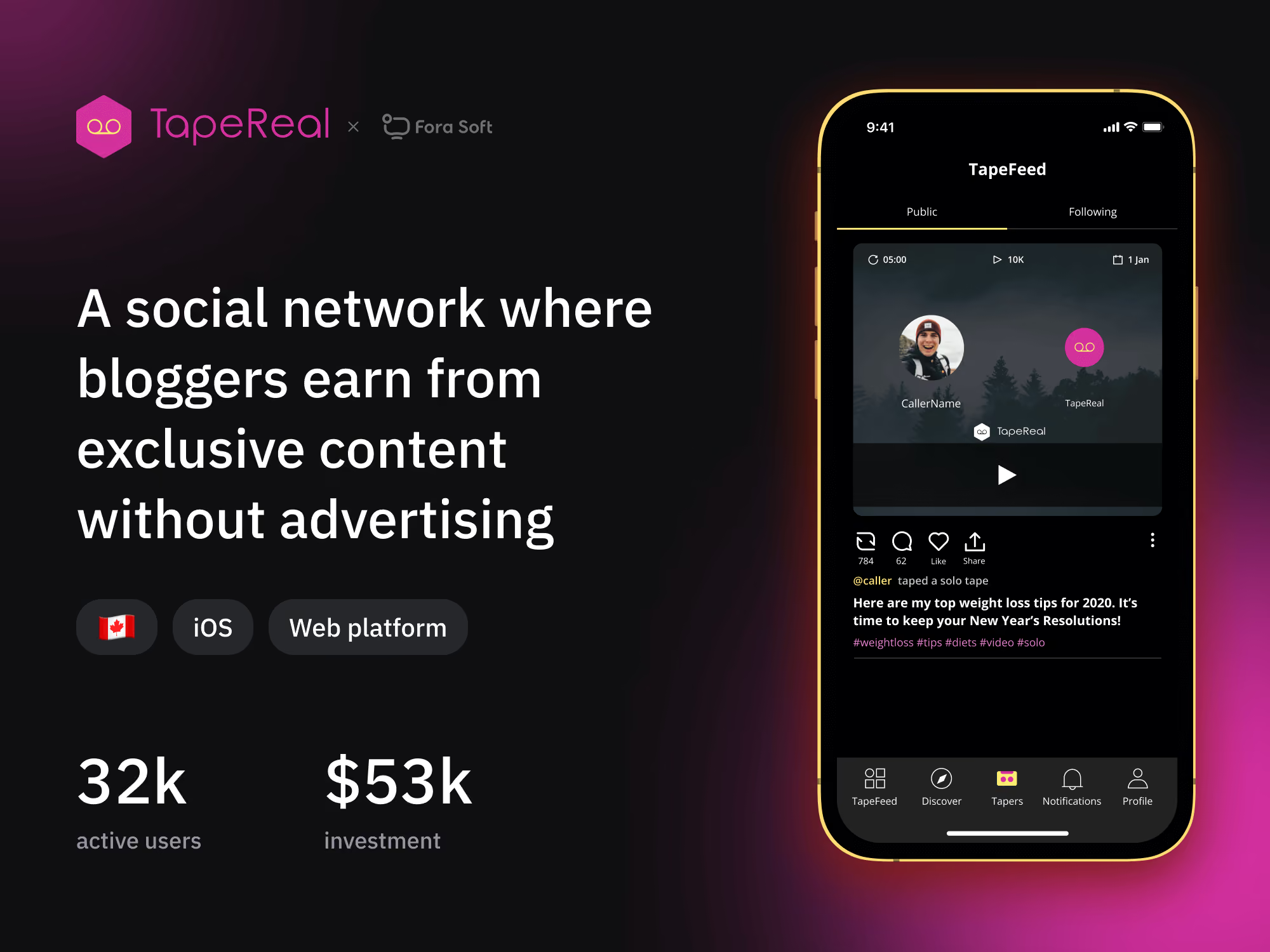
TapeReal is a creator-first video and audio network, positioned as a calmer alternative to YouTube: no advertising, no algorithmic outrage loop, no data-broker business model. Creators post genuine stories; audiences buy access to the ones they want with an in-app currency called RealCoins. Revenue comes from the fans who care, not from advertisers.
The numbers when we describe the platform: 52,000+ members, 650,000+ likes and plays, and 20+ topic-based communities, running at 99.98% uptime. Creators set custom prices on exclusive posts, earn RealCoins that convert to USD, and boost reach through a Creator Pro+ membership and a “Channel Swipe” discovery feature. Founder Ali Shah — a serial entrepreneur who has taught at Seneca College and the University of British Columbia — raised $53,835 on Equivesto (107% of goal, 29 investors) to fund the round we helped build.
That combination — small team, defensible product, paying audience — is the shape most successful creator apps take. The rest of this piece is how the engineering has to match the promise.
What a social media app development company actually builds
A social media app is six layers, and the price you pay is really the price of getting all six right. There is a client tier (iOS and web), an API and business-logic tier, a real-time media pipeline, a monetization and payments core, a trust-and-safety layer, and the data and infrastructure underneath. A vendor that only quotes you the screens you can see is quoting a third of the work.

Figure 1. The six layers of a social media app, mapped to the TapeReal stack — clients, API, real-time media, monetization, trust & safety, and infrastructure.
On TapeReal those layers are Swift and SwiftUI on iOS with a GraphQL API in front of Node.js services; WebRTC and Kurento for capture and live recording with AVKit for playback; a double-entry RealCoins ledger for purchases and creator payouts; a moderation queue wired to report-and-block; and PostgreSQL, Firebase Auth, and AWS object storage behind signed CDN URLs. Boring where it needs to be, careful where the money and the trust live.
Keep this map in mind as you read a proposal. Every layer a vendor skips is a gap you will pay to fill later, usually mid-launch when it is most expensive.
The problem TapeReal solves
Mainstream social networks have three structural problems for creators. The business model rewards attention, not authenticity, so novelty and outrage win the feed. The data model treats users as advertising inventory, which builds a privacy debt that compounds. And when a creator finally earns an audience, the platform takes a large cut and can bury them with a ranking change.
TapeReal inverts all three. It is a marketplace between creators and their audiences, so the stories are the product, not the attention. There is no advertising, so personal data does not need to be harvested. Creators price their own posts, keep most of the revenue, and hold a durable relationship with their audience because the platform is not competing with them for eyeballs.
Almost none of that is visible on the app surface. It lives in how media is stored and delivered, how playback is guarded against capture, how payments reconcile, and how moderation works without surveillance. Every one of those has a privacy-first option, and TapeReal takes it.
Screen-capture protection, done honestly
Here is the honest version most vendors skip: on iOS you cannot block screenshots the way Android’s FLAG_SECURE does. There is no single API that stops a recording. So screen-capture protection is not a switch — it is a stack of layers, each raising the cost of piracy above the price of the content. That is the bar creators actually care about.

Figure 2. Four stacked layers of screen-capture protection on iOS — capture detection, FairPlay DRM, signed URLs, and forensic watermarking.
The layers we stack
1. Capture detection. iOS exposes UIScreen.isCaptured (iOS 11+), which is true while the screen is recorded or mirrored over AirPlay. The app watches it during playback and, combined with UIScreen.capturedDidChangeNotification, blurs paid content and mutes audio the instant capture starts. On iOS 17+ you also read sceneCaptureState for the initial state. Apple documents this on the isCaptured reference.
2. DRM-protected playback. For premium video we serve HLS through FairPlay Streaming, Apple’s hardware-backed DRM — the same class of protection used for paid movie streaming. Keys are short-lived and per session, so a clean rip of the raw file is off the table even if the UI layer is defeated.
3. Short-lived signed URLs. The delivery path issues CDN URLs that expire within minutes and carry the viewer’s entitlement at the edge. A copied link is dead before it travels.
4. Forensic watermarking (the deterrent tier). When budget allows, a per-session watermark makes any leak traceable to one account. It does not stop capture; it changes the incentive to attempt it. We treat this as the layer you add once the first three are solid, not a day-one requirement.
Reach for a layered capture defense when: paid content is the core of the business, creators depend on exclusivity, and you need a trust contract that survives a determined weekend of attacker effort, not a checkbox that survives a demo.
The technology stack we shipped
The stack leans boring on purpose. Privacy-first apps live or die on predictability, and every exotic dependency in the security path is a future incident. Here is what shipped and why.
| Layer | Technology | Why |
|---|---|---|
| iOS app | Swift, SwiftUI, UIKit | SwiftUI for flows, UIKit behind the video player for predictable capture handling |
| Auth & identity | Firebase Auth | Fast phone and email auth, MFA, well-proven at scale |
| Real-time media | WebRTC, Kurento | Kurento server for live recording, WebRTC for low-latency capture |
| Playback | AVKit, AVFoundation, FairPlay | Native iOS playback with DRM for the paid tier |
| API layer | Node.js, GraphQL | One typed schema for iOS and web on the paywall and payments path |
| Database | PostgreSQL | Relational integrity for payments, audit logs, and creator ledgers |
| Location | iBeacon, CoreLocation | Coarse proximity at beacon-equipped venues, not continuous GPS |
| Media storage | Object storage + signed CDN (AWS) | Short-lived tokens, cheap egress, entitlement at the edge |
The rule across every choice: the privacy-critical path uses Apple-native, well-documented, long-lived technology. Firebase, Node, and PostgreSQL are the least surprising parts of any modern stack. That boring surface is what lets the interesting parts — capture protection, the creator economy, privacy-aware discovery — feel solid.
Architecture: the ad-free social stack
The architecture is deliberately conservative: four services, three stores, one CDN, and a clean boundary between the creator economy and the media pipeline.
Core services
1. API service. Node.js with GraphQL hosts feed, profiles, wallets, payouts, and moderation endpoints. Stateless, scales horizontally, reads and writes to Postgres.
2. Media service. Handles upload, transcoding to HLS ladders, and DRM license issuance. Kurento powers the WebRTC leg for live recording; outputs land on object storage with encrypted keys.
3. Delivery service. Issues signed CDN URLs on demand and enforces the paywall at the edge. Every request is stateless; the signature carries the entitlement.
4. Wallet and payouts service. A small ledger for RealCoins purchases, content access, and creator payouts. All writes are double-entry; every transaction has an idempotency key and an audit trail.
The flows that matter
Access flow. The user taps to open a paid story, the app calls the API with a client-generated idempotency key, the wallet deducts RealCoins, the delivery service issues a signed URL, AVKit plays through FairPlay, and the capture-detection loop stands watch. If anything fails mid-flow, the wallet rolls back — the user never loses currency without getting access.
Creator payout flow. Every purchase credits the creator’s ledger in near-real-time. Payouts run on a schedule through a payments provider; the ledger reconciles against provider statements nightly. Errors block payouts until resolved, never silently self-correct.
Key design decisions that shaped the product
1. No algorithmic ranking of the main feed. We tested an engagement-weighted feed in beta and rolled it back within a week. It rewarded controversy and buried authentic low-engagement stories, which broke the trust contract. The shipped feed is chronological with follows and curated playlists — it rewards good work, not popular work.
2. No third-party analytics or advertising SDKs. Every SDK you add is a privacy policy you inherit. Attribution, ad, and analytics SDKs never made it into the app. The cost is slower vendor-tool integration; the payoff is a privacy review that takes a week, not a quarter.
3. An in-app currency instead of raw dollar prices. RealCoins decouple the on-feed price from real-currency exchange rates, smooth micropayments below the card-processor minimum, and let the platform run bulk-buy promotions without re-pricing creator content. This is the pattern Twitch (Bits) and TikTok (Coins) converged on; note that Reddit retired its Coins in 2023, so an in-app currency is a commitment to maintain, not a free win.
4. Privacy-aware location instead of GPS tracking. Where a partner venue or event has a Bluetooth beacon deployed, iBeacon gives coarse proximity context without continuous GPS, and no location history sits in the database. It is a deliberately narrow signal rather than everywhere-tracking, which is the point.
5. Short-lived sessions and strict token hygiene. API tokens expire in hours, sessions rotate on launch, stolen credentials lose value fast, and compliance reviews go smoothly because token lifetimes are written down in one place.
Building your own creator platform?
We’ve shipped TapeReal, ChillChat, and more. Tell us your thesis and constraints, and you’ll get a scoped plan within 48 hours of the call.
Monetization without advertising: what the numbers say
Founders ask us the same question: does ad-free actually work at scale? In 2026 the answer is yes, with conditions. Goldman Sachs sized the creator economy near $250B in the mid-2020s and on track for roughly $480B by 2027; independent 2026 estimates run to about $310B. Either way it grows double digits a year, and creator revenue keeps shifting from platform-dependent ad income toward owned, recurring streams: by 2026 industry surveys, a majority of creators now run paid memberships or subscriptions. The paying-fan model beats ad ARPU once a creator crosses roughly 10,000 engaged followers. Below that, ads still monetize faster.
The levers that move revenue in an ad-free network are not mysterious. A friction-light access flow, taps not modals, lifts conversion. An in-app currency smooths micropayments and raises average transaction size. Creator-led promotions (first post free, subscriber-only feeds) keep creators invested. TapeReal ships all three, and we cover the same ground for streaming clients in our guide to monetisation strategies for streaming platforms.
The honest caveat: ad-free networks take longer to break even. You are selling trust, and trust compounds slowly — most ad-free networks we have advised take 18 to 24 months to reach the inflection where revenue outruns spend. Budget the runway and resist bolting on ads during the dip.
Reach for the ad-free paid model when: your creators have deep, niche audiences above ~10,000 engaged followers and your value is exclusivity. Stay ad-supported when your growth depends on mass, free-to-share reach.
The Apple tax: what in-app purchase does to RealCoins
Any team building a paid social app on iOS hits this wall, so plan for it early. Apple treats virtual currency and voluntary tips spent on digital content as consumable in-app purchases, which means the standard 30% commission applies — reduced to 15% under the Small Business Program if your App Store proceeds were under $1M in the prior year, or on second-year subscriptions.
That reshapes the economics of a RealCoins-style model. A $5 purchase of digital access nets roughly $3.50 after Apple’s 30%, before your platform split and the creator payout. Physical goods and real-world services are exempt and can run on your own processor. Digital content is where it gets nuanced: in-app purchase is still the default, but since a 2025 US court ruling apps on the US App Store can link out to an external web purchase for digital goods too, and the fees on that path are still in flux. We wrote a full breakdown in how to pay less App Store commission. If you do route digital purchases through Apple, model the 30% (or 15%) into creator payouts and pricing from sprint one, and lean on the Small Business Program while you qualify.
The mistake we see is teams pricing content as if 100% of the purchase reaches the ledger, then discovering the payout math does not work after launch. Build the tax into the model, not into a post-mortem.
How much social media app development costs in 2026
Straight answer: a focused social MVP runs about $25,000 to $60,000 and six to eight months; a mid-complexity build with cross-platform and live features runs $90,000 to $200,000; a complex, scaled platform with heavy moderation and AI runs $200,000 to $400,000 and up. Plan another 15–20% of the build cost a year for maintenance, infrastructure, and iteration; a live video and payments platform costs real money to run. These are 2026 US-market benchmark ranges, and the number that moves them most is scope, not day rate.

Figure 3. Social media app development cost in 2026 by build tier — MVP $25–60k, mid $90–200k, complex $200–400k+, with typical timelines.
A worked example
Take a focused TapeReal-shaped build, a bit richer than the leanest MVP: iOS app, chronological feed, RealCoins wallet, paywall with capture detection, creator payouts, and basic moderation. Ballpark it at four engineers for five months. At a blended $55 per hour and roughly 700 focused hours per engineer, that is 4 × 700 × $55 ≈ $154,000. Then Agent Engineering (our AI-assisted delivery workflow that automates scaffolding, tests, and glue code) trims 25–40% of the routine work, pulling it toward the $90,000–$115,000 band. The variance is real; treat any single number as an estimate until we scope it, and when a figure is uncertain we would rather not quote it than inflate it.
That is also why the vendor matters more than the rate card. A streaming and social build where the team has shipped the hard parts before — capture protection, ledgers, moderation — costs less in total than a cheaper team learning them on your budget.
Reach for an MVP scope when: you need to validate the trust contract with real creators before spending on Android, live streaming, and recommendations. Add those in phase two, once fans are paying.
Want a real number for your social app?
Share the feature list and target platforms. We’ll send a numbered estimate with the scope assumptions spelled out, with no inflated ranges.
Privacy, moderation, and Apple’s UGC rules
A privacy-first product has to earn the claim in its audit trail. For TapeReal that meant data minimization by default, documented lawful bases for every data flow, structured data-subject-access handling, and written sub-processor lists.
1. GDPR and CCPA alignment. Users export or delete their full account data from inside the app in one flow — stories, comments, wallet history, and a metadata manifest. Deletes cascade across sub-processors with an audit log proving each step, inside the 30-day GDPR window.
2. Apple’s User-Generated Content rules are not optional. App Store Review Guideline 1.2 requires any UGC app to filter objectionable content, provide in-app reporting, let users block others, publish contact information, and act on reports within 24 hours by removing content and ejecting the offender. Ship a Report button on every post and a Block option on every profile, or the app gets rejected. Apple spells it out in the App Review Guidelines.
3. Moderation without surveillance. Automated moderation runs on uploaded content, not on user behavior outside it, using a classifier plus hash deduplication; borderline cases go to human review within 24 hours. Voice and face embeddings are not retained past the review window — the tooling supports human moderators rather than replacing them.
Ad-free vs ad-supported: ARPU by audience size
When founders ask whether the ad-free thesis holds against an ad-supported equivalent, the honest answer is that it depends on audience size and engagement, not the model itself. The pattern across creator-economy data is consistent enough to plan against.
| Audience per creator | Ad-supported ARPU | Ad-free / paid ARPU | What to do |
|---|---|---|---|
| < 1,000 followers | Low ($1–$3/yr) | Lower (paywall too soon) | Build audience first; do not gate yet |
| 1K–10K followers | $3–$12/yr | $10–$25/yr | Inflection point begins |
| 10K–50K followers | $10–$30/yr | $30–$80/yr | Paid model wins on ARPU |
| 50K+ followers | $25–$60/yr | $60–$200+/yr | Loyal-fan model dominates |
The takeaway is operational, not ideological. If your platform is built for creators with strong, niche audiences, ad-free wins on revenue once you cross about 10,000 engaged followers per creator. Below that, the discovery that ads fund is genuinely useful. Plan the first 18 months around the creators who clear the threshold fastest (experts, performers, niche storytellers), and let the rest follow. Ranges are directional 2026 planning figures, not a guarantee for any single niche.
Lessons learned shipping TapeReal
1. Creators judge the capture experience in seconds. The first thing a creator does with their own paid story is try to screenshot it. If the app blurs cleanly and explains why, trust is won; if it stutters or half-succeeds, trust is gone for good. We spent more time on that one interaction than on any other screen.
2. Payments are harder than media. An in-app currency introduced three kinds of complexity at once (purchases, content access, and creator payouts), each with its own reconciliation and tax implications. We would not start a creator economy without a dedicated ledger service on day one.
3. Chronological feeds compounded value. We expected creator pushback on dropping algorithmic ranking and got the opposite: audiences actually saw the content, which re-energized posting and buying within a month.
4. Boring infrastructure is a feature. Firebase, Postgres, Node, AVKit, Kurento — none of them fashionable, all of them reliable. For a privacy-first app, reliability is the product. Novelty belongs in the UX, not the auth stack.
How to build a social media app: our playbook
If you are planning a privacy-first social or creator network, start with a one-page trust contract: what exactly do creators and audiences get from you that Instagram, TikTok, or YouTube will not give them? Do not compromise it for growth — every compromise shows up inside a sprint.
Keep the privacy-critical path boring and well understood, since Swift, Firebase, Node, and Postgres will carry a network to a million users if you run them well. Put the adventurous engineering in the UX, the discovery model, or the creator tools, never in the auth or payment stack. Invest in capture detection and DRM on day one if paid content is in the model; retrofitting it is brutal. If you need a team for the build, that is what our dedicated development team does.
Business-wise, budget 18 to 24 months of runway to a sustainable unit economy and measure the things that matter weekly: creator retention, average purchase value, and time-to-first-paid-post. Ignore vanity metrics; they will tempt you toward the ranking changes that burn the trust contract.
Reach for a dedicated team when: the build spans iOS, a media pipeline, payments, and moderation at once, and you need people who have shipped each part before rather than one generalist learning all four on your timeline.
A decision framework in five questions
Before you commit a budget, answer five questions honestly. The diagram below shows how the first two map to a monetization model; the full five decide whether the ad-free paid model is right for you at all.
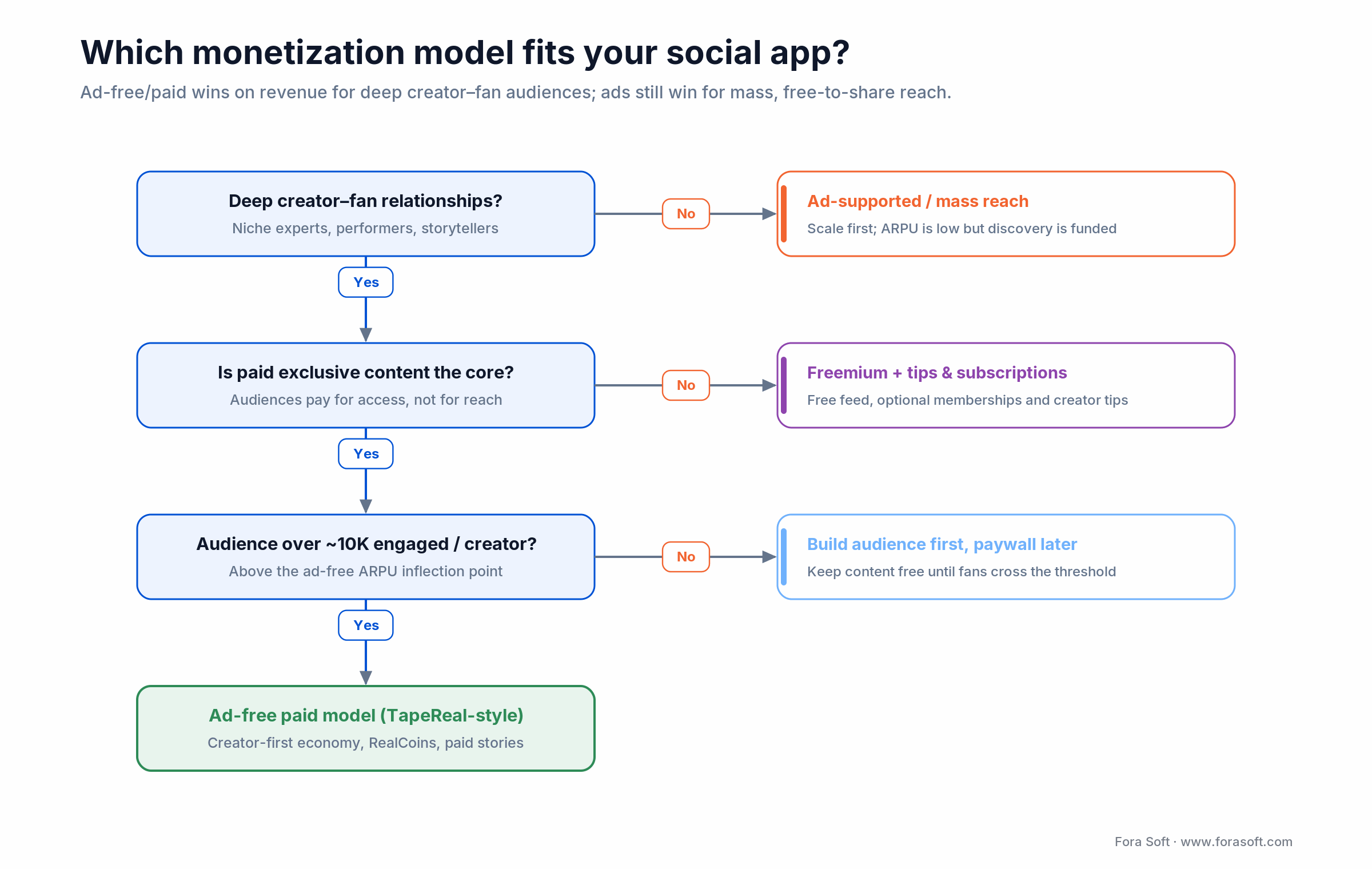
Figure 4. A monetization decision tree: ad-free paid vs freemium vs ad-supported, based on creator-fan depth and audience size.
Q1. What is the trust contract? Write it on one page. The product either delivers it end to end or it does not.
Q2. Is your monetization aligned with the contract? Ads align you with advertisers; paid access aligns you with creators and audiences. Pick the model that matches the promise.
Q3. What is your capture-protection plan? If paid content is the model, you need capture detection, DRM, and signed URLs on day one. There is no bolt-on that earns creator trust later.
Q4. Can you resist algorithmic feeds? Engagement-weighted ranking is the fastest way to burn a trust contract. If your team will push for it in six months, settle the tension now.
Q5. Do you have the runway? A privacy-first creator network is an 18-to-24-month play to break-even. Secure that runway or pivot the product.
Pitfalls to avoid
1. Treating capture protection as a feature flag. It is an architectural stance that touches the player, the CDN, the licensing service, and the UI. Shipping it half-done is worse than not shipping it, because creators find the gap and stop posting.
2. Skipping the ledger service. Building a creator economy on hand-rolled SQL is how disputes and lawsuits start. A double-entry ledger with audit logs and idempotency keys is cheap insurance.
3. Ignoring the Apple 30% until launch. Price content and creator payouts around in-app purchase from the first sprint, not after the first payout run misses its math.
4. Under-investing in human moderation. Automated moderation is 80% of the throughput and 0% of the trust. Keep humans on anything the classifier flags, and publish your response-time SLAs to satisfy Guideline 1.2.
5. Importing an attribution SDK for convenience. Every analytics, attribution, or advertising SDK undermines the privacy-first claim. Build in-house event tracking or use a tool with an explicit privacy stance.
KPIs for an ad-free creator network
1. Quality KPIs. Paid-access rate per active story (target > 8%), time-to-first-paid-post after creator signup (target < 14 days), capture-protection trigger rate (watch for anomalies), and moderation response time (target p95 < 24 hours).
2. Business KPIs. Weekly active creators (target 8–12% month-on-month in year one), creator 90-day retention (target > 40%), paying-fan ARPU (target rising quarter-on-quarter), and creator NPS (target > 40).
3. Reliability KPIs. Playback error rate (target < 1.5% of sessions), payment success rate (target > 99.5%), ledger reconciliation mismatch (target 0 unresolved at week end), and privacy-audit items aging (target none past 30 days).
When NOT to build an ad-free creator network
Three signals point to a different product. First, if your thesis leans on mass viral growth rather than deep creator-fan relationships, an ad-supported model reaches scale faster on a different cost structure. Second, if your content is primarily free-to-share (jokes, short clips, memes), a paywall cuts against the distribution that makes the content work.
Third, if your team is not aligned on the trust contract, an ad-free network is the wrong place to argue it out. The product does not tolerate half-measures. We have walked away from engagements that looked great on paper but lacked that alignment, because the products do not ship.
Related case studies from our portfolio
Across 250+ shipped products, the patterns we applied to TapeReal recur in adjacent social and creator work where trust was the core engineering problem.
ChillChat. A social video network for themed live rooms of up to eight participants — the same family of problems (trust, moderation, creator economy) in a live-video-first setting.
Tyxit. A collaborative music platform where remote musicians perform together in real time; shares TapeReal’s low-latency WebRTC and creator-first monetization.
Speakk. A WhatsApp-style messenger with 1:1 and small-group video, and the privacy patterns we brought into TapeReal’s messaging surface.
FAQ
How do I choose a social media app development company?
Judge shipped work, not feature lists. Ask for a live product with real users in your category, check who owns the hard parts (capture protection, payments, moderation), and confirm the team plans for Apple’s in-app purchase and UGC rules. A vendor that has done it before costs less in total than a cheaper team learning on your budget.
How much does it cost to build a social media app in 2026?
A focused MVP runs about $25,000–$60,000 over six to eight months; a mid-complexity build $90,000–$200,000; a complex scaled platform $200,000–$400,000+. Maintenance, infrastructure, and iteration typically run 15–20% of the build cost a year. Scope drives the number far more than the hourly rate.
Can you really prevent screen recording on iOS?
Not completely. iOS has no hard block like Android’s FLAG_SECURE. You detect capture with UIScreen.isCaptured and obscure paid content, protect video with FairPlay DRM, and expire signed URLs fast. Stacked, these raise the cost of piracy above the price of the content, which is what earns creator trust.
Does Apple take a cut of an in-app currency like RealCoins?
Yes. Virtual currency and tips spent on digital content are consumable in-app purchases, so Apple’s 30% commission applies (15% under the Small Business Program for developers under $1M in yearly proceeds). Build the cut into pricing and creator payouts from the start.
What tech stack suits a privacy-first iOS creator app?
Swift and SwiftUI for the UI, UIKit behind the video player, Firebase Auth, AVFoundation with FairPlay for DRM playback, Node.js with GraphQL for the API, PostgreSQL for the ledger, and object storage with signed CDN URLs. That is enough to ship to 100,000 users; swap parts as you scale.
How long does it take to build an app like TapeReal?
A focused iOS build (feed, paywall, capture protection, creator payouts, basic moderation) is about five to eight months with a seasoned team. Full cross-platform with live streams and richer discovery adds another six to ten months.
How does an ad-free model actually pay for the platform?
The platform takes a defined share of each purchase. Once creators cross roughly 10,000 engaged followers, paid ARPU reliably beats ad ARPU. Your levers are access friction, currency economics, and creator promotion tools — not more ads.
What regulations apply to a creator platform like this?
For Canadian and EU audiences, GDPR and Canada’s PIPEDA; for U.S. audiences, CCPA/CPRA plus state laws; Apple’s UGC Guideline 1.2 and in-app purchase rules; and COPPA for any under-13 audience. Plan data-subject-access flows, sub-processor lists, and App Store privacy labels from sprint one.
What to read next
Case Study
TradeCaster: a 46,000-user livestreaming platform
How we built a niche social streaming product where creators monetize expertise, not attention.
Case Study
ChillChat: from pixel-art chat to a live social app
Trust, moderation, and a creator economy in a live-video-first social network.
Case Study
Scholarly: a 15,000-user learning platform
What scale teaches about feeds, payments, and creator tools on a content product.
Monetization
How to pay less App Store commission in 2026
The in-app purchase rules that reshape any paid social app’s economics.
iOS
The iOS accessibility playbook for 2026
Seven pillars and WCAG 2.2 AA — the bar every creator app should clear.
Ready to build a social app creators will trust?
TapeReal is the case for what an ad-free social network can be: a trust contract with creators, backed by engineering that keeps paid content safe and business decisions aligned with the people who actually use the product. The stack is boring where it needs to be and careful where the money and the trust live. The monetization pays the bills without mining the audience.
If you are scoping a privacy-first creator network, a subscription video app, or any product where screen-capture protection is a material feature, bring the hardest question to a call. We have done the work on TapeReal, AI features, and more — and Agent Engineering turns a 30-minute call into a numbered plan within 48 hours.
Book a 30-minute call for a scoped plan
Share your trust contract, platform choice, and monetization. You’ll get a numbered estimate within 48 hours of the call.

