

Key takeaways
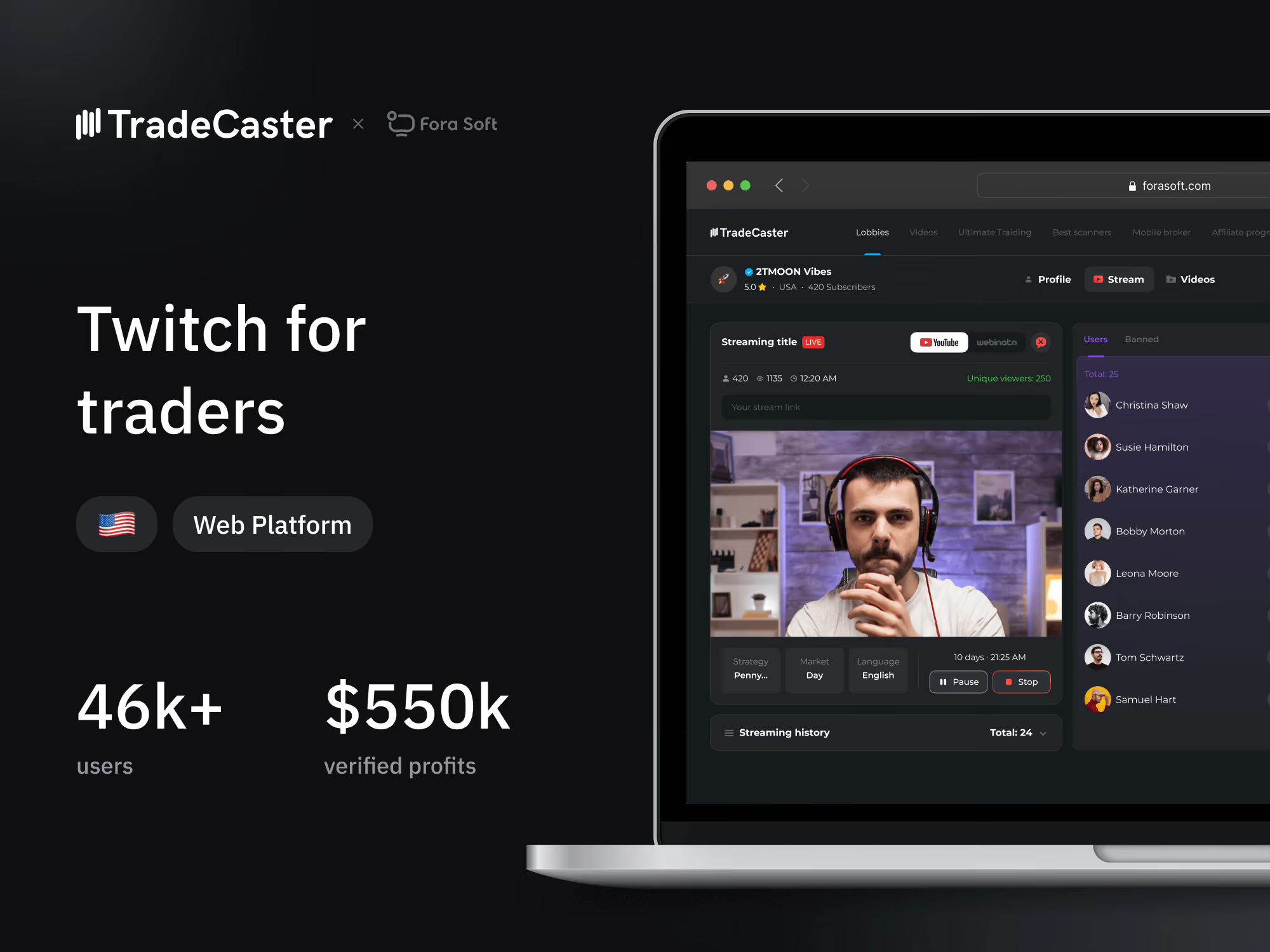
• Real product, real numbers. TradeCaster is a live trader-streaming platform Fora Soft built for a US trader who turned half a million dollars in 2021 livestreaming his sessions. It now serves 46,000+ users with sub-second video and synchronized chat, alerts and donations.
• Trader-streaming is not gaming or YouTube Live. Glass-to-glass latency must stay under one second — otherwise viewers see entries after the trader has already exited. We picked a custom WebRTC SFU stack to hit 100–300 ms instead of the 2–5 s of LL-HLS/DASH.
• The bill is in the architecture. A managed CPaaS (Agora, Twilio Video) at 50k concurrent viewers runs $30–60k/month; a self-hosted mediasoup SFU cluster lands at $20–25k/month with full control. We default to self-hosted past ~5k CCU.
• Realistic budgets to build a TradeCaster-class platform. A focused PoC starts around $5–10k, an MVP $40–70k, and a 50k-CCU production launch lands $100–200k. Agent Engineering compresses the timelines and lets us land below legacy SI quotes for the same scope.
• Compliance is part of the build. FINRA Rule 2210, SEC stock-promotion rules, and GDPR/CCPA all apply. We bake the disclaimers, the audit trail, and multi-year retention into the schema from sprint one.
More on this topic: read our complete guide — Streaming App UX Best Practices: 7 Pillars (2026).
Why Fora Soft built TradeCaster
Fora Soft has shipped real-time video and AI products since 2005, with 250+ delivered software products and a 100% job-success score on Upwork. Live, low-latency video is one of the things we do best — on top of BrainCert we’ve scaled WebRTC classrooms to thousands of concurrent rooms, and on ProVideoMeeting we shipped business conferencing with document signing and HD recording.
TradeCaster pulled all of that experience into one product. The client — a US-based professional stock trader who earned over half a million dollars in 2021 livestreaming his trading — came to us with a finite question: how do I let other traders watch my screen, chat with me, and tip me, in real time, without the 4-second delay that kills any trade signal? The rest of this article is the answer we shipped, what it cost, and what we’d do for you.
Building a trader, sports, or creator livestreaming platform?
Bring your scope, scale targets, and rough budget. We’ll spend 30 minutes mapping a streaming stack and giving you an honest estimate — no slide deck, no obligation.
What TradeCaster does in one paragraph
TradeCaster is a live-streaming platform purpose-built for traders. Professional traders share their screens and trade stocks live; viewers see every chart, ticker, and order in real time. Each streamer has a profile (their watchlist, their strategy, past sessions), a follow/subscribe loop, an in-stream chat, donation buttons, and a VOD archive. The platform auto-scales for the 9:30 AM ET market open spike and survives sustained traffic of tens of thousands of concurrent viewers per stream.
How to build a live streaming platform, step by step
To build a live streaming platform you wire seven layers, in this order: pick a low-latency transport, stand up redundant ingest, cascade a media server so one stream reaches thousands of viewers, add a transcoding and CDN ladder for weak networks, bolt on realtime chat and payouts, wire compliance and retention into the database schema from day one, then auto-scale the media layer for traffic spikes. TradeCaster is that blueprint shipped for 46,000+ traders. The rest of this article walks each layer, what it cost, and where teams get it wrong.
1. Pick the transport. WebRTC for the sub-second primary path; an LL-HLS ladder as the mobile and bandwidth-poor fallback. This one decision sets your latency ceiling.
2. Ingest. The streamer pushes one high-quality feed (RTMPS or WebRTC) into a redundant ingress. Over-provision here — it is the cheapest layer to make bulletproof.
3. Cascade the SFU. A Selective Forwarding Unit forwards the streamer’s media to every viewer without re-encoding it. You cascade pods across regions so one broadcast scales to tens of thousands without melting a single server.
4. Transcode and CDN fallback. A parallel transcoder builds an adaptive bitrate ladder served over a CDN, so a viewer on hotel Wi-Fi still gets a watchable stream.
5. Chat, payments, alerts. A realtime message bus for chat and reactions; Stripe Connect for tips, subscriptions and payouts; a synchronized overlay layer for tickers and alerts.
6. Compliance and retention. Bake disclaimers, audit logs and multi-year retention into the schema now, not as a v2 feature — regulators do not grade on a curve.
7. Auto-scale for spikes. Pre-warm capacity ahead of predictable surges (for TradeCaster, the 9:30 AM ET market open) so the first 30 seconds never crash. We build all seven as one system; if you want the same map applied to your product, grab a 30-minute scoping call and we’ll sketch it live. Our video and audio streaming development team does this end to end.
What is sub-second (glass-to-glass) latency, and why do traders need it?
Glass-to-glass latency is the delay between light hitting the streamer’s camera or screen and that frame lighting up on a viewer’s display — capture, encode, transport, decode, jitter buffer and render, all of it added together. For live trading it has to stay under one second. At the 4–30 second delay of ordinary HLS, a viewer copying a trade is acting on a price that already moved, so the signal is worthless. WebRTC holds glass-to-glass in the 100–300 ms band, which is why every serious trader-streaming build starts there.
The budget breaks down roughly like this: capture and encode eat 30–80 ms, network transport another 20–150 ms depending on distance and routing, and the decode plus jitter buffer on the viewer side 30–100 ms. Segment-based protocols add whole seconds on top because they cannot send a frame until a chunk is complete. We break the same trade-off down further in our low-latency streaming playbook.
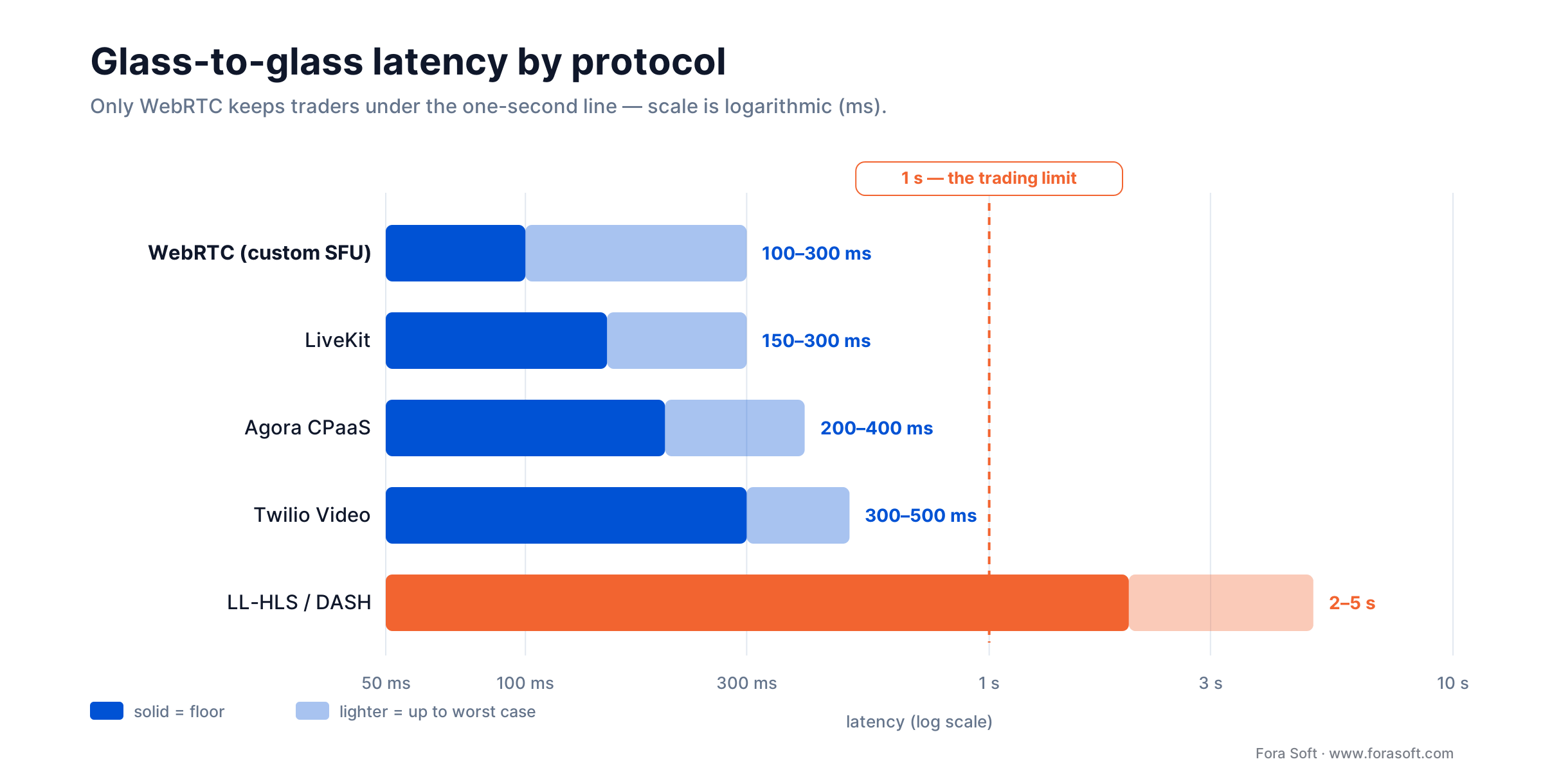
Figure 1. Why trader-streaming starts with WebRTC: only sub-second transports keep viewers on the same tick as the streamer. Scale is logarithmic.
Numbers and outcomes
| Metric | Value | Why it matters |
|---|---|---|
| Active users | 46,000+ | Validated product-market fit at scale |
| Glass-to-glass latency (P95) | < 800 ms | Viewers act on the same tick as the streamer |
| Chat & donation sync | < 500 ms | Streamer reads donations as they land |
| Auto-scale headroom | 3–5× baseline | Survives the 9:30 AM ET market-open spike |
| Stack | React, Node.js, MongoDB, custom WebRTC SFU | Full IP ownership, no CPaaS lock-in |
The five technical problems trader-streaming actually has
1. Sub-second latency. A 4-second HLS lag means viewers act after the move is gone. We picked WebRTC over LL-HLS/DASH-CMAF for that reason — native WebRTC delivers 100–300 ms; LL-HLS is 2–5 s in production.
2. Screen-sharing legibility under low latency. Default WebRTC screen-share is tuned for video, not text. Charts, tickers, and order tickets need crisp text at 1080p60 with VP8/H.264 quantization tuned down. We re-tuned the codec parameters per stream type so a Bookmap heatmap stays readable at 2 Mbps.
3. Real-time overlays in sync with video. Tickers, order-book snapshots, P&L counters need to land on the same wall-clock tick as the underlying chart. We solved this with a synchronized timing layer between ingest, the graphics service, and the SFU egress.
4. Spike traffic at market open. The 9:30 AM ET equity open drives 3–5× the average load. We auto-scale the SFU pods (each pod handles ~300–400 concurrent viewers) inside seconds, not minutes — otherwise the first 30 seconds of every session crash.
5. Compliance recording & audit trail. FINRA and SEC rules expect chat and trade alerts kept at least 3 years and financial records (donations, payouts) at least 6, under SEC Rule 17a-4 and FINRA Rule 4511. We bake that retention into the database schema, not bolt it on with a forensics tool later.
WebRTC vs LL-HLS vs LL-DASH for live trading
For live trading, WebRTC wins on latency and LL-HLS wins on reach — so you ship both, WebRTC as the primary path and an LL-HLS ladder as the fallback. WebRTC keeps glass-to-glass at 100–300 ms because it sends media over UDP with no segmenting and its own congestion control. LL-HLS chops the stream into CMAF chunks and lands at 2–5 s in production; LL-DASH is in the same band. That 2–5 s gap is the entire reason we do not lead with HLS on a trading product.
The honest trade-off: WebRTC is harder to scale to a passive audience and needs TURN servers for locked-down networks, while HLS rides ordinary CDNs and just works on every device. So the answer is not one protocol, it is a hybrid — interactive viewers on WebRTC, everyone else on the LL-HLS ladder, both fed from the same ingest.
Reach for an LL-HLS fallback when: a slice of your audience is on mobile data or corporate networks that block WebRTC, and those viewers can tolerate a few seconds of delay in exchange for a stream that never fails to connect.
Streaming stack options — what we chose and why
| Option | Latency | Cost @ 1k CCU | Trade-off |
|---|---|---|---|
| Custom WebRTC SFU (mediasoup, Janus) | 100–300 ms | $0.5–2k/mo infra | Lowest cost at scale, full control, needs DevOps |
| LiveKit Cloud / self-hosted | 150–300 ms | $2–5k/mo | Fast launch, managed scaling, modest premium |
| Agora CPaaS | 200–400 ms | $4–8k/mo | Strongest global SLA, vendor lock-in |
| Twilio Video | 300–500 ms | $3–6k/mo | Simple per-minute billing, expensive at scale |
| LL-HLS / DASH-CMAF only | 2–5 s | $0.5–2k/mo | Not viable for live trading; OK as fallback |
For TradeCaster we picked a custom mediasoup SFU. At 5k+ concurrent viewers per stream the math turns decisively in favour of self-hosted. We covered the same trade-off in our Agora alternative guide and our Twilio Video alternative guide.
Reach for a custom SFU when: you expect to cross 5k concurrent viewers per stream, you need full control over codec tuning and recording, and you have (or hire) two or three engineers who know WebRTC.
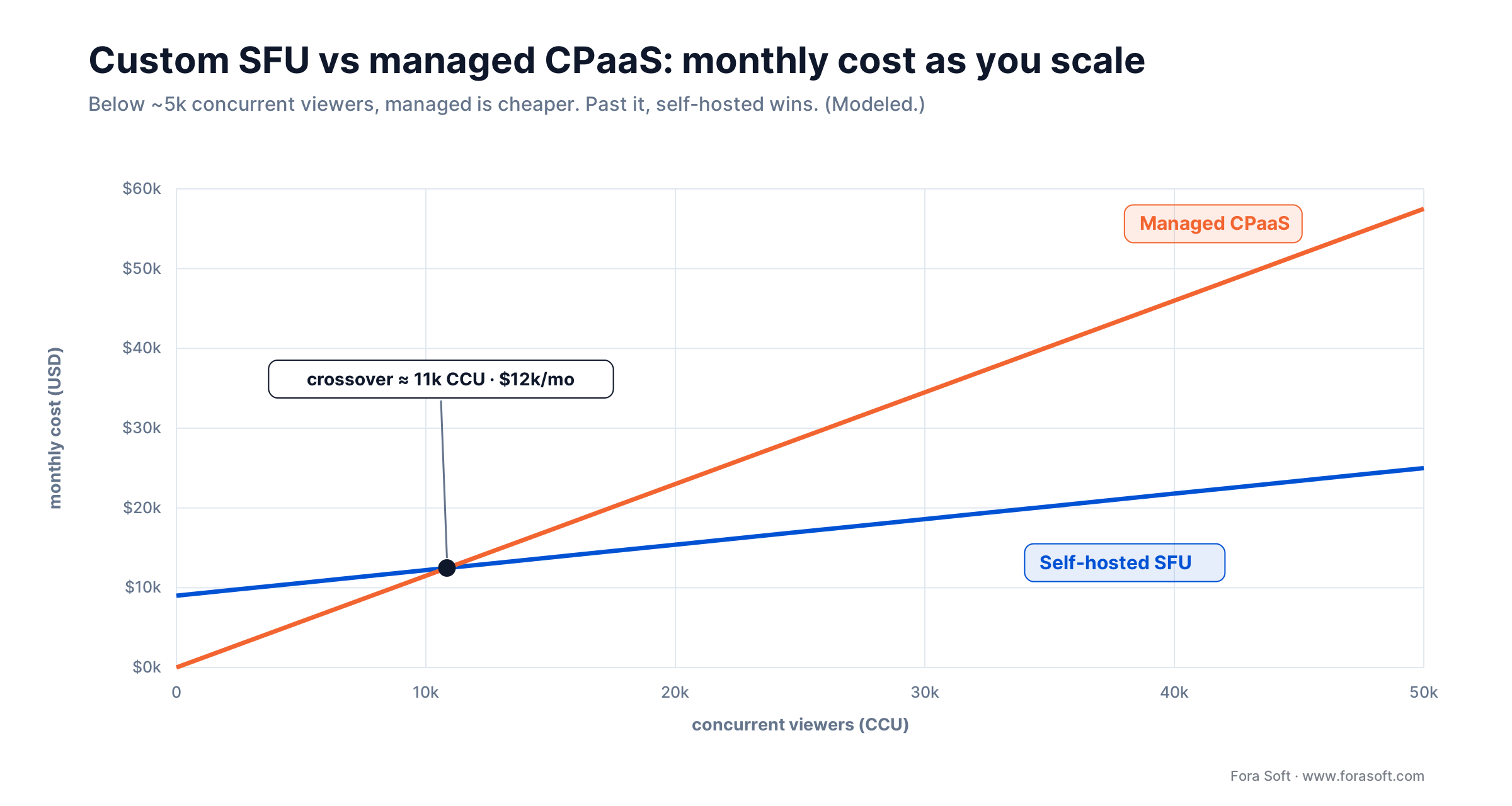
Figure 3. Below about 5k concurrent viewers a managed CPaaS is cheaper to run; past it, a self-hosted SFU wins on unit cost. Curves are modeled, not quoted.
Reach for LiveKit Cloud when: you want the fastest path to launch, you are under roughly 5k concurrent viewers per stream, and you would rather pay a managed control plane than run your own SFU on-call rotation.
Reach for a managed CPaaS (Agora, Twilio) when: you are pre-product-market-fit, still under a few thousand concurrent viewers, and a predictable per-minute bill is worth more to you than the unit-cost savings of self-hosting.
How we kept trading charts legible under low latency
Default WebRTC screen-share is tuned for camera video, not dense text — so a price ladder or a Bookmap heatmap turns to mush the moment bitrate drops. We re-tuned the encoder per stream type. The browser’s content hint is set to detail, degradation preference is pinned to maintain-resolution (drop frame rate under pressure, never spatial resolution, so the numbers stay sharp), and we cap the bitrate near 2 Mbps so the frame-rate gives first and 1080p60 chart text keeps its spatial detail.
The result: a trader’s DOM and candlesticks are pixel-crisp even when a viewer’s connection sags. It is a small set of knobs — contentHint, degradationPreference, and codec QP — but skipping it is the single most common reason a trader-streaming MVP looks broken on day one.
Reference architecture: 1k → 50k concurrent viewers
The architecture we shipped for TradeCaster has five layers. They cleanly separate the parts that scale (SFU, chat) from the parts that don’t (database, auth, payments).
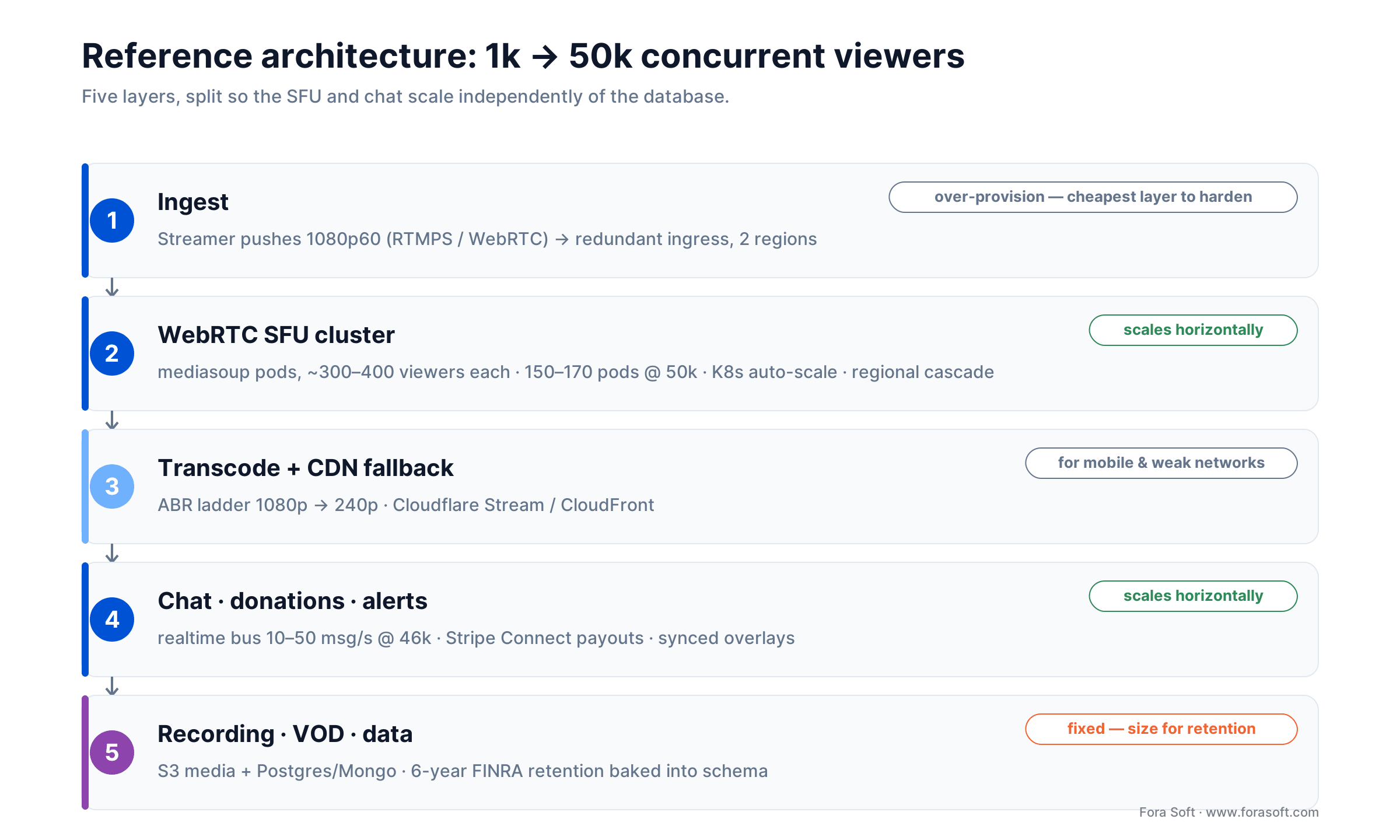
Figure 2. The five layers we shipped for TradeCaster, split so the SFU and chat scale independently of auth, payments and the database.
The SFU layer leans on mediasoup, an open-source WebRTC library whose own docs put a single worker at roughly 500 media consumers per CPU core; you scale past that by piping routers across workers, servers and regions.
1. Ingest. Streamer pushes 1080p60 RTMPS to a redundant ingress server (one origin, one fail-over region). Ingest is the cheapest layer to over-provision; we use small EC2 m5.xlarge nodes (~$200/mo each).
2. SFU cluster. A mediasoup pod handles ~300–400 concurrent viewers. For 50k CCU we run 150–170 pods, auto-scaled by Kubernetes. Each pod runs the mediasoup router plus a Node.js signaling layer; cost is roughly $0.05–0.10 per pod-hour. Pods cascade in regions to keep RTT low.
3. Transcoding + CDN fallback. A parallel transcoder produces an HLS bitrate ladder (1080p/5Mbps, 720p/2.5Mbps, 480p/1Mbps, 360p/500kbps, 240p/250kbps) for mobile and bandwidth-poor viewers. CDN (Cloudflare Stream or CloudFront) serves the ladder.
4. Chat, donations, alerts. Pusher (or self-hosted Ably-style cluster) handles 10–50 messages/sec at 46k CCU. Donations route through Stripe Connect; the streamer payout ledger lives in PostgreSQL/Mongo.
5. Recording & VOD. Live ingest writes to S3 plus metadata to RDS. VOD transcoding is async; a 1-hour 1080p stream is ~1.5–2 GB at source; the full ABR ladder sums to ~3–4 GB, so most teams archive one mid-tier rendition (~300–500 MB) and drop the rest.
Monetization features that work for traders
Tipping & donations. One-tap Stripe Connect payouts (2.9% + $0.30 per transaction). The streamer reads each donation on screen within ~500 ms of the click.
Subscriptions. Recurring tiers ($4.99 / $9.99 / $19.99) via Stripe Billing — subscriber-only chat badge, exclusive VOD, subscriber-only streams. Typical retention 3–6 months → $15–30 LTV per subscriber.
Premium VOD. Single-stream archive pass ($2.99) or all-access ($19.99/mo). VOD revenue is typically 10–15% of live revenue.
Sponsored alerts. Trade-signal vendors pay $0.50–$2.00 per viewer to have their alerts run as overlays. Disclose every paid alert as advertising — both for SEC compliance and for viewer trust.
Avoid pre-roll/mid-roll ads on live trading content. They break the moment-to-moment flow and erode subscription willingness. Gate ads behind a non-subscriber tier or skip them entirely.
Need a custom SFU built or a CPaaS replaced?
We’ve cut Agora and Twilio bills by 60–80% on production traffic for clients past 5k CCU. Bring your numbers and we’ll show you whether the math works for you.
Compliance: FINRA, SEC, GDPR — what we wired in from sprint one
FINRA Rule 2210. For a streamer who is a FINRA member or registered representative, a stream made available to more than 25 retail investors in a 30-day period counts as a retail communication under FINRA Rule 2210 and needs disclaimers and pre-approval workflows. We auto-prepend a not-investment-advice disclaimer to every stream and VOD and store the streamer’s acknowledgement of FINRA terms.
SEC stock-promotion rules. Sponsored alerts must be disclosed as paid; pump-and-dump claims invite enforcement. Our admin tool gates “sponsored” tagging into a separate moderation flow with a UI label that travels into the VOD.
Record retention. Communications like chat and trade alerts are retained at least 3 years and financial records like donations and payouts at least 6, per SEC Rule 17a-4 and FINRA Rule 4511. We size storage and database costs around the longer window, not against the live-traffic curve.
GDPR / CCPA. EU and California viewers get a consent prompt, a privacy policy that names every processor, and a working data-deletion endpoint. The mandated records retention takes priority over GDPR right-to-erasure on regulated data — we keep that path documented in the DPIA.
Cost model: what a TradeCaster-class build actually costs
| Stage | Dev cost | Monthly ops | Timeline | What you get |
|---|---|---|---|---|
| PoC (1–3 streamers, < 5k CCU) | $5–10k | ~$2k | 4–6 weeks | SFU prototype, simple chat, donations stub |
| MVP (5–20 streamers, 5–20k CCU) | $40–70k | $8–12k | 12–16 weeks | Production-ready SaaS, mobile + web, basic VOD |
| Production (50+ streamers, 20–100k CCU) | $100–200k | $25–50k | 5–8 months | Multi-region SFU, full compliance, mobile apps |
| Annual ops + retraining | — | $300–600k/yr | Continuous | Infra + on-call + monthly compliance review |
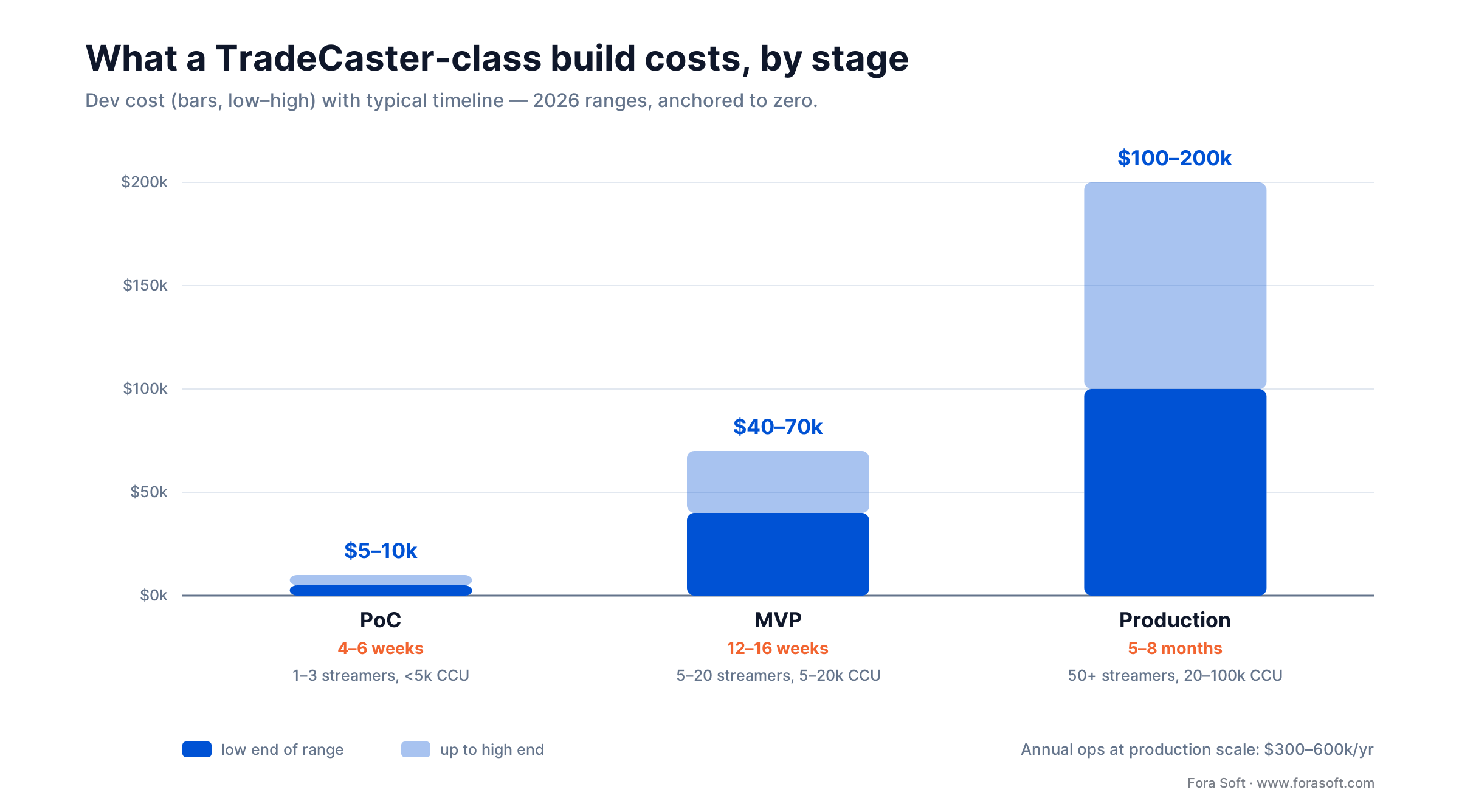
Figure 4. Budget and timeline by stage, from a 4-6 week proof of concept to a multi-region production launch. Bars are typical 2026 ranges.
At 50k CCU a self-hosted SFU runs roughly $25–50k/month all-in (infrastructure plus on-call) — comfortably under half the CPaaS list price for the same traffic, with the build-vs-buy crossover near 5–11k concurrent viewers (Figure 3). Break-even on $4.99 subscriptions typically arrives at 3–6-month retention. Our quotes come in below legacy SI vendors for the same scope because we use Agent Engineering to compress integration and DevOps cycles — not because we cut corners on validation or compliance.
KPIs to track from day one
Quality KPIs. P95 glass-to-glass latency < 800 ms; chat sync < 500 ms; viewer drop rate < 1.5% during the market-open spike; rebuffer ratio < 0.5% on the bitrate ladder.
Business KPIs. Subscriber LTV / CAC > 3; subscription retention > 3 months; share of viewers on 480p–720p in the 60–70% range (sign of healthy ABR tuning); VOD revenue 10–15% of live revenue.
Reliability KPIs. Stream uptime > 99.9% per active room; SFU pod failover < 2 s; chat-message persistence > 99.99%; full audit-log replay possible for any stream within the retention window.
Five pitfalls that wreck a trader-streaming launch
1. Picking HLS first because it’s simpler. The 4-second lag breaks the product for the use case. Start with WebRTC; add HLS only as a mobile/bandwidth fallback.
2. Treating screen-share like a video stream. Default WebRTC settings make charts blurry. Re-tune codec parameters for text and high-frequency UI updates, otherwise viewers can’t read the price ladder.
3. Ignoring the market-open spike. If your auto-scaler reacts in minutes, your first 30 seconds at 9:30 AM ET are dead. Pre-warm pods 10 minutes before open; size headroom for 5× baseline.
4. Skipping FINRA review until users sign up. Rule 2210 starts to bite at 25 retail viewers. Bake disclaimers, audit retention, and sponsored-alert tagging into the database schema, not a v2 feature.
5. Pricing CPaaS at MVP scale and assuming it’ll hold. Agora and Twilio look cheap at 500 CCU and brutal at 50k CCU. Model the full curve before committing.
Similar real-time platforms we’ve shipped
TradeCaster is one of several real-time platforms in our portfolio. BrainCert is a learning platform with virtual classrooms running thousands of concurrent rooms; ProVideoMeeting brings document signing into business video calls; Franchise Record Pool streams DJ/music content to subscribers; V.A.L.T. records and analyzes nine simultaneous IP-camera feeds in police and medical settings. Each one re-uses the same SFU/recording/auth foundations TradeCaster runs on. More projects in the portfolio →
When you should NOT build a custom streaming platform
If you’re testing a single-streamer audience with under 1,000 viewers, an existing platform (Twitch, YouTube Live, Kick) plus a Discord room and a Stripe page will be cheaper and faster. The math turns in favour of custom only when you need (a) sub-second latency that the existing platforms don’t deliver, (b) an integrated subscription/donation flow that doesn’t pay 30–50% to a marketplace, or (c) a compliance/audit footprint that off-the-shelf streaming doesn’t support.
FAQ
How do I build a trader-streaming platform like TradeCaster?
Pick a SFU stack (mediasoup if you have engineering depth, LiveKit for fastest launch). Ingest via RTMPS, cascade SFU pods for scale, transcode for an HLS bitrate ladder fallback, monetize via Stripe Connect. Run a securities-counsel review before launch and bake FINRA Rule 2210 disclaimers, audit logs, and multi-year retention (3 years for communications, 6 for financial records) into the schema from day one.
What does it cost to build something like TradeCaster?
PoC $5–10k (4–6 weeks). MVP $40–70k + ~$10k/mo ops (12–16 weeks). Production at 20–100k CCU $100–200k + $25–50k/mo ops (5–8 months). Annual ops at production scale typically lands $300–600k.
How do I scale to 50,000 concurrent viewers?
Run 150–170 mediasoup SFU pods (each handles ~300–400 viewers), auto-scale via Kubernetes, cascade across regions. Use Pusher or a self-hosted realtime cluster for chat (10–50 msg/sec at 46k CCU) and a CDN-served HLS bitrate ladder as a fallback for low-bandwidth or mobile viewers.
What latency can I realistically hit?
A well-tuned WebRTC SFU lands at 100–300 ms; LiveKit comes in around 150–300 ms; Agora 200–400 ms; Twilio 300–500 ms; LL-HLS/DASH 2–5 s. Glass-to-glass under 1 s is achievable on WebRTC end-to-end with codec tuning and regional cascades.
Agora, Twilio, LiveKit, or a custom SFU — which should you pick?
For pilots and small audiences, LiveKit Cloud is the fastest path. For production past 5k CCU per stream, custom mediasoup/Janus typically saves 40–70% versus Agora or Twilio at the same latency band. Pick by traffic curve, not by vendor brand.
How do streamers get paid?
Stripe Connect for one-tap tipping (2.9% + $0.30), recurring subscriptions ($4.99 / $9.99 / $19.99 tiers), and per-stream VOD passes ($2.99 single, $19.99 all-access). Typical platform take is 30–50%; the streamer keeps 50–70% net of payment fees.
What about FINRA, SEC, and GDPR compliance?
For FINRA-member streamers, Rule 2210 requires disclaimers once a stream reaches more than 25 retail investors in 30 days. SEC stock-promotion rules require sponsored alerts to be tagged as paid. GDPR/CCPA require consent, processor disclosure, and a data-deletion endpoint. We bake all of those into the schema from sprint one and budget 10–20% of project cost for documentation and audit.
Can the same architecture work for non-trader livestreaming?
Yes. The same WebRTC + cascade-SFU + Stripe Connect + chat stack powers our work for online learning, business conferencing, and creator-monetization platforms. The compliance layer is the only thing that swaps out per vertical.
What to Read Next
Stack
Agora.io Alternative in 2026
Custom WebRTC with LiveKit, mediasoup, Jitsi & Janus — when the math beats CPaaS.
Stack
Twilio Video Alternatives
A complete guide to custom solutions and when to switch.
LiveKit
2026 LiveKit Multimodal Agents Guide
Voice, vision & production patterns for real-time agentic streams.
Mobile
10 Ways to Optimize Android Apps for Smooth Video Streaming
Bitrate ladder, codec tuning, and battery-friendly defaults.
Real-time
3 Best Real-Time Meeting Translation Platforms in 2026
An honest comparison for the live-translation use case adjacent to ours.
Ready to ship a low-latency streaming platform that actually scales?
TradeCaster works because every layer was designed for sub-second latency, the market-open spike, and a full audit trail — not bolted on after launch. The same architecture powers our work in online learning, business conferencing, surveillance, and creator monetization.
If you’re scoping a trader, sports, edutainment, or creator livestreaming platform — or you’re bleeding money on Agora or Twilio at production scale — bring us your traffic curve and your KPIs. We’ll come back with an architecture, an honest estimate, and a number you can defend.
Let’s scope your streaming platform
Bring requirements, scale targets, and rough numbers. We’ll bring 21 years of real-time video and AI delivery and a quote we can defend.

