

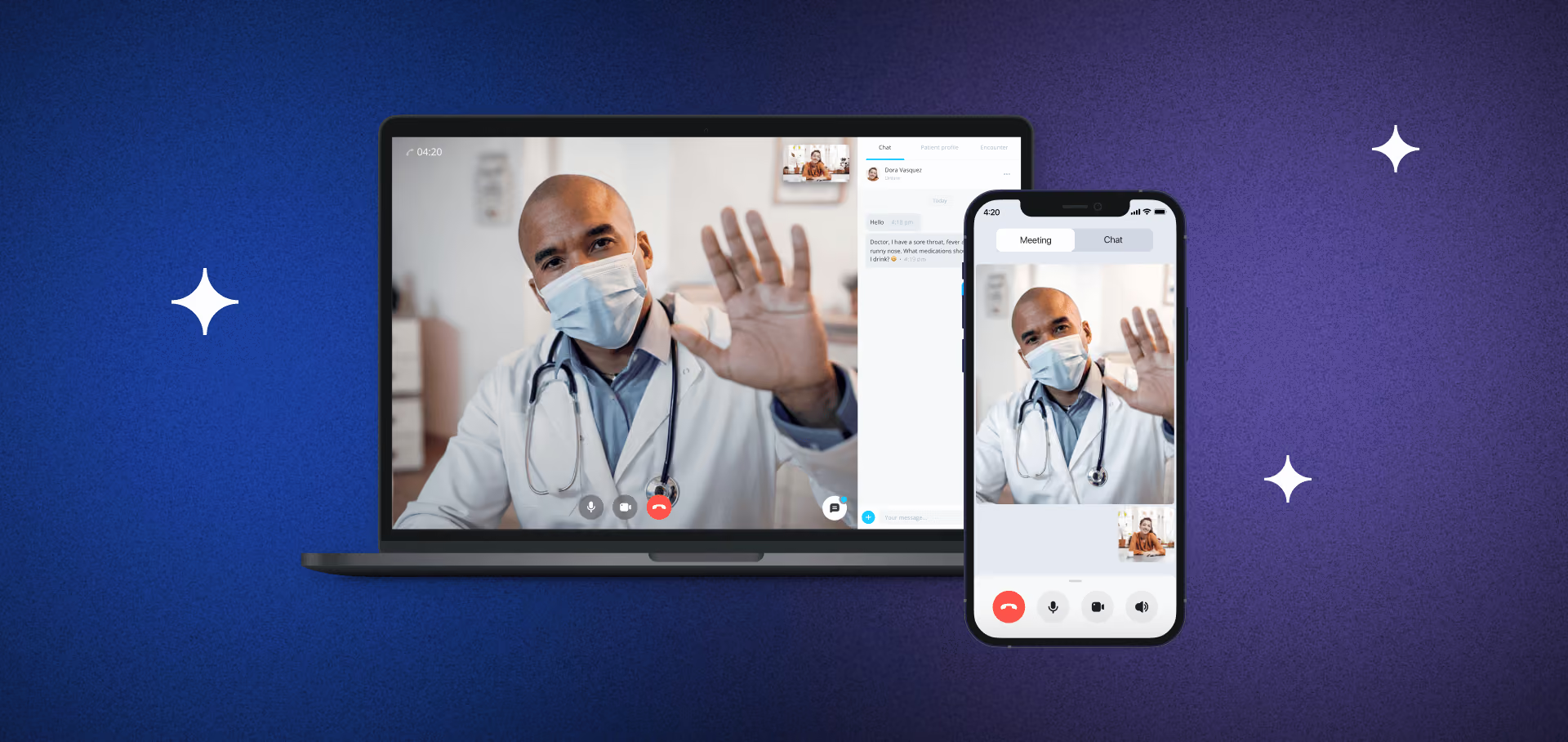
Telemedicine software development is no longer about gluing a video SDK to a patient form. In 2026 it is a full SDLC discipline with HIPAA-grade engineering: licensure-aware schedulers, FHIR R4 EHR integration, ambient AI scribing, six-year audit logs, EPCS-certified e-prescribing, and the SOC 2 Type II evidence trail to sell into US health systems. Skip any of those engineering layers and the platform looks like a 2020 demo.
Need this built? Talk to a telemedicine software development company.
This is the engineering playbook we run when we kick off a telemedicine software development project. It separates the development process (discovery → foundations → visit room → clinical workflow → AI → billing → pre-launch) from the engineering decisions inside each phase, names the tech-stack picks per layer, and shows the testing, CI/CD and observability patterns that keep a healthcare product running at 99.95% uptime.
Key takeaways
• Telemedicine software development is an SDLC discipline. Eight engineering layers (identity, video, async, EMR, workflow, AI, compliance, hosting) need to be sequenced; skipping order doubles rework cost.
• The 2026 default stack is opinionated. Next.js 15 + Postgres + NestJS or FastAPI + LiveKit/Daily + FHIR adapter via Redox or 1upHealth + Deepgram + GPT-4o or Claude under BAA + AWS HIPAA.
• Tests and observability come before AI. Per-visit telemetry (latency, MOS, ASR WER, LLM token use, hallucination flags) must exist before you ship an ambient scribe.
• Effective remote healthcare requires browser-first UX. Patients abandon native apps; clinicians abandon clunky desktop installers. Build for a 5-year-old Android on flickering WiFi.
• An MVP ships in 12–16 weeks at $40K–$90K with agent-engineering accelerated delivery. The schedule has 7 phases — we share the exact one we run below.
Why Fora Soft wrote this telemedicine software development playbook
Fora Soft has been shipping real-time video and audio products since 2005 — 250+ projects and a 50-engineer in-house team over 20+ years — and a meaningful share of our 2024–2026 docket is healthcare. The engineering choices below are the ones we actually defend on architecture review calls — not features harvested from competitor marketing pages.
The most directly relevant case is CirrusMED — a HIPAA-compliant DPC subscription platform we built for a US private practice with WebRTC video, 24/7 secure messaging, a structured EMR, lab orders and e-prescribing, all in-browser. Video Interpretations is our HIPAA-compliant 3-way medical interpreter platform with 700+ on-demand human translators.
For surrounding context, see our telemedicine service page, the telehealth software guide, and our deep-dive on telemedicine platform development cost.
Want a senior architect to review your telemedicine software development plan?
30 minutes, free, no obligation — we’ll review your tech stack, integration plan and HIPAA controls, and tell you what we’d change before week one.
The eight engineering layers of a 2026 telemedicine platform
A telemedicine software development project that ships on time has eight clearly bounded engineering layers, each with its own tech-stack pick, its own QA strategy, and its own “done” criteria.
1. Identity & access. Auth, RBAC, MFA, optional SSO. Auth0, AWS Cognito, Clerk — HIPAA-eligible only with a signed BAA.
2. Real-time video / audio. WebRTC over an SFU. LiveKit, Daily, Agora, Amazon Chime SDK, Zoom Video SDK. Twilio Video reversed its 2024 shutdown and is supported again, but the roadmap flip-flop makes it a cautious pick for a new build.
3. Asynchronous communication. Sendbird, Stream Chat, or a custom Postgres + WebSocket layer. Twilio for SMS / WhatsApp; Postmark / SendGrid for email.
4. EMR / EHR layer. Built-in lightweight EMR, or SMART-on-FHIR launch into Epic, Oracle Health (Cerner), Athenahealth, eClinicalWorks. Aggregator (Redox, 1upHealth) is the lowest-friction path under 20 sites.
5. Clinical workflow. Scheduling, queueing, intake, e-consent, e-prescribing (DrFirst Rcopia, Surescripts), lab/imaging orders, billing. CPT-aware coding (99421–99423 online digital E/M; audio-only via the 2025 telemedicine E/M family 98000–98016 that replaced the deleted 99441–99443).
6. AI augmentation. Ambient scribing, real-time transcription, translation, noise suppression, agent-assist CDS during the call.
7. Compliance & observability. Immutable audit logs, KMS, DLP, access reviews, breach drills, SOC 2 + HIPAA evidence collection. Datadog/New Relic/Honeycomb under BAA.
8. Hosting. AWS, Azure or GCP under BAA. ClearDATA, Aptible for white-glove HIPAA. Hetzner for self-hosted media servers behind a HIPAA orchestration layer.
Reach for a managed video SDK first when: your team has fewer than two senior media engineers or your launch deadline is shorter than your time-to-debug-an-SFU-cluster. That covers ~95% of telemedicine builds.
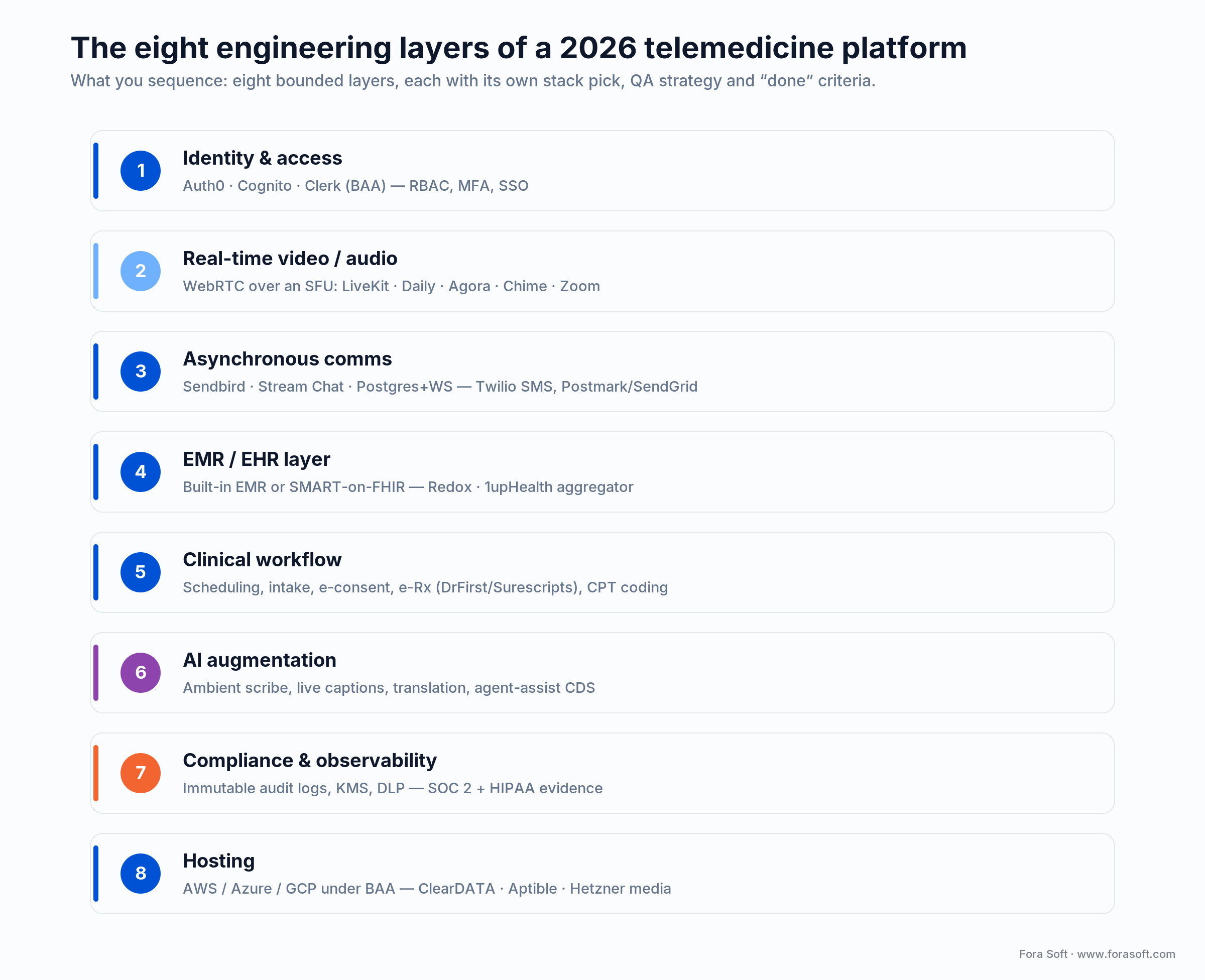
Figure 1. The eight engineering layers to sequence in a 2026 telemedicine build — each with its own stack pick and “done” criteria.
The 7-phase telemedicine SDLC we run on every build
Every successful telemedicine software development project we have shipped follows the same shape. Compressing the order saves nothing — rework eats whatever you save by skipping discovery or foundations.
| Phase | Weeks | Outputs | Engineering KPI |
|---|---|---|---|
| 1. Discovery | 1–2 | Wireframes, patient-flow maps, threat model, FHIR mapping, BAA register | Stakeholder sign-off < 5 days |
| 2. Foundations | 3–4 | Auth, RBAC, multi-tenant skeleton, audit-log spine, CI/CD with HIPAA controls | Pipeline green; auth + audit unit tests >90% |
| 3. Visit room | 5–7 | LiveKit/Daily integration, scheduling, intake, in-call chat | Glass-to-glass < 300ms p95; MOS > 4.0 |
| 4. Clinical workflow | 8–10 | EMR or FHIR adapter, e-Rx, lab orders, secure messaging | FHIR contract tests pass; DrFirst sandbox green |
| 5. AI augmentation | 11–12 | Ambient scribe, real-time captions, agent-assist with strict JSON schema | ASR WER < 8% medical; clinician edits < 15% |
| 6. Billing & ops | 13–14 | Subscriptions or X12 837P generator, ERA ingestion, dashboards | Clean-claim rate >= 98% in sandbox |
| 7. Pre-launch | 15–16 | Pen-test, breach drill, accessibility audit (WCAG 2.2), pilot launch | Zero high-severity findings; pilot live |
The 2026 default tech stack we deploy
Opinionated stacks ship faster than pluralistic ones. Below is the stack we deploy when there are no exotic constraints; substitute layers only when buyer or compliance constraints demand it.
Web frontend. Next.js 15 + TypeScript + Tailwind. App Router, RSC for clinician dashboards, ISR for marketing pages, React Query for data fetching, Zustand for ephemeral state.
Mobile. Browser-first by default. React Native if your roadmap needs background notifications and peripheral integrations (BP cuffs, glucometers). Native iOS (Swift) + Android (Kotlin) only when ARKit, advanced Bluetooth, or background recording matter.
Backend. Node.js + NestJS for typed REST/GraphQL or Python + FastAPI for ML-heavy services. Strict typing, async-first, contract testing with Pact.
Database. PostgreSQL (RDS Multi-AZ, Cloud SQL, Azure Database). Row-level security for multi-tenant; pgcrypto for high-sensitivity field encryption. Read-replicas for analytics; one schema per tenant for enterprise.
Real-time video. LiveKit Cloud or Daily for managed; LiveKit self-hosted on Hetzner once concurrency justifies it (above ~100K monthly visit-minutes).
AI scribe pipeline. Deepgram Nova-3 Medical → GPT-4o (Azure OpenAI BAA) or Claude 3.7 Sonnet (Bedrock BAA) → FHIR DocumentReference. License Abridge or Suki when buy beats build.
EHR integration. Redox or 1upHealth aggregator under 20 sites; direct Epic App Orchard / Oracle Code listing above 20 sites of the same EHR.
Messaging. Sendbird or Stream Chat (with BAA) for clinical chat; Twilio Conversations for SMS / WhatsApp / WebRTC voice; Postmark or SendGrid for transactional email.
Hosting. AWS (us-east-1, BAA) with a separate VPC for PHI workloads. Terraform-managed; secrets in AWS Secrets Manager or HashiCorp Vault; KMS-managed keys.
Engineering practices that turn HIPAA from a checklist into shipped code
HIPAA controls live in code, not in slides. The patterns below are what audit reports actually want to see.
1. Audit-log spine in week one. Every PHI read/write, login, failed login, export and admin action goes through a single append-only writer that lands in S3 Object Lock or Azure Immutable Blob. Don’t bolt this on at week ten.
2. Field-level encryption for “extra-special” PHI. Behavioral notes, genetic results, immigration status — pgcrypto envelope encryption with KMS key-rotation. Reduces blast radius of an OAuth misconfiguration.
3. Tenant isolation by default. tenant_id on every PHI table; row-level security policy enforced at the database role; cross-tenant queries explicitly forbidden in the API layer. Audit reports look here first.
4. Break-glass workflow. A documented “emergency access” flow that bypasses RBAC, captures justification text, and pages security on activation. Never “just” an admin login.
5. Dependency hygiene. Renovate or Dependabot on a 7-day SLA, with a CVE policy and a documented response runbook. Auditors love this; engineers will thank you twice a year.
6. Pre-commit secret scanning + IaC scanning. Trufflehog, gitleaks, tfsec, Checkov. PHI never lives in git, hard-coded secrets never live in git.
Testing strategy — from unit to clinical user-acceptance
Telemedicine software development demands a deeper test pyramid than typical SaaS because failures hit patient-care moments. We layer it like this:
1. Unit tests > 80% on auth, audit, RBAC, FHIR mappers, billing logic. Vitest or Jest in TypeScript; pytest in Python. Coverage gates blocking merge.
2. Contract tests on EHR adapters. Pact (consumer-driven) ensures Redox / 1upHealth / Epic / Athena always speak the FHIR shapes you expect. Run on every push; break the build on schema drift.
3. WebRTC smoke tests. Playwright + Headless Chrome with --use-fake-ui-for-media-stream. Validate join/disconnect/reconnect cycles, simulcast layer switches, and audio-only fallback. Run per PR + nightly.
4. Synthetic clinical flows. Cypress or Playwright walking the full patient + clinician path: book → intake → visit → SOAP → e-Rx → bill. Run nightly against staging.
5. Accessibility tests (WCAG 2.2). axe-core in CI for static checks; manual NVDA / JAWS / VoiceOver passes per release. Lawyers will ask.
6. Load tests on the visit room. k6 or Artillery driving SFU joins to find the concurrency cliff. Test before, not after, marketing announces a campaign.
7. Clinical UAT. Two clinicians and four patient personas walking real clinical paths in staging. Always uncovers something automated tests miss.
Observability that protects clinical experience and AI quality
Real-time video and AI features make telemedicine software development uniquely hard to debug post-launch. The observability stack must instrument every visit, end-to-end.
1. Per-visit traces. One trace per visit, with spans for ICE, simulcast switches, recording start/stop, ASR latency, LLM token counts, EHR write success. Datadog APM or OpenTelemetry to a HIPAA-tier backend.
2. WebRTC stats sampling. Stream getStats() data into your observability pipeline so latency, jitter, packet loss and MOS are queryable per clinician panel. Lights up “why does Dr. Smith’s patients disconnect?” questions.
3. AI quality dashboards. Per-visit ASR WER, LLM token use, hallucination flags (regex on SOAP draft against allergy / medication chart), clinician edit ratio. If clinician edits cross 20%, hold the next AI deployment.
4. PHI-safe logs. Logs go through a redaction layer (Pino + custom serialiser) that strips PHI by field name. Logs that escape into Sentry or Datadog must never carry PHI.
5. SLO & error budget. 99.95% availability SLO on the visit room; spend the budget intentionally (deploys, AI rollouts) rather than discovering it in incidents.
Need a senior pair on your telemedicine SDLC?
Send us your architecture diagram — we’ll come back with a technical review, pointed feedback on the risky layers, and a 12–16-week milestone plan, free.
EHR integration engineering — FHIR R4 in production
1. SMART on FHIR launch. Implement the EHR’s OAuth2 / OIDC flow once, behind an internal abstraction. Epic, Oracle Health and Athenahealth differ in scopes, redirect URI rules, and refresh-token lifetime — isolate that in adapters.
2. Resource mapping. Map your domain model to Patient, Encounter, Observation, Condition, MedicationRequest, AllergyIntolerance, DocumentReference (the visit note), ServiceRequest (lab/imaging), Appointment, Coverage. Validate against USCDI v3/v4 (US Core) from day one.
3. Bulk Data Access. For analytics, reach for the FHIR Bulk Data Access spec ($export). Pull patient cohorts asynchronously instead of N+1 GET storms.
4. Idempotency keys on writes. EHR writes can re-fire under network retries; idempotency keys per logical operation prevent duplicate Encounters and DocumentReferences.
5. Aggregator vs direct. Redox, 1upHealth, Health Gorilla, Particle Health give you one API for many EHRs — lower per-site engineering cost. Direct App Orchard / Oracle Code listing pays back above ~20 sites of the same EHR.
Reach for an aggregator when: you have under 20 sites or you span Epic + Oracle + Athena + eCW. Direct EHR listings make sense only after volume + buyer concentration justifies the per-EHR engineering and program fees.
Video SDK comparison for telemedicine software development
Five managed SDKs cover ~95% of new telemedicine builds. Twilio Video reversed its planned 2024 shutdown and is supported again, but that roadmap flip-flop is risk we’d rather not inherit on a new build. Below is the side-by-side we use in scoping calls.
| SDK | Architecture | HIPAA / BAA | Pricing shape | Best for |
|---|---|---|---|---|
| LiveKit | OSS SFU; Cloud or self-host | BAA on Cloud | $0.005/min Cloud; free self-host | AI-augmented visits, own-the-stack teams |
| Daily | Managed SFU, 75+ PoPs | BAA available | Per-minute, simple tiers | Fastest time-to-launch |
| Agora | Global SD-RTN routed mesh | BAA + HIPAA package | Per-minute, volume discounts | Cross-border telemedicine |
| Amazon Chime SDK | AWS-native SFU + media pipelines | Under AWS BAA | Per-attendee-minute | AWS-native health systems |
| Zoom Video SDK | Zoom-managed SFU | BAA on Healthcare plan | Per-session-minute | White-label apps wanting Zoom-grade reliability |
Reach for LiveKit when: AI agents are central to your roadmap and you want the option to flip from managed Cloud to self-host without rewriting integration code.
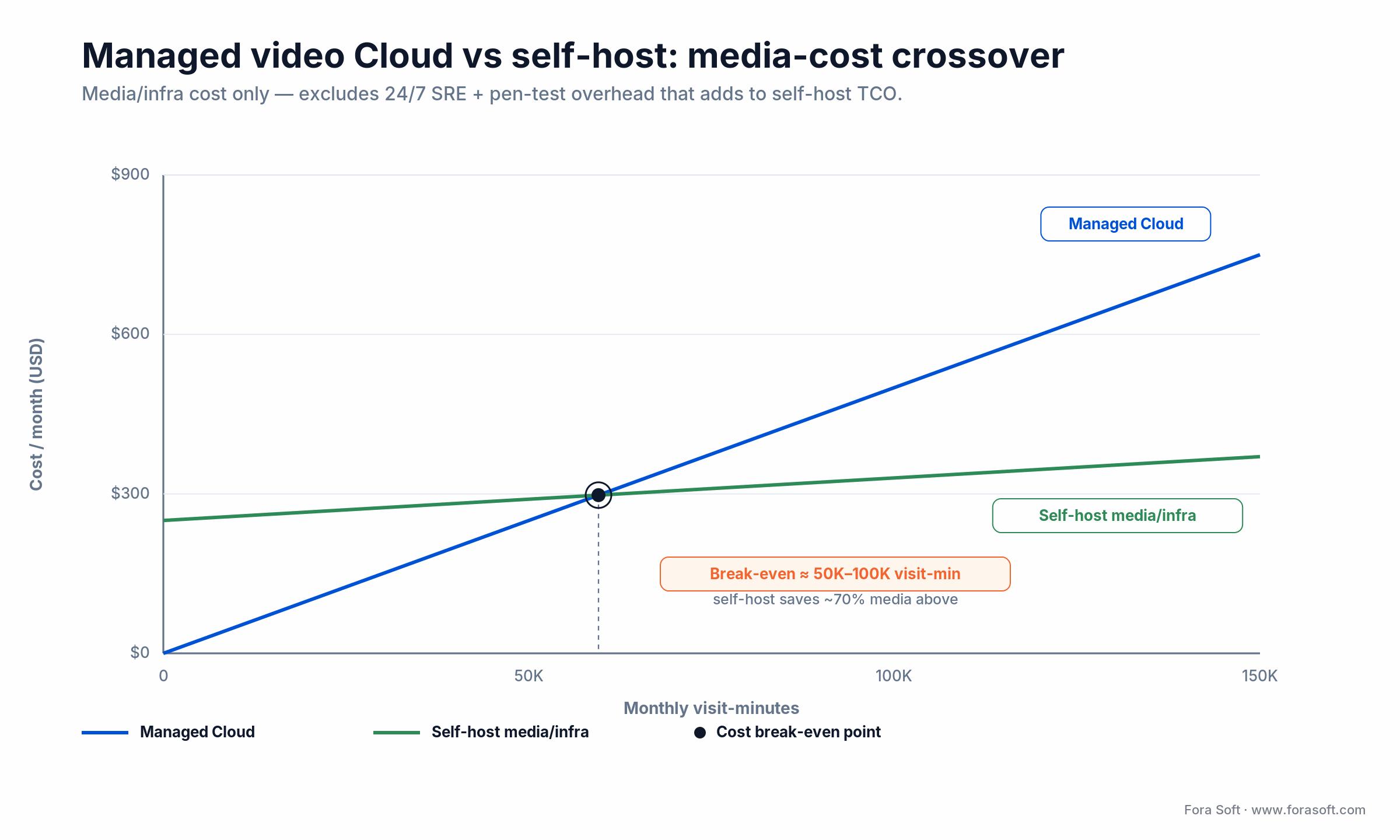
Figure 2. Media/infra cost only: managed Cloud and self-host cross near 50K–100K monthly visit-minutes (24/7 SRE and pen-test overhead not shown).
A decision framework — build, buy or hybrid in five questions
Most failed telemedicine builds we triage answered “build” on a question that should have been “buy.” Run through these — if you say “yes” to three or more, build.
Q1. Is the clinical workflow your differentiator? Off-the-shelf platforms won’t bend to a proprietary cardio-rehab pathway, an SMI-specific protocol, or a DPC subscription model. Build.
Q2. Are you the payer or the provider? Payers (insurers, employers) need analytics and authorisation hooks no provider-facing platform offers. Build.
Q3. Will you serve more than one health system? Multi-tenant white-label is hard to retrofit. If ≥4 health-system buyers in the roadmap, build with multi-tenant from day one.
Q4. Do you need deep EHR integration on day 1? If “launches inside Epic via SMART on FHIR” is a sales requirement, build. Hosted platforms surface only the integrations they choose.
Q5. Is AI part of the value prop? If yes, you need control of the call data flow, the LLM choice, and the prompt-engineering loop. Build at least the SFU + AI layer.
Reach for hybrid (license + thin custom layer) when: only one of Q1–Q5 is “yes” — license a hosted platform and build only the differentiating workflow on top.
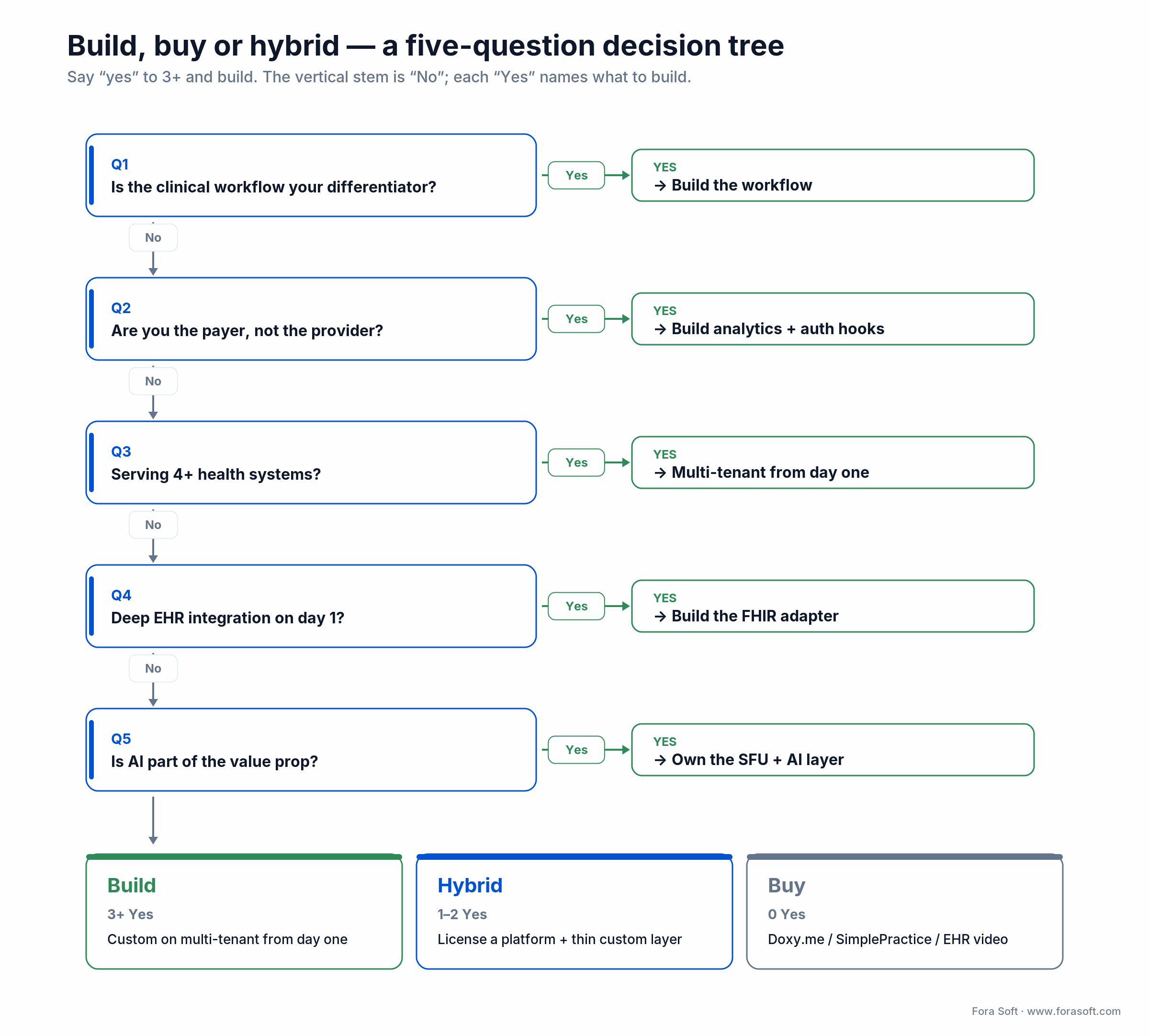
Figure 3. Build, buy or hybrid — say “yes” to three or more and build; each “yes” names the layer worth owning.
AI engineering — ambient scribing without hallucinations in production
Ambient scribing is the only AI feature with proven 2025–2026 ROI in telemedicine; clinicians save 1–2 hours of charting per day. Engineering it well is what separates a renewal-positive feature from one that drifts.
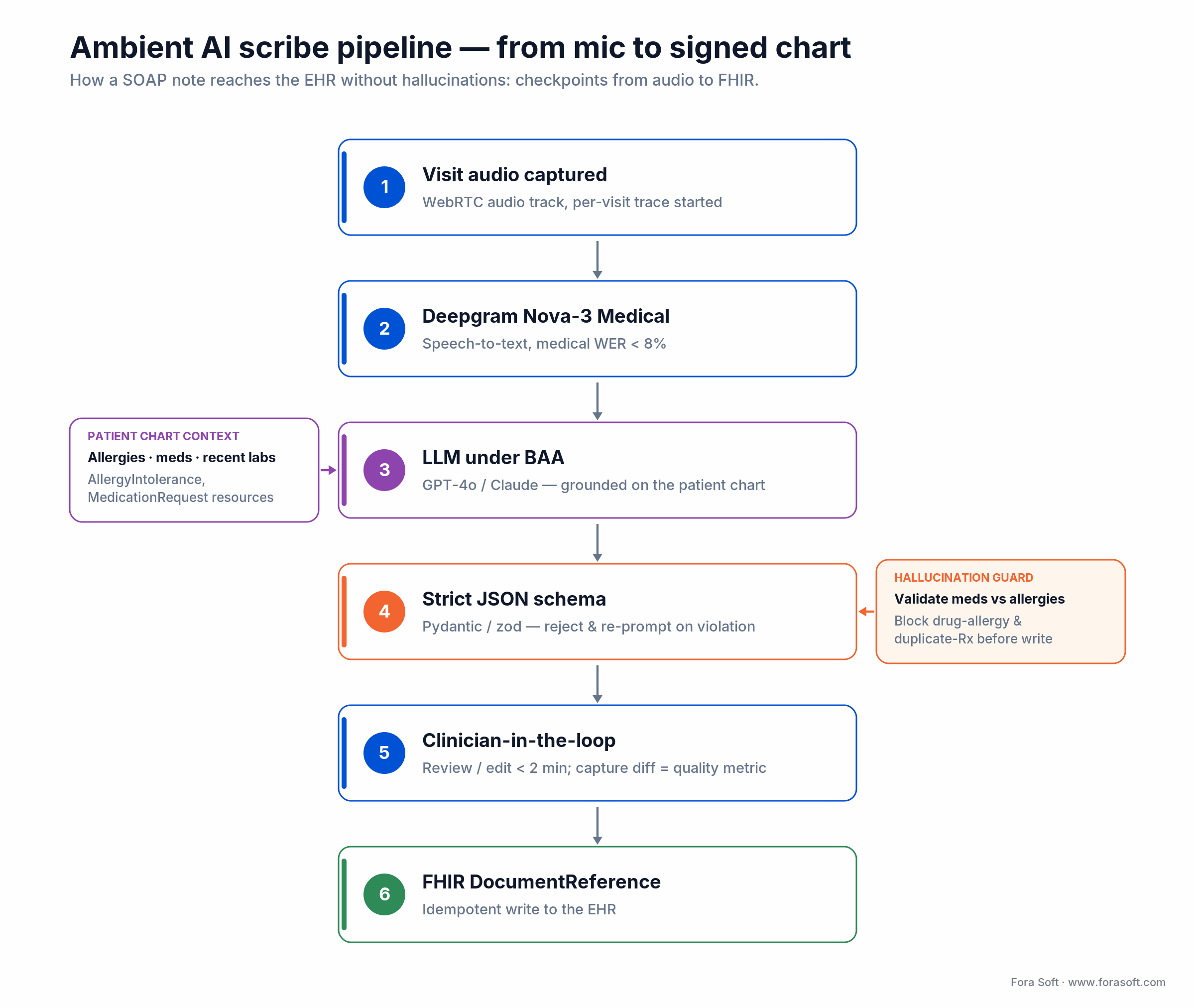
Figure 4. The ambient AI scribe pipeline, with chart-grounding and a strict-schema hallucination guard before anything reaches the EHR.
1. Strict JSON-schema output from the LLM. Constrain SOAP-note generation with Pydantic / zod schemas. Re-prompt on schema violations; never write a free-form LLM blob to the EHR.
2. Grounding against the patient chart. Pre-pend allergies, current medications and recent labs to the LLM context. Validate generated medications against the AllergyIntolerance and MedicationRequest resources to catch drug-allergy or duplicate-prescription hallucinations.
3. Clinician-in-the-loop UI. No SOAP note auto-signs; the clinician reviews and edits in < 2 minutes. Capture the diff — the edit ratio is your truest quality metric.
4. STT + LLM tier choice. Deepgram Nova-3 Medical or AssemblyAI Universal-2 for STT; GPT-4o (Azure OpenAI BAA) or Claude 3.7 Sonnet (Bedrock BAA) for SOAP generation. Both vendors offer BAA — verify before the first PHI byte.
5. Fallback path. Detect ASR failures (low confidence, >3s gap) and offer the clinician a “dictate manually” path. Never silently degrade.
6. License vs build. Abridge, Suki, Augmedix, DeepScribe, Microsoft Dragon Copilot all sell production-grade scribes. License under ~30K monthly visits; build above. We’ve done both. See LiveKit AI agent development for our build pattern.
Effective remote-healthcare UX patterns — designing for the median patient
A telemedicine product’s UX has to survive a 5-year-old Android in airplane mode with the WiFi flickering. The patterns below are floor expectations.
1. SMS-link join. One tap from the SMS reminder lands the patient in the visit room. No app store. No password reset. No “please update your browser” modal.
2. Test-your-setup screen. Camera, mic, speaker check before the clinician joins. Saves the first 90 seconds of every visit and dramatically improves MOS in clinical UAT.
3. Audio-only fallback. Auto-detect bandwidth crossing 200 kbps and offer audio-only with a one-tap upgrade once conditions improve. CMS permanently allows audio-only for behavioral-health visits, and Congress extended broader Medicare audio-only telehealth through 2027.
4. Family proxy access. Adult children managing parent visits and parents managing kid visits is the realities of who books care. Build delegation with a documented audit trail.
5. Multilingual UI. Spanish + English at minimum in the US. Each additional language opens up a meaningful patient population that off-the-shelf platforms ignore. Video Interpretations takes this further with on-demand human interpreters.
6. WCAG 2.2. Closed captions, screen reader friendly forms, ≥48px tap targets, font-scaling, sufficient contrast.
Mini case — CirrusMED’s engineering shape in production
Situation. Preferred Family Medicine, a US private practice, wanted to move 100% of patient interactions online with a HIPAA-compliant DPC subscription model: monthly / quarterly / annual plans starting at $39/mo with unlimited video visits, 24/7 secure messaging, lab orders, prescriptions and a lightweight EMR — all in-browser, no app download.
Engineering shape. Browser-only Next.js frontend, NestJS backend, PostgreSQL with row-level security for multi-tenant safety, WebRTC over a managed SFU for HIPAA-compliant video, Sendbird-style threaded messaging with Twilio SMS reminders, structured EMR (vitals, allergies, family history, surgeries, social history, prescriptions, BMI auto-calc), DrFirst-style e-prescribing, lab/imaging order routing direct to testing centers, Stripe Billing for DPC subscriptions, AWS HIPAA hosting under BAA. Full case study at forasoft.com/projects/cirrusmed.
Outcome. All ~1,500 patients in the practice now video-chat with their physicians on the platform; the practice is expanding online-first to attract patients beyond its physical catchment area. Owner Christopher Highley credited the wireframing and user-story phase — one of the cheapest deliverables in the build — for cleaner cost estimation and stack decisions.
KPIs — what engineering must hold the line on
Quality KPIs. Visit completion rate ≥90%, MOS audio ≥4.0, glass-to-glass latency ≤300ms p95, ASR WER ≤8% on medical terms, clinician-edited AI scribe sentences ≤15%. Below these thresholds, clinicians blame the platform, not the network.
Business KPIs. No-show rate <5% (industry avg ~23%), time-to-first-visit, NPS ≥45, claims clean-rate ≥98%, net collection rate 95–99%, 90-day & 12-month patient retention. The numbers your CFO will quote on the earnings call.
Reliability KPIs. 99.95% uptime on the visit room, <1% disconnects per visit, MTTR <15 min for media outages, audit-log integrity 100%, <60-second cold-start for clinician dashboard.
Five engineering pitfalls we keep cleaning up
1. Bolt-on audit logs. Adding the audit-log spine in week ten is a refactor that costs 2–3× what it would have cost in week one. Build it first.
2. Loose tenant isolation. A single missing tenant_id check is a HIPAA breach. Enforce row-level security at the database role; don’t rely on application-layer guards alone.
3. WebRTC stats invisibility. Without getStats() into observability you cannot answer “why did Dr. Smith’s panel disconnect?” Engineers who skip this end up debugging by user complaint.
4. Free-form LLM output written to the EHR. Strict JSON schema is non-negotiable. We have seen drug names hallucinated past unit tests; only the schema layer catches them reliably.
5. Unsigned BAAs in production. The cheapest dev-tools (Mixpanel free, Sentry free, Datadog free) are the most expensive in production once OCR notices PHI in their dashboards. Maintain a vendor BAA register from week zero.
When NOT to invest in custom telemedicine software development
Single physician, <100 visits/month. Doxy.me, SimplePractice or your existing EHR’s built-in video module is fine.
Your edge is “like Doxy.me but our brand.” That’s a marketing problem, not a software problem.
Single existing health system that loves its EHR. Use Epic Telehealth or Oracle Health’s native video, integrate around the edges, ship in 6 weeks.
Runway under 12 months. Custom telemedicine has a long compliance tail; license-and-grow until you can fund a year of ops on top of build.
Want a senior engineer’s read on your telemedicine SDLC?
Tell us your stack and timeline — we’ll review your SDLC, observability and HIPAA controls in a 30-minute call. Honest answer, even if it’s not us.
Reimbursement and licensure plumbing — the engineering that makes telemedicine billable
CPT-aware coding. 99421–99423 (online digital E/M, established patient, 5–10 / 11–20 / 21+ minutes), the 2025 telemedicine E/M codes 98000–98016 that replaced the deleted 99441–99443 telephone codes (Medicare hasn’t adopted the new set, so verify payer-by-payer), and 99202–99215 with modifier 95 for synchronous video. Behavioral-health audio-only is permanently allowed by CMS; broader Medicare audio-only is extended through 2027 and DEA controlled-substance telehealth prescribing through 2026 — gate the code path on the flag, not the calendar.
Eligibility & benefits checks. X12 270/271 against the patient’s insurer at booking time. Catches invalid plans before the visit.
Claims generation. X12 837P with the right CPT, ICD-10, modifier 95, POS code (10 home, 02 facility). Submit through Change Healthcare, Availity or Waystar.
ERA (835) ingestion. Auto-reconcile payments, denials, patient responsibility — the difference between 95% and 99% net collection rate.
Multi-state licensure tracking. Track each clinician’s state-by-state license expiry, IMLC status and DEA registration. Surface status warnings 60 days before expiry.
EPCS for controlled substances. EPCS-certified e-prescribing on day 1 (DrFirst Rcopia or Surescripts). Capture in-person-visit history before allowing controlled-substance e-prescription — the Ryan Haight Act demands it for most schedules outside DEA flexibilities.
FAQ
What is the right team shape for a Tier 1 telemedicine software development project?
For a 12–16-week MVP: 1 senior product designer, 1 senior frontend, 2 backend (1 senior + 1 mid), 1 senior media engineer (50% allocation, full-time during weeks 5–7), 1 QA, 1 devops/security engineer (50%), 1 PM. With agent-engineering accelerated delivery, the same scope ships at the lower end of $40K–$90K.
Should we self-host LiveKit or use LiveKit Cloud?
LiveKit Cloud until concurrency justifies self-hosting. The break-even is usually 50K–100K monthly visit-minutes. Self-hosting on Hetzner cuts media bandwidth costs by ~70% above that threshold but adds 24/7 SRE rotation and pen-test scope.
How do we structure CI/CD for HIPAA-grade telemedicine?
GitHub Actions or GitLab CI with branch protection, mandatory code review, automated tests, secret scanning, IaC scanning, container vulnerability scanning, signed commits. Deploy to staging first; production deploys behind a manual approval with SOC 2 evidence collected automatically.
Which AI feature has the cleanest 2025–2026 ROI?
Ambient AI scribing. Clinicians save 1–2 hours of charting per day; KLAS rated Abridge top-of-category in 2025; the FDA granted landmark clearance for action-oriented ambient scribes that can queue prescriptions and lab orders in early 2026. Build or license, but ship it. Emotion detection and free-form LLM symptom checkers are still secondary.
How do we handle clinician peripheral devices (BP cuffs, glucometers)?
Patient side: Apple Health or Google Health Connect for smartphone-paired devices; cellular RPM hubs (BodyTrace, iHealth, Validic) for elderly cohorts. Clinician side: native iOS/Android only when Bluetooth peripheral access is core to the workflow — otherwise stick to browser-only.
Do we need SOC 2 Type II to sell to a US health system?
Practically yes. Health-system security questionnaires almost universally ask for SOC 2 Type II. Plan to start the readiness work during the build, attest at Type I around month 9, and Type II around month 15. HITRUST CSF is heavier and only required by some IDNs.
How do we approach load testing the visit room?
k6 or Artillery against the SFU using headless Chrome with fake media to drive realistic SDP exchanges. Sweep from current peak concurrency × 1.5 up to × 3 and find the cliff. Run quarterly and before any marketing campaign launch.
How does Fora Soft engineer telemedicine software?
Agent-engineering accelerated delivery on the 7-phase SDLC above, opinionated 2026 stack (Next.js + NestJS or FastAPI + Postgres + LiveKit/Daily + FHIR adapter + Deepgram + GPT-4o or Claude under BAA + AWS HIPAA), with the audit-log spine and observability built in week one. Fixed-band per phase or T&M with a hard cap.
What to read next
Architecture
Telehealth Software Guide: AI, HIPAA, Build Cost
The full 2026 stack for AI-powered video consultations.
Cost guide
Telemedicine Platform Development Cost
Tier-by-tier cost shape, run-rate and ROI math.
Video stack
P2P vs MCU vs SFU: Which to Pick
When peer-to-peer breaks, when SFU wins on real-time video.
AI agents
LiveKit AI Agent Development
How we wire ambient scribes and clinical agents into telemedicine visits.
Ready to ship telemedicine software development that survives a SOC 2 audit?
Telemedicine software development that wins clinician adoption in 2026 is unapologetic about the eight engineering layers, runs the 7-phase SDLC end-to-end, ships an opinionated 2026 stack (Next.js + Postgres + LiveKit/Daily + FHIR + Deepgram + GPT-4o under BAA + AWS HIPAA), wires audit logs and observability before AI features, and tests every clinical flow synthetically before pilot patients see it.
If your build is Tier 1, plan for 12–16 weeks and a $40K–$90K budget with an agent-engineering accelerated team. The cheapest dollar you spend is on the architecture review with someone who has shipped this shape of platform before.
Let’s pressure-test your telemedicine software development plan
Free 30 minutes — we’ll review your stack, SDLC, observability and HIPAA controls, and tell you what to change before you sign the SOW.

