


Key takeaways
• Budget by tier. A custom-built MVP on a video API runs $80K–$120K, a multi-platform private beta $150K–$400K, and an enterprise-grade build with compliance $500K–$1.5M+. White-label and offshore builds start lower ($3K–$50K) and trade away control.
• A video API almost always wins first. For most startups, Daily, 100ms, Agora, or LiveKit ship faster and cheaper than a custom WebRTC stack. Build custom only for extreme scale, deep codec control, or a privacy moat.
• Hidden costs decide the final bill. TURN relays, egress bandwidth, QA, compliance audits, and post-launch upkeep can add 25–40% on top of the headline engineering number if you don’t plan them in.
• Per-minute pricing moved in 2026. Daily and 100ms sit at $0.004/participant-minute, LiveKit Cloud at $0.0004, Agora HD at $3.99/1,000 min. Dyte folded into Cloudflare; Twilio Video reversed its shutdown and is still supported.
• Time-to-market beats perfection. Launch a single-platform MVP in 12–16 weeks, validate demand, then spend on compliance and mobile in beta. Shipping everything on day one is how $200K projects become $400K projects.
Why Fora Soft wrote this playbook
We’ve built video and real-time communication products since 2005 — 250+ projects across healthcare, education, and enterprise, with a 50-engineer in-house team. Conferencing is our home turf: we run iMind, our own video meeting product, and we built BrainCert, a virtual classroom that has delivered 500M+ classroom minutes to 100K+ customers, and CirrusMED, a HIPAA telehealth platform. Those projects taught us where the money actually goes, and it’s rarely the part founders expect.
Here’s the uncomfortable truth: video conferencing app development cost swings 10× for what looks like the same app. The swing isn’t random, though. It comes from six drivers — scope, platforms, real-time scale, compliance, team rates, and your tech stack. This guide unpacks each one with 2026 numbers, gives you a worked cost model you can actually check, and hands you a five-question framework to scope your own build.
Whether you’re weighing a video API (Daily, 100ms, Agora, LiveKit) against custom WebRTC or a hybrid of both, we’ll show the numbers that matter and the metrics that predict whether the build pays off. By the end you’ll have a realistic budget, a timeline, and a clear go/no-go signal.
Mapping the cost of your video conferencing build?
Book a 30-min scoping call with our video engineering team. We’ll compare a video API against custom WebRTC for your exact use case — free, no pitch deck.
Video conferencing app development cost at a glance
Here’s the headline. Video conferencing app development cost starts around $30K–$50K for an offshore or white-label MVP, sits at $80K–$120K for a custom, North-America-quality MVP on a video API, climbs to $150K–$400K for a multi-platform private beta, and reaches $500K–$1.5M+ for a full enterprise build with compliance, analytics, and global scale.
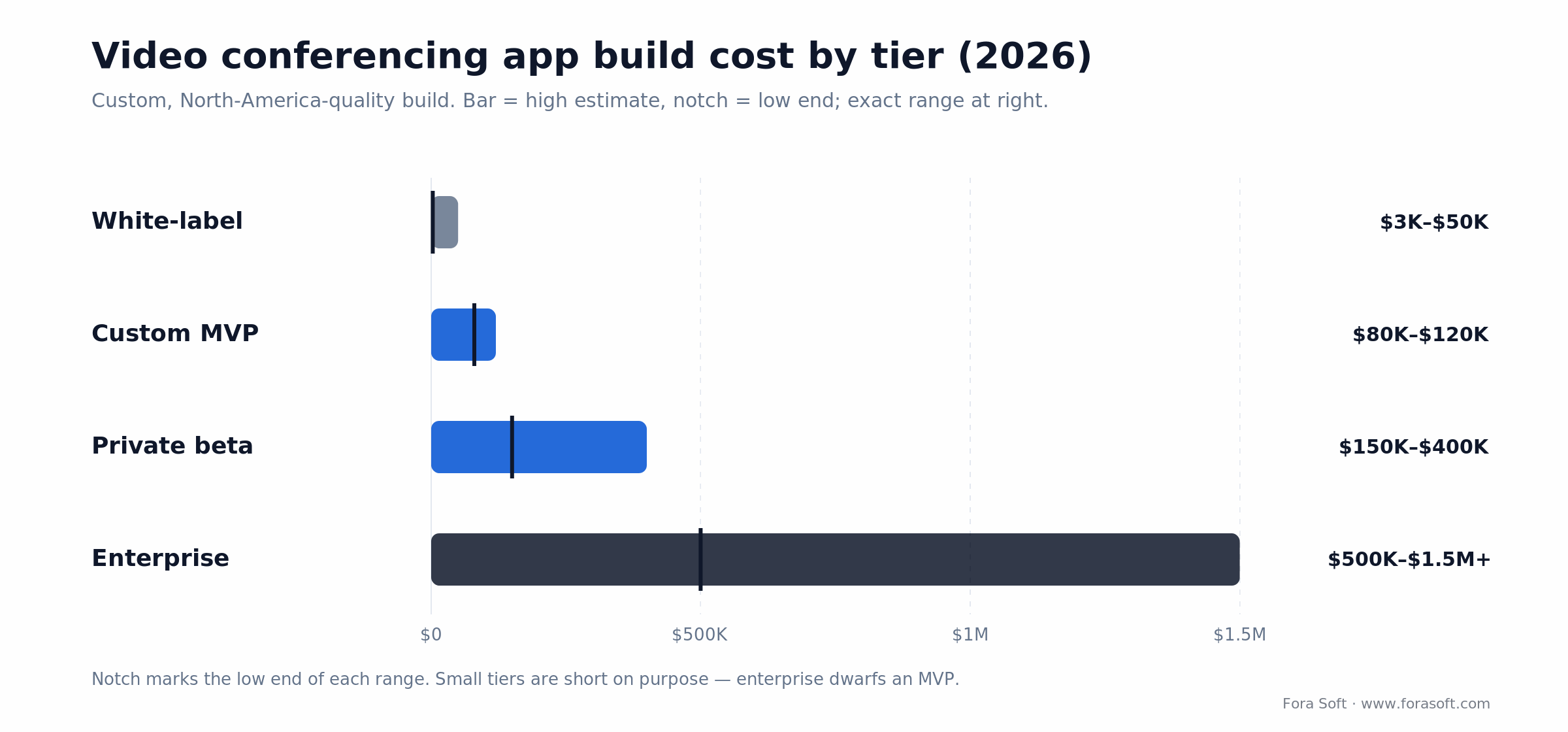
Figure 1. Build cost by tier — the bar shows the high estimate, the notch marks the low end of each range.
Those are averages, and the range is wide on purpose. Your real number depends on platform count, participant scale, compliance regimes, team geography, and whether you buy a video API or build custom WebRTC. We use AI-assisted engineering to keep our own estimates lean — senior architects reuse proven signaling and call-state patterns instead of rebuilding them per project, but we quote conservatively and won’t print a savings figure we can’t defend.
The one insight that saves the most money: don’t pay for features you don’t need yet. Most founders over-scope day one. A lean MVP (1-to-1 calls, small groups, screen share, no recording) costs roughly half a full-featured beta and reaches market weeks earlier. That’s also the answer to “how do I make a video chat app without burning the runway” — start narrow.
Why every quote you see is different
Video conferencing app development cost isn’t linear. Double the participant count and infrastructure cost more than doubles. Add one platform and engineering effort multiplies, not adds. These six drivers explain why one agency quotes $50K and another quotes $500K for “the same” app.
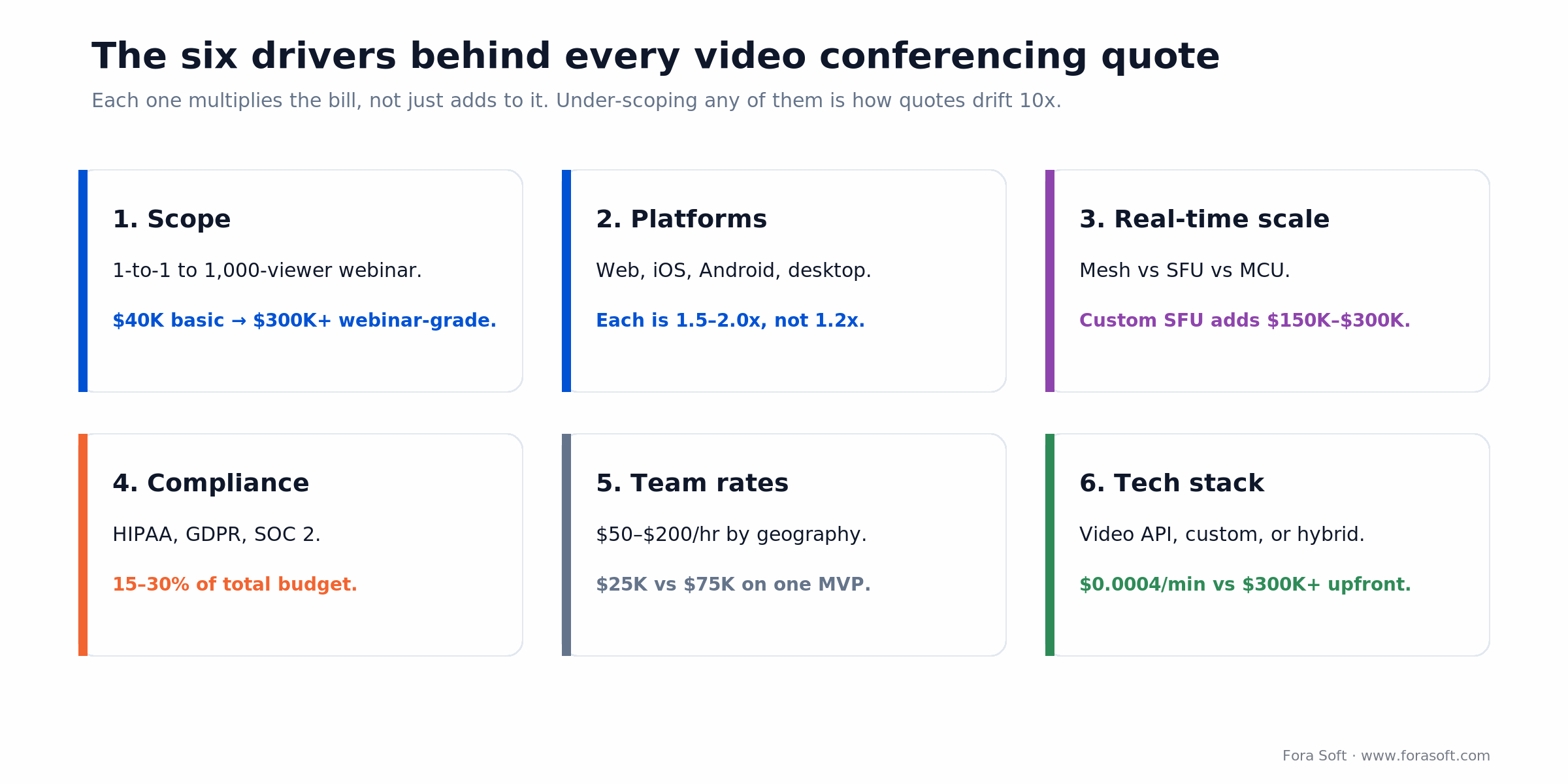
Figure 2. The six drivers that move a video conferencing quote — each multiplies the bill rather than adding to it.
1. Scope: from 1-to-1 to 1,000-person webinar
A basic call app (1-to-1, up to a 4-person group) is around $40K. Add recording and you’re near $80K. Add transcription, live captions, and speaker detection and you’re at $180K. Webinars (one-to-many with 100+ viewers) need a Selective Forwarding Unit (SFU) and adaptive bitrate, pushing past $300K. Each feature tier is a hard engineering gate, not a slider.
2. Platforms: web, iOS, Android, desktop
Web is cheapest (roughly $25K). iOS adds about $35K. Native WebRTC differs from the browser. Android adds another $40K. A desktop app (Electron) adds around $20K. Cost multiplies because each platform has its own codec support, hardware acceleration, and SDK quirks. Founders routinely underestimate mobile: it’s never 1.2× the web cost, it’s 1.5–2.0×.
3. Real-time scale: mesh, SFU, or MCU
A full peer-to-peer mesh looks free: everyone encodes and sends directly — but it’s practical only to about 4–6 participants before uplink and CPU blow up. An SFU (each client sends once, the server forwards) scales to 100+ but needs server infrastructure ($5K–$20K/month at scale). An MCU mixes everyone into one stream, which enables server-side recording but roughly doubles server cost. A video API handles the SFU for you; a custom SFU adds $150K–$300K and 12–16 weeks. Our deep-dive on P2P vs MCU vs SFU walks the trade-offs.
4. Compliance: healthcare, finance, GDPR
A generic app with no compliance is about $60K. HIPAA for healthcare adds roughly $40K (audit trails, encryption at rest, data residency, access controls). GDPR data residency (EU-only servers) adds about $30K. A SOC 2 Type II audit adds $50K or so. Compliance isn’t a feature — it’s a tax layered on the build, usually run in parallel. Teams under-plan it constantly; budget 15–30% of total.
5. Team rates by geography
A senior full-stack engineer costs $150–$200/hour in San Francisco, $100–$140 in Toronto or London, and $50–$80 in Eastern Europe. On a 500-hour MVP that’s a $25K vs $75K spread. Offshore saves cash but can cost time in timezone lag, communication overhead, and QA rework. The sweet spot is a dedicated team with real synchronous overlap, wherever it sits.
6. Tech stack: video API vs custom WebRTC vs hybrid
A video API (Daily, 100ms, Agora, LiveKit) charges $0.0004–$0.006 per participant-minute but ships in 4–8 weeks. Custom WebRTC has no per-minute fee but needs $300K–$600K upfront and 18–24 weeks. A hybrid (API for group calls, custom SFU for webinars) splits the difference. We work this out with real numbers in the build-vs-buy section below.
MVP: $80K–$120K and 12–16 weeks
What’s in scope
A lean MVP targets one platform (web or iOS) with core calling: 1-to-1 and small group calls (up to 4), basic screen sharing, text chat, and email auth. You use a video API for the media layer, which outsources NAT traversal, codec negotiation, and bandwidth adaptation. The backend is a signaling server (Node.js, Python, or Go) that manages call state, auth, and sessions.
The frontend is a responsive web app in React or Vue. If you go iOS-first, expect native Swift with the WebRTC library. Android waits for beta. You ship web first, gather feedback, then port. Infrastructure is a cloud database (PostgreSQL or DynamoDB), logging (CloudWatch or Datadog), and CI/CD. Total compute for an MVP is $500–$2K/month across dev, staging, and production.
What’s out of scope
Recording, transcription, live streaming, and end-to-end encryption are cut. No admin dashboard, no fancy analytics (log basic call metrics only), no custom branding beyond a default theme, no mobile apps, no compliance audits, no i18n beyond English. Testing is manual QA. Every one of those is a real cost you defer, not delete — and deferring is the point.
Where the money goes
Roughly: $55K–$80K engineering (2–3 people over 12–16 weeks), $8K–$15K design and UX, $6K–$12K core-flow QA, $3K–$8K infrastructure and API usage during build, and a 10–15% contingency you will use. Our edge is boring but real: we reuse signaling patterns, WebRTC state machines, and API scaffolding across projects, and senior engineers review AI-generated boilerplate instead of hand-writing it. That trims the repetitive backend work — we just won’t nail it to a percentage we can’t prove for your build. See our custom software development approach for how the team is structured.
Reach for an MVP when: you have $80K–$120K, one platform is enough to validate the market, and you can launch in 12–16 weeks without being blocked by compliance or mobile.
Private beta: $150K–$400K over 4–6 months
What’s in scope
A beta adds the second platform (iOS and Android, or web and desktop), scales calls to 16+ participants, and improves recording and screen sharing. You invest in UX based on MVP feedback. Meeting transcripts, basic speaker detection, and call analytics come online. Auth expands to SSO (Google, Microsoft, Okta). You add a basic admin dashboard for user management and billing.
Infrastructure now spans multiple regions (US East, US West, EU). You stand up a TURN pool (managed via Twilio or Cloudflare, or self-hosted coturn) to handle NAT traversal reliably. Load and network-simulation testing begins; you target 99.5% uptime. QA goes semi-automated with unit, integration, and browser tests.
Timeline is 4–6 months with 4–6 engineers (backend, frontend, iOS, Android, QA, DevOps). Costs break down to $120K–$250K salaries, $5K–$15K infrastructure and bandwidth, $3K–$8K API charges or TURN licensing, $2K–$5K third-party integrations, and $15K–$30K QA and security hardening.
Risks if you under-budget
Teams under-estimate mobile and QA. iOS and Android aren’t 1.2× web; they’re 1.5–2.0× because of different WebRTC SDKs, hardware quirks, and device fragmentation. Skip network-simulation testing and you ship a product that fails on Wi-Fi and 4G, forcing a $50K–$100K rework. Under-provision infrastructure and your platform melts when 500 users show up instead of 100, and you lose the credibility you just earned.
Reach for a beta when: your MVP shows product-market fit, you’re ready to invest in multi-platform and UX polish, and you have 4–6 months and $200K+ to spend.
Enterprise: $500K–$1.5M+ over 12–18 months
What’s in scope
Enterprise is a full platform: iOS, Android, web, desktop (Electron), and an embeddable SDK. Calls run 50+ participants, and webinar mode supports 1,000+ viewers. Recording is multi-format (MP4, WebM, HLS) with cloud storage. Live transcription runs in real time with speaker identification. Analytics dashboards show call quality (MOS, latency, packet loss), usage, and engagement.
Compliance is baked in: HIPAA for healthcare, GDPR for EU residency, SOC 2 Type II. End-to-end encryption is an option for premium tiers. Security covers token rotation, rate limiting, data-loss prevention on transcripts, and immutable audit logs. A full admin portal handles user management, licensing, billing, and usage.
Infrastructure spans 5+ regions with sub-100ms latency to most users. You run a custom SFU (or a tier-1 video API) with simulcast, optional E2E encryption, and quality optimization. The team is 8–15 engineers. Timeline is 12–18 months. Costs break down to $350K–$700K salaries, $50K–$150K infrastructure and bandwidth, $30K–$80K compliance and security audits, $40K–$100K DevOps and monitoring, $40K–$80K QA, $30K–$60K design, and $20K–$50K licensing and third-party APIs.
Compliance load (HIPAA / GDPR / SOC 2)
HIPAA requires encryption at rest and in transit, audit logging, role-based access, disaster recovery, and a Business Associate Agreement (BAA) — and every third-party vendor that touches PHI must sign one too. Budget $30K–$60K for the build and $8K–$15K/year for audits.
GDPR requires consent management, EU data residency, right-to-deletion (purge within the statutory window), and data-processing agreements with every vendor. Budget $20K–$40K for the build plus ongoing monitoring. Get these wrong and the fines dwarf the build: GDPR runs up to €20M or 4% of global annual turnover, whichever is higher.
Reach for enterprise when: you have strong product-market fit, 10K+ customers, and you need compliance, global scale, and advanced features (AI, E2E, webinars) to defend your moat.
Cost comparison: MVP vs beta vs enterprise vs custom
The table compares scope, team, timeline, typical price, and compliance readiness across six build strategies. Prices are 2026 North-America-quality build estimates.
| Build tier | Scope & features | Team size | Timeline | Typical cost | Compliance |
|---|---|---|---|---|---|
| White-label / offshore | Rebranded meeting room or 1-to-1 web calls on a video API | 1–3 | 3–10 weeks | $3K–$50K | None built-in |
| Custom MVP (video API) | 1-to-1 & group (4), screen share, web or iOS | 2–3 | 12–16 weeks | $80K–$120K | API-provided (basic) |
| Beta (dual platform) | iOS + web, 16 participants, recording, SSO | 4–6 | 4–6 months | $150K–$400K | Foundation only |
| Enterprise | All platforms, 50+ concurrent, webinars, E2E, analytics | 8–15 | 12–18 months | $500K–$1.5M+ | HIPAA, GDPR, SOC 2 |
| Custom WebRTC MVP | Self-hosted SFU, advanced codec control, no per-minute fee | 3–4 | 18–24 weeks | $300K–$600K | None built-in |
| Hybrid (API + custom SFU) | API for group calls, custom SFU for webinars | 5–8 | 6–10 months | $400K–$700K | Depends on build |
The pattern holds for most teams: start on a video API. Custom WebRTC only wins once your per-minute fees clear the cost of building and running your own stack, and we compute exactly where that crossover sits below.
Video API pricing snapshot for 2026
Your video API locks in the per-minute cost that follows you for the life of the product, so pick deliberately. Here’s where the market sits in 2026, verified against each vendor’s current pricing page. One big shift: Dyte was acquired by Cloudflare in April 2025 and its SDKs now live inside Cloudflare Realtime and RealtimeKit, so don’t build new work against standalone Dyte.
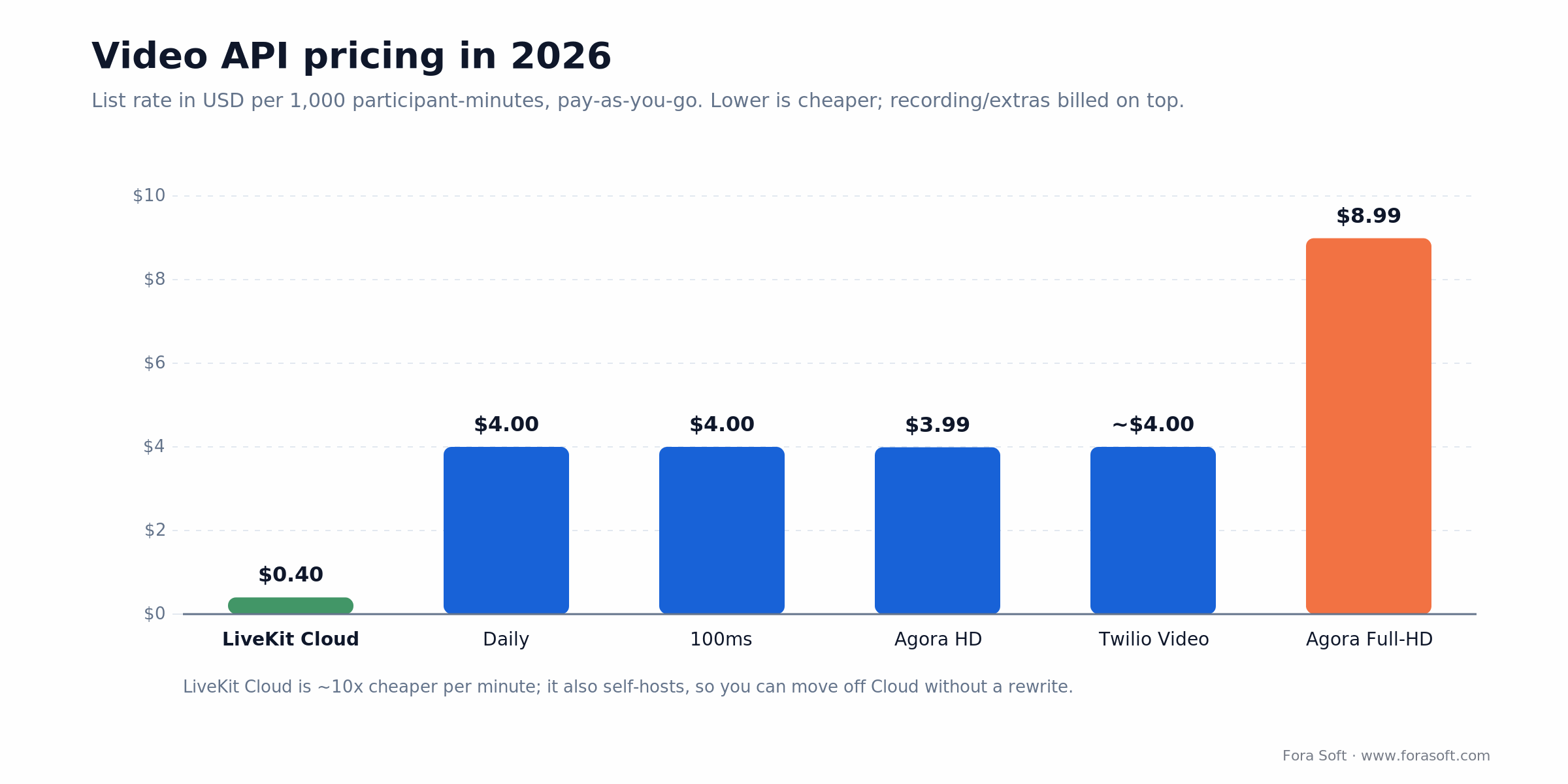
Figure 3. 2026 list rates per 1,000 participant-minutes — LiveKit Cloud is roughly 10× cheaper per minute.
LiveKit Cloud: the low per-minute option
Rate: $0.0004 per participant-minute for WebRTC on LiveKit’s Scale tier ($0.0005 on Ship) — still roughly 10× cheaper per minute than Daily or 100ms. Tiers: Build (free), Ship ($50/month), Scale ($500/month), Enterprise. Why it’s here: the same open-source server powers self-hosting, so you can move off Cloud later without a rewrite. LiveKit is our current focus stack for real-time and AI video; see our LiveKit vs Agora cost analysis. Watch-out: AI agent sessions bill separately (about $0.01/minute), and egress/inference add up.
Daily: predictable per-minute, strong SDKs
Rate: $0.004 per participant-minute, 10,000 free participant-minutes/month, automatic volume discounts, no seats or subscription. Where it wins: excellent SDK quality, sub-100ms routing, transcription and recording built in. Where it breaks: smaller ecosystem than Agora; costs climb once you’re past a few million minutes and haven’t negotiated. See our Daily alternatives breakdown for the flip points.
100ms: pay-as-you-grow, migration-friendly
Rate: $0.004 per participant-minute ($4/1,000) for conferencing, audio-only discounted ~75%, recording $10/1,000 min, RTMP-out $12/1,000 min, 10,000 free minutes/month. Where it wins: clean pay-as-you-go, strong for education and Asia-Pacific latency, Zoom-migration discounts. Where it breaks: premium support and compliance add-ons cost extra; smaller global footprint than Agora.
Agora: the large ecosystem
Rate: HD video (up to 720p) $3.99 per 1,000 min ($0.00399/min); Full HD (1080p) $8.99/1,000; audio $0.99/1,000; first 10,000 min/month free. Committed subscriptions drop HD to about $0.81–$0.92/1,000. Where it wins: 200+ data centers, mature ecosystem, extensions for AI and moderation. Where it breaks: Full-HD and extras get pricey fast; support can lag for sub-enterprise accounts.
Twilio Video: still here, enterprise-oriented
Status: Twilio announced end-of-life for Programmable Video in 2024, then reversed it in October 2024 — it remains a supported standalone product in 2026 and accepts new accounts. Rate: group rooms around $0.004 per participant-minute plus recording and composition fees; check Twilio’s calculator for your mix. Where it wins: deep telephony and messaging integration, enterprise support. Where it breaks: the EOL scare pushed many teams off, so weigh roadmap confidence; our Twilio Video migration guide covers the alternatives if you’re nervous.
Build, buy, or hybrid — the decision that drives the bill
Your tech-stack choice is the single biggest cost lever. Three archetypes, three cost shapes.
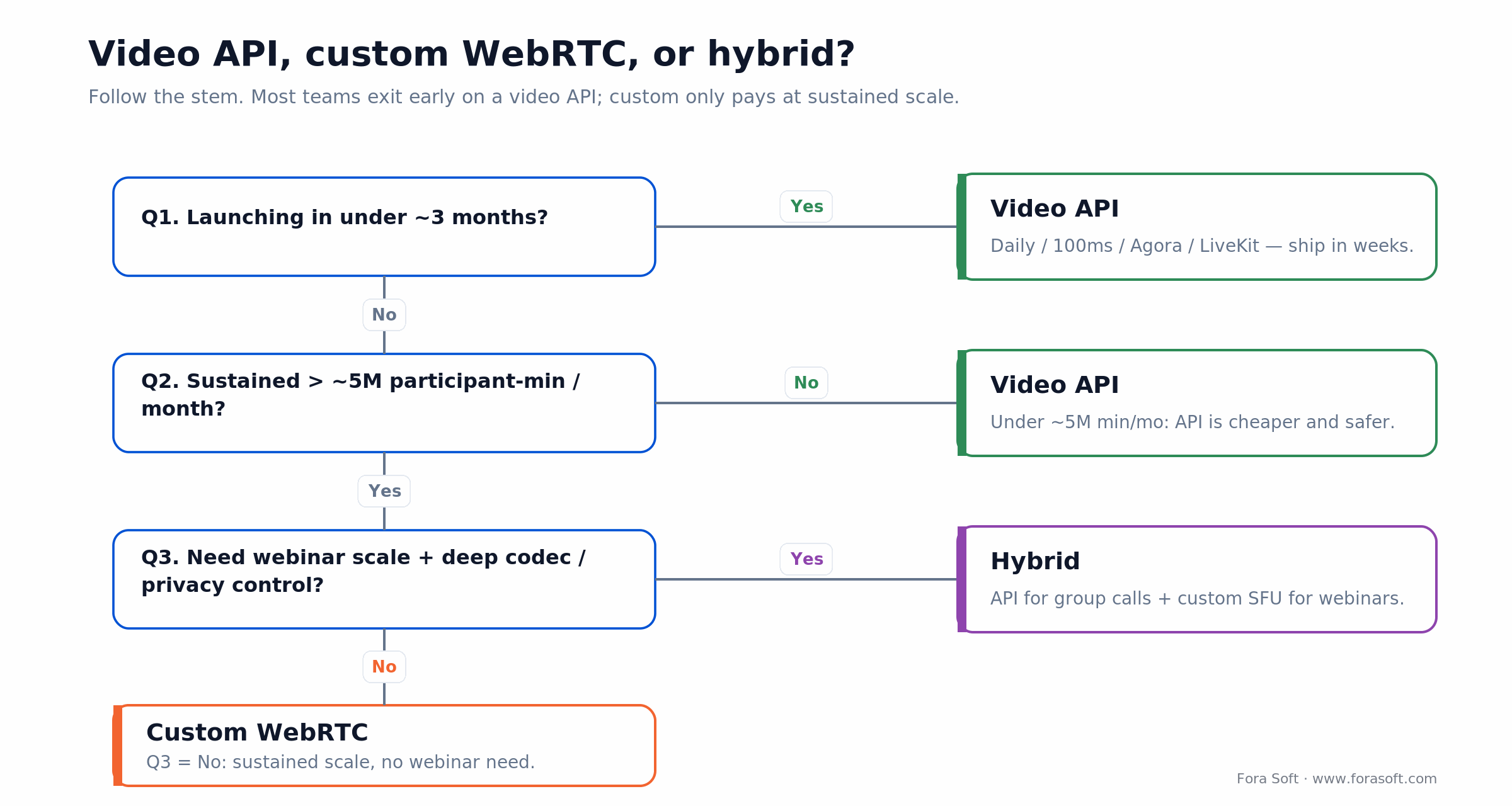
Figure 4. Build-vs-buy-vs-hybrid decision tree — most teams exit early onto a video API.
Pure video API (Daily, 100ms, Agora, LiveKit)
Where it wins: fast launch (4–8 weeks for an MVP), no media-server ops, HIPAA/GDPR readiness on most platforms, 99.95%+ uptime, no scaling headaches. Where it breaks: per-minute fees eat margin at scale, some vendor lock-in (switching is a 4–6 week rewrite unless you abstract the SDK), and you’re bound to their roadmap.
Best for: most SaaS founders, B2B platforms, and any startup under $10M ARR. The large majority of new video apps should start here.
Reach for a pure video API when: you want to launch fast, you don’t have millions of participant-minutes a month in your near-term forecast, and you value stability over full control.
Custom WebRTC (build your own SFU)
Where it wins: no per-minute fee (fixed cost after launch), full control over features and data, better margins at very high volume, and a real privacy moat. Where it breaks: $300K–$600K upfront, an 18–24 week timeline, and a heavy ops burden (24/7 on-call, DDoS mitigation, codec bugs, SFU tuning is a specialty). Open-source servers like LiveKit, mediasoup, and Janus cut the build but not the ops.
Cost: $300K–$600K upfront + $50K–$150K/year ops. Best for: privacy-first products, very high sustained volume, or hyper-specialized latency/codec requirements.
Reach for custom WebRTC when: you sustain millions of participant-minutes a month, privacy or deep codec control is a competitive moat, and you can absorb a $300K+ upfront bet and a 6-month delay.
Hybrid (video API for group calls, custom SFU for webinars)
Where it wins: speed-to-market for group calls, differentiation on webinars and large-group features, and better unit economics than pure API at scale. Where it breaks: two stacks to run, higher dev cost, two vendor relationships.
Cost: roughly $400K–$700K upfront. Best for: education platforms, enterprise meeting rooms, and telemedicine with group sessions — API simplicity for small calls, custom SFU for scale.
Reach for hybrid when: you need fast group calling but want webinar-scale differentiation, and you’re heading toward millions of participant-minutes a month.
Video API, custom WebRTC, or hybrid — unsure which?
Tell us your participant-minute forecast and compliance needs. We’ll model the crossover for your case and recommend the cheapest stack that still scales.
The cost math: what a video API actually bills
Most cost guides quote per-minute rates and stop. Let’s finish the arithmetic, because the participant-minute — not the user count — is what you actually pay for.
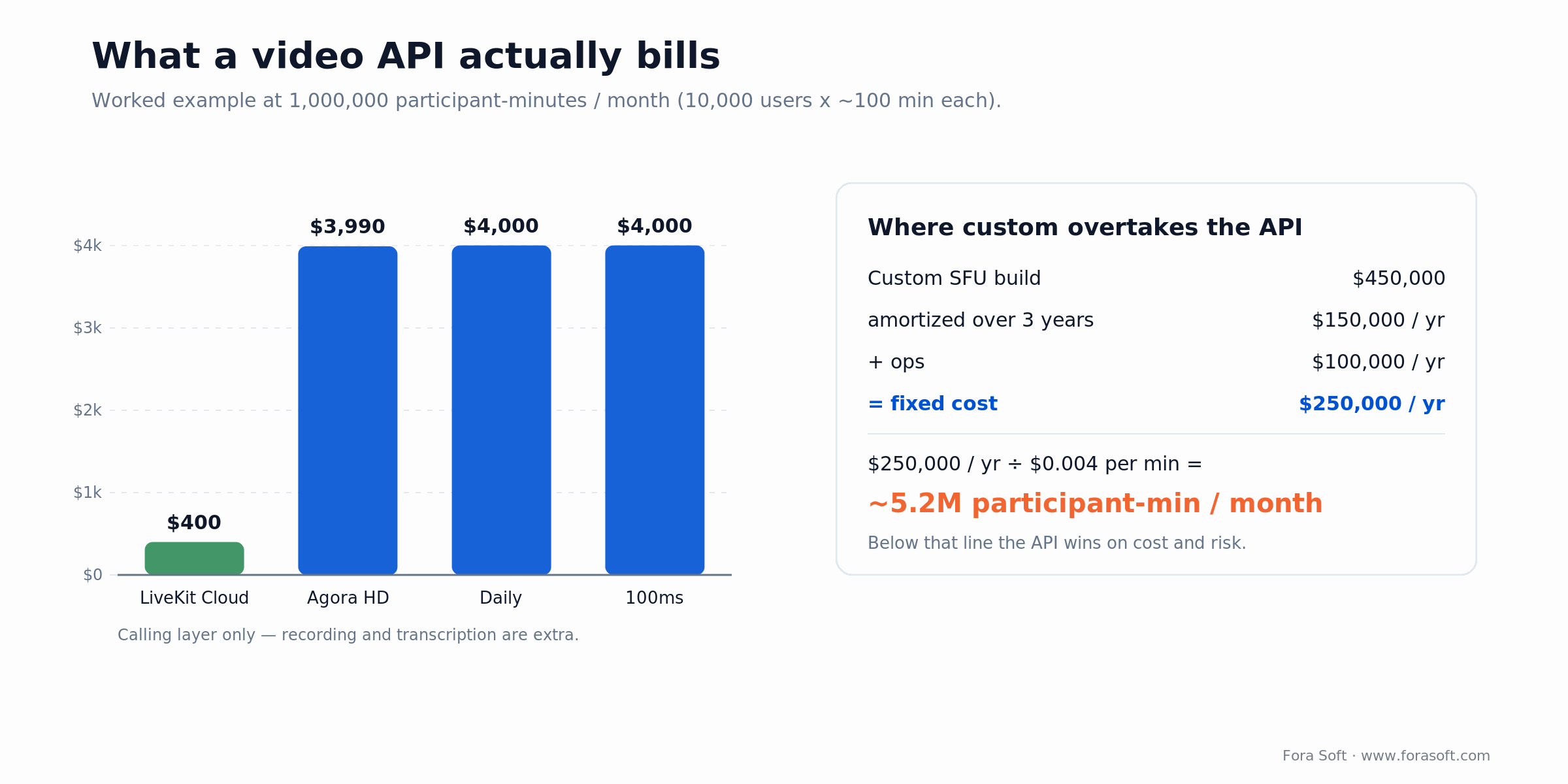
Figure 5. The worked bill at one million participant-minutes a month, and where a custom SFU finally overtakes an API.
Worked example. Say you have 10,000 monthly active users, and each spends about 100 minutes in calls per month. That’s 10,000 × 100 = 1,000,000 participant-minutes/month. Run that through 2026 rates: Daily or 100ms at $0.004 → about $4,000/month; Agora HD at $3.99/1,000 → about $3,990/month; LiveKit Cloud at $0.0004 → about $400/month plus your tier fee. Recording and transcription are extra, but the calling layer is a four-figure line item, not a five-figure one.
Where custom overtakes the API. A custom SFU costs, say, $450K to build and $100K/year to run. Amortize the build over three years ($150K/year) and add ops, and you’re at roughly $250K/year in fixed cost. A video API at $0.004/participant-minute reaches $250K/year at about 62,500,000 participant-minutes/year — roughly 5.2 million participant-minutes a month. Below that line the API is cheaper and far less risky; above it, custom starts to pay. That’s the honest break-even — measured in minutes, not a hand-wavy “500K users.”
Two caveats worth stealing. Against LiveKit Cloud’s $0.0004/minute, the crossover sits roughly 10× higher, so self-hosting rarely beats it on cost alone. And bandwidth is the sleeper line: a 720p stream is about 1–1.5 Mbps, and egress runs $0.085–$0.09/GB on AWS or CloudFront for the first 10 TB, a real cost a custom stack pays and an API hides.
Custom WebRTC: build it right, or not at all
Custom WebRTC is the most expensive, highest-risk path — and the one with the best unit economics if you truly scale. The decision hinges on three things: your sustained-volume forecast, your tolerance for ops, and your engineering depth. If you want the deeper architecture reasoning, our LiveKit engineering guide in Learn walks the server side.
Build custom when: you sustain millions of participant-minutes a month and API fees would eat 60%+ of margin, you have (or can hire) 2–3 senior WebRTC and DevOps specialists, your timeline is 18–24 months, and you can afford $300K–$600K of sunk cost if you pivot.
Don’t, when: your near-term volume is modest, your timeline is under 12 months, or you lack WebRTC expertise on staff. Use an API, iterate fast, and revisit in 18 months with real usage data. Teams that build custom too early routinely waste $200K+ and ship six months late.
Mini case: how BrainCert scaled to 500M+ minutes without a custom SFU
The situation: BrainCert started as an online testing platform, then realized live virtual classrooms were the feature that mattered. Building custom WebRTC from scratch would have cost $400K+ and taken 12–18 months. We recommended the opposite: use a video API for the calling layer, then spend the budget on the parts that actually differentiate — auth, recording, and an interactive whiteboard.
The plan: ship an API-based classroom MVP in about four months, wrap it in custom UX and recording, and keep the media layer swappable behind a thin interface so pricing or vendor changes wouldn’t touch the product code.
The outcome: BrainCert has delivered 500M+ classroom minutes to 100K+ customers, reached $3M ARR (2024, up 58% year over year), and won four Brandon Hall awards for its virtual classroom, all without the complexity and cost of a custom SFU. The expensive part of video conferencing was never the calling; it was everything around it.
The lesson: use a video API for the media, spend your money on what differentiates. Want a similar assessment? Book a 30-min scoping call and we’ll map it to your roadmap.
A decision framework: scope your build in five questions
Video conferencing app development cost is predictable once you answer these five questions honestly. Use them to scope your build and pressure-test any quote you receive.
Q1: How many concurrent participants per call?
1-to-1 or small groups (up to 4) can use mesh or a simple video API. 5–16 participants need an SFU (add $50K if custom, or pay per-minute on an API). 50+ need webinar-grade scaling (custom SFU $150K+). 1,000+ need MCU or a tier-1 API at enterprise pricing. Your answer sets the infrastructure tier and $50K–$200K of the estimate.
Q2: Which compliance regimes apply?
None (generic SaaS) adds nothing special. GDPR (EU residency) adds $20K–$30K. HIPAA (healthcare) adds $40K–$60K. HIPAA + SOC 2 adds $70K–$100K. PCI-DSS (payments) adds $25K–$45K. They stack, and they’re additive to the build, not a discount on it.
Q3: Mobile plus web, or web-only?
Web only: $60K–$100K for the MVP. iOS + web: add $35K–$50K. iOS + Android + web: add $80K–$120K. Each platform is a 1.5–2.0× adder, not a 1.2× one, because WebRTC SDKs and device fragmentation are real. Most teams under-estimate mobile.
Q4: Recording, transcription, AI, and E2E?
Recording: add $15K–$25K (storage, transcoding). Transcription and live captions: add $20K–$40K (speech-to-text, speaker detection). AI features (background blur, summaries, emotion cues): add $30K–$60K. End-to-end encryption: add $25K–$50K (key exchange, no cleartext storage). These stack, so keep them out of the MVP and add in beta.
Q5: Time-to-market vs unit economics?
Need to launch in three months? Use a video API. Sustain millions of participant-minutes a month and need the best unit economics? Custom WebRTC. Somewhere between, wanting both speed and some control? Hybrid. This answer alone moves the budget by $200K–$400K.
The five hidden cost categories that wreck budgets
Cost estimates often exclude real-world physics and operations. Here are five categories teams consistently under-budget.
1. TURN/STUN relays and bandwidth
The problem: 15–20% of sessions sit behind firewalls or symmetric NATs that block a direct connection and need a TURN relay for media. A single TURN server runs $2K–$5K/month for a few thousand concurrent relays; egress runs $0.085–$0.09/GB on AWS or GCP, and a 30-minute group call moves 500MB–2GB per participant depending on resolution. Skip TURN and 15–20% of users get dropped calls. Budget: add $8K–$12K to an MVP infrastructure line.
2. Design and UX iteration
The problem: engineers treat calling as a pure tech problem and skip design. The MVP ships on default component styling, and beta brings 500+ comments about confusing call flows and missing controls. A 4–6 week UX rework costs $20K–$40K and delays launch. Budget: $15K–$30K upfront design plus $8K–$15K for a design system — cheaper than the rework.
3. QA and load testing
The problem: real QA is network simulation (jitter, packet loss, throttling), cross-browser testing (Chrome, Firefox, Safari, Edge; Chrome and Safari on mobile), and load testing at target concurrency. A WebRTC bug, say echo cancellation breaking on 4G, can hit 10% of your base. You catch that in testing, not production. Budget: $30K–$80K for a production-grade launch across manual QA, network simulation, load, and a penetration test. A lean MVP runs a subset (the core-flow QA above), but skipping network simulation is how you ship a product that fails on 4G.
4. Compliance audits
The problem: you launch a HIPAA app, then a customer asks for a signed BAA and SOC 2 Type II you don’t have. An auditor costs $15K–$40K and takes 8–12 weeks; remediation adds $10K–$20K and four weeks of engineering. Budget: $30K–$50K for the HIPAA build, $8K–$15K/year audits, $20K–$40K for SOC 2 — planned in parallel with development, never after.
5. Post-launch maintenance and incident response
The problem: a Chrome update breaks codec compatibility, an iPad edge case takes three weeks to chase down, your TURN pool saturates during a big event and you buy capacity at a markup. Post-launch maintenance runs 20–30% of launch cost per year. Budget: $50K–$80K/year for one maintenance engineer plus a $5K–$15K/month incident retainer — expect 15–25% of MVP cost added annually.
Pitfalls that turn $200K projects into $400K projects
We’ve seen every one of these. Here are five that reliably double a project’s cost.
1. A mesh architecture that can’t scale
The mistake: you build a full P2P mesh — each user sends to every other user. It’s great for 1-to-1 and 4-person calls. At 8 people, CPU and uplink explode, video goes choppy, and support tickets pile up. The fix: move to an SFU (send once, server forwards N times). That’s a 2–4 week refactor at $15K–$30K, or avoid it entirely by starting on a video API that handles the SFU for you.
2. Under-provisioning NAT traversal
The mistake: you deploy one TURN server for 1,000 users. In production, 15–20% are behind corporate firewalls and need the relay. It saturates, calls drop, and emergency scaling is expensive. The fix: load-test with network simulation, budget for 15–20% of users hitting TURN, and use a managed relay (Twilio, Cloudflare) if you lack ops depth.
3. Codec assumptions that don’t hold
The mistake: you assume one codec is universal and skip negotiation testing. In 2026, H.264 and VP8 are the safe baseline; VP9 is now supported in Chrome, Firefox, and Safari, and AV1 real-time is emerging but carries encode cost and uneven hardware support. Betting on a single codec without fallbacks breaks calls on older devices. The fix: negotiate H.264/VP8 as the floor, offer VP9/AV1 where available, and test across Chrome, Firefox, Safari, and Edge on desktop and mobile before launch.
4. Recording without consent or legal review
The mistake: you enable recording by default. A user records without everyone’s consent, and now you’re exposed — GDPR runs up to €20M or 4% of global turnover, HIPAA penalties reach roughly $2M per violation category per year, and several US states require all-party consent. The fix: require explicit in-call consent, show a persistent recording banner, keep an immutable audit log of who recorded when, and have legal review your terms before launch.
5. Vendor lock-in you later regret
The mistake: you couple your codebase tightly to one API. Two years in, per-minute costs bite and you want to switch, but migration is now $80K–$150K. The fix: abstract the API behind a thin “VideoClient” interface from day one. Swapping the backend then costs a sprint, not a quarter. It adds 5–10% to MVP dev ($5K–$10K) and saves $80K+ later.
Need a HIPAA-compliant telemedicine build?
Healthcare compliance is non-negotiable. We’ve shipped HIPAA video platforms like CirrusMED. Let’s scope timeline and cost for your use case.
KPIs to measure once you ship
After launch, track these to know if the investment is paying off and where to optimize next.
Quality KPIs
Mean Opinion Score (MOS): perceived audio/video quality on a 1–5 scale; target above 3.5. Latency: one-way audio/video under 150ms, aim for under 100ms. Packet loss: under 2% is fine, above 5% noticeably degrades calls. Jitter: keep under 30ms. Collect these from the WebRTC stats API or your video API’s analytics.
Business KPIs
Customer acquisition cost (CAC): sales and marketing spend per new customer, weighed against lifetime value. Average revenue per user (ARPU): subscription revenue over active users; rising ARPU means upsell is working. Retention: share of users who return 30 days after their first call — target above 60% for video apps.
Reliability KPIs
Uptime: target 99.5% (about 43 minutes down/month) or 99.9% (about 8 minutes). Call error rate: share of calls that drop or fail to connect; target under 0.5%. Mean time to recovery (MTTR): how fast you fix an outage; aim for under 15 minutes. Track these with Datadog, New Relic, or Sentry.
When NOT to build a video conferencing app
Sometimes the smart move is not to build. Here’s when buying or embedding wins.
Your budget is under $80K
You can’t build a production-grade video conferencing MVP for under $80K without going offshore and accepting lower quality. With $30K–$50K, use a video API and a white-label platform (Whereby Embedded, Daily Prebuilt, or similar) to get a branded meeting room fast, then reinvest once you have traction.
Video isn’t your core differentiation
If you’re building telemedicine, the moat is EHR integration and patient experience, not the codec. If you’re building training software, the moat is content and adaptive learning. Embed a meeting via API, save $80K–$300K, and ship months sooner.
You have no clear differentiation
Zoom, Teams, and Google Meet own most of the market. If your only pitch is “a video conferencing app,” you’ll spend $500K+ chasing parity and still lose. You need a real edge — privacy-first, AI-native, industry-specific, or hyper-specialized (large webinars, virtual events). Without one, don’t build.
FAQ
How much does it cost to build a video conferencing app?
As of 2026, a custom, production-quality MVP on a video API runs $80K–$120K over 12–16 weeks. A multi-platform private beta is $150K–$400K, and an enterprise build with compliance is $500K–$1.5M+. White-label or offshore builds start at $3K–$50K and trade away control and quality. The single biggest variable is whether you use a video API or build custom WebRTC.
How much does it cost to build a Zoom-like app?
A true Zoom-parity app (all platforms, 300+ per call, recording, transcription, admin, compliance) costs $1.2M–$2M and 18–24 months with 12–18 engineers. Zoom had a decade’s head start and enormous R&D. Don’t compete on parity — compete on a niche or a feature Zoom won’t build.
Can we build an MVP for under $50K?
Yes, offshore or white-label, at $30K–$50K for web plus a video API. Expect timezone lag, more QA rework, and communication overhead. A dedicated team with synchronous overlap costs $80K–$120K but compresses the timeline and reduces rework, usually the better total cost of ownership.
Why is custom WebRTC so much more expensive than a video API?
Custom WebRTC means building or customizing an SFU (Janus, LiveKit, mediasoup, Pion), then handling codec negotiation, bitrate adaptation, NAT traversal, STUN/TURN pools, and monitoring — four to six months of specialist work ($300K+) plus ongoing ops. A video API does all of that for you; you pay per participant-minute instead of per engineer-month.
What’s the cheapest video API in 2026?
On raw per-minute rate, LiveKit Cloud is lowest at $0.0004/participant-minute (plus a $50–$500/month tier). Daily and 100ms sit at $0.004/minute with 10,000 free minutes/month. Agora HD is $3.99/1,000 minutes. Dyte, once a low-cost favorite, was acquired by Cloudflare in 2025 and folded into Cloudflare RealtimeKit, so evaluate that stack instead of standalone Dyte.
When does custom WebRTC become cheaper than a video API?
At roughly 5.2 million participant-minutes a month. A custom SFU costing about $450K to build (amortized over three years) plus $100K/year to run is around $250K/year; a video API at $0.004 per participant-minute reaches $250K/year near 5.2M minutes/month. Below that, the API is cheaper and less risky. Against LiveKit Cloud at $0.0004/minute the crossover is roughly 10× higher, so self-hosting rarely beats it on cost alone.
Is Twilio Video still available in 2026?
Yes. Twilio announced an end-of-life for Programmable Video in 2024, then reversed it in October 2024. It remains a supported standalone product in 2026 and accepts new accounts. That said, the scare pushed many teams to migrate, so factor roadmap confidence into your choice.
How long does HIPAA compliance add to the timeline?
Planned upfront, 4–6 weeks (data residency, encryption, audit logging). Bolted on after launch, 8–12 weeks and $30K–$50K extra. Audits (BAA, verification) add another 8–12 weeks and $15K–$40K. Design compliance in from the start. Retrofitting is always the expensive path.
Do we need iOS and Android from day one?
No. Start with a web MVP (12–16 weeks), launch, validate demand, then port to iOS in beta (4–6 weeks) and Android after (another 4–6 weeks). That defers $70K–$100K and 8–10 weeks. A responsive web app covers most phone users in the meantime.
What to read next
Architecture
P2P vs MCU vs SFU for Video Conferencing
Which media topology scales, and what each one costs to run.
Cost
WebRTC Development Cost: Build vs Buy
Unit economics for custom WebRTC vs video APIs at scale.
Vendors
LiveKit vs Agora: 2026 Cost Analysis
Side-by-side per-minute economics for two popular video stacks.
Build guide
Video Conferencing Software Development
The architecture and scaling guide behind the numbers here.
Ready to scope your video conferencing build with confidence?
Video conferencing app development cost varies wildly because scope, platforms, scale, compliance, team rates, and tech stack all compound. But the variance is predictable. Use the five questions to lock your scope, then pick a video API (most startups), a hybrid, or custom WebRTC based on your timeline and sustained participant-minutes.
The hidden costs — TURN, QA, compliance, UX, maintenance — are real and routinely blow budgets by half, so plan them in. And you don’t need every feature on day one: ship a lean MVP in 12–16 weeks on a video API, validate fit, then scale in beta. That’s the fastest, cheapest path to a working video app.
Ready to get a realistic estimate?
Since 2005 we’ve shipped 250+ video and real-time products. Send us your scope and we’ll recommend a stack and a costed timeline — no obligation.

