

Key takeaways
• Secure video streaming is a stack, not a feature. Multi-DRM, signed short-TTL tokens, forensic watermarking, MFA, device attestation, and a hardened CDN edge work together — remove any one and the others stop mattering.
• The threat is paid for, not theoretical. Parks Associates (2023) projects cumulative US streaming piracy losses of $113B by 2027; Streameast, shut down in September 2025, had 1.6B visits in a year across 80 domains; and Disney+ saw thousands of accounts hijacked through credential stuffing on its 2019 launch.
• Multi-DRM (Widevine + FairPlay + PlayReady) is the new baseline. Together they cover virtually every consumer playback device; CMAF + CBCS encryption lets you ship one set of files instead of two or three, cutting storage and CDN cache by up to ~66%.
• Tokens beat secrets. Short-lived signed URLs (5–15 min TTL) bound to client IP, a refresh-token rotation policy, and OAuth 2.0/OIDC + MFA stop the credential-stuffing attacks that bypass DRM entirely: Microsoft Research (2023) measured a 99.22% lower risk of account compromise with MFA.
• Spend where the leaks are. A lean MVP can ship multi-DRM + signed CDN + MFA for $50K–$150K in year one and ~$500–$5K/month in licensing — forensic watermarking and device attestation are premium-tier add-ons, not launch blockers.
Updated October 2026: Streameast takedown and live-piracy takedown data (2025), Microsoft MFA study figures, FIDO passkey adoption (May 2026), 2026 identity and DRM pricing, and a platform table for short-lived playback links.
Secure video streaming means only entitled viewers can fetch and decrypt your video, on devices you trust, and any copy that leaks can be traced to one account. In practice that takes seven layers working together: strong identity (MFA or passkeys), TLS 1.3 transport, multi-DRM encryption (Widevine, FairPlay, PlayReady), short-lived signed playback URLs, device attestation, forensic watermarking, and encrypted storage with audit logs.
Why Fora Soft wrote this playbook
We’ve been building video and audio streaming software since 2005, across 20+ years and 250+ shipped projects, every major architecture from naive HLS over a single origin to globally-distributed WebRTC SFUs with end-to-end encryption. That includes live concert platforms, telemedicine, e-learning, courtroom recording, IPTV, social broadcasting, and OTT — each with its own threat model and its own definition of “secure enough.”
We wrote this guide because every prospect we talk to asks the same first question — “what security does our video streaming app actually need?” — and the honest answer is layered. There is no single feature that secures a streaming product. There is a stack: WebRTC or HLS transport, multi-DRM packaging, signed CDN delivery, identity, watermarking, monitoring, and compliance. If you skip a layer, attackers eventually find that layer. We’ve seen it in production, on real platforms, with real revenue at stake.
One concrete example: our Worldcast Live project broadcasts HD concerts to up to 10,000 concurrent viewers with sub-second latency on a custom WebRTC + Kurento stack. That platform has to authenticate paying ticket-holders, defend against link-sharing, watermark sessions, and stay up under a DDoS-attractive event window — all without sacrificing the <1s latency artists demand. Different threat model from VOD, same stack discipline. The patterns below come from work like that.
Designing security for a streaming product right now?
Get a 30-minute architecture review with a senior engineer who has shipped this stack before — no slides, no sales reps.
The 2026 threat picture, in numbers
Before we talk solutions, fix the size of the problem in your head. Video streaming security is not paranoia — it is paid back, repeatedly, by attackers who already have working tooling.
The numbers below come from Parks Associates, the Alliance for Creativity and Entertainment (ACE), Grant Thornton’s 2025 study for the Live Content Coalition, Microsoft Research, and incident postmortems. They describe what video streaming apps face today, not in some hypothetical future.
| Threat | Scale | Primary defense |
|---|---|---|
| Streaming piracy (US) | ~$113B cumulative loss projected by 2027 (Parks Associates) | Multi-DRM + forensic watermarking + signed URLs |
| Credential sharing | $12.5B in US lost revenue to piracy plus password sharing by 2024 (Parks Associates forecast, 2020) | Concurrent stream limits, device binding, MFA |
| Credential stuffing | Disney+ hit hours after launch (Nov 2019); accounts resold $3–$11 | MFA (push/passkeys), bot detection, rate limiting |
| Illegal IPTV restreaming | 1,000+ domains, 10,000+ IPs (Silent Push); Photocall ring 26M visits/yr | Forensic watermarking, ASN/VPN blocking |
| Stream ripping (yt-dlp class) | Widevine L3 (software CDM) publicly broken repeatedly since 2019 | CMAF CBCS + L1/L3 differentiation, hardware-bound license |
| Illegal sports streaming networks | Streameast: 80 domains, 1.6B visits in 12 months, shut down by ACE and Egyptian authorities in September 2025 | Forensic watermarking, session revocation, piracy monitoring |
| Live-event takedown gap | 26.2M takedown notices in 18 months to mid-2025; 89% did not stop the broadcast (Grant Thornton for the Live Content Coalition, September 2025) | In-stream controls you own: watermark-to-revoke, short TTLs |
| DDoS on edge / license server | Live events are DDoS-magnets — ingest, manifest, license | CDN scrubbing (Cloudflare/Akamai), WAF, rate limits |
| Source-code/secret leaks | Twitch 2021: 125GB, ~194 AWS keys + 68 Google keys exposed | Secret scanning, KMS-only keys, quarterly rotation |
Two patterns repeat in those numbers. First, the leaks are always at the cheapest, dumbest layer: a hardcoded key, a missing MFA prompt, a 24-hour signed URL shared in a Discord channel. Second, no single control catches all attack classes — DRM stops casual rippers but not credential sharers; MFA stops credential stuffing but not IPTV restreamers. You have to layer.
Do not count on takedowns to save a live event. The European Commission’s November 2025 assessment of its 2023 live-piracy Recommendation found it “has not resulted in considerable curbing” of live piracy, and it proposed no new law. The controls that work during the match are the ones inside your own stack. For live-specific ingest, live DRM and match-day DDoS, see our secure live streaming playbook.
The seven layers of video streaming app security
Secure video streaming is never one switch you flip; it is the sum of the seven layers below. Each layer has a specific job, a specific failure mode, and a specific cost. The full stack looks like this:
- Identity & account. Who is asking? OAuth 2.0 / OIDC, MFA, passkeys, session management, anti-bot.
- Transport. TLS 1.3 + HSTS for HTTP, RTMPS or SRT-AES for ingest, DTLS-SRTP for WebRTC.
- Content packaging. CMAF + CBCS encryption, multi-DRM keys (Widevine / FairPlay / PlayReady).
- Delivery. Signed URLs / signed cookies, short TTL, IP/device binding, geo-blocking, VPN detection.
- Player & device. Hardware-backed DRM (Widevine L1, FairPlay), App Attest / Play Integrity, HDCP, anti-tamper.
- Forensics & watermarking. Visible watermarks for deterrence, session-based forensic watermarks for source tracing.
- Storage, monitoring, compliance. AES-256 + KMS at rest, audit logs, anomaly detection, GDPR/CCPA/HIPAA/MPA-TPN.
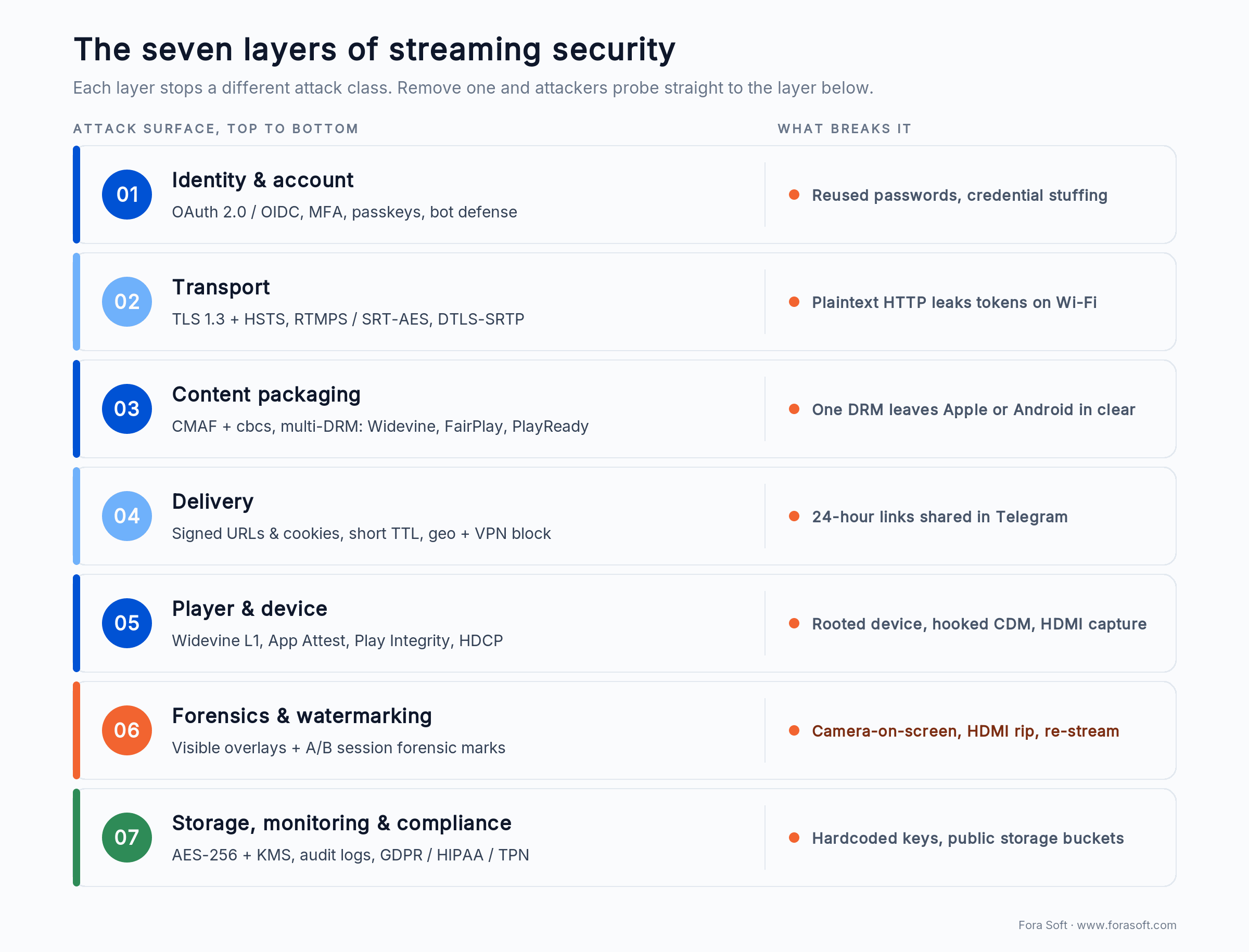
Figure 1. The seven-layer model. Each layer blocks a distinct attack class; remove one and attackers probe straight to the layer below.
A pragmatic MVP does the four core layers properly (identity, transport, packaging, delivery) and the rest at a basic level: visible overlays instead of forensic marks, encrypted storage and audit logs, attestation later. A premium-tier streaming product (theatrical day-and-date, live sports, 4K HDR) doubles down on packaging, player, and forensics. The decision framework later in this article tells you which layers to harden first based on the value of your content.
Identity and authentication: the cheapest 99% you’ll ever buy
Most successful attacks on streaming products in the last five years didn’t crack DRM. They walked through the front door with a leaked password. Disney+ in November 2019 is the canonical example. The service was hours old when credential-stuffing bots produced thousands of valid logins, harvested from breaches of unrelated sites where the same users had reused passwords. Microsoft Research’s 2023 study of real accounts found MFA lowers the risk of compromise by 99.22%, and by 98.56% even when the password has already leaked. That is the highest single-layer ROI in this whole article. Passkeys are now mainstream too: the FIDO Alliance estimated about 5 billion passkeys in use in May 2026, and 75% of consumers it surveyed had enabled one on at least one account.
What good identity looks like
1. OAuth 2.0 / OpenID Connect. Use a hardened identity provider (Auth0, Okta, Firebase Auth, AWS Cognito, or your own Keycloak) instead of rolling your own login. You inherit password hashing (Argon2id or bcrypt), brute-force lockouts, breached-password checks, and SOC 2 audit trails.
2. MFA by default. Push notifications and TOTP first, passkeys (WebAuthn) for premium tiers, SMS only as a fallback — SIM-swap fraud makes SMS a liability for high-value accounts. Make MFA mandatory at signup, not optional.
3. Short-lived access tokens, rotated refresh tokens. 15–60 min on the access token. Refresh-token rotation invalidates the old token on every refresh; a stolen token works exactly once.
4. Bot defense at the auth edge. Cloudflare Turnstile, Akamai Bot Manager, or hCaptcha Enterprise on login + signup. Combine with adaptive rate limits (e.g., 5 failures → lockout + MFA challenge) and impossible-travel detection (logins from two continents in 30 minutes → require step-up).
5. Device-aware sessions. Track the device fingerprint and revoke on mismatch. A “sign out everywhere” button is non-negotiable.
Reach for passkeys when: your premium subscribers churn over MFA friction or you ship to enterprise (SOC 2, MPA-TPN). Passkeys (WebAuthn) are phishing-resistant and pass most enterprise-security RFPs without further argument.
Transport security: TLS 1.3, RTMPS/SRT, and DTLS-SRTP
If your manifests, license requests, or signaling channel travel over plaintext HTTP, every other control on this list is wasted — a passive observer on hotel Wi-Fi will collect tokens and replay them. Transport security is the bottom of the stack and the easiest to verify: it either works or it doesn’t.
HTTP (manifests, license, API)
TLS 1.3 only, with HSTS preload and an A+ rating on Qualys SSL Labs. Disable TLS 1.0/1.1, ban CBC ciphers, pin OCSP stapling. Your CDN (CloudFront, Cloudflare, Akamai) does most of this for you — but verify, because misconfigured custom origins are where most TLS regressions land.
Live ingest
Plain RTMP is unencrypted — never use it for paid live ingest. Use RTMPS (RTMP over TLS) or SRT with AES-256. SRT additionally tolerates lossy networks better than RTMPS, which matters for stadium and remote crew ingest. WHIP (WebRTC-HTTP Ingestion Protocol) is the modern alternative for sub-second-latency live and inherits DTLS-SRTP encryption automatically.
WebRTC media
DTLS-SRTP is mandatory in every modern WebRTC implementation — you don’t opt in, you can only break it by disabling certificate validation. Authenticate signaling over WSS (WebSocket Secure), authenticate TURN with short-lived OAuth tokens (RFC 7635), and rotate TURN credentials at least hourly. We cover the SFU-vs-MCU trade-offs in detail in our P2P vs MCU vs SFU article and in the WebRTC explainer; the security implication is that an SFU sees decrypted media unless you layer in end-to-end encryption (more on that in section 11).
Multi-DRM: Widevine, FairPlay, PlayReady — and why CMAF saves you up to 66%
Digital Rights Management is the layer that decrypts content on the user’s device under license-server control. Without DRM, premium content on iOS and Android browsers is one yt-dlp command away from a clean MP4. With one DRM, you cover one ecosystem. With three, you cover everyone. Our multi-DRM 101 explainer walks the license handshake end to end.
The three DRMs you actually need
| DRM | Vendor | Devices | Container / Encryption | Levels |
|---|---|---|---|---|
| Widevine | Chrome, Firefox, Edge, Android, smart TVs | DASH/CMAF, CENC or CBCS | L1 (TEE) / L2 / L3 (software) | |
| FairPlay Streaming | Apple | Safari, iOS, iPadOS, tvOS, macOS | HLS / CMAF, CBCS | Hardware-backed on supported Apple devices; no public security levels |
| PlayReady | Microsoft | Edge legacy, Xbox, Windows native, Roku, smart TVs | DASH/CMAF, CENC or CBCS | SL2000 (software or hardware) / SL3000 (hardware TEE) |
| All three combined | Multi-DRM service | Virtually all consumer playback devices | CMAF + CBCS (single asset) | Required for studio-grade content |
CMAF + CBCS: one file instead of three
Historically you packaged the same content two or three times: CTR-mode fragmented MP4 for DASH (Widevine, PlayReady), CBC or sample-AES for HLS (FairPlay), and often a third set for legacy Smooth Streaming. CMAF (Common Media Application Format) with CBCS encryption uses a single fragmented MP4 set that all three DRMs can decrypt. Result: up to ~66% less storage and CDN cache pressure if you were storing three packages, and about half versus the common two-package setup (cenc for DASH plus cbcs for HLS), plus less packaging work. If you’re building from scratch in 2026, CMAF/cbcs is the default; keep a cenc rendition only for older devices that cannot decrypt cbcs, such as pre-2018 Android Widevine builds and PlayReady clients older than 4.0.
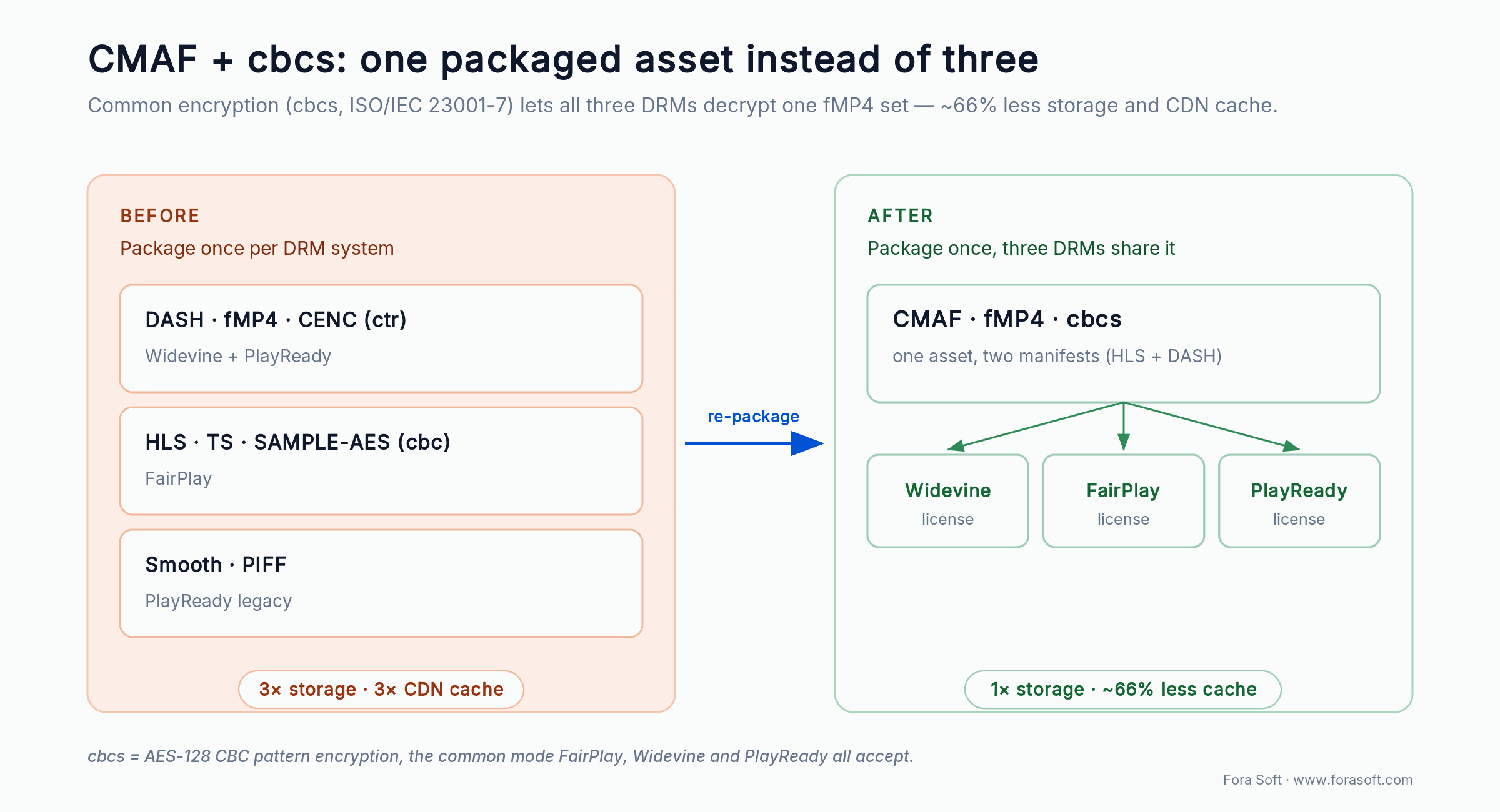
Figure 2. CMAF plus cbcs common encryption replaces three per-system packages with one asset all three DRMs decrypt, cutting storage and CDN cache by up to roughly 66% versus three separate packages.
License-server economics
You don’t self-host a DRM license server unless you’re Netflix-scale. Every major multi-DRM SaaS (BuyDRM, EZDRM, Bitmovin/Vualto, Verimatrix, NAGRA, Axinom, Castlabs) is significantly cheaper than rolling your own and lets you focus on packaging and policy. Indicative price points we’ve quoted in real projects:
- Entry-level multi-DRM SaaS: ~$100–$200/month base + per-license fee (often $0.001–$0.01 per playback). Good for indie OTT, e-learning, niche live. Published example (2026): Mux charges $100/month plus $0.003 per DRM license, and requires signed playback URLs for DRM content.
- Mid-tier (Bitmovin, EZDRM, Castlabs): $500–$3,000/month plus volume tiers. Studio-friendly, integrates with the major encoders.
- Enterprise (Verimatrix, NAGRA, Irdeto): custom contracts, often $50K+ per year, with hardware-rooted L1/SL3000 enforcement, forensic watermarking, and SOC 2 / TPN-aligned audit support.
Reach for multi-DRM when: you charge for content, distribute studio licenses, or expose 4K/HDR. Our OTT and IPTV platform development team ships multi-DRM, key policies per tier and the device test matrix as part of the build. Reach for HLS AES-128 + signed URLs when content is low-value (free webinars, internal training) and a casual rip wouldn’t cost you a customer.
Signed URLs, signed cookies, and short TTLs
DRM protects what plays. Signed delivery protects who can fetch the bytes in the first place. Done right, a paste of your manifest URL into a Discord channel expires before the screenshot finishes uploading.
How it works. Your origin or a trusted edge worker mints a signed token (HMAC or an RSA/ECDSA signature, depending on the CDN) bound to: the path or path prefix, an expiration timestamp, and (optionally) the requester’s IP or geo. The CDN (CloudFront, Cloudflare, Akamai, Fastly) verifies the token at the edge for every segment request. Any tampered or expired URL returns 403 before the bytes leave the cache.
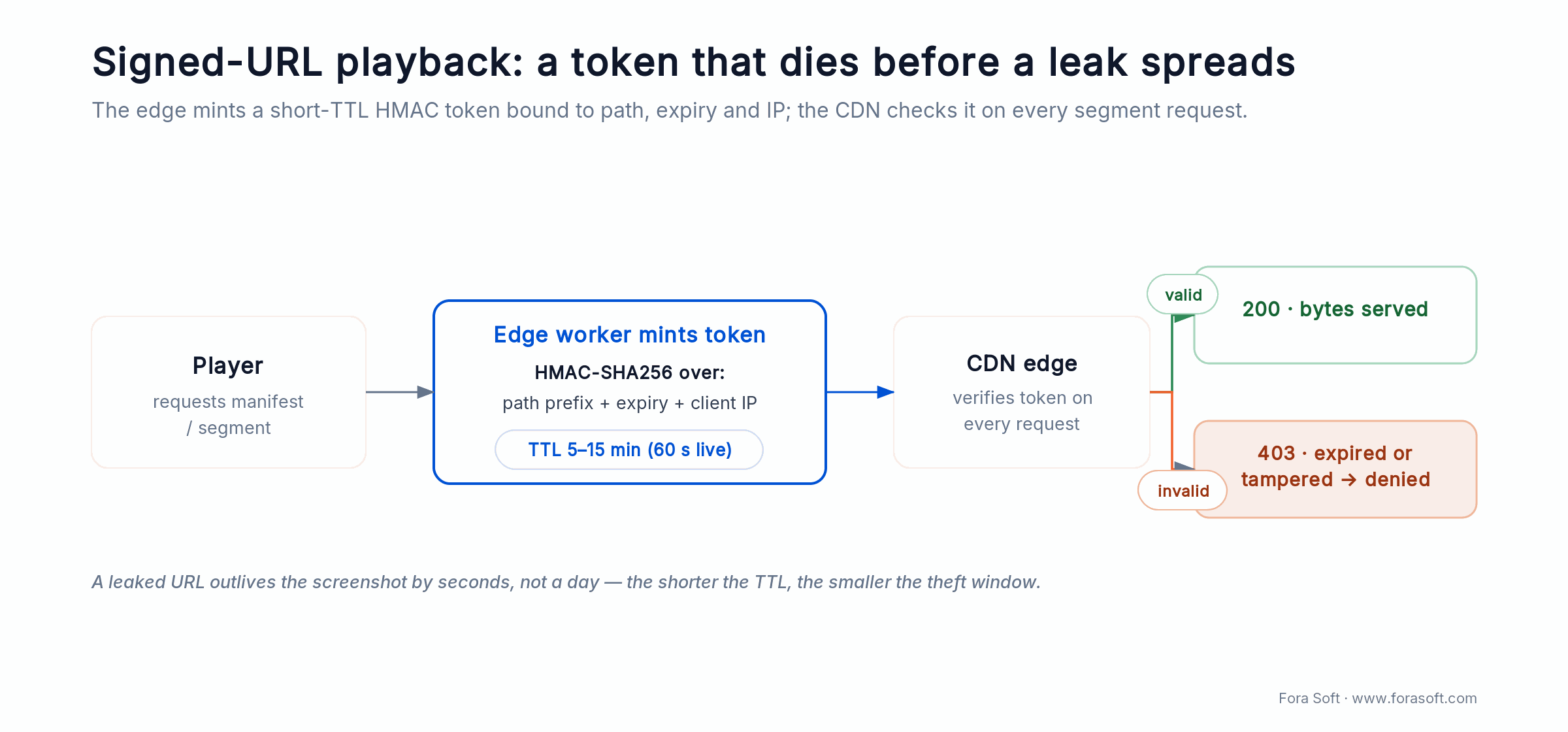
Figure 3. A signed-URL request: the edge mints a short-TTL HMAC token bound to path, expiry and IP, and the CDN validates it on every segment.
The four rules
1. Short TTL. 5–15 minutes for VOD segments, 60–120 seconds for live segments. The TTL must be shorter than the time it takes a leaked link to spread.
2. IP binding for high-value tiers. Tie the token to the requester’s /24 or /32. Annoying for mobile users on changing networks — use signed cookies that re-mint on session, or scope to a country block. For premium pay-per-view, full IP binding is correct.
3. One token per session, not per asset. A signed cookie covers an entire entitlement window for one device. Cuts the number of token mints by 100× and is harder to scrape.
4. Reject unknown referers and ASNs. CDN rules can drop requests from data-center ASNs (Hetzner, OVH, DigitalOcean) that legitimate consumer playback never originates from. Combined with VPN detection, this kills most stream-ripping bots.
Short-lived playback links: what the major platforms give you
If you want playback links that are issued only after an entitlement check in your app and expire quickly, every major delivery platform supports it. Your backend checks the subscription, then signs a token for that one viewer. The difference is in what the token can carry and how fast you can revoke it (vendor docs, checked October 2026):
| Platform | How links are signed | Expiry and limits | Extra controls |
|---|---|---|---|
| AWS CloudFront | Signed URLs or signed cookies with a trusted key group | Expiry set per URL or cookie policy | Custom policy can restrict by IP range and start time |
| Cloudflare Stream | requireSignedURLs plus tokens from the API or a self-held signing key |
Default 1 hour, maximum 24 hours after signing | Country and IP access rules (up to 5 per token), allowed origins, key revocation |
| Mux | Signed playback IDs with JWT playback and license tokens | Expiry in the JWT | Required for Mux DRM (Widevine, FairPlay, PlayReady) |
| Amazon IVS | Private channels with ES384-signed JWT playback tokens | Expiry in the token | Viewer session revocation for live channels |
Whichever you use, set the expiry yourself. A one-hour default is far longer than the 5–15 minutes we recommend for VOD and 60–120 seconds for live.
Forensic and visible watermarking
DRM stops most rippers. Determined attackers point a camera at a screen, capture the HDMI output of a hacked STB, or screen-record a desktop. Watermarking doesn’t prevent that. It makes the stolen copy traceable back to the leak source so you can shut down the account and pursue legal action.
Visible watermarks
A small overlay with the user’s email, account ID, and timestamp. Cheap, deterrent-grade, easy to crop. Use them on internal screeners, B2B sports trials, and corporate training to make leaks self-incriminating. Don’t expect them to survive a serious pirate — they will be cropped out.
Forensic (invisible) watermarks
Session-level identifiers embedded into the video itself, designed to survive transcoding, screen recording, recompression, and re-streaming. Two implementation patterns dominate:
- A/B (server-side) watermarking. The encoder produces two slightly different versions of each segment (A and B). The packager assembles a unique A/B sequence per session; from a leaked clip, the vendor can match the A/B pattern back to one user. NAGRA NexGuard, Friend MTS, Verimatrix StreamMark, Irdeto TraceMark.
- Client-side watermarking. The player blends a per-session payload during decode. Lower bandwidth overhead, but only as trustworthy as the player — usable for OTT and e-learning, not for studio releases.
DRM and watermarking options in one line each. DRM: Widevine, FairPlay and PlayReady through a multi-DRM service (EZDRM, BuyDRM, Axinom, castLabs, Mux DRM). Watermarking: a dynamic visible overlay in the player, client-side forensic marks, or server-side A/B forensic marks (NAGRA NexGuard, Irdeto TraceMark, Verimatrix StreamMark, Friend MTS). Use DRM to stop copying and watermarking to trace the copies DRM cannot stop.
For premium live sports and theatrical day-and-date, A/B server-side watermarking plus active piracy monitoring (Friend MTS, Athletia, MarkScan) detects the leak within minutes and revokes the offending account. In practice a server-side A/B mark embeds in roughly 200–400 ms and vendors extract it from a leaked clip in 5–15 seconds, so you can trace and kill an offending account inside about 15 minutes, before a pirate re-stream (which typically surfaces around 90 seconds after kickoff, 2025) builds an audience. AWS Elemental MediaPackage supports NexGuard server-side watermarking with serverless CloudFront Functions, the cheapest production-grade entry point we’ve shipped.
Reach for forensic watermarking when: a single leaked stream costs you >$10K (live sports rights, theatrical, pre-release screeners) or your studio contract requires it. Skip it for free webinars, low-tier subscription content, and ad-supported VOD.
Picking between EZDRM, BuyDRM, and Bitmovin?
We’ve integrated every major multi-DRM provider in production. Get an unbiased comparison for your traffic profile in one call.
Geo-blocking, VPN detection, and concurrent stream limits
Most streaming products live and die on territorial licensing. If you’re paying a sports league for UK rights, you have to prove to them that French viewers can’t watch. That’s a geo-blocking problem, and over a VPN it becomes a VPN-detection problem, and over a shared password it becomes a concurrent-stream problem.
Geo-blocking
Done at the CDN edge using MaxMind GeoIP2 or the CDN’s built-in GeoIP. Block at the manifest level (no manifest = no playback), not at the player level (player-side geo gates can be bypassed by trivial proxying). Allow per-asset overrides — you almost always have specific titles licensed in only some markets.
VPN / proxy / data-center detection
GeoComply GeoGuard, IPQS, and MaxMind anonymous-IP databases identify residential VPNs (NordVPN, ExpressVPN), data-center IPs, Tor exits, and Smart DNS providers. GeoGuard reports 99.8% streaming-location accuracy and 99.1% VPN detection at a 0% false-positive rate (September 2025), which is the accuracy bar a rights holder will hold you to. Reject playback from these ranges for licensed-territory content. Whitelist enterprise and corporate VPNs by ASN if you sell to B2B audiences who legitimately come through them.
Concurrent stream limits
Use DRM license heartbeats, not player heartbeats. Issue licenses with a duration shorter than the content (e.g., 10 minutes) and require renewal; on renewal, count active sessions per account and reject above the limit. This is harder to bypass than client-side stream counting because the DRM module enforces it on a hardware key. Pair with device signals — App Attest keys (iOS) and Play Integrity verdicts (Android) are per-install, not stable hardware IDs, but they make it expensive to fake “four devices” with emulators and device farms.
Player and device hardening: App Attest, Play Integrity, HDCP
A hardened backend is undermined by a soft client. Mobile and OTT clients run on devices that can be jailbroken, rooted, emulated, or spoofed; a player binary can be patched, a CDM can be hooked, a debugger can intercept license responses. Two technologies close most of those holes for free or near-free.
iOS App Attest & DeviceCheck
App Attest generates a hardware-backed key in the Secure Enclave at first install. Your server can require an App Attest assertion on every license request, proving (a) the request comes from a genuine, unmodified instance of your app, (b) running on real Apple hardware. Roll out as soon as iOS 14 is your minimum — it’s a few hundred lines of code and removes a whole class of player-tampering attacks.
Android Play Integrity
Play Integrity API (Google Play Services), which fully replaced SafetyNet Attestation when Google turned SafetyNet down in January 2025, reports device integrity (genuine device, locked bootloader), app integrity (Play-installed binary, unmodified), and account integrity. Use the “strong” verdict for premium content; downgrade to standard for free/ad-supported tiers. Pair with rejection of Widevine L3 for studio content — Widevine L1 (TEE) is mandatory for the major studios on 4K.
HDCP enforcement
HDCP 2.2 over HDMI/DisplayPort is required for 4K by most studio licensing terms and DRM output-protection policies (HDCP 2.3, from 2018, is the current revision). Enforce in the player: refuse to upgrade resolution if HDCP negotiation fails. Same logic blocks most consumer-grade HDMI capture cards.
WebRTC and end-to-end encryption (SFrame, Insertable Streams)
For real-time video conferencing, telemedicine, and interactive live streaming, the threat model is different. Content value is per-session (a doctor consultation, a private legal hearing) rather than catalogue-wide. The attacker isn’t a pirate — it’s an eavesdropper, a compromised SFU operator, or an over-broad lawful-intercept request. When those sessions run inside a hospital, court or school, our playbook on secure video communication software for regulated facilities covers the HIPAA, FedRAMP and CJIS controls.
The default: DTLS-SRTP
Every WebRTC session encrypts media hop-by-hop with DTLS-SRTP. That’s great between two peers (P2P) but breaks down with an SFU in the middle. The SFU terminates SRTP, decrypts, and re-encrypts. The SFU operator (you, your cloud provider, a hostile insider, or a subpoena) can read the media.
Adding end-to-end encryption
Two production-ready approaches:
- Encoded Transforms + custom key exchange. The browser exposes RTCRtpScriptTransform (Encoded Transforms), Baseline across the major browsers since October 2025. You encrypt frames in a Web Worker before they enter the SRTP pipeline, so the SFU forwards ciphertext only.
- SFrame (Secure Frame, RFC 9605). Standardised as an IETF RFC in August 2024, SFrame defines the encrypted frame format for SFU-routed media. Key exchange and rotation when participants join or leave come from a separate protocol, typically MLS (RFC 9420). No browser ships SFrame natively yet, so you implement it on top of Encoded Transforms.
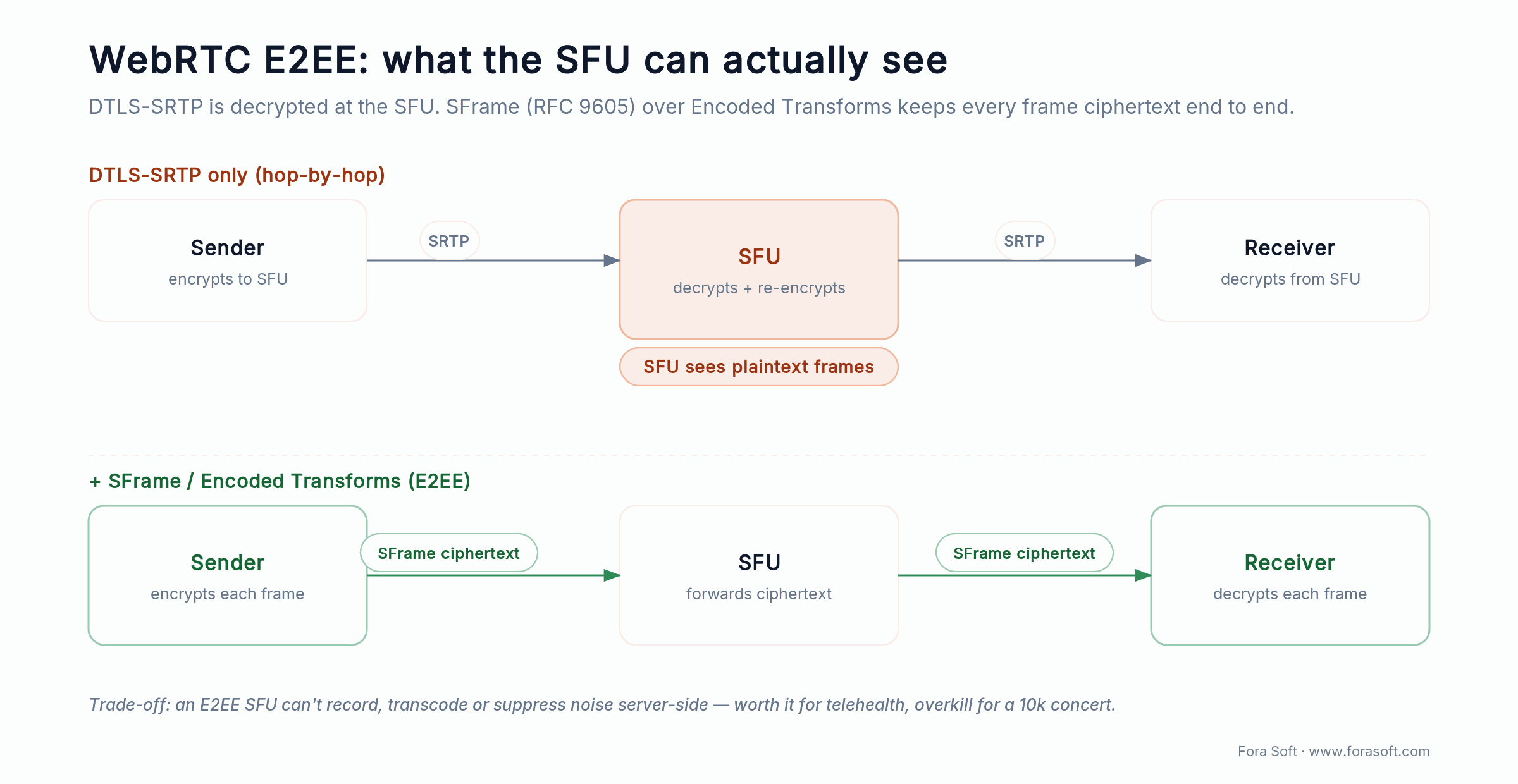
Figure 4. What the SFU can see. DTLS-SRTP is decrypted at the SFU; SFrame (RFC 9605) over Encoded Transforms keeps every frame ciphertext end to end.
The trade-off is real: an E2EE SFU cannot do bandwidth adaptation by inspecting frames, can’t do server-side recording without a participating “recorder bot,” and can’t do server-side noise suppression. For telehealth (HIPAA), legal, and sensitive enterprise meetings, E2EE is worth the trade. For 10,000-viewer concert broadcasts, hop-by-hop DTLS-SRTP plus a hardened SFU is usually the right call.
Reach for SFrame E2EE when: you carry PHI, legal testimony, or board-level conversation through an SFU you don’t want to be able to read — telehealth, e-signing, M&A war rooms. Skip it for one-to-many broadcasts, where a hardened SFU plus DTLS-SRTP protects the media without breaking server-side recording and transcoding.
Storage, monitoring, and key management
The fanciest stack collapses if your ingest bucket is public or your DRM keys live in an un-rotated S3 file. Boring fundamentals, but they’re where breaches start. Twitch’s 2021 leak (~125GB, 6,000 Git repos, 194 AWS keys, 68 Google API keys) was a misconfiguration on internal Git infrastructure, not a video bug but a Git bug that nuked the trust of the whole platform.
Encryption at rest
AES-256 server-side on every storage tier (S3 SSE-KMS, GCS CMEK, Azure Storage Service Encryption). Keys live in a managed KMS or HSM (AWS KMS, GCP Cloud KMS, Azure Key Vault), never in code or config. Rotate quarterly. Separate keys per tier (mezzanine, encoded, packaged, license) so a leak is bounded.
Audit logging and anomaly detection
CloudTrail / Cloud Audit Logs for every API call. VPC Flow Logs for network access. Store at least 90 days hot, 7 years cold for compliance. Pipe into a SIEM (Datadog, Splunk, AWS Security Hub) with alerts on: bulk asset downloads, unusual KMS decrypt patterns, non-CDN egress, and admin console logins outside business hours. Pair with active piracy monitoring on the public internet (Friend MTS, MarkMonitor) so you discover leaks before your studio partner does.
Compliance frameworks you should know
1. GDPR / CCPA. Data residency, right to deletion, lawful basis for analytics. Honour deletion across viewing-history, recommendations, billing, and CRM.
2. COPPA. Kids platforms (under-13 in the US): no behavioural profiling, parental consent, scrubbed analytics. Severe FTC penalties — build it in from day one.
3. HIPAA. Required for any telemedicine video product touching US patient data. Encryption in transit and at rest (end-to-end where an SFU should not see the media), access controls, a BAA with every cloud vendor, audit logs.
4. MPA Content Security (TPN). Required by Hollywood studios for vendors handling pre-release content. Annual audit, hardened ingest, watermarking, restricted physical access. Assessments now run on the TPN+ platform, launched in 2023.
5. SOC 2 Type II. Table-stakes for B2B sales. Plan a 12-month observation window; many of the controls above (KMS, audit logs, MFA, secret rotation) directly map to SOC 2 trust services criteria.
6. PCI-DSS 4.0.1. If you take card payments in-app, PCI-DSS 4.0.1 has been mandatory since 31 March 2025, including Req 6.4.3 controls on payment-page scripts. Keep the billing surface tokenised and off your streaming origin so a compromised player never touches cardholder data.
Cost model: what hardening actually costs
Real numbers, real trade-offs, real budgets. The figures below are blended ranges from the projects we’ve scoped recently. Because we run on agent-engineering pipelines (AI-assisted code generation and review), our integration timelines are noticeably shorter than a typical agency. The hourly cost difference is the same; the elapsed-calendar difference is what makes the bill smaller.
| Layer | MVP cost (year 1) | Premium cost (year 1) | Ongoing |
|---|---|---|---|
| Identity (OAuth + MFA) | Auth0 free up to 25K MAU; Cognito 10K MAU free, then $0.0055–$0.015/MAU (2026) | + passkeys, bot defense ($1K–$5K/mo) | Scales with users |
| Multi-DRM SaaS | ~$100–$300/mo + per-license | $3K–$10K/mo, hardware L1/SL3000 | Volume tier |
| CDN + signed URLs | CloudFront/Cloudflare standard egress | + WAF, bot, DDoS Advanced ($3K–$15K/mo) | Bandwidth-driven |
| Forensic watermarking | Not in MVP | $0.01–$0.10 per session, custom contract | Session-driven |
| Compliance (SOC 2 / TPN) | Optional | $30K–$80K audit + tooling | Annual |
| Integration engineering | ~$30K–$80K (multi-DRM + signed CDN + MFA) | + $40K–$120K (watermark + attestation + E2EE) | Maintenance retainer |
The year-one MVP figure we quote, $50K–$150K, is the $30K–$80K integration engineering above plus twelve months of licensing, CDN security add-ons, QA, and a pen test. Most streaming MVPs ship a credible security baseline for under $150K in year one and run at a few thousand a month. Premium-tier products (live sports, theatrical) push closer to $300K and $20K/month, mostly because of forensic watermarking, hardware-rooted DRM, and TPN audits.
Mini case: securing a 10,000-viewer live concert platform
Situation. The Worldcast Live platform broadcasts paid HD concerts and DJ sets to up to 10,000 concurrent viewers, with sub-second latency, on a custom WebRTC + Kurento stack. The threat: ticketless viewers, link-sharing in Telegram channels, and IPTV restreams that monetise within minutes of show start.
Plan. We built the security stack as a single coherent layer cake: OAuth 2.0 with mandatory MFA at signup, short-lived signed-cookie entitlements per ticket, IP-bound playback for the duration of a single show, ASN/data-center blocking, dynamic visible watermarks (username + show ID + timestamp), and an active piracy-monitoring loop that scrapes Telegram and IPTV aggregators during the show window.
Outcome. The platform delivers sub-second latency at 10K-viewer scale without sacrificing security: every authenticated session is uniquely identifiable, leaked links die within minutes (short-lived WebRTC join tokens, 60-second TTL on HLS fallback), and the operations team can revoke any session live during a show in <3 seconds. The same architecture pattern carries to live sports, ticketed esports, and pay-per-view events.
Want a similar assessment for your platform?
Send your architecture diagram, we’ll come back with a layer-by-layer threat map and a prioritised hardening backlog — free, 30 minutes.
A decision framework: which security layers do you need now
Every product owner asks the same question: how much is enough? Answer it with five questions. Each “yes” bumps you up the stack.
1. Does a single leaked stream cost you >$10K? If yes (live sports, theatrical, premium PPV, broadcast rights), you need forensic watermarking and L1/SL3000 hardware DRM, not just multi-DRM SaaS.
2. Do you license content from third parties (studios, leagues, distributors)? If yes, your contract dictates the floor: CMAF/CBCS, multi-DRM, geo-blocking, anti-piracy monitoring, and often MPA-TPN audit. Build to the contract, not to your own threat model.
3. Is your product subscription-based with shared accounts as a risk? If yes, concurrent-stream limits via DRM heartbeats, device binding via App Attest/Play Integrity, and an explicit account-sharing policy in T&Cs. Netflix-style household enforcement is overkill for most; a 4-device cap usually is enough.
4. Are you touching regulated data (PHI, kids, EU residents)? Compliance dictates architecture: HIPAA requires risk-based safeguards (encryption in transit and at rest is the norm) and BAAs, with E2EE as a strong option; COPPA forces analytics scrubbing; GDPR forces deletion plumbing. Get this right at design time — retrofitting compliance is two to five times more expensive.
5. Are you a launch-stage MVP or a scale-stage product? MVP: nail identity (MFA), transport (TLS 1.3), packaging (CMAF/CBCS multi-DRM), and signed delivery. Defer watermarking, attestation, E2EE, and TPN audits until you have revenue. Scale stage: harden in priority order based on questions 1–4.
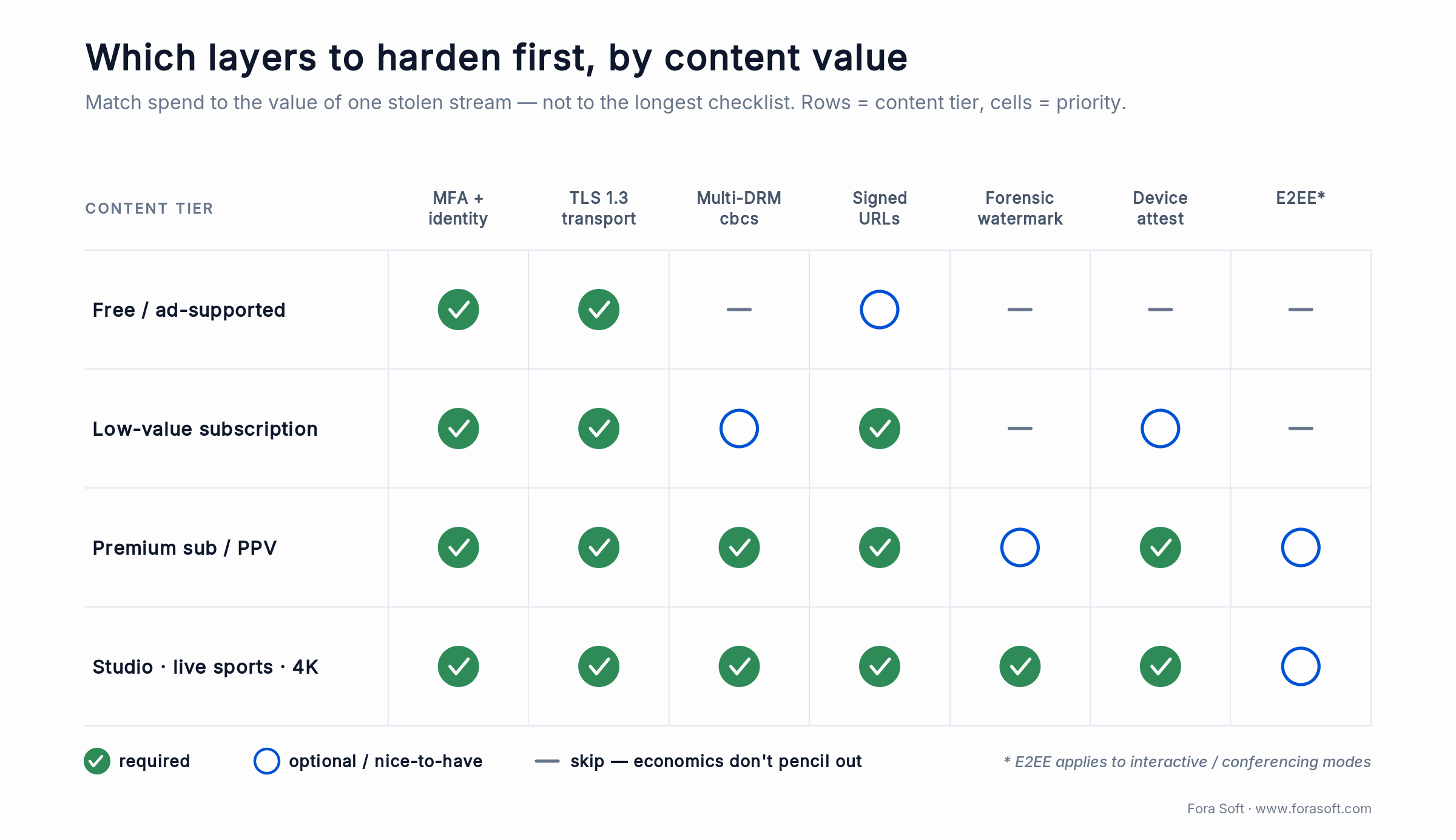
Figure 5. Match hardening to the value of one stolen stream: required, optional or skip for each content tier.
Before you sign a multi-year streaming platform contract: 8 checks
If you are choosing a video platform or video CMS rather than building, check these before you commit. Each one is hard to add later:
- Audience authentication. SSO or OIDC with your own identity provider, MFA, and passkeys, not just a password on the player.
- Entitlement-bound playback. Signed URLs or tokens minted by your backend after an entitlement check, with an expiry you control.
- Multi-DRM. Widevine, FairPlay and PlayReady, with hardware-level (L1/SL3000) policies for premium tiers.
- Watermarking. Visible dynamic overlays at minimum; forensic marks if one leaked stream costs you more than $10K.
- Encryption and keys. Encryption at rest with customer-managed or per-tenant keys, and a key-rotation policy.
- Audit logs and permissions. Exportable logs of admin, upload and playback events; role-based permissions per workspace.
- Compliance paperwork. SOC 2 Type II report, a HIPAA BAA if you carry patient video, GDPR data-residency options.
- Exit path. Bulk export of masters, captions and metadata, so the security stack is not also a lock-in.
Already live and not sure where the gaps are? A security and architecture code audit reviews your streaming code, keys and infrastructure and returns every issue with the file, line and fix.
Five pitfalls that quietly kill streaming security
1. Shipping unencrypted HLS “just for the MVP.” Plain HLS without DRM or signed URLs is one yt-dlp command from a clean MP4. If the content is paid, this is technical debt with interest. Use HLS AES-128 + signed URLs at minimum, even for closed-beta.
2. 24-hour signed URL TTLs. Convenient for caching, fatal for security. A single Discord paste lasts a day; you’ve donated a stream. Cap at 5–15 minutes, refresh server-side via signed cookies.
3. Hardcoded keys and secrets in client or repo. Twitch’s 2021 leak exposed 194 AWS keys and 68 Google API keys via an internal Git misconfiguration. Use KMS, scan repos with TruffleHog/GitGuardian, rotate quarterly.
4. MFA “optional.” Optional MFA is statistically off. Make it mandatory at signup, especially before any monetisation event. MFA’s 99.22% lower compromise risk (Microsoft Research, 2023) is the highest-ROI line item in your roadmap.
5. No incident-response plan. When (not if) you get breached, you have hours to revoke keys, rotate tokens, force re-auth, notify users, and brief regulators. A printed runbook plus a tabletop drill once a quarter is the difference between a Plex-style controlled disclosure and an HBO-style ransom headline.
KPIs: what to measure
1. Quality KPIs. License-issuance latency (P95 <200 ms), playback start-up time with DRM (P95 <3 s), watermark embed overhead (<3% bitrate inflation). If security latency degrades QoE, users churn faster than pirates steal.
2. Business KPIs. Account-takeover rate (target: <0.1%/MAU/month), credential-sharing detected (concurrent-stream rejections), unique forensic watermark detections per piracy report (1:1 traceability), CDN abuse 403 ratio (signed-URL violations / total requests).
3. Reliability KPIs. License-server uptime (99.99%), DDoS mitigation actions per quarter, time-to-revoke a compromised session (target: <5 s), KMS key rotation compliance (100% on schedule), audit-log completeness (zero gaps over rolling 90 days).
When NOT to over-build security
Free, ad-supported content with no exclusivity contract doesn’t need multi-DRM. The piracy economics don’t pencil out for the attacker either. Closed enterprise webinars on a single-tenant SaaS rarely need forensic watermarking. Internal corporate training behind SSO doesn’t need geo-blocking.
Over-building has a real cost: license fees, latency, support tickets, integration time, and worst of all, false confidence that distracts you from the actual weak point (usually identity). The honest answer to “do we need DRM?” is “what is one stolen stream worth?” If the answer is single dollars, you need signed URLs and MFA, not Widevine L1.
FAQ
What is secure video streaming?
Secure video streaming is delivering video so that only entitled viewers can fetch and decrypt it, on trusted devices, with every leaked copy traceable to one account. It combines MFA or passkeys, TLS 1.3, multi-DRM, short-lived signed URLs, device attestation, forensic watermarking and encrypted storage.
How do I issue short-lived playback links after an entitlement check?
Have your backend check the subscription, then sign a playback token or URL for that viewer with a 5–15 minute expiry for VOD and 60–120 seconds for live. CloudFront signed URLs or cookies, Cloudflare Stream signed tokens, Mux signed playback IDs and Amazon IVS private channels all support this; set the expiry yourself, because defaults can be an hour or more.
Which encryption, audit-log and permission features matter most in a secure streaming platform?
Multi-DRM with hardware-level policies, encryption at rest with managed keys and rotation, exportable audit logs for admin and playback events, and role-based permissions. Add SSO/MFA for viewers and a SOC 2 Type II report before you sign a multi-year contract.
Do I really need three DRMs, or is just Widevine enough?
Widevine alone covers Chrome, Firefox, Android, and most smart TVs. Without FairPlay, every Apple device falls back to plain HLS or shows an error; without PlayReady, you lose Edge legacy, Xbox, and many smart-TV apps. For a paid streaming product, three DRMs are mandatory. CMAF + CBCS lets you ship one set of files to all three, so the cost difference is mostly license-server fees.
What is the cheapest credible security baseline for a paid streaming MVP?
Multi-DRM SaaS (EZDRM, BuyDRM, Mux DRM, or Bitmovin entry-level) ~$100–$300/month + per-license; OAuth 2.0 with mandatory MFA via Auth0 or Cognito; CloudFront or Cloudflare with signed URLs and 5–15-minute TTL; AES-256 at rest with AWS KMS. Total Year-1 budget including integration: $50K–$150K. That’s the floor; everything else is optimization on top.
How do I prevent concurrent stream sharing without breaking legitimate household use?
Allow 3–4 concurrent streams per account (industry norm). Enforce via DRM license heartbeats, not player heartbeats — the DRM module on a hardware key is much harder to spoof. Bind sessions to device IDs via App Attest (iOS) and Play Integrity (Android). For premium tiers, drop to 1–2 streams and add geo-clustering checks (sessions in two distant cities at once flag for review).
Is HLS AES-128 the same as DRM?
No. HLS AES-128 encrypts the segments but the decryption key is fetched over HTTPS; any authenticated client can save it and decrypt offline. Real DRM (Widevine, FairPlay, PlayReady) issues a license tied to a hardware-backed CDM with policy (expiration, output protection, persistence). HLS AES-128 is a useful low-grade obfuscation for low-value content; for anything paid, it is not DRM.
How do I add end-to-end encryption to a video conference SFU?
Use Insertable Streams (RTCRtpScriptTransform) in the browser to encrypt frames before they enter the SRTP stack, with a Web Worker doing AES-GCM. SFrame (RFC 9605, published August 2024) standardises the encrypted frame format; browsers give you the Encoded Transforms hook (Baseline since October 2025), and you supply the SFrame layer plus key management such as MLS. Trade-off: an E2EE SFU loses bandwidth-adaptation hooks and server-side recording. For HIPAA telemedicine and legal video, the trade is correct; for 10K-viewer broadcasts, hop-by-hop DTLS-SRTP is usually sufficient.
How long should a signed-URL TTL be for live vs VOD?
For live: 60–120 seconds, scoped to the segment time horizon. For VOD: 5–15 minutes per token, refreshed via signed cookies for the entitlement window. Anything over 30 minutes is a piracy gift — the link will outlive the user’s screen-record session and end up shared. Bind to the requester’s IP for premium PPV; bind to a device-derived nonce for normal subscription playback.
Does my video streaming app need SOC 2 or MPA-TPN?
SOC 2 Type II is table-stakes for B2B streaming SaaS — enterprise procurement teams ask for it before they’ll sign. Plan a 12-month observation window. MPA-TPN (now TPN+) is required if you handle pre-release Hollywood content; it covers ingest hardening, watermarking, physical security, and personnel checks. If you’re doing direct-to-consumer streaming with your own catalog, neither is mandatory but both make sales easier.
What does forensic watermarking actually catch in practice?
Session-level forensic watermarks survive transcoding, screen recording, recompression, and streaming through Telegram/IPTV networks. When piracy-monitoring partners (Friend MTS, NAGRA Active Streaming, MarkScan) detect a leaked stream, they extract the watermark and your operations team gets back the exact subscriber ID and session ID that originated the leak. From there: revoke, suspend, lawsuit, or referral to a content-protection vendor. For premium live sports, watermark-to-revocation is typically 5–15 minutes inside a single match.
What to Read Next
Partner selection
Video Streaming App Development: Choosing the Right Partner
How to evaluate a streaming-app vendor on architecture, security, and delivery cost.
Architecture
P2P vs MCU vs SFU for Video Conferencing
Which architecture sees decrypted media, and how to layer in end-to-end encryption.
Tech stack
Best Technologies for Video Streaming Apps
CMAF, HLS, WebRTC, DRM — how today’s streaming stack fits together.
Cost
Video Platform Development Cost
A budget breakdown that includes the security, DRM, and CDN layers most estimates skip.
Foundation
What Is WebRTC?
A primer on the protocol behind sub-second video, including its built-in encryption.
Ready to ship a video streaming app you can defend?
Secure video streaming isn’t a single feature. It’s a stack. Identity blocks credential stuffing. Transport blocks passive observers. Multi-DRM blocks rippers. Signed URLs block link-sharing. Watermarks trace what slips through. App attestation kills the patched-player path. Storage and KMS keep the keys away from your repo. Compliance keeps the studios and regulators on side. Skip a layer, attackers find that layer.
If you’re scoping a new platform, harden a launched one, or trying to translate a studio contract into actual architecture, the fastest path is a 30-minute call with someone who has shipped this stack repeatedly. We’ll bring our checklist; you bring the threat model.

The book · Volume 3 of 7
Video Streaming: A Complete Guide to Video Delivery: From ABR and CDNs to Players, WebRTC, DRM, and the Economics of Streaming
Multi-DRM, signed URLs and watermarking protect the stream, and each one sits inside the delivery chain. Volume 3 covers DRM alongside ABR, CDN caching, players, WebRTC and the economics of delivery, so security choices can be weighed against playback, device coverage and egress cost. Written by Nikolay Sapunov, CEO at Fora Soft.
Read it on Amazon →Kindle & paperback · Fora Soft Video Engineering Handbook
Let’s harden your video streaming app together
20+ years of multimedia engineering, 250+ shipped products, and an honest opinion on whether you actually need the expensive layer. One call.

