

Key takeaways
• Architecture is the first decision, not the framework. Real-time interaction (calls, auctions, betting) means WebRTC and sub-500ms latency; a large passive audience means HLS/DASH at 5–30s over any CDN. Most funded products end up hybrid.
• The cloud bill hides in two stages. Transcoding and CDN egress scale with every quality rung and every viewer-minute. Budget them at 25–40% of build cost. A CDN swap alone can move a monthly bill 8×.
• Vet for shipped scale, not slideware. Ask for a named live app with real concurrency, the hardest scaling bug they fixed, and a client you can call. Vague answers are the tell.
• Get IP assignment and escrow in writing. No 100% IP transfer or code escrow means one bankruptcy away from losing your app. This is non-negotiable, not a nice-to-have.
• Pick the model to the risk. Fixed-bid for a locked MVP scope, dedicated team for open-ended scale, staff augmentation to fill a gap in a team you already trust.
Why Fora Soft wrote this guide
Choosing the wrong video streaming app development partner is an expensive mistake you only notice at month four: the encoder chokes under load, DRM was skipped, and the code is too tangled to scale. Picking the right team compresses the timeline and hands you an app that survives its own launch. This guide is the checklist and the technical depth we wish every founder had before they signed.
Fora Soft has built video and real-time communication products since 2005 — 250+ projects, 50 in-house engineers, a 100% job-success score on Upwork. We shipped TradeCaster, a trader-livestreaming platform now serving 46,000+ users at sub-second latency, scaled BrainCert past 500 million classroom minutes, and built CirrusMED’s HIPAA-compliant telehealth video. We have also inherited enough half-broken streaming stacks to know exactly where they crack. That is the lens for everything below.
Weighing a video streaming app development company?
Bring us your use case, target scale and timeline. Thirty minutes, a straight technical read, no pitch.
What video streaming app development actually covers
Video streaming app development is building the software that captures, processes, protects and delivers video to viewers on phones, browsers and TVs — plus the backend that keeps it playing under load. It splits into three product shapes, and the shape decides most of the engineering.
Video on demand (VOD) serves a pre-encoded library — think a course catalog or a Netflix-style app. Live streaming app development handles real-time ingest and delivery, from a single broadcaster to a stadium feed. Hybrid apps do both: live events that become on-demand replays, the pattern most OTT products land on. A music or audio app is the same pipeline with a lighter payload.
None of these is a weekend framework choice. Each one drags in encoding, adaptive bitrate, a content delivery network, digital rights management and player engineering across iOS, Android and web. If you want the ground-up mechanics, our Learn: Video Streaming section walks the whole pipeline; this guide stays on the build-and-hire decisions.
Pick your streaming architecture first
The first real fork is not iOS versus Android. It is latency. How fast video must travel from camera to screen decides your protocol, and the protocol decides your cost and scale ceiling. Get this right and everything downstream gets easier.
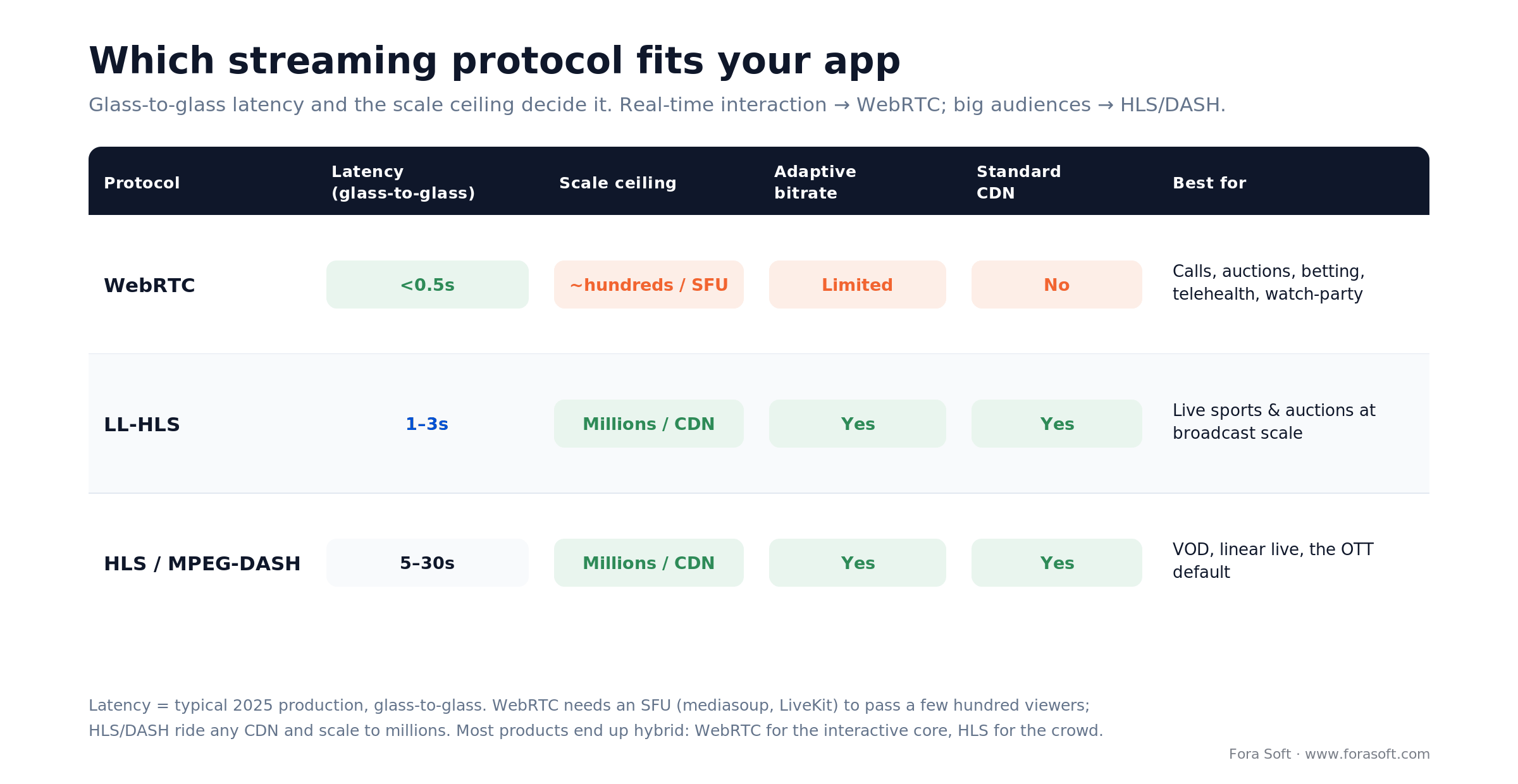
Figure 1. How glass-to-glass latency and scale ceiling separate WebRTC from LL-HLS and HLS/DASH.
WebRTC delivers glass-to-glass latency under 500 ms, often under 200 ms, which is the only option when viewers talk back: video calls, telehealth, live auctions, sports betting, interactive classrooms. The catch: WebRTC does not ride a standard CDN and needs a selective forwarding unit (an SFU such as mediasoup or LiveKit) to pass a few hundred concurrent viewers.
Reach for WebRTC when: viewers interact in real time and you can accept an SFU tier to scale — conferencing, telehealth, auctions, betting, watch-parties under a few thousand concurrent per room.
HLS and MPEG-DASH chop video into segments any CDN can cache, so they scale to millions of viewers cheaply, at the price of 5–30 seconds of latency. Low-Latency HLS (LL-HLS) narrows that to a reliable 1–3 seconds, close enough for live sports and auctions at broadcast scale. These are the OTT default for a reason.
Reach for HLS/DASH when: a large, mostly passive audience matters more than sub-second latency — VOD, linear live, and any product that has to reach millions without an SFU fleet.
A partner who cannot draw this trade-off in the first call will pick the protocol they already know instead of the one your product needs. If your build is conference-shaped, our breakdown of P2P vs MCU vs SFU architecture goes a level deeper.
The five stages inside every streaming app
Every streaming product, whatever the protocol, is the same five-stage pipeline. Knowing the stages lets you ask a vendor precise questions instead of trusting a demo.
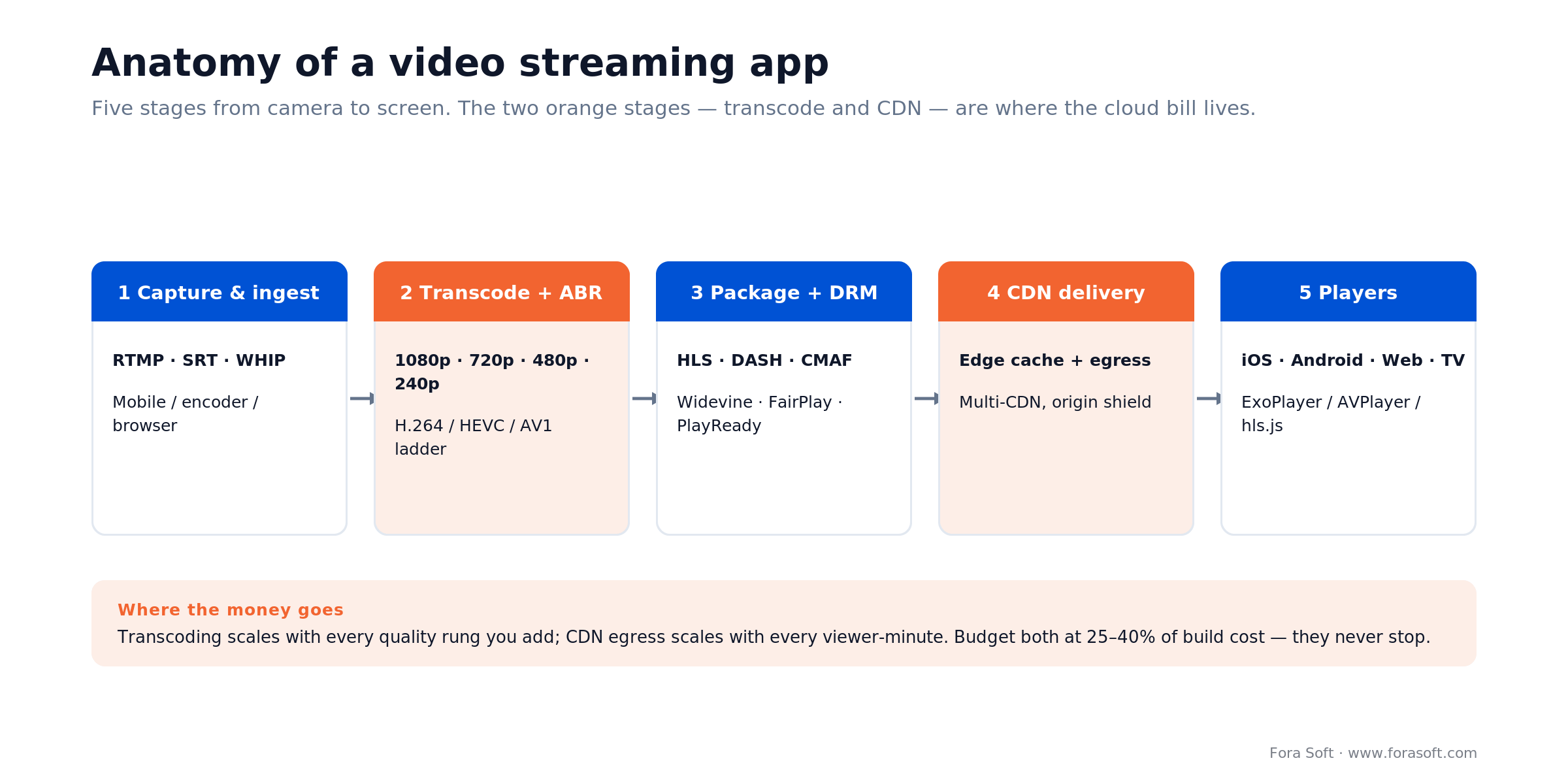
Figure 2. The five stages from camera to screen; transcoding and CDN egress are the two that dominate the cloud bill.
1. Capture and ingest. Video arrives over RTMP, SRT or WHIP from a mobile app, a hardware encoder or a browser. 2. Transcode and adaptive bitrate (ABR). The source is re-encoded into a ladder of qualities (1080p, 720p, 480p, 240p) so the player can drop down on a weak network instead of buffering. 3. Package and protect. Segments are wrapped as HLS, DASH or CMAF and, for premium content, encrypted with DRM. 4. CDN delivery. Edge servers cache segments near viewers. 5. Players. ExoPlayer on Android, AVPlayer on iOS, hls.js and Shaka on the web, plus the smart-TV variants.
The two orange stages carry the recurring cost. Transcoding scales with every quality rung you add; CDN egress scales with every viewer-minute. Neither ever stops, which is why we budget both at 25–40% of build cost from day one, not as a launch-week surprise.
Must-have engineering skills to check for
A credible video streaming app development company should be able to speak to each of these without reaching for a glossary. If they hand-wave, that is your answer.
Protocols and low-latency delivery
WebRTC (STUN/TURN/ICE, SFU scaling) for interaction; HLS, LL-HLS, DASH and CMAF for scale. The senior on your account should explain when they would bridge WebRTC to HLS rather than pick one — the pattern behind most large interactive events.
Codecs and DRM
H.264, HEVC and AV1 on the encode side (see the codec math below), and multi-DRM on the protect side. Premium or regulated content needs Widevine for Android and Chrome, FairPlay for Apple devices, and PlayReady for Windows and Xbox. One system never covers every device; a partner who says “we’ll add DRM later” is planning a rewrite.
CDN, mobile and backend scale
CDN selection and multi-CDN failover, mobile players that survive spotty networks and battery limits, and a backend that separates encoding, manifest generation, analytics and player logic so one hot path does not take down the rest. Security is part of this, not a bolt-on — our guide to secure video streaming covers the stack that actually holds.
Codec and bitrate economics
Codec choice is a direct line on your CDN invoice, because fewer bits per second means fewer gigabytes delivered. Here is the arithmetic on one 4K stream, matched for quality:
- H.264 / AVC — the universal baseline every device decodes: about 16 Mbps for 4K.
- HEVC / H.265 — roughly 50% smaller: about 8 Mbps for the same quality, but with licensing to manage.
- AV1 — royalty-free and about 30% more efficient than HEVC, which is roughly half the bitrate of H.264: about 5–6 Mbps. Netflix reports quality parity with HEVC at around 20% lower bitrate.
Cutting the bitrate cuts your egress bill by roughly the same proportion. The catch is device support: AV1 hardware decode landed on flagships in 2022–2023 (Snapdragon 8 Gen 2, Apple A17 Pro and M3) and is common on 2023-and-newer phones, but absent on older hardware, so mixed audiences still need a dual-codec ladder (HEVC plus AV1, H.264 as the floor). We wrote a full field guide on when AV1 actually saves money if this is your cost driver.
Reach for AV1 when: 90%+ of your audience is on 2023+ hardware and egress is your biggest line item; otherwise ship a dual-codec ladder and let the player pick.
The delivery cost nobody quotes upfront
Build quotes cover engineering hours. They rarely cover the bill that arrives every month after launch: CDN egress. It is the single most under-estimated number in streaming, so here is a worked example you can hold a vendor to.
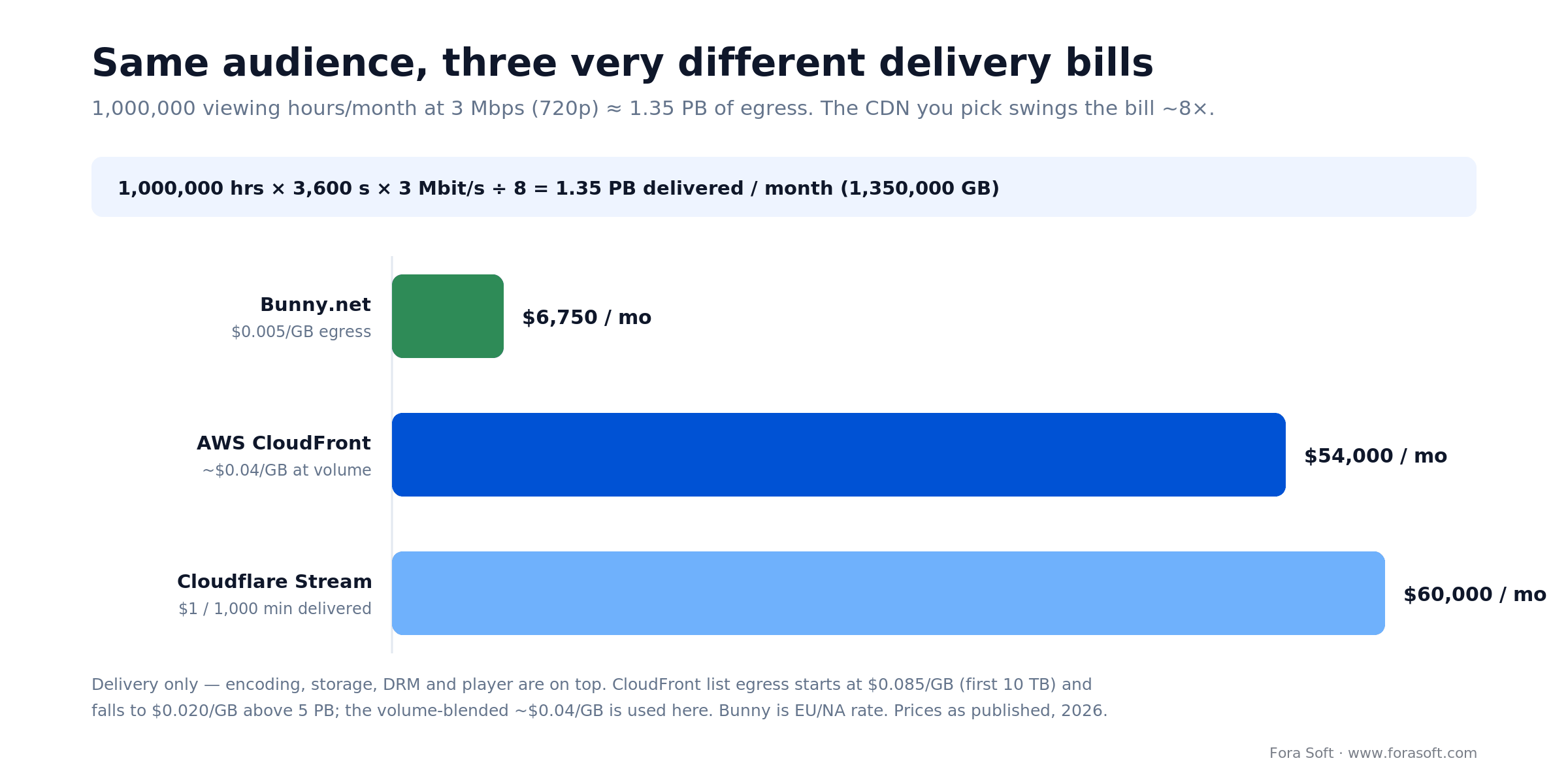
Figure 3. Delivery cost for the same 1M viewing hours a month swings roughly 8x by CDN choice.
Take 1,000,000 viewing hours a month at 3 Mbps (a 720p stream). That is 1,000,000 × 3,600 s × 3 Mbit/s ÷ 8 ≈ 1.35 PB of egress, or 1,350,000 GB. Now price the delivery three ways with 2026 published rates:
- Bunny.net at $0.005/GB (EU/NA) → about $6,750/month.
- AWS CloudFront at a volume-blended ~$0.04/GB → about $54,000/month (list egress starts at $0.085/GB for the first 10 TB and falls to $0.020/GB above 5 PB).
- Cloudflare Stream at $1 per 1,000 minutes delivered → about $60,000/month, though that price bundles encoding, storage and the player.
Same audience, an 8× swing in the bill. The point is not that one CDN wins. It is that a partner who quotes a build price without a delivery model is hiding your largest running cost. Ask for the egress math before you sign. If cost is the whole question, our dedicated guides to video streaming app development cost and video platform development cost break it down further.
Reach for a managed video platform when: you want to launch this quarter and delivery volume is still small — Mux, Cloudflare Stream or Vimeo OTT trade per-minute fees for zero infrastructure. Move to a raw CDN once egress dwarfs the platform premium.
Engagement models compared
The contract shape decides who carries the risk when scope moves. There is no universally right model — there is the one that fits how well you can define the work today.
| Model | Best for | Typical range | Who carries risk |
|---|---|---|---|
| Fixed-bid | A locked MVP with a written scope | $50K–$250K per milestone | Vendor — but they may cut corners if they under-bid |
| Time & materials | Exploration, unclear scope, R&D | $15K–$40K / month | You — budget can drift without tight scope control |
| Dedicated team | Long-term, evolving product | $30K–$80K / month (3–5 engineers) | Shared — you own the backlog, they own delivery |
| Staff augmentation | Filling one skill gap in your team | $60–$150 / hour per person | You — you manage them day to day |
| Hybrid | Fixed-bid MVP, then a dedicated team | $80K MVP + $40K/mo scale | Shifts from vendor to shared after launch |
Reach for fixed-bid when: your scope is genuinely locked and you value cost certainty over flexibility; reach for a dedicated team the moment the roadmap is still moving.
Not sure which engagement model fits your build?
We’ll map your scope, risk and timeline to the model that protects your budget — and tell you if you don’t need us yet.
Rate geography: onshore, nearshore, offshore
Where your team sits sets the rate and the timezone friction. The honest read in 2026:
Onshore (US-based): $150–$200/hour. Best for tight regulatory work and same-timezone collaboration; the most expensive way to buy engineering hours. Nearshore (Western Europe, Canada, Latin America): $100–$140/hour. A common balance — strong English, workable overlap, meaningfully lower cost. Offshore (Eastern Europe, South and Southeast Asia): $50–$80/hour. The biggest savings, with timezone and oversight overhead you have to manage with clear acceptance criteria.
For a $100K streaming MVP, a strong nearshore team often delivers onshore-grade quality at a real discount. The variable that actually predicts outcomes is not the flag on the invoice. It is whether senior engineers with streaming scars are on your account, or whether you were sold seniors and staffed juniors.
Reach for nearshore when: you want most of the cost saving without night-shift standups — and always confirm the named seniors from the pitch are the ones writing your code.
How to vet a video streaming app development company
Do not read the portfolio — interrogate it. Three questions separate teams that have shipped streaming at scale from teams that have watched a tutorial.
1. Name a live app with real concurrency. A team that has done this offers two or three production apps with verifiable users — App Store listings, named clients, a concurrency number they will stand behind. “We built something like that” is not an answer.
2. What was the hardest scaling bug you fixed? Listen for specifics: DRM key rotation under load, ABR ladder switching that stuttered during a live event, TURN server exhaustion, CDN cache-miss storms. War stories are proof of production time.
3. Can I talk to a recent client in this domain? References in your vertical, willing to take a call, are the strongest signal there is. A team confident in its work makes this easy.
The green flags worth trusting
A partner worth signing explains WebRTC or DRM without a glossary and shows code or a live demo; names production apps with numbers instead of adjectives; raises IP assignment and escrow before you ask; and quotes a delivery cost model, not just a build price. When we hand over projects like Worldcast Live, the client can call the last three before they call us. That is the bar.
Red flags: when to walk away
1. Vague technical answers. “We use standard libraries” where you needed “we run an SFU with simulcast and here is why” means they will learn on your budget.
2. No IP assignment or weak escrow. If the contract lets them keep the code or skips escrow, you are one bankruptcy away from losing your product.
3. QA farmed to a third party. In streaming, defects hide across encoding, network and device layers; splitting QA off diffuses ownership and misses them.
4. No named app with real users. A team that will not point to a single production streaming app with a concurrency number is hiding the absence of one.
5. No SLA, or a vague one. “We try our best” is not an uptime commitment. Streaming is uptime-critical; you need numbers and remedies.
Contract essentials: IP, escrow, and SLAs
IP assignment. The contract must transfer 100% of the code IP to you. “Shared ownership” or a “limited license” creates a future hostage situation.
Code escrow. A third-party escrow agent releases source, build scripts and infrastructure docs if the vendor is acquired or folds. It costs $1K–$3K and is cheap insurance against a single point of failure.
Audit rights and NDAs. You should be able to audit code, infrastructure and security practices, protected by a mutual NDA — not a one-sided one that only shields the vendor.
Termination and SLAs. Exit on 30–60 days notice with a clean handover, and a written service level: uptime target (99.5% or 99.9%), critical-bug response time, and what happens — credits or penalties — when it is missed.
Cost expectations from POC to enterprise
Rough 2026 ranges for a nearshore team, so you can sanity-check a quote. Onshore runs 1.5–2× higher; offshore lower with more oversight. These are build costs — the CDN and transcoding bill from the delivery-cost section sits on top.
| Tier | What you get | Typical build | Timeline |
|---|---|---|---|
| Proof of concept | One core flow, no DRM, single region | $25K–$50K | 4–6 weeks |
| MVP | iOS + Android + web, basic DRM, 10K–100K users | $80K–$200K | 14–20 weeks |
| Scale / beta | Global CDN, multi-DRM, analytics, recommendations | $250K–$500K | 20–28 weeks |
| Enterprise | HIPAA/PCI, failover, white-label, 500K+ concurrent | $750K–$2M+ | 28–40+ weeks |
We keep these deliberately conservative. Fora Soft leans on reusable WebRTC, HLS and DRM components and AI-assisted engineering, so our estimates tend to land below the market ranges above rather than above them — but any number we are unsure of, we would rather scope with you than print here.
Mini-case: shipping TradeCaster to 46,000 traders
The situation. TradeCaster needed live trader broadcasts where a host’s market call reaches thousands of viewers fast enough to act on — a few seconds of latency would make the stream useless. Passive HLS was too slow; naive WebRTC would not reach the audience size.
The plan. We built the interactive core on WebRTC with an SFU so a broadcaster could fan out to a large room at sub-second latency, and engineered the delivery path to hold that latency as the room grew. Chat, presence and the trading overlays rode alongside the video rather than fighting it for bandwidth.
The outcome. TradeCaster now serves 46,000+ users with sub-second latency on live trading streams. The lesson generalizes: the architecture decision from section three, interactive means WebRTC and WebRTC means an SFU, is what made the product possible. Want a similar read on your own build? Book a 30-minute scoping call.
A decision framework in five questions
Before you sign anything, answer these. They also double as the tree we walk with clients on the first call.
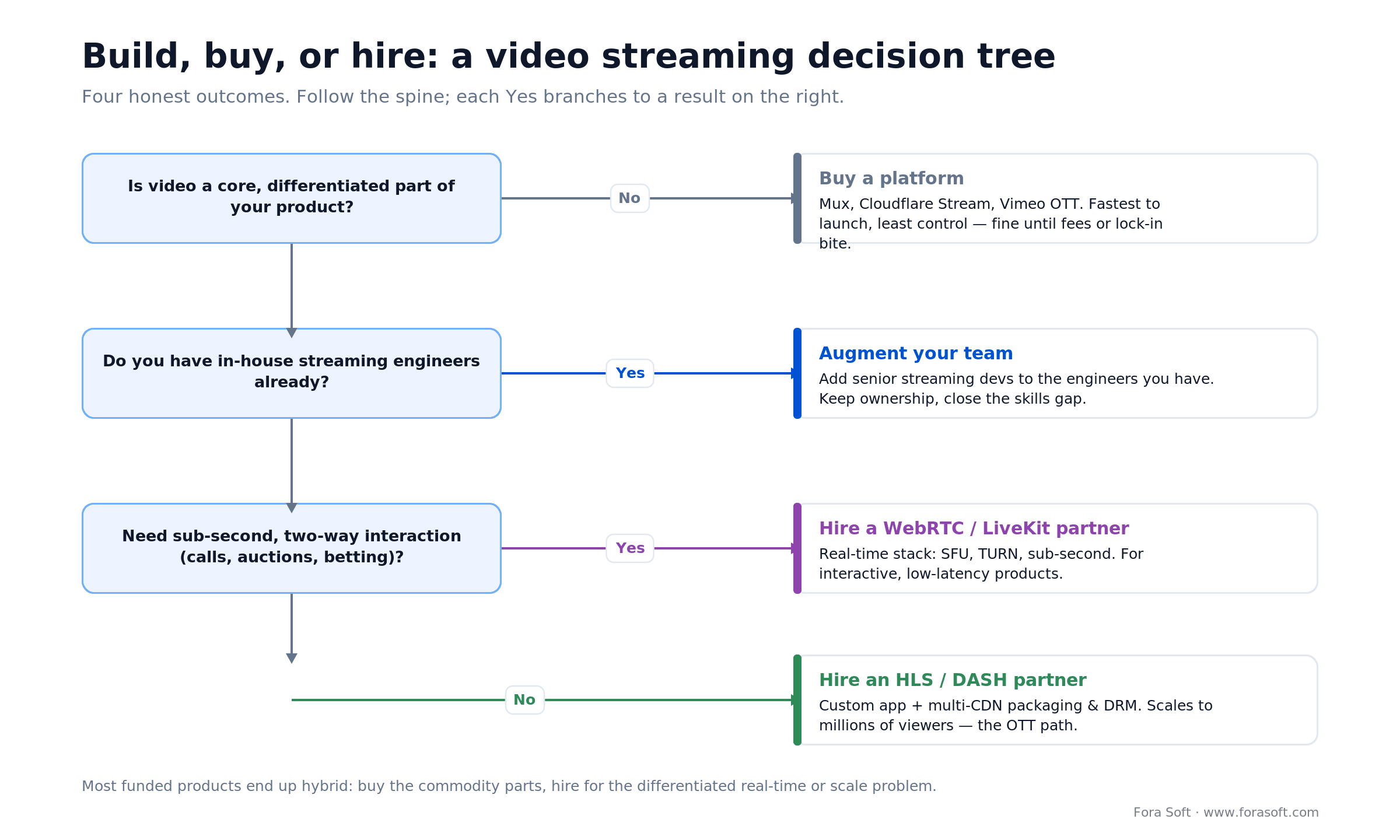
Figure 4. Build, buy, or hire: four honest outcomes depending on how differentiated and interactive your video is.
Q1. Is video a core, differentiated part of your product? If not, buy a platform (Mux, Cloudflare Stream, Vimeo OTT) and move on. If yes, keep going.
Q2. Do you already employ streaming engineers? If yes, staff augmentation keeps ownership in-house while closing the gap. If no, you are hiring a partner — which kind depends on Q3.
Q3. Do you need sub-second, two-way interaction? Yes points to a WebRTC/LiveKit partner; no points to an HLS/DASH partner who can scale you to millions.
Q4. Will they assign 100% IP and include escrow? A no here ends the conversation, whatever the rate.
Q5. Can they show a live app and a reference in your domain? If not, you are their experiment. Keep looking.
Want a second opinion before you sign?
We’ll pressure-test a vendor’s scope, architecture and cost model against what we’ve shipped — and flag the gaps for free.
Five mistakes that wreck launch timelines
1. Treating infrastructure as an afterthought. CDN setup, DRM licensing and encoding tuning are weeks of work, not a launch-week toggle. Teams that plan them last ship late.
2. Changing the protocol mid-build. Switching HLS to DASH — or bolting WebRTC onto an HLS app — after the manifest layer is built is a partial rewrite. Lock the architecture in the statement of work.
3. Deferring DRM to beta. DRM touches packaging, players and key servers. Added late, it is a 3–4 week rework; planned upfront, it is a config.
4. Thin communication. No weekly progress, blockers and risk report means you find the surprises at the milestone gate, when they are expensive.
5. Testing mobile last. Most viewers watch on a phone. Skip real-device testing on iOS and Android and you ship the latency, battery and DRM bugs that never appear on a laptop.
When not to build a custom streaming app
Honesty sells better than a pitch, so here is when custom development, ours or anyone’s, is the wrong call.
When a platform already fits. If your needs map cleanly onto Mux, Cloudflare Stream, Vimeo OTT or a white-label OTT product and volume is modest, buy it. Custom pays off when platform fees or lock-in start to hurt, usually past 100K active users or a feature the platform will not build.
When the differentiator must stay in-house. If your streaming or recommendation algorithm is the moat, keep it on your own team and outsource only the commodity layers around it.
When you ship weekly with your own team. Very fast internal iteration can outrun the coordination cost of any external partner. In that case, augment a gap rather than hand off the product.
FAQ
How much does video streaming app development cost in 2026?
A proof of concept runs $25K–$50K, an MVP $80K–$200K, and a scale build $250K–$500K at nearshore rates, with enterprise work $750K–$2M+. Those are build costs; CDN egress and transcoding are a separate monthly bill you should model before signing.
How long does it take to build a video streaming app?
A single-flow proof of concept takes 4–6 weeks; a production MVP across iOS, Android and web typically 14–20 weeks; a global, multi-DRM scale build 20–28 weeks. Timelines stretch fast if the protocol or DRM decision is left open.
Is WebRTC or HLS the right protocol for a streaming app?
Pick WebRTC when viewers interact in real time and latency must stay under about 500 ms (calls, auctions, telehealth); pick HLS or LL-HLS when a large, mostly passive audience matters more, accepting 1–30 seconds of latency. Many products run both.
How do I choose a video streaming app development company?
Ask for a named live app with real concurrency, the hardest scaling bug they fixed, and a reference in your domain. Confirm 100% IP assignment and code escrow in the contract, and require a delivery cost model, not just a build quote.
What does it cost to deliver video once it is live?
CDN egress dominates. One million viewing hours a month at 3 Mbps is about 1.35 PB, roughly $6,750 on Bunny.net, $54,000 on AWS CloudFront at volume, or $60,000 on Cloudflare Stream. Switching the codec from H.264 to AV1 can roughly halve it.
Do I need DRM for my video streaming app?
Yes, if content is premium, licensed or regulated. Full device coverage needs multi-DRM: Widevine for Android and Chrome, FairPlay for Apple, PlayReady for Windows and Xbox. Plan it from the start — retrofitting DRM in beta is a multi-week rework.
Should I build a custom app or use a platform like Mux or Vimeo?
Buy a managed platform to launch fast while volume is small; build custom once platform fees or lock-in bite, usually past 100K active users or a feature the platform will not support. Many teams start managed and migrate to a custom CDN path later.
Can you build a video streaming app on React Native or Flutter?
Yes for the app shell and UI, and both are common for cross-platform streaming front ends. The streaming core (players, DRM, ABR) still leans on native components such as ExoPlayer and AVPlayer bridged in, which is exactly the kind of work to confirm a vendor has done before.
What to read next
Cost
Video Streaming App Development Cost
A 2026 CTO pricing guide from MVP to enterprise.
Architecture
How to Build a Netflix-Style Platform
VOD architecture: ABR, CDN and DRM that scale.
Encoding
Video Encoding 101
Codecs, bitrate and ABR — the layer under every stream.
Security
Secure Video Streaming
DRM, encryption and access control that actually hold.
Real-time
P2P vs MCU vs SFU
Which real-time topology fits interactive video.
Ready to build your video streaming app?
Pick the architecture before the framework: interactive means WebRTC and an SFU, scale means HLS or LL-HLS over a CDN, and most products end up hybrid. Model the delivery bill before you sign, because a CDN choice can move it 8×. And vet the company on shipped scale and a signed IP-and-escrow clause, not on a slide deck.
Do that and video streaming app development stops being a gamble and becomes a plan. Fora Soft has shipped this pipeline for 250+ projects since 2005, from sub-second trader streams to HIPAA telehealth, and we are happy to tell you when you don’t need us.
Let’s scope your video streaming app
Bring your use case, target scale and timeline. We’ll give you an architecture, a realistic cost model and a straight answer — in 30 minutes.

