

Key takeaways
• A video conferencing solution is a workflow, not a feature list. The parts that move retention in 2026 are the ones that fit a real meeting: persistent rooms, in-meeting docs and whiteboard, AI captions and summaries, breakout rooms, and a mobile experience that survives a flaky LTE link.
• Pick the media stack by latency budget. WebRTC over an SFU (300–500 ms) for two-way collaboration; LL-HLS / CMAF (2–5 s) for one-to-many broadcast; a SIP / PSTN bridge if you sell into healthcare, legal or contact-centre buyers. Most production platforms run two of the three side by side.
• You have three build paths, not one. White-label ($3–50K), an SDK build on Daily / Twilio / LiveKit ($50–300K), or a custom platform. A defensible custom MVP lands in 8–12 weeks at $55–110K with our Agent Engineering pipeline — well below the $500K–2M scratch builds most vendors quote.
• Compliance is the schema, not a phase 2. The EU Accessibility Act has been enforceable since 28 June 2025; HIPAA BAAs and EU-resident storage decide whether you can sell into healthcare or the EU public sector at all.
• What we’d build for you. A custom WebRTC platform on LiveKit / mediasoup with whiteboard, live AI captions and summaries, breakouts, chain-of-custody recording, mobile with AirPlay / Cast, and a React admin — benchmarked against our ProVideoMeeting product and V.A.L.T. (770+ organizations, 50,000+ users).
Why we wrote this playbook
Fora Soft has built video and real-time communication products since 2005 — 250+ projects, 50 in-house engineers, a 100% job-success record on Upwork. Our conferencing line includes ProVideoMeeting, a custom video conferencing solution with breakouts, screen share, recording and a whiteboard, plus large WebRTC engagements built on LiveKit, mediasoup, Janus, Agora, Twilio and Daily. Our flagship surveillance and clinical-skills platform V.A.L.T. serves 770+ US organizations and 50,000+ users with multi-tenant access control and evidentiary recording — the same engineering shape as a production conferencing platform.
In 2026 we build with Agent Engineering: multi-agent code generation paired with senior architectural review, which compresses boilerplate, IaC and mobile scaffolding by roughly 70%. A custom conferencing MVP that used to take 16–20 weeks now ships in 8–12.
This is the playbook we hand to product owners and CTOs before they sign a build contract or extend their Zoom / Teams / Daily.co line. It assumes you know what WebRTC and an SFU are; what you want is a defensible architecture, an honest feature-priority list and a build-vs-buy verdict. If you want the process-and-team angle instead, read our companion piece on how to build custom video conferencing solutions.
Need an architecture review before you commit?
Bring your latency target, expected concurrency and the workflow you’re shipping. We’ll come back with a build-vs-buy verdict and a 12-week roadmap.
What a video conferencing solution has to clear in 2026
A video conferencing solution is the full stack that lets people meet over live audio and video — the media transport, the signalling, the collaboration surface (chat, screen share, whiteboard), the recording pipeline, and the auth and compliance controls around it. In 2026, “good” is not a longer feature list; it’s a small set of hard numbers a buyer can check in the first minute.
Here is the bar we hold every build to, and the one you should hold vendors to: sub-2-second join time at the 95th percentile, a freeze ratio under 0.5%, audio MOS above 4.0, live captions on by default, recordings that never live on the same process as the media, and a data-residency story you can put in a contract. Miss any of those and the demo feels fine but the platform loses trust in month two.
The one-line test: a strong video conferencing solution answers “where does my meeting data live, and what happens when 300 people join at once?” before you have to ask.
Feature priority: what actually moves retention
Pick features by what users do in a meeting, not by what looks good in a comparison table. The top of this list earns its keep on every conferencing platform we’ve shipped; the bottom is optional polish.
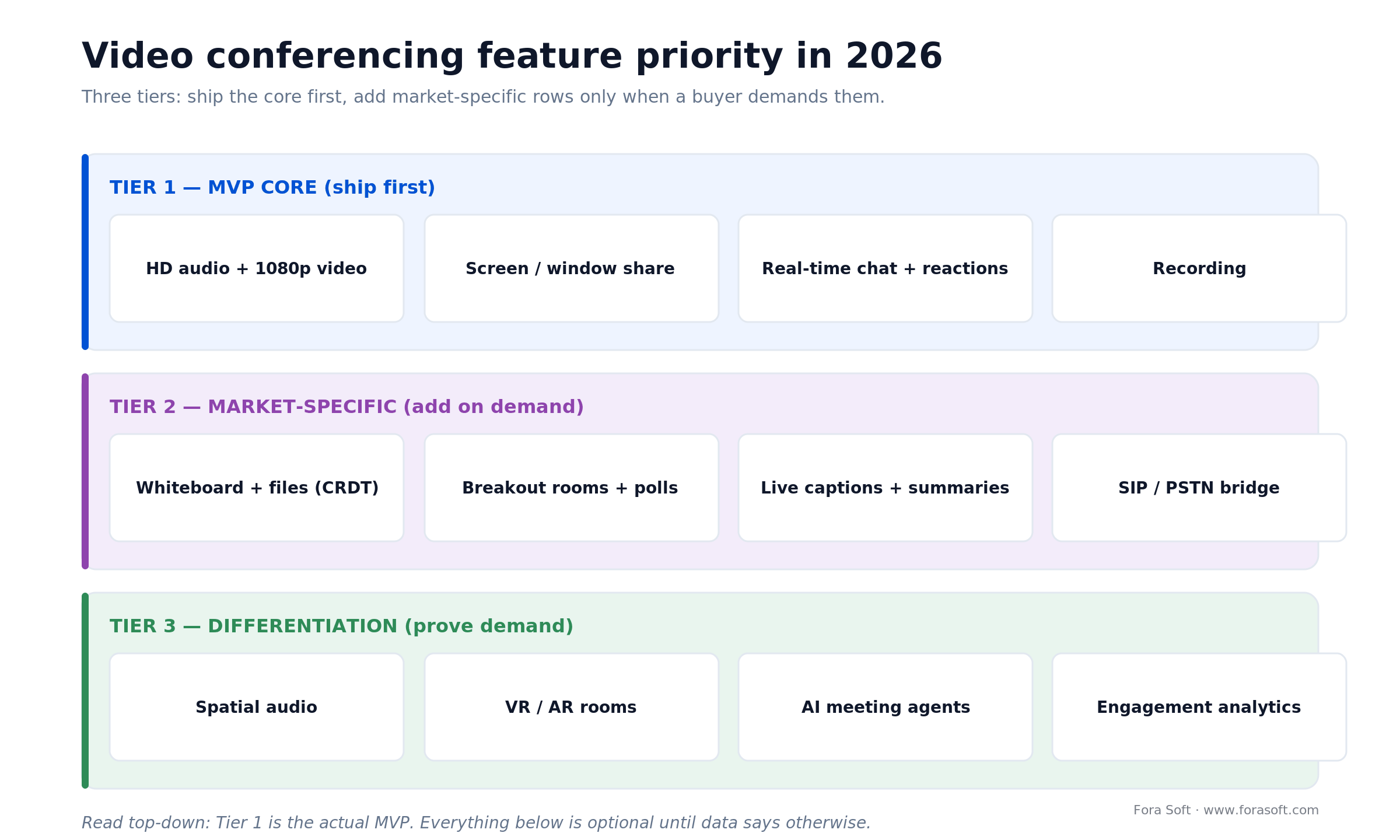
Figure 1. Feature priority in three tiers — ship Tier 1 first, add lower tiers only when a buyer asks.
| Feature | Why users care | Engineering shape |
|---|---|---|
| HD audio + 1080p video | Tablestakes; first 30 s decide retention. | Opus + VP9 / AV1; simulcast + SVC; SFU. |
| Screen + window share + remote control | Demos, pair-programming, IT support. | getDisplayMedia + dedicated 30 FPS encoder track. |
| Whiteboard + file sharing | Workshops, education, design reviews. | tldraw / excalidraw + CRDT (Yjs / Automerge); S3 / R2 vault. |
| Real-time chat + reactions | Backchannel; cuts interruption rate. | WebSocket + persisted history (Postgres / Redis). |
| Breakout rooms + polling | Education, sales, large all-hands. | Sub-room API on the SFU; lifecycle automation. |
| Live captions + summaries | Accessibility, EAA / EN 301 549. | Whisper / Deepgram + LiveKit Agents; LLM summary post-call. |
| Recording + chain of custody | Compliance, training, evidence. | Egress workers, hash-chained chunks, signed exports. |
| Mobile-first behaviour | ~50% of joins are now from phones. | CallKit (iOS) + ConnectionService (Android); PiP; bg audio. |
| SIP / PSTN bridge | Healthcare, legal, contact centres. | Janus or LiveKit + carrier integration. |
| Spatial audio + VR / AR | Workshops, social, training. | Dolby.io Spatial; Unity / WebXR clients (optional). |
Read the table top-down: rows 1–7 are the actual MVP. Rows 8–9 are mandatory if you sell into mobile-heavy or telephony-bridged markets. Row 10 is differentiation, not requirement — ship it only when you have proof your audience asks for it.
Three ways to ship: white-label, SDK, or custom build
Before you argue architecture, decide which of three lanes you’re in. They differ by 100x in cost and by everything in control.
1. White-label / rebrand ($3–50K, days). You take someone else’s platform, put your logo on it, and launch this week. Fastest path to a demo; you inherit their roadmap, their pricing and their ceilings. Right for a cheap video conferencing solution for a small business or a channel play, wrong the moment you need a custom workflow or your own data residency.
2. SDK build on a CPaaS ($50–300K, 8–16 weeks). You build your own app but rent the media plane from Daily, Twilio, Zoom Video SDK, Agora or LiveKit Cloud. You own the UX and the product; you pay per participant-minute and you’re exposed to per-minute price moves. This is where most startups should start.
3. Custom build ($55–385K with Agent Engineering). You own the SFU, the signalling, the recording and the data. Highest control, best unit economics at scale, and the only path that clears strict HIPAA or EU-residency requirements or a genuinely non-standard workflow — a white-label video conferencing solution for franchisees, evidence-grade recording, or a multi-tenant platform. It needs a permanent owner.
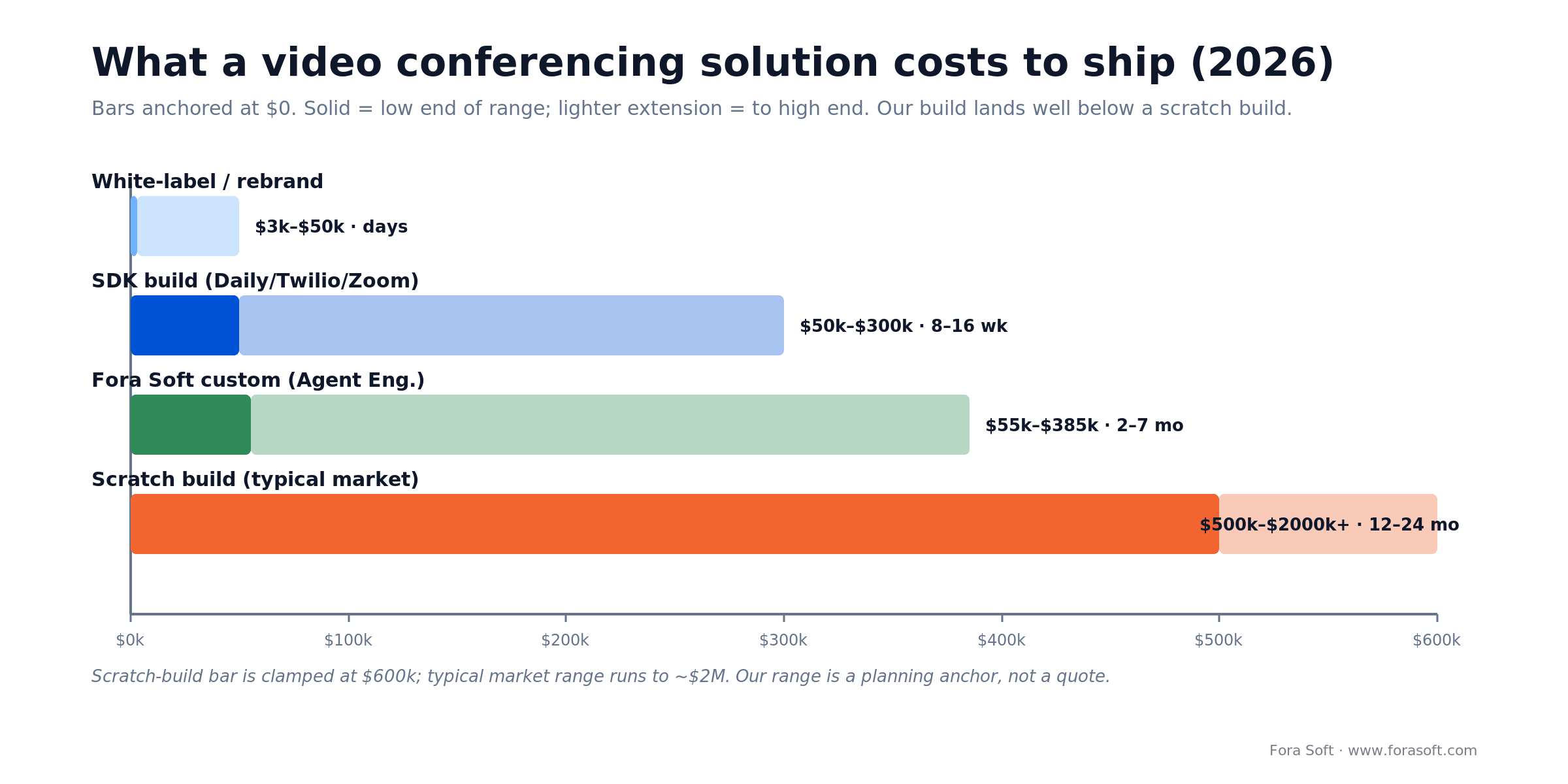
Figure 2. Cost ranges by build path. Our custom range lands well below a from-scratch build.
Reach for a custom build when: two or more of residency, >1,000-participant calls, AI-agent depth, or a non-standard workflow are true. Otherwise start on an SDK and revisit in 12 months.
Reference architecture for an advanced-feature platform
Every advanced-feature conferencing system we’ve shipped converges on the same shape: a clean separation of media, signalling, collaboration data and recording. Cross those wires and the system creaks at the worst possible time.
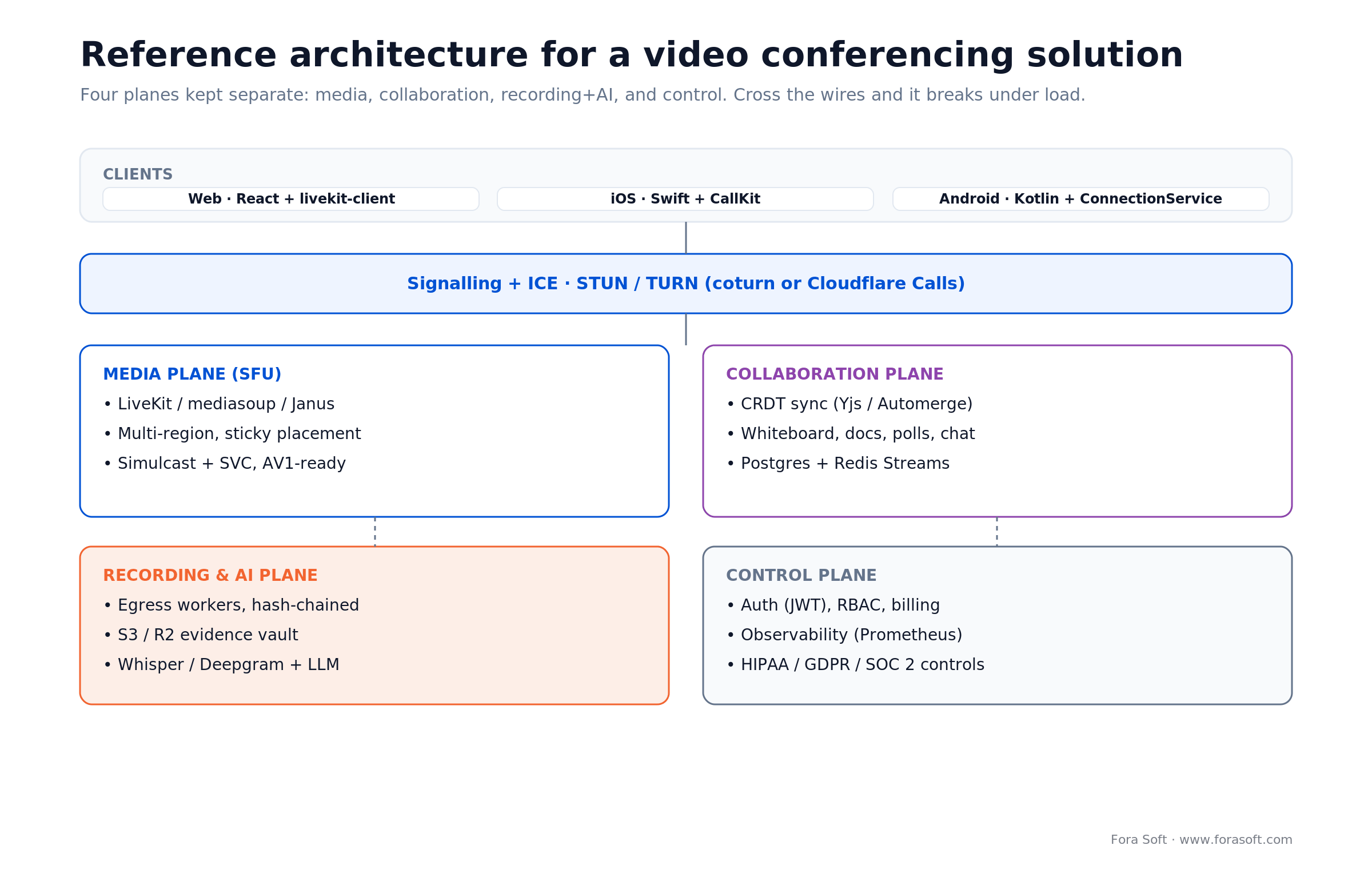
Figure 3. Four planes kept separate — media (SFU), collaboration (CRDT), recording + AI, and control.
Three rules make or break this in production:
1. Don’t put whiteboard or chat on the SFU. The SFU should only carry RTP. CRDT sync, polls, file shares and chat live on a separate WebSocket plane backed by Postgres or Redis Streams.
2. TURN is a real cost. Roughly 15–25% of WebRTC sessions need a TURN relay. Plan 100–300 GB per 100K participant-minutes; budget $2–5K per month at moderate scale on coturn (Hetzner / OVH) or Cloudflare Calls.
3. Recording is its own pipeline. Egress workers, lifecycle policies, signed URLs, post-processing (transcription, summarisation, redaction). Don’t entangle it with the SFU process — recordings vanish exactly when you need them most.
Protocols 2026: WebRTC, LL-HLS, SIP, WHIP
Choose by latency budget and audience scale, not by what’s trending. WebRTC itself is a W3C Recommendation, so the browser side is stable; the choice is really about the transport around it.
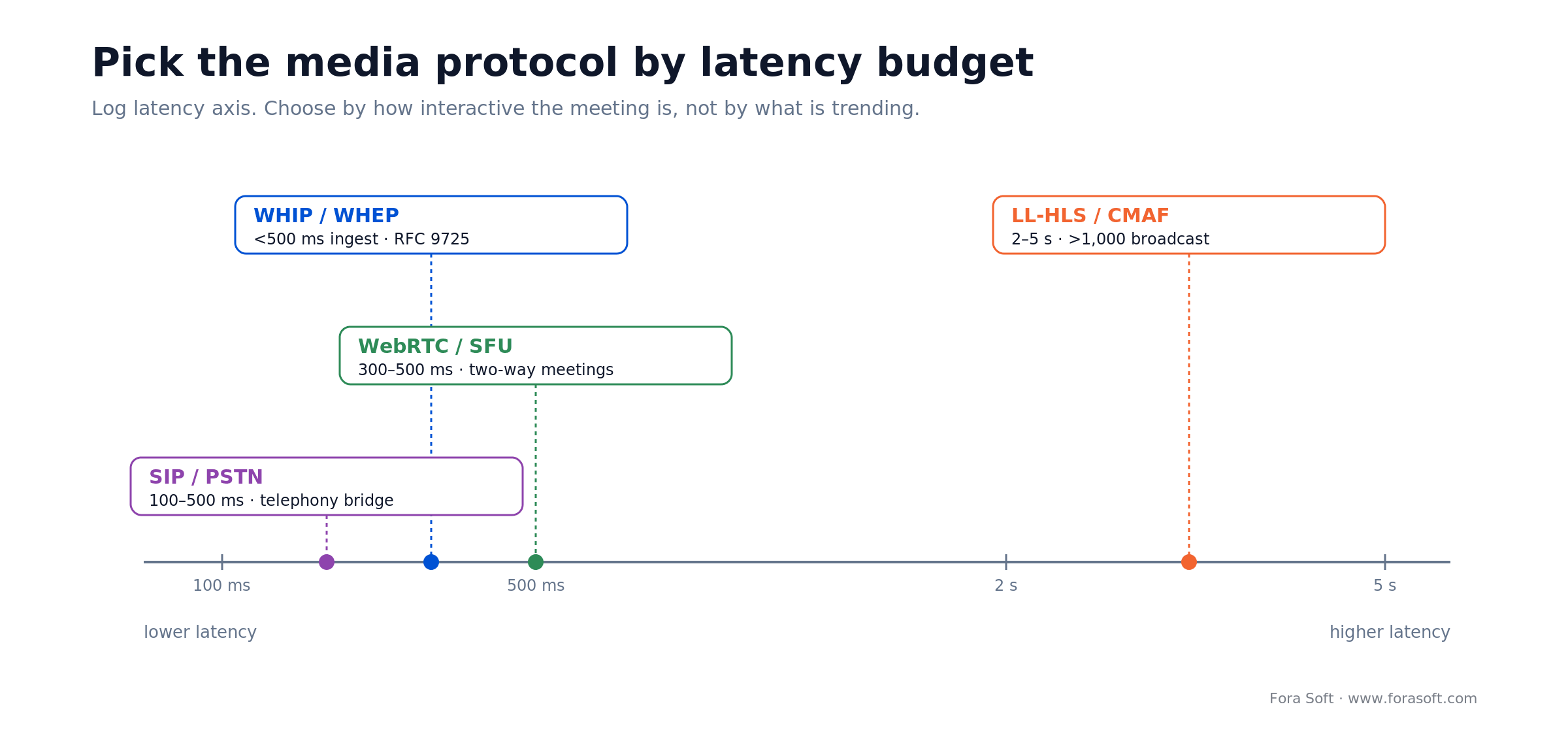
Figure 4. Where each protocol sits on the latency axis, and the job each one is for.
| Protocol | Latency | Where it wins | Watch out for |
|---|---|---|---|
| WebRTC over SFU | 300–500 ms | Two-way meetings, classroom, support | Stateful infrastructure; per-viewer cost rises. |
| LL-HLS / CMAF | 2–5 s | Town halls, webinars, broadcast layer | Player support uneven outside Safari / hls.js. |
| SIP / PSTN | 100–500 ms | Healthcare, legal, contact centres | Carrier integration; per-minute fees. |
| WHIP / WHEP | <500 ms | Replacing RTMP for ingest from OBS / hardware | WHIP is now RFC 9725 (March 2025); WHEP still draft. |
In practice we use WebRTC over an SFU for the meeting itself, LL-HLS for any broadcast layer above ~1,000 participants, and SIP only when the buyer demands telephony. Open-source MediaMTX handles protocol bridging if you also need RTSP / SRT for hardware ingest, and RFC 9725 finally standardised WHIP for sub-500 ms ingest. For the topology tradeoffs see our P2P vs MCU vs SFU guide.
Codecs and bandwidth: what to encode and how much you need
The protocol moves the packets; the codec decides how many packets there are. For a video conferencing solution in 2026, H.264 is still the safe default because every device made in the last decade decodes it in hardware, while VP9 and AV1 buy you 30–50% less bitrate at the cost of encoder CPU. Pick per track: H.264 for the compatibility floor, VP9/AV1 with simulcast + SVC for the efficient upper layers.
| Codec | Bitrate vs H.264 | Encode cost | Licensing | Best for |
|---|---|---|---|---|
| H.264 / AVC | baseline | Light (HW everywhere) | Royalty (MPEG-LA / Via) | Universal fallback layer. |
| VP9 | ~30–50% less | Moderate | Royalty-free (Google) | Web / WebRTC efficient tiers. |
| AV1 | ~30% less than VP9 | Heavy real-time | Royalty-free (AOMedia) | Bandwidth-critical, SVC-native. |
| H.265 / HEVC | ~40–50% less | Heavy | Royalty-heavy | Apple / broadcast pipelines. |
Then size the network. Plan roughly 1.0–1.5 Mbps per 720p30 stream and 2.5–3.5 Mbps per 1080p30 stream, and hold these quality thresholds before video visibly degrades: one-way latency under 150 ms (ITU-T G.114), jitter under 30 ms, and packet loss under 2–3% with FEC and NACK in place. Above those, drop a simulcast layer rather than let the whole call freeze.
AI features that actually earn their place
AI for its own sake will burn your runway. Five capabilities we ship because they consistently move retention, accessibility or revenue:
1. Live captions + translation. Whisper-large-v3 or Deepgram Nova-3 for speech-to-text, NLLB-200 / DeepL for translation, with optional human review on regulated content. Accuracy runs 92–96% on clean meeting audio and 80–88% with noise or strong accents, so pair it with noise suppression. Detail in our real-time meeting translation roundup and multilingual translation in video calls.
2. AI summaries + action items. Post-meeting summaries, decisions and action items drafted by an LLM from the caption transcript, with the user owning the edit. Saves 5–10 minutes per meeting; clean retention lift.
3. Noise suppression + echo cancellation. RNNoise, the Krisp SDK, or LiveKit’s built-in pipeline. Required for any platform that can’t assume a quiet office.
4. AI agents that join calls. Note-takers, schedulers and voice avatars, built on LiveKit Agents or Daily Pipecat. LiveKit Agents is the cleanest production path because the audio I/O bus is native, and caption-to-agent latency lands at 800–1,500 ms. See our multimodal AI agents with LiveKit guide.
5. Sentiment / engagement signal (optional). Real-time facial-expression or voice-emotion analytics for moderators. Powerful but legally sensitive — see our emotion recognition in video conferencing piece for the consent, BIPA and GDPR angles.
Security and compliance: HIPAA, GDPR, SOC 2, EAA
Compliance is now the schema, not an afterthought. The fines and lost deals dwarf a year of platform spend:
| Regime | Key requirement | Penalty floor | Architectural impact |
|---|---|---|---|
| HIPAA (US healthcare) | BAAs, encryption, audit logs | $137–$68K / violation | Per-tenant key encryption; locked-down recording. |
| EU GDPR | Lawful basis, DSAR, residency | €20M or 4% global revenue | EU-resident SFU + storage; DPA with subprocessors. |
| EAA / EN 301 549 | Captions, accessible UX | Set per EU member state | Live captions on day one; keyboard-only flows. |
| SOC 2 Type II | Documented controls + audit | Lost enterprise deals | Centralised logging, IAM, change control. |
| PCI-DSS (if billing yourself) | Tokenised PAN, segmented network | Acquirer fines; merchant cert loss | Use Stripe / Adyen; never persist raw card data. |
Two practical heuristics. One: end-to-end encryption (E2EE) is rarely worth the UX hit. Insertable Streams (Chromium) and DTLS-SRTP between client and SFU give you transit and media-plane security without breaking recording, transcription and AI features. Use E2EE only when the threat model requires it (defence, journalism, certain healthcare).
Two: residency is non-negotiable in the EU. Spin a separate stack in Frankfurt or Dublin (Hetzner / OVH + Cloudflare Calls in the EU) so no EU meeting media ever lands in a US bucket. The EU Accessibility Act adds captions and accessible flows to that list — enforceable since 28 June 2025 via EN 301 549 (currently WCAG 2.1 AA, with 2.2 expected). For HIPAA specifics see our HIPAA-compliant video platform guide and WebRTC security in plain language.
Reach for a private stack when: you sell into EU healthcare, government or finance — default vendor tenancy can’t give you the residency and BAA guarantees those buyers demand.
Buy first: realistic vendor + SDK comparison
Before you build, pressure-test against managed players. The shortlist below covers most of the WebRTC SDK / CPaaS market in 2026.
| Vendor / stack | Per-minute* | Sweet spot | Limits to know |
|---|---|---|---|
| Daily.co | $0.004 | Fast time-to-market, prebuilt UI | 1,000 active participants per call ceiling. |
| 100ms / Whereby Embedded | $0.004 | Live audio rooms, no-code embed | Customisation ceiling. |
| Zoom Video SDK | $0.0035 | Brand-recognisable Zoom UX | Branded UI; less native customisation. |
| Agora.io | $0.00399 (HD), $0.00899 (Full HD) | APAC distribution, audio rooms | Per-minute escalates fast at HD. |
| Twilio Video | ~$0.0015–$0.005 | Existing Twilio shops; Flex tie-in | No longer growing aggressively. |
| Vonage Video API | ~$0.00395 + add-ons | Telco-grade compliance, PSTN | Add-on pricing complex. |
| LiveKit Cloud / OSS | $0.0004–$0.0005 (Cloud) | ~10× cheaper / min; native AI Agents SDK; OSS escape hatch | Newer ecosystem than mediasoup. |
*Per-minute is participant-minute for HD video; treat as a planning anchor, not a procurement quote. The headline: LiveKit (cloud or self-hosted) is the cleanest advanced-features path in 2026 because the AI Agents SDK lets you ship captions, summaries and voice avatars without a third-party adapter. Its Ship tier is $50/mo (150K participant-minutes, then $0.0005/min); Scale is $500/mo (1.5M, then $0.0004/min). We dig into the Daily math in our Daily.co alternative, the Agora path in our Agora alternative, and the head-to-head in our LiveKit vs Agora cost analysis.
Custom build cost model: MVP to production
If you decide to build, here is the cost shape we’d quote a typical advanced-feature video conferencing solution (web + iOS + Android, breakouts, whiteboard, recording, captions, HIPAA / GDPR controls). Numbers assume our Agent Engineering pipeline and a senior squad: tech lead, two backend, one front-end, one mobile (50%), one DevOps.
| Stage | Scope | Calendar | Typical price |
|---|---|---|---|
| Discovery + architecture | Latency / scale targets, residency, RBAC | 2–3 weeks | $15–$25K |
| Web MVP | SFU, TURN, React client, screen share, chat | 8–12 weeks | $55–$110K |
| Whiteboard + collaboration plane | tldraw / excalidraw + Yjs CRDT, files, polls | + 4–6 weeks | $30–$55K |
| Mobile + breakouts | iOS (CallKit, PiP), Android (ConnectionService) | + 6–10 weeks | $55–$95K |
| Recording + captions + summaries | Egress workers, Whisper / Deepgram, LLM summary | + 4–6 weeks | $30–$55K |
| HIPAA / GDPR / SOC 2 | Encryption, BAAs, EU residency, pen-test | + 4–6 weeks | $25–$45K |
| Production-grade total | Web + mobile + advanced + compliance | 5–7 months | $210–$385K |
Year-2 run cost typically lands at $90–$160K (one DevOps + cloud + TURN + observability). That total sits well under the $500K–$2M that a from-scratch build usually runs elsewhere — the gap is Agent Engineering plus reusing hardened media components instead of re-deriving them. For deeper unit economics see our video streaming cost guide.
Want a defensible build-vs-buy verdict?
Bring your monthly minutes, peak concurrency, residency requirements and current vendor bill. We’ll come back with a one-pager and a 12-week roadmap.
Mini case: ProVideoMeeting and lessons from V.A.L.T.
ProVideoMeeting is our custom video conferencing product — meetings, breakouts, screen share, recording, whiteboard, file sharing — built end-to-end on a custom WebRTC stack and shipped on web and mobile. It is the exact engineering shape this article describes.
What carries over from V.A.L.T. Our flagship surveillance and clinical-skills platform (770+ US organizations, 50,000+ users) crossed ~1,500 active sessions during peak windows; the original cloud-only ingest pipeline started choking on bursty multi-camera recordings, and audit-export latency jumped from 30 s to 4 min.
The fix. Over a 12-week sprint we (1) split the media plane from the recording plane, (2) added per-region SFU placement, (3) re-implemented exports as a hash-chained job queue with tiered storage, and (4) shipped a Prometheus / Grafana SLO board the ops team owned end to end.
Outcome. Average export latency dropped from 240 s to 28 s, retrieval failures fell from 0.9% to under 0.05%, and storage spend held flat through 60% growth in session count. The same moves apply directly to a custom conferencing platform. Want a similar assessment? Book a 30-min call.
Five pitfalls we keep cleaning up after
1. Whiteboard or chat on the SFU. The SFU should only carry RTP. Push collaboration data through a CRDT plane (Yjs / Automerge) backed by Postgres or Redis Streams.
2. Single-region SFU. Pinning every room to us-east-1 works in dev and dies in production. Build sticky room placement to the closest healthy SFU on day one.
3. Treating recording as a side feature. Recording lives or dies as its own pipeline — egress workers, lifecycle policies, signed URLs, post-processing — not bolted to the SFU.
4. Skipping observability. If you can’t answer “how many users had p95 join time over 3 seconds in the last hour?” in under 30 seconds on a Sunday, your monitoring isn’t real.
5. Ignoring AI integration shape. If your roadmap includes captions, summaries or AI agents, design the audio I/O bus that feeds them now. Retrofitting it later is expensive.
KPIs that decide whether the platform is working
Quality KPIs. Join time p95 under 2 s, freeze ratio under 0.5%, audio MOS above 4.0, 1080p-capable on over 90% of sessions. Track per device-class and per region.
Engagement KPIs. Average meeting duration, return rate within 7 days, reactions and chat per minute, recording playback hours. If a feature ships and these don’t move, kill it.
Reliability KPIs. SFU uptime at or above 99.95%, TURN availability at or above 99.99%, recording success over 99.5%, transcript success over 98%, caption end-to-end latency under 1.5 s p95.
Decision framework: build or buy in five questions
1. How custom is the workflow? Standard meetings mean a vendor wins. White-label conferencing for franchisees, regulated workflows or evidence-grade recording mean a build wins.
2. What latency do you need? Two-way conferencing under 500 ms is WebRTC over an SFU. Mass broadcast is LL-HLS / CMAF. Telephony is a SIP bridge.
3. Concurrent users at peak? Under 200K participant-minutes per month: any vendor. 200K–2M: LiveKit Cloud is roughly 10× cheaper per minute than Daily / Twilio / Agora. Over 2M: build economics tilt your way.
4. Where will the data live? EU residency or strict HIPAA means custom or LiveKit Cloud regional pinning, not default vendor tenancy.
5. Can you fund a 2–3 person team for 3+ years? If no, buy. A custom video conferencing solution without a permanent owner rots within 12 months.
Reach for build when: three or more answers push toward custom — especially residency, calls above 1,000 participants, AI-agent depth or a non-standard workflow. Otherwise stage a vendor pilot first and revisit in 12 months.
Not sure which side of the line you’re on?
Send us your five answers. We’ll tell you honestly whether to buy, build, or start on an SDK and migrate later.
A realistic 14-week rollout plan
| Phase | Weeks | Outcome |
|---|---|---|
| Discovery + architecture | 1–2 | Latency / scale targets; residency; feature priority. |
| SFU + TURN + signalling | 2–5 | LiveKit cluster, coturn, JWT auth, room API. |
| Web client + screen share | 4–8 | React + livekit-client, lobby, chat, reactions. |
| Whiteboard + breakouts | 6–10 | tldraw + Yjs, polls, sub-room API. |
| Mobile clients | 7–12 | iOS + Android, push, CallKit / ConnectionService, PiP. |
| Recording + AI captions | 9–13 | Egress workers, Whisper / Deepgram, summaries. |
| Hardening + compliance | 12–14 | Pen-test, BAAs, EU residency, SOC 2 prep. |
| Soft launch | 14 | Phased rollout, runbook, on-call drill. |
How Agent Engineering changes the build math
Three years ago, an advanced-feature conferencing MVP comfortably ran past $300K in year one. Today, with multi-agent code generation paired with senior architectural review, we squeeze the same scope into the $210–$385K band. The savings concentrate in three places:
Boilerplate. Auth, room API, RBAC, IaC, observability and mobile scaffolding — agents emit roughly 70% of the first draft, and senior engineers refactor and harden it.
Test scaffolding. Generated unit and integration tests cover the happy paths; humans add the failure modes that actually trip in production (ICE failures, codec fallbacks, recording gaps, caption-latency spikes).
Docs that don’t rot. OpenAPI, runbooks and mobile SDK docs are generated from the same source of truth, so the team gets accurate handover docs at month six instead of a stale wiki.
When NOT to build a custom video conferencing solution
1. Below ~150K participant-minutes per month. Daily.co or LiveKit Cloud is cheaper than any custom-build amortisation.
2. You need to ship in under 6 weeks. Vendor SDKs and Jitsi-based JaaS are genuinely the fastest path on the market.
3. No internal owner for two years. Custom WebRTC platforms die without a sponsor.
4. Standard meetings + mainstream compliance. Buying is just cheaper, especially if you don’t need EU residency.
5. No multi-year operating budget. A platform that ships and then starves of maintenance is worse than no platform — the quality numbers tank by month six.
FAQ
Which solution is best for video conferencing?
There is no single best video conferencing solution — the right pick depends on latency, scale, residency and workflow. For standard meetings, a managed vendor (Daily, LiveKit Cloud, Zoom Video SDK) wins on time-to-market. For strict HIPAA or EU-residency needs, non-standard workflows, or over ~2M participant-minutes a month, a custom build on LiveKit or mediasoup wins on control and unit economics.
Which advanced features actually matter for retention?
In rank order: HD audio + 1080p video, screen and window share, whiteboard and file share, real-time chat and reactions, breakout rooms, live captions and summaries, recording, and mobile parity. SIP / PSTN bridge and spatial audio matter only when your buyer demands them.
Should we use WebRTC, LL-HLS or both?
Use WebRTC over an SFU for the meeting itself (300–500 ms, two-way collaboration). Add LL-HLS / CMAF (2–5 s) only if you also broadcast town-hall sessions to over 1,000 viewers. Add SIP / PSTN only if telephony bridging is in the contract.
How much does a custom video conferencing solution cost in 2026?
A defensible MVP (web + core features) is $55–110K over 8–12 weeks with our Agent Engineering pipeline. A production-grade platform with mobile, whiteboard, AI captions and HIPAA / GDPR controls is $210–385K over 5–7 months — well below the $500K–2M a from-scratch build usually costs elsewhere.
How accurate are AI live captions in 2026?
Whisper-large-v3 and Deepgram Nova-3 deliver 92–96% word accuracy on clean meeting audio, falling to 80–88% with noise or strong accents. Pair with a noise-suppression stage (RNNoise / Krisp) to stay above 90% in the field. End-to-end caption latency lands at 800–1,500 ms with LiveKit Agents.
What about HIPAA, GDPR and EU data residency?
For HIPAA you need a BAA with every subprocessor (SFU, TURN, transcription, storage), per-tenant encryption keys and locked-down recording. For GDPR you need EU residency for both the media plane and recordings — a separate stack in Frankfurt or Dublin. The EU Accessibility Act has mandated accessible flows and captions since 28 June 2025.
Can we start on a vendor SDK and migrate to custom later?
Yes — if you wrap the vendor SDK (Daily, Agora, Twilio, Zoom) behind your own thin SDK from day one (one room API, one client wrapper, one auth). When you migrate to LiveKit or self-hosted, you swap the implementation under the wrapper without touching feature code, which roughly halves the rewrite.
How does Fora Soft typically engage on a project like this?
A 60-minute discovery, then a two-week paid architecture sprint that produces a target architecture, a build-vs-buy verdict and a 14-week roadmap. From there it’s a fixed-scope MVP (8–12 weeks), a soft launch with 1–3 customers, and a hardening and compliance phase. Book a 30-min call to scope it.
What to Read Next
Development
How to Build Custom Video Conferencing Solutions
The build process, team shape and timeline — the companion to this guide.
Architecture
P2P vs MCU vs SFU for Video Conferencing
When each topology wins, with real numbers.
Vendor
Daily.co vs Building Your Own in 2026
Per-minute pricing, flip points, build-vs-buy verdict.
Vendor
Agora.io Alternative in 2026
Custom WebRTC with LiveKit, mediasoup, Jitsi & Janus.
Compliance
HIPAA-Compliant Video Platform Development
BAAs, encryption, residency and the audit checklist.
Ready to ship a video conferencing solution that earns its keep?
A video conferencing solution in 2026 isn’t about whether you can technically build it — the protocols, codecs and SDKs are mature. It’s about whether the math works for your minutes, your concurrency, your residency requirements and your AI roadmap. The architecture has converged: WebRTC over an SFU, a separate CRDT collaboration plane, a recording and AI plane that lives off the SFU, and an auth / RBAC / observability control plane that treats compliance as a first-class constraint.
If you’re on the hook for the conferencing roadmap or the SaaS bill, you don’t need another generic feature list. You need the build-vs-buy line drawn against your actual minutes, concurrency and jurisdictions. We’ll bring the architecture, the cost model, and receipts from ProVideoMeeting, V.A.L.T. and other production WebRTC systems, plus our AI-for-video-engineering knowledge base. The full scope is on our video conferencing services page.
Get a build-vs-buy verdict in 30 minutes
Bring your monthly minutes, peak concurrency, residency requirements and current vendor bill. We’ll come back with an architecture sketch, a cost model and an honest recommendation.