


Key takeaways
• Daily.co is still the easiest WebRTC SDK to ship in a week. $0.004 per participant-minute after 10,000 free minutes/month, prebuilt UI, recording at $0.0135/min, no TURN bills. For <200K minutes/month and no EU residency hard rule, it’s the cheapest correct answer.
• The flip points are clear. Below ~200K participant-minutes/month: stay on Daily.co. 200K–500K: move to LiveKit Cloud (~$0.0004–0.0005/min) for ~10× cheaper unit cost. Above ~500K, or with strict EU / HIPAA / multi-tenant residency: self-host LiveKit, mediasoup, Janus or Jitsi.
• Custom build economics. A WebRTC MVP on LiveKit / mediasoup lands in 8–12 weeks at $55–$110K with our Agent Engineering pipeline. Production-grade web + iOS + Android with recording, AI captions and HIPAA controls: 5–7 months, $180–$300K. Year-2 run cost: $90–$160K (one DevOps + cloud + TURN).
• Daily.co loses on: hard 1,000-participant ceiling per call, US-only data residency, customisation ceiling on the prebuilt UI, AI-agent integration via third-party Pipecat (vs LiveKit Agents native).
• What we’d build for you. A LiveKit / mediasoup SFU + TURN cluster, recording & transcription pipeline, multi-platform SDK (web React + iOS Swift + Android Kotlin), HIPAA / GDPR controls, and AI agents (real-time captions + summarisation) — benchmarked against our VALT production deployment (770+ US organizations, 50,000+ users, evidentiary recording). Talk to us via the video streaming services page or book a 30-min call.
Comparing Daily.co against more than one option? Start from all vendor comparisons.
Why we wrote this comparison
Fora Soft has built real-time video products since 2005. We’ve shipped on top of Daily.co, Agora, Twilio, Vonage and Zoom Video SDK, and we’ve built custom WebRTC stacks on LiveKit, mediasoup, Janus and Jitsi for clients who outgrew CPaaS or needed residency / HIPAA / multi-tenant features the vendors won’t sell. Our flagship surveillance platform VALT serves 770+ US organizations and 50,000+ users with evidentiary recording and multi-tenant, HIPAA-grade access control. It’s the exact engineering shape of a custom Daily-replacement.
In 2026 we use Agent Engineering: multi-agent code generation paired with senior architectural review — which compresses our boilerplate by ~70%. Net result: we ship custom WebRTC MVPs in 8–12 weeks where typical agencies still quote 16–20.
This guide is the playbook we hand to product owners and CTOs before they sign or cancel a Daily.co contract. It assumes you know what WebRTC, SFU and TURN are; what you want is a defensible cost line, a vendor matrix, and the five questions that decide build vs buy.
Daily.co bill creeping past $5K/month?
Book a 30-minute architecture review. We’ll size LiveKit Cloud vs self-hosted vs staying on Daily.co for your minute volume and tell you honestly which one wins.
Daily.co vs the alternatives: the 30-second verdict
Short version: keep Daily.co until one of four things breaks — your minutes, your data-residency rules, your 1,000-participant ceiling, or your AI roadmap. Below ~200K participant-minutes a month, Daily.co at $0.004 per participant-minute is the cheapest correct answer and nothing on the market ships faster. Between ~200K and ~2M minutes, LiveKit Cloud is roughly 10× cheaper per minute and worth the migration. Above ~2M minutes, or under a hard EU / HIPAA / >1,000-participant rule, a self-hosted SFU (LiveKit, mediasoup, Janus or Jitsi) starts paying for itself inside 12–18 months.
The one-liners we give clients: Daily.co — fastest to ship, US-only, 1,000-participant cap. LiveKit — ~10× cheaper per minute, native AI Agents SDK, self-host escape hatch. Agora — strong APAC coverage, per-resolution pricing. Twilio — fine if you already live in Twilio, otherwise not growing. Vonage — telco-grade PSTN/SIP and compliance. The rest of this guide is the receipts: real per-minute math, the flip points, the architecture, and the honest “when NOT to move.”
Reach for Daily.co when: you’re under ~200K participant-minutes/month, need to ship in weeks, and have no hard EU-residency or >1,000-participant requirement. The prebuilt UI and clean $0.004/min pricing beat any custom build at that scale.
Daily.co pricing 2026: the actual numbers
Daily’s public pricing in 2026 is unusually clean for a CPaaS. You can model your bill on the back of an envelope.
| Line item | Headline price | What it covers |
|---|---|---|
| Free tier | 10,000 participant-min/month | All API features; sufficient for <100 daily 5-min calls. |
| Video / audio minutes | $0.004 / participant-min | Real-time SFU; up to 1080p; TURN included. |
| Cloud recording | $0.01349 / min | Composite or raw tracks; S3-compatible export. |
| Live streaming (RTMP out) | $0.005 / min (typical) | Bridge to YouTube / Twitch / Wowza / IVS. |
| Real-time transcription | Add-on / Deepgram metered | Captions, summarisation; pass-through pricing. |
| Hard ceiling per call | 1,000 real-time participants | Up to 100K via broadcast / view-only mode. |
Quick example: 50,000 daily participant-minutes × 30 days = 1.5M min/month. Net of free tier ≈ $5,960/month for video, plus $1,350/month if you record 100K min, plus a few hundred dollars for transcription. Source: daily.co/pricing/video-sdk.
There are no surprises in this model. The two things to watch are (1) you can’t natively force EU-only data residency, and (2) the 1,000-participant ceiling kicks in for any call larger than a typical webinar without flipping to view-only broadcast.
Daily.co alternatives: full vendor matrix
If you’re shopping replacements, the realistic shortlist below covers ~90% of the WebRTC SDK / CPaaS market in 2026. Pricing is from public docs (for example Agora’s published rates) and partner quotes; assume ±20% on real procurement quotes.
| Vendor | Per-minute (HD video) | Free tier | Best fit |
|---|---|---|---|
| Daily.co | $0.004 | 10K min/mo | Fast time-to-market, prebuilt UI, AI agents via Pipecat. |
| 100ms | $0.004 | 10K min/mo | Live audio rooms, livestreams, India-grown stack. |
| Whereby Embedded | $0.004 | 2K min/mo | No-code embed in SaaS apps; EU-friendly. |
| Zoom Video SDK | $0.0035 | 10K min/mo | Brand-recognisable Zoom UX inside your product. |
| Vonage Video API (formerly TokBox / OpenTok) |
~$0.00395 + add-ons | Custom | Telco-grade compliance, deep PSTN integration. |
| Twilio Video | ~$0.0015–$0.005 (Group) | Trial credit | Existing Twilio shops; Flex contact-centre tie-in. |
| Agora.io | ~$0.00399 (HD), ~$0.009 (Full HD) | 10K min/mo | APAC distribution; high-quality audio rooms. |
| Dolby.io | ~$0.0025 start | $50 credit | Spatial audio, premium voice, broadcast bridges. |
| LiveKit Cloud | $0.0004–$0.0005 | 5K–150K min/mo (tiered) | Open-source escape hatch + hosted convenience; native AI Agents SDK. |
The headline insight: LiveKit Cloud is roughly 10× cheaper per minute than Daily.co (and the other CPaaS) at the same quality, and you can drop down to self-hosted LiveKit / mediasoup whenever the math justifies it (rates from livekit.io/pricing). That’s why most teams that outgrow Daily land on LiveKit, not on Twilio or Agora. For a deeper look at custom WebRTC vs Agora specifically see our Agora.io alternative analysis.
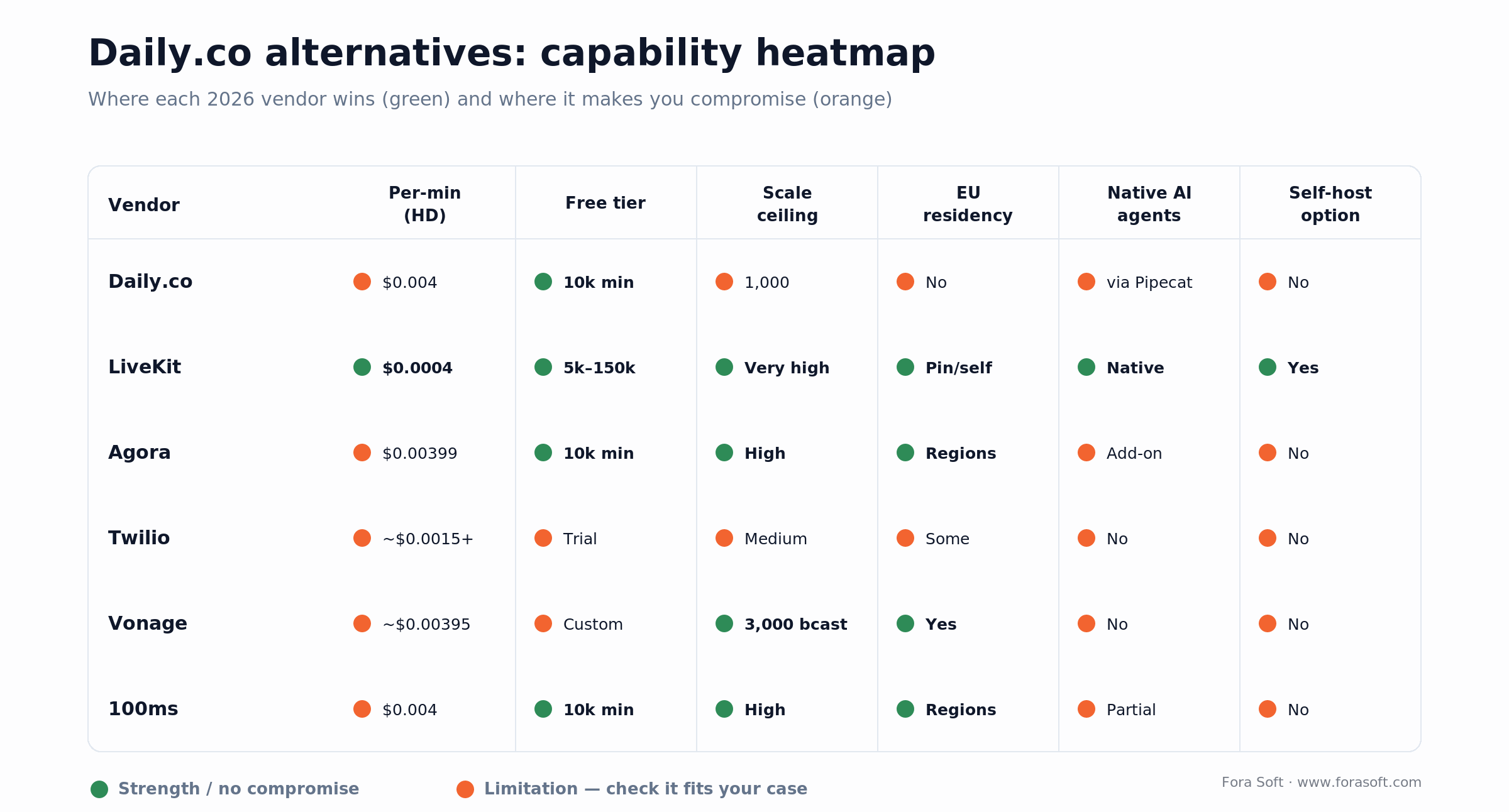
Figure 1. Where each 2026 vendor wins (green) and makes you compromise (orange). Green clusters on LiveKit; Daily.co’s red cells are cost, scale ceiling and residency.
Open-source stacks: LiveKit, mediasoup, Janus, Jitsi
If you decide to leave CPaaS entirely, the realistic open-source SFUs in 2026 are these four. Each makes a different trade-off between ergonomics, scale ceiling and ops burden.
| Stack | Strength | Watch out for | Pick when… |
|---|---|---|---|
| LiveKit | Modern Go SFU + native Agents SDK + cloud or self-host | Newer than mediasoup; ecosystem still maturing. | You want AI agents, real-time transcription, and the option to switch self-hosted later. |
| mediasoup | Battle-tested Node SFU library; surgical control | No hosted offering; you build your own control plane. | You need fine-grained routing, simulcast control, custom recording. |
| Janus Gateway | Plugin-based C SFU/MCU; mature; broadcast features | Operational ergonomics dated; harder hiring. | You need broadcast / streaming / SIP bridges and have C-comfortable engineers. |
| Jitsi Meet / JaaS | Drop-in conferencing app + hosted JaaS | Less suitable as a building-block SDK; product-shaped. | You want a fast Daily-replacement webinar / meeting experience without writing UI. |
For more depth on choosing among these for video conferencing specifically, see our P2P vs MCU vs SFU guide and how to hire LiveKit developers; the raw unit economics are in our LiveKit vs Agora cost analysis.
Reference architecture for a Daily.co replacement
A custom WebRTC stack that replaces Daily.co cleanly converges on the same shape. Anything missing from this picture and you ship a system that creaks under load.
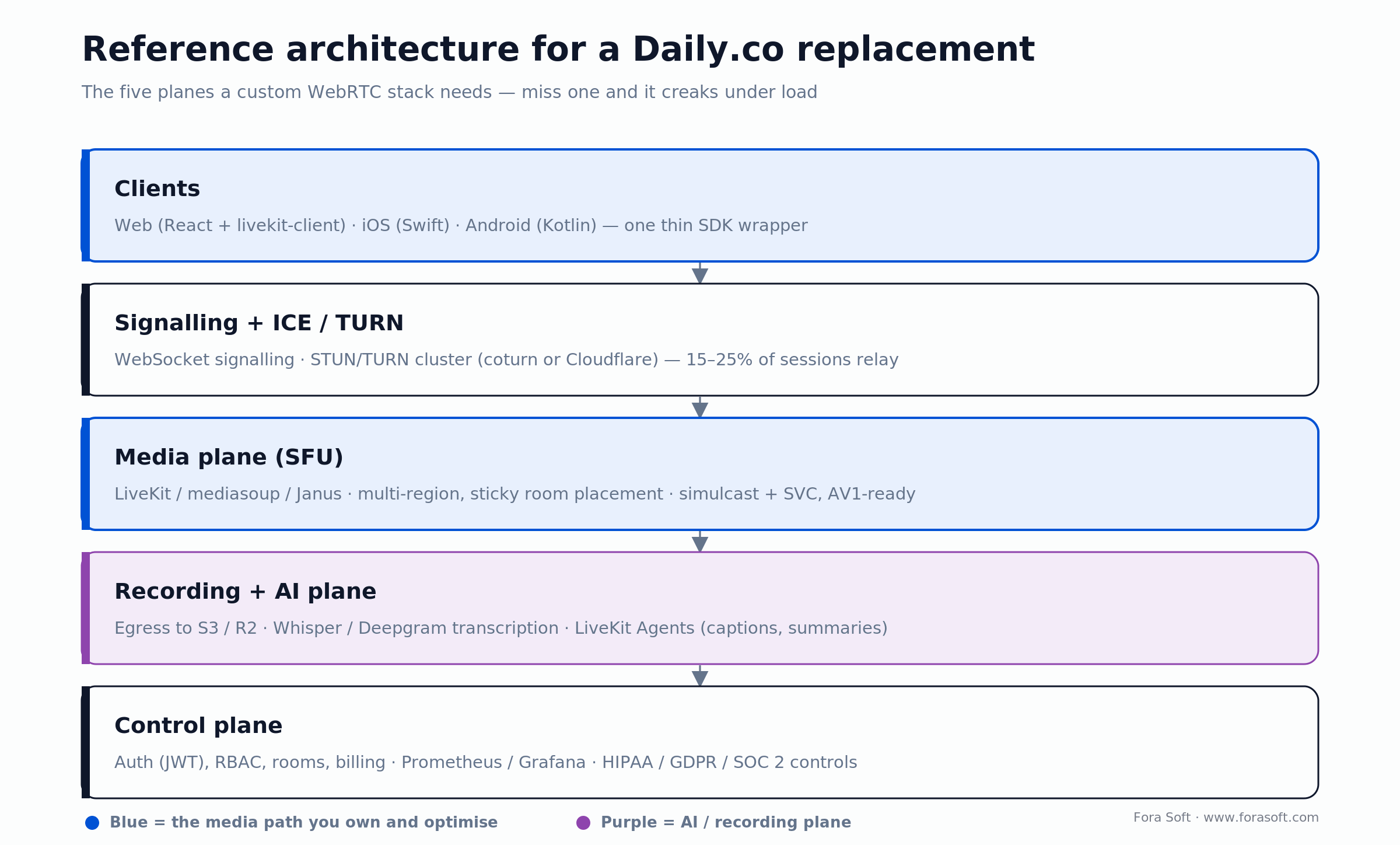
Figure 2. The five planes a custom WebRTC stack needs to replace Daily.co cleanly — clients, signalling + TURN, SFU media, recording + AI, and control.
We break each plane down further in our WebRTC architecture for production systems guide.
Three operational rules:
1. TURN is a real cost. Roughly 15–25% of WebRTC sessions need TURN relay. Plan for 100–300 GB / 100K participant-minutes; budget $2–5K / month at moderate scale on Hetzner / OVH or Cloudflare Calls.
2. Multi-region from day one. Don’t pin all rooms to us-east-1. Sticky room placement to the nearest SFU region cuts p95 latency 30–50% and is the difference between a calm support inbox and a furious one.
3. Recording is its own pipeline. Egress workers, S3 / R2 sink, post-processing (transcription, summarisation, redaction). Don’t entangle it with the SFU process.
Custom build cost model: MVP → production
Here is the cost shape we’d quote for a typical Daily-replacement on LiveKit (web + iOS + Android, recording, transcription, basic AI captions, GDPR / HIPAA controls). The numbers assume our Agent Engineering pipeline and a senior squad: tech lead, two backend, one front-end, one mobile (50%), one DevOps.
| Stage | Scope | Calendar | Typical price |
|---|---|---|---|
| Discovery + architecture | Latency / scale targets, residency, RBAC, infra map | 2–3 weeks | $15–$25K |
| Web MVP | LiveKit SFU, TURN, React client, auth, rooms | 8–12 weeks | $55–$110K |
| Mobile clients | iOS + Android, background audio, push, CallKit | + 6–10 weeks | $55–$95K |
| Recording + AI captions | Egress workers, Whisper / Deepgram, summarisation | + 4–6 weeks | $30–$55K |
| HIPAA / GDPR / SOC 2 | Encryption, BAAs, audit logs, EU residency, pen-test | + 4–6 weeks | $25–$45K |
| Production-grade total | Full Daily replacement | 5–7 months | $180–$300K |
One honesty note on the LiveKit Cloud comparison: its headline $0.0004–$0.0005 is per connection-minute, and it also meters downstream bandwidth at roughly $0.10–$0.12/GB (upstream is free). At high resolutions or large rooms, egress — not minutes — becomes the bill, so model both lines before you commit. Year-2 run cost typically lands at $90–$160K (one DevOps + cloud + TURN + observability). For deeper unit economics see our video streaming app development cost guide.
The flip point: when build beats buy
Three thresholds matter, and they’re cleaner than most CPaaS-vs-build articles admit.
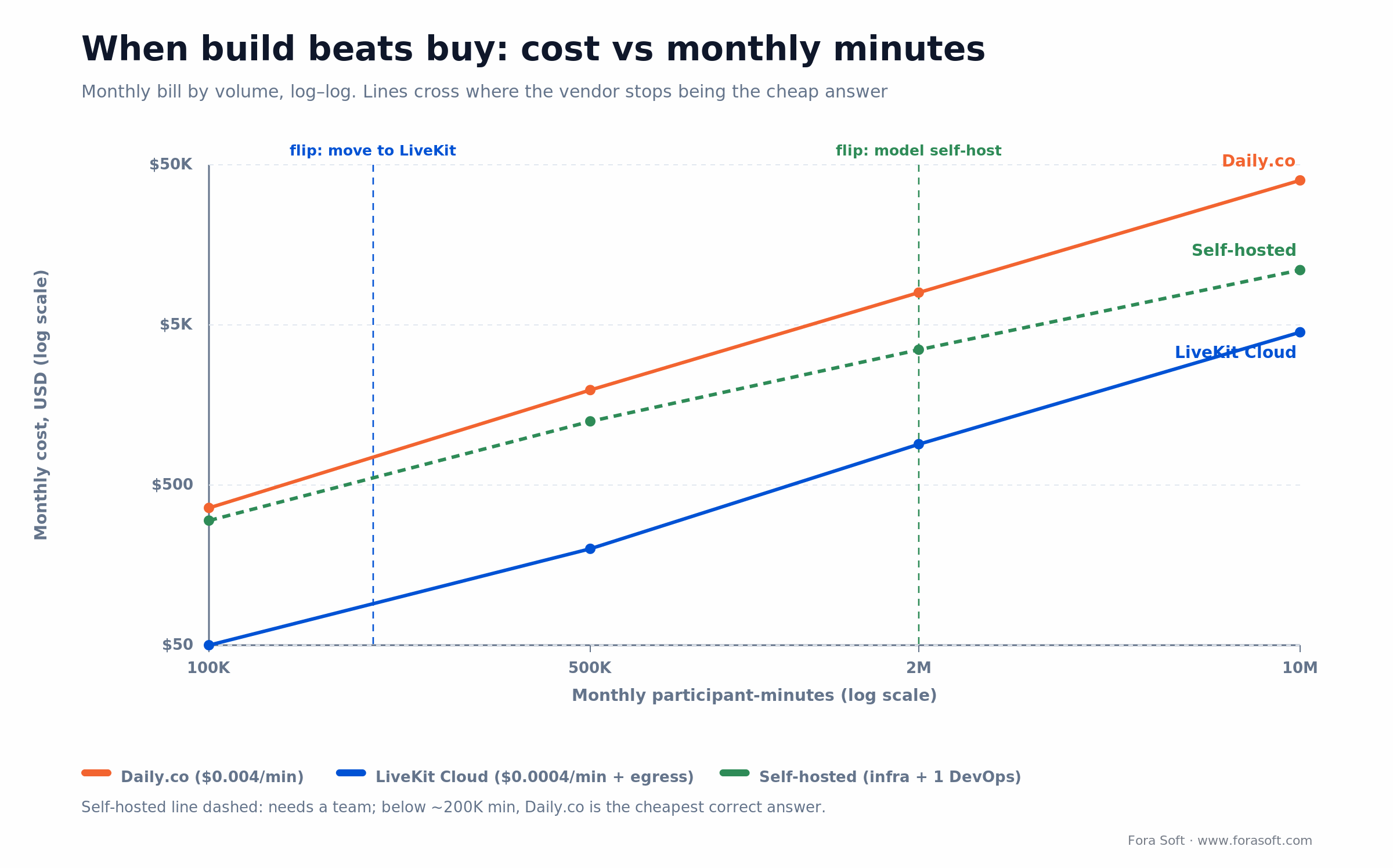
Figure 3. Monthly bill by volume (log–log). The flip points: ~200K minutes to LiveKit Cloud, ~2M minutes to a self-hosted SFU.
| Monthly minutes | Daily.co bill | LiveKit Cloud bill | Self-hosted (LiveKit on Hetzner) | Recommendation |
|---|---|---|---|---|
| 100K | ~$360 | ~$50 (Ship plan) | ~$300 + ops | Stay on Daily; LiveKit Cloud if you want optionality. |
| 500K | ~$1,960 | ~$200–$250 | ~$1.0–1.5K + 0.5 FTE | Move to LiveKit Cloud now. |
| 2M | ~$7,960 | ~$800–$1,000 | ~$3–4K + 1 FTE DevOps | LiveKit Cloud or self-host; build payback <18 months. |
| 10M+ | ~$39,960+ | ~$4–5K | ~$8–15K + 1–2 FTE | Self-host; build payback <6 months. |
Net rule of thumb: under ~200K minutes/month, paying Daily.co or 100ms is the right answer. Between 200K and 2M minutes, LiveKit Cloud is almost always cheaper without giving up vendor convenience. Above 2M minutes — or with strict residency — self-hosting LiveKit / mediasoup pays back inside 12–18 months on a custom build invested between $180K and $300K.
Reach for LiveKit Cloud when: you’re between ~200K and ~2M participant-minutes/month and want ~10× lower per-minute cost without running your own SFU. You keep a managed control plane and buy yourself the option to self-host later.
When to build instead of stay on Daily.co
1. EU / regulated residency. Daily is US-based. If you sell to EU healthcare, EU government, or any sector that demands “data never leaves the region,” you must self-host inside that region or use a vendor with explicit EU-residency guarantees.
2. HIPAA with a real BAA. Daily signs BAAs on paid plans, but if you also need control over recording storage encryption, audit logs and per-tenant isolation, custom is faster to defend in an audit.
3. Calls bigger than 1,000 active participants. Daily caps real-time at 1,000 (broadcast view-only mode goes to 100K). Big interactive events (mass classroom, town halls, esports lobbies) often need a custom SFU mesh.
4. Deep AI agent / two-way bot integration. LiveKit Agents native SDK is more flexible than Daily + Pipecat for production AI co-hosts (live captions, summarisation, voice avatars). Detail in our LiveKit multimodal agents guide.
5. Cost line crossing $5–10K / month. At that monthly bill, the engineering hours of moving to LiveKit Cloud or self-hosted return inside 6–12 months.
Reach for a self-hosted build when: you’re above ~2M minutes/month, or a residency / HIPAA / >1,000-participant rule rules out CPaaS — and you can staff two to three engineers to own it for the long haul.
Hidden costs both sides forget
On Daily.co. Recording at $0.0135/min stacks fast (1M min/mo of recording = $13.5K). Deepgram / OpenAI transcription is metered separately. Every region a customer demands above the Daily baseline can be a custom contract conversation. RTMP-out for streaming bridges adds another $0.005/min line.
On a custom build. TURN bandwidth (~15–25% of sessions need relay) at 100–300 GB / 100K participant-minutes. Storage + lifecycle for recordings. Observability (Prometheus, Grafana, Sentry, Datadog: pick one but pick early). On-call (typically 0.25 FTE worth of pager budget). Compliance (HIPAA, SOC 2 Type II, GDPR DPAs, together $30–$80K year-1 audit + remediation).
Most build-vs-buy spreadsheets miss the on-call line and underestimate TURN. Don’t.
Want a defensible build-vs-buy verdict?
Bring your monthly minutes, peak concurrency, residency requirements and current Daily / Twilio / Agora bill. We’ll come back with a one-pager and a 12-week roadmap.
Mini case: VALT lessons for a Daily.co replacement
VALT is our flagship video surveillance and clinical-skills platform — 770+ US organizations, 50,000+ users, evidentiary recording, HIPAA controls, multi-tenant access. The shape is identical to a custom video-conferencing platform: thousands of concurrent media sessions, recording with chain-of-custody, multi-tenant data isolation, EU + US residency.
Situation. When VALT crossed ~1,500 active sessions during peak windows, the original cloud-only ingest pipeline started choking on bursty multi-camera recordings, and audit-export latency jumped from 30 s to 4 min.
Plan. Over a 12-week sprint we (1) split media plane and recording plane, (2) added per-region SFU placement, (3) re-implemented exports as a hash-chained job queue with tiered storage, (4) shipped a Prometheus / Grafana SLO board the ops team owned end-to-end.
Outcome. Average export latency dropped 240 s → 28 s, retrieval failures fell from 0.9% to under 0.05%, and storage spend held flat through 60% growth in session count. Same architectural moves apply 1:1 to a custom Daily.co replacement.
Five pitfalls we see on Daily-replacement projects
1. Underestimating TURN. Don’t skip TURN, don’t use a single relay, and don’t put it on the same node as your SFU. Consider Cloudflare Calls if you don’t want to run coturn yourself.
2. Pinning all rooms to one region. Single-region SFU works in dev and dies in production. Build sticky room placement to the closest healthy SFU on day one.
3. Treating recording as a side feature. Recording is its own pipeline. Run egress workers, lifecycle policies, signed URLs, and post-processing as a separate plane, not bolted to the SFU process.
4. Skipping observability. If you can’t answer “how many users had p95 join time > 3 seconds in the last hour?” in <30 seconds on a Sunday afternoon, your monitoring isn’t real.
5. Ignoring AI integration shape. If your roadmap includes AI agents, real-time captions, summarisation or voice avatars, design the bus that pipes audio out and inserts audio in now. Retrofitting it later is expensive.
KPIs that decide whether the platform is working
Quality KPIs. Join time p95 <2 s, rebuffer / freeze ratio <0.5%, audio MOS >4.0, 1080p capable on >90% of sessions. Track per device-class and per region.
Reliability KPIs. SFU uptime ≥99.95%, TURN availability ≥99.99% (don’t share fate with the SFU), recording success rate >99.5%, transcript success rate >98%.
Cost KPIs. $/participant-minute, $/recorded minute, % of sessions through TURN. If TURN % jumps above 30%, you have a network or NAT-traversal issue, not a scaling issue.
Decision framework: build or stay in five questions
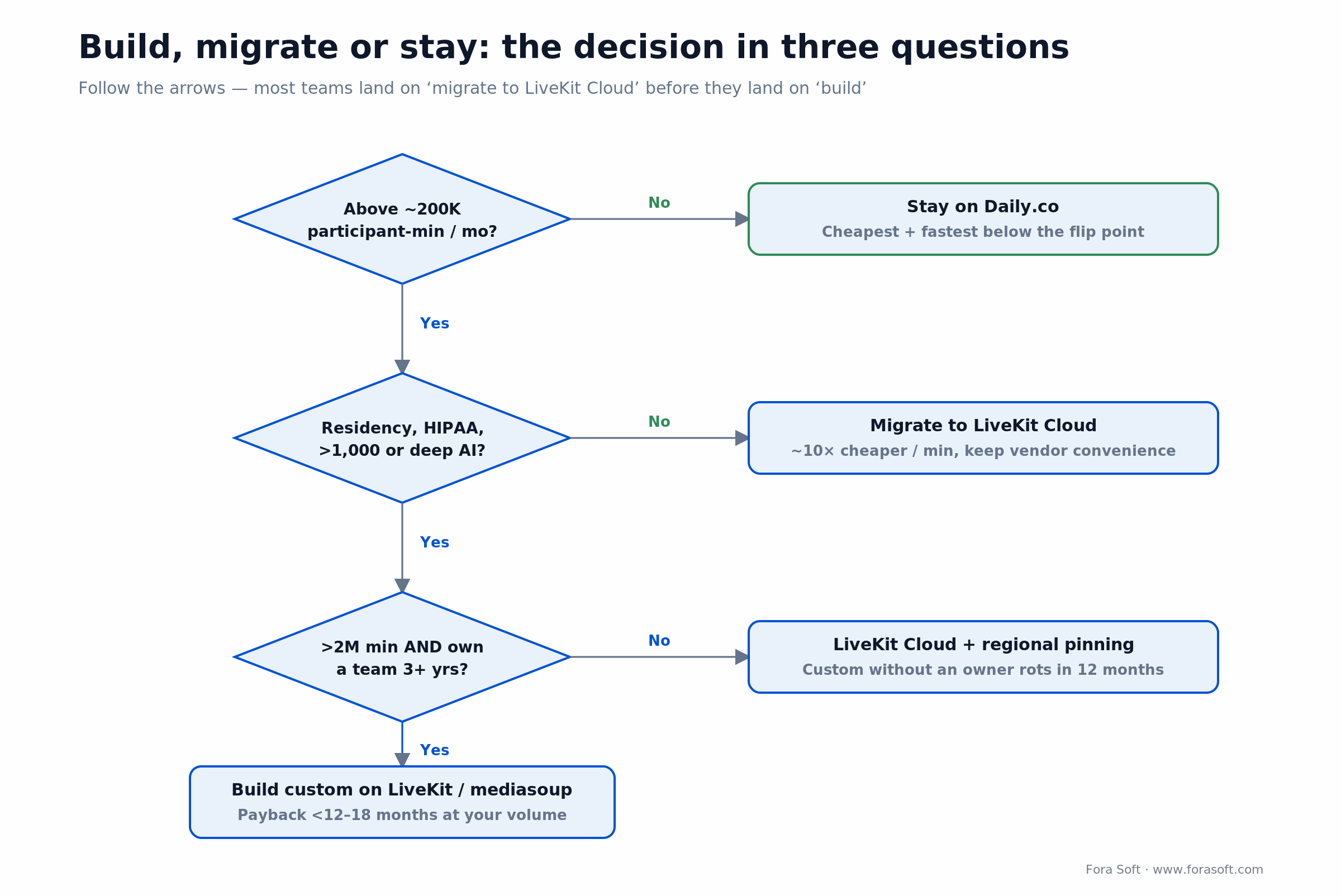
Figure 4. Three questions that route most teams: stay on Daily.co, migrate to LiveKit Cloud, or build a custom SFU.
1. Are you above ~200K participant-minutes / month? If yes, at minimum move to LiveKit Cloud. If above ~2M / month, model self-hosting.
2. Do you have a hard residency or HIPAA / SOC 2 line? If yes, custom or LiveKit Cloud with regional pinning — not Daily.co.
3. Do you need calls > 1,000 active participants? Daily caps real-time at 1,000. Custom SFU mesh or LiveKit / mediasoup if yes.
4. Is AI integration central to your product? LiveKit Agents native SDK is the cleanest path. Daily + Pipecat works but is a layer thicker.
5. Can you fund a 2–3 person engineering team for 3+ years? If not, do not self-host. LiveKit Cloud or stay on Daily — a custom platform without an owner rots in 12 months.
Reach for build when: three or more answers above push toward custom — especially residency, >1,000-participant calls, or AI agent depth. Otherwise migrate to LiveKit Cloud first and revisit in 12 months.
A realistic 14-week rollout plan
| Phase | Weeks | Outcome |
|---|---|---|
| Discovery + architecture | 1–2 | Latency / scale targets, residency, TURN strategy. |
| SFU + TURN + signalling | 2–5 | LiveKit cluster, coturn, JWT auth, room API. |
| Web client | 4–8 | React + livekit-client, lobby, screen-share, chat. |
| Mobile clients | 6–11 | iOS (Swift, CallKit, PiP), Android (Kotlin, ConnectionService). |
| Recording + AI captions | 8–12 | Egress workers, S3 / R2 sink, Whisper / Deepgram. |
| Hardening + compliance | 12–13 | Pen-test, BAAs, EU residency, SOC 2 prep. |
| Soft launch | 14 | Phased migration off Daily; runbook; on-call drill. |
How Agent Engineering changes the build math
Three years ago, a multi-platform Daily-replacement comfortably ran past $300K in year 1. Today, with multi-agent code generation paired with senior architectural review, we squeeze the same scope into the $180–$300K band. Savings concentrate in three places:
Boilerplate. Auth, room API, RBAC, IaC, observability scaffolding. Agents emit ~70% of the first draft, senior engineers refactor and harden.
Test scaffolding. Generated unit + integration tests cover the happy paths; humans add the failure modes that actually trip in production (network blips, ICE failures, codec fallbacks, recording gaps).
Docs that don’t rot. OpenAPI, runbooks, mobile SDK docs generated from the same source of truth, so the team gets accurate handover docs at month-6 instead of a stale wiki.
When NOT to leave Daily.co
Five situations where we will tell a prospect to stay on Daily.co:
1. Below ~150K participant-minutes / month. Daily’s 10K-min free tier + ~$600 / month is cheaper than any custom build amortisation.
2. You need to ship in <6 weeks. Daily’s prebuilt UI is genuinely the fastest path on the market.
3. No internal owner for two years. Custom WebRTC platforms die without a sponsor.
4. AI agent flow is exploratory. Daily + Pipecat is fine for v0 / v1 AI features; revisit when the product fit is proven.
5. No multi-year operating budget. A custom WebRTC platform that ships and starves of maintenance is worse than a managed bill.
FAQ
Is Daily.co actually expensive?
It depends on volume. At <200K participant-minutes/month, Daily.co is cheap and convenient. Above ~500K minutes/month, LiveKit Cloud is roughly 10× cheaper per minute at comparable quality. Above ~2M minutes / month, self-hosting LiveKit / mediasoup pays back inside 12–18 months on a $180–300K custom build.
What’s the cleanest Daily.co alternative in 2026?
LiveKit — either LiveKit Cloud (managed, ~10× cheaper per minute) or self-hosted (no per-minute fee, infra + ops only). LiveKit also has the strongest native AI Agents SDK, which matters if real-time captions, summarisation or AI co-hosts are on your roadmap.
Does Daily.co support EU data residency / HIPAA?
Daily signs HIPAA BAAs on paid plans, but explicit EU-only data residency isn’t advertised in standard plans. You’ll need an enterprise conversation. If your customers demand “data never leaves the EU,” LiveKit Cloud regional pinning or self-hosting in Frankfurt / Dublin (Hetzner / OVH) is faster to defend in an audit.
How long does it take to migrate off Daily.co?
A like-for-like migration to LiveKit Cloud typically takes 4–6 weeks (auth, room API, web client refactor). A full custom build with web + iOS + Android + recording + transcription + HIPAA controls runs 5–7 months at $180–$300K with our Agent Engineering pipeline.
Are there real hidden costs in custom WebRTC?
Yes. TURN bandwidth (15–25% of sessions need relay), recording storage + lifecycle, observability tooling, on-call rota (~0.25 FTE), and compliance audits ($30–$80K year 1 for HIPAA / SOC 2 Type II). Most spreadsheets miss on-call and underestimate TURN.
Can we start on Daily.co and migrate later without a rewrite?
Yes, if you wrap Daily.co behind your own thin SDK from day one (one room API, one client wrapper, one auth). When you migrate to LiveKit, you swap the implementation under the wrapper without touching feature code. We’ve done this exact migration twice; it cuts the rewrite cost roughly in half.
What about Twilio Programmable Video being sunset?
Twilio reversed it. After announcing an end-of-life (later pushed to December 2026), Twilio confirmed in 2024 that Programmable Video remains a standalone product it will keep investing in. It’s a safe choice if you already run on Twilio, but it isn’t growing aggressively — evaluating from scratch in 2026, LiveKit, Daily.co and 100ms are the more active bets.
How does Fora Soft typically engage on a project like this?
A 60-minute discovery, then a 2-week paid architecture sprint that produces a target architecture, build-vs-buy verdict and 14-week roadmap. From there it’s a fixed-scope MVP (8–12 weeks), a soft launch with phased Daily.co migration, and a hardening + compliance phase. Book a 30-min call to scope it.
What to Read Next
Vendor
Agora.io Alternative in 2026
Custom WebRTC with LiveKit, mediasoup, Jitsi & Janus.
Architecture
P2P vs MCU vs SFU for Video Conferencing
When each architecture wins, with real numbers.
AI
Building Multimodal AI Agents with LiveKit
Voice + vision agents in production WebRTC.
Hiring
How to Hire LiveKit Developers
Skills, interview signals, typical engagement shapes.
Build guide
How to Build Custom Video Conferencing Solutions
From discovery to production, with cost lines.
Ready to settle Daily.co vs build for your product?
Daily.co is a great default in 2026 — until your minutes, your residency requirements, your scale ceiling, or your AI roadmap stop fitting the prebuilt model. The flip points are predictable: ~200K participant-minutes/month moves you to LiveKit Cloud; ~2M minutes/month or a hard residency / HIPAA / 1,000-participant constraint moves you to a custom build on LiveKit, mediasoup, Janus or Jitsi.
If you’re the person on the hook for the WebRTC roadmap or the Daily.co invoice, you don’t need another generic comparison. You need the build-vs-buy line drawn against your actual minutes, your concurrency, and your jurisdictions. We’ll bring the architecture, the cost model, and two decades of receipts from VALT, Vodeo and other production WebRTC and streaming systems. The full scope is on our video streaming engineering page.
Get a Daily.co vs build verdict in 30 minutes
Bring your monthly participant-minutes, peak concurrency, residency requirements, and current vendor bill. We’ll come back with an architecture sketch, a cost model, and an honest recommendation.