

Key takeaways
• Custom object detection cameras finally pencil out for niche, industry-specific problems. The computer vision market runs about $19.82B (2024) heading to $58.29B by 2030 at 19.8% CAGR (Grand View Research); scope varies by source, but ~20% annual growth is the through-line. Edge AI cameras are the fastest-growing slice.
• Buy a platform first. Build custom only when the platform genuinely can’t serve. Verkada, Avigilon, Genetec, Milestone, Eagle Eye, BriefCam, Viso.ai cover ~80% of standard use cases. Custom wins when you need a domain-specific class (rare livestock disease, your manufacturing line’s defect taxonomy, an industry-unique compliance signal).
• Cloud APIs (AWS Rekognition, Google Vision, Azure CV) are the cheapest path to validate the idea. Pricing: $1.00–$2.00 per 1,000 images. Use them for the prototype. Move to edge or custom only when latency, privacy, cost-at-scale, or accuracy on your specific classes forces it.
• Real outcomes from production deployments: retail loss prevention 35–56% shrinkage reduction. Manufacturing QC at 95–99% defect catch rate vs. 70–80% human. Construction PPE 95–99% detection. Dock door near-100% scan accuracy at 40–60% labor reduction.
• Custom MVP economics (2026): $60K–$140K for a focused 8–14 week build (single use case, single site). Production-grade multi-site rollout: $180K–$450K. Agent Engineering compresses routine integration and inference work by 25–40% — faster and lower-cost than typical vendor estimates.
Why Fora Soft wrote this guide
Fora Soft has been shipping real-time video, AI, and computer-vision software since 2005 — 250+ projects, 50 in-house engineers. We built VALT, a video surveillance and observation platform now used by 770+ US organizations and 50,000+ users, where we’ve been the sole engineering team for 10+ years — plus custom video-analytics and recognition pipelines for clients in retail, security, healthcare, and industrial automation. Companion reading: our Custom VMS Development guide on the surveillance / video-management spine these recognition pipelines plug into, our video surveillance learning hub, and our Edge Computing in Live Streaming playbook on the latency model behind recognition placement. This is the decision-oriented companion: when does a custom object detection camera actually beat off-the-shelf, and what does building it cost?
Evaluating object recognition cameras for your operation?
Tell us the use case (retail loss prevention, manufacturing QC, dock-door automation, construction PPE, agriculture, traffic, security) and rough scale. We’ll come back with a concrete recommendation: cloud API, off-the-shelf platform, or custom build — and an honest estimate.
Why custom object recognition is now buildable, not aspirational
Three things changed between 2022 and 2026 that made custom object recognition a real procurement option, not a science project:
- Edge silicon got real. NVIDIA’s Jetson Orin Nano Super (67 TOPS after the late-2024 “Super” update, ~$249 — up from 40 TOPS at $499) runs YOLOv8-medium past 30 FPS. Hailo-8 (26 TOPS, ~$170) and Google Coral (4 TOPS, ~$60) cover lower-power jobs. Hardware that needed a $5K workstation in 2021 now ships in a $400 camera.
- Models got accurate and small. YOLOv8–v11 hit 85–95% mAP on common objects with 25–100 MB model size. RT-DETR pushes accuracy higher when latency budget allows. Foundation models (Grounding DINO, SAM2) cut data labeling effort 40–70%.
- Annotation tooling matured. Roboflow, CVAT, Labelbox, Encord: 2,000–5,000 well-labeled images per class now reach production accuracy on most industrial use cases. With pre-trained backbones, you can be at 90%+ accuracy in 8–12 weeks for a focused class.
What this means for budget-holders: the question is no longer “can we build it?” The question is “is the custom-build economically justified vs. the off-the-shelf platform that already covers 80% of generic use cases?” That’s a much more answerable question.
The one-line decision rule: If your problem is generic (people counting, license plates, common safety violations, basic intrusion), buy an existing platform. If your problem is industry-specific (your defect taxonomy, your livestock condition library, your asset class) — and the platform vendors don’t cover it — custom wins.
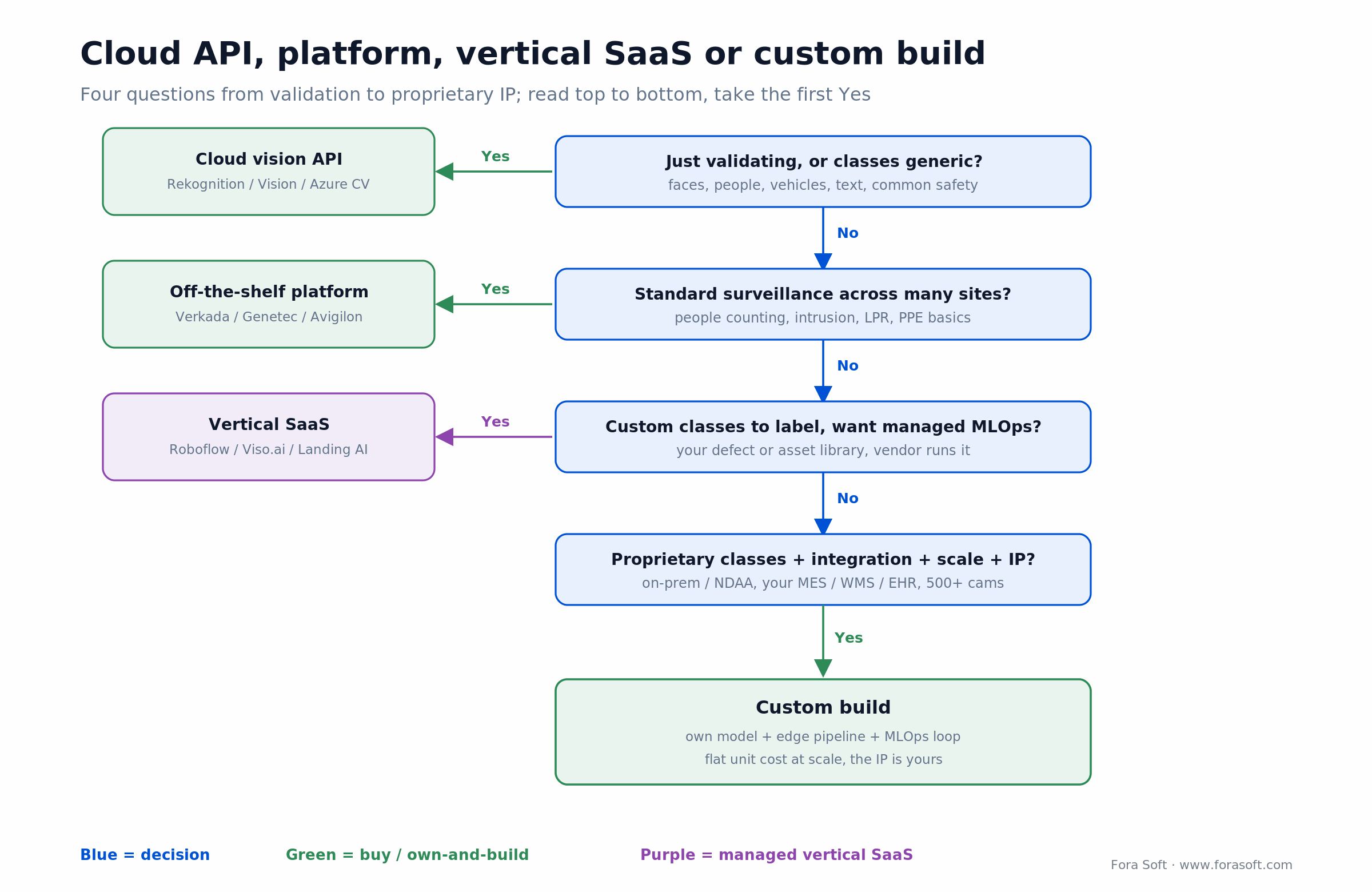
Figure 1. Take the first Yes — most teams stop at cloud API or an off-the-shelf platform; custom build is the last resort, not the default.
The 2026 object recognition camera market in one snapshot
The numbers that frame the buying decision:
- Global computer vision market: $19.82B (2024) → $58.29B (2030), 19.8% CAGR (Grand View Research). Scope shifts the number — MarketsandMarkets’ “AI in computer vision” cut reaches $63.48B by 2030, Statista pegs 2025 at $42.88B — but every source lands near ~20% a year.
- Edge AI camera segment: $33.8B (2025) → $120.6B (2035), 21.52% CAGR — the fastest-growing slice.
- Video analytics software: $11.4B (2025) → $25.9B (2030). The platform layer that recognition pipelines plug into.
- License plate recognition (LPR/ANPR): $3.1B (2025) → $4.8B (2030), 9.2% CAGR.
- Industry adoption: 65% of manufacturers plan to invest in computer-vision QC by 2027 (Gartner). 50%+ of large retailers run shelf-analytics or loss-prevention CV today.
- Edge inference share: 40% of all CV workloads in 2025, projected 60% by 2028. Privacy regulation, latency, and bandwidth economics are pushing inference to the camera.
The three buying paths — cloud API, platform, or custom build
Decide which lane you’re in before you start vendor calls. The wrong lane is the most expensive mistake.
| Path | Best when | Year-1 cost | Time to value |
|---|---|---|---|
| Cloud API (Rekognition / Vision / Azure CV) | Generic classes, <100K images/month, no hard latency | $1.5K–$20K | Days |
| Off-the-shelf platform (Verkada, Avigilon, Genetec, Eagle Eye, BriefCam) | Standard surveillance / analytics, multi-site, IT can’t maintain ML | $25K–$200K (per site) | Weeks |
| Vertical SaaS (Roboflow, Viso.ai, Landing AI, Chooch) | Custom classes you can label, but want managed MLOps | $30K–$120K | 4–10 weeks |
| Custom build (your team or agency) | Proprietary classes + tight integration + scale + IP ownership | $60K–$450K | 8–24 weeks |
Buy a cloud API when
- You’re validating the idea (POC, internal demo, hackathon).
- Your classes are generic (faces, common objects, text, logos).
- Volume is < 100,000 images/month. (Above that, cloud cost crosses dedicated infra.)
- Latency tolerance is 200ms+ and you can ship images to the cloud.
- You don’t need on-prem / air-gapped deployment.
Buy an off-the-shelf platform when
- You need surveillance + analytics, not pure recognition.
- You have multiple sites and your IT team won’t maintain a custom ML stack.
- Your use cases match an existing analytics catalog (people counting, vehicle classification, common safety, intrusion).
- You need certified hardware + SOC 2 + compliance posture out of the box.
- You can live with the platform’s integration boundaries (most ship REST/webhooks; a few support deep VMS / ERP integration).
Build custom when
- Your detection target is genuinely industry-specific (rare livestock condition, your line’s defect taxonomy, a specific medical or industrial signal).
- You need tight integration with proprietary systems (your MES, your SCADA, your custom WMS, your EHR).
- On-prem / air-gapped / NDAA-compliant deployment is mandatory.
- Long-term unit economics matter: 10K+ cameras, custom IP that becomes a moat.
- Off-the-shelf accuracy on your classes plateaus below your minimum.
Need help deciding which lane you’re in?
Send the use case, expected camera count, and accuracy target. We’ll return a one-page recommendation with a comparison: cloud API cost projection, top 2 platform fits, custom-build estimate.
Where custom object recognition actually pays back — 8 verticals with real numbers
Retail — loss prevention, shelf analytics, queue management
Production deployments cut shrinkage by 35–56% with self-checkout monitoring, intelligent video analytics, and basket-bottom detection. Average savings: $43K per store per year. Vendors used: Everseen, Standard Cognition, Verkada at the platform layer; custom builds for chains with proprietary planograms or specific brand-tied SKU libraries.
Manufacturing — visual quality inspection
Computer vision QC delivers 95–99% defect detection vs. 70–80% for human inspectors, at 10–100× the throughput. 65% of manufacturers are planning AI vision investment by 2027 (Gartner). Vendors: Landing AI, Cognex VisionPro, Keyence; custom for your specific defect taxonomy when off-the-shelf models don’t cover the defect class. For deployment-level detail — detection methods, false-reject tuning, and buy-vs-build — see our guide to machine vision inspection systems.
Logistics + warehousing — dock door, package tracking
Dock-door automation reaches near-100% scan accuracy at 40–60% labor reduction on parcel and pallet scenarios. Vendors: Cognex, Sick AG, custom builds for non-standard packaging (irregular shapes, no barcodes). Payback: typically 12–18 months on a 5+ dock door installation.
Agriculture — livestock counting, crop health, weed detection
Field deployments report 120–150% ROI, 25% yield improvement, 50% pest reduction with computer-vision-guided spraying (Blue River / John Deere See & Spray). Custom builds dominate here — few off-the-shelf platforms know your livestock breed library or your weed species mix.
Healthcare — patient monitoring, fall detection
Hospital deployments: 92–98% fall detection accuracy, 15–40% reduction in adverse incidents. Specialty vendors: Inspiren, AvaSure, Care.ai. HIPAA scope is non-negotiable; on-prem or BAA-covered cloud only. Heavy bias toward custom or vertical-specialist platforms over generic surveillance vendors.
Construction — PPE compliance, safety hazards
PPE detection (helmet, vest, fall-arrest line) hits 95–99% accuracy on most sites. Incident reduction: 40–50%. Vendors: Smartvid.io, viAct, Buildots, Eyrus. Custom builds when site-specific equipment, regional PPE standards, or proprietary safety taxonomies exceed off-the-shelf class coverage.
Traffic + smart cities — LPR, vehicle classification, anomaly
License plate recognition (LPR/ANPR) reaches 95%+ accuracy in good conditions; lower in adverse weather. Market: $3.1B (2025) → $4.8B (2030). Vendors: Rekor, OpenALPR, Genetec AutoVu, Vaxtor. Custom builds for tolling integration, special-jurisdiction plate formats, or fleet-specific classification.
Security + access — perimeter intrusion, tailgating, weapon detection
Modern intrusion detection: 95%+ true positive rate at calibrated false-positive thresholds. Vendors: Avigilon, Genetec, Eagle Eye, Verkada at the platform layer; ZeroEyes and Actuate for weapon detection specifically. Custom for unusual scene geometry, high-security facilities, or integration with proprietary access systems.
The 2026 vendor map — who to evaluate
A short list of vendors serious enough to be on a shortlist. Vet only the ones that match your problem — not all of them.
| Vendor | Category | Deployment | Best fit |
|---|---|---|---|
| Verkada | Cloud-managed cameras + analytics | Cloud + edge | Multi-site, low-IT, generic analytics |
| Avigilon (Motorola) | Enterprise VMS + AI analytics | On-prem + cloud | Large enterprise, government |
| Genetec | Unified VMS + access + LPR | On-prem + cloud | Government, smart cities, transit |
| Milestone XProtect | Open VMS platform | On-prem | Best-of-breed analytics integration |
| Eagle Eye Networks | Cloud VMS + analytics | Cloud-first | SMB to mid-market multi-location |
| Axis Communications + ACAP | Cameras + open analytics platform | Edge | Best camera + 3rd-party analytics flexibility |
| BriefCam | Video analytics + investigation | On-prem + cloud | Forensic search, retroactive analytics |
| Viso.ai | No-code CV application platform | Edge + cloud | Custom apps without full ML team |
| Roboflow | Annotation + training + deployment | Cloud + edge SDK | Custom model dev, fast iteration |
| Landing AI | Manufacturing visual inspection | On-prem + cloud | QC defect detection at scale |
| NVIDIA Metropolis | SDK + reference apps + DeepStream | Edge (Jetson) | Custom edge pipelines on Jetson |
| Edge Impulse | Tiny ML / embedded CV | Edge (MCU + accelerator) | Battery / low-power devices |
| Hailo (chip + SDK) | Edge AI accelerator silicon | Edge | High inference / low power, hard real-time |
| Rekor (LPR / ANPR) | License plate recognition | Cloud + edge | Tolling, fleet, public safety |
| Chooch | Custom CV models + monitoring | Cloud + edge | Industrial / safety / weapon detection |
NDAA + procurement gotcha: Hikvision and Dahua are banned from US federal use under NDAA Section 889 (2019) and excluded from many state and enterprise procurement lists. Even if you can technically buy the cameras, banks, healthcare, government contractors, and many large enterprises will reject the deployment. Default to NDAA-compliant brands: Axis, Avigilon, Bosch, Hanwha, Verkada, i-PRO.
Cloud computer vision APIs — pricing and the crossover point
Three serious players plus a few specialists. Pricing per 1,000 images (April 2026, list price; volume discounts apply):
| API | Per 1,000 images | Strengths |
|---|---|---|
| Google Cloud Vision | $1.50 | Best OCR, label detection, Vertex AI integration |
| AWS Rekognition | $1.00 (tiered) | Custom Labels, video analysis, deep AWS integration |
| Azure Computer Vision | $2.00 | Custom Vision, Florence model, enterprise tooling |
| Clarifai | $1.20–$3.00 | Custom workflows, multimodal, on-prem option |
When cloud is the right answer
Validation, < 100K images/month, generic classes, no hard latency, no on-prem requirement. The cheapest path to learn whether the idea works at all.
When cloud breaks
At ~100K–200K images/month, cloud per-call pricing crosses dedicated edge or cloud-GPU infrastructure. At 1M+/month, cloud APIs are 2–5× more expensive than running your own inference. Add latency constraints (real-time alerts < 200ms), privacy/compliance (HIPAA, on-prem), or proprietary classes that don’t exist in the cloud catalog — cloud is no longer the answer.
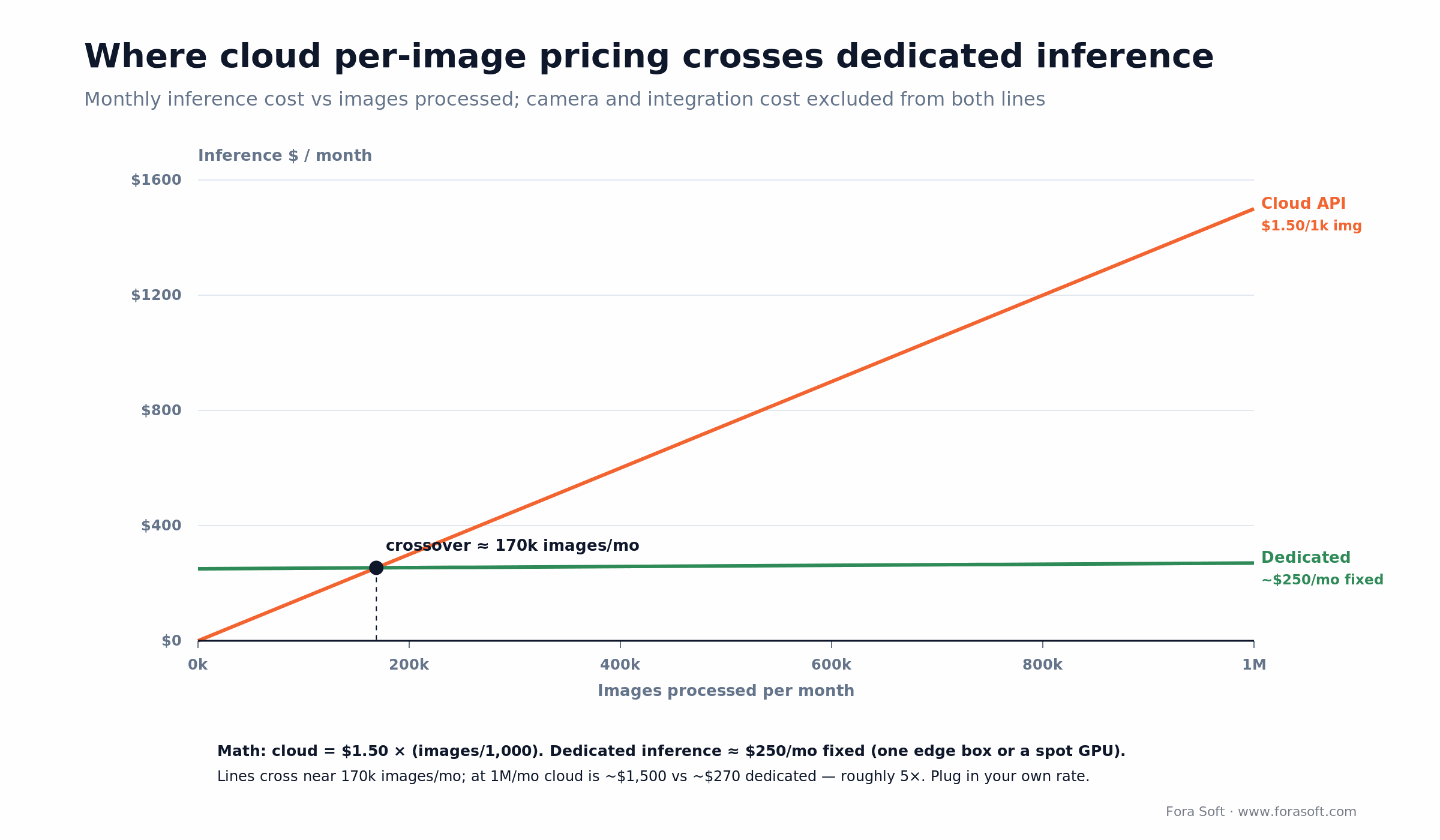
Figure 2. Cloud is cheapest until volume climbs; past ~170k images/month, dedicated inference wins and the gap reaches ~5× at 1M/month.
Edge AI hardware in 2026 — what to put in (or near) the camera
Choose hardware after you know the model, not before. The hardware choice is downstream of inference budget (FPS × resolution × model size), power envelope, and physical deployment.
| Hardware | Performance | Power | Approx. price | Best for |
|---|---|---|---|---|
| Google Coral (Edge TPU) | 4 TOPS | 2 W | $60–$160 | Lightweight, single-stream |
| NVIDIA Jetson Orin Nano Super | 67 TOPS | 7–15 W | ~$249 | YOLOv8-medium @ 30+ FPS, multi-camera (2024 “Super” update: 40→67 TOPS) |
| Hailo-8 | 26 TOPS | 2.5 W | ~$170 | Power-constrained, hard real-time |
| Hailo-8L | 13 TOPS | 1.5 W | ~$70 | Sub-$100 entry, single stream |
| NVIDIA Jetson Orin NX | 100 TOPS | 10–25 W | $699–$899 | Multi-stream, large models (157 TOPS in JetPack 6.2 Super mode) |
| NVIDIA Jetson AGX Orin | 275 TOPS | 15–60 W | $1,999 | Heavy edge, autonomous mobile, robotics |
| Hailo-15 (vision SoC) | 20 TOPS | 5 W | Integrated | In-camera intelligence |
| Axis ARTPEC chips | Variable | Low | In-camera | Pre-installed analytics, ACAP apps |
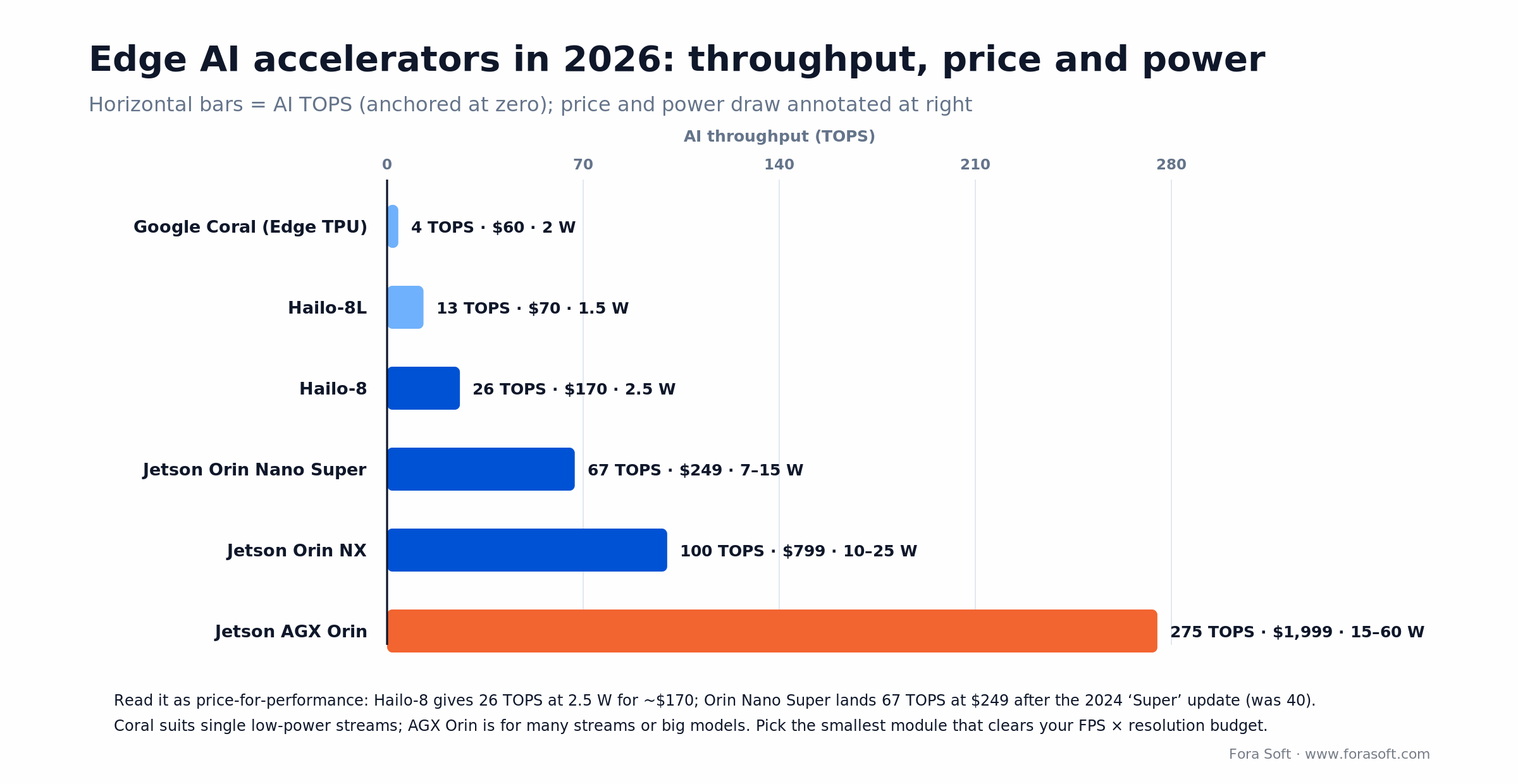
Figure 3. Pick the smallest module that clears your FPS × resolution budget — Hailo-8 and the Orin Nano Super hit the price-for-performance sweet spot.
Model architectures — what 2026 actually ships
The state-of-the-art for object detection in 2026, with the trade-offs each makes:
YOLO26 and the YOLOv8–v12 line (Ultralytics)
The default. Strong accuracy + latency balance. Multiple sizes (n, s, m, l, x) match different hardware budgets. Pick this for 80%+ of object-detection use cases. mAP 50–55 on COCO with reasonable training; 85–95% on focused custom classes. YOLO26 (Ultralytics, January 2026) is the current edge-first default — natively NMS-free and end-to-end, up to ~43% faster on CPU than YOLO11 at similar accuracy, with detection, segmentation, and pose in one model. The older v8–v12 releases stay fine where you’ve already standardized on them.
RT-DETR (Real-Time DETR)
Higher accuracy than YOLO when the latency budget tolerates it. Transformer-based, no NMS. Pick this when accuracy matters more than the last 10ms. RF-DETR (2026) is the real-time DETR variant to watch — the first to clear 60 AP on COCO while staying deployable at the edge.
Detectron2 / MMDetection
Research-grade frameworks with hundreds of detector configurations. Pick this for unusual training regimes or model architectures unavailable in YOLO.
Grounding DINO + SAM2
Open-vocabulary detection (text prompts) + zero-shot segmentation. The combo cuts annotation effort 40–70% by pre-labeling new classes. Pick this for the data labeling pipeline, not production inference (too heavy for most edge deployments).
YOLO-World
Open-vocabulary YOLO — detect classes by text prompt, no training. Pick this for early prototyping and data labeling assistance, not steady-state production.
Inference optimization
ONNX as portability format. TensorRT for NVIDIA edge (2–5× speedup). OpenVINO for Intel. Quantization (FP16, INT8) cuts model size and latency 2–4× with minor accuracy cost. Plan for these from day one — not as an afterthought when latency targets miss.
The data pipeline + MLOps spine that production needs
The single biggest predictor of whether a custom CV system survives in production: did the team build the data pipeline before they shipped the model?

Figure 4. The live path (camera → inference → operator) is the easy half; the MLOps loop that feeds production frames back into training is what keeps accuracy from decaying.
Annotation
Tools: CVAT (open-source, self-hosted), Labelbox (managed, enterprise), Roboflow (developer-friendly), Encord (active learning loop). Effort: budget 30–60 seconds per bounding box per image. For production accuracy on a focused class: 2,000–5,000 well-labeled images per class; harder cases need 10K+.
Versioning + experiment tracking
Data: DVC, Pachyderm, or LakeFS. Models + experiments: MLflow, Weights & Biases, Neptune. Without these, you can’t reproduce your own results six months in.
Training infra
Vertex AI (Google), SageMaker (AWS), Azure ML — managed routes. For control + cost: spot GPUs on a Kubernetes cluster, or a small on-prem GPU rig for sensitive data. Most production training fits on 1–4 A100 / H100 GPUs.
Drift monitoring + retraining
Production accuracy decays. Distribution shift (new lighting, new SKUs, new camera angles, seasonality) is the silent killer. Monthly drift review is a sensible default; trigger-based retraining kicks in when monitored confidence-score distributions move beyond thresholds. Plan for monthly to quarterly retraining cadence in steady state.
Edge deployment
OTA model updates (NVIDIA Fleet Command, AWS IoT Greengrass, Azure IoT Edge), staged rollouts (10% → 50% → 100%), automatic rollback on accuracy regression, signed model artifacts.
What we see most teams skip: A model registry, signed artifacts, rollback policy, and a closed feedback loop from production back to training data. These are not nice-to-haves — they’re the difference between a deployed system and a deteriorating one.
Mini-case: the surveillance backbone behind 50,000 users
Intelligent Video Solutions came to us needing a video recording and observation platform their customers — medical schools, law-enforcement interview rooms, child-advocacy centers — could trust with sensitive footage. Off-the-shelf VMS products didn’t fit: they needed PTZ multi-camera capture, motion-triggered recording, word-level search inside video, and a HIPAA/GDPR posture, all under their own brand.
We built VALT from scratch and have stayed their sole engineering team for 10+ years. The stack pairs fixed IP cameras and mobile capture with encrypted RTMPS streaming, scheduled and motion-triggered recording, and an Amazon Transcribe pipeline that makes spoken words searchable and exportable as PDF. Object- and event-recognition hooks plug into that same ingestion spine — the same pattern our video surveillance development team reuses across recognition projects.
VALT now runs across 770+ US organizations and 50,000+ active users. The year v1 launched, IVS hit $1M in revenue; within five years, $8M — and they were named the 4th fastest-growing tech company in Wisconsin. Want a similar read on your camera stack? Grab a 30-minute assessment.
What a custom object recognition system actually costs in 2026
Short answer: a focused single-site MVP runs $60K–$140K (8–14 weeks), a production multi-site system with MLOps runs $180K–$450K (4–7 months), and a regulated FDA/IEC 62304 track runs $500K–$1.5M+. Three representative scenarios below; estimates assume Agent Engineering acceleration and exclude ongoing cloud / camera procurement (covered separately).
Scenario A — focused MVP, single use case, single site
| Line item | Range |
|---|---|
| Discovery + use-case framing (1–2 weeks) | $5,000–$10,000 |
| Data collection + annotation (3K–5K images, 1–3 classes) | $8,000–$25,000 |
| Model selection, training, optimization | $15,000–$30,000 |
| Inference pipeline (camera ingest, edge or cloud, alerting) | $15,000–$35,000 |
| Dashboard / API / integration | $10,000–$25,000 |
| Site pilot + tuning + handover | $7,000–$15,000 |
| MVP total (8–14 weeks) | $60,000–$140,000 |
Scenario B — production system, multi-site, MLOps
Adds: model registry + drift monitoring, OTA edge deployment, multi-tenant ingestion, hardened HTTPS APIs, role-based dashboards, monitoring + alerting. $180K–$450K, 4–7 months. Annual run-cost (cloud, monitoring, retraining): typically $30K–$120K depending on scale.
Scenario C — production system with FDA / regulated track
Adds: design controls, software validation per IEC 62304 or equivalent, cybersecurity plan, SBOM, formal QMS integration, extended clinical or industrial validation. $500K–$1.5M+, 12–24 months, plus regulatory consulting cost. Required only if your CV product is itself classified as a medical device, automotive safety component, or similarly regulated artifact.
Where Agent Engineering compresses cost
Routine integration code, inference pipeline scaffolding, dashboard plumbing, test-scaffolding generation, edge deployment scripts — AI-assisted delivery cuts the typical hourly load 25–40% on these layers. The savings don’t come out of the model quality budget — they fund the data pipeline + MLOps work that’s typically under-budgeted on first-time CV builds. See how we scope custom software development engagements.
Want a concrete estimate for your use case?
Send the use case (vertical, target class, expected accuracy, camera count, deployment site profile). We’ll return a one-page scope with model + hardware + integration approach and a defensible cost range.
Privacy, biometric, and procurement compliance you cannot skip
CV deployments fail in legal review more often than they fail technically. The big ones in 2026:
GDPR + biometric data
Facial recognition and other biometric IDs are special-category data under GDPR Article 9. Lawful basis is narrow (explicit consent or substantial public interest). DPIA required. Data minimization, retention limits, subject access rights enforced.
BIPA (Illinois Biometric Information Privacy Act)
Strict consent + retention rules for biometric data of Illinois residents. $1,000 per negligent violation, $5,000 per intentional — class actions have settled in the hundreds of millions. If you operate cameras anywhere your customers might be Illinois residents, this is a board-level risk.
CCPA / CPRA (California)
Biometric data is sensitive personal information. Consumer rights to know, delete, opt-out. Purpose limitation requirements.
NDAA Section 889
Bans US federal use (and many state and prime-contractor flow-down) of Hikvision, Dahua, Hytera, Huawei, ZTE products. Default: NDAA-compliant cameras (Axis, Avigilon, Hanwha, Bosch, Verkada, i-PRO).
Local facial recognition bans
San Francisco, Oakland, Portland, Boston, Berkeley, Somerville, plus statewide bans (Massachusetts, Maine for state agencies). Many private-sector deployments restricted by city ordinance.
EU AI Act
Biometric identification systems are classified high-risk. Requires conformity assessment, risk management, data governance, human oversight, transparency. Real-time biometric ID in public spaces is largely banned for law enforcement (with narrow exceptions).
Practical compliance posture: Default to no facial recognition unless you have an unambiguous legal basis. Default to NDAA-compliant cameras. Default to data minimization (don’t store images longer than necessary). Run privacy review before deployment, not after. Document everything.
Twelve pitfalls that wreck object recognition deployments
1. Lighting variation. Models trained on daylight imagery degrade 20–40% at night, in mixed lighting, or under industrial sodium lamps. Mitigation: train on full lighting range or use IR / multispectral cameras.
2. Motion blur. 30 FPS at 1080p is fine for slow-moving subjects; fast subjects need 60 FPS+ and shorter exposure. Camera selection matters as much as model selection.
3. Occlusion. Real scenes have boxes in front of people, cars in front of plates, equipment in front of workers. Train on occluded examples or accept reduced accuracy in occluded regions.
4. Distribution drift. Production data drifts. New SKUs, new uniforms, new vehicle models, new equipment, new camera angles. Without monitoring, accuracy decays silently. Plan for monthly drift review.
5. Class imbalance. If 99% of frames have no event of interest, the model learns to say “nothing”. Counter with focal loss, oversampling, or generative augmentation.
6. Camera lifecycle mismatch. Cameras last 5–7 years; AI accelerators get a generation refresh every 2–3. Plan refresh cycles separately.
7. ONVIF + RTSP integration sloppiness. “ONVIF compatible” varies wildly. Test each camera model against your VMS / ingestion pipeline before procurement — spec sheet compatibility ≠ working integration.
8. Insufficient annotation. Teams ship with 500 images per class and wonder why production accuracy is 60%. Plan 2K–5K minimum; complex classes need 10K+.
9. Latency assumptions. “Real-time” means different things. Sub-100ms (vehicle-speed alerts), sub-500ms (worker safety), sub-2s (queue management) — each implies different architecture.
10. False-positive fatigue. A 5% false-positive rate on 1M events = 50K false alerts. Operators stop responding. Calibrate thresholds for your true acceptable alert volume, not for the demo.
11. No model versioning. Six months in, no one can reproduce why production behaves like it does. Use MLflow / W&B / DVC from week 1.
12. Privacy oversights. Faces, license plates, employee badges captured incidentally. Data masking, retention windows, consent posters, signage all matter. Privacy-by-design is cheaper than privacy retrofit.
A 6-question decision framework for object recognition projects
Q1. Is the detection class generic or industry-specific? Generic (faces, cars, people, common safety): cloud API or platform. Industry-specific (your defect taxonomy, livestock conditions, custom assets): custom build.
Q2. What’s your camera count and image volume? < 50 cameras / 100K images per month: cloud or platform. 50–500: vertical SaaS or custom. 500+: custom + edge inference.
Q3. What’s your latency budget? > 2 seconds: cloud OK. 200ms–2s: cloud with regional endpoint. < 200ms: edge inference required.
Q4. What’s your data residency / privacy posture? Public cloud OK: cloud or platform. On-prem only: custom + edge or self-hosted. HIPAA / regulated: custom + BAA-covered cloud or on-prem.
Q5. Do you need integration with proprietary systems (MES, SCADA, WMS, EHR)? No: platform fits. Yes: custom or vertical SaaS with deep integration.
Q6. What’s your team’s ML / MLOps maturity? Strong in-house ML team: build with cloud GPUs + open-source stack. No in-house ML: vertical SaaS or agency-built custom with managed MLOps.
A realistic 90-day object recognition pilot plan
What good looks like in each 30-day window:
Days 1–30: scoped POC with cloud API or pre-trained model
Pick the single most valuable use case. Pull 500–1,000 representative images. Run them through the cloud API or a pre-trained model. Measure baseline accuracy. Decide: does this approach plausibly hit your accuracy target, or do you need custom training?
Days 31–60: pilot deployment with custom training (if needed)
Annotate 2K–5K images. Train YOLOv8/RT-DETR on your classes. Deploy to one site / one camera / one inference endpoint. Run shadow-mode for 2 weeks (your model runs alongside existing process; outputs are compared, not acted on).
Days 61–90: production-mode pilot + scale decision
Move from shadow mode to live alerting. Calibrate false-positive thresholds with operator feedback. Run a 90-day retrospective with hard data: accuracy, alert volume, operator response, business outcome. Decide: scale, redirect, or kill.
Planning a 90-day CV pilot?
We’ll send a pilot-planning checklist (data collection script, annotation guideline template, baseline test rig, shadow-mode KPI sheet) and walk through it on a 20-minute call if useful.
Choosing the camera — specs that actually matter for recognition
Recognition accuracy is bounded by camera quality. Spec checklist:
- Resolution. 1080p is fine for general detection. 4K helps with small objects, distant subjects, ANPR at distance, fine defects in QC.
- Frame rate. 15 FPS for slow scenes, 30 FPS for general detection, 60 FPS+ for fast motion (vehicles, sports, conveyors).
- Sensor size + low-light performance. Larger sensors + low f-stop (1.4–2.0) for low-light. IR illuminators or starlight sensors for night.
- Lens / FOV / focal length. Wide FOV for area coverage; long focal length for distant subjects (LPR, perimeter). Avoid fisheye for recognition (distortion hurts model accuracy).
- Codec. H.264 / H.265 widely supported. Native MJPEG for frame-by-frame analytics workflows.
- ONVIF + RTSP. Test, don’t trust the spec sheet. Some cameras only support ONVIF Profile S (live), not Profile T (advanced) or Profile G (recording).
- NDAA compliance. Confirmed not on the Section 889 list. Default Axis, Hanwha, Avigilon, Bosch, Verkada, i-PRO.
- Power. PoE+ (30W) for higher-power cameras with onboard analytics. Some edge-AI cameras need 60W (PoE++).
- Environmental rating. IP66/67 for outdoor, IK10 for vandal resistance, operating temperature range matching site environment.
VMS, NVR, and pipeline integration — making recognition show up where ops actually look
The most common deployment failure: the model works, but the alerts don’t reach the security operator’s screen, the floor manager’s tablet, or the incident-response system. Three integration layers that must work:
Camera → ingestion
RTSP for live, ONVIF for control, HTTP/HTTPS for snapshot APIs. Test each camera model against your ingest layer; vendor “ONVIF compatible” varies in implementation.
Inference → alerting / events
Webhooks, MQTT, Kafka, gRPC streams to the downstream system. Plan for re-delivery, deduplication, and rate limiting.
Events → operator workflow
Integration with VMS (Genetec, Milestone, Avigilon, Verkada), SOC platforms, ticketing (ServiceNow, Jira), MES / WMS / ERP. The Custom VMS Development guide goes deep on the integration patterns.
What’s actually changing in object recognition in 2026
Open-vocabulary detection is real. Grounding DINO, YOLO-World, and SAM2 mean teams can prototype new classes by text prompt before committing to label thousands of images. Production accuracy still benefits from supervised training, but the prototype loop is 5–10× faster.
Foundation models cut annotation cost 40–70%. Pre-label with a foundation model, human-correct rather than human-label-from-scratch. Single biggest cost compression in CV pipelines this year.
In-camera inference is the default. Hailo-15 in cameras, Axis ARTPEC chips with on-device analytics, Sony IMX500 with embedded inference. The trend is clear: the camera does the work, not the cloud.
Multi-modal models entering production. Vision-language models that answer arbitrary questions about the scene (“is anyone holding a weapon?”, “is this conveyor jammed?”) are real, but expensive at the edge. Used for retroactive search, alert triage, and high-value cases.
Privacy-preserving CV. On-device inference + immediate frame discard, federated training on edge captures, differential privacy for reported metrics. Becoming a procurement requirement.
Regulatory tightening. EU AI Act enforcement begins, more US states pass biometric privacy laws, more municipalities ban facial recognition. Plan for tighter procurement, narrower lawful bases, and required impact assessments.
When you should NOT build a custom object recognition system
Three honest cases:
Your use case is generic and an existing platform covers it. Don’t build people-counting, basic intrusion, or LPR from scratch. Buy from Verkada, Genetec, or Rekor. Custom only when generic doesn’t serve.
You don’t have the data and can’t collect it. No data, no model. If you can’t collect 2K–5K representative images per class within the project budget, custom isn’t feasible. Use a platform with general models and accept their accuracy.
Your team can’t maintain ML in production. Custom models drift. Without a team or partner who can monitor + retrain, the system decays. Either commit to MLOps or use a managed vertical SaaS (Roboflow, Viso.ai, Landing AI, Chooch) where the vendor handles drift.
FAQ
How much data do I need to train a custom object recognition model?
For production accuracy on a focused class with a pre-trained backbone: 2,000–5,000 well-labeled images per class is a sensible target. Easy classes (high contrast, well-lit, single object) reach acceptable accuracy with 1,000–2,000 images. Hard classes (occlusion, lighting variation, fine-grained categories, rare events) need 10,000+. Foundation-model pre-labeling can cut annotation effort 40–70%.
When do cloud APIs beat edge inference?
Cloud APIs make sense for: validation, generic classes, < 100K images/month, no hard latency, no on-prem requirement. Edge inference makes sense when: you need sub-200ms latency, you have privacy/data-residency constraints, you operate at scale where cloud costs dominate, or you need offline operation. The crossover point is roughly 100K–200K images/month where dedicated inference infrastructure becomes cheaper than cloud.
What accuracy can I realistically expect?
Off-the-shelf models on common classes: 70–85% mAP@0.5 on COCO (the stricter mAP@[.5:.95] runs ~40–55%). Trained on your specific classes with 3K–5K well-labeled images: 85–95% mAP is realistic. Hard classes (occlusion, fine-grained) can plateau at 80–88%. For mission-critical applications (medical, automotive, safety), plan for human-in-the-loop verification regardless of stated accuracy.
How often do I need to retrain my model?
Steady state: monthly to quarterly retraining cadence is common. Trigger-based retraining kicks in when monitored confidence-score distributions move beyond thresholds. Major changes (new SKUs, new uniforms, seasonal shifts, camera replacements) are explicit retraining triggers. Without monitoring + retraining, production accuracy decays 5–15% per year.
Can I deploy facial recognition in 2026?
Legally: depends entirely on jurisdiction. Banned for many use cases in San Francisco, Portland, Boston, Massachusetts, and others. Heavily restricted under EU AI Act. Requires explicit consent under GDPR + BIPA. Default posture in 2026: no facial recognition unless you have an unambiguous legal basis, an executed DPIA, and clear consumer notice. Many enterprises now reject facial recognition as a vendor requirement regardless of legality.
How do I integrate object recognition with my existing VMS / NVR?
Three layers: camera ingestion (RTSP, ONVIF, HTTP snapshots), inference event output (webhooks, MQTT, Kafka, gRPC), and downstream integration (VMS metadata overlay, alert routing, ticketing). Most VMS platforms (Genetec, Milestone, Avigilon, Verkada, Eagle Eye) support 3rd-party event ingestion via documented APIs. Test the full pipeline before procurement — spec-sheet ONVIF compliance ≠ working integration.
Which edge hardware should I pick?
Default: NVIDIA Jetson Orin Nano Super (~$249, 67 TOPS after the 2024 update) for most multi-stream scenarios. Power-constrained: Hailo-8 (~$170, 26 TOPS, 2.5W) or Hailo-8L (~$70, 13 TOPS). Lightweight single-stream: Google Coral (~$60, 4 TOPS). Heavy multi-stream / large models: Jetson Orin NX (~$799, 100 TOPS) or AGX Orin (~$1,999, 275 TOPS). In-camera intelligence: Axis ACAP cameras or Hailo-15-equipped cameras.
What hidden costs should I plan for?
Annotation (often underestimated by 2–3×), data infrastructure (storage + versioning + pipeline), MLOps tooling (registry, monitoring, retraining infrastructure), edge device fleet management (OTA updates, monitoring, replacement), camera replacement cycle (5–7 years), and ongoing model maintenance (drift monitoring + retraining). Budget 30–50% of build cost annually for run + maintain.
How long until production?
POC with cloud API: days. Pilot with custom training and one site: 8–14 weeks for an MVP. Production-grade multi-site rollout: 4–7 months. FDA / regulated track: 12–24 months. Foundation models and Agent Engineering acceleration are compressing these timelines — 2026 builds typically ship 30–40% faster than equivalent 2023 builds.
What’s the biggest implementation risk?
Distribution drift in production. The model that hit 95% accuracy in pilot will drift over months as lighting, SKUs, equipment, and camera angles change. Without drift monitoring + scheduled retraining, accuracy decays silently. Plan for it from day one or accept eventual deployment failure.
Should I build with my in-house team or hire an agency?
In-house: best when you have permanent ML engineering capacity and the system is core IP. Agency: best for scoped builds, when speed matters more than ownership, when in-house team is small or single-domain. Hybrid: agency builds the v1, transitions to in-house for ongoing MLOps. The wrong answer is starting in-house with one ML engineer who leaves before the system stabilizes.
Are there NDAA or compliance issues with the cameras I want to buy?
Yes, frequently. Hikvision, Dahua, Hytera, Huawei, ZTE are banned from US federal use under NDAA Section 889 (2019), with flow-down to many state and prime-contractor procurements. Default to NDAA-compliant brands: Axis, Avigilon, Bosch, Hanwha, Verkada, i-PRO. Healthcare adds HIPAA, financial adds SOC 2, federal adds StateRAMP / FedRAMP. Check before procurement, not after deployment.
What does object recognition cost long-term?
For a custom production system: build $180K–$450K, run $30K–$120K annually (infrastructure, monitoring, retraining), edge hardware refresh every 3–5 years. Total 5-year TCO commonly $400K–$1M for a multi-site enterprise system. Off-the-shelf platforms: subscription typically $25K–$200K per year per major site. Cloud-API-based: scales with image volume.
How do I benchmark vendors?
Provide them the same 500–1,000 representative images from your environment. Score on accuracy (mAP, F1), latency (p50, p95, p99), false-positive rate at your operating threshold, integration depth, total cost of ownership over 3 years, and compliance posture (NDAA, SOC 2, HIPAA where relevant). Vendors that won’t run a test on your data are not finalists.
What does object recognition look like in 2027?
Multi-modal vision-language models in retroactive search and alert triage. In-camera inference standard, not optional. Open-vocabulary detection mainstream for prototyping. Foundation-model pre-labeling cutting annotation cost 60–80%. Tighter regulatory scope (EU AI Act enforcement, more US biometric laws). Convergence of CV and robotics in industrial automation. Edge AI accelerator costs continuing to fall.
What to Read Next
VMS spine
Custom VMS Development: The Complete Guide
The video management system layer that object recognition pipelines plug into — integration patterns, deployment models, and the buy-vs-build call.
Edge architecture
Edge Computing in Live Streaming
The latency model that drives where to run inference — cloud vs. regional vs. edge, with cost models and decision triggers.
AI video analytics
AI Video Analytics for Online Learning
A vertical example of how object + behavior recognition plug into a domain-specific platform — analytics design, integration, and outcome metrics.
Adjacent vertical
Multi-Unit Intercom Software for Buildings
A connected vertical (smart-building access + video) where object recognition cameras increasingly drive the user experience.
Portfolio
VALT — Video Surveillance Platform
The surveillance and observation platform we built and still run for 770+ US organizations and 50,000+ users — the spine recognition plugs into.
Ready to put object recognition cameras to work in your operation?
Object recognition has crossed from research demo to procurement line. Edge silicon is real. Models are accurate and small. Annotation tooling is mature. The 2026 question is not “does this work?” — it’s “cloud API, off-the-shelf platform, vertical SaaS, or custom build, and how do we ship in a quarter?”
We’ve been shipping real-time video, AI, and computer-vision software since 2005. If you’re scoping a pilot, evaluating vendors, or sizing a custom build — we’ll help you think through the decision honestly.
Scoping an object recognition rollout or custom build?
Tell us the use case, expected camera count, accuracy target, and deployment site profile. 30 minutes with us gets you a concrete recommendation, a rollout timeline, and a defensible build-vs-buy call — without a sales cycle.

