


Key takeaways
• Startup WebRTC builds land $25K–$90K. SDK-based MVP, web client, basic recording, payments, SOC 2 readiness if the buyer asks. 4–10 weeks calendar.
• Enterprise WebRTC builds land $200K–$600K. Self-hosted SFU, native mobile, HIPAA + SOC 2 controls, observability, multi-region, full DevOps. 4–7 months.
• Run-rate flips near 1M participant-minutes/month. Below that, managed SDKs at roughly $0.004 per participant-minute win. Above it (~500 concurrent users), self-hosted infra plus ops is cheaper.
• Compliance is the biggest enterprise delta. A SOC 2 + HIPAA bundle adds $30K–$70K to the build and $30K–$60K/year in audits. SDKs bundle some of it; self-hosting hands the work to your team.
• Twilio Video is alive again. Twilio reversed its 2023 shutdown in October 2024, so in 2026 you have more managed options, not fewer. Hybrid (ship on a cloud SDK now, self-host later) is the safest path for most teams.
Why Fora Soft wrote this playbook
Most WebRTC quotes miss because founders ask the wrong question. They ask “what does WebRTC development cost?” when the answer that matters is “what does it cost at my stage, and when does the cheap path stop being cheap?” Get the stage wrong and you either burn three months self-hosting an SFU before product-market fit, or you hit a per-minute bill that eats your margin at scale.
We’ve shipped real-time video at both ends of that range. Fora Soft has built 250+ projects since 2005 with 50 in-house engineers, and WebRTC is our core. Public examples: BrainCert, a virtual-classroom platform that grew from an MVP to 100K+ customers and 500M+ classroom minutes; ProVideoMeeting, an enterprise conferencing platform; and VocalViews, a video research marketplace used by Google, Samsung and Netflix at 1M+ participants. We use Agent Engineering — our AI-assisted delivery process — to cut routine scaffolding and testing, so our estimates come in faster and leaner than a traditional shop on the same scope. It’s the same real-time media work behind our custom software development practice. Need a team? Here’s where you can hire WebRTC developers.
How much does WebRTC development cost in 2026?
A WebRTC MVP built on a managed SDK costs $25K–$90K and ships in 4–10 weeks. A production-grade enterprise build — self-hosted media server, native mobile, recording, and compliance — costs $200K–$600K over 4–7 months. After launch, the recurring bill is dominated by per-minute SDK fees below roughly 1M participant-minutes a month, and by bandwidth plus a site-reliability engineer above it. Those two shapes cover almost every WebRTC project we see.
The spread inside each band is driven by four things: how many concurrent users you plan for, whether you need native iOS and Android on day one, which compliance regime your buyer demands, and whether you rent a media server (SDK) or run your own (self-hosted). The rest of this playbook prices each one with current 2026 numbers.
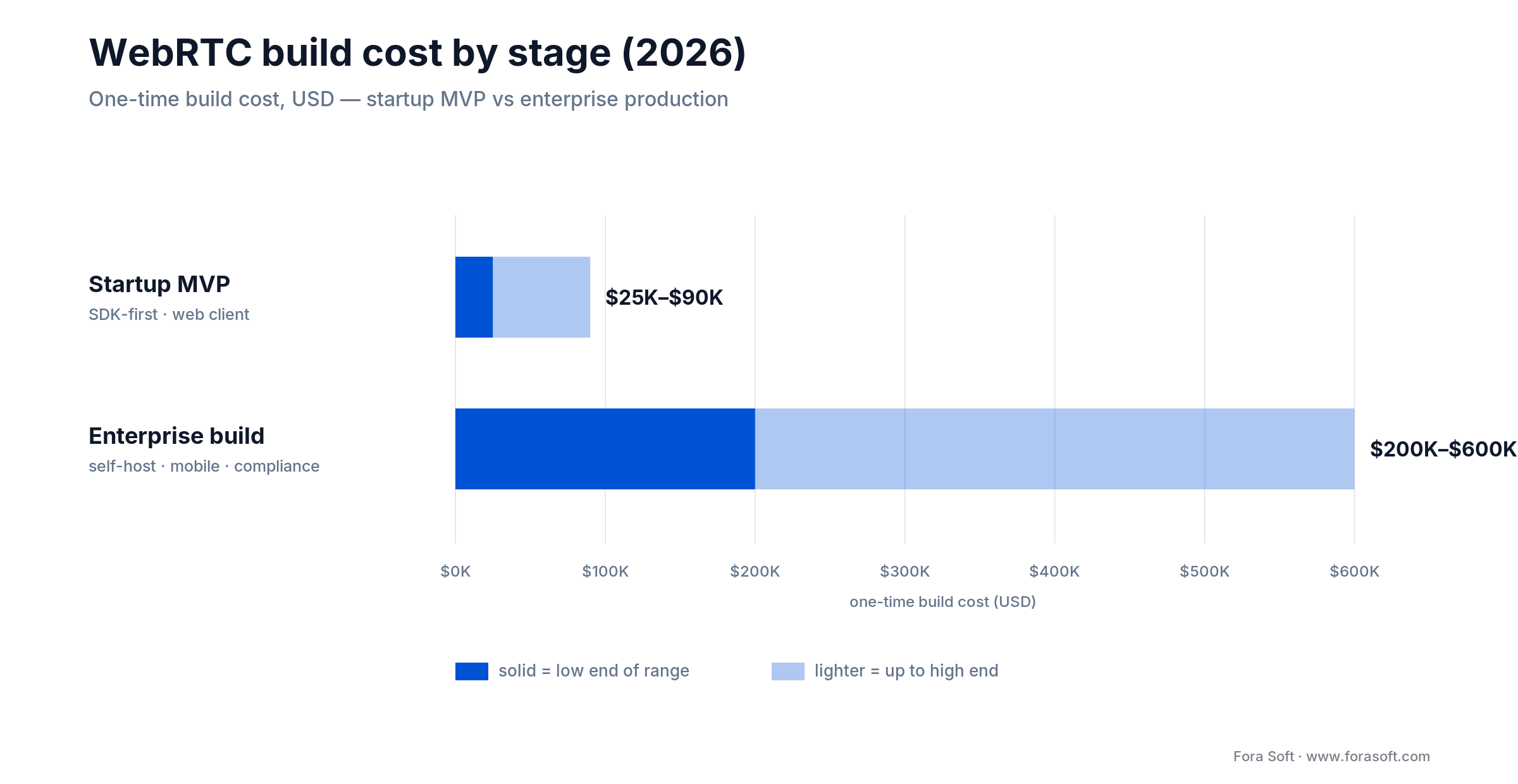
Figure 1. The two cost shapes: a startup MVP sits at $25K–$90K, an enterprise build at $200K–$600K.
Need a cost estimate matched to your stage?
A 30-minute call gets you a build cost, a per-minute run-rate, and a calendar — sized to your concurrent-user count and compliance regime.
Two buyer profiles: startup vs enterprise
Startup and enterprise buyers ask different questions and accept different answers. Working out which profile you fit settles most of the cost conversation before anyone opens a spreadsheet.
| Dimension | Startup profile | Enterprise profile |
|---|---|---|
| Concurrent users | < 200 | 500–5,000+ |
| Time-to-market | 4–10 weeks | 4–7 months |
| Compliance floor | SOC 2 readiness, GDPR DPA | SOC 2 Type II + HIPAA + GDPR + region-specific |
| Mobile clients | Web first; mobile later | Web + iOS + Android day one |
| Recording / archive | Basic, single retention tier | Searchable, multi-region, legal-hold |
| Observability + SRE | Sentry + uptime monitor | APM, distributed tracing, 24/7 on-call |
| Vendor lock-in tolerance | High (speed wins) | Low (data residency, exit strategy) |
Startup pricing: what an MVP actually costs
A WebRTC MVP is rarely about the media server. It’s about one tight loop: sign up, create a room, invite a participant, record, and get paid. The faster you prove that loop, the sooner your next round arrives. SDK-first paths win here because they hand you the hard part — the SFU, TURN, and mobile libraries — on day one.
| Component | Range | Notes |
|---|---|---|
| Frontend (React + custom UI) | $10K–$25K | Room UI, operator console, replay |
| Backend + signalling + auth | $8K–$20K | Rooms API, RBAC, audit log |
| SDK integration (Daily / LiveKit / Agora) | $3K–$10K | Token issuance, session lifecycle |
| Recording + payments | $4K–$15K | SDK recording or per-track; Stripe billing |
| QA + observability | $3K–$10K | Sentry, smoke tests, free-tier APM |
Total: $25K–$90K, 4–10 weeks. The rows above are typical component ranges, not a fixed bill: a lean MVP that skips recording or a custom console lands near $25K, while payments, polish, and project management push a fuller build toward $90K. After month one the run-rate is mostly SDK fees. At roughly $0.004 per participant-minute (Daily, Twilio, Agora HD, Vonage all sit near this in 2026), a 100-user product running 30-minute sessions lands around $300–$1,000/month — small enough to ignore while you chase traction.
Reach for an SDK MVP when: you’re validating the product loop, the team is small, and the per-minute fee is trivial next to what you charge per session. Below ~200 concurrent users it’s almost always the right call.
Enterprise pricing: production-grade cost
Enterprise budgets start where startup budgets stop. The drivers: native mobile clients, HIPAA plus SOC 2 controls, a multi-region self-hosted SFU, real observability, recording with legal-hold, and a 24/7 on-call rotation. None of that is optional once a Fortune 500 procurement team is reviewing you.
| Component | Range | Notes |
|---|---|---|
| Self-hosted SFU (LiveKit OSS / mediasoup) | $60K–$140K | Autoscale, multi-region, failover |
| Native iOS + Android SDKs | $35K–$80K | Native clients, push, PiP, telephony bridge |
| Recording + transcoding pipeline | $20K–$45K | HLS ladder, transcripts, search index |
| Compliance pack (SOC 2 + HIPAA + GDPR) | $30K–$70K | Audit logs, BAA, encryption review, audit prep |
| Observability + SRE bootstrap | $15K–$30K | APM, tracing, runbooks, on-call setup |
| Custom signalling + admin / RBAC | $25K–$60K | Tenant isolation, SCIM, SSO |
| QA + load testing | $15K–$30K | Synthetic load to 1K+ concurrent users |
Total: $200K–$455K for the core build; native mobile at full scope, FedRAMP-adjacent controls, and multi-region redundancy push the top of the band to $600K. Year-one operations then add roughly $40K–$80K for SRE plus $60K–$120K for multi-region compute and bandwidth at 1,000 concurrent users.
2026 CPaaS video pricing, compared
If you go the managed route, the big providers cluster tightly at about $4 per 1,000 participant-minutes for HD video. The prices below are 2026 list rates pulled from each vendor’s own pricing page. The real differentiators are the free tier, how billing is structured, and whether egress is bundled or metered separately.
| Provider | HD video price | Free tier / month | Notes |
|---|---|---|---|
| Daily | $0.004 / min | 10,000 min | Drops to $0.0015 at 50M+ min |
| Twilio Video | $0.004 / min | Trial credit | TURN included; up to 50 in a room |
| Agora (Video HD) | $0.00399 / min | 10,000 min | Full HD $0.00899; 2K $0.01599 |
| Vonage Video | $0.0041 / min | 100,000 min (new) | Formerly TokBox / OpenTok |
| Zoom Video SDK | ~$0.0035 / min | Trial credits only | Sold via a credit subscription, not pay-as-you-go |
| LiveKit Cloud | $0.0004–$0.0005 conn/min + egress | 5,000 min + 50 GB | Data transfer billed at $0.10–$0.12/GB |
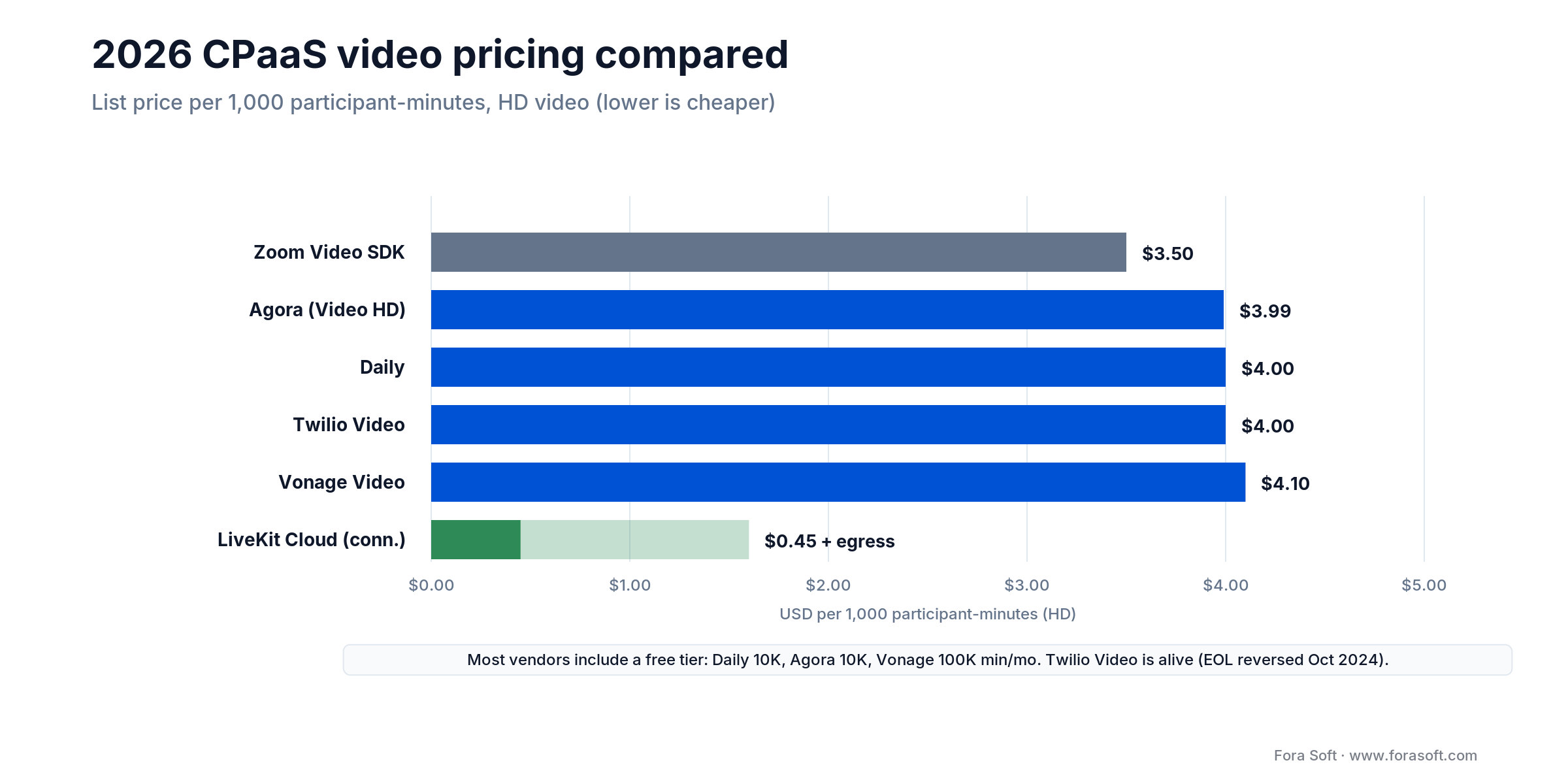
Figure 2. List price per 1,000 participant-minutes. LiveKit prices connection and egress separately, so it looks cheaper until you add data transfer.
Two footnotes matter. First, LiveKit’s headline rate looks 8× cheaper because it only prices the connection; once you add downstream data at $0.10–$0.12/GB (per LiveKit’s pricing), it lands closer to the pack for heavy HD. Second, Zoom sells the Video SDK through a monthly credit subscription rather than true metered billing, so model it against your real volume before assuming it’s the cheapest. Full details on each are on the Daily and Agora pricing pages.
Reach for a managed SDK when: you value engineering time over per-minute cost, you want native mobile SDKs for free, and your monthly volume stays under ~1M participant-minutes. Daily, Twilio, and Agora all ship generous free tiers to prototype on.
Run-rate: the SDK vs self-host crossover
SDK fees scale linearly with traffic. Self-hosted infrastructure scales sub-linearly, because compute, bandwidth commitments, and the ops headcount get amortised across more minutes. The crossover sits around 1M participant-minutes a month, or roughly 500 concurrent users. Below it, rent. Above it, owning your media plane starts paying back.
| Volume / month | SDK path | Self-hosted | Winner |
|---|---|---|---|
| 100K participant-min | ~$350–$500 | ~$3K (infra + ops floor) | SDK |
| 1M participant-min | ~$3,500–$5,000 | ~$3,500–$5,500 | Tie (crossover) |
| 5M participant-min | ~$17K–$25K | ~$8K–$12K | Self-hosted |
| 20M participant-min | ~$70K–$100K | ~$20K–$30K | Self-hosted by 3–5× |
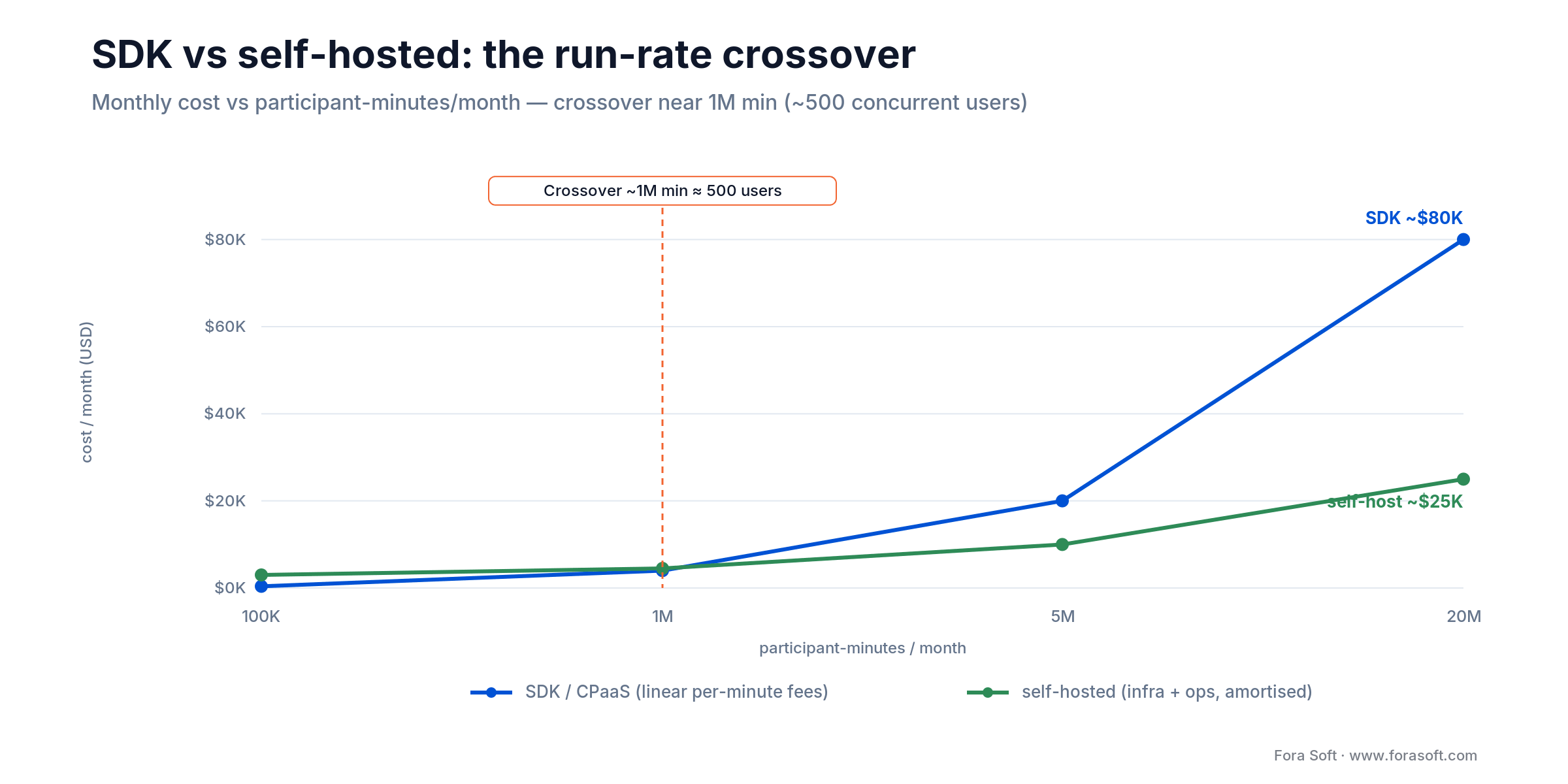
Figure 3. SDK fees climb in a straight line; self-hosted cost flattens once infrastructure and ops are spread across more minutes.
Reach for self-hosting when: you’re past ~1M participant-minutes a month, you already carry (or can hire) an SRE, and data residency or margin pressure makes the per-minute bill hurt. The build pays back in 12–16 months at 5M+ minutes.
Not sure which side of the crossover you’re on?
Send your concurrent-user target and session profile. We’ll model your build cost, run-rate, and crossover point and tell you when to switch.
Self-hosting math: egress, TURN, and SRE
Here’s the math almost every “WebRTC is cheap to self-host” post skips. Start with bandwidth. A four-person HD call pushes about 4.2 GB of media per hour through an SFU (measured by WebRTC.ventures, 2025). On AWS egress at $0.09/GB, that’s about $0.38/hour in data transfer alone, before a single dollar of compute.
Scale that to ~5M participant-minutes a month and the monthly bill breaks down like this: bandwidth egress ~$4.5K, an amortised SRE on-call ~$2.2K, compute and SFU nodes ~$1.8K, recording and storage ~$0.9K, and TURN relay ~$0.6K — about $10K/month all-in. Egress is the single biggest slice, and it’s exactly the line item that per-minute SDK pricing hides inside its rate.
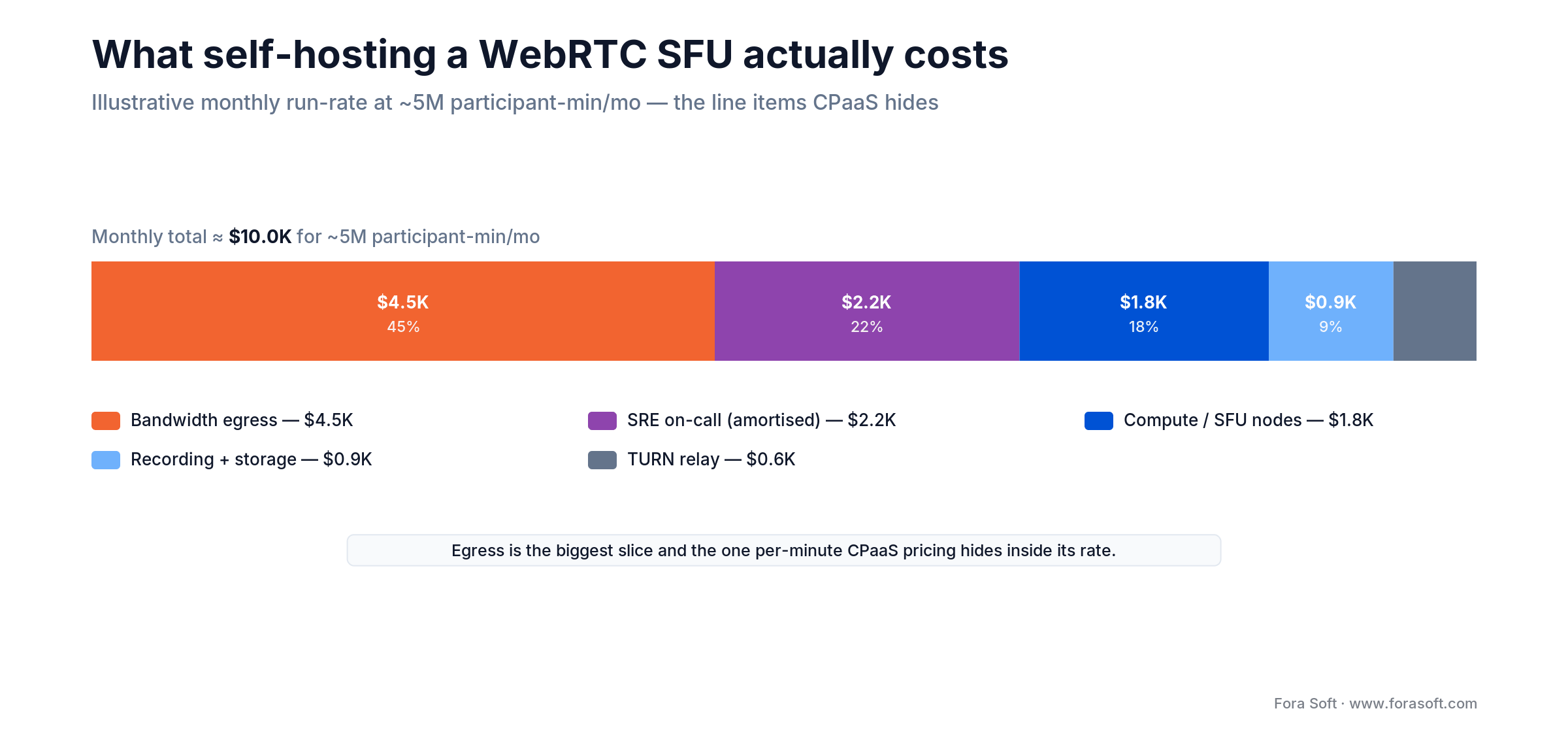
Figure 4. Where the ~$10K/month goes when you self-host at 5M participant-minutes. Bandwidth dominates.
Two levers cut that bill hard. Move egress off AWS: budget bare-metal hosts (Hetzner, OVH) charge a fraction of $0.09/GB, and that swaps the biggest slice for a much smaller one. And don’t self-run TURN until it earns its keep — TURN only relays the ~5–10% of connections that can’t punch through NAT. Cloudflare’s managed TURN is $0.05/GB with the first 1,000 GB free each month; a self-hosted coturn only pays underlying egress. For the deeper architecture trade-offs, see our WebRTC architecture cost breakdown.
Reach for managed TURN when: your relayed volume is under ~5M minutes a month. Below that, Cloudflare or Twilio’s TURN is cheaper than paying an engineer to babysit coturn; above it, self-hosting the relay wins.
Twilio, Vonage, and the 2026 vendor shake-up
A lot of cost articles are working from stale news. Twilio announced it would shut down Programmable Video in December 2023, extended the deadline in March 2024, then reversed the decision entirely in October 2024. In 2026 Twilio Video is a supported, standalone product again at $0.004 per participant-minute. If a vendor comparison tells you Twilio Video is dead, it was written before the reversal — check the date.
That whiplash is the real lesson: your media vendor is a dependency that can change terms overnight. Wrap whichever SDK you pick in a thin internal media API so swapping providers costs three weeks, not three months. Teams that had already migrated off Twilio during the scare mostly landed on Daily, LiveKit, or self-hosted mediasoup; if you’re weighing a move, our Twilio Video migration guide compares the destinations. Vonage (the old TokBox/OpenTok) is still around at $0.0041/minute and remains a fine pick for teams that want a mature managed API with a large free tier.
AV1, WHIP and WHEP: what standards do to cost
Two 2026 shifts move the cost needle. AV1, the royalty-free codec, now has around 91.5% decoder support and hardware encode on Apple M-series, Intel 12th-gen and newer, and AMD RDNA3 chips. It compresses roughly 30–40% better than H.264, which is a direct cut to the bandwidth slice that dominates self-hosted bills. The catch: Safari is still the holdout for encode, and AV1 encoding is CPU-heavy, so most teams ship it as an opt-in for capable devices rather than the default.
WHIP and WHEP matter for lock-in, not codecs. WHIP (WebRTC-HTTP Ingest) became a standards-track RFC in 2024; WHEP (its playback sibling) is still an IETF draft. Both replace proprietary SDK signalling with plain HTTP for getting streams in and out, which makes swapping ingest or egress providers cheaper. If you’re planning a build that mixes real-time and broadcast, designing around WHIP now keeps your options open later — our video streaming guide covers where the two worlds meet.
Compliance: where budgets diverge most
1. Startup floor. SOC 2 readiness ($10K–$15K), a GDPR data-processing addendum, and a basic encryption review. Total $15K–$25K plus about $10K/year ongoing. Enough to close most SMB deals.
2. Enterprise floor. SOC 2 Type II ($25K–$40K), HIPAA controls plus a signed BAA ($20K–$50K), a GDPR DPIA, and ISO 27001 if you sell into EMEA. Total $50K–$120K plus $30K–$60K/year in recurring audits.
3. Sector-specific. FedRAMP for US public sector ($150K–$500K), PCI DSS for payment-bridged calls ($30K–$80K), and CJIS for police or court video ($30K–$60K). These are floors, not averages — scope them early because they reshape architecture, not just paperwork.
Native mobile: the deferred line item
A web-only WebRTC product caps adoption fast — most consumer and field users live on phones, not desktops. Native iOS and Android clients add $35K–$80K and 6–10 weeks. Managed SDKs soften this: Daily, LiveKit, Agora, and Zoom all ship native mobile libraries, so you build the UI, not the transport. Self-hosted mediasoup or Janus need either a per-project mobile SDK or a thin native shim, which is why mobile is pricier once you own the media plane.
Rule of thumb: if your buyer is enterprise procurement, plan native mobile from sprint one. If your buyer is a creator or SMB, ship mobile web first and add native in v2 — the SDK’s mobile-web fallback carries the first six months without the extra spend.
Hidden costs that surprise CFOs
1. TURN relay. NAT-traversal failovers cost $0.05–$0.40 per relayed GB depending on provider. Plan for 5–10% of traffic to route through TURN; that’s $200–$2,000/month at scale.
2. Cloud egress. AWS data transfer at $0.09/GB is the number that blows up spreadsheets. A 500-user HD simulcast SFU can bill $200–$400/day. Moving egress to Cloudflare or a bare-metal host is the biggest single saving you can make.
3. Recording storage. S3 standard at ~$0.023/GB-month plus retrieval. A 100-user product with 30-day retention runs $400–$1,500/month before lifecycle tiering. Transcripts and search cost more.
4. On-call SRE. A senior site-reliability engineer on rotation runs $190K–$250K/year fully loaded in the US (2026 salary data). Below ~5,000 concurrent users you can share the role; above it, budget a dedicated rotation.
5. Vendor switching. Migrating SDKs costs $25K–$60K and 3–6 weeks — the same scope as the original integration. Budget for it before your second pricing renegotiation, and wrap the SDK behind your own API to shrink it.
Mini-case: what actually drove the cost
Take VocalViews, a video research marketplace that runs live sessions for brands like Google, Samsung, and Netflix. The situation was the classic fork: the team needed to prove the marketplace loop quickly, but knew that if it worked, volume would climb into the millions of participant-minutes where per-minute fees hurt.
The plan we ran was the hybrid path this article keeps recommending. We shipped the first release on a managed SDK so the product loop — recruit participant, run session, record, deliver — could be validated in weeks, not months. Recording, moderation, and the marketplace logic sat in our own backend so none of it was locked to one vendor. As sessions scaled past 1M+ participants, the heaviest recurring cost shifted from per-minute SDK fees toward bandwidth and storage — exactly the roughly $0.004-per-minute-to-~$0.001 shift Figure 3 models.
The outcome: a marketplace serving global brands at scale, built without over-engineering the media plane on day one or getting trapped by it later. That’s the whole game — spend where it moves the product, defer where it doesn’t. Want a similar assessment of your own stack? Book a 30-minute call and we’ll map it.
Want a stage-matched WebRTC plan?
A 30-minute call gets you a build path, a run-rate, and a calendar — calibrated to your stage, not a generic price list.
A decision framework in five questions
1. What stage are you in? Pre-seed or seed points to an SDK MVP. Series A points to a cloud SDK plus a custom layer. Series B and enterprise point to self-hosting with full compliance.
2. What’s your concurrent-user target in 18 months? Under 200 means SDK. 200–500 means hybrid. Over 500 means plan to self-host.
3. What does your buyer demand for compliance? SOC 2 only, and an SDK is fine. HIPAA, FedRAMP, or CJIS, and you build with bundled compliance from sprint one.
4. Do you ship native mobile? Yes points to an engine with strong mobile SDKs (LiveKit, Daily, Agora). No, and web-only carries you for the first six months.
5. What’s your DevOps appetite? Low points to a managed SDK or LiveKit Cloud. Medium points to LiveKit OSS. High points to mediasoup or Janus.
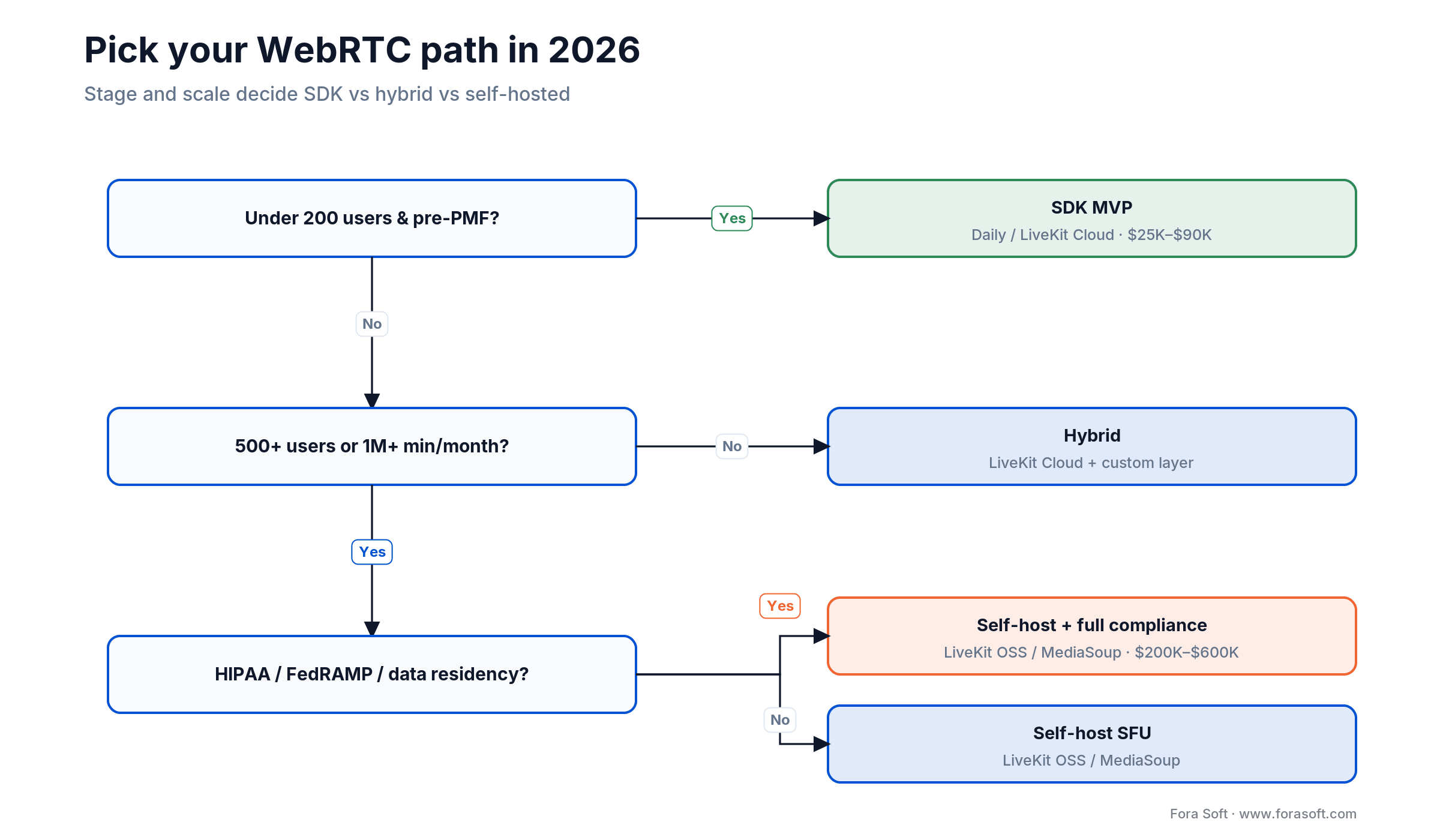
Figure 5. The same five questions as a decision tree: stage and scale route you to SDK, hybrid, or self-hosted.
Pitfalls WebRTC budgets fall into
1. Premature self-hosting. Standing up mediasoup at the seed stage burns 12 weeks before product-market fit. Use an SDK and switch to OSS once revenue justifies the team.
2. Premature mobile. Building native clients before the web product proves demand doubles the cost and delays validation. Defer to v2 unless the buyer demands it.
3. Compliance retrofit. SOC 2 and HIPAA bolted on in year two cost about 3× what designing them in does. Build the controls in sprint one, even at startup stage.
4. Forgetting TURN and egress. Self-hosted budgets blow up because relay and bandwidth never made it into the spreadsheet. Reserve 15% of infra budget for them from the start.
5. Lock-in without an exit. Pick an SDK, but wrap it in a thin internal API so the swap-out is 3 weeks, not 3 months. Twilio’s 2024 U-turn is the reminder that terms change.
KPIs: what to measure at each stage
Quality KPIs. p95 join time under 4 s, p95 video freeze rate under 1%, audio MOS above 4.0, recording success rate above 99.5%.
Business KPIs. Cost per participant-minute, gross margin per session, conversion lift from the video feature, and expansion revenue from premium tiers.
Reliability KPIs. SFU uptime 99.95%, incident MTTR under 30 minutes, audit-log completeness 100%, and first-attempt compliance pass rate.
When NOT to build custom WebRTC
Skip the custom build when concurrent users stay below ~100 and the buyer accepts a Zoom-branded experience, when the team has no plan to hire WebRTC ops, when the timeline is under six weeks, or when the total budget is below $25K. In those cases, ship a Daily or Zoom Video SDK MVP with a thin custom UI and revisit the question at $1M ARR. Building your own media plane before you need it is the most expensive mistake on this page.
FAQ
What is the cheapest WebRTC MVP a startup can ship?
$25K–$40K with Daily or LiveKit Cloud as the media server and a thin custom UI on top, in 4–8 weeks. Run-rate at 100 active users is $300–$1,000/month, almost all of it SDK fees.
What does enterprise WebRTC cost end to end?
$200K–$600K to build, depending on mobile, recording, and compliance scope, plus $100K–$200K/year in ops and infrastructure for a 1,000-concurrent-user product. FedRAMP or CJIS variants add $50K–$200K.
When should a startup migrate from SDK to self-hosted?
Around 1M participant-minutes/month, or roughly 500 concurrent users. At that volume, self-hosted infrastructure plus an SRE is cheaper than SDK fees, and the build typically pays back in 12–16 months.
Which CPaaS is cheapest for WebRTC video in 2026?
For all-in per-minute billing, Zoom Video SDK (~$0.0035) and Agora HD ($0.00399) edge out Daily and Twilio ($0.004) and Vonage ($0.0041). LiveKit Cloud is cheapest on connection but bills egress separately, so it depends on your data mix.
Is Twilio Video still being shut down?
No. Twilio announced end-of-life in December 2023, but reversed it in October 2024. Twilio Programmable Video is a supported standalone product in 2026 at $0.004 per participant-minute. Any article saying otherwise predates the reversal.
How do compliance costs differ at startup vs enterprise?
Startup floor is $15K–$25K (SOC 2 readiness + GDPR DPA). Enterprise floor is $50K–$120K (SOC 2 Type II + HIPAA + GDPR DPIA + ISO 27001). FedRAMP and CJIS each add $30K–$200K on top.
Why is bandwidth the biggest self-hosting cost?
A four-person HD call moves ~4.2 GB/hour through the SFU. At AWS egress of $0.09/GB, bandwidth is the largest line item — often ~45% of a self-hosted monthly bill. Moving egress to a bare-metal host or Cloudflare is the biggest single saving.
Does AV1 reduce WebRTC costs?
It can. AV1 compresses ~30–40% better than H.264, cutting the bandwidth that dominates self-hosted bills. But it needs more encode CPU and Safari still lags on encode, so most teams ship it as an opt-in for capable devices, not the default.
Has Fora Soft shipped both startup and enterprise WebRTC products?
Yes. BrainCert grew from an MVP to 100K+ customers; ProVideoMeeting is enterprise-grade. We’ve shipped on stacks from Daily and Vonage to mediasoup and Janus.
What to Read Next
Architecture cost
WebRTC architecture cost: custom development vs SDK
The deeper architectural cost model behind the budgets here.
Buyer’s guide
How to choose a WebRTC development company in 2026
A 4-step playbook for picking the right build partner.
Cost guide
Video conferencing app development cost
The same cost lens applied to full conferencing apps.
Migration
Twilio Video migration guide for 2026
Where teams land after Twilio: Daily, LiveKit, self-hosted.
Topology
P2P vs MCU vs SFU for video conferencing
The topology choice that drives your cost shape.
Ready to size your WebRTC budget honestly?
Startup and enterprise WebRTC are different products. Startup budgets ($25K–$90K) are dominated by speed and SDK fees; enterprise budgets ($200K–$600K) are dominated by self-hosted infrastructure, native mobile, and compliance. The run-rate flips near 1M participant-minutes a month, bandwidth is the cost that hides in per-minute pricing, and Twilio being back means you have more managed options in 2026, not fewer.
Get the stage right and the number falls into one of two well-known shapes. If you want a build cost, a per-minute run-rate, and a calendar matched to yours, the fastest next step is a 30-minute call. We’ll walk both profiles, tell you which fits, and quote the work — including the parts to skip on sprint one.
Talk to our video engineering leads
Book a 30-minute call. We’ll scope the build — engine, calendar, budget, run-rate, compliance — in one session.

