

Key takeaways
• QUIC is the transport the modern web already runs on. RFC 9000 (2021) puts TLS 1.3 inside the handshake, multiplexes streams over UDP, and adds 0-RTT resume and connection migration. By 2026 it is the default on every major browser and CDN: roughly a third of sites advertise HTTP/3, and support passes half among the top-1,000, though HTTP/2 still carries the larger share of total requests.
• QUIC streaming means Media over QUIC (MoQ): the layer that ships sub-500 ms live video at CDN scale. The IETF spec is at draft-ietf-moq-transport-19 (Standards Track, expires 7 January 2027), and at NAB Show 2026 eleven vendors demoed interoperable MoQ.
• The business case is the cost curve. MoQ makes live shopping, auctions, sports and interactive esports affordable without the per-viewer SFU bill of pure WebRTC. WebTransport hit Baseline browser support in March 2026 (Safari 26.4), so the last big client-side blocker is gone.
• It is still a draft. Bet on MoQ today only if you can pin a version, plan a spec-cutover window, and keep a WebRTC or LL-HLS fallback for enterprise networks that still block UDP/443.
• Fora Soft has shipped real-time video since 2005, with 250+ projects and 50+ in-house specialists. If you want a second opinion on whether QUIC, MoQ or WebRTC fits your roadmap, book a 30-min scoping call.
Why Fora Soft wrote this QUIC and MoQ guide
We have built real-time video and media stacks since 2005, with 250+ projects across video and audio streaming, video conferencing and internet TV. We have shipped on RTMP, SRT, WebRTC, HLS, LL-HLS and DASH, and we benchmark every new transport against real client traffic before we recommend it.
QUIC and MoQ are the most consequential protocol shifts in real-time media since WebRTC went mainstream. They move three things at once (the transport, the latency budget and the cost model), so CTOs, product managers and finance all need a working mental model of what they are. This is the guide we wish every prospect arrived with.
It is opinionated, vendor-neutral, and grounded in the IETF drafts, RFCs and production deployments we read every week. Where a claim is an estimate rather than a measurement, we say so. Two companion reads: our production-status tracker, Media over QUIC (MoQ): Production Status 2026, and the how-it-works explainer in our Learn track on MoQ.
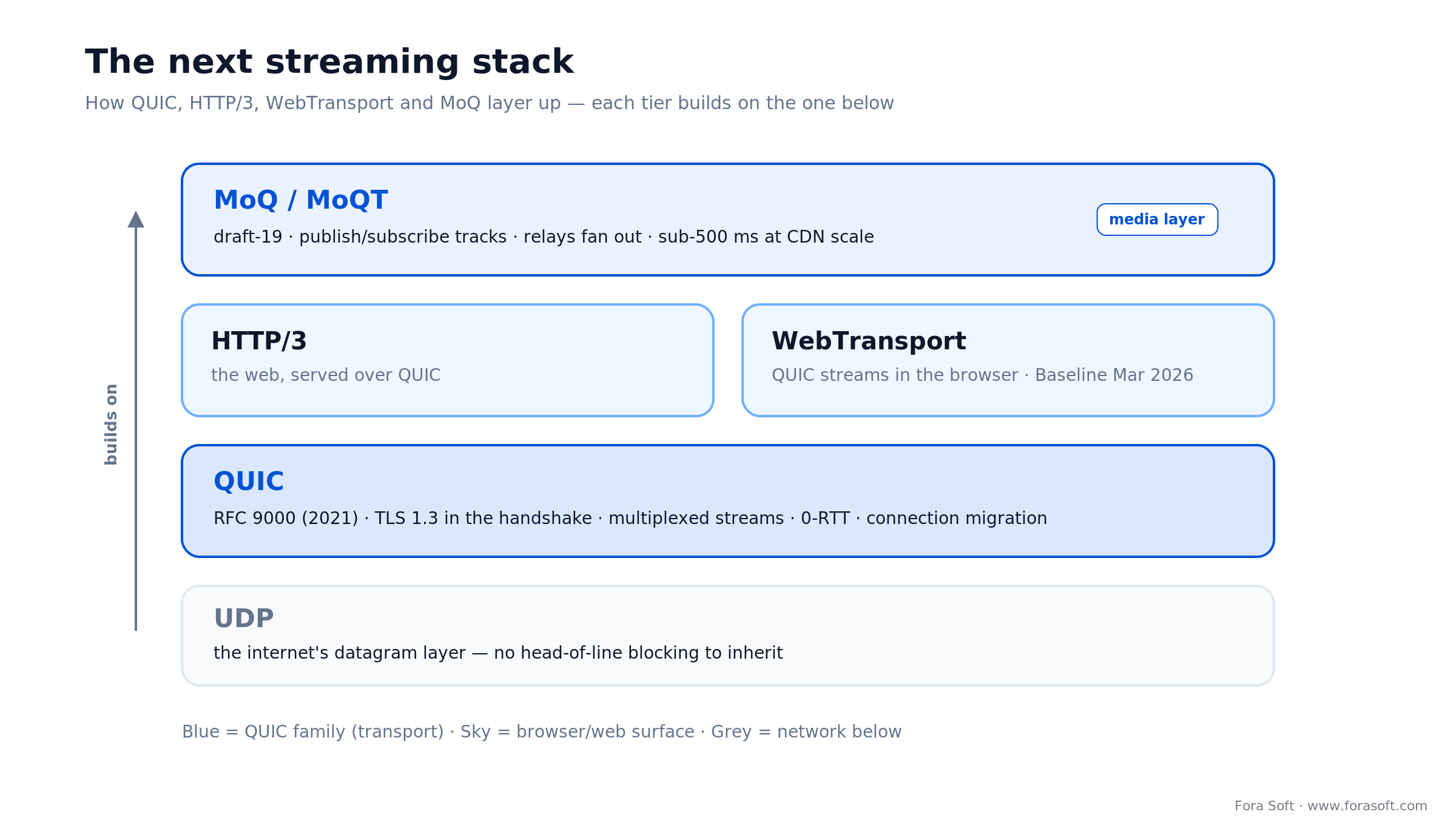
Figure 1. The next streaming stack. QUIC sits above UDP; HTTP/3 and WebTransport ride on QUIC; MoQ is the media layer on top.
Wondering if QUIC or MoQ belongs on your 2026 roadmap?
We will benchmark MoQ, WebRTC and LL-HLS against your real product KPIs (latency, scale, browser reach, CDN cost), and tell you which to bet on now and which to defer.
QUIC, explained without the protocol jargon
QUIC is a transport protocol, the same category as TCP. It rides on UDP, has TLS 1.3 built into its handshake (no handshake-after-handshake), and carries many independent byte-streams over one connection. It is the engine HTTP/3 runs on, and the foundation MoQ builds on.
Three properties make QUIC worth a product team’s attention. 0-RTT resume lets a returning client send useful data on the first packet, cutting time-to-first-byte to almost nothing on warm connections. Connection migration keeps a phone’s secure session alive when it switches from Wi-Fi to cellular — no reconnect, no token refresh, no buffering spike. Per-stream flow control removes the head-of-line blocking that hurt HTTP/2 on lossy mobile links.
In practice, QUIC helps most where the network is lossy or high-latency: mobile and last-mile links. On saturated fibre above roughly 600 Mbps, a naive QUIC setup can actually lose throughput to well-tuned HTTP/2, because its userspace ACK and pacing logic costs more CPU than kernel TCP. That trade-off is why HTTP/3 adoption is broad but not universal: the win is concentrated where it matters, and the plumbing under it is exactly what QUIC streaming needs.
QUIC in one sentence: the web’s new lower layer — faster on mobile, encrypted by default, multiplexed without head-of-line blocking, and the base every modern real-time media protocol now builds on.
HTTP/3 adoption in 2026 — the snapshot every CTO should know
How much of the web runs on QUIC depends on how you count. W3Techs reports roughly 39 % of sites advertising HTTP/3 support (via alt-svc). Measured request share is lower: on Cloudflare’s network HTTP/3 runs around a fifth of requests in 2026, with HTTP/2 still the most common protocol. Both point the same way for large sites: HTTP/3 support passes half of the top-1,000.
| Surface | HTTP/3 reality (2026) | What it means |
|---|---|---|
| Traffic share | ~39 % of sites advertise it; ~20 % of Cloudflare requests (HTTP/2 still leads) | No longer experimental — a production default |
| Browsers | Chrome, Firefox, Safari, Edge — all native | Effectively universal client support |
| Major CDNs | Cloudflare, Fastly, Akamai, CloudFront enabled | Turn-on is usually a single toggle |
| Mobile last-mile gain | Meaningful latency wins on lossy 4G/5G and degraded Wi-Fi | Real benefit where head-of-line blocking hurt |
| Fibre-class link gain | Flat or negative above ~500 Mbps | CPU and pacing overhead can outweigh the win |
| Corporate firewalls | A slice of enterprise networks still block UDP/443 | Always keep an HTTP/2 or LL-HLS-over-HTTPS fallback |
Media over QUIC, explained for product owners
Media over QUIC (MoQ) is the IETF’s answer to a long-standing problem: every existing live-video protocol is good at exactly one thing. HLS scales to millions but is multi-second slow; WebRTC is sub-second but per-viewer expensive; SRT is professional but not browser-native. MoQ aims to do all three — sub-500 ms latency, CDN-native scale and browser-native delivery.
Mechanically, MoQ is a publish-subscribe layer on top of QUIC and WebTransport. Producers publish “tracks” (video, audio, captions, metadata) into a relay; consumers subscribe to those tracks by name. Relays cache and fan out the way HTTP caches replicate web pages, so distribution scales like a CDN. The result looks like a CDN to operators and like a real-time channel to applications. If you want the wire-level data model (namespaces, groups, objects), our Learn explainer on MoQ goes deeper.
As of August 2026 the core spec is draft-ietf-moq-transport-19, a Standards Track document that expires 7 January 2027, with an RFC realistically landing in 2027. Companion drafts cover the low-overhead media container (LOC) and streaming formats. The working group draws contributors from Cisco, Meta, Google and others, and the transport runs over either raw QUIC or WebTransport.
Reach for MoQ when: you need sub-500 ms glass-to-glass latency, more than 10k concurrent viewers, browser-native delivery, and you can pin a draft version until the RFC lands.
The glass-to-glass latency budget — where every millisecond goes
Latency arguments get fuzzy because everyone counts different segments. Here is the breakdown we use for capacity planning, so you can see which lever actually moves your number.
| Stage | Typical 2026 budget | Tunable lever |
|---|---|---|
| Capture & encoder buffer | 10–50 ms | Hardware H.265 / AV1, GOP size |
| Encoding (1 P-frame at 30 fps) | 10–33 ms | B-frame removal, low-latency profile |
| Network ingest | 10–100 ms | Edge ingest region, RTMP → QUIC |
| Origin / re-package | 20–100 ms | CMAF chunked encoding for LL-HLS; relay for MoQ |
| CDN fan-out / delivery | 0–200 ms | PoP density, viewer geography |
| Client decode & jitter buffer | 10–100 ms | WebCodecs hardware decode, smaller buffer |
| Display render | 16–33 ms | 60 Hz vs 30 Hz target |
Add it up: a well-tuned MoQ stack lands at 100–500 ms glass-to-glass; a well-tuned LL-HLS stack at 1–3 s (2–6 s is common in the field); a WebRTC SFU at 50–300 ms; classic HLS at 6–30 s. The differences come from where the buffer sits, not from any single magic component.
Live streaming protocols compared — HLS, LL-HLS, DASH, WebRTC, SRT, RTMP, MoQ
Every live streaming protocol trades latency for reach or reach for control. The map below plots where each one sits; the table gives the detail. MoQ is the first serious attempt to occupy the empty corner — sub-second latency and millions of viewers at once.
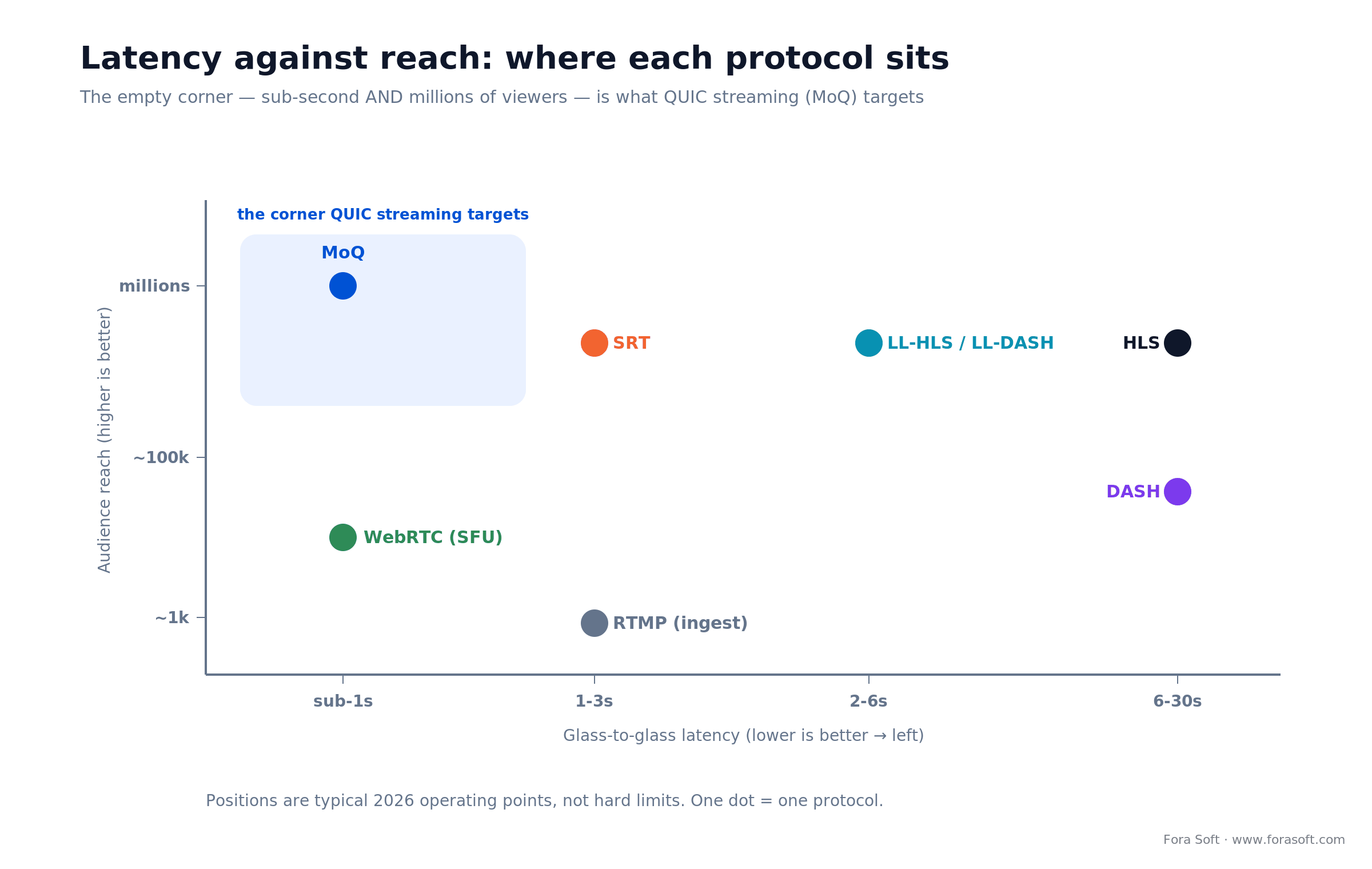
Figure 2. Latency against audience reach; MoQ targets the sub-second, millions-of-viewers corner.
| Protocol | Latency | Scale | Best fit | Maturity & when it breaks |
|---|---|---|---|---|
| HLS | 6–30 s | Millions, CDN-native | VOD, classic linear live | Stable; too slow for interaction |
| LL-HLS | 1–3 s | Millions, CDN-native | Sports, news, broadcast | Stable; real-world often 2–6 s |
| DASH / LL-DASH | 2–20 s | Millions, CDN-native | Non-Apple OTT, EU broadcast | Stable; no native Safari support |
| WebRTC (SFU) | <500 ms (50–300 typical) | Tens of thousands per cluster | Conferencing, telehealth | Stable; per-viewer cost at scale |
| SRT | 50–120 ms | Origin-to-origin | Pro contribution | Stable; not browser-native |
| RTMP | 60–250 ms | Origin ingest only | Legacy ingest | Deprecated on the client side |
| MoQ | 100–500 ms | Millions, CDN-native + pub-sub | Live commerce, auctions, sports, esports | Draft-19, early production |
Where MoQ stands in 2026 — production deployments and gaps
MoQ is no longer a paper protocol. The first production rollout shipped in 2025, and WebTransport (the in-browser plumbing MoQ relies on) reached Baseline support (Chrome, Firefox, Edge and Safari 26.4) in March 2026, which removed the last client-side blocker.
First production and the NAB 2026 interop
nanocosmos was first to bring MoQ into production, launching it on nanoStream at IBC 2025. The bigger signal came at NAB Show 2026 in April, where eleven vendors demoed interoperable MoQ (Ant Media, AWS, Bitmovin, Broadpeak, CacheFly, Cloudflare, Nomad Media, Norsk, Oracle, Red5 and Synamedia): the largest coordinated MoQ interop to date.
Oracle anchored a multi-partner demo (Ateme encoding, Broadpeak packaging, Cloudflare delivery) over a shared MOQT relay fabric, and Bitmovin showed an encoder publishing into a Cloudflare relay for sub-second global playback in its web player. In other words, the interop story is real: independent stacks now speak the same transport.
Library and tooling ecosystem
QUIC libraries are production-grade: Cloudflare’s quiche, LiteSpeed’s lsquic, Microsoft’s msquic and Meta’s mvfst. The MoQ tooling layer is younger — the most active reference stack is moq-rs / moq.dev (Rust core plus a TypeScript and WebTransport client for the browser).
Gaps still to plan around
The parts that matter for monetised streaming are the least finished. Multi-vendor ad insertion (SCTE-35 / SSAI), DRM (Widevine, FairPlay, PlayReady), rights and blackout handling, and standardised telemetry are still being prototyped for MoQ — nowhere near HLS, DASH or WebRTC maturity. This is exactly where we spend most of a real MoQ project: we built a custom Wowza SCTE-35 SSAI module for Mangomolo (30M+ viewers), so we know how much of the revenue plumbing you still have to bring yourself.
Want a MoQ vs WebRTC proof-of-concept on your own traffic?
We will benchmark both stacks on your real audience profile (including iOS Safari and corporate firewalls) in 2–4 weeks, and hand you a written go / no-go.
Use cases where QUIC and MoQ change the unit economics
QUIC on its own improves any latency-sensitive web experience — checkout, dashboards, mobile API calls. MoQ changes the maths on a tighter set of categories, where sub-500 ms live video at scale was previously impossible without a per-viewer SFU bill.
1. Live shopping and shoppable video. Below 500 ms glass-to-glass, viewers react to flash drops and inventory pulls in the same second the host announces them — the difference between an impulse buy and a missed one. Our work on Sprii (a live commerce platform with 3,000+ brands) shows what the experience looks like when the latency budget is tight.
2. Live auctions and bidding. A two-second feed delay is a lost bid. MoQ pulls the feed inside the 200–400 ms human reaction window without the SFU bill that auction houses balk at.
3. Sports and betting. Sub-second video has to match the sub-second odds feed, or the operator either freezes betting or eats the cost of users betting on already-resolved events.
4. Population-scale telehealth. One-to-one consults have WebRTC; population-scale broadcast (mass triage, screening) needs MoQ’s CDN fan-out cost model.
5. Esports and interactive spectating. Twitch-grade audiences with real-time chat and reactions inside a single second, without paying per viewer for it.
Cost model: WebRTC SFU vs MoQ-on-CDN at scale
The reason MoQ matters to finance is the per-viewer cost curve. WebRTC SFUs price like compute — per concurrent connection; CDNs price like delivered bytes. Those two curves diverge fast, and the gap is the whole business case.

Figure 3. Estimated cost per 90-minute event. The SFU curve (per connection) climbs far steeper than MoQ-on-CDN (per byte).
Here is the arithmetic behind the shape. Take a 1080p stream at 4 Mbps for a 90-minute event. Each viewer pulls about 4 Mbps × 5,400 s ÷ 8 ≈ 2.7 GB. At a blended CDN egress of roughly $0.01/GB, that is about $0.027 per viewer — so 100,000 concurrent viewers cost on the order of $2,700 in raw delivery, plus origin and relay overhead. A WebRTC SFU billed per concurrent connection (public benchmarks run $0.50–$5 per concurrent viewer, bitrate-dependent) lands in a very different place at the same 100k.
| Scenario (1080p, 4 Mbps, 90-min event) | WebRTC SFU | MoQ-on-CDN (estimated) |
|---|---|---|
| 10k concurrent | ~$1,500–$3,000 per event | ~$1,000–$2,000 |
| 100k concurrent | ~$15,000–$30,000 per event | ~$10,000–$20,000 |
| 1M concurrent | Often impractical; multi-region SFU sprawl | Scales roughly linearly with delivered bytes |
These are direction-of-magnitude figures from public SFU pricing and typical CDN egress — your real numbers depend on vendor, bitrate and commit. The point is the shape, not the decimals: MoQ inherits the CDN cost model, which is what makes it interesting at six-figure concurrency. For a granular per-minute WebRTC comparison, see our LiveKit vs Agora cost analysis.
Four ways to ship MoQ today
1. Managed platform (nanocosmos and peers)
Fastest path. End-to-end ingest, relay, CDN and player from one vendor; a proof-of-concept in days. The trade-off is vendor lock-in and less protocol-level control. The right pick when MoQ is one feature inside a product, not the product itself.
2. Media-server plugin (Ant Media, Red5)
If you already run an Ant Media or Red5 fleet for WebRTC, MoQ support slots in alongside it. Setup is typically 2–4 weeks. Good for teams comfortable with media-server operations who want to add MoQ tracks to an existing real-time stack.
3. Build your own origin and relay
Use moq-rs, quiche, msquic or lsquic to write a custom MoQ relay. Pick this when you have unusual ingest logic — interactive layers, custom DRM, programmable mid-roll. Budget 8–12 weeks for a team already comfortable with QUIC, lock to a specific draft, and plan the migration up front. Our Media over QUIC development team builds relays like this on quic-go, Cloudflare quiche and WebTransport.
4. CDN partner (Cloudflare and follow-ons)
Cloudflare runs an MoQ relay capability on its edge, and after NAB 2026 more CDNs are moving. The right path when you already buy delivery from one of them and want to consolidate vendors — but confirm the production SLA before you bet a launch on it.
Risks to plan for before you commit
1. Spec churn. Draft-19 expires in January 2027; the RFC may land in 2027. Lock to a specific draft, version-pin both relay and player, and budget a one-to-two-sprint cutover window when the wire format moves.
2. Browser API edges. WebTransport is Baseline as of Safari 26.4 (March 2026), but older devices and embedded WebViews still need an LL-HLS or WebRTC fallback. Keep those fallbacks in CI from day one.
3. Corporate firewalls and middleboxes. A meaningful slice of enterprise networks block UDP/443. Newer Cisco, Palo Alto and Check Point firewalls inspect QUIC; older fleets do not. Always offer an HTTP/2 fallback for B2B audiences.
4. CPU and pacing cost on dense links. QUIC’s userspace ACK and pacing logic costs more CPU than kernel TCP. On fibre above ~600 Mbps, naive tuning loses throughput — plan for hardware pacing or kernel-bypass on the relay side.
5. The revenue plumbing is not standardised yet. Ad insertion, DRM and blackout handling for MoQ are still in flux. If your business depends on server-side ads or content protection, budget custom work — and keep your DASH/HLS monetisation path live in parallel.
A decision framework — pick QUIC, MoQ or WebRTC in five questions
Walk these top to bottom and take the first Yes. The tree below is the same logic in one picture.
Q1. Are you optimising a web app, not video? Yes → turn on HTTP/3 (QUIC) at the CDN. That is the whole project; you do not need MoQ.
Q2. Is your live video fine with 1–3 s latency? Yes → LL-HLS / LL-DASH on a major CDN. RFC-stable, and every player supports it.
Q3. Do you need sub-500 ms at 100k+ concurrent, browser-native? Yes → MoQ via a managed platform or an Ant Media / Red5 plugin, with an LL-HLS fallback.
Q4. Do you need true conferencing (multi-publisher, mute, dominant speaker, screen-share)? Yes → WebRTC SFU. MoQ is not a conferencing protocol.
Q5. Do you have a hard requirement to be on an RFC-stable spec? Yes → defer MoQ to 2027. Use WebRTC plus LL-HLS today and prepare a migration path.
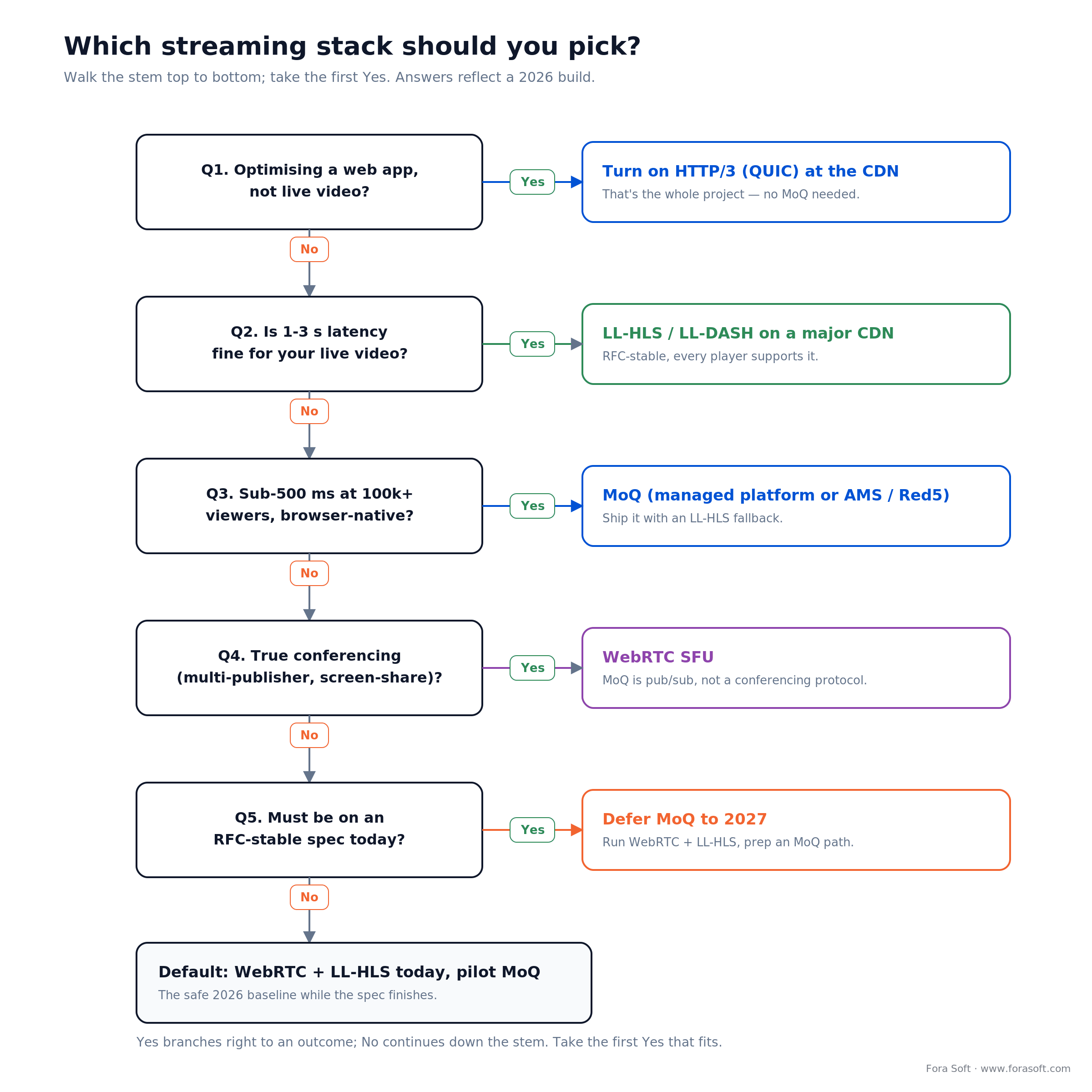
Figure 4. Which streaming stack to pick. Take the first Yes down the stem; the default baseline sits at the bottom.
Reach for QUIC + LL-HLS when: your latency target is 1–3 s, your audience is mostly mobile, and you do not need real-time interactivity beyond the chat layer.
QUIC and MoQ glossary — the seven terms you will see in every doc
QUIC. A UDP-based transport protocol with TLS 1.3 built in. Defined in RFC 9000 (2021). The plumbing under HTTP/3 and MoQ.
HTTP/3. The version of HTTP that runs on QUIC. The benefit shows up as faster page loads on mobile and lossy networks.
WebTransport. A browser API that exposes QUIC streams to JavaScript — what MoQ needs to deliver media into a tab without a plugin. Baseline across major browsers since March 2026 (Safari 26.4).
MoQ Transport (MOQT). The IETF working group’s core spec — a publish-subscribe layer on top of QUIC and WebTransport. Currently draft-ietf-moq-transport-19.
Track. A single named stream of media (video, audio, captions, telemetry). MoQ publishes and subscribes at the track level, not at the whole-feed level.
Relay. The MoQ equivalent of a CDN edge node. It accepts subscriptions, fans out tracks, and caches recent objects so latecomers join fast.
WebCodecs. The browser API for hardware-accelerated encode/decode. Pair it with WebTransport and you own the last 100 ms of the latency budget instead of leaving it to a default video element.
Bookmark this section. Most MoQ docs assume you already know these terms; you will hit all seven in the first paragraph of any draft.
Mini case — sub-second concert streaming at 10,000 viewers
Situation. Worldcast Live streams HD concerts where the audience reacts together — applause, chat, tipping. Anything past about a second of delay and the room feels dead; the shared moment is the product.
Plan. We built a custom WebRTC + Kurento pipeline with multichannel audio, tuned the encoder and jitter buffers against real traffic, and kept an LL-HLS fallback for clients that could not hold a UDP session. The same architecture is what a browser-native MoQ path would target next, once the spec and CDN SLAs settle.
Outcome. Measured glass-to-glass of 0.4–0.5 s at 10,000 concurrent viewers, with a clean fallback path. That is the number MoQ is built to hit at CDN scale without the per-viewer SFU multiplier — and the kind of target we scope against. Want a similar plan? Book a scoping call.
Already running real-time video and weighing MoQ?
We will benchmark MoQ against your current stack on real audience traffic in 2–3 weeks and give you a written go / no-go recommendation.
Five pitfalls that derail QUIC and MoQ projects
1. Skipping the fallback. However clean your MoQ pipeline is, you will meet a corporate UDP block. Ship LL-HLS or WebRTC alongside it, and put the fallback in CI from day one.
2. Floating on the latest draft. Pin your MoQ draft. The IETF process changes wire formats; if relay and player disagree, traffic drops silently.
3. Treating QUIC like TCP. Load balancers, observability and firewalls that are happy with TCP/443 may not understand UDP/443. Plan dashboards (eBPF, qlog) and alerts before traffic, not after.
4. Forgetting CPU cost. QUIC pacing and crypto are heavier than TCP/TLS. Right-size relay nodes and watch CPU more closely than packet rate.
5. Missing the WebCodecs piece. Browser-side latency dominates if you use a default video element with software decode. Ship WebCodecs hardware decode and a small jitter buffer; that is where you win or lose 100 ms.
KPIs to track once you ship
Quality KPIs. Glass-to-glass P50 / P95, freeze ratio, rebuffer rate, audio-video sync drift, decode error rate per browser and OS combination.
Business KPIs. Conversion lift versus the LL-HLS baseline, time-to-first-frame after click, viewer drop-off curve, CDN egress cost per viewer-hour, fallback-protocol hit rate.
Reliability KPIs. Successful join rate, mid-stream reconnection success, MoQ subscribe-failure rate, UDP-blocked client share by region, relay CPU and packet drop.
When you should not adopt MoQ in 2026
MoQ is not a universal upgrade. Stay on your existing transport if (a) your audience is fine with 1–3 s latency, (b) your concurrency stays well under 10k, (c) you need an RFC-stable protocol for compliance, or (d) you have no team capacity to track draft changes for the next year.
Real conferencing (multi-publisher with screen-share, dominant speaker, mute and unmute) stays a WebRTC problem. MoQ’s pub-sub model is not a drop-in for that workload, and we expect the two to stay complementary rather than competitive through 2027.
Frequently asked questions
What is QUIC streaming?
QUIC streaming means delivering live media over QUIC — in practice, Media over QUIC (MoQ), a publish-subscribe protocol on top of QUIC and WebTransport. It targets sub-500 ms latency with CDN-scale fan-out and browser-native playback, combining WebRTC-class speed with HLS-class reach.
What is Media over QUIC (MoQ)?
An IETF publish-subscribe protocol on top of QUIC and WebTransport, designed to combine sub-500 ms latency with HLS-class scale and browser-native delivery. The core spec is draft-ietf-moq-transport-19 (2026), not yet an RFC.
Should we adopt MoQ now or wait for the RFC?
Adopt now if sub-500 ms latency at scale is core to your unit economics and you can track draft changes. Wait if you need RFC-stable compliance, your audience is below 10k concurrent, or LL-HLS latency is good enough.
Will MoQ replace WebRTC?
No — they solve different problems. WebRTC wins symmetric, multi-publisher conferencing; MoQ wins asymmetric pub-sub broadcast at scale. Most stacks in 2026–2027 run both, with MoQ taking over the long-tail audience that used to sit behind LL-HLS.
Does MoQ work in browsers without a plugin?
Yes, via WebTransport, which reached Baseline support across Chrome, Firefox, Edge and Safari 26.4 in March 2026. There is no native MoQ stack in browsers yet, so playback uses a JavaScript player over WebTransport plus WebCodecs. Older WebViews still need an LL-HLS or WebRTC fallback.
What about corporate firewalls that block UDP?
A real, persistent risk: a slice of enterprise networks block UDP/443. Always ship a TCP-based fallback — LL-HLS over HTTPS is the usual choice. Newer Cisco, Palo Alto and Check Point firewalls inspect QUIC; older fleets do not.
How much cheaper is MoQ-on-CDN than a WebRTC SFU?
At six-figure concurrency, MoQ-on-CDN typically runs well below a per-connection WebRTC SFU, because CDN delivery is priced in delivered bytes rather than concurrent connections. The advantage compounds as concurrency grows; below ~10k it is often a wash.
Does Fora Soft build on QUIC and MoQ today?
Yes. We have shipped real-time video on WebRTC, LL-HLS, SRT and CDN delivery across projects like Worldcast Live (0.4–0.5 s at 10k concurrent) and Sprii, and we scope MoQ proofs-of-concept against real traffic. Book a call.
What to read next
MoQ status
Media over QUIC (MoQ): production status in 2026
Who is shipping, the NAB 2026 interop, and when to pilot.
Cost analysis
LiveKit vs Agora: a 2026 cost analysis with real workload numbers
Granular per-minute math when WebRTC vendors are on the shortlist.
WebRTC alternatives
Agora.io alternative in 2026: custom WebRTC with LiveKit, mediasoup and Janus
If MoQ is too early for you, this is the WebRTC route to sub-second video.
Architecture
Scalable video management systems in 2026
The five engineering decisions behind a video stack that survives scale.
Ready to map QUIC and MoQ to your roadmap?
QUIC is no longer optional — if your CDN supports HTTP/3, turn it on. MoQ is the next leap, the protocol that finally collapses the latency, scale and browser-native trilemma. Production started in 2025, the interop story landed at NAB 2026, WebTransport is Baseline, and the spec is heading to RFC in 2027.
The right move depends on your workload: turn on QUIC at the edge for any web app, run LL-HLS plus WebRTC for live video today, and pilot MoQ if sub-500 ms at scale is core to your unit economics. Our streaming engineering team ships these stacks for a living.
The book · Volume 2 of 7
Video Streaming: A Complete Guide to Video Delivery: From Network Protocols and Transport to Ingest, HLS, and MPEG-DASH
If the five-question framework points you toward a MoQ pilot, the transport details decide whether it holds up in production. Volume 2 of our Fora Soft Video Engineering Handbook covers TCP versus UDP, congestion control, QUIC and HTTP/3, glass-to-glass latency budgets, and ingest over SRT and RIST. It gives your team the grounding to compare MoQ, WebRTC and LL-HLS on numbers. Written by Nikolay Sapunov, CEO at Fora Soft.
Read it on Amazon →Kindle & paperback · Fora Soft Video Engineering Handbook
Get a QUIC and MoQ assessment tailored to your stack
A 30-minute call, a written protocol roadmap within five working days, and a fixed-scope quote. No commitment.

