


Key takeaways
• Twilio Video didn’t shut down — migration is now a choice, not a deadline. Twilio reversed its December 2026 end-of-life in October 2024; Programmable Video is still live and supported in 2026. Video analytics companies leave for cost, AI-agent velocity, and self-host control, while keeping motion, anomaly, and face/plate pipelines running.
• The 2026 shortlist for analytics-aware video runs four routes: LiveKit (best for custom AI integration), Daily, Cloudflare RealtimeKit (formerly Dyte), and a custom WebRTC + analytics pipeline. Azure Communication Services is a credible enterprise pick for Microsoft shops.
• The upside sits on the analytics layer. Modern WebRTC stacks ship better simulcast / SVC, AV1 support, and first-class hooks for AI agents (LiveKit Agents, MCP) that Twilio’s Video API never added, and in our builds that has meant meaningfully lower latency on live-inference features.
• Migration projects for video analytics companies run $40–200k depending on whether AI inference, custom models, and multi-tenant analytics dashboards are in scope. Plan 8–16 weeks for most, longer for a full custom rebuild.
• Use this article as a buyer’s checklist. Real architecture, real numbers, and a 5-question framework for picking a partner who’s shipped video analytics on the post-Twilio stack.
If you run a video analytics company on Twilio Programmable Video in 2026, here’s the good news first: you are not on a countdown. Twilio announced a December 2026 shutdown in early 2024, then reversed it in October 2024 — Programmable Video is still a supported, standalone product. So the real question isn’t how fast you can beat a deadline; it’s whether moving the analytics layer off Twilio actually pays off. Often it does — for cost, for AI-agent velocity, and for control. But in 2026 it’s a decision you make on your own terms. This is the briefing we hand new clients on day one of a video analytics migration.
We’re Fora Soft, a software development company that has shipped 250+ video and AI projects since 2005, for clients including Mindbox (50+ deployments, 99.5% face ID, 500k+ ANPR/day), VALT (770+ US organizations, 50k+ users), BrainCert classroom analytics, and TradeCaster trader streaming. The numbers below come from production analytics builds — not vendor decks.
Why Fora Soft wrote this video analytics migration playbook
Generic Twilio Video alternatives guides cover the conferencing layer well and ignore the analytics layer entirely. Video analytics dev companies have a different problem: motion detection pipelines, anomaly classifiers, face/plate models, behavioural analytics — all of which need to keep running through the migration without gaps. The architecture choices that work for a basic conferencing migration produce regressions on the analytics side. Our Twilio migration and development team moves rooms, recordings and the analytics hooks together, so the models never lose their feed.
Companion reads we maintain on adjacent topics: the broader Twilio Video alternatives playbook, our video analytics × surveillance integration guide, the anomaly detection models guide, and the AI video surveillance software development playbook.
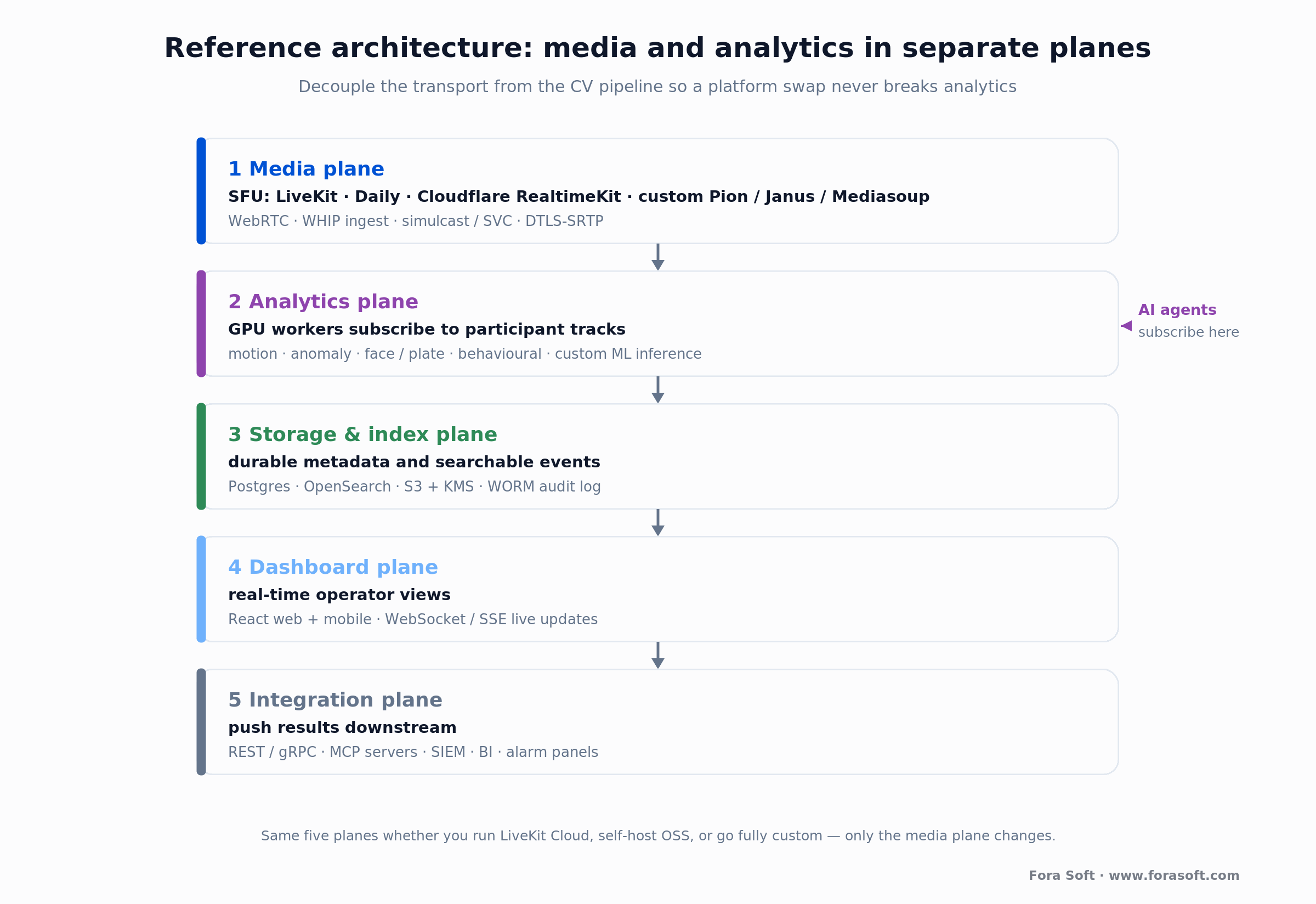
Figure 1. Keep the analytics pipeline in its own plane so a platform swap never breaks motion, anomaly, or face/plate features.
Running video analytics on Twilio and need a migration plan?
Tell us your analytics features (motion, anomaly, face/plate, behavioural) and current scale. We’ll quote a fixed-bid migration timeline and walk through the analytics-preserving architecture in 30 minutes.
Twilio Video in 2026: the shutdown that got reversed
Short answer: Twilio Video is not shutting down. Twilio announced a December 5, 2026 end-of-life in early 2024, then reversed that decision in October 2024: Programmable Video “will remain a standalone product,” still supported and still accepting new accounts in 2026. If a competitor’s guide is still telling you to evacuate before a deadline, it is working from the retracted 2024 memo.
So why do video analytics companies still move? Three reasons keep showing up. Cost: at scale, LiveKit self-host or a custom SFU undercuts per-minute pricing. AI velocity: LiveKit Agents and MCP make server-side inference first-class, where Twilio’s Video API never went. Control: self-hosting the media plane puts nothing between your GPU workers and the stream. The catch is the analytics layer: Twilio’s VideoTrack abstractions are consumed directly by your motion, anomaly, and face/plate pipelines, so a move touches more than the conferencing code. Plan for both planes.
Reach for migration now when: your Twilio Video bill grows faster than revenue, or your roadmap needs real-time AI that Twilio can’t serve. If neither is true and the product is stable, staying on Twilio is a legitimate 2026 choice.
Best video analytics platforms for migrating from Twilio
Four credible alternatives for analytics-aware video products. Each has a distinct profile.
1. LiveKit OSS or Cloud
The strongest fit for analytics-aware video. The LiveKit Agents framework was built for AI: agents subscribe to participant tracks and run inference, transcription, or behavioural analysis with first-class API support. LiveKit Cloud is tiered — Build $0/mo (5,000 WebRTC min), Ship $50/mo (150,000 min, then $0.0005/min plus $0.12/GB egress), Scale $500/mo ($0.0004/min, $0.10/GB, HIPAA BAA). The media server and Agents framework are open source (Apache-2.0), so self-hosting on your own boxes cuts per-minute cost at scale. Native WHIP, simulcast, SVC.
2. Daily.co
10,000 free participant-minutes a month, then usage-based (about $0.004/participant-min) — one of the cleanest developer experiences in the SaaS WebRTC class. Daily also maintains Pipecat for voice-AI pipelines, handy when analytics includes audio. Best fit for teams who want to ship fast without operating an SFU.
3. Cloudflare RealtimeKit (formerly Dyte)
Dyte was acquired by Cloudflare in April 2025 and folded into RealtimeKit, backed by Cloudflare’s Realtime SFU (first 1,000 GB/month free, then $0.05/GB). Prebuilt SDKs for web and mobile, recording, transcription, and Cloudflare-native edge. Good fit if you want analytics features bundled — but the old Dyte SDKs are in migration mode, so budget for that if you are already on them.
4. Custom WebRTC + analytics pipeline
For high-volume products or when analytics is the differentiator, custom on LiveKit OSS, Pion, Janus, or Mediasoup with a dedicated analytics service plane. Build cost: $80–180k. Best fit: products where the analytics layer is the moat.
Honorable mention: Azure Communication Services
For Microsoft shops, ACS provides a credible Twilio Video replacement with strong enterprise compliance posture and Azure-native AI services for analytics integration. Pricing similar to Twilio.
Comparison matrix: video analytics-friendly Twilio Video alternatives
| Platform | Pricing | Analytics hooks | AI agent path | Best for |
|---|---|---|---|---|
| LiveKit Cloud | $0.0005/min +$0.12/GB (Ship) | First-class via Agents framework | Native (LiveKit Agents) | Default analytics replacement |
| LiveKit OSS | Hardware + ops | Full control via tracks API | Native + custom | High-volume analytics |
| Daily.co | 10k free min, ~$0.004/min | Raw / custom tracks + webhooks | Via webhooks + Pipecat | Fast SaaS launch |
| Cloudflare RealtimeKit | SFU $0.05/GB (1,000GB free) | Prebuilt SDKs + recording | Via workers / webhooks | Cloudflare-native edge |
| Azure Communication Services | Twilio-equivalent | Azure Cognitive Services hooks | Strong via Azure AI | Microsoft shops |
| Custom WebRTC + analytics | $80–180k build + ops | Tailored, no ceiling | Any AI stack | Differentiated analytics |
Reach for LiveKit (Cloud or OSS) when: AI integration is core to your analytics product. The LiveKit Agents framework is the cleanest path from media frames to GPU inference in the 2026 ecosystem.
Real-world success: video analytics in education and surveillance
Two production reference points from Fora Soft client work. Mindbox. 50+ deployments, 99.5% face ID accuracy, 500k+ ANPR plates per day. Custom WebRTC + Hailo edge boxes + Triton cloud inference. The architecture survived 2024-era SDK churn because we kept analytics decoupled from the underlying media transport.
BrainCert classroom analytics. Live engagement tracking, attendance verification, behavioural anomaly flags during proctoring sessions. Migrated from a Twilio-based prototype to LiveKit OSS in 2024 with zero loss of analytics depth and noticeably lower latency on the live-feedback features.
The pattern that consistently works: media transport on a modern SFU, analytics service plane in a separate Kubernetes namespace, MCP servers for AI agent tooling, dashboards on a fast Postgres + Elasticsearch stack. Want a similar architecture session for your product?
Want our migration architecture diagrammed against your scope?
Send us your current Twilio Video setup and analytics features. We’ll recommend LiveKit, Daily, Cloudflare RealtimeKit, or custom — with a fixed-bid migration timeline at the end of the call.
Reference architecture: video analytics on a 2026 SFU stack
The pattern that consistently survives migration: keep media transport and analytics in separate planes. Media on a modern SFU (LiveKit OSS or Cloud); analytics in a dedicated service plane that subscribes to participant tracks via the SDK and pushes inference results to a downstream pipeline.
Media plane. LiveKit OSS / Cloud, Daily, Cloudflare RealtimeKit, or custom Pion / Janus / Mediasoup on a production WebRTC architecture. WebRTC over DTLS-SRTP. WHIP for ingest. Simulcast / SVC for bandwidth efficiency.
Analytics plane. Dedicated Kubernetes namespace running motion detection, anomaly classification, face/plate recognition, behavioural analysis, custom ML inference. GPU-backed where needed.
Storage and indexing plane. PostgreSQL for metadata, Elasticsearch / OpenSearch for event search, S3-compatible object storage with KMS encryption, immutable audit log on dedicated WORM storage.
Dashboard plane. Web (React) and mobile clients showing real-time analytics output. WebSocket / SSE for live updates.
Integration plane. REST and gRPC APIs to downstream systems: SIEM, BI tools, alarm panels, MCP servers for AI agent tooling.
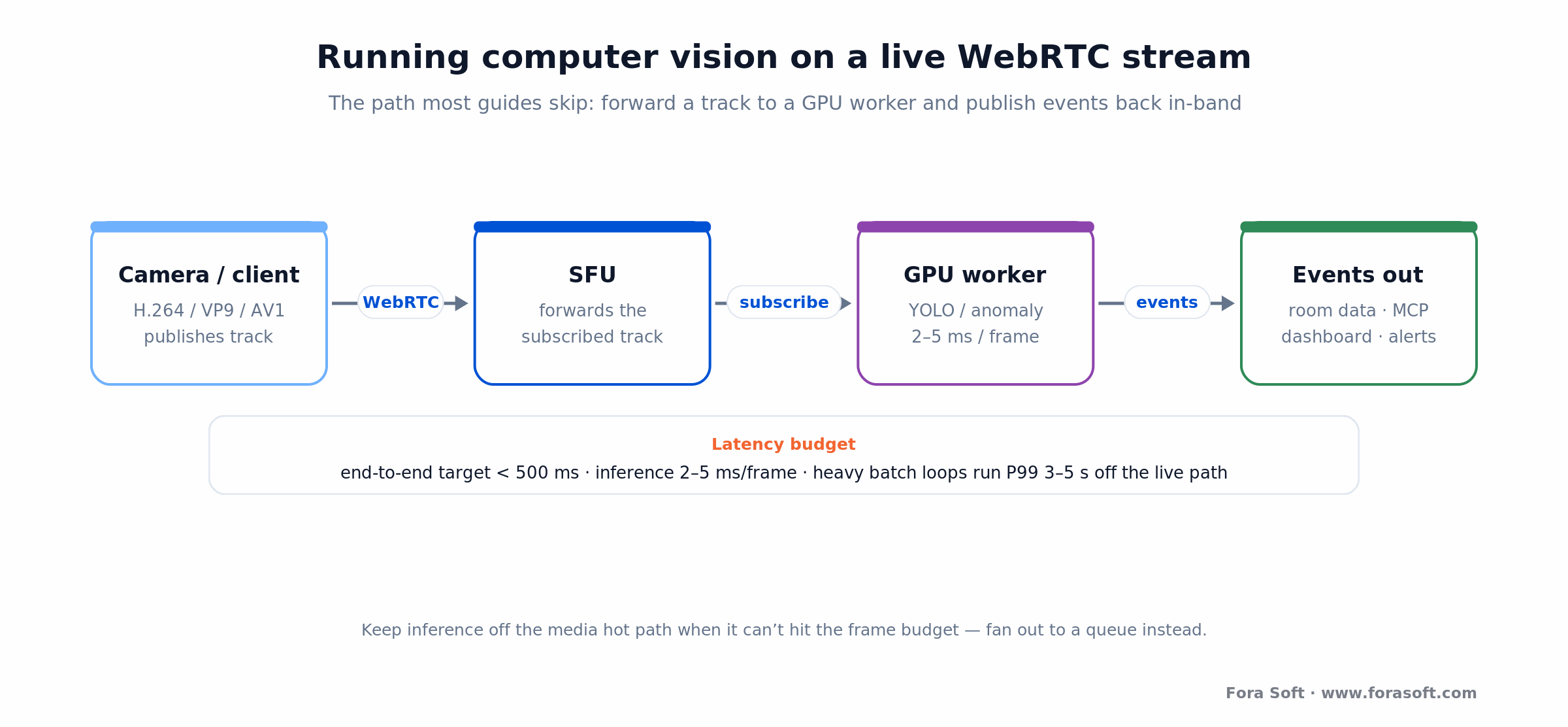
Figure 2. The pattern most migration guides skip: run CV on the live stream by fanning a track out to a GPU worker.
Reach for plane separation when: the analytics layer is your moat. Coupling analytics tightly to the media transport is the single most common reason Twilio migrations break analytics.
How to execute the migration: dependencies, shims, refactor
A safe video analytics migration runs in five phases. Phase 1 (week 1): dependency mapping. List every module that touches Twilio Video SDK; identify analytics-specific call sites. Phase 2 (weeks 2–4): shim layer. Wrap Twilio Video API behind your own abstraction so the analytics pipeline is decoupled. Run regression tests against the shim to catch hidden dependencies. Phase 3 (weeks 5–8): swap implementation. Replace the Twilio implementation behind the shim with LiveKit / Daily / Cloudflare RealtimeKit / custom. Phase 4 (weeks 9–10): shadow traffic A/B. Route 5–25% of traffic through the new stack, validate analytics parity. Phase 5 (weeks 11–12): ramped cutover.
The shim pattern is the key. Without it, every analytics call site changes simultaneously and you lose A/B testing. With it, you can run both stacks side-by-side, validate analytics parity per feature, and roll back at any phase without re-doing work.
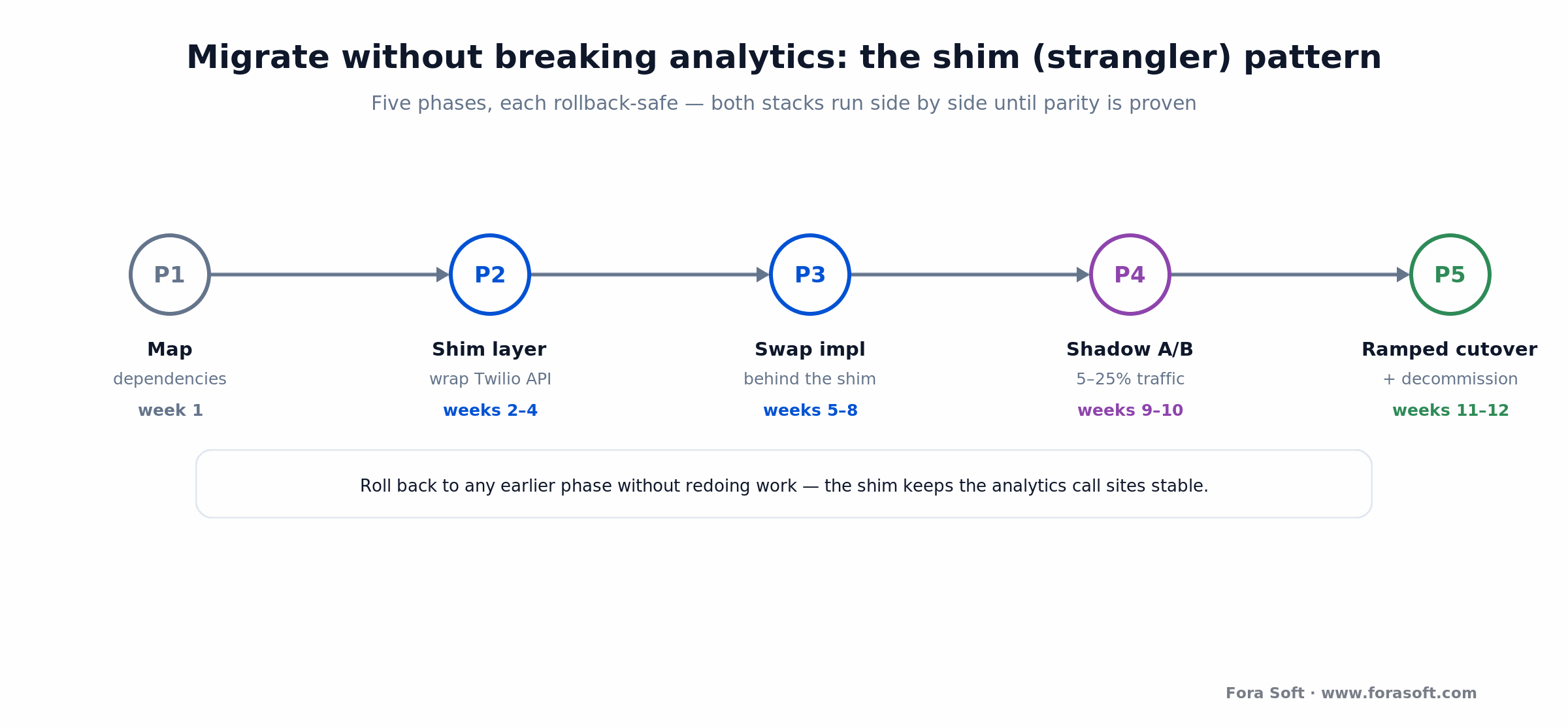
Figure 3. The shim pattern runs both stacks side by side, so you can prove analytics parity and roll back at any phase.
Analytics features matrix: what survives the migration
A typical video analytics product runs four feature classes. Each migrates differently.
1. Motion detection. Mature on every modern SFU. LiveKit, Daily, Cloudflare RealtimeKit all expose participant tracks that motion-detection libraries (OpenCV, ffmpeg) consume cleanly. Migration risk: low.
2. Anomaly classification. Behaviour-based, trajectory-based, or LLM-judged. Native via LiveKit Agents framework; possible via Daily raw tracks + webhooks (or Pipecat). Migration risk: medium — the classification model usually ports cleanly, but the trigger pipeline needs adapting.
3. Face / plate recognition. Compute-heavy. Native via LiveKit Agents with GPU pools; via webhooks + raw tracks on Daily / RealtimeKit. Migration risk: medium-high — inference latency matters and architecture must preserve it.
4. Behavioural analytics + dashboards. The dashboard layer migrates trivially; the input data pipeline can change shape. Test thoroughly before cutover.
Migration cost ranges in 2026 (with Agent Engineering)
| Migration shape | Cost | Timeline | When |
|---|---|---|---|
| Twilio Video → LiveKit Cloud (with analytics shim) | $40–80k | 8–12 weeks | Standard analytics features |
| Twilio Video → Daily / RealtimeKit | $35–70k | 8–12 weeks | Lighter analytics scope |
| Twilio Video → LiveKit OSS | $70–130k | 10–16 weeks | Egress >$3k/mo |
| Twilio Video + custom AI → LiveKit + Agents | $80–160k | 12–18 weeks | Custom AI in scope |
| Full custom WebRTC + analytics rebuild | $120–200k | 14–22 weeks | Differentiated analytics moat |
Numbers run ~30% under 2024 baselines because Agent Engineering compresses the SDK rewrite. The shim layer is mostly mechanical — Claude Code with curated prompts can port wrappers at a service file at a time, with senior reviewers validating analytics parity.
Build vs buy on the analytics layer
For under 100k participant-min/month with standard analytics features, SaaS conferencing platforms (Daily, LiveKit Cloud, Cloudflare RealtimeKit) deliver fastest ROI. Past 500k participant-min/month or when analytics is the differentiator, custom on LiveKit OSS pays back inside 18–24 months and gives you the IP. The crossover sharpens further when AI inference is custom or compliance regimes (HIPAA, EU AI Act) constrain the cloud SaaS path.
Worked example: 300k participant-min/month with custom face recognition. Managed (LiveKit Cloud Scale tier) lands near $1.5–2k/month for media plus $4–6k/month for cloud GPU inference, so call it $6–8k/month all-in. Self-host on LiveKit OSS with a dedicated GPU pool runs about $5k/month once built, but carries an $80k one-time build. Year 1 managed ≈ $84k; year 1 self-host ≈ $140k. Self-host’s monthly run cost is lower, but the $80k build takes roughly three years of those savings to pay back — which is why the analytics IP and control, not the dollars, usually decide it.
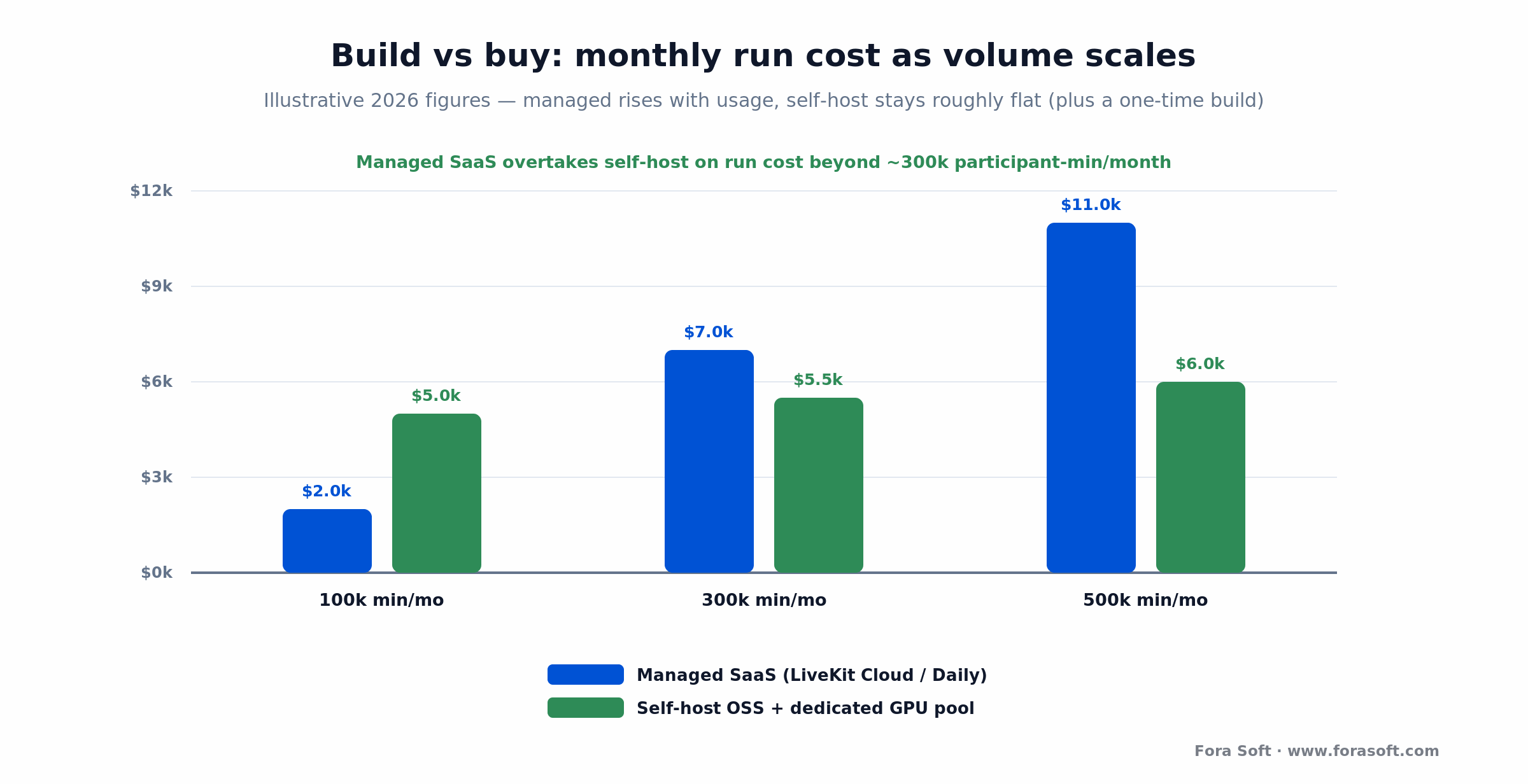
Figure 4. Illustrative run cost: managed pricing scales with usage; self-host trades a one-time build for a flatter monthly bill.
Reach for custom analytics when: the analytics IP is your competitive moat. SaaS analytics are commoditising fast; differentiated analytics live in a custom plane.
A decision framework: pick your post-Twilio analytics platform in five questions
1. What analytics features must survive the migration? Motion detection, anomaly classification, face/plate recognition, behavioural analytics, custom ML inference. Map each to a feature in the candidate platform before scoping.
2. What’s your monthly participant-minute volume? Below 100k, ship on LiveKit Cloud or Daily. 100k–500k, lean LiveKit Cloud. Above 500k, plan a 3–6 month move to LiveKit OSS or custom.
3. Is custom AI inference in scope? If yes, the LiveKit Agents framework is the cleanest path. Daily and Cloudflare RealtimeKit need more glue code.
4. Is HIPAA / SOC 2 / GDPR in scope? LiveKit OSS or the Scale tier, Azure Communication Services, and self-hosted custom have the strongest enterprise compliance posture.
5. What’s your team’s ops capacity? SaaS (LiveKit Cloud, Daily, Cloudflare RealtimeKit) requires almost no ops; OSS LiveKit needs a dedicated DevOps engineer; custom builds need 1–2 senior engineers per quarter for ongoing work.
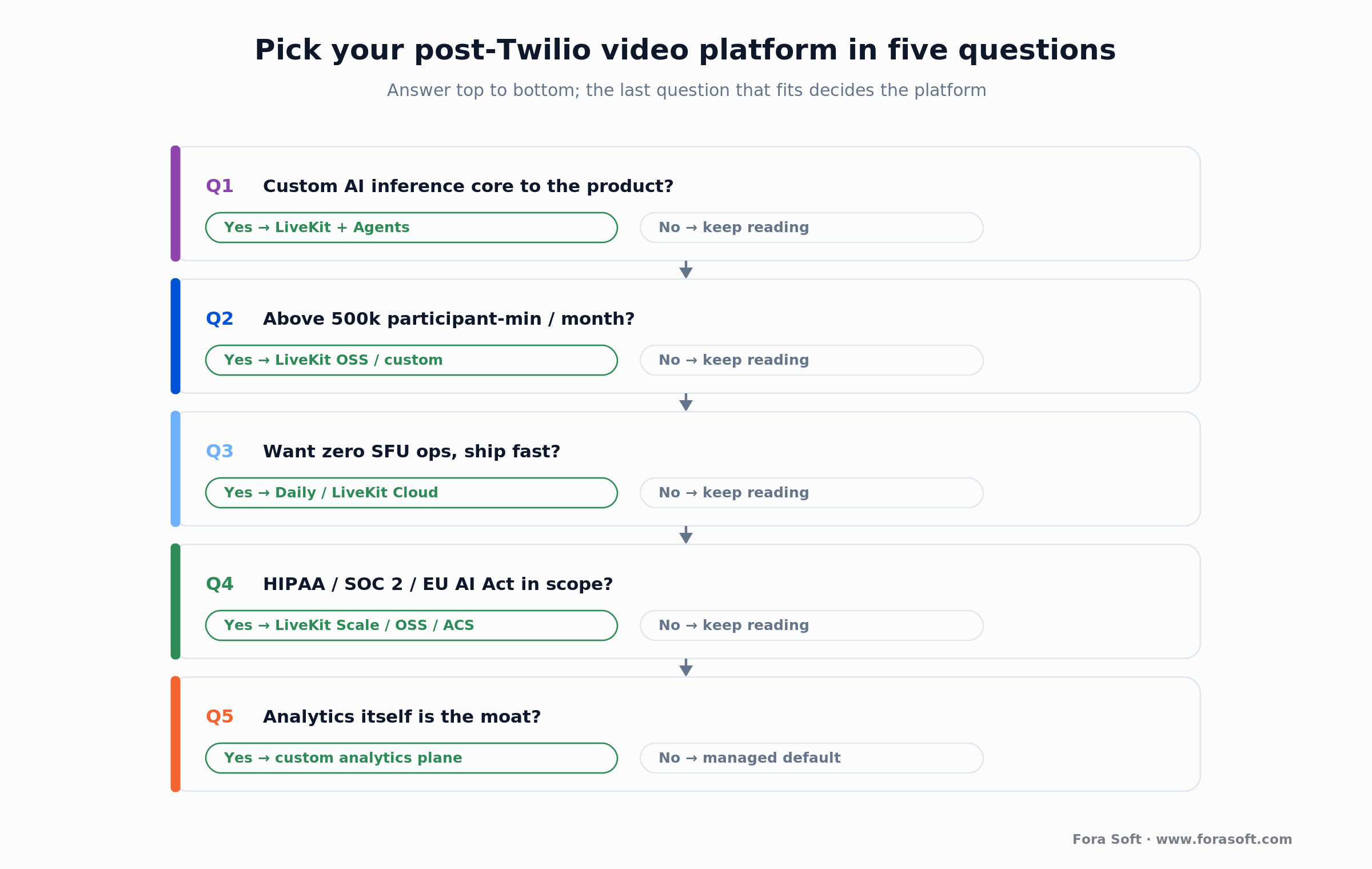
Figure 5. Work top to bottom; the last question that fits picks your post-Twilio platform.
Want our scoring against those five questions?
Send your scope and we’ll quote LiveKit Cloud, LiveKit OSS, Daily, Cloudflare RealtimeKit, and custom — ranked — with a fixed-bid migration timeline.
How to spot a real video analytics migration partner
1. Show me a recent LiveKit (or Daily / RealtimeKit) commit on an analytics-aware build. Specifics, not aspirations.
2. Walk through your shim layer pattern. If they don’t use one, they’ll do big-bang migrations that lose analytics features.
3. Draw the LiveKit Agents data flow on a whiteboard. Subscribe to participant tracks, publish analytics events, integrate with downstream services.
4. Show me the analytics regression suite. Without one, you can’t verify parity post-migration.
5. Name three video analytics products they’ve built or migrated. Mindbox, BrainCert classroom analytics, VALT-class are the kind of references you want.
AI agents in 2026 video analytics: LiveKit Agents, MCP, custom
By Q1 2026 the analytics product surface is also an AI agent surface. SOC analysts, classroom teachers, and retail managers ask agents “summarise unusual activity in the last hour” or “flag any participant whose behaviour deviated from the cohort baseline”. The pattern: an MCP server wraps the analytics event API, and a Claude Code-class agent or custom security copilot queries it natively.
Three architectures are credible: 1. LiveKit Agents framework as the native integration point — agent subscribes to participant tracks and pushes analytics events to MCP. 2. Daily / Cloudflare RealtimeKit webhooks pushing analytics events to a dedicated agent service. 3. Custom WebRTC + custom MCP server for fully bespoke flows. The migration is the right moment to wire the AI agent layer; bolting it on later is more expensive.
Compliance during the migration
If your video analytics product runs HIPAA, SOC 2, GDPR, or EU AI Act-bound traffic, the migration must inherit the same posture. HIPAA: get a BAA from the new vendor before traffic touches it. SOC 2: refresh the audit. GDPR: data residency may push you toward EU-region cloud. EU AI Act: remote biometric-identification features fall under the Act’s high-risk obligations, which apply from August 2026 — budget for conformity assessment and technical documentation if you operate in the EU.
For HIPAA video analytics specifically: LiveKit OSS on a HIPAA-eligible cloud (AWS, GCP) with a BAA, segregated GPU inference pool, audit logs to S3 with retention, BAAs with all subprocessors. Build cost: $80–160k. We’ve done this for telehealth-adjacent products that needed HIPAA-grade analytics.
Five pitfalls in video analytics migrations
1. Big-bang migration without a shim. Every analytics call site changes simultaneously. You lose A/B testing and rollback capability.
2. Skipping the analytics regression suite. The migration is “done” in name only if you can’t prove parity per analytics feature.
3. Picking SaaS without checking analytics extensibility. Daily and Cloudflare RealtimeKit ship great defaults; if you need to plug in proprietary AI inference, the API ceiling can bite. Test before committing.
4. Forgetting Twilio Voice + SMS. Many video analytics products also depend on Twilio Voice for dial-in or SMS for notifications. Plan the combined migration to share discovery and ops.
5. Underestimating the cutover window. Plan a 2-week parallel-traffic phase with metric-driven gates. Skipping this is the most common cause of post-migration rollbacks.
KPIs to track post-migration
Quality KPIs. Analytics feature parity (target 100% per feature), end-to-end latency p95 (target match or beat Twilio baseline), false-positive/false-negative rate per analytics class (no regression vs Twilio baseline).
Business KPIs. Cost per participant-minute (target 30%+ reduction vs Twilio), feature lead time post-migration, AI agent containment rate (if applicable), churn through migration window (<1% degradation).
Reliability KPIs. SFU uptime (target 99.95%), session error rate (<0.5%), MTTD on outages (<5 min), regression suite pass rate before traffic cutover (≥99%).
When NOT to start the migration in 2026
Plenty of teams should stay on Twilio Video in 2026. Because the shutdown was reversed, there is no forced clock. Don’t migrate if Twilio meets your feature needs, your per-minute bill is comfortable, you have no real-time-AI roadmap, and your volume is modest — a migration that buys nothing is just risk and spend. Same if you’re mid-funding-round or mid-major-release: don’t rip out working infrastructure at the worst possible moment.
Where a move does pay off: products with active analytics roadmaps, AI-agent ambitions, scaling minute volumes, or a Twilio bill that has outgrown its value. Our AI integration services, video conferencing services, and custom video processing services map the scope.
FAQ
Is Twilio Video shutting down in 2026?
No. Twilio announced a December 5, 2026 end-of-life in early 2024, then reversed it in October 2024. Programmable Video remains a supported, standalone product in 2026 and still accepts new accounts. Migration is now elective — driven by cost, AI features, or control, not a deadline.
What’s the best Twilio Video alternative for video analytics dev companies?
LiveKit (Cloud or OSS) is our default recommendation. The LiveKit Agents framework is purpose-built for analytics and AI integrations: agents can subscribe to participant tracks and run custom inference with first-class API support. Daily, Cloudflare RealtimeKit (formerly Dyte), and custom builds are credible alternatives depending on scope.
How long does a video analytics migration take?
8–12 weeks for SaaS-to-SaaS lifts (LiveKit Cloud, Daily, Cloudflare RealtimeKit). 10–16 weeks for SaaS-to-OSS migrations on a self-hosted SFU. 14–22 weeks for full custom rebuilds. Add 2–3 weeks if a HIPAA / SOC 2 / EU AI Act audit is in scope.
What does a video analytics migration cost?
Lift-to-LiveKit-Cloud projects with analytics shim: $40–80k. Twilio → LiveKit OSS for high-volume: $70–130k. Custom AI integration on LiveKit Agents: $80–160k. Full custom WebRTC + analytics rebuild: $120–200k. Numbers run ~30% under 2024 baselines because Agent Engineering compresses the SDK rewrite.
Will my analytics latency improve after migration?
Often, though it depends on the workload. Modern SFUs ship simulcast/SVC, AV1 support, and faster track APIs that Twilio Video never added, which helps bandwidth-heavy inference most. In our builds we’ve seen meaningful latency drops on live-feedback features, but measure your own pipeline before you promise a number.
Should I migrate Twilio Voice / SMS at the same time?
If you’re using both, yes. Coordinate the migrations to share discovery, infrastructure, and ops setup. Telnyx is the cleanest Twilio Voice + SMS replacement (40–70% cheaper). Pair Telnyx for voice with LiveKit for video and you’ve replaced the entire Twilio stack with stronger components. See our Twilio → Telnyx migration guide.
How do I prove analytics parity post-migration?
An analytics regression suite: replay a representative dataset of media frames through both old and new analytics pipelines, compare outputs, fail the migration if any feature regresses below threshold. We typically design the suite during phase 2 (shim layer) and run it continuously through cutover.
How does Fora Soft price a video analytics migration?
Most migrations land in the $40–200k range covered by our cost table above with a fixed-bid milestone structure. Lift-to-LiveKit-Cloud projects start at $40k; full custom rebuilds top out around $200k. Book a scoping call and we’ll quote a specific range against your spec.
What to read next
Migration playbook
Twilio Video Alternatives
Conferencing-side migration guide for the post-Twilio stack.
Integration
Video Analytics × Surveillance
How analytics plugs into broader surveillance stacks.
Buyer’s playbook
AI Video Surveillance Software Development
Architecture, vendors, compliance, cost in 2026.
Pricing
LiveKit vs Agora Pricing
Per-minute math and OSS migration paths.
AI integration
OpenAI Realtime + WebRTC + SIP
Wire AI agents into your post-migration stack.
Ready to migrate your video analytics product?
Twilio Video survived its own shutdown, so this is a decision, not a fire drill. If the analytics layer stands to gain — lower cost at scale, real-time AI, or full control — the shortlist is clear: LiveKit (Cloud or OSS) is the default for AI-integrated analytics; Daily and Cloudflare RealtimeKit for fast SaaS lifts; custom for differentiated moats. Pair the video plane with Telnyx for voice. Use a shim layer to enable parallel-traffic A/B and analytics regression testing. Cut over inside 12–16 weeks — on your schedule, not a vendor’s.
If you’re scoping a video analytics migration in 2026, we can show you what we’ve shipped on Mindbox, BrainCert classroom analytics, and VALT, recommend the right alternative for your scope, and quote a fixed-bid migration timeline in 30 minutes.



The handbook · 7 volumes
Fora Soft Video Engineering Handbook
Leaving Twilio Video means moving the media path and the analytics models at the same time. Our seven-volume handbook covers both sides: start with the volume on WebRTC, SFUs and delivery, then the AI volume on detection and tracking, and the real-time AI volume on agents, serving and cost per stream-hour. Written by Nikolay Sapunov, CEO at Fora Soft.
Browse the handbook on Amazon →7 volumes · 9,000+ pages · Kindle & paperback
Move your video analytics product off Twilio — with a partner who’s shipped on every alternative
30 minutes, real engineering opinions, no slides, a fixed-range estimate at the end.

