


Key takeaways
• Retail shrink runs about 1.6% of sales in the US, roughly $112B a year (NRF, 2023 survey, 2022 data). The NRF retired that survey in 2024 over method concerns, and its 2025 work shows shoplifting actually easing while fraud schemes rise. So drop the “theft is exploding” framing and measure your own stores.
• Self-checkout is where retail video surveillance earns its keep. SCO lanes leak about 3.5% of sales versus 0.21% at staffed lanes (Grabango, 2023). AI that flags skip-scans and bagging anomalies is the reason some chains keep SCO instead of ripping it out.
• Off-the-shelf wins below ~30 stores; custom wins above. Verkada, Solink, Spot AI, Avigilon, Everseen and Trigo each own a sweet spot. Past ~30 stores, or with a non-mainstream POS, a custom build beats the SaaS curve on five-year cost and keeps the data yours.
• Compliance is the silent budget line. Illinois BIPA, GDPR, and the EU AI Act (prohibitions live since Feb 2025) make naive facial recognition a courtroom risk. Design consent, signage, retention windows and an audit trail before a single camera goes live.
• Realistic build budgets. A focused proof-of-concept across 2–4 stores starts at $40–80k; a 10–15-store rollout $180–350k; a 50-store deployment $1.2–2.5M with hardware. Our Agent Engineering practice compresses those timelines and lands us below legacy integrator quotes for the same scope.
What retail video surveillance means in 2026
Retail video surveillance in 2026 is a network of IP cameras plus an AI layer that turns raw footage into events a person can act on: a skip-scan at a self-checkout lane, a refund with no customer at the counter, a repeat offender walking back through the door. The camera is the sensor. The value is in the software that decides what deserves a human’s attention and ties it to the transaction that caused it.
That is the shift worth understanding before you spend a dollar. A decade ago a retail system recorded video so you could review it after a loss. Today the job is to catch the loss as it happens, cut the false alarms that burn out your investigators, and feed store-operations data (traffic, queues, dwell) off the same cameras. This guide is written for the person picking a stack: which AI features pay back, which vendor fits your store count, when a custom build beats SaaS, what it costs, and where the compliance mines are buried.
Why Fora Soft wrote this guide
Fora Soft has shipped real-time video and AI products since 2005, with 250+ delivered software products and a 100% job-success score on Upwork. Surveillance is one of our oldest practices. We built V.A.L.T. (police interrogation rooms, courts and medical-training centers, nine simultaneous IP-camera feeds with synchronized analytics, now used by 770+ US organizations), drone surveillance for DSI Drones, and IP-camera mobile clients including NETCAM.
Retail is its own discipline. The cameras, the people-counting, the POS link, and the regulatory posture all look different than they do in courts or hospitals. This is the retail-specific version of what we’d tell a regional grocer, an apparel chain, or a quick-service operator weighing a SaaS subscription against a system built to fit their stores. We sell development, so read the vendor sections as an honest map, not a pitch: for most small fleets the right answer is to buy, and we say so below.
Scoping a retail surveillance build or rollout?
Bring your store count, POS stack, and shrink baseline. We’ll spend 30 minutes mapping a stack and giving you an honest estimate. No slide deck, no obligation.
The 2025–2026 retail shrink picture
Start with an honest number. US retail shrink was about $112B, or 1.6% of sales (the highest rate in over a decade), in the last full NRF National Retail Security Survey (2023 report, 2022 data). The NRF then retired the 32-year survey in 2024 over methodology concerns, and its 2025 theft-and-violence work found shoplifting easing while organized fraud schemes rose. If a vendor quotes you “theft is up 30% year over year,” ask for the source. The defensible position in 2026 is that shrink is a large, steady 1–2% drag, and the only number that matters for your business case is your own.
Where the loss sits decides which cameras and which AI pay back. The table below is a directional read across formats; treat it as a starting hypothesis to validate against your own point-of-sale and inventory data, not gospel.
| Vertical | Shrink as % of sales | Per-store annual loss | Dominant theft type |
|---|---|---|---|
| Grocery / convenience | 1.5–3.0% | $45–65k | Self-checkout, ORC |
| Apparel / specialty | 2.0–3.5% | $80–180k | External shoplifting, ORC |
| Big-box / general | 1.4–2.5% | $120–400k | Mixed |
| Quick-service restaurant | 1.0–2.5% | $25–50k | Sweethearting, refund fraud |
| Personal care / pharmacy | 2.0–3.5% | $60–150k | ORC, employee theft |
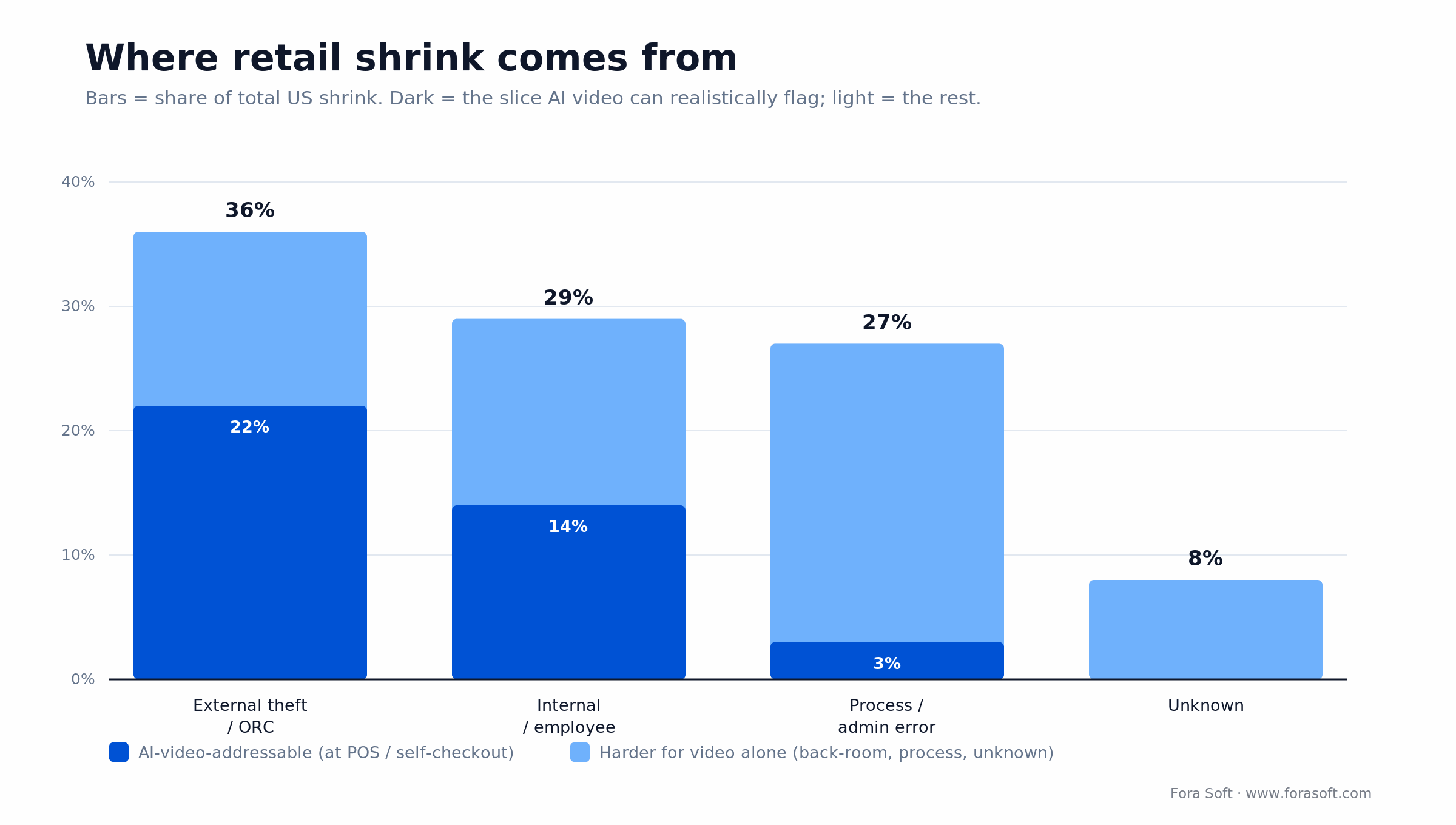
Figure 1. Shrink splits roughly a third internal, a third external, a third process error. Video AI mostly attacks the point-of-sale and self-checkout slices, not back-room error.
The takeaway from Figure 1: AI video moves the needle most where theft is visible at the register or the self-checkout lane. Organized crime at the door and back-room employee theft each need a different toolkit, and no camera fixes an admin-error problem that is really a receiving or markdown process gap.
Self-checkout: monitor with AI or pull it out?
This is the live retail debate of 2025–2026, so answer it first: for most operators the fix is to instrument self-checkout with AI, not remove it, unless a specific store bleeds so badly that staffed lanes cost less than the loss. Self-checkout leaks about 3.5% of sales versus 0.21% at staffed lanes (a 2023 Grabango study), and researchers at the University of Leicester estimate self-checkout accounts for a fifth to nearly a quarter of all unknown store losses. A December 2025 LendingTree survey found 27% of self-checkout users admit taking at least one item on purpose, up from 15% in 2023.
That pain is why some chains started pulling SCO out. Dollar General removed self-checkout from most of its stores and reported loss down meaningfully; Five Below has been quietly removing it at higher-risk locations; Walmart pulled it from select stores while keeping it chain-wide. Removal works, but it trades a shrink problem for a labor bill and slower lanes. The middle path, and the one this guide backs, is computer vision on the SCO lane: flag the skip-scan or the bagging-without-scan in under a second, alert the attendant’s tablet, and let the shopper self-correct before they leave.
Reach for SCO vision (not removal) when: self-checkout is more than ~20% of your transactions, your loss per SCO lane is under the fully-loaded cost of staffing it, and you can put an attendant within a few steps of the alert. Rip SCO out only when a store’s SCO shrink stays above staffed-lane labor cost after you’ve tuned the AI for a full quarter.
Vendors have moved fast here. Everseen, used by 11 of the top 20 global retailers, unveiled its Everact agentic AI at NRF 2026 to field loss questions in plain language, with pilots rolling out through 2026. Trigo shipped a dedicated loss-prevention product in June 2025 that compares each scanned item to what the shopper actually picked up. Mashgin’s vision kiosks ring up a full tray at once at around 99.9% item accuracy. The common thread: the camera stops being a passive recorder and becomes a real-time referee at the lane.
The AI features that actually pay back in retail
1. Self-checkout loss prevention. Vision flags skip-scanning, the banana trick, ticket switching, and bagging without a scan at 65–75% precision when tuned per store. Vendors: Everseen, Trigo, Mashgin. Reported impact in production grocery and QSR: a 35–42% cut in SCO-attributable shrink, worth $2.5–4k per store per year.
2. POS×video correlation. Tie every transaction-log line to the matching video frame. That catches sweethearting (cash-tender exclusions, voids at tender time, no customer in frame), refund fraud (returning a pristine item coded “damaged”), and discount abuse. Payback runs $500–2k per store per year on refunds alone, and it is the single feature most SaaS demos gloss over.
3. People counting and queue analytics. Conversion math (visitors to transactions), staffing on live queue depth, and dwell-time heat zones for merchandising. The shrink side-effect: heat maps of frequent concealment spots guide where you place deterrents. For the counting engine on its own, its methods, accuracy, privacy, and build-vs-buy, see our people counting software guide.
4. ORC tracking and license-plate recognition. Repeat-offender matching at entry where it is legal (see compliance), plate recognition for getaway vehicles, and cross-store alerts within a chain. Published cases report 60%+ fewer repeat hits from flagged offenders, though that figure comes from vendors and deserves a pilot before you bank on it.
5. Age estimation at self-checkout. Real-time facial-age estimation, not identification, gates alcohol and tobacco with a manager override. It carries far lower legal weight than full facial recognition because no identity is matched or stored.
6. Behavior anomaly detection. Loitering, repeated basket insertion and removal, concealment motions. Useful, but vendor maturity varies wildly, so treat it as a triage layer that raises a soft flag, never a hard alert that dispatches staff. We covered the model side in Top 7 Surveillance Anomaly Detection Algorithms, and the wider primer lives in our AI video surveillance guide.
The retail surveillance vendor field in 2026
No single platform wins every store. The bands below are directional 2026 list prices, not quotes, and every one of these vendors will discount at volume. Match the sweet spot to your fleet size and integration depth, then price the five-year total, not the monthly sticker.
| Vendor | Sweet spot | Pricing band | Where it wins |
|---|---|---|---|
| Verkada | 100–1,000+ cameras, multi-site | $200–400/cam/yr | Cloud UX, managed fleet, fast rollout |
| Solink | 5–50 stores, food / grocery | $400–700/store/mo | Native POS / TLog correlation |
| Spot AI | 1–15 locations, value buyers | $100–250/cam/mo | Affordable, friendly UX |
| Avigilon (Motorola) | 50–500 cameras, enterprise | $300–600/cam/yr | Native 4K, mature on-prem |
| Sensormatic | Tier-1 retail with EAS legacy | Custom enterprise | RFID + EAS + video bundle |
| Everseen | Self-checkout-heavy stores | Custom per location | Best-in-class SCO accuracy |
| BriefCam | Forensic / post-incident review | $150–300/cam/yr | Video synopsis and search |
| Rhombus | Modern bespoke / integrator builds | ~$20–50/cam/mo | Open API, customization friendly |
For the platform-versus-development-partner split in more depth, see our companion guide on top video surveillance software companies in 2026, and for the store-analytics angle specifically, our retail video analytics playbook.
Reach for a custom build when: you’re past ~30 stores, you run non-standard cameras or a non-mainstream POS, you need on-prem retention windows the SaaS won’t honor, or your use case (niche merchandising analytics, a cross-banner ORC network) sits outside every vendor’s roadmap.
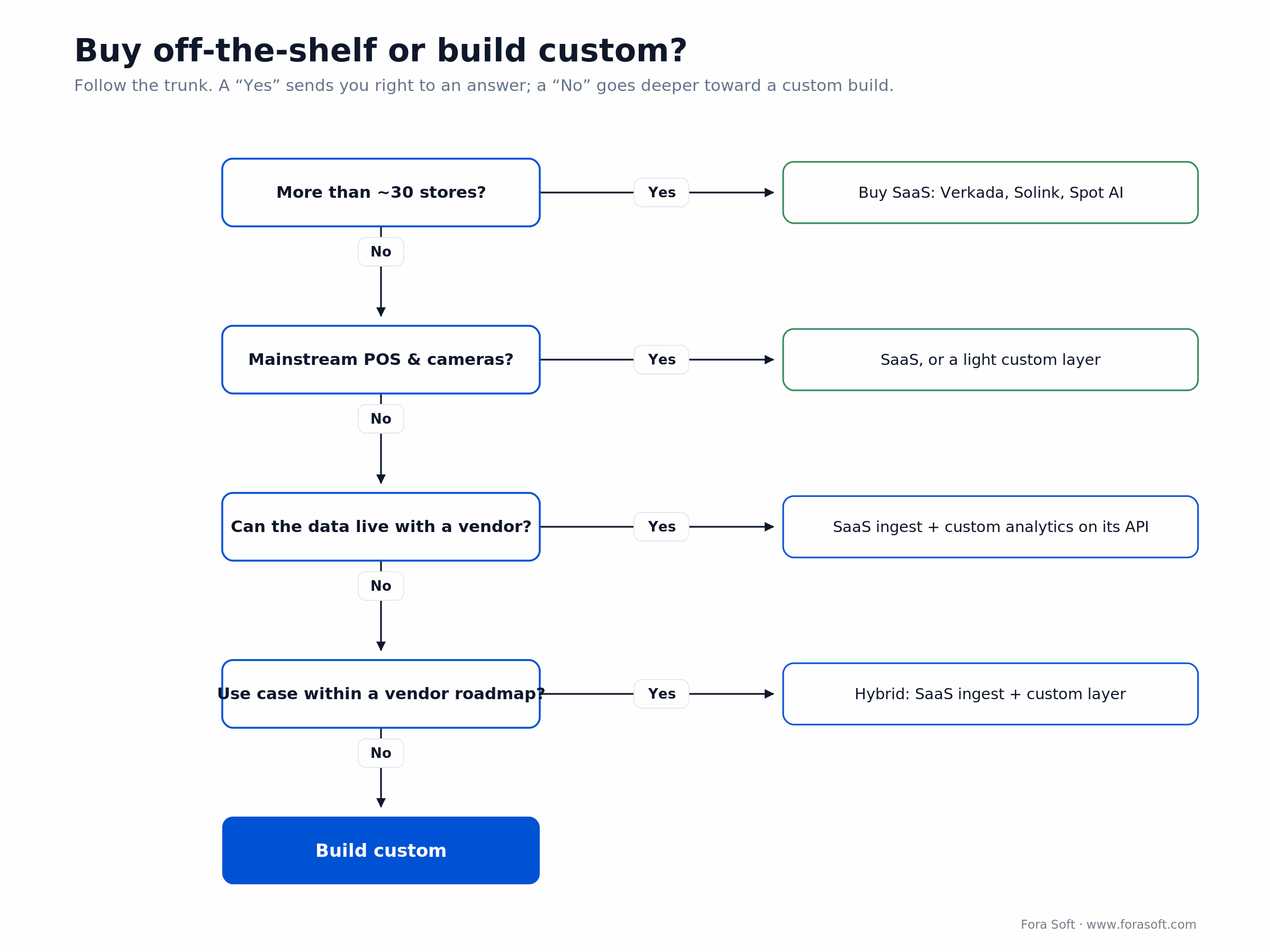
Figure 2. Buy vs build in four questions: store count, POS mainstream-ness, retention control, and roadmap fit. Most small fleets land on SaaS; the custom branch opens past ~30 stores.
Camera coverage and placement for a store
Before you argue about AI, get the cameras right, because a great model on a badly placed camera still misses the theft. A typical store fleet is 12–16 cameras: entry and exit, one over every self-checkout lane, high-value zones (spirits, electronics, cosmetics, baby formula), the back-of-house door, and the loading dock. Run 1080p–2K at 30 fps; go 4K only on wide zones where you need to read faces or labels at distance, because 4K quadruples your storage and inference bill.
Two placement rules save the most grief. First, the self-checkout camera looks down at the bagging area and the scan bed, not at the shopper’s face, so it sees the item, which is what the model needs and what keeps you out of biometric territory. Second, mount the entry camera for clean full-body captures at a choke point, so ORC matching and people-counting share one good feed instead of two mediocre ones. Cheap cameras in the right spots beat expensive cameras in the wrong ones every time.
Edge or cloud? Both, in this order
A store running 12–16 cameras at 1080p–2K moves on the order of 12–16 GB per camera per day of raw video, so cloud-only ingest gets expensive fast. We default every retail build to a hybrid edge-then-cloud topology, and the ordering in the heading is deliberate: the edge earns its place first.
The edge does the time-critical work: sub-second SCO alerts, recording continuity when the WAN drops, and a motion or embedding pre-filter so the heavy model only runs on candidate frames. The cloud does the cross-store work: chain-wide ORC repeat-offender alerts, central dashboards, model retraining, and the audit trail. We worked through the latency math in Edge AI vs Cloud AI for Video Surveillance. Figure 3 shows why that pre-filter matters to the bill.
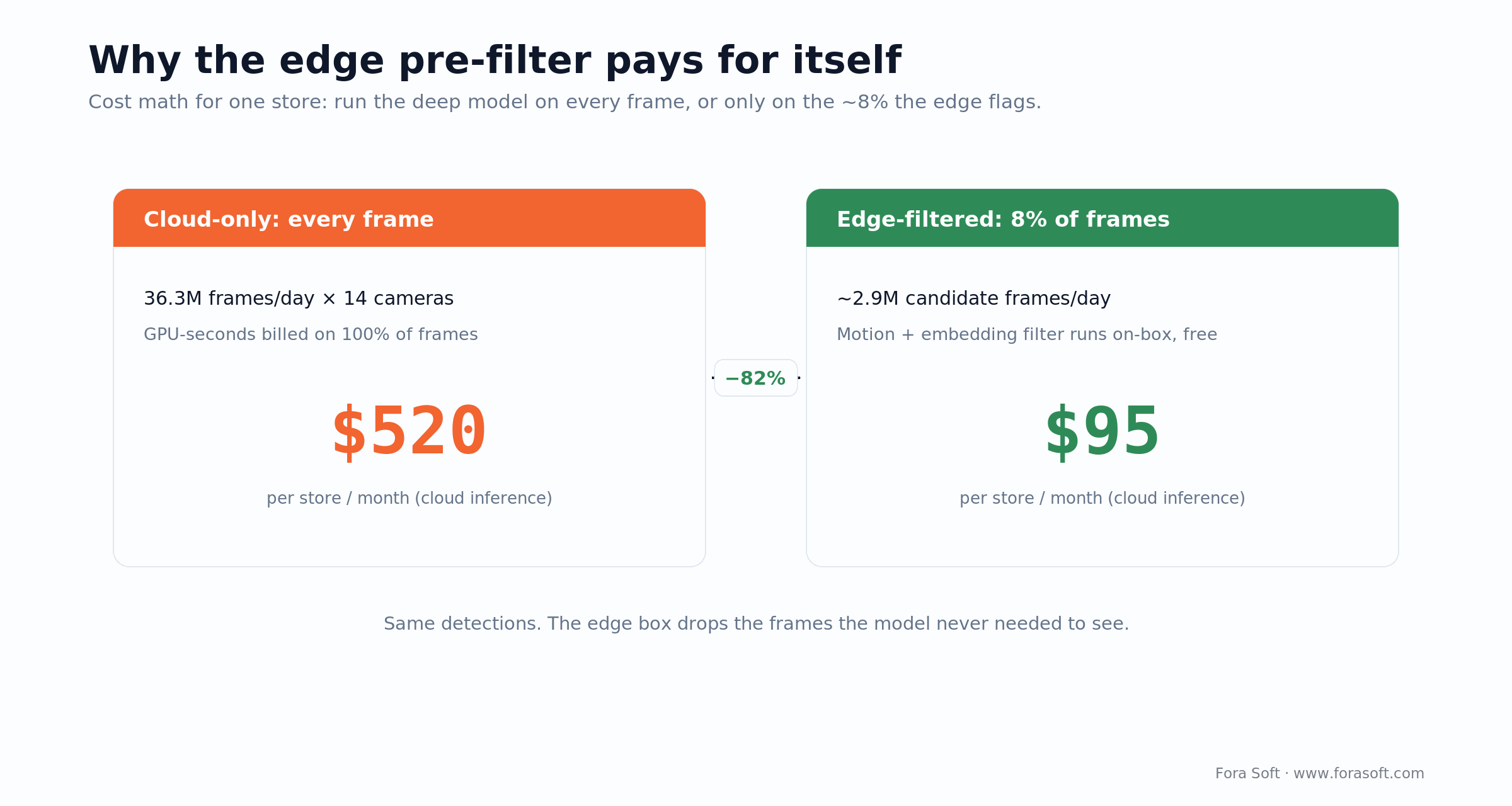
Figure 3. An edge motion filter that passes only ~8% of frames to the deep model turns a $520/store/month cloud-inference bill into about $95. Multiply by your store count.
POS×video integration patterns that actually work
TLog correlation. Every refund, void, and no-sale event is timestamp-matched to the lane camera. The investigator dashboard shows the transaction line, the staff member, and the synced clip in one view. Native integrations exist for NCR, Oracle, Toast and Lightspeed; everything else goes through an SFTP drop or a webhook bridge, which is a week of integration work, not a research project.
Sweethearting detection. A cash-tender exclusion plus a tender-time void plus a customer-count anomaly fires a triage alert. Accuracy lands at 70–85% once you tune it per store; skip the baseline tuning and the false-positive rate destroys investigator trust in a fortnight.
Refund fraud. Match the return reason code against the item’s actual condition on camera. “Damaged” returns of pristine goods, off-receipt returns of high-value SKUs, and return-without-customer events all surface here.
Self-checkout overlays. Live vision runs on the SCO lane and the alert goes to the attendant’s tablet, not a cloud queue. The latency budget is sub-second: if the shopper has bagged and left before the alert lands, the system failed, full stop.
Need POS×video correlation on a non-mainstream stack?
We’ve built TLog correlation against NCR, Oracle, Toast and bespoke ERP/POS systems. Bring your stack and we’ll come back with a clear plan and a price we can defend.
How we’d build it: a reference architecture
Here is the stack we reach for on a custom retail build, bottom to top. At the store: IP cameras (ONVIF Profile S/T so you’re not locked to one brand) feeding an on-site edge box (a small GPU appliance) that handles recording, the motion pre-filter, and the sub-second SCO and POS alerts. A local buffer keeps 7–30 days of footage so a WAN outage never blinds a store.
Above that, a cloud tier ingests only events and thumbnails, not full video, which is what keeps the bandwidth bill sane. It runs chain-wide correlation (the same offender across three stores), the investigator dashboard, model retraining, and the audit log. The POS integration sits beside the edge box as a TLog listener so correlation happens locally and privately. Figure 4 lays out the whole path from camera to case file.
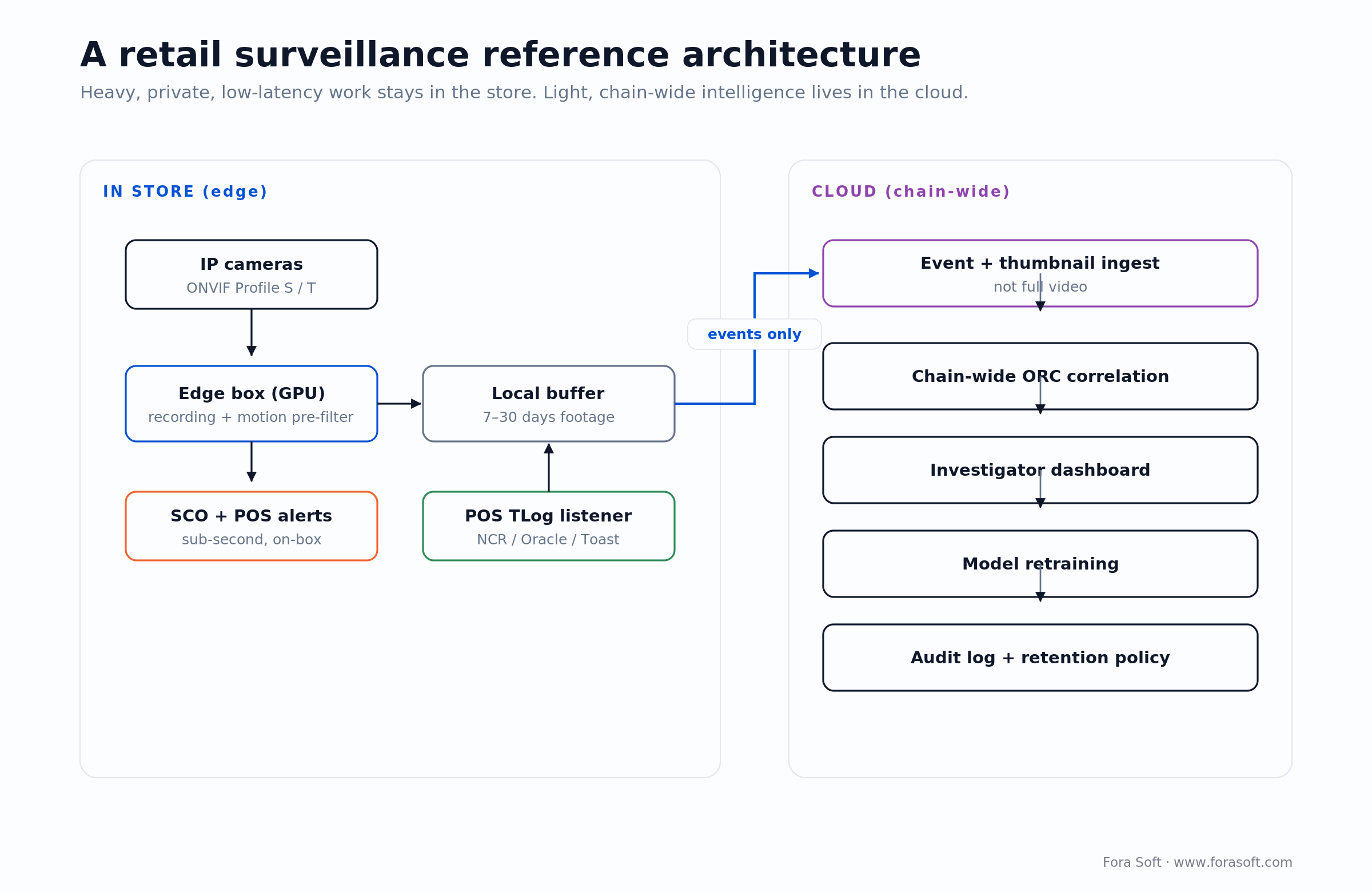
Figure 4. The hybrid retail reference architecture: heavy, private, low-latency work stays at the edge; light, chain-wide intelligence lives in the cloud.
If you want the model-engineering layer under this (how the detectors and trackers are trained), our AI for video engineering hub goes deep, and our AI integration team builds exactly this class of system. For the vendor-neutral overview of the surveillance stack, our computer vision for video surveillance page is the shorter read.
Compliance: BIPA, GDPR, EU AI Act
We’re engineers, not lawyers, so treat this as a map of where the mines are and get counsel before you deploy biometrics. The short version: skip identification-grade facial recognition in retail unless you can defend it, and the legal weight of your system drops sharply.
Illinois BIPA. Biometric data, including face geometry, needs written consent before collection plus a documented retention-and-destruction policy. It carries a private right of action, and six- and seven-figure class settlements are routine. Collect any face geometry in Illinois without consent and you have a litigation problem, not a feature.
EU AI Act. Under Regulation (EU) 2024/1689, prohibitions have been enforceable since 2 February 2025, and real-time remote biometric identification in publicly accessible spaces is largely banned, with narrow law-enforcement carve-outs and fines up to €35M or 7% of global turnover. High-risk obligations (risk file, dataset governance, human oversight, conformity assessment, EU registration) were pushed back by the 2026 Digital Omnibus: the main high-risk deadline is now 2 December 2027, with product-embedded systems following in 2028. Post-event and behavioral uses are where retail can still operate, carefully.
GDPR and US state law. Footage is personal data and biometric processing is special category, so you need a lawful basis, a DPIA, signed data-processing agreements with every processor, retention windows (30–90 days is typical, longer only for an active investigation), and a working data-subject access endpoint. In the US, CCPA/CPRA treat biometrics as sensitive personal information, and NYC, Portland and San Francisco restrict facial recognition in private spaces with narrow loss-prevention exemptions.
Reach for age estimation over facial recognition when: the job is gating alcohol or tobacco at self-checkout. Age estimation reads a face without matching or storing an identity, so it sidesteps most BIPA and EU AI Act exposure while still doing the compliance job. Keep a manager override for edge cases.
A worked example: 25-store chain, five-year cost
Numbers beat adjectives, so here is the arithmetic for a 25-store regional grocer, 14 cameras per store, deciding between SaaS and a custom build. SaaS at $550 per store per month is $550 × 25 × 12 = $165,000 per year, or $825,000 over five years, and you own none of it at the end. A custom build lands near $600,000 to stand up (PoC plus a 25-store rollout) plus 18% annual ops, so $600,000 + (4 × ~$108,000) = about $1.03M over five years, and you own the platform, the data, and the roadmap.
On raw five-year cost the SaaS looks cheaper by ~$200k. The build wins when any of three things is true: you keep operating past year five (the SaaS meter never stops, the build’s ops cost is a fraction), you need integrations the SaaS won’t sell (a bespoke POS, a cross-banner ORC network), or the data itself has value you can’t hand to a vendor. Figure 5 shows exactly where the two lines cross. Below ~30 stores the SaaS usually still wins; that is the honest answer, and it is why we tell most small chains to buy.
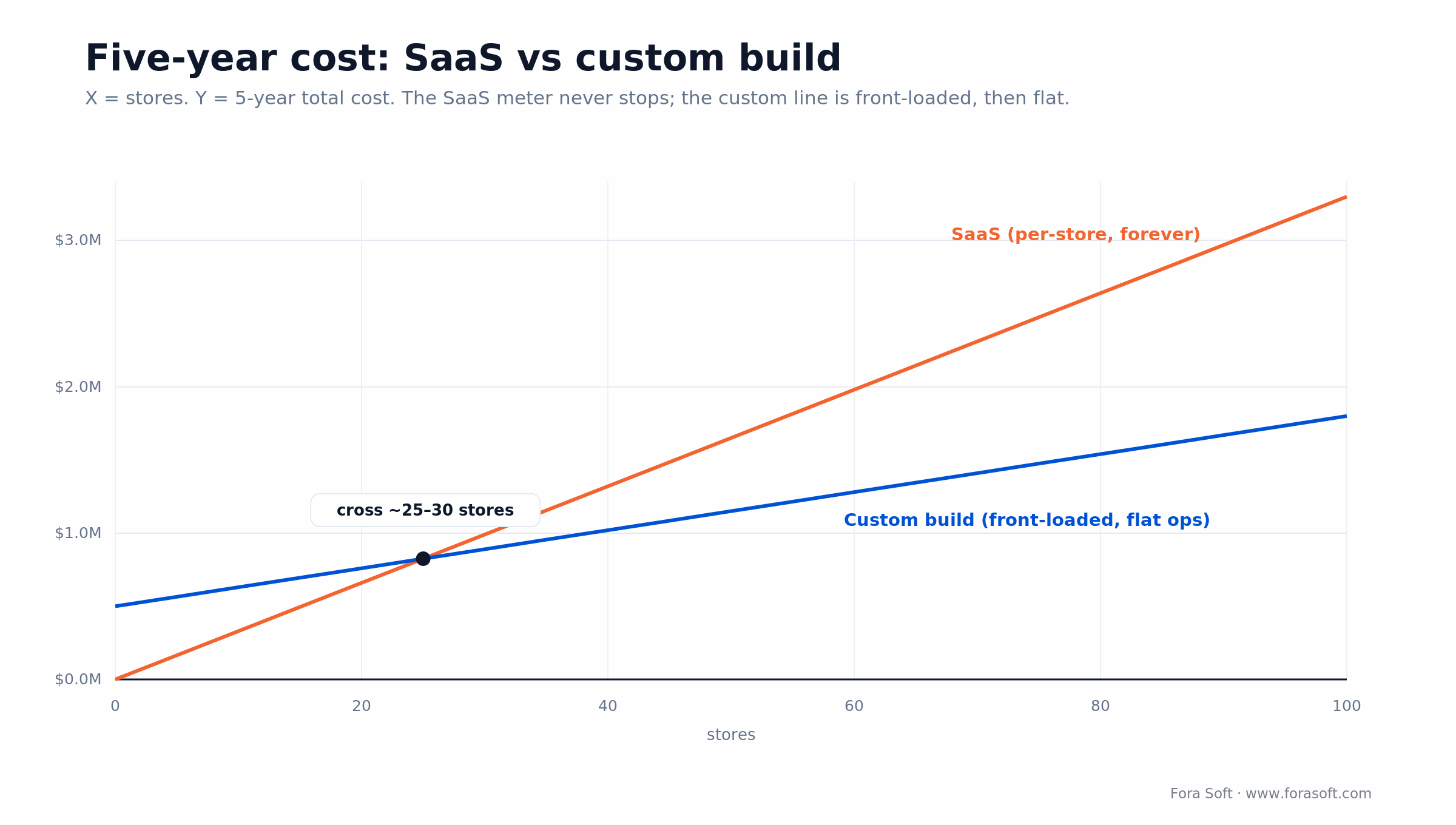
Figure 5. Five-year total cost of ownership: the SaaS line rises with store count forever; the custom line is front-loaded then nearly flat. They cross around 30 stores.
We’ve run the multi-feed version of this at scale. On V.A.L.T., our recording-and-analytics platform for justice and medical-training sites, we sync nine IP-camera feeds per room with searchable events across 770+ organizations and 50,000+ users. It isn’t a store, but the hard parts (synchronized multi-camera capture, event search, retention and audit at scale) are the same muscles a chain rollout needs. If you want us to run your numbers instead of these sample ones, grab 30 minutes and bring your store count and POS.
ROI: what published deployments actually deliver
| Pattern | Vertical | Reported impact | Payback |
|---|---|---|---|
| Self-checkout AI | QSR, grocery | 35–42% SCO shrink ↓, $2.5–4k/store/yr | 18–24 mo |
| POS×video correlation | Regional grocery | $8–12k/store/yr (sweethearting + staffing) | 14–18 mo |
| Behavior + dwell analytics | Apparel | 1.2–1.8% shrink ↓; modest conversion lift | 20–30 mo |
| ORC repeat-offender alerts | Personal care, pharmacy | 60%+ fewer repeat hits on flagged offenders | 12–18 mo |
A safe ROI message for a retail board is “1–2% shrink reduction plus staffing optimization, payback 18–30 months.” Anyone promising 5–10% shrink reduction in year one is selling, not measuring. These are vendor-reported ranges; your mileage depends on how well you tune alerts and staff the investigator queue, which is the topic of the next two sections.
Cost model: what a custom build costs in 2026
| Stage | Scope | Timeline | Typical cost |
|---|---|---|---|
| Proof-of-concept | 2–4 stores, 8–16 cameras, edge + cloud, custom alerts | 6–8 weeks | $40–80k |
| Rollout MVP | 10–15 stores, 120–180 cameras, POS integration, training | 12–14 weeks | $180–350k |
| 50-store deployment | 600–800 cameras, full hybrid, SOC integration | 16–20 weeks | $1.2–2.5M |
| Annual ops + retraining | Continuous | Per year | 15–20% of build |
A 50-store deployment breaks down roughly as: cameras and edge appliances 45–55% of capex, cloud infrastructure 10–15%, custom POS integration 5–8%, deployment labor 12–18%, training and change management 4–6%, contingency 10–15%. Because we run Agent Engineering, our AI-assisted delivery practice, estimates tend to come in faster and below legacy system-integrator quotes for the same scope; where we’re unsure of a number we tell you, rather than pad it.
Storage and retention: the quiet cost driver
Retention is where the compliance rule and the cloud bill meet, so decide it early. A store with 14 cameras at 1080p/30 fps on H.265 generates roughly 12–16 GB per camera per day, so a 30-day window is on the order of 5–7 TB per store. Keep that on the edge box locally, push only events and thumbnails to the cloud, and your bandwidth and cloud-storage lines stay small. Push full video to the cloud for every camera and the bill balloons for footage nobody will ever watch.
Set the retention window to the shortest period that satisfies both your investigation needs and the law: 30–90 days is typical, with an evidence-hold flag that pins a specific clip past the auto-delete when an incident is opened. Under GDPR and BIPA, keeping footage “just in case” is a liability, not an asset. A clean auto-delete policy with a documented hold process is both cheaper and more defensible than a giant archive you can’t justify.
KPIs to track from day one
Loss-prevention KPIs. Shrink as % of sales against baseline; a flagged-to-confirmed incident ratio above 30%; alert-to-investigator-action time under 60 seconds on SCO; and repeat-offender hit rate on flagged individuals.
Operational KPIs. False-alarm rate under 1.5%; alert-fatigue rate (ignored alerts) under 10%; investigator capacity used 60–80%; and per-camera uptime above 99.5%.
Compliance KPIs. Retention windows respected 100%; consent capture where required 100%; data-subject access request turnaround under 30 days; and a full audit-log replay possible for any retained event. If you can’t report these, you can’t defend the system in a deposition.
Five buyer pitfalls in retail surveillance
1. Skipping the PoC and rolling 50 stores at once. Without baseline shrink data and a tuned alert workflow, false-positive volume crushes investigator trust in week two. Pilot 2–4 stores, measure, then scale.
2. Buying facial recognition without legal clearance. BIPA in Illinois, signage rules in NYC, San Francisco and Portland, and EU AI Act obligations can turn a feature pitch into a class action. Get a legal review before you buy, not after.
3. Pricing per-camera SaaS without a five-year total. $500 per store per month feels small until you’re at 100 stores paying $600k a year forever. Build the five-year curve before you sign anything.
4. Ignoring POS integration depth. Without TLog correlation, sweethearting and refund-fraud detection are mostly theatre. Demand a native API or a dedicated integration sprint in the statement of work.
5. No investigator capacity plan. Most systems generate 50–200 alerts a week. Without 0.5–1 full-time investigator per 50–100 cameras and a triage playbook, alerts get ignored inside a month and the whole spend goes to waste.
Reach for a phased pilot when: this is your first AI surveillance system, your shrink baseline is fuzzy, or you’re integrating a POS nobody has a native connector for. Prove the alert-to-action loop in a handful of stores, publish the numbers internally, then let the results (not the vendor deck) fund the rollout.
When you should NOT build a custom system
If you run fewer than ~10 stores with mainstream POS and generic loss-prevention needs, off-the-shelf SaaS is almost always cheaper and faster. Solink, Spot AI, Rhombus and Verkada all install inside three weeks and don’t need an in-house dev team. The middle path, running a SaaS for ingest and adding a custom analytics or ORC layer on top of its event API, is often the right play for 10–30-store operators who want an edge without a from-scratch build. We’ll happily scope that hybrid too; the goal is the system that fits your stores, not the biggest invoice.
FAQ
What is retail video surveillance in 2026?
It’s a network of IP cameras plus an AI layer that turns footage into actionable events: a skip-scan at self-checkout, a refund with no customer present, a repeat offender at the door. The camera is the sensor; the software decides what a human should act on and links it to the transaction that triggered it.
Can AI cameras really stop self-checkout theft?
They don’t physically stop it; they flag bagging anomalies at 65–75% precision and alert the attendant within sub-second latency. Reported impact in production grocery and QSR is a 35–42% cut in self-checkout-attributable shrink within 12 months. Self-checkout lanes lose about 3.5% of sales versus 0.21% at staffed lanes, so that is where AI pays back fastest.
Should we remove self-checkout instead of monitoring it?
Usually no. In 2025 chains like Dollar General and Five Below pulled self-checkout at high-loss stores, but removal trades shrink for labor cost and slower lanes. For most operators, AI monitoring on the SCO lane is cheaper than staffing it. Remove SCO only when a store’s tuned SCO shrink still exceeds staffed-lane labor cost after a full quarter.
What does it cost to deploy AI surveillance to 100 stores?
SaaS like Solink or Spot AI runs roughly $500–700 per store per month, so $600–850k a year for 100 stores. A custom build is usually $2–5M capex plus 15–20% annual ops, with payback inside year three at a typical 1–2% shrink reduction. Past roughly 30 stores the custom curve starts to win on five-year total cost.
Is facial recognition legal in retail?
In most US states yes, but with strict rules in Illinois (BIPA), New York, Oregon and California. Under the EU AI Act, real-time remote biometric identification in publicly accessible spaces has been largely prohibited since February 2025. Best practice is to skip identification-grade facial recognition in retail unless you can defend it, and use age estimation and behavioral anomaly detection, which are lower-risk.
How does video integrate with POS to catch theft?
Through TLog correlation: each transaction-log line (refund, void, no-sale, manual discount) is timestamp-matched to the lane camera, so sweethearting, refund fraud and discount abuse surface in one investigator view. Native APIs exist for NCR, Oracle, Toast and Lightspeed; everything else goes through an SFTP drop or a webhook bridge.
Can the cameras run on the edge with no cloud connection?
Yes. An on-store edge box plus local inference covers SCO alerts, recording continuity during a WAN outage, and in-store analytics. The cloud tier handles chain-wide ORC alerts, central dashboards, retraining and audit. The default is hybrid edge plus cloud, not either alone.
What’s the biggest failure mode in retail AI surveillance?
Alert fatigue. Without trained investigator capacity (0.5–1 full-time person per 50–100 cameras) and a triage playbook, the system fires hundreds of alerts a week and the team stops reading them. The bottleneck is operational, not algorithmic.
What to Read Next
Vendors
Top Video Surveillance Software Companies in 2026
Platforms vs custom development partners, the deeper comparison.
Analytics
Retail Video Analytics: The 2026 Playbook
People-counting, conversion and store intelligence off the same cameras.
Architecture
Edge AI vs Cloud AI for Video Surveillance
The latency math behind sub-second self-checkout alerts.
Loss Prevention
AI Retail Loss Prevention in 2026
Self-checkout, exit, employee and ORC, the AI playbook.
Features
12 Essential Features of Modern VMS Software
A buyer’s checklist before commissioning any VMS build.
Ready to harden your stores against modern shrink?
Pick the AI features that map to your dominant theft type, wire the camera to the POS so investigators see one event instead of two, run the system at the edge for real-time alerts and in the cloud for chain-wide intelligence, and design compliance and investigator capacity into the rollout from day one. The math works at scale; below ~10 stores it usually doesn’t, and we’ll tell you so.
If you’d rather not run the matrix alone, that’s the call we like to take. Bring your store count, your POS stack, and your shrink baseline; we’ll bring 20 years of real-time video and AI delivery and a quote we can defend.
Let’s scope your retail surveillance build
Bring requirements, store count, POS stack and rough numbers. We’ll come back with an architecture, a clear shortlist, and a quote we can defend.

