

Key takeaways
• Media over QUIC is one protocol for sub-second live and on-demand. MoQ aims to replace the RTMP-ingest + HLS-delivery + WebRTC-for-low-latency split with a single publish/subscribe transport over QUIC.
• 11 vendors demoed interoperable MoQ at NAB Show 2026. Ant Media, AWS, Bitmovin, Broadpeak, CacheFly, Cloudflare, Nomad Media, Norsk, Oracle, Red5 and Synamedia. nanocosmos had the first commercial deployment at IBC 2025.
• The browser plumbing went Baseline in March 2026. WebTransport shipped in Safari 26.4, so every current Chrome, Edge, Firefox and Safari now speaks the transport MoQ needs. No native MoQ stack yet, though: playback still rides JavaScript libraries.
• The gap is money, not media. Sub-second delivery works in demos. Multi-vendor ad insertion (SCTE-35 / SSAI), DRM and blackout rights are still being prototyped, and those are what gate a monetisable OTT rollout.
• Pilot in 2026, ship at scale in 2027. The transport draft is still moving (draft-ietf-moq-transport-19, July 2026). Run a 6–8-week pilot now to build the muscle; hold production OTT until the monetisation tooling settles.
Why Fora Soft wrote this MoQ playbook
We build video and real-time platforms for a living: 250+ projects since 2005, 50 in-house engineers. We shipped Worldcast Live at 0.4–0.5 s glass-to-glass for 10,000 concurrent viewers, built the SCTE-35 server-side ad insertion behind Mangomolo’s OTT platform, and run interactive sports for StreamLayer’s clients (NBC, CBS, Chelsea FC). Sub-second at scale is the problem we already solve today, the hard way, with stitched-together protocols.
That is why Media over QUIC matters to us. We have tracked the IETF MOQ working group since 2023, ran a pilot on a draft implementation, and walked the MoQ demos at NAB Show 2026. This guide is the buyer’s-side view: what MoQ is, how it actually moves media, who is shipping, where it beats and loses to WHIP/WHEP and LL-HLS, and the honest answer to “should we touch it in 2026?”
If you want the deeper protocol teardown, read our companion explainer, Media over QUIC (MoQ) In Depth. This page is the decision layer: strategy, vendors, cost, timing.
Planning your 2027 streaming architecture?
Send us your current ingest and delivery topology plus your 2027 latency target. We’ll return a one-page MoQ migration sketch in 48 hours, free.
What Media over QUIC is in 90 seconds
Media over QUIC (MoQ) is an open standard from the IETF MOQ working group that delivers real-time, sub-second video and on-demand video over one protocol. The wire format is called MoQT (Media over QUIC Transport): a publish/subscribe protocol that runs over QUIC and WebTransport, and fans out through relays the way a CDN does for files today.
The problem it targets. A modern live pipeline is a stack of protocols that barely know each other. The encoder pushes RTMP (a TCP protocol Adobe stopped developing). The origin repackages to HLS at 15–30 s, or LL-HLS at 2–6 s, for the mass audience. WHIP/WHEP or WebRTC handles the sub-second tier. Each layer carries its own ad insertion, DRM and monitoring. MoQ’s pitch: run all of it on one transport.
Status in 2026. Working-group drafts are maturing (draft-ietf-moq-transport-19 landed in July 2026, up from -18 in May, Standards Track, not yet an RFC). Eleven vendors demoed interoperable implementations at NAB Show 2026. nanocosmos has been in production since IBC 2025. The transport is real; the ecosystem around it — ad insertion, DRM, standardised telemetry — is still forming. For most operators, 2027 is the production year and 2026 is the pilot year.
Why QUIC, HTTP/3 and WebTransport change the math
QUIC is a transport that runs over UDP with TLS 1.3 built in. Its headline feature for media is the fix for head-of-line blocking: TCP stalls every stream on one connection when a single packet is lost, while QUIC is stream-aware, so only the affected stream waits and the rest keep flowing. It also merges the transport and encryption handshake into one exchange, which cuts time-to-first-frame from the hundreds of milliseconds a TCP+TLS setup costs down to roughly one round trip, or near zero for a repeat connection.
HTTP/3 is HTTP over QUIC. Faster setup, better behaviour on lossy mobile links, and it survives a network change mid-session. It has been a standard since 2022 and sits above 92% browser reach in 2026.
WebTransport is the browser API that hands QUIC streams and datagrams to JavaScript. It is the piece that lets a browser join a MoQ session without WebRTC’s signalling machinery. We cover the ingest side of it in our note on WebTransport and WHIP-over-WebTransport.
Put together, MoQ speaks WebTransport to browsers, raw QUIC server-to-server, and a relay model that scales to a broadcast audience over standard web infrastructure — no SFU mesh, no peer-to-peer bookkeeping.
How MoQ moves media: tracks, groups and objects
MoQ treats media as subscribable tracks in a publish/subscribe system. That single design choice is what makes it interoperable, and it is the part most overviews skip. Three roles and four nouns run the whole thing.
The three roles. Publishers announce a Track Namespace and send Objects. Subscribers ask for specific Tracks by name. Relays sit in the middle and forward immutable Objects from publishers to subscribers, caching along the way. Because every relay speaks the same MoQT, any compliant system can publish or subscribe to any Track with no bilateral, per-vendor negotiation — the thing HLS and DASH workflows still require.
The four nouns, from big to small.
1. Track Namespace. The publisher’s address, for example a channel or an event. It groups the tracks that belong together and is what a relay announces upstream.
2. Track. A named media flow inside a namespace — “hd-video”, “en-audio”, “captions”. A subscriber can request one track or several, so audio, video, metadata and timed text travel as parallel tracks and the client picks the subset it wants. This is the answer to the common question of whether one subscribe pulls one track or many: you subscribe per track, and you can hold several subscriptions at once.
3. Group. A join point inside a track, usually a decodable boundary like a group of pictures. A late subscriber attaches at the start of a group instead of waiting for the next keyframe negotiation, which is part of how MoQ keeps join latency low.
4. Object. The smallest addressable payload — a chunk of encoded media. Objects are immutable, so a relay can cache and forward them without rewriting, which is exactly the property that lets one upstream copy serve thousands of downstream viewers.
Recent drafts add a Subgroup layer between Group and Object for finer delivery priority, but those four nouns are the load-bearing ones for reasoning about how MoQ moves media.
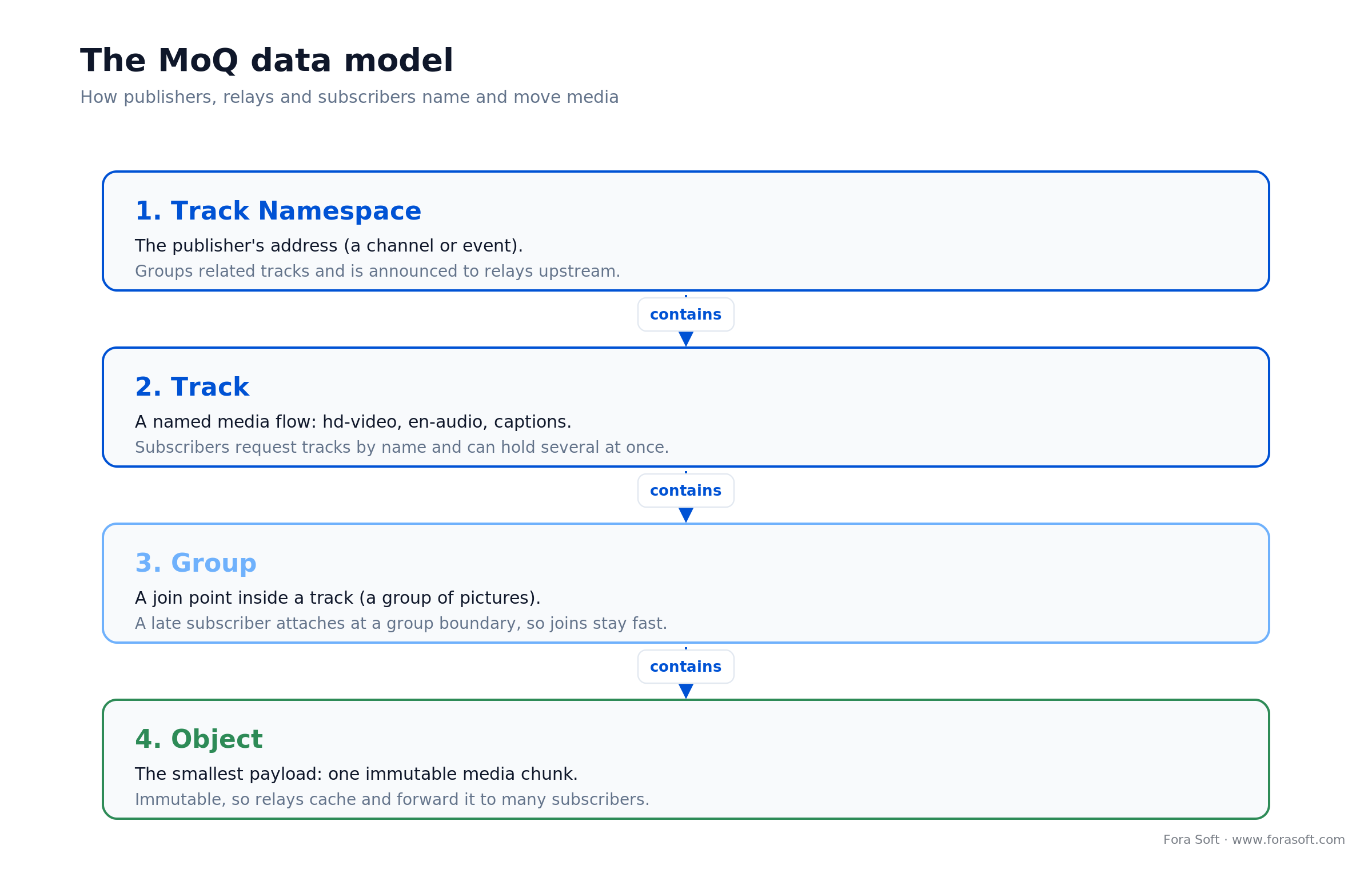
Figure 1. The MoQ naming hierarchy. Publishers announce a namespace; subscribers request tracks by name; groups are join points; objects are the immutable, cacheable payloads relays forward.
Reach for the pub/sub model when: you need one stream fanned out to many, with clients selecting tracks (languages, quality, data) independently, and you want relays to cache instead of every viewer hitting the origin.
Reference architecture: publishers, relays, subscribers
A MoQ deployment looks like a CDN drawn for real-time media. A publisher (encoder plus MoQ publisher) sends Objects into an origin relay. The origin fans out to regional edge relays. Subscribers — browsers or native apps — attach to the nearest relay over WebTransport. No viewer holds a connection to the origin; the relay fabric handles fan-out and short-term caching.
The same fabric serves recent on-demand from the same buffer. There is no separate HLS packaging step and no second delivery path: live and catch-up look identical to the subscriber. That single-pipeline property is the operational prize, and also why the unsolved pieces (ad insertion, DRM) matter so much — they have to work inside this one path, not bolted on beside it.

Figure 2. MoQ reference architecture. One publisher, a relay fabric that fans out and caches, and subscribers on the edge. Live and on-demand share the protocol and the path.
MoQ vs WHIP/WHEP vs LL-HLS vs HESP
Here is the honest positioning. MoQ is not the only sub-second option, and in 2026 it is the least mature of them. The value is the unified pipeline, not a latency record.
| Protocol | Latency | Scale | 2026 status | When it fits |
|---|---|---|---|---|
| RTMP → HLS | 15–30 s | Unlimited (CDN) | Legacy, fading | Passive VOD, legacy CTV |
| LL-HLS / LL-DASH | 2–6 s | Unlimited (CDN) | Mature, OTT default | Mass premium OTT today |
| WHIP/WHEP | 200–500 ms | Large, via SFU mesh | WHIP is RFC 9725; WHEP late draft | Ship sub-second in 2026 |
| HESP | 0.5–2 s | Unlimited | Vendor-led (HESP Alliance) | Low latency, single-vendor OK |
| MoQ | Sub-second, plus on-demand | CDN-grade relays | Multi-vendor demos 2026; production 2027 | One pipeline for live + VOD |
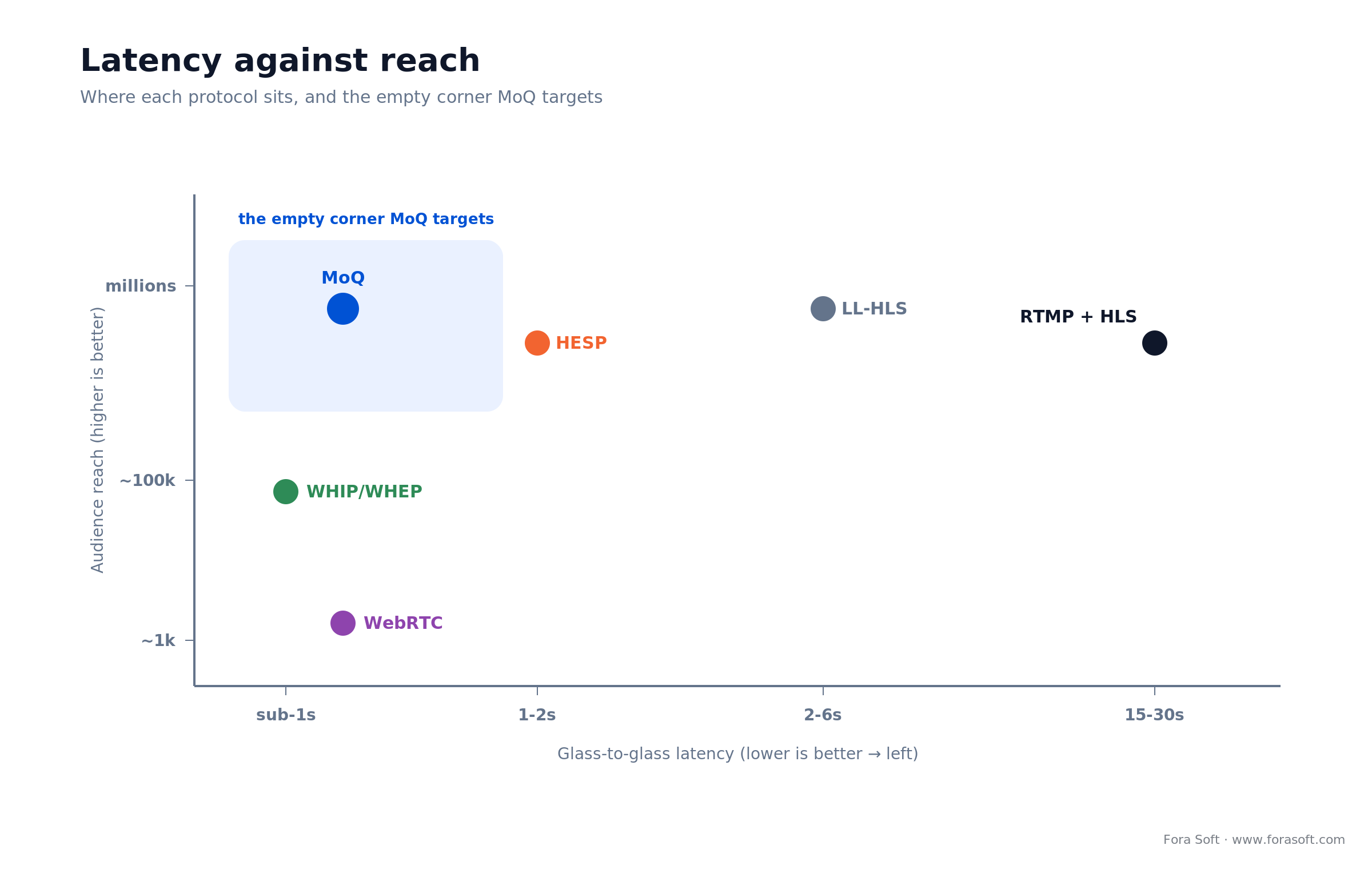
Figure 3. Latency against reach. WebRTC and WHIP/WHEP own sub-second at moderate scale; HLS owns scale at higher latency; MoQ aims for the empty corner — sub-second at CDN scale.
Reach for WHIP/WHEP today (2026) when: sub-second is mandatory and you have to ship this year. WHIP is finalised as RFC 9725 with production-ready vendors. See our WHIP/WHEP guide.
Reach for LL-HLS today when: 2–6 s is fine, the audience is in the millions, and CDN unit cost is the thing you optimise. It is the 2026 default for premium OTT.
Reach for MoQ in 2026 only when: you can pilot, absorb beta-grade tooling, and you want early-mover positioning on the 2027 protocol before your competitors learn it.
Reach for MoQ in 2027 when: production deployments mature, ad insertion and DRM stabilise, and relay tooling reaches price parity with HLS. That is most operators’ sweet spot.
MoQ vs WebRTC: when each one wins
Short answer: WebRTC wins conversations, MoQ wins broadcasts. They overlap on latency but target different shapes of traffic, and the smart deployments in 2026 use both.
WebRTC is built for two-way, low-participant interactivity where every millisecond of round-trip counts: video calls, telehealth consults, live auctions, remote drone control, interactive betting. Its SFU architecture is superb at 1:1 and 1:few, and it gets progressively more expensive and complex as you push it toward one-to-many at broadcast scale.
MoQ is built for one-to-many sub-second distribution: concerts, sports, large events, financial data feeds where a million viewers need the same stream fast, but full conversational interactivity is not the point. The relay-and-cache model scales cleaner than an SFU mesh for that job.
The pragmatic pattern is what nanocosmos does in production: WebRTC for browser-based ingest, MoQ for large-scale delivery. If you run a video-conferencing product, MoQ is not replacing your calls. If you run a broadcast product, MoQ is the piece you are watching. Either way, the WebRTC work you invest in now carries forward — the operational discipline of running a sub-second SLA is identical.
Production status across 11 vendors at NAB Show 2026
NAB Show 2026 (Las Vegas, April) was the moment MoQ stopped being a paper protocol. Eleven vendors demonstrated interoperable implementations, with multi-vendor publisher–relay–subscriber chains working across the show floor: Ant Media, AWS, Bitmovin, Broadpeak, CacheFly, Cloudflare, Nomad Media, Norsk, Oracle, Red5 and Synamedia.
Cloudflare launched the first MoQ relay network, running on every Cloudflare server across 330+ cities. At NAB, a Bitmovin encoder published into that relay fabric and played back sub-second in Bitmovin Player Web X for viewers worldwide. This is the closest thing to a turn-key MoQ path today, though the SLA tooling is not yet at HLS parity.
Oracle Video @ Edge ran a multi-partner demo: Broadpeak packaging, Oracle’s edge on OCI, and Bitmovin playback, reporting lower latency than traditional DASH. The point of the demo was interoperability — independent systems agreeing on MoQT with no bilateral setup.
nanocosmos remains the production reference. It calls itself the first vendor to bring MoQ into production, launching on the nanoStream platform at IBC 2025; after NAB, trade coverage put its live MoQ CDN usage in the low hundreds of thousands of concurrent users. Real, but not yet OTT-broadcast scale.
AWS demoed without a generally available service — a roadmap signal that Elemental is committing to MoQ. Open source centres on the moq-dev/moq reference implementation (Rust core plus a web/TypeScript stack, published at moq.dev), the Eyevinn toolkit, and in-progress FFmpeg patches. All pilot-grade today, production-grade the target for 2027.
Browser support reality: WebTransport is Baseline
The browser story changed in March 2026. When Safari 26.4 shipped WebTransport, the API became Baseline — it works in every current Chrome, Edge, Firefox and Safari with no polyfill. That removes the biggest “can browsers even do this?” objection MoQ faced.
The version reality for teams that support older clients: WebTransport shipped in Chrome and Edge 97 (January 2022), Firefox 114 (June 2023) and finally Safari 26.4 and iOS 26.4 (March 2026). HTTP/3, which WebTransport needs on the server, is above 92% reach.
The catch. Baseline WebTransport is the plumbing, not a player. There is still no native MoQ stack in any browser: playback rides JavaScript libraries and custom players, and cross-vendor interop is early rather than routine.
Smart TV and CTV remain the long tail. Connected-TV browsers vary widely; older Roku and Fire TV boxes generally do not do WebTransport in 2026, while newer Tizen and webOS panels do. Plan an LL-HLS fallback for the CTV tail no matter what.
Mini-case: sub-second at scale before MoQ existed
The situation. Worldcast Live wanted HD concerts streamed to thousands of paying viewers at a latency low enough for two-way performer interaction — a use case MoQ is being designed for, years before MoQ was demoable.
The build. We engineered a custom WebRTC and Kurento architecture with five-channel audio and dynamic quality adaptation for weak connections. Full-duplex two-way streaming let performers in different cities play together in real time, and a white-label multi-venue plugin synced the same stream across many sites at once.
The result. Glass-to-glass latency of 0.4–0.5 s at 10,000 concurrent viewers, in HD, with monetisation via pay-per-view and donations. That is the exact envelope MoQ promises to make routine. The reason we read the MoQ drafts so closely is that we have paid the “stitch it together yourself” tax and know precisely which parts a single protocol would remove. Want a similar sub-second assessment of your stack? Grab 30 minutes.
The monetisation gap: ad insertion, DRM, blackouts
This is the section that decides whether MoQ is a 2026 or a 2027 project for you. The media path works. The money path does not yet, at least not across vendors. We say this from the ad-insertion side specifically: we built the custom Wowza SCTE-35 server-side ad insertion behind Mangomolo’s OTT platform and the server-guided ad insertion in StreamLayer, so we know what “production ad insertion” actually demands.
1. Server-guided ad insertion (SCTE-35). Demoed at MoQ interims and NAB, but not yet a multi-vendor interoperable spec. Until SGAI over MoQ is boring and standard, an ad-funded OTT service cannot fully move.
2. DRM. Premium content needs Widevine, PlayReady or FairPlay. Apple FairPlay in particular is tied to HLS-native packaging that has no clean MoQ path yet, so premium iOS content stays HLS for now.
3. Regional blackouts. Sports rights are territorial. The model is marker-plus-relay-side enforcement, and it needs spec finalisation and multi-vendor testing before a rights holder will trust it.
4. Standardised telemetry. HLS and DASH have years of QoE analytics tooling. MoQ’s equivalent is still being prototyped, which matters the moment you owe an SLA report.
Need ad insertion or DRM to work over a new protocol?
We’ve shipped SCTE-35 SSAI and DRM on production OTT platforms. Tell us your monetisation stack and we’ll map what does and doesn’t carry to MoQ.
Migration playbook from RTMP/HLS
Phase 0 (now, 2026): pilot. 6–8 weeks. Stand up a MoQ relay on Cloudflare plus Bitmovin, or self-host moq-dev/moq. Push one channel through MoQ in parallel with your live RTMP/HLS. Measure latency, quality and vendor maturity, and build the internal muscle.
Phase 1 (early 2027): premium tier. Move one premium surface where sub-second earns money — interactive sports, live commerce, telehealth — onto MoQ. Keep RTMP/HLS for the cost-sensitive long tail.
Phase 2 (mid-2027): unified pipeline. Consolidate live and on-demand on MoQ, retire the separate HLS packaging step, and let CDN bills consolidate. This is the phase that pays for itself, and it depends on the monetisation tooling having stabilised.
Phase 3 (late 2027 / 2028): cutover. Retire RTMP. Keep HLS only for legacy CTV. Run a multi-codec ladder (AV1 + HEVC + H.264) inside MoQ tracks — see our AV1 in production guide. The multi-region relay design carries over from how you already scale streaming to a million viewers.
What a 2026 MoQ pilot actually costs
A single-channel MoQ pilot is an engineering exercise, not a platform rebuild. Here is the arithmetic we use when we scope one, shown so you can adjust it to your own rates.
Engineering. A pilot needs roughly one senior streaming engineer for 6–8 weeks, part-time support from a second. Call it about 8 person-weeks. At a typical blended rate that lands near the low five figures; with our Agent Engineering workflow we scope it tighter than a classic staff-augmentation quote, and if a number ever looks shaky we would rather not print it than pad it.
Infrastructure. A Cloudflare-plus-Bitmovin path keeps relay cost near your existing egress; a self-hosted moq-dev/moq relay on a mid-tier cloud instance is on the order of low hundreds of dollars for the pilot window. Encoding you already own.
The worked total. 8 person-weeks of engineering + a few hundred dollars of infrastructure + the encoder you already run = a single-channel pilot that produces a real number: measured glass-to-glass latency, a vendor-maturity verdict, and a go/no-go on your 2027 roadmap. The output is a decision, not a demo — which is the only thing worth buying at this stage of a draft protocol.
Reach for a pilot, not a migration, when: the protocol you depend on is still a moving draft. Spend 8 weeks buying certainty; do not spend six months re-platforming onto a spec that can still change on the wire.
When to wait, when to pilot, when to ship
Wait if you serve mass-market OTT on LL-HLS at 2–5 s, your audience does not need sub-second, and your engineers are committed elsewhere. MoQ in 2027–2028 will be cheaper and lower-risk than MoQ today.
Pilot if you have an interactive use case (sports betting, live commerce, telehealth), you want early protocol expertise, and you can spare 6–8 weeks in 2026. A pilot teaches you the protocol shape and vendor maturity without a production commitment.
Ship now if you run a niche premium tier (live betting, financial trading, a telehealth specialty), you can absorb beta-grade tooling, and you have a direct line to one of the 11 vendors. Production MoQ in 2026 is real, as nanocosmos shows, but you are buying operational complexity along with the latency.
A decision framework: pick MoQ in five questions
Q1. What is your latency requirement? Sub-second mandatory: WHIP/WHEP today, MoQ in 2027. 2–6 s fine: LL-HLS today, MoQ when convenient. 15 s+ fine: stay on RTMP/HLS until forced.
Q2. What is your audience shape? Niche premium with a sub-second need: pilot now. Mass-market OTT: wait. Mixed: LL-HLS for the mass plus WHIP/WHEP for the premium today, then consolidate on MoQ in 2027.
Q3. Do you have pilot bandwidth? A free 6–8-week window: pilot. None: wait for production-grade tooling and let someone else debug the drafts.
Q4. What are your monetisation needs? SCTE-35 ad insertion or DRM required today: wait for MoQ tooling to mature. Free or subscription tier: a pilot is feasible now.
Q5. What is your strategic appetite? Want to be first: pilot 2026, ship 2027, own the early-mover story. Risk-averse: wait for 2027–2028 production-grade. Either answer is defensible; pretending the draft is finished is not.
Pitfalls to avoid
1. Migrating production to MoQ in 2026. Tooling is not production-grade at OTT scale yet. Keep production on LL-HLS and pilot MoQ beside it.
2. Ignoring the CTV tail. Smart-TV browsers do not all speak WebTransport. Always keep an LL-HLS fallback for connected-TV.
3. Locking to one vendor’s extensions. The whole point of MoQT is no bilateral negotiation. Build for multi-vendor relays; do not adopt a proprietary fork of the draft.
4. Skipping the WHIP/WHEP step. Plenty of operators benefit from WHIP/WHEP now, even if they land on MoQ in 2027. The sub-second operational learning carries straight across; do not leapfrog it.
5. Underestimating the monetisation gap. Ad insertion and DRM are the production blockers, not latency. A pilot is fine without them; an ad-funded OTT launch is not.
KPIs to measure on a MoQ pilot
Quality KPIs. Glass-to-glass latency p50/p95 (target sub-500 ms / sub-1 s). First-frame time on join (target sub-800 ms). Stall rate (target under 0.5%). Whether the multi-codec ladder holds inside MoQ tracks.
Business KPIs. Cost per delivered minute against your HLS baseline. Engagement uplift on the sub-second tier. Conversion on the premium surface you piloted.
Reliability KPIs. Multi-vendor interop success rate (target 99%+). Subscriber join success (target 99.5%+). Recovery behaviour on a forced 4G-to-Wi-Fi network switch, where QUIC connection migration should shine.

Figure 4. MoQ readiness timeline. First interop in 2023, first production in 2025, multi-vendor interop and Baseline browsers in 2026, and the production window opening in 2027.
FAQ
What is Media over QUIC (MoQ)?
Media over QUIC (MoQ) is an IETF open standard for delivering sub-second live and on-demand video over a single publish/subscribe protocol. The wire protocol, MoQT, runs on QUIC and WebTransport and fans out through relays that cache immutable media objects, so one upstream copy can serve many viewers.
Is MoQ an IETF RFC yet?
Not yet. As of August 2026 the transport spec is at draft-ietf-moq-transport-19 (July 2026), Standards Track, with an RFC expected in 2027. Vendors are interoperating against late-stage drafts, which is why wire behaviour can still shift.
What is the difference between a track namespace and a track name in MoQ?
A Track Namespace is the publisher’s address, such as a channel or an event, and it groups related tracks. A Track is a single named media flow inside that namespace, like “hd-video” or “en-audio”. Subscribers request tracks by name, and can subscribe to several tracks (video, audio, captions, data) from the same namespace at once.
MoQ vs WHIP/WHEP: which should I ship in 2026?
Ship WHIP/WHEP in 2026 if you need sub-second today: WHIP is finalised as RFC 9725 and vendors are production-ready. Move to MoQ in 2027 when its DRM and ad insertion mature. The WHIP/WHEP investment carries forward because the sub-second operational discipline is identical.
Will MoQ replace HLS?
For premium sub-second tiers, probably yes over time. HLS will persist for legacy connected-TV and cost-sensitive long-tail delivery well into the 2030s. Expect the same gradual, multi-protocol coexistence that the RTMP-to-HLS transition took, not a sudden switch.
Does MoQ work on poor mobile networks?
QUIC handles a 4G-to-5G-to-Wi-Fi handoff gracefully through connection migration, one of its headline features, and recovers from loss better than TCP. Early results suggest MoQ over 4G outperforms RTMP/HLS over 4G; broad production data is still emerging.
Which browsers support the transport MoQ needs?
WebTransport became Baseline in March 2026 when Safari 26.4 shipped it, so current Chrome, Edge, Firefox and Safari all support it. Versions: Chrome 97+, Edge 98+, Firefox 114+, Safari 26.4+ and iOS 26.4+. There is still no native MoQ player; playback uses JavaScript libraries.
Are there open-source MoQ implementations?
Yes. The moq-dev/moq project (Rust core plus a web/TypeScript stack, at moq.dev) is the de facto reference, the Eyevinn toolkit is solid, and FFmpeg patches are in development. All permissively licensed and pilot-grade today, with production-grade the goal for 2027.
Is MoQ better than WebRTC for live video?
For one-to-many broadcast at scale (thousands of concurrent viewers), MoQ’s relay fan-out is architecturally cleaner than a WebRTC SFU mesh. For true two-way interactivity (calls, auctions, telehealth), WebRTC is still better. They coexist; MoQ is not replacing WebRTC for conversations.
What to Read Next
Streaming
WHIP/WHEP Replace RTMP
The sub-second protocol you can actually ship in 2026.
Codec
AV1 in Production
Pair MoQ delivery with AV1 for the bandwidth savings.
Scale
Scale to 1M Viewers
The multi-region relay topology that MoQ reuses.
Sports
Interactive Sports Streaming
A prime sub-second, MoQ-pilot use case.
Architecture
Build vs Buy Video SDK
How to make the vendor call for streaming infra.
Ready for the 2027 streaming protocol?
Media over QUIC is real. NAB Show 2026 put 11 vendors on one interoperable transport, Cloudflare runs a relay network across 330+ cities, nanocosmos has been in production since IBC 2025, and WebTransport is Baseline in every current browser. The promise — sub-second and on-demand on one publish/subscribe pipeline — is close enough to plan around.
For most operators, 2027 is the production year and 2026 is the pilot year. If you need sub-second now, ship WHIP/WHEP and migrate later. The move that pays off is claiming the protocol expertise early, so your 2027 rollout is a configuration change instead of a re-platform. That is the kind of pilot we scope through our video and audio streaming development team.
Want a 6–8-week MoQ pilot scoped for your stack?
Send us your existing topology and target tier. We’ll return an architecture, a vendor pick and an 8-week pilot plan in 48 hours, free.