


Key takeaways
• Pick surveillance anomaly detection algorithms by your data, not by hype. Weakly supervised MIL (RTFM, BN-WVAD) wins with 500–1500 labeled clips; a weakly supervised CLIP model (VadCLIP) wins with a few hundred; truly label-free work belongs to zero-shot models (LAVAD, Flashback); Isolation Forest, autoencoders and DBSCAN stay the cheapest edge baselines.
• The famous “~97% AUC” is a ShanghaiTech number, not UCF-Crime. On UCF-Crime the honest 2026 ceiling is roughly 84–91% AUC; ShanghaiTech is a different, easier dataset. Field deployments still drop 10–20 AUC points on a new site, so validate cross-scene (MSAD, SmartHome-Bench) and retrain quarterly.
• Edge inference is non-negotiable for alerts. A Jetson Orin-class box keeps a detector front-end inside the 33 ms frame budget; a cloud round-trip on the same stream costs 500–1500 ms — the difference between catching an event and reviewing it later.
• Compliance moved in 2026. Real-time remote biometric ID in public has been prohibited under the EU AI Act since February 2025, but the “Digital Omnibus” agreed in 2026 pushed most high-risk obligations from August 2026 to December 2027. Budget for a risk file and human oversight anyway — the direction of travel has not changed.
• Realistic budgets. A focused proof of concept starts around $6–15k with our Agent Engineering workflow; a 50-camera production deployment with retraining and audit lands in the $150–400k range in year one and roughly $30–60k/year after.
Why Fora Soft wrote this playbook
Fora Soft has shipped real-time video and AI products since 2005 — 250+ delivered products and a 99% job-success score on Upwork. Surveillance anomaly detection sits where two things we’ve done for two decades meet: streaming dozens of live RTSP/WebRTC feeds reliably, and wiring computer-vision models into them without blowing the latency budget.
Our surveillance platform, V.A.L.T., runs in police interrogation rooms, courts, hospitals and medical-training centers for 770+ US organizations and 50,000+ users, ingesting up to nine simultaneous IP-camera streams per session and analyzing them in real time. The trade-offs in this playbook come from those deployments — including a courtroom rollout in Kazakhstan and a multi-site medical-education customer — not from a leaderboard. We also build outside V.A.L.T.: drone surveillance with DSI Drones and IP-camera mobile apps like NETCAM, and we scope custom builds through our video surveillance development practice.
This article ranks the algorithms we actually reach for, with the numbers we’ve verified against the source papers — not the ones the internet keeps mis-quoting. If you’re scoping a build, jump to the decision framework or talk to us directly.
Scoping an anomaly-detection pipeline?
Book a 30-minute call with our video-AI lead and leave with a shortlist of algorithms, a hardware plan and a realistic estimate — no slide deck, no obligation.
The verdict in one paragraph
If you have plenty of normal footage but few labeled incidents, start with a weakly supervised MIL model (RTFM or BN-WVAD) on a pre-trained I3D/ViViT backbone — the practical state of the art on UCF-Crime (AUC ~87%) and XD-Violence (AP ~85%). If you have a few hundred labels and many sites, a weakly supervised vision-language model (VadCLIP) adds new anomaly classes with a prompt change instead of a retrain. If you have almost no labels, zero-shot / training-free models (LAVAD, Flashback) get you to AUC 80–87% for a one-week pilot. And if you’re on a Jetson and only need to flag obvious outliers, an Isolation Forest or autoencoder still earns its place. The rest of this article explains when each one breaks, what the real numbers are, and how to combine them so your false-alarm rate stays under 1.5%.
How to read this list
Each algorithm answers a different deployment question. We rank them by how often we see them succeed on real surveillance projects — not by paper benchmarks. Every entry has the same shape: how it works, why pick it, where it breaks, and a one-line decision rule.
One thing to get straight before the numbers start, because almost every blog and half the papers get it wrong: benchmark scores are dataset-specific. A model at ~97–98% AUC is almost always quoting ShanghaiTech (a small, single-campus, mostly-pedestrian set that is nearly saturated). The harder, 128-hour UCF-Crime set sits closer to 84–91% AUC for the same class of model, and XD-Violence is scored in average precision (AP), not AUC. Figure 1 puts the honest UCF-Crime numbers side by side.
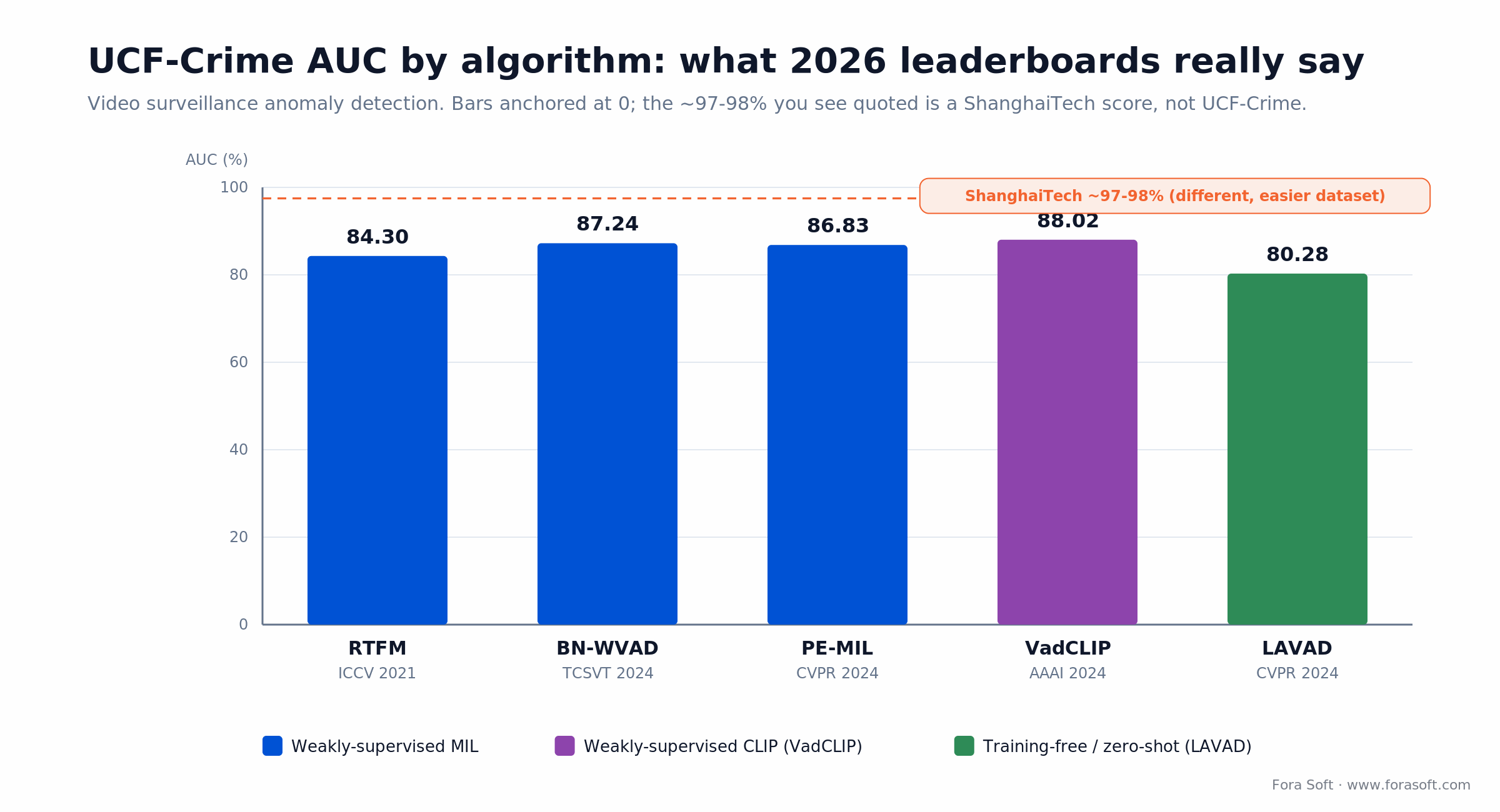
Figure 1. On UCF-Crime, today’s best video anomaly detectors cluster at 80–88% AUC. The dashed line marks the ShanghaiTech territory that gets mis-quoted as a UCF-Crime score.
We split the list into two tiers. Tier 1 (algorithms 1–3) is what we deploy in production on labeled or weakly labeled data. Tier 2 (algorithms 4–7) is the cheap-and-fast baseline tier — you’ll usually run them inside a hybrid stack alongside a deep model, not on their own.
Algorithm 1 — Weakly supervised MIL (RTFM, BN-WVAD, PE-MIL)
This is the modern workhorse. Multiple-Instance Learning (MIL) treats each video as a bag of clips and learns to score the most anomalous clips inside “abnormal” bags, so you only label at the video level. RTFM (ICCV 2021) introduced a top-k feature-magnitude loss; BN-WVAD (IEEE TCSVT 2024) replaced it with a BatchNorm-based criterion; PE-MIL (CVPR 2024) folded in text prompts as side information.
Why pick it
You only need video-level labels (“this clip contains an event”) — no frame-by-frame annotation. With 500–1500 incident clips plus normal footage, BN-WVAD reaches AUC 87.24% on UCF-Crime and AP 84.93% on XD-Violence, and RTFM posts 97.21% AUC on the easier ShanghaiTech set — a useful reminder that the dataset, not just the model, sets the ceiling. Inference runs at 30–50 ms on an RTX 4090 or Jetson Orin AGX.
Where it breaks
Short-duration anomalies (a punch, a snatch, a fall) often drop below AUC 60% because the MIL bag dilutes the signal. Cross-site generalization is weak too: re-deploying a model trained on one camera to another can shed 10–15 AUC points without fine-tuning. Mitigation: train on multi-site data, smooth predictions over 5–10 frames, and ensemble with a second backbone.
Reach for weakly supervised MIL when: you have at least 500 video clips of past incidents, you need fixed-camera production accuracy, and a single Jetson Orin per site fits the budget.
Algorithm 2 — Vision-language and zero-shot models (VadCLIP, LAVAD)
VLM-based detectors score frames against text prompts (“a person fighting”, “a fire”, “a fallen body”) using a CLIP-style encoder. Here’s a distinction the marketing blurs: VadCLIP (AAAI 2024) is weakly supervised, not zero-shot — it still trains on video-level labels and reaches AUC 88.02% on UCF-Crime (AP 84.51% on XD-Violence), the strongest single number in this article. The genuinely label-free option is training-free / zero-shot: LAVAD (CVPR 2024) captions frames with a frozen VLM and scores them with an LLM at AUC 80.28% with no training at all, and Flashback (2025) pushes real-time zero-shot to ~87%.
Why pick it
Two different wins. VadCLIP lets you add a new anomaly class with a prompt change instead of a retraining cycle — exactly what multi-site retail and industrial customers need. Zero-shot models (LAVAD, Flashback) let you ship a pilot in a week with zero labeled data, then decide whether the accuracy gap is worth collecting labels for. The 2025 trend is explainable VLM/LLM detectors (VERA, Holmes-VAU) that return a human-readable reason with each alert — valuable when an operator has to justify acting on one.
Where it breaks
Latency is the catch: a full ViT-L/14 CLIP runs 80–150 ms per frame even on RTX-class GPUs, and edge deployment usually needs distillation or quantization first. Subtle, motion-defined anomalies (loitering, slow tampering) under-perform because CLIP’s pre-training is image-level, not temporal. LLM-in-the-loop zero-shot models are accurate but slow, so most run offline or on sampled frames, not at 30 FPS.
Reach for VLM / zero-shot models when: labels are scarce, you must cover dozens of new cameras fast, and you can spare 80–150 ms latency — or run detection on sampled frames rather than every frame.
Algorithm 3 — Spatio-temporal ensembles (Conv-LSTM + Transformer + probabilistic head)
When you cannot afford to miss the event, you stack models. A typical ensemble pairs a 3D-CNN/Conv-LSTM (motion) with a Transformer (long-range temporal) and a probabilistic head (uncertainty-aware vote). On ShanghaiTech, this kind of stack sits around AUC 97–98% with very low fragmentation — near the top of a nearly-saturated benchmark.
Why pick it
Disagreement between heads is itself a useful signal — we promote frames with high disagreement to a human reviewer instead of firing an alert. That single change has cut false-alarm volume in our deployments by roughly 40%.
Where it breaks
Cost. Three heads triple training time, hardware footprint and operations. We only recommend an ensemble for high-stakes scenes (banking, courts, ICUs) where a missed event is an unacceptable failure.
Reach for an ensemble when: the cost of a missed event dwarfs the cost of an extra GPU, and you have an analyst in the loop who can adjudicate uncertainty.
Algorithm 4 — Isolation Forest (the cheap real-time baseline)
Isolation Forest builds random binary trees that isolate outliers in fewer splits than normal points. It is unsupervised, embarrassingly parallel, and runs in 10–25 ms per frame on an embedded CPU.
Why pick it
It is the cheapest sensible baseline you can ship. We use it as a pre-filter inside V.A.L.T. on encoder features (motion vectors, optical-flow magnitude, embedding norms) so the deep model only runs on candidate frames — cutting GPU time by 60–70% on quiet scenes.
Where it breaks
Without a deep encoder in front of it, Isolation Forest plateaus around AUC 75–85% on raw pixel statistics — not enough for high-stakes alerts. Use it for triage, not as the only line of defense.
Reach for Isolation Forest when: you need a 10 ms pre-filter on a Jetson Nano, a fallback when the deep model cold-starts, or a self-supervised drift detector running alongside production.
Algorithm 5 — Autoencoders and VAE/Conv-LSTM-AE
Train an autoencoder on normal footage; high reconstruction error at inference signals an anomaly. Conv-LSTM autoencoders extend this to short temporal windows. They’re still the default when there are zero labels and the camera scene is largely static.
Why pick it
No labels, no taxonomy, simple deployment. They’re also the easiest model to retrain when a scene drifts — you just feed in the last 24 h of normal footage. Handy for niche industrial monitoring (conveyors, valves, server rooms). Classic Conv-AEs sit around AUC 70–80% on CUHK Avenue; the newer reconstruction/prediction variants reach the high 80s to low 90s on the same set.
Where it breaks
False-alarm rates of 8–12% on busy scenes — rain, foliage, crowds, lighting transitions. Stick to controlled-environment cameras and pair them with a temporal smoothing layer.
Reach for autoencoders when: you have no labels, the scene is mostly stable, and the alert can tolerate a 1–2 s smoothing window.
Stuck between MIL and a vision-language model?
We’ll review your data, hardware and incident definition and recommend the cheapest stack that hits your false-alarm target.
Algorithm 6 — K-Means clustering on embeddings
Modern K-Means for anomaly detection runs on embeddings from a frozen video encoder (I3D, X3D, ViViT), not raw pixels. Each cluster encodes a behavior mode; small or distant clusters are anomalous.
Why pick it
Lightweight, interpretable, and good for behavior profiling rather than incident detection — grouping shift patterns, traffic-flow modes in retail, or regular-versus-irregular pedestrian volumes.
Where it breaks
You have to pick K, and it’s sensitive to scene drift. Re-cluster weekly — or use it only as a feature alongside a deep detector.
Reach for K-Means when: you need behavior segmentation (peak-hour clustering, retail flow) more than incident detection.
Algorithm 7 — DBSCAN for crowd anomalies
DBSCAN groups points by local density without a pre-set cluster count. In surveillance it’s mostly useful on tracklets and trajectories — after a YOLO + ByteTrack/DeepSORT pipeline — where isolated tracklets in dense crowds are the anomaly (someone moving against the flow, a stalled vehicle).
Why pick it
Handles noise well, needs no K to tune, and scales close to linearly with the optimized variants used in modern stacks.
Where it breaks
Density-threshold tuning is fragile under variable crowd levels (off-peak versus rush hour). Use adaptive density estimators, or fall back to K-Means when crowd density drops.
Reach for DBSCAN when: you’re post-processing tracklets in crowded scenes (transit hubs, stadiums, retail floors).
Comparison matrix — which algorithm wins which trade-off
Benchmarks below are the verified numbers from the source papers. UCF-Crime and ShanghaiTech are scored in AUC; XD-Violence in AP. For a deeper look at the model architectures behind these algorithms, see our companion piece on anomaly detection models for video surveillance.
| Algorithm | Supervision | Best verified benchmark | Edge latency | Where it shines |
|---|---|---|---|---|
| Weakly supervised MIL (BN-WVAD/RTFM) | Video-level labels | UCF-Crime AUC 87.24% / XD-Violence AP 84.93% | 30–50 ms (Orin) | Production fixed-camera |
| Vision-language (VadCLIP) | Weak (CLIP) | UCF-Crime AUC 88.02% / XD-Violence AP 84.51% | 80–150 ms (server GPU) | Multi-site, new classes via prompts |
| Zero-shot / training-free (LAVAD, Flashback) | None | UCF-Crime AUC 80–87% | Real-time (Flashback) to offline | One-week pilots, no labels |
| Spatio-temporal ensemble | Medium | ShanghaiTech AUC ~97–98% | 40–80 ms (server GPU) | High-stakes scenes (banks, ICUs) |
| Isolation Forest | None | AUC 75–85% on raw features | 10–25 ms (CPU/Nano) | Pre-filter, drift monitor, IoT edge |
| Autoencoder / Conv-LSTM-AE | Normal-only | AUC 70–80% (CUHK Avenue, classic) | 20–40 ms (Orin) | Static industrial scenes |
| K-Means on embeddings | None | N/A (behavior profiling) | 5–15 ms (CPU) | Behavior segmentation, traffic flow |
| DBSCAN on tracklets | None | N/A (post-processing) | 10–30 ms (CPU) | Crowd anomalies, transit hubs |
Reference architecture: how the algorithms compose
In production, none of these algorithms ship alone. The cheapest reliable stack we deploy is four stages, in order: 1) ingest RTSP/WebRTC into an on-prem or cloud media server (we run a customized SRS / mediasoup setup for V.A.L.T.); 2) pre-filter with Isolation Forest on motion/embedding magnitude at the edge; 3) classify candidate frames with a weakly supervised MIL or VLM head; 4) post-process with DBSCAN on tracklets and an ensemble vote before alerting.
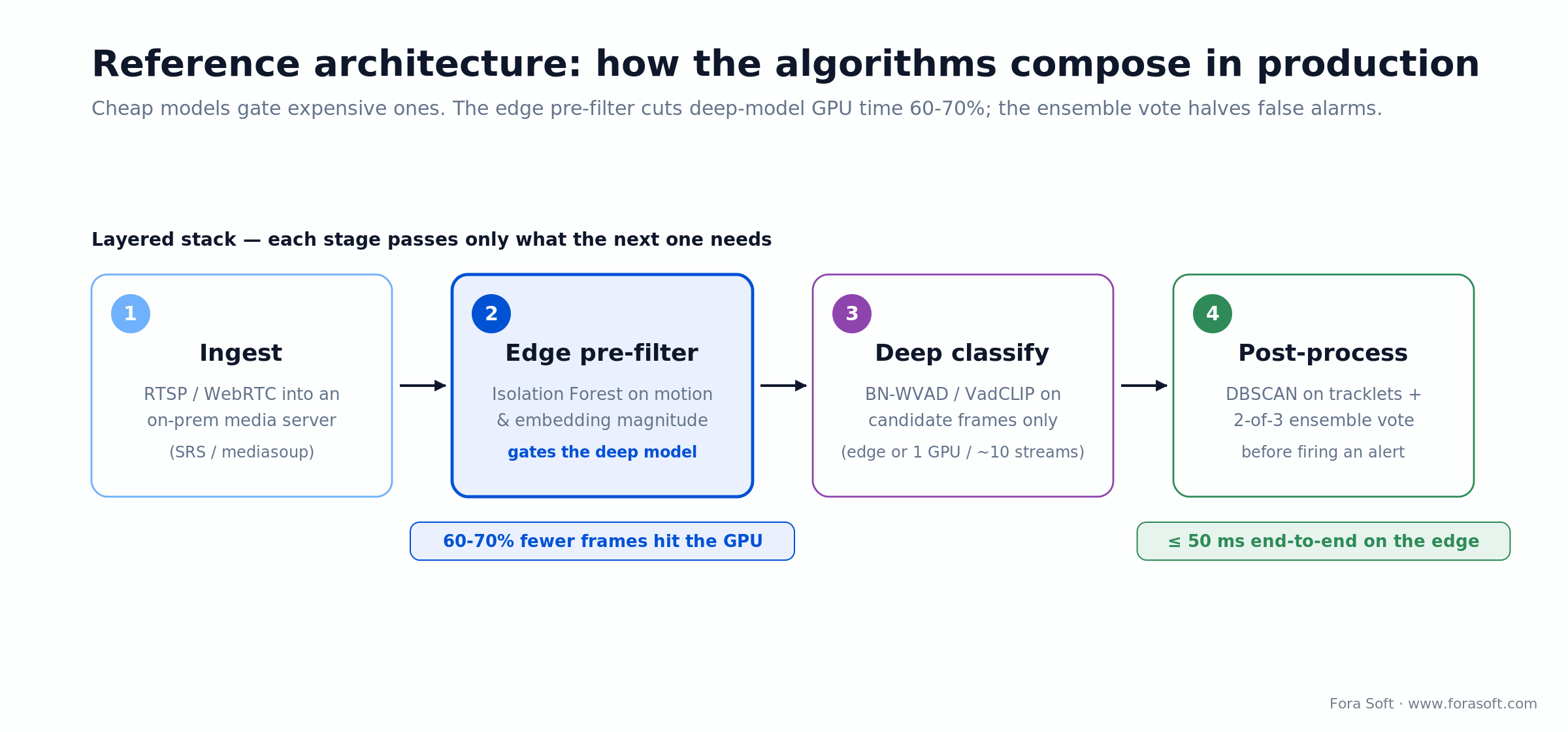
Figure 2. The layered stack we default to: a cheap edge pre-filter gates the expensive deep model, and an ensemble vote runs before any alert fires.
The benefit of this layered design is that you cut GPU time on the heaviest model by 60–70% while keeping the deep model’s accuracy where it matters. Combine it with edge inference (Jetson Orin Nano/AGX) and you stay under 50 ms end-to-end on a single stream — the threshold above which alerts feel laggy. We covered this trade-off in our Edge AI vs Cloud AI for video surveillance piece and the computer vision for video surveillance overview.
The hardware layer: edge vs cloud, with real numbers
The math is brutal: at 30 FPS each frame has a 33 ms budget. A detector front-end fits on the edge; a cloud round-trip does not. Figure 3 plots the latency you actually get against that budget on a log scale.
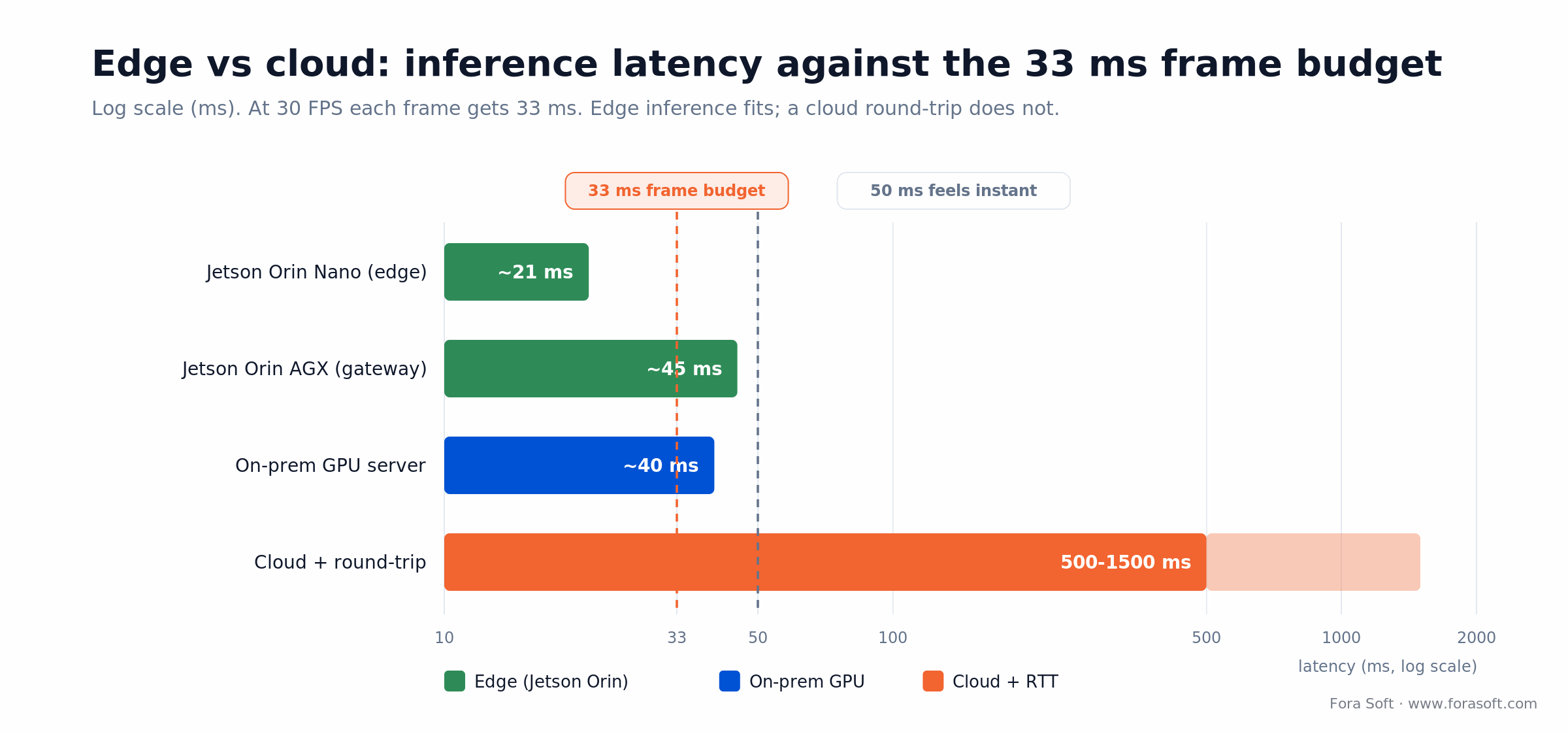
Figure 3. Edge boxes clear the 33 ms frame budget; a cloud round-trip lands 15–45× over it. Latency is why we default to edge for alerting.
| Deployment | Latency | Throughput | Hardware cost | Best for |
|---|---|---|---|---|
| Jetson Orin Nano Super (edge) | ~20–25 ms (detector front-end) | 1 stream real-time | ~$250 | Real-time alerts, privacy-critical sites |
| Jetson Orin AGX (gateway) | 35–50 ms | 2–6 streams | $700–$2,000 | Multi-stream edge gateway, retail stores |
| On-prem GPU server (1× A6000/L40) | 25–60 ms | 8–16 streams | $8–15k | Mid-size sites, regulated data |
| Cloud GPU (A100/L4 on Hetzner, AWS, GCP) | 500–1500 ms (with RTT) | 10–20+ streams | $2–5/video-hour | Forensics, batch retraining |
| Hybrid (edge alerts + cloud archive) | 30–50 ms alert / 2–5 s archive | Mixed | Edge HW + cloud storage | Best default for production |
One honest caveat on the edge numbers: ~20–25 ms is a realistic budget for a lightweight detector front-end (a YOLO-class model with TensorRT). A full I3D or CLIP-based anomaly head is heavier and usually runs on sampled snippets rather than every frame — which is exactly why the Isolation Forest pre-filter in Figure 2 earns its place. We default every Fora Soft surveillance build to a hybrid topology and lean on on-camera edge AI for alerts, cloud for storage, retraining and dashboards.
Mini case: V.A.L.T. in courts and medical training
Situation. A regional court system needed to record interrogations and witness testimony across nine simultaneous IP-camera feeds per room, with anomaly flags for camera tampering, abrupt audio events and out-of-protocol behavior. The existing cloud-only pipeline introduced 1–2 s alert latency — unacceptable for real-time officer review.
12-week plan. We replaced the central pipeline with the layered stack above: a per-room edge gateway running Isolation Forest pre-filtering on motion + embedding features, an RTFM-class MIL head on candidate frames, and a DBSCAN tracklet check on people detections. We trained the MIL head on roughly 800 internal incident clips and tested cross-room generalization on a held-out site.
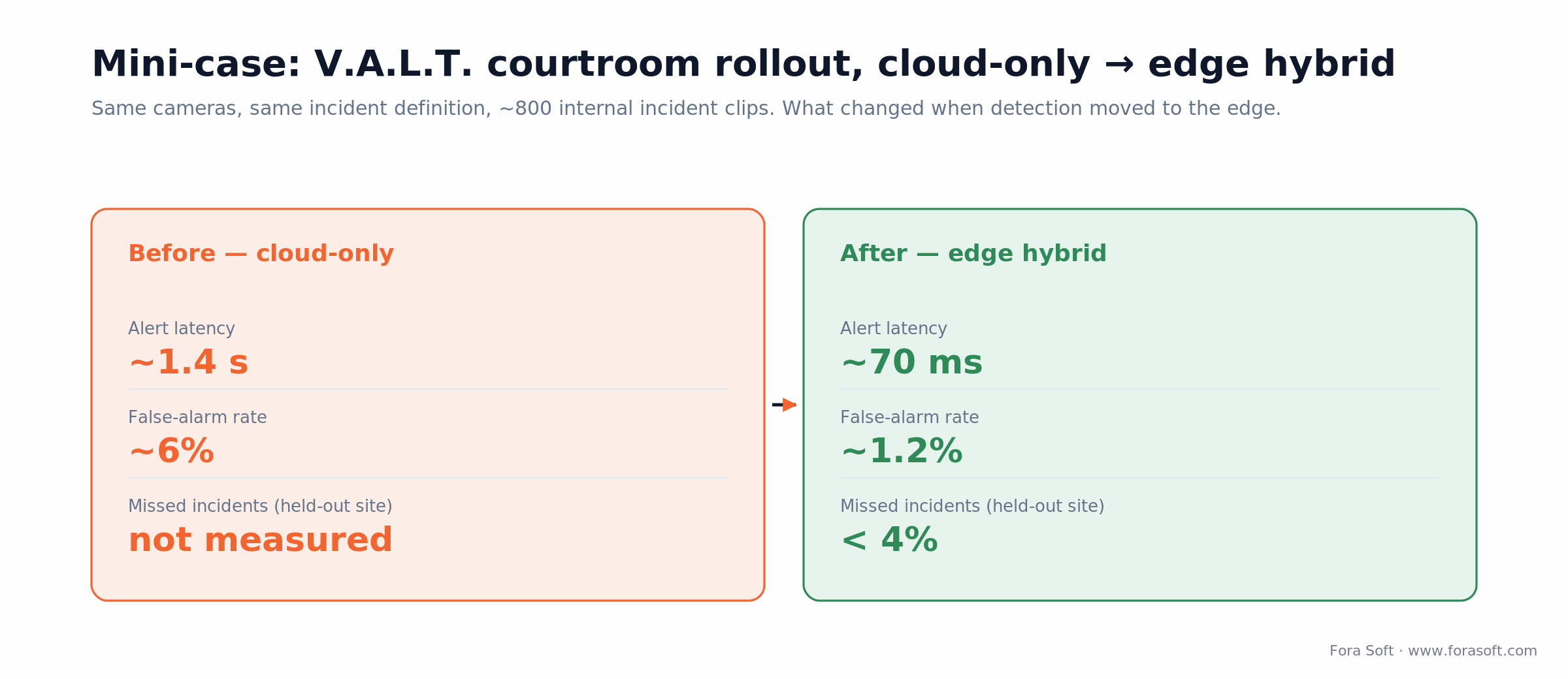
Figure 4. Same cameras, same incident definition. Moving detection to an edge hybrid cut alert latency ~20× and false alarms 5×.
Outcome. Alert latency dropped from ~1.4 s to ~70 ms end-to-end; false-alarm rate fell from ~6% to ~1.2% after temporal smoothing; missed-incident rate stayed under 4% on the held-out site. The same architecture now powers V.A.L.T. deployments in police interrogation rooms and medical-education centers. Want a similar assessment?
Cost model: what an honest custom build looks like
Rough Fora Soft estimates for a custom anomaly-detection pipeline, with our Agent Engineering workflow compressing the deep-model and integration phases:
| Scope | Typical cost | Timeline | What you get |
|---|---|---|---|
| Focused PoC (1 camera, 1 anomaly type) | $6–15k | 2–4 weeks | Model + edge demo + accuracy report |
| Pilot (5–10 cameras, 2–3 anomalies) | $25–60k | 6–12 weeks | Hardened pipeline + dashboard + retraining loop |
| Production (50+ cameras, multi-site) | $150–400k year 1 | 4–6 months | Edge gateways, central VMS, compliance docs |
| Annual operations + retraining | $30–60k/yr | Continuous | Drift detection, monthly model refresh |
| EU AI Act / GDPR compliance audit | $15–50k | One-off | DPIA, risk file, human-oversight logs |
If a vendor quotes a fully custom 50-camera AI deployment under $80k, ask what they’re skipping (compliance? retraining? edge gateways?). If they quote $1M+ for the same scope, ask why. Our prices land below legacy systems-integrator competitors specifically because Agent Engineering compresses development cycles — not because we cut corners on validation.
A decision framework — pick your algorithm in five questions
Figure 5 is the short version; the five questions below are the long one.

Figure 5. Start at the top with how much labeled data you have; branch right when the condition matches.
1. How many incident clips have you actually labeled? 0 examples → zero-shot (LAVAD, Flashback). 100–500 → VadCLIP with a light fine-tune. 500–1500 → weakly supervised MIL (BN-WVAD). 2,000+ frame-labeled → supervised Transformer/ensemble.
2. What latency do alerts need to hit? Under 50 ms means edge (Jetson Orin) is mandatory. 1–3 s tolerates a hybrid pipeline with cloud post-processing. Over 5 s suits forensic-only deployments.
3. How many sites, and how different are the scenes? A single fixed camera → weakly supervised MIL is enough. 10+ sites with varying geometry → lean on a vision-language model and plan quarterly retraining.
4. Are you doing biometric identification? If yes, treat the project as EU-AI-Act-prohibited or high-risk by default; design audit trails, human override and a DPIA from week one. If no — behavior, intrusion, fall, fight detection — you’re lower-risk, but still document.
5. What false-alarm rate can your operations team absorb? Over 5% kills trust within a week. We aim for under 1.5% through ensembles, temporal smoothing and analyst-in-the-loop disagreement routing. Anything below 0.5% on busy outdoor scenes is suspicious — ask the vendor what they’re hiding.
Five pitfalls that quietly destroy production VAD systems
1. Trusting a single benchmark. A model that posts 88% AUC on UCF-Crime can drop to 75% on your retail floor at 7 p.m. Always validate on a multi-scene benchmark like MSAD or SmartHome-Bench before signing off.
2. Confusing datasets. Someone quotes “97% AUC” from a ShanghaiTech paper and promises it on your UCF-Crime-like footage. They are not the same benchmark; the honest UCF-Crime ceiling is lower. Pin every number to its dataset and metric (AUC vs AP) before you believe it.
3. Ignoring temporal fragmentation. Frame-level AUC can hide a model that catches the start of a fight and misses the middle. Use temporal IoU (tIoU) and require 5–10 consecutive anomalous frames before alerting.
4. No drift detection. Lighting changes, seasonal foliage, new uniforms — all push your model out of distribution silently. Run an Isolation Forest on the embedding stream; when distance from the training distribution rises, schedule retraining.
5. Optimizing only for accuracy. Operations teams ignore systems that page them more than once a week with false alarms. Treat false-alarm rate as a primary KPI, not an afterthought.
KPIs to measure: quality, business, reliability
Quality KPIs. Frame-level AUC over 90% on a multi-scene held-out set (not a single-dataset split); temporal IoU over 0.5; cross-site AUC drop under 10% between the training and deployment cameras.
Business KPIs. Operator response time under 60 s on a true-positive alert; false-alarm rate under 1.5% during peak hours; time-to-add a new anomaly class under 2 weeks for VLM-based stacks.
Reliability KPIs. End-to-end alert latency P95 under 100 ms on edge; pipeline uptime over 99.9% per stream; retraining cadence 90 days or better; drift-alarm to retrain within 14 days.
Compliance: EU AI Act, GDPR, BIPA
EU AI Act. Real-time remote biometric identification in public spaces has been largely prohibited since February 2025. Most other video anomaly detection used for safety, security or workplace monitoring is classed “high-risk.” The important 2026 update: the “Digital Omnibus” package agreed by EU institutions in 2026 pushed the high-risk obligations from their original 2 August 2026 date to 2 December 2027 (and to August 2028 for AI embedded in regulated products), while the Article 50 transparency duties still apply from August 2026. Verify the current date before you budget — but design for a risk-management file, dataset governance and human-oversight logging regardless. We keep a running note on face detection and the EU AI Act for teams that need the detail.
GDPR. Footage is personal data, and anomaly classifications can constitute Article 22 automated decisions. Run a DPIA, define retention windows (often 7–30 days), and make sure data-subject access processes actually work for video.
US state laws. Illinois BIPA, plus Texas and Washington biometric laws, require explicit consent for biometric capture. The CCPA gives Californians the right to know and delete biometric data. Model your consent flow before you light up cameras.
When you should NOT build custom VAD
If you only need generic detection — loitering, intrusion, motion in restricted zones — off-the-shelf VMS platforms (Avigilon, Eagle Eye Networks, Verkada, BriefCam, Sighthound) bundle the algorithms and the compliance posture for $200–1,000 per camera per year. A custom build only makes sense when (a) your anomaly definition is industry-specific, (b) you need on-prem/private-cloud processing for compliance, or (c) you’re building an integrated product around the model rather than just monitoring.
For everyone else, we usually recommend running an off-the-shelf platform first, then layering custom anomaly detection on top of its event stream — cheaper, faster, less risk. And if your anomalies aren’t video at all — network traffic, transactions, sensor telemetry — start with our guide to machine learning algorithms for anomaly detection instead, which covers the non-video side.
Need a sanity check on your VAD architecture?
We’ll spend 30 minutes on your incident definition, dataset and infrastructure and tell you what to build, what to buy and what to skip.
FAQ
What are the best surveillance anomaly detection algorithms in 2026?
For labeled data, weakly supervised MIL models (BN-WVAD at 87.24% AUC on UCF-Crime, RTFM) and the weakly supervised CLIP model VadCLIP (88.02% AUC) are the strongest. With no labels, zero-shot models LAVAD (80.28%) and Flashback (~87%) let you pilot fast. Isolation Forest, autoencoders, K-Means and DBSCAN remain the cheap edge baselines you run underneath a deep model.
Is 97% AUC realistic for video anomaly detection?
Only on ShanghaiTech, a small, near-saturated benchmark where top models reach 97–98% AUC. On the harder UCF-Crime dataset the honest 2026 ceiling is roughly 84–91% AUC, and XD-Violence is scored in average precision, not AUC. If a vendor promises 97% on real surveillance footage, ask which dataset that number came from.
Is VadCLIP a zero-shot model?
No. VadCLIP (AAAI 2024) is weakly supervised — it trains on video-level labels and reaches 88.02% AUC on UCF-Crime. The genuinely training-free options are LAVAD (CVPR 2024, 80.28%) and Flashback (2025, ~87%), which score frames with a frozen VLM or LLM and need no labeled data at all.
How much labeled data do I really need?
Weakly supervised MIL: 500–1500 video-level labels. VadCLIP with a light fine-tune: 100–500. Zero-shot models (LAVAD, Flashback): none. Unsupervised autoencoders: 100–300 normal-only clips. Below those minimums, prefer a zero-shot model and a tight definition of the anomaly.
Edge or cloud — what should I default to?
Hybrid. Edge (Jetson Orin) for sub-50 ms alerts and privacy; cloud for storage, dashboards and centralized retraining. Cloud-only is too slow for in-the-moment alerting (500–1500 ms with the round-trip) and exposes raw footage; edge-only blocks continuous improvement.
How low can I push the false-alarm rate without missing real events?
In our deployments we land at 0.9–1.5% false-alarm rate with a 4–5% missed-incident rate by combining temporal smoothing (5–10 consecutive anomalous frames), an ensemble vote, and an analyst queue for high-uncertainty alerts. Below 0.5% on busy outdoor scenes usually means the threshold is too high and you’re missing genuine events.
Does the EU AI Act still apply to video anomaly detection in 2026?
Yes. Real-time remote biometric identification in public has been prohibited since February 2025. Most other security/safety anomaly detection is high-risk, though the 2026 Digital Omnibus moved those obligations from August 2026 to December 2027 (August 2028 for product-embedded AI). Article 50 transparency duties still start in August 2026. Budget for a risk file and human oversight regardless of the exact date.
Where does Isolation Forest still fit in 2026?
Three places: an edge pre-filter on motion or embedding magnitude that gates the deep model and cuts GPU time 60–70%; a drift detector on the embedding stream that triggers retraining automatically; and a cold-start fallback when the deep model is unavailable. As a sole detector on raw pixels, it’s no longer competitive.
What to Read Next
Models
Top 7 Anomaly Detection Models for Video Surveillance
A deeper look at the model architectures we ship in production.
Architecture
Edge AI vs Cloud AI for Video Surveillance
Latency, cost and privacy trade-offs with real numbers.
Engineering
Scalable Video Management Systems in 2026
The five engineering decisions that decide whether your VMS scales.
Trends
2026 Android Video Surveillance Trends
Five AI features reshaping how mobile-first VMS apps are built.
Features
12 Essential Features of Modern VMS Software in 2026
A buyer’s checklist before commissioning any VMS build.
Ready to ship anomaly detection that actually fires when it matters?
Pick the surveillance anomaly detection algorithm by your data and your latency budget, not by the leaderboard. Layer a cheap baseline (Isolation Forest, autoencoder) under a deep detector (BN-WVAD, VadCLIP, or a zero-shot model), validate on a multi-scene benchmark, run it on the edge, and treat the false-alarm rate as the KPI your operators actually care about.
If you’d rather not figure all of that out alone, we’ve done it for police interrogation rooms, courts and medical-training centers, and we’d be glad to do it again for you. The fastest way to start is a 30-minute call with the team that built V.A.L.T.

The book · Volume 6 of 7
AI for Video: A Complete Guide to Intelligence in Video Products: From Models and Inference to Computer Vision, Speech, Search, and Generative Video
RTFM, VadCLIP and LAVAD show where anomaly scoring is going, and each still depends on detection and tracking running underneath. Volume 6 covers computer vision in video products, from detection, tracking, segmentation and pose to OCR, along with model artifacts and deployment topologies for the camera, the edge box or the cloud. Written by Nikolay Sapunov, CEO at Fora Soft.
Read it on Amazon →Kindle & paperback · Fora Soft Video Engineering Handbook
Let’s scope your anomaly-detection build
Bring your incident definition and a few sample clips. We’ll bring 20+ years of real-time video and AI delivery — and an honest estimate.

