
Key takeaways
• An AI tutor is not a chatbot with a system prompt. It needs five pillars: curriculum-grounded RAG, a mastery model, an explicit pedagogical strategy, a conversational layer, and an engagement engine. Drop one and it decays into a homework-answer machine within a week.
• The evidence sets an honest bar. Bloom’s 1984 study put one-to-one tutoring at +2 standard deviations over a classroom. A 2025 randomized trial put Khanmigo at +0.34 SD in algebra. AI tutors work — they are roughly one-sixth of the way to a human tutor, and the whole product is closing that gap.
• Mastery beats screen time. Students who use a tutor 10 hours a week without learning anything are a failure mode, not a win. Track topics mastered per hour and growth on a third-party benchmark, never session length.
• Compliance is a market-access gate, not a feature. The EU AI Act classifies education AI as high-risk, with obligations enforceable from 2 August 2026. Add COPPA (US under-13), FERPA (student records), and GDPR. None of it is optional.
• A vertical MVP ships in 16 weeks at $180–320k. Vertical depth (USMLE prep, IELTS, AP Computer Science, K-12 state standards) is the moat. Horizontal generic tutors compete with Khanmigo and lose.
Why Fora Soft wrote this playbook
Fora Soft has built learning software since 2005, back when “AI tutoring” still meant rule-based intelligent tutoring systems. Our reference build is BrainCert, the world’s first WebRTC HTML5 virtual classroom, now at roughly $10M a year in revenue, 100,000+ customers, 500M+ delivered minutes across 10 datacenters, and four Brandon Hall Awards. We also built Quillionz, an AI question-generation product that did curriculum-aware quiz generation before it was fashionable, and Scholarly, an e-learning platform with 15,000+ users.
Across 2024–2026 we ran technical diligence on four AI-tutor products at pre-seed and seed. Three of the four shared one failure pattern: a thin LLM wrapper over a curriculum, no mastery model, no pedagogical strategy, day-30 retention under 12%. The patterns here come from those engagements plus the public record — Khan Academy’s Khanmigo research, OpenAI’s ChatGPT-Edu deployments, the Bayesian Knowledge Tracing literature, and the EU AI Act Annex III high-risk classification. This is a build-and-ship guide; if you want the vendor-neutral primer on what an AI tutor is, our Learn hub on AI tutors and learning assistants covers the fundamentals.
If you’re an EdTech PM bolting a tutor onto an existing platform, an L&D leader evaluating adaptive-learning vendors, or a founder building from scratch, this gives you the architecture, the algorithm choices, the compliance reality, and the 16-week plan we use with our own AI integration clients.
Building a vertical AI tutor in 2026?
Send us your domain (medical, language, coding, K-12) and curriculum. We’ll return a 16-week architecture and shipping plan in 48 hours, free.
What an AI tutor actually is
An AI tutor is a software system that grows a student’s mastery on a defined curriculum by tracking what they know, choosing a teaching strategy, and refusing to just hand over answers. That last clause is the whole difference from ChatGPT. If you’ve used a general chatbot to “help with homework,” you have a mental model of a tutor that is wrong, and fixing it is the first design decision.
Different objective. A general chatbot’s goal is to satisfy the request. A tutor’s goal is to grow mastery, even when that means refusing the request. A student who asks “what’s the answer to question 7” should not get the answer — they should get a question that walks them toward it.
Different state. A chatbot is stateless across sessions by default. A tutor holds per-topic mastery, knows the curriculum and the target exam, and remembers last week’s plan. State is the spine of adaptation.
Different boundaries. A chatbot answers almost anything. A tutor won’t solve the homework verbatim, won’t write the essay, won’t do the calculation the student is meant to learn. The refusal is pedagogical, not a safety filter.
Different evaluation. A chatbot is judged on response quality. A tutor is judged on whether test scores or skill benchmarks went up after using it. The metric lives outside the conversation, and that is the honest, uncomfortable part most teams skip.
Reach for an AI tutor when: students need mastery on a structured curriculum — exam prep, language proficiency, certification — and the cost of a generic chatbot cheating for them is high enough to justify one that won’t.
Reach for ChatGPT-Edu or a generic LLM when: the job is research help, brainstorming, or writing assistance — open-ended work with no curriculum to ground against and no mastery to track.
Why most AI tutors die in two weeks
Most AI tutors die because they’re chatbots wearing a tutor costume: no memory of what the student knows, no strategy, no reason to open the app tomorrow. In late 2024 we ran a cohort-retention analysis on three AI-tutor products in seed diligence. Day-1 sign-up was strong, with 35–55% of paid acquisitions opening the tutor. Day-7 retention crashed to 18%. By day-30 only one had double-digit retention, and that product baked pedagogical strategy into its prompts instead of bolting it on. Five patterns explain the graveyard.
1. The chatbot trap. The product is “ChatGPT for X subject.” Students ask, the model answers, and within a week they’ve learned the tutor is an answer machine — so they paste in homework and stop learning. It’s a cheating tool with extra steps.
2. No mastery model. Nothing represents what the student has learned. Every conversation starts from zero. The tutor can’t say “you got three of the last four quadratics right, let’s move to factoring.” Every interaction is unanchored from progress, and students drift.
3. No engagement loop. No goals, no streaks, no spaced reminders, no parent or teacher dashboard. Without external commitment devices, adoption follows the same drop-off curve as a meditation app. Habits need scaffolding.
4. Curriculum-blind answers. The tutor doesn’t know which textbook, chapter, or exam the student is on, so it offers generic-internet answers that clash with the syllabus. Curriculum-grounded RAG is what makes it feel like it belongs to the course.
5. The wrong success metric. The team optimized for time-in-app and message volume. The heaviest users were often the ones learning least — brute-forcing prompts for a working homework solution. The right metric is mastery growth per hour, not minutes per session.
The five-pillar AI tutor architecture
Every AI tutor that survives in production rests on five components. The mastery model and curriculum knowledge base feed the conversational layer; pedagogical strategy mediates how it responds; the engagement engine wraps the student experience in habit-forming structure; and everything sits under a privacy layer you cannot bolt on at the end. Drop any one pillar and you regress to a chatbot.
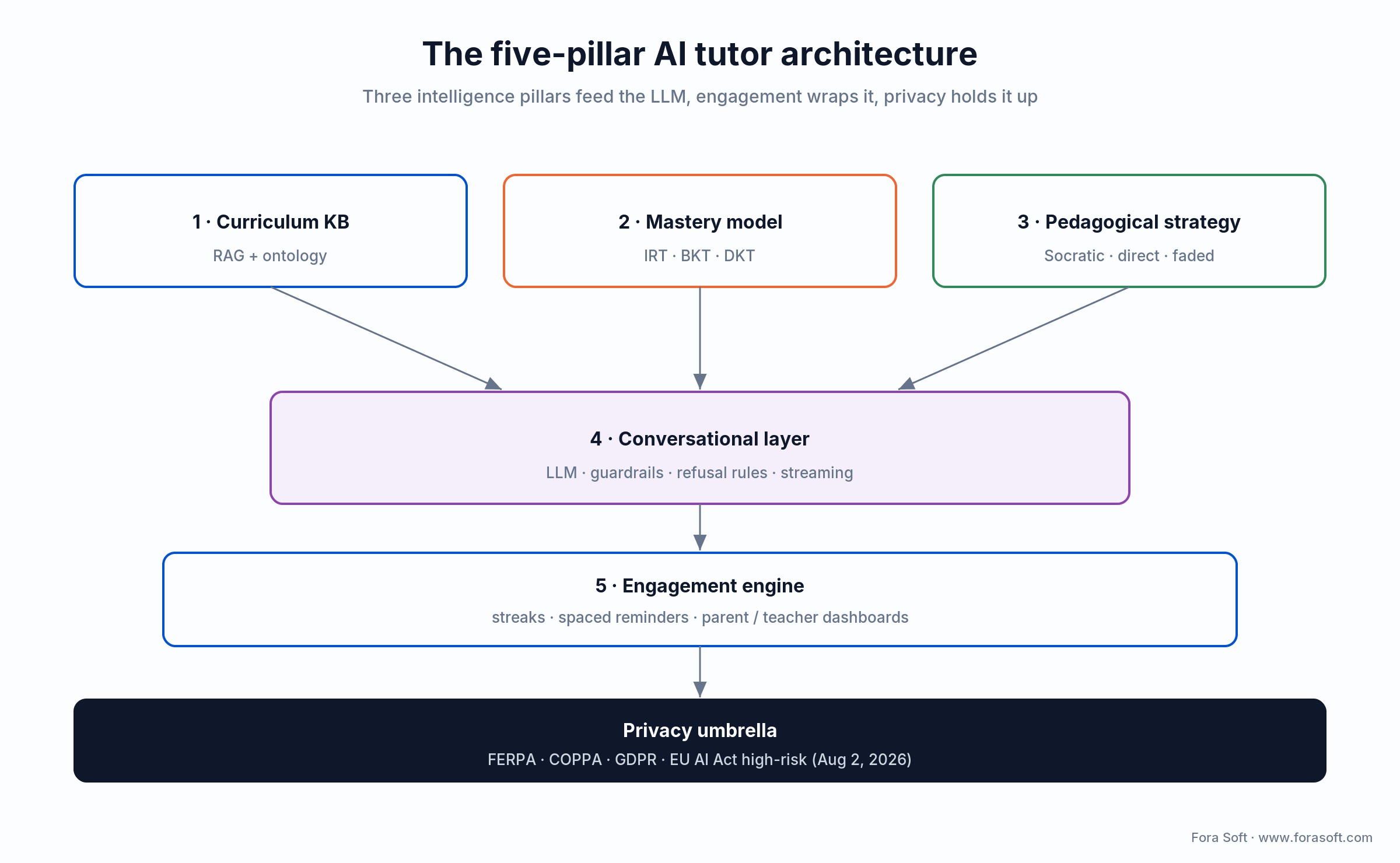
Figure 1. The five pillars. Three intelligence pillars feed the conversational layer; engagement wraps it; the privacy layer holds up the whole stack.
Pillar 1 — Curriculum knowledge base (RAG)
The curriculum knowledge base is the spine. It’s what makes “give me a similar problem” or “explain photosynthesis the way my Year-9 textbook does” actually work. Without it, the tutor offers generic answers that conflict with the student’s syllabus.
Ingest layer. Textbooks, lecture transcripts, slide decks, problem banks, past papers, instructor notes. Convert each into chunks of 200–400 tokens with rich metadata: subject, chapter, topic, learning-objective code, difficulty band, source citation. Strip pagination and running headers; keep figures as caption-as-text.
Embedding choice. OpenAI’s text-embedding-3-large, Cohere Embed v4, or open-source bge-large-en all work. The differentiator isn’t the model — it’s the chunk metadata schema. A content-only embedding loses to a metadata-rich one on every benchmark we’ve run.
Curriculum ontology. Map every chunk to a learning-objective code in a real taxonomy: Common Core for K-12 maths, CEFR descriptors for language, the USMLE content outline for medical prep, your own competency framework for a coding bootcamp. The ontology is what lets the mastery model and the conversational layer speak the same language — and it pays off. A knowledge-graph-enhanced RAG design (KG-RAG) lifted assessment scores by 35% in a controlled AI-tutor study (KG-RAG, IEEE ICEIT 2025) versus plain retrieval.
Retrieval logic. Hybrid sparse plus dense (BM25 + vector cosine), filtered by the current topic from the mastery model, then reranked with a cross-encoder to 4–6 chunks with citations. In 2026 the high-stakes move is a grading loop: a Self-RAG or CRAG pass drops chunks the model can’t ground an answer in, so the tutor cites the syllabus instead of hallucinating it.
Vector store. Postgres with pgvector under 10M chunks, Qdrant or Weaviate for sharded production, Pinecone for managed convenience. We default to pgvector for greenfield tutors — the transactional schema lives in the same database, one fewer system to operate. Our RAG-over-recordings guide covers the ingest patterns in depth.
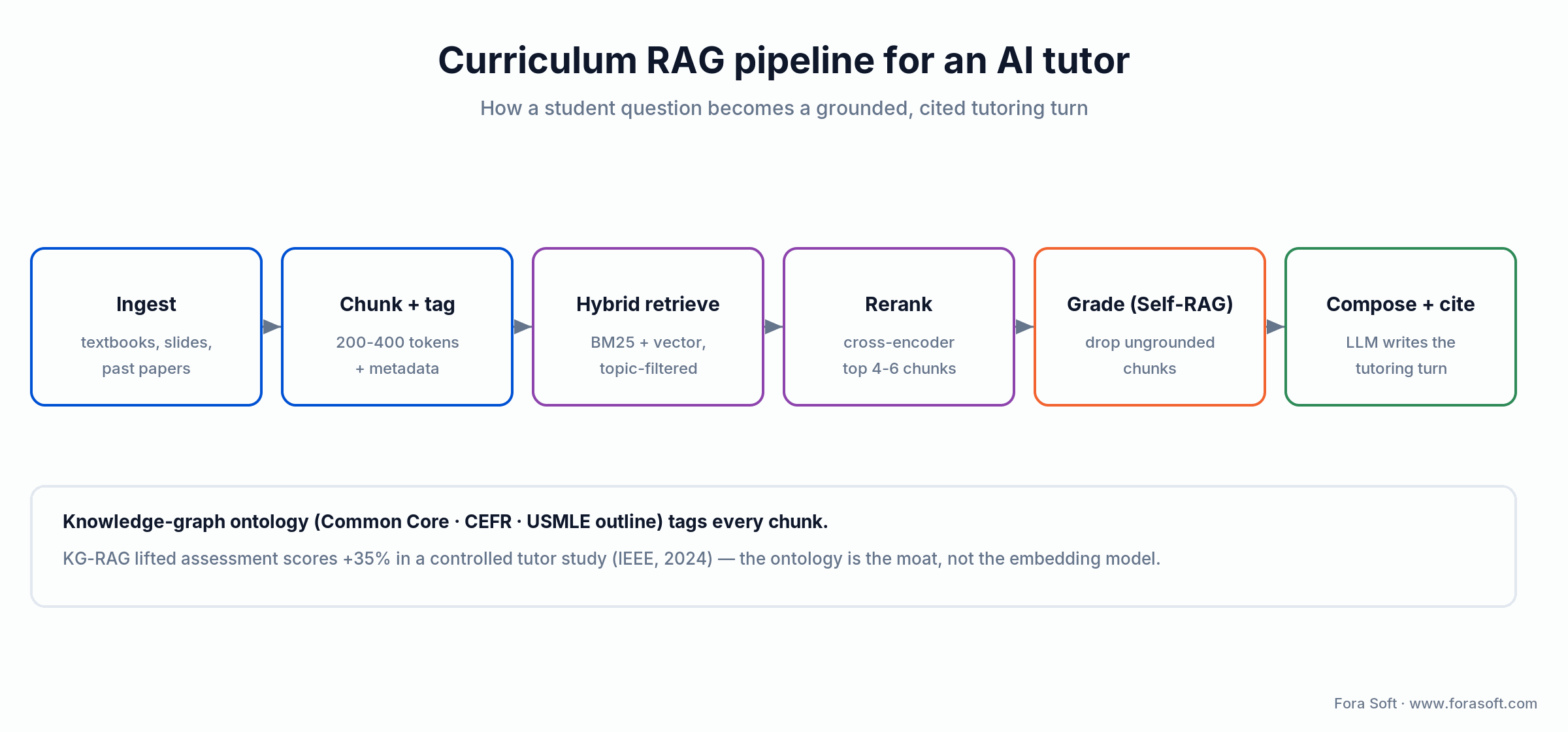
Figure 2. The curriculum RAG pipeline — ingest to a cited tutoring turn, with a Self-RAG grading step that drops ungrounded chunks.
Pillar 2 — Mastery model (IRT, BKT, DKT)
The mastery model is the per-student, per-topic estimate of “how well does this learner know this concept.” It’s the hardest pillar to get right, and it’s what separates a tutor from a chatbot. Three model families do most of the work in production.
IRT (Item Response Theory). Classic 1960s psychometrics. Each item has a difficulty and a discrimination parameter; the student has an ability parameter; probability of a correct response is a logistic function of ability minus difficulty. IRT is what makes computer-adaptive testing (the GRE, the GMAT, computerized language placement) work. Cheap to fit, interpretable. Its limit: it assumes static ability and models no learning over time.
BKT (Bayesian Knowledge Tracing). A hidden-Markov model where each topic has a hidden mastered/not-mastered state and four parameters: prior knowledge, learning rate, slip rate (mastered student answers wrong), guess rate (unmastered student answers right). Update the posterior after each response. BKT is the workhorse of intelligent tutoring systems — it’s what Carnegie Learning’s products run. It models learning explicitly; its limit is per-topic independence (no transfer) and a coarse binary state.
DKT (Deep Knowledge Tracing). A neural sequence model (originally an LSTM, now often a Transformer) that takes a sequence of (topic, correct?) pairs and predicts the probability of correct on the next item per topic. DKT captures cross-topic transfer and longer dependencies, and it’s state-of-the-art on the ASSISTments benchmark. Its cost: it’s opaque, data-hungry, and harder to debug.
Our default. BKT for the first 90 days while you collect response data. Migrate high-volume topics to DKT once you’ve crossed 50,000+ student-topic interactions. Keep IRT in the assessment-only flow (placement, end-of-unit) where adaptive item selection beats fixed forms. Below that data line, a 4-parameter BKT beats a neural model, and a parent can understand it.

Figure 3. Pick your mastery model by data volume, not by fashion. Most launches start at BKT and graduate topics to DKT.
| Algorithm | Data hunger | Interpretability | When to use |
|---|---|---|---|
| IRT (1PL / 2PL / 3PL) | ~500 responses per item | High — difficulty + ability are scalar | Adaptive testing, placement |
| BKT (4-parameter) | ~50 responses per topic | Medium — binary mastery + rates | First 90 days, low data |
| DKT (LSTM / Transformer) | 50,000+ interactions | Low — opaque hidden state | High-volume, cross-topic |
| PFA (Performance Factors) | ~30 responses per topic | High — counts + logit | Cold start, simple maths |
| Hybrid BKT + DKT | Tier per topic | Medium | Production at scale |
Reach for BKT when: you’re launching a new vertical tutor under 10,000 students, need explainable mastery for parent and teacher dashboards, and want a model engineers can debug without an ML team.
Reach for DKT when: you’ve crossed 50,000 student-topic interactions, you have an ML team, and your benchmark shows BKT plateauing on accuracy.
Pillar 3 — Pedagogical strategy
Pedagogical strategy is the policy that decides, given mastery state and curriculum context, how the tutor responds next. It’s not a prompt — it’s a controller that picks among prompts.
Socratic. Ask leading questions, never give the answer. It’s how Khanmigo refuses to solve homework, and it works for procedural skills like maths, coding, and debugging. The hard part is calibrating the gap: the question has to be answerable at the student’s current mastery or they give up.
Direct instruction. Teach the concept, then ask the student to apply it. Better for declarative knowledge (vocabulary, anatomy, history) and for true beginners who don’t yet have the mental model to be led Socratically.
Worked example then fading. Show a fully worked example, then a partial one with the last step blank, then a problem with nothing filled in. Strong evidence from cognitive-load theory, especially for novices on multi-step procedures.
Spaced retrieval. Re-test a topic the student mastered three days ago, seven days ago, twenty days ago. Anchored in the testing-effect literature. The controller schedules these without the student having to ask.
A real controller picks among these per turn based on the mastery posterior, time since last attempt, and detected confusion in the conversation. We ship it as a small rules engine that reads the mastery model and outputs a strategy code the prompt template branches on. Keep it inspectable — when a parent asks why their kid got a hint, you want an answer.
Pillar 4 — Conversational layer
The conversational layer is what users see — but architecturally it’s the least clever part. The intelligence lives upstream in mastery, curriculum, and pedagogy. The LLM’s job is to phrase the response fluently given the strategy code, the retrieved chunks, and the conversation history.
Model choice (2026). GPT-5.4 or Claude Opus for high-touch verticals like medical exam prep and professional certification, where a wrong explanation is expensive. Gemini 3 Flash or a fine-tuned open model (Llama-class) for K-12 at scale, where token cost dominates. Gemini 2.5 Flash or 3.1 Flash-Lite for cost-sensitive consumer apps. We benchmark several on every project — the winner is never the same twice.
Prompt structure. The system prompt encodes the role (tutor), the strategy code (Socratic / direct / faded), the refusal rules (“never solve homework verbatim”), and the curriculum context. Add a tool-use spec for “look up topic,” “fetch worked example,” and “log mastery update.” Stream the response with first-token latency under 500 ms.
Voice mode. For K-8 readers, language learners, and accessibility, voice is mandatory. The OpenAI Realtime API or a Deepgram + ElevenLabs duplex stack both work; see our production voice-agent guide for the latency budget.
Guardrails. Output classification for refusal (homework verbatim, unsafe content), citation enforcement (every factual claim ties to a curriculum chunk), and PII redaction on incoming student messages before they reach the LLM provider. Under the EU AI Act high-risk regime, none of this is optional. Regression-test it with an eval set — our LLM evaluation guide shows a working setup.
Need a second opinion on your AI tutor stack?
We’ll audit your architecture, mastery model, and prompts, and hand back a report with concrete fixes — usually inside two weeks.
Pillar 5 — Engagement engine
Engagement is what gets the student back tomorrow. Without it, even a pedagogically perfect tutor loses to a phone. The engagement engine is a separate product surface that wraps the tutor.
Goal-setting. A weekly target tied to mastery growth, not minutes. “Master 4 new sub-topics by Sunday” beats “spend 5 hours studying.” The mastery model can score the first; minutes-tracking optimizes the wrong thing.
Streaks and spaced reminders. A streak for consecutive days of real progress (not just app-opens). Push notifications timed to the spaced-repetition schedule, not arbitrary daily nags that fatigue the user.
Parent and teacher dashboards. For under-18 audiences the buyer is the parent or teacher, not the student. Curriculum-coded mastery dashboards are the conversion lever, and a daily summary email is mandatory for K-12.
Social proof. Opt-in cohort leaderboards, study-group threads, peer challenges. They help with teens and early-20s; they backfire for adults in professional certification, who want privacy.
Engagement KPIs that matter. Time-to-first-question is the best onboarding signal — students who hit it under 90 seconds retain about 3× more at day-30 in the cohorts we’ve measured. And weekly active learners, not daily, is the right rhythm metric: cramming three sessions on Saturday is a valid pattern for exam prep.
Pedagogical prompt patterns
A handful of prompt templates do most of the work. We keep about 25 in production; here are the four most-used. The mastery posterior decides which one fires.
SOCRATIC_TEMPLATE = """
You are a tutor for {subject}. The student is on topic {topic_code}
({topic_title}). Their current mastery posterior is {mastery:.2f}.
The user said: "{user_msg}".

Strategy: SOCRATIC. Do NOT solve the problem. Ask one leading question that:
- is answerable given mastery {mastery:.2f},
- targets the most likely misconception in {misconceptions},
- references the curriculum chunk: {chunk_text}.

If the user pastes homework verbatim, refuse and offer a similar problem.
"""
Direct-instruction template. Fires when the mastery posterior is below 0.3 — the student needs the concept taught before being questioned. Renders the curriculum chunk in 3–5 plain sentences with one worked example.
Worked-example fading template. Fires at posterior 0.3–0.6. Shows a complete worked example, then a partial one with the last step blank for the student to finish.
Spaced-retrieval template. Triggered by the engagement scheduler. Picks an item the student previously mastered, recasts it as a fresh problem, and updates the spacing posterior.
Confusion-rescue template. Activated when the conversation classifier detects frustration (sentiment plus repeat-asking). The tutor pauses, validates, drops difficulty one band, and offers a reset.
What the evidence actually shows
Here’s the honest scorecard: a good AI tutor moves the needle, but it is not a human tutor yet. In 1984 Benjamin Bloom reported that one-to-one tutoring with mastery learning produced a two-standard-deviation gain over a conventional classroom — the average tutored student outscored 98% of classroom peers. He called it the “2 sigma problem” because human tutoring for everyone was too expensive to scale. Chasing that number at software cost is the entire premise of AI tutoring.
Where are we in 2026? A randomized controlled trial published in Educational Technology Research and Development in 2025 tracked students using Khanmigo for math support three times a week and found a 0.34-standard-deviation gain in algebra over a semester. Khanmigo now reaches more than 5 million students across 110 countries and its district partners grew from about 68,000 users to over 700,000 in a single school year. So the demand is real and the effect is real. And 0.34 SD is roughly one-sixth of Bloom’s 2 sigma.

Figure 4. AI tutors today reach about 0.34 SD — a real effect, and roughly a sixth of what a human 1:1 tutor delivers. That gap is the roadmap.
Two takeaways for a builder. First, don’t promise 2 sigma — promise a measured, benchmarked gain and show it. Second, the gap between 0.34 and 2.0 is exactly the product roadmap: better mastery estimation, better misconception targeting, better spaced retrieval. The teams closing it are the ones treating pedagogy as engineering, not decoration.
Privacy — FERPA, COPPA, EU AI Act
Privacy in education AI is a market-access requirement, not a feature. School districts reject non-compliant products, app stores reject non-compliant apps, and EU regulators fine non-compliant vendors. Plan for all four regimes from week one.
1. FERPA (US student records). Applies to any system holding US student records. The district is the data controller; you’re a “school official” under contract. Deliverables: a signed school-official agreement, no use of student data for advertising, no third-party disclosure without parent consent, parent right of access.
2. COPPA (US, under-13). Verifiable parental consent before data collection, data minimization, no behavioral advertising. It auto-applies to general-audience products once you have “actual knowledge” of under-13 users, so the default for K-8 tutors is full COPPA compliance whether or not parents are gating.
3. GDPR (EU users). A lawful basis for processing (consent for under-16, or under-13 in member states that opted down), data residency in the EU for the storage layer, and rights to erasure, portability, and rectification.
4. EU AI Act, high-risk. Annex III lists AI systems that determine access to education, evaluate learning outcomes, or monitor students during tests as high-risk. Obligations become enforceable on 2 August 2026: a risk-management system, data governance, technical documentation, transparency, human oversight, accuracy, resilience, and cybersecurity testing, a conformity assessment before market entry, and post-market monitoring. A November 2025 Omnibus proposal floated deferring stand-alone Annex III duties to December 2027, but it isn’t law yet, so treat August 2026 as the operative date and build the paper trail now.
5. WCAG 2.2 AA accessibility. US Section 508 and the EU European Accessibility Act both reference WCAG 2.2 AA: keyboard navigation, contrast ratios, screen-reader support. Designed in, it costs nothing; retrofitted, it costs 6–10 weeks of rework.
Cost model
Two cost lines: build (one-time engineering) and operate (per active learner per month). Let’s show the arithmetic.
Build — 16-week MVP. A team of 4 (senior backend, senior frontend/mobile, ML engineer, product designer). Weeks 1–4: curriculum ingest, ontology, RAG. Weeks 5–8: BKT mastery model plus the learner/parent/teacher web app. Weeks 9–12: conversational layer, guardrails, mobile shell. Weeks 13–16: engagement engine, dashboards, COPPA/FERPA wiring, beta. Range: $180–320k depending on geography and seniority. With pattern reuse from Quillionz and BrainCert and our Agent Engineering practice, we usually land toward the low end.
Operate. LLM cost dominates, so do the arithmetic. Take Gemini 2.5 Flash at 2026 pricing: $0.30 per 1M input and $2.50 per 1M output tokens. A tutoring turn is input-heavy — the system prompt, four to six retrieved curriculum chunks, and recent history push it to roughly 4,500 input tokens, plus about 400 output. That’s near $0.0023 a turn; at 12 turns a session and about 20 sessions a month (240 turns), roughly $0.55 per active learner in model spend. Add embedding refresh (~$0.05 per learner share) and a pgvector store on Hetzner (~$0.10), and you land near $0.70 text-only. Duplex voice adds about $0.60, taking a voice learner to ~$1.30. Drop to Gemini 3.1 Flash-Lite ($0.10 / $0.40) and the model line drops by roughly three-quarters.
Break-even. A B2C subscription at $19.99 a month with 60% gross margin needs operate cost under ~$8 per learner — comfortable. A B2B district contract at $40 per student per year needs it under ~$1.50 per student per month. Text-only ($0.70) clears that comfortably, and average voice usage (~$1.30) still fits, but a heavy-voice power user can run past $1.50 — so meter voice minutes or move to a Flash-Lite tier. The break-even is what decides whether you fine-tune an open model or stay on a hosted flash tier.
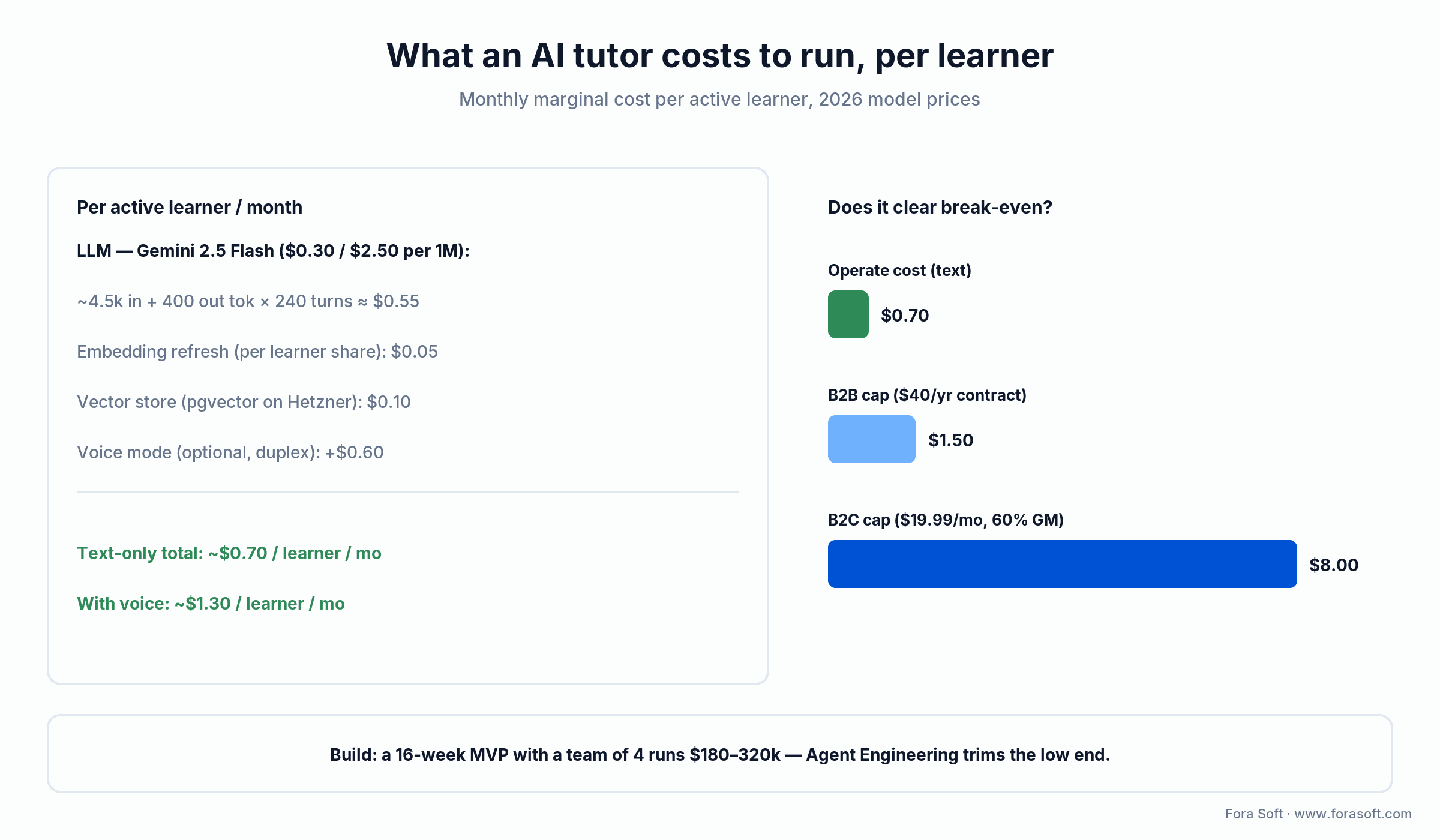
Figure 5. Per-learner operate cost against break-even caps. Text-only clears both B2C and B2B; voice-heavy usage needs a cheaper model tier for tight B2B contracts.
Build vs buy — ChatGPT-Edu, Squirrel, custom
Buy if you want a generic assistant for many courses; build if you want product differentiation in a vertical. Here’s where each option wins and breaks.
OpenAI ChatGPT-Edu. Hosted and generic — no curriculum ingest, no mastery tracking, no pedagogical strategy. The right tool for a university giving every student a seat. The wrong tool if differentiation is the goal.
Squirrel AI. A mature K-12 adaptive-learning platform from China with white-label deals. It wins on a decade of mastery-data tuning; it breaks on opacity, a generic curriculum, and China-headquartered data-residency questions that disqualify some buyers.
Khanmigo. Khan Academy’s tutor; not licensable as a platform. Study it as a benchmark, don’t plan to buy it.
MagicSchool. A teacher-facing assistant (lesson planning, rubrics, IEP support) more than a student tutor. A complementary integration target, not a replacement.
Custom (our pick for vertical depth). A 16-week MVP with full control over mastery model, curriculum, and pedagogy. Differentiation lives in vertical depth (USMLE prep, IELTS, software-engineering interviews) where horizontal players won’t match the curriculum quality. Our e-learning development team ships these.
Mini case — medical exam prep AI tutor
A medical-education startup came to us in 2024 with 18,000 USMLE-style questions, three licensed textbooks, and a thesis: an AI tutor that drills the highest-yield missing topics for each board candidate. Their v1 was a thin GPT-4 wrapper: day-30 retention 8%, mastery growth unmeasured.
The 16-week rebuild. Weeks 1–4: ingest all three textbooks and the question bank, mapped to the USMLE Step 1 content outline (213 topic codes). Weeks 5–8: a BKT mastery model trained on 1.4M existing question-bank responses (plenty for BKT, not yet enough for DKT). Weeks 9–12: a Socratic + worked-example controller, a GPT-4o conversational layer at the time, and refusal rules tuned on a 200-prompt eval set. Weeks 13–16: a spaced-retrieval scheduler, a learner dashboard with predicted board-pass probability, and a beta with 80 paying users.
Outcome. Day-30 retention rose from 8% to 38%. Average questions per learner per week went from 11 to 47. Self-reported confidence on the USMLE moved from 4.2/10 to 6.8/10 over a 12-week prep cycle. The mastery model surfaced each candidate’s weakest topics a week earlier than their human-built study plans. Book a 30-min call for a similar audit on your tutor.
A decision framework in five questions
Q1. What vertical and what curriculum exactly? Generic tutors lose to Khanmigo. Vertical tutors with named curricula (USMLE Step 1, IELTS Academic, AP Computer Science A) win because horizontal players have no incentive to build that depth.
Q2. Do you have curriculum data and response history? If yes, BKT trains in days. If no, budget a 4-week ingest sprint and synthetic-response bootstrapping. Either path works; the difference is money and time.
Q3. Audience age? Under-13 means COPPA plus a parent dashboard. K-12 inside school means FERPA plus district SSO. Adult professional cert means lighter compliance and optional voice. The audience dictates the whole engagement design.
Q4. EU users? If yes, EU data residency and EU AI Act high-risk classification both apply from August 2026. Plan compliance from day 1; it adds roughly 4 weeks.
Q5. What’s your honest mastery-growth target? Pre-commit to a benchmark — topics mastered per hour, or growth on a third-party score like a Lexile or IELTS practice test. Without a target, the team optimizes for engagement vanity metrics and the product drifts.
Have curriculum data and a deadline?
Tell us the vertical and the exam. We’ll map a mastery model, a compliance path, and a 16-week build with real numbers.
When not to build an AI tutor
Sometimes the right answer is don’t. Building a full tutor is a five-pillar commitment, and several situations don’t justify it.
You have no defined curriculum. If learning is open-ended exploration with no syllabus and no mastery to track, you want a good assistant, not a tutor. Ground a general LLM in your docs and stop there.
You can’t measure outcomes. If there’s no benchmark — no test, no placement score, no skill rubric — you can’t prove the tutor works, and you’ll drift into optimizing screen time. Fix the measurement problem first.
Your audience is tiny and horizontal. A few hundred learners spread across unrelated subjects can’t feed a mastery model and can’t justify the build. Concentrate on one vertical or buy a generic seat.
Compliance would sink the timeline. If you’re pre-revenue, targeting EU K-12, and can’t fund the conformity work before August 2026, start with an adult, non-EU vertical and expand once the compliance muscle exists. Honesty here beats a rejected procurement review later.
Pitfalls to avoid
1. A ChatGPT wrapper masquerading as a tutor. Without a mastery model, curriculum-grounded RAG, and a pedagogical controller, you have a chatbot. It retains badly and it gets your brand flagged as a cheating tool.
2. Optimizing for time-on-app. The heaviest users are often the ones learning least — paste-and-cheat looping. Optimize for mastery growth per hour and benchmarked outcomes.
3. Choosing DKT before you have data. A neural mastery model with 1,000 students is worse than a 4-parameter BKT. Stay on BKT until you cross 50,000+ student-topic interactions.
4. Skipping COPPA and FERPA in the MVP. US district sales close at procurement. Without district SSO, a FERPA addendum, and COPPA documentation, you fail security review and the deal evaporates.
5. No human-in-the-loop evaluation. Every release should ship with a 200-prompt eval set scored by curriculum experts. Without it, prompt regressions silently wreck pedagogical quality.
KPIs to measure
Quality KPIs. Mastery growth per hour (target: ≥ 1 sub-topic per 45-minute session). Time-to-first-question on day 1 (target: under 90 s). Refusal accuracy on homework-verbatim probes (target: ≥ 95%).
Business KPIs. Day-30 retention (target: 35% B2C, 60% B2B). Weekly active learners. Parent/teacher dashboard NPS. B2B contract retention. Cost per active learner per month.
Reliability KPIs. 99.9% uptime during peak study hours. First-token latency under 500 ms p95. PII-redaction recall above 99.5% on the eval set.
FAQ
What is an AI tutor?
An AI tutor is a software system that grows a student’s mastery on a specific curriculum. It tracks per-topic mastery, follows an explicit pedagogical strategy (Socratic, direct, or faded examples), grounds answers in course material via RAG, and refuses to solve problems verbatim. A general chatbot does none of these by default.
How is an AI tutor different from ChatGPT?
A tutor refuses to solve problems verbatim, keeps per-topic mastery state, follows a pedagogical strategy, and is grounded in a defined curriculum. ChatGPT is stateless, answers almost anything, and is judged on response quality. A tutor is judged on whether test scores went up — a different objective function and a different architecture.
Do AI tutors actually improve learning?
Yes, modestly and measurably. A 2025 randomized trial found Khanmigo produced a 0.34-standard-deviation gain in algebra. For reference, Bloom’s 1984 work put one-to-one human tutoring at +2 SD. So AI tutors deliver a real effect today — roughly one-sixth of a human tutor — and improving mastery estimation is how that gap closes.
When should you use BKT vs DKT for mastery tracking?
Start with BKT. Migrate high-volume topics to DKT once you have 50,000+ student-topic interactions and a benchmark showing BKT plateauing. Below that threshold, BKT outperforms DKT in our experiments and is far easier to debug and explain to parents and teachers.
What does the EU AI Act mean for an AI tutor?
AI used to determine access to education, evaluate learning outcomes, or monitor exams is high-risk under Annex III, with obligations enforceable from 2 August 2026: risk management, technical documentation, human oversight, accuracy testing, conformity assessment, and post-market monitoring. A proposed Omnibus deferral to 2027 is not yet law, so plan around August 2026 and add about 4 weeks for EU launches.
How long does it take to build an AI tutor MVP?
About 16 weeks at $180–320k with a team of 4: senior backend, senior frontend/mobile, ML engineer, product designer. That covers curriculum ingest, a BKT mastery model, a conversational layer with refusal guardrails, mobile plus web, and a beta with 50–100 paying users.
How do you stop students cheating with the tutor?
Refusal rules in the system prompt (no homework verbatim), a paste-detection classifier, an output classifier that rewrites verbatim solutions into Socratic prompts, and a teacher dashboard that flags suspicious sessions. Ship a 200-prompt eval set to regression-test refusal accuracy on every release.
Build a custom AI tutor, or buy Khanmigo or ChatGPT-Edu?
Buy if you’re an institution giving many courses a generic tutor — ChatGPT-Edu fits. Build custom if you want differentiation in a vertical (medical prep, IELTS, programming interviews). Khanmigo isn’t licensable as a platform, and Squirrel AI is buyable but China-headquartered, which kills some buyers on data residency.
What to read next
E-learning
What an E-Learning Platform Costs to Build
The platform layer this AI tutor plugs into, itemized.
Evaluation
Evaluating LLM Apps in Production
How to keep tutor quality from regressing.
Voice
Realtime Voice Agent Production Guide
The latency budget for the tutor’s voice mode.
Content
AI Textbook Creation in 2026
Build the curriculum your tutor teaches from.
Estimation
The CTO’s Estimation Guide
Worked example for scoping an AI tutor MVP.
Ready to ship an AI tutor students actually use?
AI tutoring went mainstream in about 24 months, and the bar to look credible rose with it — wrapper products get filtered out by district procurement, by parents, and soon by EU regulators. The bar to actually grow mastery has been there since 1984: curriculum-grounded RAG, an explicit mastery model, a strategy that refuses to solve homework, an engagement engine that tracks learning not minutes, and a privacy layer that ships in week one.
A vertical MVP ships in 16 weeks at $180–320k, and the moat is depth in a named curriculum where horizontal players won’t invest. With Quillionz and BrainCert behind us, we compress the build by reusing curriculum-ingest and mastery patterns — and we’ve done it on every AI tutor we’ve shipped since 2023.
Want a 16-week AI tutor shipping plan?
Send your domain (medical, language, coding, K-12) and a curriculum reference. We’ll return architecture, a mastery-model choice, and a cost forecast in 48 hours, free.