
Key takeaways
• A real budget number. E-learning platform development in 2026 runs about $40–80K for a basic MVP, $80–150K for a mid-tier build, and $150–300K+ for a full platform with live class, AI tutor and compliance. We break every line item down below.
• The cost lives in four modules. Live class, AI tutor, the content/standards engine, and compliance eat most of the budget. Cut those wrong and you either overspend by 40% or ship something enterprise buyers reject.
• LMS vs LXP is the wrong first question. The real fork is buy-vs-build. Off-the-shelf wins for internal compliance training; custom wins when the workflow or the AI is your product.
• SCORM isn’t dead. It’s still the widest-installed standard in 2026. Build for xAPI plus cmi5 on new content, keep SCORM import for the legacy library. Most enterprise catalogs run more than one format.
• We shipped this pattern at BrainCert. A bootstrapped 12-person build grew to $3M revenue (2024, up 58% year over year) and 500M+ classroom minutes. The architecture below is the one that got it there.
Why Fora Soft wrote this playbook
We’ve been building video and learning software since 2005, 250+ projects across the team. Our trophy in this space is BrainCert, the world’s first WebRTC + HTML5 virtual-classroom LMS. It went from a solo founder with no technical co-founder to $3M revenue in 2024, 100K+ customers and 500M+ real-time classroom minutes, all bootstrapped, with a 12-person team. We also built Scholarly (15,000+ users, live classes to 2,000 concurrent) and ALDA, an AI course generator whose institutions serve 500K+ students a year.
So this isn’t a listicle scraped from other listicles. The numbers here come from real builds and real invoices, cross-checked against public benchmarks (the 2026 e-learning market is worth about $276B and still growing double digits) and the primary specs for xAPI, LTI and the EU AI Act.
Who it’s for: an EdTech founder scoping a Series A raise, a corporate L&D director weighing build-vs-buy, or an education publisher going digital. If instead you’re building a consumer language learning app with speaking practice, that’s a different build; start there.
Scoping an e-learning platform in 2026?
Send us your spec and target audience. We’ll return a one-page architecture and an itemized cost forecast in 48 hours, free.
What does an e-learning platform cost to build?
Direct answer: in 2026, a custom e-learning platform costs roughly $40–80K for a basic MVP, $80–150K for a mid-tier build, and $150–300K+ for a full platform with a live virtual classroom, an AI tutor and enterprise compliance. Published 2026 benchmarks from development agencies like Cleveroad land in the same bands, and our own builds do too.
The spread is wide because “e-learning platform” covers everything from a course-selling site to a real-time teaching product. Three things move the number more than anything else: how many native clients you ship (web only, or web plus iOS plus Android), whether you need a live virtual classroom, and how serious your AI tutor is. Each of those roughly doubles the module underneath it.
The chart below shows where the money actually goes, module by module. Read the solid bar as a focused MVP and the lighter cap as the extra to reach a full multi-platform build.
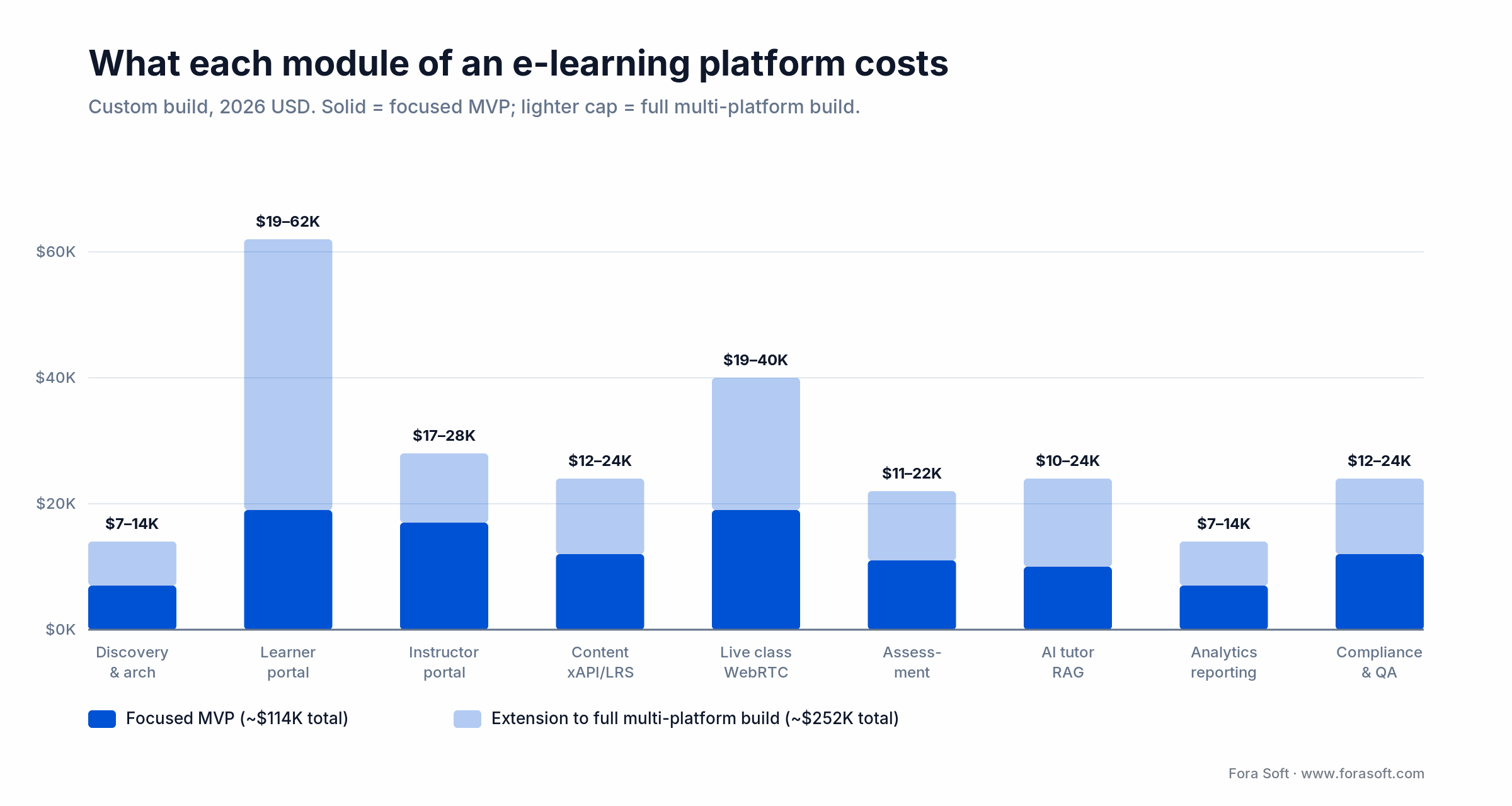
Figure 1. Cost by module for a custom build. The learner portal jumps most when you add native iOS and Android.
The itemized cost breakdown
Here’s the walkthrough, module by module, with what drives each line and where teams overspend. Figures are 2026 USD for a custom build at a senior blended rate.
| Module | MVP | Full build | What drives it |
|---|---|---|---|
| Discovery & architecture | $7K | $14K | Compliance scope, integrations, non-functional targets |
| Learner portal | $19K | $62K | Web only vs web + native iOS + Android |
| Instructor / admin portal | $17K | $28K | Authoring depth, grading, multi-tenant admin |
| Content & standards (SCORM/xAPI/LRS) | $12K | $24K | Standards you support, LRS build vs hosted |
| Live class (WebRTC) | $19K | $40K | Whiteboard, breakouts, recording, scale |
| Assessment & grading | $11K | $22K | Question types, rubrics, proctoring hooks |
| AI tutor | $10K | $24K | RAG grounding, mastery model, guardrails |
| Analytics & reporting | $7K | $14K | Dashboards, exports, audit reporting |
| Compliance & QA | $12K | $24K | FERPA/GDPR/WCAG/AI Act, cross-cutting |
Add the MVP column and you get about $114K. Add the full-build column and you’re near $252K. On top of the build itself: design runs $3–25K depending on polish, each third-party integration is roughly $1.5–5K, and ongoing maintenance is 15–20% of the build per year. Course production, if you’re authoring content rather than importing it, is a separate $5–20K per course.
Reach for a phased MVP when: you haven’t validated pricing or the core workflow yet. Ship the learner portal, assessment and a basic live class first (about $95–114K), then fund the native apps and AI tutor from early revenue.
A worked cost example, arithmetic shown
Ranges are easy to hand-wave, so here’s the actual math. A focused, web-first MVP (learner and instructor portals, assessment, a basic live class, a light AI tutor) is around 1,900 engineering hours. At a $60/hr senior blended rate, that’s about $114K. Because we reuse proven patterns from BrainCert instead of rebuilding the virtual classroom from scratch, that number typically drops around 17%, to roughly $95K.
A full multi-platform build (web, iOS and Android, a production WebRTC classroom, AI tutor v1, full compliance and analytics) is closer to 4,200 hours. Same rate, and you land near $252K. The gap between the two is almost entirely the native apps, the harder live-class features and the compliance work.
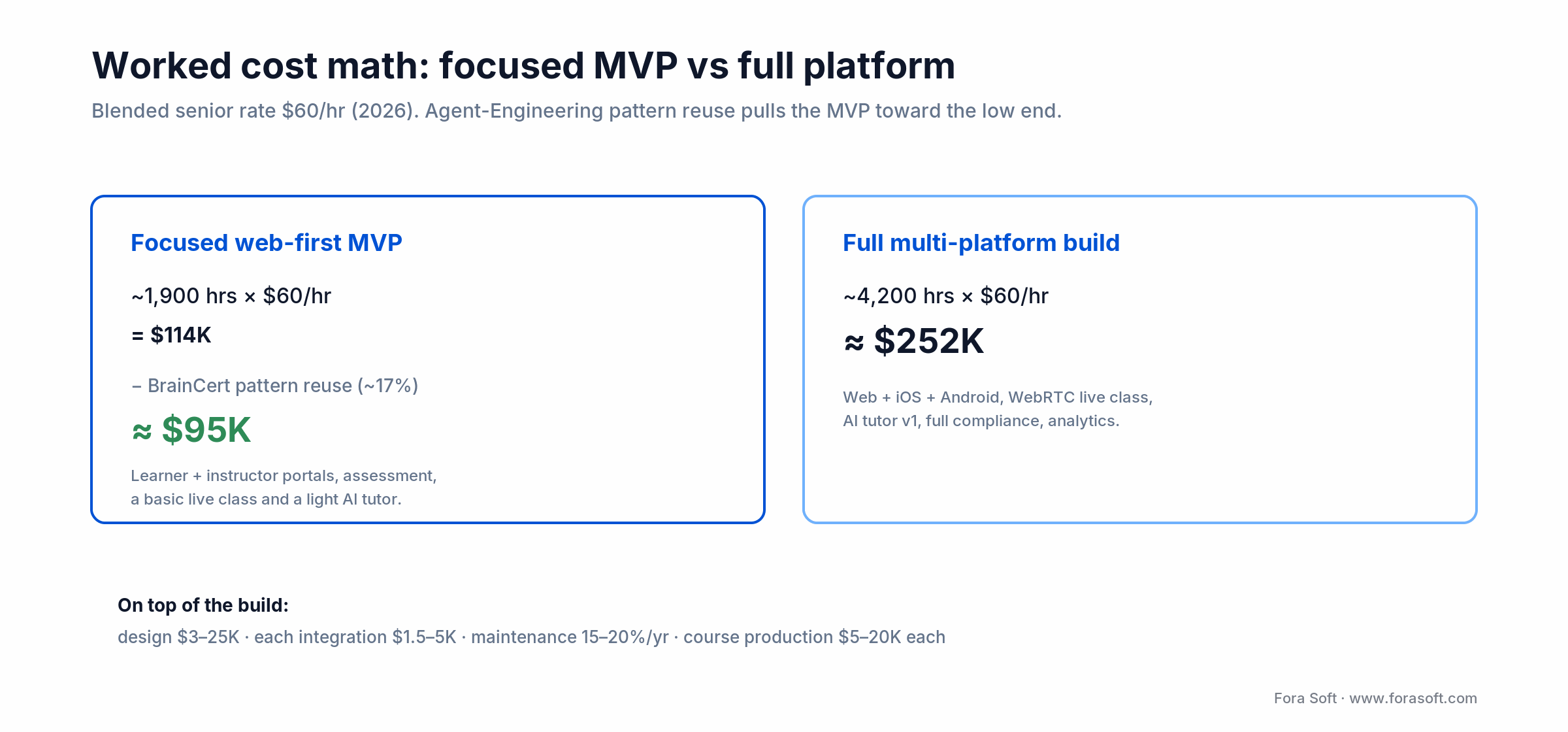
Figure 2. The MVP-versus-full-build math, with rate and hours shown so you can re-run it against your own scope.
If a quote comes in far above these numbers with the same scope, ask what’s driving it. Sometimes it’s real, like on-prem deployment or heavy custom proctoring. Often it’s a vendor rebuilding a solved problem. For a deeper look at reading quotes, our estimation guide unpacks where the padding hides.
Why most EdTech teams pick the wrong stack
In 2024 we audited four EdTech platforms in scaling or M&A due diligence. Three had stack decisions that cost the founders 6–12 months of rework. The same four mistakes show up again and again.
1. Forking Moodle for a product startup. Moodle is free and open-source, which is the trap. It’s a 20-year-old PHP monolith tuned for a traditional university LMS. Two of the four audits were Moodle forks where the team spent most of its effort working around Moodle’s assumptions instead of shipping their own product.
2. SCORM-only when a buyer wanted xAPI. Some enterprise L&D buyers now ask for xAPI or cmi5 in RFPs. One audited team had built SCORM-only because their template did, then spent three unbudgeted months adding xAPI. Support both from the start; don’t bet the roadmap on one format.
3. An AI tutor bolted on as a feature flag. Dropping a ChatGPT box next to courseware isn’t an AI tutor, it’s a chat widget, and students abandon it fast. Real tutoring needs curriculum-grounded retrieval, a mastery model and a teaching strategy. We cover the build in our AI tutor architecture guide.
4. Accessibility left until launch. WCAG 2.2 AA is the floor for anything sold to schools, government or large enterprise. Retrofitting it costs 6–10 weeks that designing it in would have saved. It’s cheaper as a habit than as a fire drill.
LMS vs LXP vs purpose-built
Short version: an LMS is compliance-first (it tracks who completed which required training), an LXP is discovery-first (Netflix-style recommendation and learner-driven exploration), and a purpose-built platform folds in exactly the pieces of both that your vertical needs. Standalone LMS is increasingly giving way to hybrids; pure LXP can’t carry compliance-driven L&D on its own. Most 2026 products blend the two.
The examples: LMS is Cornerstone, Docebo, SAP SuccessFactors, Moodle, Canvas. LXP is Degreed, 360Learning, Udemy Business. Purpose-built is what you commission when the workflow is specific, medical CME, financial certification prep, a coding or language bootcamp, K-12.
| Your situation | Pick |
|---|---|
| Compliance training, mandatory completion tracking | Off-the-shelf LMS |
| Skill development for knowledge workers | LXP or LMS + LXP hybrid |
| K-12 or higher education | Canvas, Open edX, or purpose-built |
| Vertical certification (medical CME, CFA prep) | Purpose-built |
| Coding or language bootcamp with live class | Purpose-built (BrainCert pattern) |
| Selling courses as a creator or instructor | Teachable / Thinkific, or custom |
If you want a single flow to follow, the decision tree below gets you to a concrete pick in three questions.

Figure 3. LMS, LXP or purpose-built, resolved in three questions.
Reach for purpose-built when: the workflow is vertical-specific, the moat is your content and AI rather than generic LMS features, and you intend to sell the platform as a product rather than run it internally.
Reference architecture for an e-learning platform
Every serious e-learning platform we’ve built comes down to eight layers under one compliance umbrella. You can ship a subset in the MVP, but the shape holds. Knowing it up front is what keeps the AI tutor and the standards engine from becoming the bolt-ons we warned about.

Figure 4. The eight-layer reference architecture, with compliance treated as a cross-cutting concern rather than a bolt-on.
Two design calls matter most. First, put an identity layer (SSO, LTI 1.3, SAML, OAuth, per-role RBAC, tenant scope) between the portals and everything else, so multi-org selling doesn’t become a rewrite later. Second, treat the Learning Record Store as the system of record for learning events from day one; it’s what makes analytics, compliance reporting and the AI tutor’s mastery model all read from the same truth.
SCORM vs xAPI vs cmi5, honestly
Answer first: build new content on xAPI plus cmi5, keep SCORM import and playback for the legacy library, and put a Learning Record Store behind it. Don’t believe anyone who tells you SCORM is dead. In 2026 it still has the largest installed base of enterprise content, and plenty of catalogs are SCORM-only.
SCORM (from 2001 and 2004) tracks completion, score and time inside an LMS frame. It can’t follow a learner offline, into a mobile app, or through a simulation. xAPI, the modern Experience API, records any experience as an Actor–Verb–Object statement (“Sarah passed Module 5”) sent to a Learning Record Store, across web, mobile, VR and the real world. cmi5 is an xAPI profile that adds the launch, suspend and pass/fail rules SCORM had built in, so it bridges “structured course” and “tracked experience.”
One more piece people confuse with these: LTI 1.3 is how external tools (graders, simulators, content libraries) plug into an LMS, with deep linking and grade passback. It’s required for most K-12 and higher-ed integration. The honest 2026 stack is xAPI/cmi5 for new content, an LRS for tracking, LTI 1.3 for tools, and SCORM import for what you already own.
AI tutor integration (and where it disappoints)
The AI tutor is the headline 2026 feature, and also the one most likely to underwhelm. A blunt data point: Khan Academy’s Khanmigo, one of the best-funded efforts out there, grew from 40,000 to 2 million users and 108M+ interactions since its 2023 launch, yet only about 15% of eligible students actively engage with it. Khan is now redesigning it to offer help inside assignments instead of waiting to be asked. The lesson: adoption is the hard part, not the model.
There are three integration patterns worth planning for. Pre-class, the student studies solo while the tutor answers questions and generates practice (the Khanmigo pattern). In-class, the tutor handles routine clarifications so the instructor can focus. Post-class, it quizzes, surfaces gaps and recommends the next topic on a mastery track.
All three depend on the same four things: retrieval grounded in your actual course content, a mastery model that tracks what the student knows, a teaching strategy (Socratic versus direct), and an engagement layer that earns the second session. Skip the grounding and the tutor confidently invents answers, which in education is worse than useless. If you want the tutor as a real product surface, our AI integration team builds these end to end.
Live-class infrastructure (WebRTC)
Live class is the most demanding layer in the whole platform. You need sub-second latency for two-way Q&A, a synced whiteboard, breakout rooms, recording, chat, polls and hand-raising, plus separate instructor and student views. It’s also where budgets quietly blow out: the whiteboard and breakout sync are usually harder than the media server itself.
The 2026 default is an SFU (LiveKit or self-hosted mediasoup) for the media, a collaborative-state layer (Yjs or Liveblocks) for the whiteboard, and cloud transcoding for recording playback. Below roughly 100K minutes a month, a managed SFU (Daily, Vonage, LiveKit Cloud) is cheaper than running your own; above that, self-hosting starts to pay. Our build-vs-buy video SDK guide works the crossover, and the Learn: video streaming hub covers the protocol layer.
If you stream lectures out to large audiences rather than teach small cohorts, the ingest path changes; WHIP and WHEP replace RTMP for sub-second delivery.
Reach for a managed SFU when: you’re under ~100K live minutes a month and want to ship in weeks, not build an on-call rotation. Move to self-hosted mediasoup once minutes and unit economics justify a dedicated media team.
Building a live virtual classroom?
We’ve shipped WebRTC classrooms that hold 2,000 concurrent students. Tell us your scale target and we’ll spec the media stack.
Build vs buy: Moodle, Canvas, Open edX, custom
Moodle (v4.5, Oct 2024) is a free PHP LMS with 500M+ users and thousands of plugins. Right for institutional deployment where its feature set fits; wrong for a product startup, because the monolith fights modern AI and WebRTC work.
Canvas (Instructure) holds roughly half of North-American higher-ed enrollment. Modern Ruby/JS, LTI 1.3 first-class, dual-licensed (open-source core, commercial cloud). Strong for higher-ed; over-featured for a lean corporate build.
Open edX is Python/Django, xAPI-native, and runs 100M+ learners across 2,200+ sites. It’s the best open base if you want MOOC-scale structure without starting from zero, and it’s a reasonable foundation for an async-first custom build.
Off-the-shelf SaaS (Cornerstone, Docebo, SAP SuccessFactors) is right for large-enterprise compliance training. Fast to stand up, priced per user, and hard to differentiate on, since your competitors buy the same thing.
Custom is our call for product startups: modern stack, an AI tutor as an architectural primitive rather than an afterthought, and full control over how the LMS, LXP and assessment pieces fit. Higher up-front cost, but the differentiation is uncapped, and we build these to spec.
Reach for off-the-shelf SaaS when: your need is internal compliance training at enterprise scale, integration with existing HR systems matters more than UX, and being different from competitors isn’t the point.
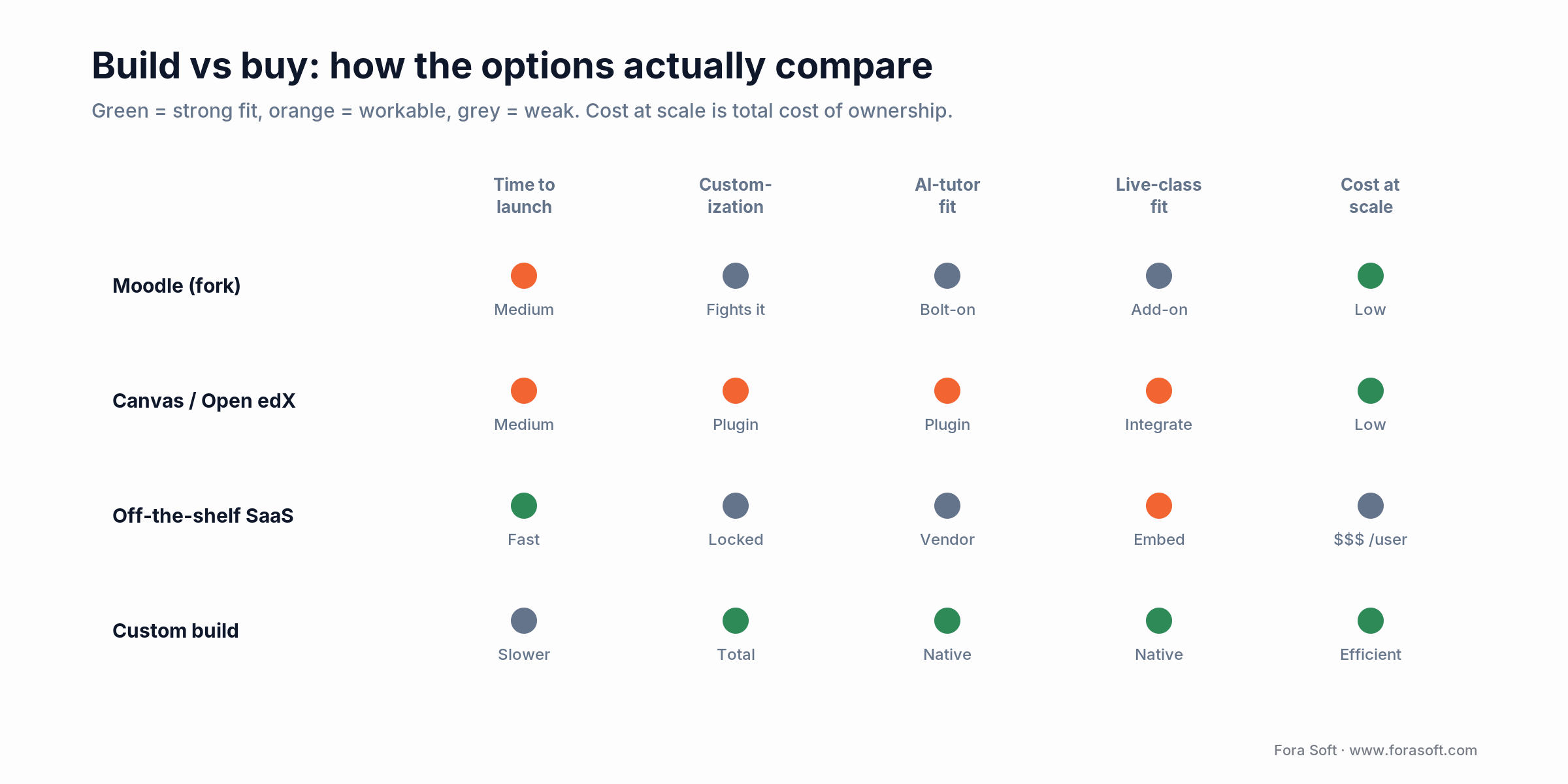
Figure 5. How the four routes trade off. Off-the-shelf wins on speed; custom wins on fit and cost at scale.
Compliance: FERPA, COPPA, GDPR, accessibility, EU AI Act
Compliance is cross-cutting, not a phase. Which rules bite depends on who your learners are and where they live.
FERPA (US). Applies to platforms holding student education records: consent for disclosure, audit logs on every record access, and retention rules.
COPPA (US). Covers under-13 users. The FTC’s amended rule requires full compliance by 22 April 2026: verifiable parental consent, data minimization, and biometric identifiers now in scope.
GDPR (EU). Education data falls under standard GDPR; biometric proctoring triggers Article 9 special-category rules. Plan for data minimization, purpose limitation and the right to erasure.
Accessibility. Treat WCAG 2.2 AA as the bar. US Section 508 requires it for federal procurement, the EU’s European Accessibility Act has applied to many digital products since 28 June 2025, and ADA Title II adds phased 2026–2027 deadlines for public schools and universities.
EU AI Act. AI that decides admission, evaluates learning outcomes or monitors test-takers is high-risk under Annex III. Those obligations now apply from 2 December 2027 (the 2026 Digital Omnibus pushed the date back from August 2026), while transparency duties still land in August 2026. Emotion recognition in education has been outright prohibited since February 2025. Design for documentation, human oversight and bias testing if your AI touches assessment.
Need a FERPA, GDPR or AI Act gap check?
Send us your platform spec and target jurisdictions. We’ll return a one-page compliance gap analysis in 48 hours, free.
MVP scope and timeline
A full first release lands in about 24 weeks with a team of four. The phases overlap; compliance runs in parallel the whole way rather than waiting at the end.
| Phase | Weeks | Deliverables |
|---|---|---|
| Discovery | 1–3 | Architecture, non-functional targets, integrations, compliance scope |
| Learner portal | 4–12 | Discover, learn, assess (web first, native later) |
| Instructor portal + content | 7–14 | Authoring, grading, analytics, SCORM/xAPI/cmi5 |
| Live class + AI tutor | 10–20 | WebRTC SFU, whiteboard, AI tutor v1 |
| Compliance (parallel) | All | FERPA, GDPR, WCAG 2.2 AA, EU AI Act |
| Total | ~24 | ~1,900–2,800 engineering hours, roughly 5–7 months with a team of four |
Adding a serious AI tutor to the MVP adds roughly $14K over the light version. If the budget is tight and the tutor isn’t your core differentiator, defer it to v2 once you have real learner data to ground it. For the non-functional targets to lock in during discovery, our NFR checklist is a good starting point.
Mini case: BrainCert, from MVP to $3M ARR
A solo founder with a teaching background and no technical co-founder came to us with one idea: a course catalogue, a live virtual classroom, assessment, certificates and AI-driven recommendations, all in one product. No outside funding, and a plan to bootstrap.
The build. We built the product from the ground up, the WebRTC infrastructure and the full LMS: learner portal on web, iOS and Android; instructor portal with SCORM and xAPI support; a native HD virtual classroom with an interactive whiteboard; a proctored assessment engine; certificates; and a white-label storefront with a 90% instructor revenue share. It became the world’s first WebRTC + HTML5 virtual-classroom LMS.
The outcome. BrainCert grew to $1.5M revenue in 2021, $1.9M in 2023, and $3M in 2024, up 58% year over year, entirely bootstrapped. Today it serves 100K+ customers and has delivered 500M+ real-time classroom minutes across 10 datacenters at 99.995% uptime, with 300+ features and four Brandon Hall Awards. A 12-person team, outbuilding VC-backed giants. Book a 30-min call if you want a similar assessment of your idea.
A decision framework in five questions
Q1. Selling a product, or running an internal tool? Internal compliance training: buy off-the-shelf. A product with differentiation: build custom.
Q2. Is the AI tutor core? If yes, go custom. A real tutor can’t bolt onto Moodle or Canvas cleanly.
Q3. Is a live virtual classroom critical? If yes, build on LiveKit or mediasoup. Native beats a Zoom embed once teaching is your product.
Q4. What’s your compliance posture? K-12: COPPA plus FERPA plus WCAG. Higher-ed: FERPA plus WCAG. Corporate with EU users: GDPR. Plan it from day one.
Q5. What volume are you planning for? Under 1,000 learners: any path works. 1,000–100,000: custom or Open edX. Above 100,000: custom, for cost efficiency at scale.
When not to build custom
Custom is the wrong call more often than agencies admit, so here’s the honest counter-position. If your goal is internal compliance training, buy Docebo or Cornerstone and spend the saved budget on content. If you’re a creator selling a handful of courses, Teachable or Thinkific will out-ship anything custom for years.
And if you haven’t validated demand, don’t commission a $250K platform to find out. Run a cohort on an off-the-shelf tool first, prove people pay, then build the parts that the off-the-shelf tool can’t do. Custom earns its cost when the workflow, the AI or the live experience is the product, not before.
Pitfalls to avoid
1. Forking Moodle for a product. The PHP monolith fights modern architecture. Build custom, or start from Open edX if you want an open base.
2. Betting on one content standard. Support xAPI and cmi5 for new content and SCORM import for legacy. Single-format platforms lose RFPs.
3. Shipping a chatbot as an “AI tutor.” Without grounding and a mastery model it invents answers and students quit. Build the real thing or wait.
4. Skipping accessibility. WCAG 2.2 AA is procurement table stakes. Designing it in is far cheaper than retrofitting.
5. Underestimating live class. Whiteboard sync, breakouts and recording are harder than the media server. Budget the live layer at 25–35% of the project.
KPIs to measure
Quality. Course-completion rate (aim for 50%+ on paid courses), live-class join success (99%+), and average time-on-task per learner.
Business. Monthly active learners, revenue per learner, instructor activation rate, NPS from both sides of the marketplace, and B2B contract retention.
Reliability. 99.95%+ availability during peak class hours, recording success rate, and xAPI statement delivery success. If the LRS drops events, your analytics and your AI tutor both go blind.
FAQ
How much does e-learning platform development cost in 2026?
Roughly $40–80K for a basic MVP, $80–150K for a mid-tier build, and $150–300K+ for a full platform with a live virtual classroom, AI tutor and enterprise compliance. A focused, web-first MVP with pattern reuse can land near $95K.
How long does it take to build an e-learning platform?
About 5–7 months (roughly 24 weeks) for a first release with a team of four: learner and instructor portals, a live class, assessment and an MVP-grade AI tutor, with compliance running in parallel.
Should you use Moodle or build custom?
Moodle for institutional deployment where its feature set fits. Custom for product startups. Forking Moodle to build a modern product is a common mistake, because the 20-year-old PHP monolith fights AI and WebRTC work.
SCORM or xAPI?
Build for xAPI, add cmi5 for course-based content, and keep SCORM import for legacy material. SCORM is still the widest-installed standard in 2026, so import matters, but new tracking should be xAPI to a Learning Record Store.
Do you need an AI tutor in the MVP?
Only if it’s your core differentiator. A tutor done well needs curriculum-grounded retrieval and a mastery model, so if it’s a nice-to-have, defer it to v2 once you have learner data to ground it.
Live class via Zoom embed or custom WebRTC?
Zoom embed for the fastest time-to-market. Custom WebRTC when you need recording control, and native whiteboard, breakout and assessment integration. Most product startups outgrow a Zoom embed within a year.
Which compliance rules apply, FERPA, COPPA or GDPR?
FERPA if you store US student records, COPPA for any users under 13 (full compliance due 22 April 2026), and GDPR for EU users. Add WCAG 2.2 AA for accessibility. Most serious platforms plan for several of these at once.
What does the EU AI Act mean for my platform?
AI that decides admission, evaluates learning outcomes or monitors test-takers is high-risk under Annex III, with obligations from 2 December 2027 and transparency duties from August 2026. Emotion recognition in education is already prohibited. Plan for documentation, human oversight and bias testing.
What to read next
AI Tutor
AI Tutors and Adaptive Learning
The tutor architecture that pairs with this build.
Adaptive
Build an Adaptive Learning Platform
Algorithms, architecture and cost.
Live Class
Build vs Buy: Video SDK
The SFU decision for your live layer.
Proctoring
Online Proctoring and Anti-Cheating
The assessment-integrity layer.
Estimation
The CTO’s Estimation Guide
How to read a software quote.
Ready to scope your e-learning platform?
Here’s the whole thing in three lines. A custom build runs $40–80K for a basic MVP and $150–300K+ for a full platform, with live class, the AI tutor, the standards engine and compliance driving most of the cost. The first real decision is buy-vs-build, not LMS-vs-LXP. And the architecture is well understood: eight layers, one compliance umbrella, an LRS as the source of truth.
BrainCert proved a bootstrapped 12-person team can build this and reach $3M revenue and 500M+ classroom minutes. The vertical focus is the moat, medical CME, certification prep, coding and language bootcamps, where off-the-shelf can’t compete. Bring us your scope and we’ll turn it into an itemized plan.
Want an itemized e-learning build plan?
Send us your spec and target audience. We’ll return architecture, feature scope and a cost forecast in 48 hours, free.