

Key takeaways
• Video analytics is a solved capability in 2026, not a demo. Edge chips (Hailo-8, Jetson Orin Nano Super) plus mature models (YOLO26, ByteTrack) run real-time detection on the cameras you already own. The question stopped being “does it work” and became “which two or three use cases pay back fastest.”
• Eight categories cover most of the demand. Detection, tracking, behaviour, crowd density, licence plates, face, PPE, and heat-mapping. Ship two or three per site; teams that chase all eight at once stall.
• Hybrid edge-plus-cloud is the production default above ~100 cameras. Edge filters 95% of frames on-device; the cloud only sees flagged events. Pure cloud at fleet scale is a cost trap.
• The EU AI Act high-risk clock is later than most posts claim. Prohibited uses have applied since 2 Feb 2025, but stand-alone high-risk obligations (biometric ID, workplace monitoring) were pushed to 2 Dec 2027 by the 2026 Digital Omnibus. You still design for it now.
• Integration is ~70% of the bill, not the model. The AI is cheap. Wiring events into your VMS, alerting, and workflows is where budgets go, so pilot on your own footage before you sign.
Why Fora Soft wrote this playbook
We build custom video products, and surveillance is one of the places we live. Our security-specific playbook is AI video analytics for security. Fora Soft has shipped 250+ projects since 2005, and our video-surveillance work includes VALT, a review-and-analysis platform recognised by US police and now running in 770+ organizations with 50,000+ active users, plus NetCam Studio and several NDA retail and transit deployments.
So this is the integrator’s view of video analytics, not a vendor pitch. If you’re a smart-building product manager, a retail loss-prevention director, a transit operator, or a construction PM weighing options, you’ll get the architecture, the models, the vendors, and the ROI math with the arithmetic shown. We’ll also tell you where each option breaks, because that’s the part the brochures skip. Want a second opinion on your own stack? Our computer vision for video surveillance team does vendor-neutral audits.
Need an independent video analytics audit?
Send your camera count, vertical, and the events you want to catch. We’ll return a vendor-neutral architecture and an ROI forecast, no sales theatre.
What AI video analytics actually means in 2026
Video analytics is software that turns a video stream into structured events, people, vehicles, objects, and behaviours, that other systems can act on. AI video analytics does that with computer-vision models instead of hand-tuned motion rules, so it reads a scene the way a trained operator would rather than tripping on every shadow and swaying tree.
Two things changed in the last 24 months. First, edge inference became the default: a Hailo-8 runs 30 fps detection at 1080p for a couple of watts (a Jetson Orin Nano Super trades more power for multi-model headroom), so the analytics live next to the camera instead of in a pricey cloud GPU. Second, pre-trained models got good enough that roughly 80% of use cases work off the shelf; the other 20% needs a domain fine-tune. The pipeline below is what a modern deployment looks like end to end.

Figure 1. A modern video analytics pipeline. The edge does the cheap, constant work; the cloud only wakes up for flagged events.
Where the video analytics market stands in 2026
The video analytics market is worth about $14.65 billion in 2026 and is forecast to reach $41.39 billion by 2031, a 23.1% CAGR (MarketsandMarkets, 2026). Two other firms land within a rounding error for 2026, Fortune Business Insights at $14.81 billion and Mordor at $15.04 billion, so the growth story is real and broadly agreed.
What that money is actually buying has shifted. Five years ago the spend went to cloud GPU inference and proprietary camera platforms. In 2026 it’s going to edge silicon and integration services, the services line is the fastest-growing slice, because the models themselves have largely commoditised. That’s good news for buyers: you’re paying for outcomes and wiring, not for a magic algorithm.
The 8 video analytics categories that cover most use cases
Almost every request we get maps to one of eight categories. Learn these and you can scope any brief.
1. Object detection. Person, vehicle, package, weapon, PPE, the foundation everything else builds on. YOLO26 and YOLO11 are the 2026 workhorses; DETR-style transformers do better in cluttered scenes.
2. Tracking and re-identification. Following the same person across cameras. It powers crowd flow, retail path analytics, and perimeter following. ByteTrack, BoT-SORT, and StrongSORT are the current picks.
3. Behaviour analysis. Loitering, falls, abandoned objects, fights, abnormal trajectories. It stacks tracking, pose, and temporal models such as MMAction2 and SlowFast. This is where security video analytics earns its keep.
4. Crowd density and flow. Heads per square metre, flow direction, choke points, for stadiums, transit hubs, and busy stores. CSRNet and transformer-based counters lead here.
5. Licence-plate recognition (LPR). Car-park access, tolling, traffic. A mature category; the 2026 twist is privacy-aware LPR that matches against an allow-list on-device and never ships plates to the cloud.
6. Face detection versus recognition. Detection (is there a face) is generally fine. Recognition (whose face) triggers GDPR Article 9 and EU AI Act high-risk rules. Use it sparingly, and only with a written justification.
7. PPE compliance. Hard hats, vests, gloves, goggles, for construction and industrial sites. Usually a YOLO26 fine-tune on labelled PPE data. It’s one of the highest-signal, lowest-drama wins we ship.
8. Heat-mapping and dwell time. Where customers linger, where commuters bottleneck. Time-aggregated, usually anonymised location data that drives merchandising, layout, and staffing. This is the backbone of video analytics in retail.
Reference architecture: edge, cloud, or hybrid
Three deployment patterns cover the field. Hybrid is the 2026 default for anything serious; pure edge suits connectivity- or privacy-constrained fleets; pure cloud fits low-volume forensic work.
| Pattern | Where inference runs | Cost shape | Best for |
|---|---|---|---|
| Edge-only | Camera NPU or AI box | Hardware capex, near-zero opex | Connectivity-constrained, privacy-first, >50 cameras |
| Cloud-only | AWS / GCP / Azure GPU | Per-inference opex | <30 cameras, forensic analysis, prototyping |
| Hybrid | Edge filters, cloud verifies | Mixed capex plus light opex | Most production deployments >100 cameras |
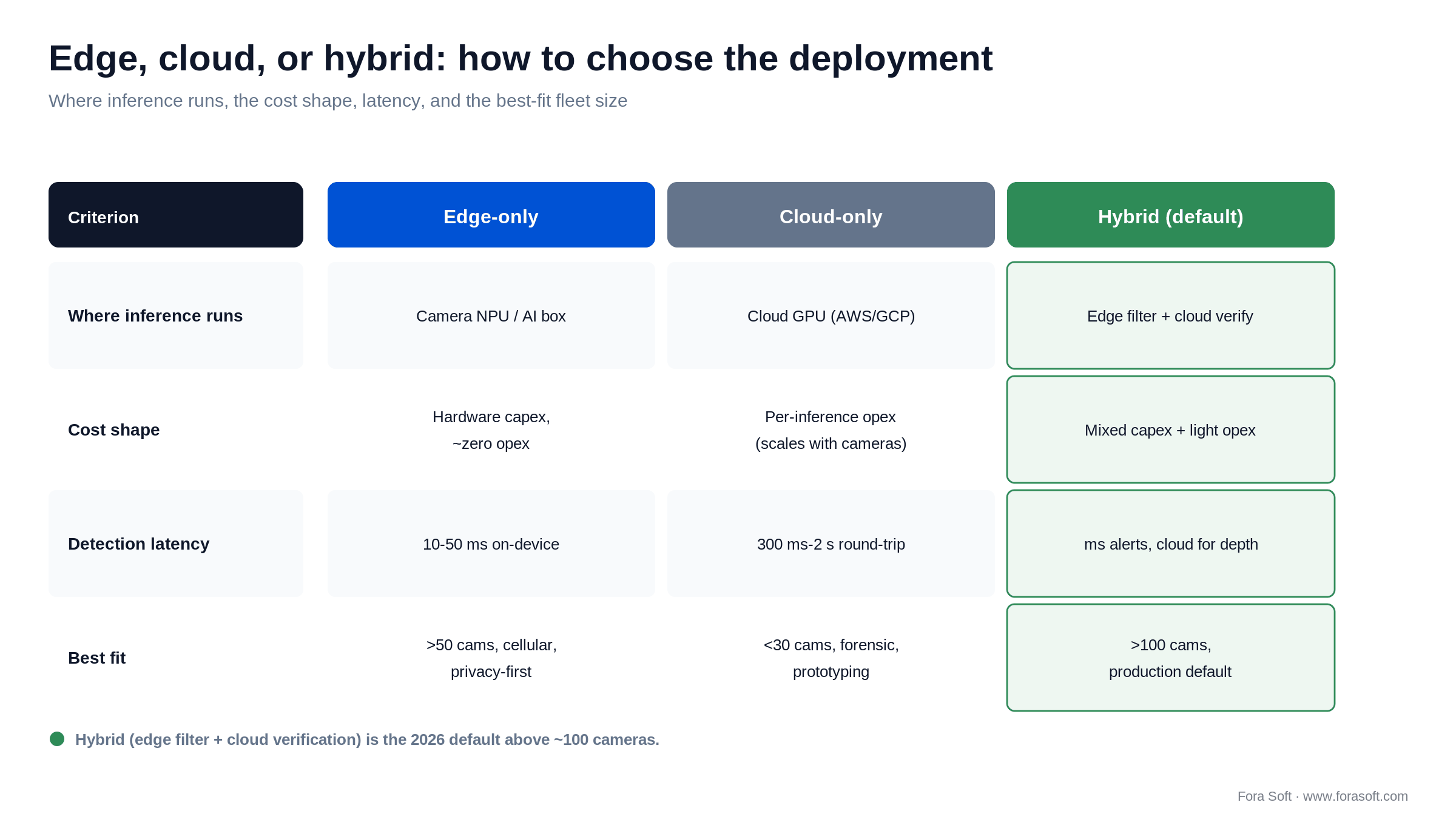
Figure 2. The three deployment patterns side by side. Hybrid wins once the fleet grows past ~100 cameras.
Reach for edge-only when: you have >50 cameras on a cellular uplink, data-residency rules, or sites in remote locations where bandwidth is scarce.
Reach for hybrid when: you run 100+ cameras and want both fast on-device alerts and cloud-side multi-camera correlation. This is the safe default for production.
Reach for cloud-only when: you’re running one-off forensic analysis on archived footage, or piloting with fewer than 30 cameras before you scale.
Reach for a VLM in the loop when: the task is open-ended (“flag anything unusual”). Running a vision-language model such as Gemini or Qwen3-VL on edge-flagged events catches what fixed-category models miss, at the cost of 1–3 seconds and a per-call fee.
Vertical applications: retail, transit, construction, sports
Retail. Loss prevention (theft and sweet-hearting at checkout), customer-flow analytics, queue length, staff coverage, and planogram compliance. Big-box chains have run this for years; mid-market is adopting now, which is where most of the new demand sits. If retail is your vertical, our retail video analytics playbook goes deeper on store-level architecture, per-store cost and the ROI math.
Transit and smart city. Traffic flow, incident detection, parking enforcement, crowd density, public safety. It carries the heaviest EU AI Act burden, since several use cases land in the high-risk tier.
Construction. PPE compliance, safety-zone breaches, equipment movement, after-hours intrusion, progress tracking. Insurers increasingly reward documented safety monitoring, which turns a cost centre into a line-item saving.
Sports. Player tracking, game analytics, and automated highlight generation. Sports video analytics overlaps with broadcast tech; if that’s your world, our interactive sports streaming guide covers the delivery side.
ROI math by vertical
Retail loss prevention. US retail shrink ran about 1.6% of sales, roughly $112 billion, in the NRF’s last National Retail Security Survey (FY2022 data). Analytics typically cuts shrink 20–30% on the addressable slice. On $50M of sales that’s $200k+ recovered a year against a $60–150k deployment, so payback lands inside a year. The full worked model is in the next section.
Construction safety. Documented PPE monitoring can lower insurance premiums and cut incident-related delays. The exact discount is carrier-specific, so we don’t quote a fixed percentage, but on a large site the premium line alone often covers the deployment in under a year.
Smart city and transit. Incident-detection time drops from minutes to seconds. It’s hard to price in dollars, but it’s decisive for safety SLAs and regulatory reporting, which is often the whole reason the project is funded.
Sports broadcasting. Automated highlights cut editorial labour materially, and player-tracking data becomes a saleable feed to teams and sponsors, a second revenue line on top of the cost saving.
Want a custom ROI forecast for your vertical?
Give us your camera count, vertical, and current pain point. We’ll return a one-page ROI model with the arithmetic shown, so you can pressure-test it.
Worked example: retail loss-prevention ROI, step by step
Here’s the arithmetic we’d walk a retail client through. Treat it as a model built on public benchmarks, not a specific client’s audited numbers, and swap in your own figures.
Take a 40-store grocery chain doing $50M in annual sales. At 1.6% shrink that’s $800k lost a year. Focused analytics on self-checkout and exits realistically recovers about a quarter of it, so $200k a year back. The deployment is 40 AI boxes at roughly $2k each plus about $60k of software and integration, so $140k one-time. Year-one net is $200k minus $140k, or $60k, with payback around 8.4 months. Because the hardware and models carry into later years, three years of operation recovers roughly $600k against that one-time $140k build, before any recurring opex.

Figure 3. The loss-prevention model, line by line. The integration layer, not the model, is where ~70% of the spend goes.
Two honest caveats. Recovery rates vary with store format and how disciplined the operator is about acting on alerts, so we model 20–30%, not a flattering peak. And the $60k integration line is the one that surprises people; it’s the real work. On production surveillance at scale we’ve run exactly this wiring for VALT across 770+ organizations, and the pattern reuse is why our estimates come in lower than a from-scratch quote. Book a 30-min call and we’ll rebuild this model with your numbers.
Vendor matrix: Axis, Hanwha, Avigilon, BriefCam, custom
These are the incumbents you’ll shortlist for camera-plus-analytics buys. Facts current as of 2026.
| Vendor | Strength | Where it breaks | Best for |
|---|---|---|---|
| Axis Communications | Strong cameras plus on-camera ACAP analytics | Premium pricing | Enterprise security, retail |
| Hanwha Vision | Wisenet cameras plus on-box AI | Slower integration cycle | Mid-market with a premium budget |
| Avigilon (Motorola) | Appearance search; Alta cloud plus Unity on-prem | Vendor lock-in | Public safety, large enterprise |
| BriefCam (Milestone) | Video Synopsis: review hours in minutes | Backend only; needs cameras separately | Forensic, post-event review |
| Genetec | Security Center plus AI integrations | Heavy platform, complex rollout | Government, transit |
| Hikvision / Dahua | Cheapest cameras, broad SDK | Restricted in US federal (NDAA/FCC), EU concerns | Cost-sensitive, non-restricted markets |
| Custom build | Full IP control, vertical-specific models | Engineering investment up front | Vertical SaaS, differentiated products |
AI-native platforms: the modern buy-side option
A newer class of vendor ships cloud management and analytics as one product, so you skip bolting models onto legacy cameras. Verkada, Eagle Eye Networks, Coram, Spot AI, and Ambient.ai lead this group in 2026. They’re fast to stand up and pleasant to operate, with search and alerting built in.
The trade-off is control and cost curve. You’re renting their model roadmap and their cloud, which is great until you need a vertical-specific event they don’t support, or your camera count makes the per-seat pricing sting. We tell mid-market buyers to start here for generic detection and move to a custom analytics layer only when a real gap appears. Sports is a textbook example of that gap: player tracking, tactical metrics, and the build-vs-buy call have their own playbook in our guide to sports video analysis software.
Reach for an AI-native platform when: you want generic detection live in weeks, your fleet is under a few hundred cameras, and a cloud-managed VMS is acceptable to your security team.
The models and edge hardware you’ll actually use
On the model side, YOLO26 (Ultralytics, released 14 Jan 2026) is the current default. It’s end-to-end and NMS-free, which means predictable latency and cleaner edge deployment, and Ultralytics reports up to 43% faster CPU inference than YOLO11 on the nano variant. YOLO11 remains a safe fallback with a mature ecosystem. For tracking, pair it with ByteTrack; for behaviour, add MMAction2. The deeper model and pipeline patterns live in our AI for video engineering hub.
On the hardware side, two chips do most of the work. The NVIDIA Jetson Orin Nano Super delivers up to 67 TOPS for $249, a big jump from the 40-TOPS board it replaced, and handles multi-model pipelines per node. The Hailo-8 gives about 26 TOPS at roughly 2.5 watts, so it’s ideal for always-on single- or few-camera edge inference where power budget matters. Between them you can put real-time detection on almost any camera without cloud round-trips. If you’re weighing the deeper edge trade-offs, our edge AI for surveillance guide goes chip by chip, and the YOLO26 docs cover the model side.
Privacy, GDPR, and the EU AI Act in 2026
Get the EU AI Act timeline right, because a lot of the internet has it wrong. Prohibited practices under Article 5 (including real-time remote biometric identification in public by law enforcement, and emotion recognition at work or school) have applied since 2 Feb 2025. Transparency duties under Article 50 apply from 2 Aug 2026.
The high-risk obligations, the ones that hit biometric ID, workplace monitoring, and critical-infrastructure use cases, were pushed back by the 2026 Digital Omnibus. Stand-alone Annex III high-risk systems now apply from 2 Dec 2027, and product-embedded Annex I systems from 2 Aug 2028. That’s more runway than the “fully in force in 2025” headlines suggested, but you still design for it now, because retrofitting documentation and human-oversight controls late is painful. The official AI Act implementation timeline is the reference to bookmark.
GDPR Article 9. Biometric data, including face-recognition templates, is special-category data. Processing needs explicit consent (rare in surveillance) or a specific Article 9 basis. Most EU face-recognition deployments sit on shaky legal ground, so expect regulator pushback. Face detection, which never identifies anyone, is a much safer default.
US patchwork. Illinois BIPA carries a private right of action; Texas has CUBI; California’s CCPA is lighter on surveillance itself but combines with state biometric law. The safe engineering answers are the same everywhere: redact PII on-device (blur faces before any frame leaves the camera), store events rather than raw frames, cap retention, and run a DPIA before launch.
How to pilot without buying everything
1. Define two or three outcomes. “Cut shrink,” “detect intrusion in under five seconds,” “flag PPE violations.” Pilots chasing five-plus outcomes fail because you can’t measure them all in four weeks.
2. Pilot two or three vendors on your footage. Vendor demos run on clean data. Your cameras see bad light, occlusion, and weather, so the pilot has to run on your streams, in your conditions.
3. Measure precision and recall on a labelled set. Ask each vendor for results on 200–500 labelled events from your environment. Vendor-supplied benchmarks don’t transfer.
4. Run two to four weeks across day, night, and weekends. Model drift shows up during the pilot, not the demo. Measure at the end, not day one.
5. Cost the integration separately. Plug each candidate into your VMS and alerting. Integration cost is usually the deciding factor at fleet scale, and the one buyers forget.
Build vs buy: routing the decision
Most teams overthink this. Three questions route almost everyone, and the tree below shows the path.
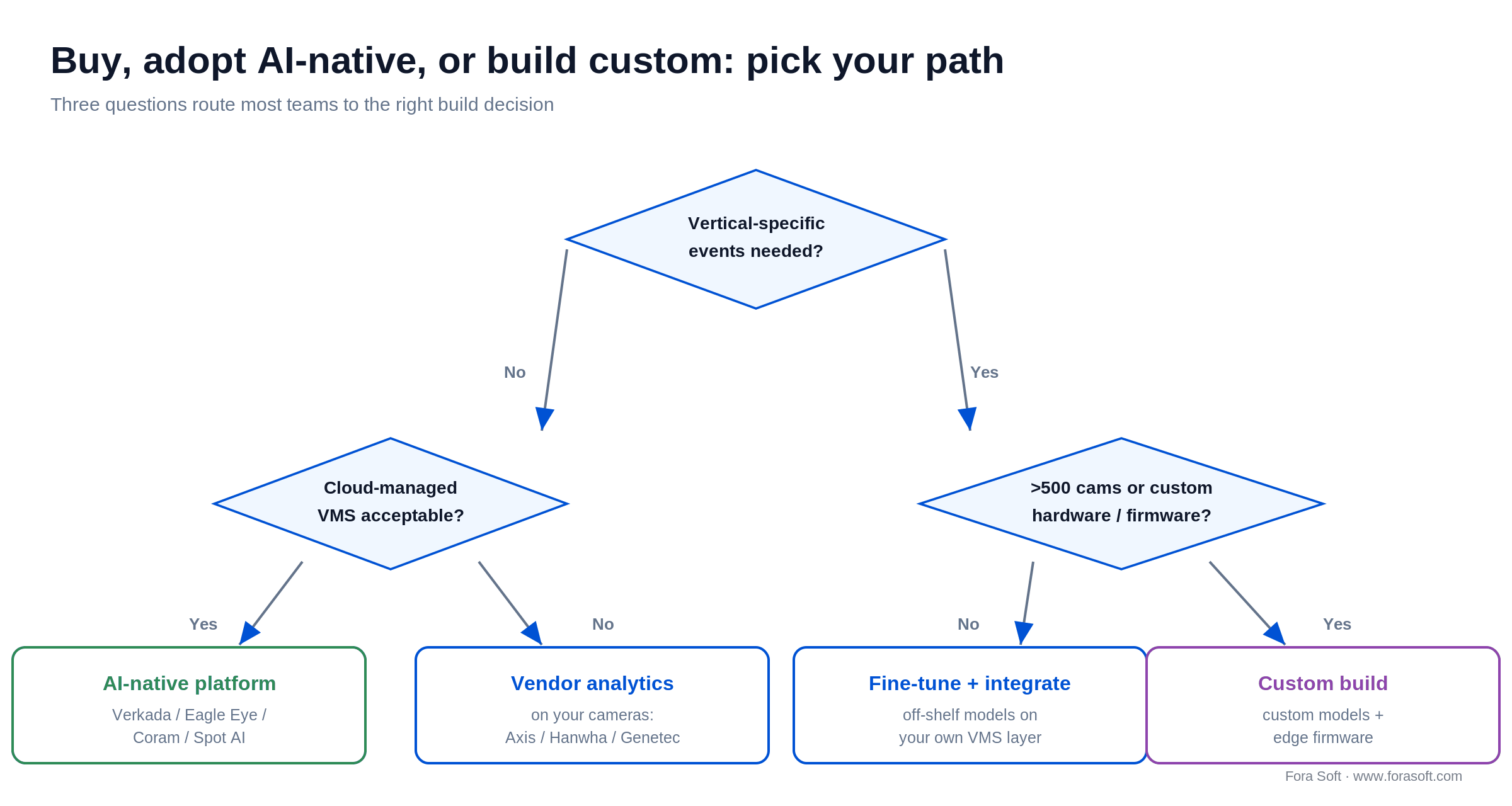
Figure 4. Buy, adopt AI-native, or build. Three questions get most teams to the right answer.
Buy or adopt AI-native when events are generic (person, vehicle, face), you’re under ~500 cameras, and there’s no vertical-specific behaviour to catch. Build or fine-tune when you need domain events (specific PPE, planogram compliance, team-logo player tracking), your camera count makes cost dominate, or you need custom hardware and firmware. Plenty of production systems are hybrid: off-the-shelf cameras for ingest, a custom analytics layer on top. That’s the common shape for mid-market verticals where bundled analytics feel too generic, and it’s where our AI integration team usually plugs in.
A decision framework in five questions
Q1. What two or three outcomes will you measure? Without sharp outcomes, vendor selection is guesswork.
Q2. Edge or hybrid? Over 100 cameras points to hybrid; over 500 on cellular points to edge-dominant.
Q3. Off-the-shelf or custom analytics? Generic events go off-the-shelf; vertical-specific events go custom or fine-tuned.
Q4. What’s your privacy posture? EU deployment, biometric data, or workplace monitoring puts you on the EU AI Act high-risk path. Plan the documentation from day one.
Q5. How does it fit your VMS? ONVIF Profile M (analytics metadata and events) support is the integration baseline; without it you’re building a parallel stack. If you get stuck on Q5, that’s exactly the conversation to book a call about.
Pitfalls to avoid
1. Believing vendor benchmarks. Always pilot on your footage in your conditions. Vendor numbers are best-case lab results.
2. Shipping all eight categories at once. Pick the two or three with the clearest ROI and expand later. Breadth-first pilots collapse.
3. Ignoring the EU AI Act high-risk tier. Workplace and school monitoring are formally regulated now. It’s an expensive surprise mid-deployment, even with the 2027 runway.
4. Forgetting integration cost. The analytics layer is ~30% of the project; VMS, alerting, and workflow wiring are the other 70%. Budget accordingly.
5. Cloud-only at fleet scale. A thousand cameras on cloud-only inference is a runaway bill. Move to hybrid before you pass ~500.
KPIs to measure
Quality KPIs. Precision and recall on a labelled validation set, operator-reported false-positive rate, and detection latency at p50 and p95.
Business KPIs. The two or three outcome metrics you set upfront, shrink, incident time, PPE compliance rate, and the 12-month ROI they roll up to.
Reliability KPIs. Camera fleet uptime, model-drift signal, and over-the-air deployment success rate. A model that silently degrades is worse than no model.
When NOT to deploy AI video analytics
Honesty sells better than hype, so here’s where we tell people to wait. If you have fewer than about 20 cameras and no recurring problem to solve, a good VMS with basic motion alerts is cheaper and enough; analytics is overkill. If your only goal is face recognition of the public in the EU, the legal risk usually outweighs the benefit, and we’ll steer you to face detection or a different approach.
If nobody owns the alerts, don’t start. Analytics that fire into an inbox no one watches is money burned; the human workflow has to exist first. And if your cameras are so old or badly placed that a person can’t read the scene, fix the placement before you add AI, because no model rescues a camera pointed at a wall. Get those basics right and the ROI section above starts to look conservative.
FAQ
What is video analytics?
Video analytics is software that turns a video stream into structured events, people, vehicles, objects, and behaviours, that other systems can act on. AI video analytics does the same job with computer-vision models rather than motion rules, so it reads scenes far more accurately and can flag specific behaviours like loitering or a fall.
What is the difference between AI video analytics and traditional video analytics?
Traditional analytics uses pixel-change and motion rules, which trip on shadows, weather, and moving foliage. AI video analytics uses trained models (detection, tracking, behaviour) that recognise what an object is and what it’s doing, cutting false positives sharply and enabling categories like PPE compliance or crowd density that rules can’t handle.
Can I add AI video analytics to my existing cameras?
Yes. Add an AI box (Hailo-8 or Jetson Orin Nano Super) alongside the existing IP camera, ingest its RTSP stream, and run inference there. It’s the standard pattern when replacing cameras for capex reasons isn’t an option, and it’s how most retrofits ship.
How much does video analytics software cost?
For a mid-size fleet, budget roughly $2k per AI box plus software and integration. In our 40-store worked model, a full deployment ran about $140k one-time against $200k a year recovered. AI-native platforms price per camera or per seat instead, which is cheaper to start and more expensive at scale. Integration, not the model, drives most of the bill.
What is intelligent video analytics?
“Intelligent video analytics” is a marketing synonym for AI-based video analytics, systems that use deep-learning models to detect, track, and interpret behaviour rather than simple motion detection. There’s no formal standard behind the term; treat it as AI video analytics and evaluate the underlying models and accuracy.
Is video analytics legal under GDPR and the EU AI Act?
General detection and anonymised analytics are broadly fine with a DPIA and signage. Face recognition triggers GDPR Article 9 and needs a specific legal basis. Under the EU AI Act, prohibited uses have applied since 2 Feb 2025, while high-risk obligations (biometric ID, workplace monitoring) apply from 2 Dec 2027 after the 2026 Digital Omnibus deferral.
Do I need machine-learning expertise to deploy?
For off-the-shelf vendor or AI-native analytics, no, the vendor handles the models. For custom domain models you need a data scientist or a partner with computer-vision experience. Fine-tuning a pre-trained YOLO26 is medium difficulty: doable with strong DevOps and modest ML knowledge, faster with a team that’s shipped it before.
What about vision-language models like Gemini or GPT-4V?
They’re excellent for cloud-side verification on flagged events, answering open-ended questions like “is this person doing anything suspicious?” They add 1–3 seconds and a per-call cost, so run them only on edge-flagged events, never every frame. Using a VLM in the loop for open-ended detection is the standout 2026 trend.
What to Read Next
Edge AI
Edge AI for Surveillance
The hardware tier and on-device inference, chip by chip.
ML
Anomaly Detection Algorithms
The behaviour-analytics deep-dive companion.
VMS
Integrate Analytics with VMS
Wiring analytics events into your VMS and alerting.
Architecture
Scalable VMS Design
Managing a camera fleet at production scale.
AI Infra
MCP for Video Apps
Add an LLM agent layer on top of analytics events.
Ready to ship video analytics that pays back?
The 2026 answer is refreshingly boring: the models work, the edge hardware is cheap, and the market agrees it’s worth $14.65 billion this year. Pick two or three outcomes per site, pilot on your own footage, measure precision and recall on a labelled set, and integrate through ONVIF Profile M. Get the EU AI Act timeline right, high-risk lands in December 2027, not 2025, and design for it now.
Hybrid edge-plus-cloud is the production default. Vendor and AI-native platforms cover generic events; custom analytics win the vertical-specific moats. And remember the number that decides projects: integration is ~70% of the spend, so budget for the wiring, not the algorithm.
Want a 16-week analytics deployment plan?
Send your camera fleet and target outcomes. We’ll return an architecture, a vendor shortlist, and an ROI forecast with the math shown.